1(a)
Sound cannot travel in:
- (a)solid
- (b)liquid
- (c)gas
- (d)vacuum
Show SolutionHide Solution↓
vacuum
Reason — Sound needs a medium for its propagation. It cannot travel in vacuum.
ICSE Class 8 Physics · Selina Solutions Concise Physics Class 8 ICSE · 45 solved questions
Sound cannot travel in:
vacuum
Reason — Sound needs a medium for its propagation. It cannot travel in vacuum.
When sound travels in form of a wave:
the particles of medium transfer energy without leaving their mean positions.
Reason — Sound travels in air in form of longitudinal waves. The particles of the medium vibrate about their mean positions and transfer energy with a constant speed from one place of medium to another place during propagation of wave.
The safe limit of loudness of audible sound is:
0 to 80 dB
Reason — The safe limit of level of sound for hearing is from 0 to 80 dB.
The unit of loudness is:
decibel
Reason — The unit of loudness of sound is decibel.
In a piano, pitch is decreased by:
using thicker string
Reason — In stringed instruments like piano, a note of lower pitch can be obtained by vibrating the string under low tension or by vibrating a thicker string.
By reducing the amplitude of a sound wave, its:
loudness decreases
Reason — Loudness is proportional to the square of the amplitude i.e.,
Loudness ∝ (amplitude)2
So, when a body vibrates with a lesser amplitude, it sends forth a smaller amount of energy.
Hence, the energy received by the ear drum is also small, so the loudness of the sound decreases.
Pitch of a note depends on :
frequency
Reason — The pitch of a sound depends on the frequency of the vibrating body. A sound of high frequency is said to have a high pitch, while a sound of low frequency is said to have a low pitch.
Assertion (A) : To make a shrill sound in a flute, holes are opened.
Reason (R) : The holes are opened to increase the length of the vibrating air column.
Assertion is true but reason is false
Explanation
Assertion (A) is true because to increase the pitch (or make the sound shrill) in a flute, the holes are opened so as to reduce the length of the vibrating air column.
Reason (R) is false because in a flute, holes are opened to reduce the length of the vibrating air column and vice versa.
Hence, assertion is true but reason is false.
Assertion (A) : Loudness and quality of sound are independent of each other.
Reason (R) : Loudness depends on amplitude while quality of sound depends on the waveform of sound.
Both A and R are true and R is the correct explanation of A
Explanation
Assertion (A) is true because loudness and quality (or timbre) of sound are independent properties and changing one does not necessarily affect the other.
Reason (R) is true because loudness depends on the amplitude of the sound wave such that greater amplitude means louder sound and quality depends on the waveform or the shape of the sound wave, which is influenced by the mixture of frequencies.
So here reason correctly explains why the loudness and the quality of sound are independent of each other.
Hence, both A and R are true and R is the correct explanation of A.
Fill in the blanks:
(a) The time period of a wave is 2 s. Its frequency is ............... .
(b) The pitch of a stringed instrument is increased by ............... tension in string.
(c) The pitch of a flute is decreased by ............... length of air column.
(d) Smaller the membrane, ............... is the pitch.
(e) If a drum is beaten hard, its loudness ............... .
(f) A tuning fork produces sound of ............... frequency.
(a) The time period of a wave is 2 s. Its frequency is 0.5 hertz.
(b) The pitch of a stringed instrument is increased by increasing tension in string.
(c) The pitch of a flute is decreased by increasing length of air column.
(d) Smaller the membrane, higher is the pitch.
(e) If a drum is beaten hard, its loudness increases.
(f) A tuning fork produces sound of single frequency.
Write true or false for each statement:
(a) When sound propagates in air, it does not carry energy with it.
(b) In a longitudinal wave, compression and rarefaction are formed.
(c) The distance from one compression to nearest rarefaction is called wavelength.
(d) The frequency is measured in second.
(e) The quality of a sound depends on the amplitude of wave.
(f) The pitch of sound depends on frequency.
(g) Decibel is the unit of pitch of a sound.
(a) False
Correct Statement — When sound propagates in air, it carries energy with it.
(b) True
(c) False
Correct Statement — The distance between two consecutive compressions or between two consecutive rarefactions is equal to one wavelength.
(d) False
Correct Statement — The frequency is measured in hertz.
(e) False
Correct Statement — The quality of a sound depends on the wave form.
(f) True
(g) False
Correct Statement — Decibel is the unit of loudness of a sound.
Match the following:
| Column A | Column B |
|---|---|
| (a) Amplitude | (i) frequency |
| (b) Frequency | (ii) amplitude |
| (c) Loudness | (iii) maximum displacement on either side |
| (d) Pitch | (iv) presence of other frequencies |
| (e) Wave form | (v) 1/Time period |
| Column A | Column B |
|---|---|
| (a) Amplitude | (iii) maximum displacement on either side |
| (b) Frequency | (v) 1/Time period |
| (c) Loudness | (ii) Amplitude |
| (d) Pitch | (i) frequency |
| (e) Wave form | (iv) presence of other frequencies |
How does sound travel in air?
Sound travels in air in form of longitudinal waves. When a body vibrates, it creates a periodic disturbance in air. The disturbance then travels in air in the form of waves.
What is a longitudinal wave?
The wave in which the particles of the medium vibrate about their mean positions, in the direction of propagation of sound is called longitudinal wave.
Define the following terms:
(a) Amplitude
(b) Frequency
(c) Time period
(a) Amplitude (a) — The maximum displacement of a particle of medium on either side of its mean position, is called the amplitude of wave.
(b) Frequency (f) — The number of vibrations produced by a particle of the medium in one second is called the frequency of the wave.
(c) Time period (T) — The time taken by a particle of medium to complete its one vibration is called the time period of the wave.
Obtain relationship between the time period and frequency.
If T is the time period of a wave, then by definition
In time T, the number of waves = 1
∴ In 1 second, number of waves (or frequency) =
$\text f = \frac{\text{1}}{\text{T}}$
Thus,
$\text{frequency} = \frac{\text{1}}{\text{Time period}}$
or
$\text{time period} = \frac{\text{1}}{\text{frequency}}$
Name the three characteristics of a musical sound.
The three characteristics of a musical sound are:
Which of the following determines the loudness of a sound wave?
(a) Wavelength
(b) Frequency, or
(c) Amplitude.
Amplitude determines the loudness of a sound wave.
How is loudness related to the amplitude of a wave?
Loudness is directly proportional to the square of amplitude of wave.
Loudness ∝ (amplitude)2
Hence, greater the amplitude of vibrations, louder is the sound produced.
If the amplitude of a wave is doubled, what will be the effect on its loudness?
The loudness (L) of a sound is directly proportional to the square of amplitude of wave.
Loudness ∝ (amplitude)2
L = (2)2 = 4 times.
So, if the amplitude (a) of a wave is doubled, loudness will be four times.
Name the unit in which the loudness of sound is expressed.
The unit in which loudness of sound is expressed is decibel (dB).
Why is the loudness of sound heard by a plucked wire increased when mounted on a sound board?
[Hint : The surface area of vibrating air increases]
Larger the surface area of the vibrating body, louder is the sound heard as a large vibrating area sends forth a greater amount of energy. By mounting a wire on a sound board, the surface area increases which in turn increases the loudness of the sound produced.
State three factors on which loudness of sound heard by a listener depends.
The three factors on which loudness of sound heard by a listener depends are:
What determines the pitch of a sound?
Frequency determines the pitch of a sound. Higher the frequency, higher is the pitch and sound produced is shrill. Lower the frequency, lower is the pitch and sound produced is flat.
Name the characteristic of sound related to its frequency.
The characteristic of sound related to its frequency is pitch.
Which characteristic of sound makes it possible to recognize a person by his voice without seeing him?
Timbre or quality of sound makes it possible to recognize a person by his voice without seeing him. The vibrations produced by the vocal cord of each person have a characteristic wave form which is different for different persons.
State the factors that determine
(a) the pitch of a note.
(b) the loudness of the sound heard.
(c) the quality of the note.
(a) Frequency determines the pitch of a note.
(b) Amplitude determines the loudness of the sound heard.
(c) Wave form determines the quality of the note.
Name the characteristic of the sound affected due to a change in its:
(a) amplitude
(b) wave form
(c) frequency
(a) Loudness.
(b) Quality.
(c) Pitch.
How is the pitch of a sound in a guitar changed if:
(a) a thin wire is used
(b) a wire under less tension is used?
(a) Pitch of sound will be higher if a thin wire is used in a guitar.
Thin wires in stringed musical instruments produce sound with higher frequency and hence higher pitch.
(b) Pitch of sound will be low if a wire under less tension is used in guitar.
In stringed musical instruments, wires under less tension produce sound with lower frequency and hence lower pitch.
Explain the mechanism of formation of a longitudinal wave when a source vibrates in air.
When a source of sound vibrates, it creates a periodic disturbance in the medium near it. The disturbance then travels in the medium in the form of waves. This can be understood by the following example —
Take a thin metal strip. Keeping it vertical, fix it's lower end. Push it's upper end to one side and then release it. As it vibrates (i.e., moves alternatively to the right and left) sound is heard.

When the strip advances to the right from a to b, it pushes the particles of air in layers in front of it. So the particles of air in these layers gets closer to each other i.e., air of these layers gets compressed.
The particles of these layers while moving forward, push and compress the layers next to them, which then compress the next layers and so on. Thus, the disturbance moves forward in form of compression. The particles of the medium get displaced, but they do not move along with the compression.
As the metal strip starts returning from b to a as shown in figure, after pushing the particles in front, the particles of air near the strip starts returning back to their mean positions due to the elasticity of the medium.
When the strip moves to the left from a to c, it pushes back the layers of air near it towards it's left and thus produces a space of very low pressure on it's right side. The air layers on the right side of the strip expand in this region thus forming the rarefied air layers. This region of low pressure is called the rarefaction R.
When the strip returns from c to it's normal position a, it pushes the rarefaction R forward and the air layers near the strip again pass through their mean positions due to the elasticity of the medium.
In this manner, as the strip moves to the right and left repeatedly, the compressions and rarefactions regions are produced one after the other which carry the disturbance with it with a definite speed depending on the nature of the medium. Gradually due to friction, the strip losses its energy to the medium and the disturbance dies out.
One complete to and fro motion of the strip forms one compression and one rarefaction which together constitute one longitudinal wave. This is how sound waves propagate through the formation of a longitudinal wave when source vibrates in air.
How does the wave pattern of a loud note differ from a soft note? Draw a diagram.
Loudness is the characteristic by virtue of which a loud sound can be distinguished from a faint one, both having the same pitch and quality.
The figure below shows how a wave pattern of a loud note differ from the soft note.

Name and define the characteristic which enables one to distinguish two sounds of same loudness, but of different frequencies, given by the same instrument.
Pitch of sound enables to distinguish two sounds of same loudness, but of different frequencies, given by the same instrument.
Pitch is the characteristic of sound which distinguishes a shrill sound from a flat sound. Pitch of a sound depends on the frequency of the vibrating body.
Draw a diagram to show the wave pattern of a high pitch note and a low pitch note, but of the same loudness.
Wave patterns of high pitch note and low pitch note of the same loudness are shown in the diagram below:

Standing at a distance, how is it possible to detect the filling of a bucket under a water tap by hearing the sound?
As the bucket fills up with water, the length of air column decreases, so the frequency of sound produced increases. Pitch or shrillness of sound will increase with increase in frequency of sound. So with increase in shrillness of sound we can detect the filling of a bucket under water tap.
The frequencies of notes given by flute, guitar and trumpet are respectively 400 Hz, 200 Hz and 500 Hz. Which one of these has the highest pitch?
Trumpet has the highest pitch because it has the highest frequency i.e. 500 Hz.
Pitch of a sound depends on its frequency. More the frequency of the note, higher is its pitch.
Below figure shows two jars A and B containing water up to different heights. Which will produce sound of higher pitch when air is blown in them?

Jar B will produce sound of higher pitch when air is blown in it because jar B has less air column above water. Frequency of sound produced increases with decrease in the length of air column. Pitch or shrillness of sound increases with increase in frequency of sound.
Two identical guitars are played by two persons to produce notes of the same pitch. Will they differ in quality? Give reason for your answer.
When two identical guitars are played by two persons to give notes of the same loudness and pitch then they will not differ in quality as the identical guitars will produce identical wave forms.
Quality of a musical instrument depends on the number of subsidiary notes and their relative amplitudes present in it along with the principal note.
As same instruments produce same principal and subsidiary notes. Hence, the quality of identical guitars will be same.
Two musical notes of the same pitch and same loudness are played on two different instruments. Their wave patterns are as shown in below figure.
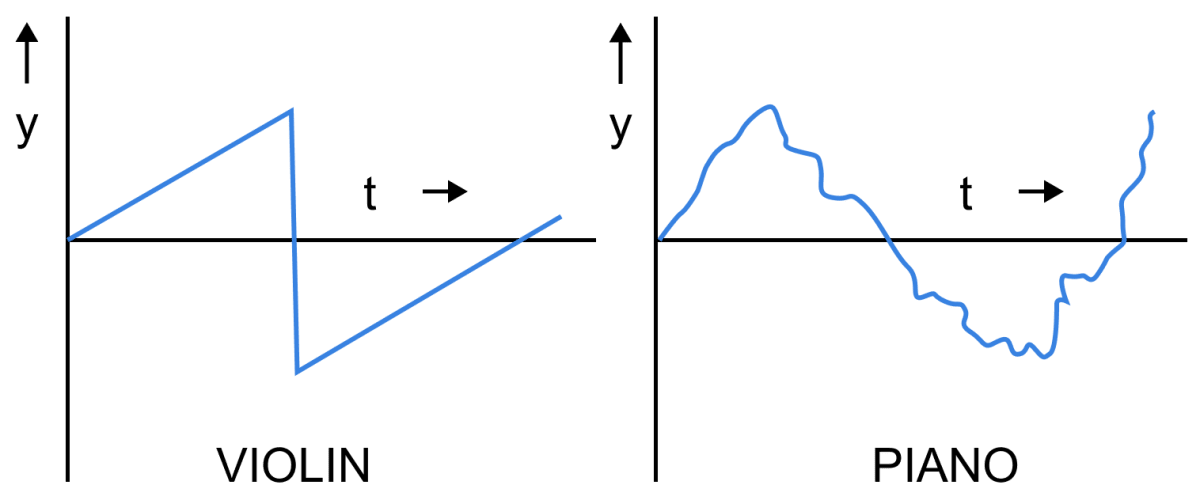
How do they differ in:
(a) loudness,
(b) pitch and
(c) quality?
(a) Loudness will be same for both the instruments because they have same amplitude.
(b) Pitch will be same for both the instruments as they have same frequencies.
(c) Quality will be different as they have different wave forms as seen in the diagram of the given wave patterns.
Figure shows four waves A, B, C and D.

Name the wave which shows
(a) a note from a musical instrument,
(b) a soft note,
(c) a shrill note.
(a) Note from a musical instrument is shown by figure (d) because the sound produced by the musical instruments comprises of different frequencies and amplitudes resulting in a mixed type of wave form.
(b) Soft note is shown by figure (a) because this wave has low amplitude.
(c) Shrill note is shown by figure (c) because this wave has high frequency.
What happens when a lighted candle is placed in front of a loudspeaker making a loud and steady noise. Give reason.
When a lighted candle is placed in front of a loudspeaker producing a loud and steady noise, the flame of the candle flickers.
A loudspeaker produces sound waves, which are longitudinal pressure waves in the air. These waves consist of alternating regions of compression and rarefaction that move outward from the speaker, causing the air near the loudspeaker to vibrate rapidly back and forth. The resulting air currents disturb the flame, making it flicker in step with the pressure variations of the sound waves.
Two waves of the same pitch have amplitudes in the ratio 1:3. What will be the ratio of their:
(i) loudness
(ii) pitch?
(i) Loudness (L) ∝ [amplitude (a)]2
Ratio of loudness =
$\frac{\text{L}_1}{\text{L}_2} = \frac{(\text{a}_1)^2}{(\text{a}_2)^2} = \frac{(1)^2}{(3)^2} = \frac{1}{9}$
So L1 : L2 = 1 : 9.
(ii) Frequency remains the same if the pitch remains unchanged.
$\frac{\text{pitch of 1st wave}}{\text{pitch of 2nd wave}} = \frac{\text{1}}{\text{1}} = 1:1$
So pitch will be 1 : 1.
Two waves have frequencies 256 Hz and 512 Hz, but same amplitude. Compare their:
(i) loudness, and
(ii) pitch.
(i) Since amplitude of two waves are same so loudness of both the waves will be same.
$\frac{\text{amplitude of 1st wave}}{\text{amplitude of 2nd wave}} = \frac{\text{1}}{\text{1}} = 1:1$
So, loudness of first wave : loudness of second wave = 1:1.
(ii) Frequency determines the pitch of the sound.
$\frac{\text{frequency of 1st wave}}{\text{frequency of 2nd wave}} = \frac{\text{256}}{\text{512}} = \frac{\text{1}}{\text{2}} = 1:2$
So pitch of first wave : pitch of second wave = 1 : 2.
Two waves have the same pitch but their amplitudes are in the ratio of 1 : 2. Draw a figure to show the two waves.
In figure (a) the amplitude of wave A is 2 m and in figure (b) the amplitude of wave B is 4 m. But both the waves have same frequency (pitch).
Ratio of amplitude of wave A to wave B = 2 : 4 = 1 : 2.

Two waves of the same amplitude have frequencies 256 Hz and 512 Hz respectively. Represent the two waves in the graphical form.
(Hint : 1 wave represents 256 Hz of frequency)
The two waves with frequencies 256 Hz and 512 Hz are represented in graphical form below :

Riya and Ankita entered the school music room after class. Riya gently struck a drum and heard a deep, loud "dumm" sound that travelled across the room. Ankita then plucked a guitar string. She then tightened the guitar string a little and plucked it again. The sound became sharper and higher pitched compared to that produced by the loose string.
Both of them tried singing together. Riya sang loudly, while Ankita held a long note in a high pitch. Their music teacher, passing by the corridor, immediately asked them to lower their voices because the sound was echoing down the entire hallway.
Answer the following:
(i) Why was the sound of the drum deep and able to travel a long distance?
(ii) Why did the guitar string produce a sharper sound when it was tightened?
(iii) Why did the sound reach the corridor so clearly?
(iv) What is the basic difference between pitch and loudness?
(i) The drum produced a deep sound because its membrane vibrated with a low frequency. It was heard over a long distance because the membrane vibrated with a large amplitude, producing a loud sound.
(ii) Tightening the guitar string increased its tension. Therefore, the string vibrated with a higher frequency and produced a sharper, higher-pitched sound.
(iii) The sound reached the corridor clearly because it was loud and travelled through the air and the open doorway. The hard surfaces of the corridor reflected the sound waves, causing reverberation.
(iv) Pitch is the characteristic of sound that tells us how high or low a sound is. It depends on the frequency of vibration.
Loudness is the characteristic of sound that tells us how loud or soft a sound is. It depends mainly on the amplitude of vibration.
Press ↓ to reveal a solution and move to the next question. Back to Selina Solutions Concise Physics Class 8 ICSE.