Which of the following segment can be omitted in a for loop?
(a)initialisation
(b)test condition
(c)update expression
(d)All of these
Show SolutionHide Solution↓
All of these
Reason — A for loop can also be written as for( ; ; ) within the program code.
21 Mark · Multiple Choice Questions
Which of the following loop executes at least once?
(a)while
(b)for
(c)do-while
(d)None of these
Show SolutionHide Solution↓
do-while
Reason — do-while is an exit controlled loop and the test condition is checked at the end of the loop. Hence, it always executes at least once.
31 Mark · Multiple Choice Questions
Which of the following is an exit-controlled loop?
(a)while
(b)do-while
(c)for
(d)None of these
Show SolutionHide Solution↓
do-while
Reason — do-while is an exit-controlled loop as the test condition is checked at the end of the loop.
41 Mark · Multiple Choice Questions
Which of the following is an invalid loop?
(a)repeat
(b)for
(c)do-while
(d)while
Show SolutionHide Solution↓
repeat
Reason — repeat is not a loop.
51 Mark · Multiple Choice Questions
Which of the following statement causes complete termination of the loop?
(a)continue
(b)jump
(c)break
(d)terminate
Show SolutionHide Solution↓
break
Reason — break statement causes complete termination of the loop.
61 Mark · Multiple Choice Questions
Which of the following is an empty loop?
(a)for(i = 0; i < 5; i++);
(b)while (i < 5) i++;
(c)do {i++;} while (i < 5);
(d)All of these
Show SolutionHide Solution↓
for(i = 0; i < 5; i++);
Reason — The statement for(i = 0; i < 5; i++); has a semicolon at its end. Thus, any statement following it will be treated as outside the for loop.
71 Mark · Multiple Choice Questions
Which of the following is not a jump statement in Java?
(a)break
(b)jump
(c)return
(d)continue
Show SolutionHide Solution↓
jump
Reason — jump is not a jump statement in Java.
81 Mark · Multiple Choice Questions
How many times will the following code print "Java"?
for (int i = 1; i <= 5; i ++);
{
    System.out.println("Java");
}
(a)0
(b)1
(c)5
(d)4
Show SolutionHide Solution↓
1
Reason — Since for loop has a semicolon at its end, the block following the loop will be executed after the for loop is terminated. Thus, Java will be printed only once.
91 Mark · Multiple Choice Questions
What will be the output of the following code?
public static void main(String args[])
{
    int sum = 0;
    for (int i = 1; i <= 5; i++)
    {
        sum = i;
    }
    System.out.println(sum);
}
(a)15
(b)21
(c)5
(d)0
Show SolutionHide Solution↓
5
Reason — The last value of i for which the condition i <= 5 will be true is 5. Thus, 5 will be assigned to sum after which the condition will become false and the loop will terminate. Thus, 5 will be printed as output.
101 Mark · Multiple Choice Questions
How many times will the following loop execute?
public static void main(String args[])
{
    int sum = 0;
    for (int i = 10; i > 5; i++)
    {
        sum += i;
    }
    System.out.println(sum);
}
(a)5
(b)0
(c)15
(d)Infinite loop
Show SolutionHide Solution↓
Infinite loop
Reason — The initial value of i is 10 and the test condition is i > 5 is true. In the next iteration, the value of i is incremented by 1 and again the condition is true. Thus, the value of i will keep on incrementing and the test expression will remain true, creating an infinite loop.
111 Mark · Multiple Choice Questions
Which of the following for loops will cause the body of the loop to be executed 10 times?
(a)for (int i = 0; i <= 10; i++)
(b)for (int i = 1; i < 10; i++ )
(c)for (int i = 10; i > 1; i-- )
(d)for (int i = 0; i < 10; i++ )
Show SolutionHide Solution↓
for (int i = 0; i < 10; i++ )
Reason — The initial value of i is 0 and the test expression i < 10 will remain true till the value of i becomes 9. So, the body of the loop will be executed till the value of i remains between 0 to 9, i.e. 10 times.
121 Mark · Multiple Choice Questions
How many times will the following loop execute?
public static void main(String args[])
{
    int i = 1;
    while (i < 10)
        if (i++ % 2 == 0)
            System.out.println(i);
}
(a)4
(b)5
(c)0
(d)10
Show SolutionHide Solution↓
Loop executes 9 times
Reason — There is a misprint in the book. The loop executes 9 times. Value of i is printed 4 times inside the loop. The condition if (i++ % 2 == 0) will be false when i is odd and true when i is even. Value of i will be incremented after if check is performed due to post increment opertor i++. Execution of the loop is summarized in the table below:
Iterations
i
i++ % 2 == 0
Output
Remarks
1st
1
False
Value of i becomes 2 after if check as i++ increments it after the evaluation of i++ % 2 == 0
2nd
2
True
3
i becomes 3 after if check, hence 3 is printed in this iteration.
3rd
3
False
i becomes 4.
4th
4
True
5
i becomes 5.
5th
5
False
i becomes 6.
6th
6
True
7
i becomes 7.
7th
7
False
i becomes 8.
8th
8
True
9
i becomes 9.
9th
9
False
i becomes 10.
As value of i is now 10, the test condition of while loop becomes false hence, 10th iteration of the loop is not executed.
1State whether the given statements are True or…
The while loop is an exit-controlled loop. False
Solution not available in the source paper.
2State whether the given statements are True or…
To execute a do-while loop, the condition must be true in the beginning. False
Solution not available in the source paper.
3State whether the given statements are True or…
The while part of a do-while statement must be terminated by a semicolon. True
Solution not available in the source paper.
4State whether the given statements are True or…
All types of loops in Java (for, while, and do-while) can be infinite loops. True
Solution not available in the source paper.
5State whether the given statements are True or…
The continue statement terminates the current loop and then continues from the statement immediately following the current loop. False
Solution not available in the source paper.
6State whether the given statements are True or…
The return statement is a jump statement. True
Solution not available in the source paper.
7State whether the given statements are True or…
The for loop may contain multiple initialisations and updates. True
Solution not available in the source paper.
8State whether the given statements are True or…
A loop that never terminates is called an empty loop. False
Solution not available in the source paper.
9State whether the given statements are True or…
The do-while loop executes at least once even if the condition is false. True
Solution not available in the source paper.
10State whether the given statements are True or…
The do-while loop is an exit-controlled loop. True
Solution not available in the source paper.
11State whether the given statements are True or…
An infinite loop can be constructed using a while loop only. False
Solution not available in the source paper.
12State whether the given statements are True or…
The statements that facilitate unconditional transfer of control are called jump statements. True
Solution not available in the source paper.
1Assignment questions
What are loop control structures? What are the essential segments of a loop control structure?
Show SolutionHide Solution↓
A loop is a set of instructions that is continually repeated until a certain condition is met. Looping control structures refer to certain looping constructs which execute a block of code repeatedly until a certain condition remains true. For example, for loop, while loop, do - while loop etc.
The essential parts of a looping control structure are as follows:
Initialisation — This segment initialises the loop control variable before starting the loop. It is executed only once at the beginning of the loop. For example, int counter = 1;
Test-condition — The test-condition is the expression that is evaluated at the beginning of each iteration. Its value determines whether the body of the loop is to be executed (test condition is true) or the loop is to be terminated (test condition is false). For example, counter <= 10
Update — This is the increment or decrement operation of the control variable. This operation is performed at the end of each iteration. For example, counter++;
2Assignment questions
How are these statements different from each other? i. break
ii. continue
iii. System.exit(0)
iv. return
Show SolutionHide Solution↓
(i) The break statement terminates the current loop or switch statement. The execution then continues from the statement immediately following the current loop or switch statement.
(ii) The continue statement tells the computer to skip the rest of the current iteration of the loop. However, instead of jumping out of the loop completely like break statement, it jumps back to the beginning of the loop and continues with the next iteration. This includes the evaluation of the loop controlling condition to check whether any further iterations are required.
(iii) Unlike break and continue statements which are used to control the flow of execution, System.exit(0) command terminates the execution of the program by stopping the Java Virtual Machine which is executing the program. It is generally used when due to some reason it is not possible to continue with the execution of the program.
(iv) A return statement is used to end the execution of a method and return a value to the calling method, optionally.
3(i)Assignment questions
Identify all the errors in the following statements.
for (int i = 5; i > 0; i++)
{
    System.out.println("Java is fun!");
}
Show SolutionHide Solution↓
The test expression i > 0 will always remain true and hence, the for loop will become an infinite loop and keep on iterating.
3(ii)Assignment questions
Identify all the errors in the following statements.
while (x < 1 && x > 50)
{
    a = b;
}
Show SolutionHide Solution↓
The test expression x < 1 && x > 50 will never be true as the conditions x < 1 and x > 50 cannot be true at the same time. Thus, the && operator will always result in false.
3(iii)Assignment questions
Identify all the errors in the following statements.
while (x ==	y)
{
    xx = yy;
    x = y;
}
Show SolutionHide Solution↓
The test expression x == y will always remain true as in each iteration x = y is executed, which will store the value of y in x. Thus, an infinite loop will be generated.
4Assignment questions
What is an empty statement? Explain its usefulness.
Show SolutionHide Solution↓
Empty statement consists only of a semicolon ;. It is useful when we want to make a loop an empty loop.
To make a for loop an empty loop, we write the following code:
for (int i = 1 ; i <=10 ; i ++);
5Assignment questions
Convert the following for loop statement into the corresponding while loop and do-while loop:
int sum = 0;
for (int i = 0; i <= 50; i++)
    sum = sum + i;
Show SolutionHide Solution↓
while loop
int sum = 0, i = 0;
while (i <= 50)    {
    sum = sum + i;
    i++;
}
do-while loop
int sum = 0, i = 0;
do {
    sum = sum + i;
    i++;
} while(i <= 50);
6Assignment questions
What are the differences between while loop and do-while loop?
Show SolutionHide Solution↓
do-while loop
while loop
do-while is an exit-controlled loop.
while is an entry-controlled loop.
do-while loop checks the test condition at the end of the loop.
while loop checks the test condition at the beginning of the loop.
do-while loop executes at least once, even if the test condition is false.
while loop executes only if the test condition is true.
do-while loop is suitable when we need to display a menu to the user.
while loop is helpful in situations where number of iterations is not known.
7(i)Assignment questions
How many times are the following loop bodies repeated? What is the final output in each case?
int x = 2;
while (x < 20)
    if (x % 2 == 0)
        System.out.println(x);
Show SolutionHide Solution↓
The loop repeats for infinite times.
2
2
2
2
2
.
.
.
.
The value of x is 2. The test condition of while loop — x < 20 is true and the test condition of if — x % 2 == 0 is also true. So the loop prints the value of x i.e., 2 for the first time.
In the absence of update expression, the while loop continues infinitely and keeps on printing 2 on the output screen.
7(ii)Assignment questions
How many times are the following loop bodies repeated? What is the final output in each case?
int y = 2;
while (y < 20)
    if (y % 2 == 0)
        System.out.println(y++);
Show SolutionHide Solution↓
The loop repeats for infinite times.
2
The value of y is 2. The test condition of while loop — y < 20 is true and the test condition of if — y % 2 == 0 is also true. So the loop prints the value of y i.e., 2 for the first time and then the postfix operator increments it to 3.
In the next iteration, the test condition y < 20 is true but the condition of if — y % 2 == 0 is false. Thus, there is no updation in the value of y and y remains less than 20. This creates an infinite loop.
7(iii)Assignment questions
How many times are the following loop bodies repeated? What is the final output in each case?
int z = 2;
while (z < 20)
    if ((z++) % 2 == 0)
        System.out.println(z);
Show SolutionHide Solution↓
The loop repeats for 18 times.
3
5
7
9
11
13
15
17
19
The loop executes 18 times. Value of z is printed 9 times inside the loop. The condition if((z++) % 2 == 0) will be false when z is odd and true when z is even. Value of z will be incremented after if check is performed due to post increment operator z++. Execution of the loop is summarized in the table below:
Iterations
z
(z++) % 2 == 0
Output
Remarks
1st
2
True
3
Value of z becomes 3 after if check as z++ increments it after the evaluation of (z++) % 2 == 0. Hence, 3 is printed.
2nd
3
False
z becomes 4 after if check
3rd
4
True
5
z becomes 5.
4th
5
False
z becomes 6.
5th
6
True
7
z becomes 7.
6th
7
False
z becomes 8.
7th
8
True
9
z becomes 9.
8th
9
False
z becomes 10.
9th
10
True
11
z becomes 11.
10th
11
False
z becomes 12.
11th
12
True
13
z becomes 13.
12th
13
False
z becomes 14.
13th
14
True
15
z becomes 15.
14th
15
False
z becomes 16.
15th
16
True
17
z becomes 17.
16th
17
False
z becomes 18.
17th
18
True
19
z becomes 19.
18th
19
False
z becomes 20.
As value of z is now 20, the test condition of while loop becomes false hence, 19th iteration of the loop is not executed.
8Assignment questions
What is the output produced by the following code?
int n = 20;
do   {
    System.out.println(n);
    n = n - 3;
} while (n > 0);
Show SolutionHide Solution↓
20
17
14
11
8
5
2
The initial value of n is 20. Every time the do-while loop is executed, n decreases by 3. Execution of the loop is summarized in the table below:
Iteration
n
Output
Test Condition n > 0
Remarks
1st
20
20
True
n is initially 20. After updation, it becomes 17 (20 - 3)
2nd
17
17
True
n becomes 14 (17 - 3)
3rd
14
14
True
n becomes 11 (14 - 3)
4th
11
11
True
n becomes 8 (11 - 3)
5th
8
8
True
n becomes 5 (8 - 3)
6th
5
5
True
n becomes 2 (5 - 3)
7th
2
2
True
n becomes -1 (2 - 3)
Since, the condition of while loop becomes false, the loop terminates.
9Assignment questions
What is the output produced by the following code?
int num = 20;
while (num > 0)
{
    num = num - 2;
    if (num == 4)
        break ;
    System.out.println(num);
}
System.out.println("Finished");
Show SolutionHide Solution↓
18
16
14
12
10
8
6
Finished
The initial value of num is 20. Every time the while loop is executed, num decreases by 2. Execution of the loop is summarized in the table below:
Iteration
num
Test Condition num > 0
Output
Remarks
1st
20
True
18
num becomes 18 (20 - 2) if condition false
2nd
18
True
16
num becomes 16 (18 - 2) if condition false
3rd
16
True
14
num becomes 14 (16 - 2) if condition false
4th
14
True
12
num becomes 12 (14 - 2) if condition false
5th
12
True
10
num becomes 10 (12 - 2) if condition false
6th
10
True
8
num becomes 8 (10 - 2) if condition false
7th
8
True
6
num becomes 6 (8 - 2) if condition false
8th
6
True
num becomes 4 (6 - 2) if condition becomes true, loop terminates.
Since, in 8th iteration num becomes 4, the condition of if statement becomes true. break statement is executed and control jumps out of while loop to the println statement and "Finished" is printed on the screen.
10Assignment questions
What is the output produced by the following code?
int num = 10;
while (num > 0)
{
    num = num - 2;
    if (num == 2)
        continue;
    System.out.println(num);
}
System.out.println("Finished");
Show SolutionHide Solution↓
8
6
4
0
Finished
The initial value of num is 10. Every time the while loop is executed, num decreases by 2. Execution of the loop is summarized in the table below:
Iteration
num
Test Condition num > 0
Output
Remarks
1st
10
True
8
num becomes 8 (10 - 2) if condition false
2nd
8
True
6
num becomes 6 (8 - 2) if condition false
3rd
6
True
4
num becomes 4 (6 - 2) if condition false
4th
4
True
num becomes 2 (4 - 2) if condition becomes true, Continue statement sends control to next iteration of while loop
5th
2
True
0
num becomes 0 (2 - 0) if condition false
After 5th iteration, num becomes 0 so the loop terminates.
Since, the body of if contains continue statement, when num becomes 2, control ignores the remaining statements in the loop and starts the next iteration of the loop.
11Assignment questions
Write a program to input n number of integers and find out:
i. Number of positive integers
ii. Number of negative integers
iii. Sum of positive numbers
iv. Product of negative numbers
v. Average of positive numbers
import java.util.Scanner;

public class KboatIntegers
{
    public static void main(String args[]) {
        Scanner in = new Scanner(System.in);
        int pSum = 0, pCount = 0, nPro = 1, nCount = 0;
        System.out.println("Enter n:");
        int n = in.nextInt();

        System.out.println("Enter " + n + " integers:");
        for (int i = 1; i <= n; i++) {
            int num = in.nextInt();
            if (num >= 0) {
                pSum += num;
                pCount++;
            }
            else {
                nPro *= num;
                nCount++;
            }
        }

        double pAvg = pSum/(double)pCount;
        System.out.println("Positive Integers = " + pCount);
        System.out.println("Negative Integers = " + nCount);
        System.out.println("Sum of Positive = " + pSum);
        System.out.println("Product of Negative = " + nPro);
        System.out.println("Average of Positive = " + pAvg);

    }
}
Solution not available in the source paper.
12Assignment questions
Write a program using do-while loop to compute the sum of the first 500 positive odd integers.
public class KboatSumOdd
{
    public static void main(String args[]) {
        long sumOdd = 0;
        int num = 1;
        do  {
            sumOdd += num;
            num += 2;
        }while(num <= 500);

        System.out.println("Sum of 500 odd positive numbers = "
                            + sumOdd);
    }
}
Solution not available in the source paper.
13Assignment questions
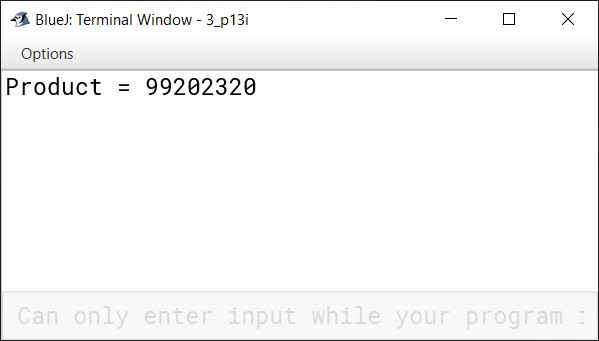
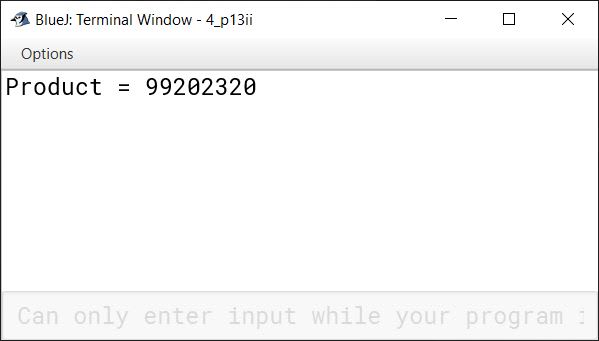
Write three different programs using for, while, and do-while loops to find the product of series 3, 9, 12,... 30.
public class KBoatSeries
{
    public static void main(String args[]) {
        int pro = 1;
        for(int i = 3, t = 1; i <= 30; t++) {
            pro *= i;
            if(t % 2 == 0)
                i += 3;
            else
                i += 6;
        }
        System.out.println("Product = " + pro);
    }
}
public class KBoatSeries
{
    public static void main(String args[]) {
        long pro = 1;
        int num = 3, t = 1;

        while(num <= 30)    {
            pro *= num;
            if(t % 2 == 0)
                num += 3;
            else
                num += 6;
            t++;
        }
        System.out.println("Product = " + pro);
    }
}
public class KBoatSeries
{
    public static void main(String args[]) {
        long pro = 1;
        int num = 3, t = 1;

        do {
            pro *= num;
            if(t % 2 == 0)
                num += 3;
            else
                num += 6;
            t++;
        } while(num <= 30);

        System.out.println("Product = " + pro);
    }
}
Solution not available in the source paper.
14Assignment questions
Write a program to convert kilograms to pounds in the following tabular format (1 kilogram is 2.2 pounds):
Kilograms
Pounds
1
2.2
2
4.4
20
44.0
public class KboatKiloToPound
{
    public static void main(String args[]) {
        System.out.println("Kilograms \t Pounds");
        for(int i = 1; i <= 20; i++) {
            double p = i * 2.2;
            System.out.println(i + "\t\t" + p);
        }
    }
}
Solution not available in the source paper.
15Assignment questions
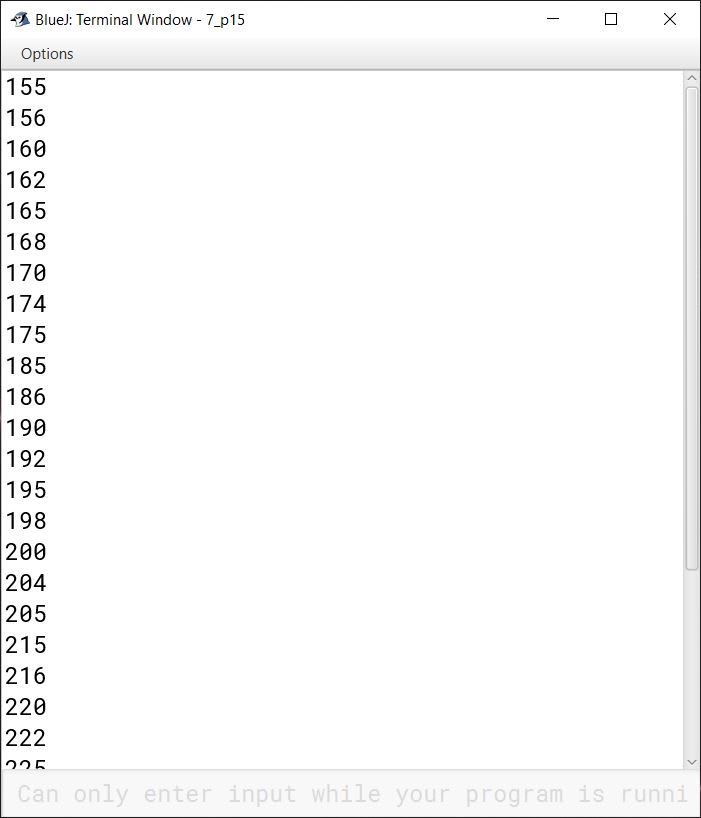
Write a program that displays all the numbers from 150 to 250 that are divisible by 5 or 6, but not both.
public class KboatFactorCheck
{
    public static void main(String args[]) {

        for (int i = 150; i <= 250; i++) {
            int mod5 = i % 5;
            int mod6 = i % 6;

            if ((mod5 == 0 || mod6 == 0)
                    && !(mod5 == 0 && mod6 == 0)) {
                System.out.println(i);
            }
        }
    }
}
Solution not available in the source paper.
16Assignment questions
Write a program in Java to read a number and display its digits in the reverse order. For example, if the input number is 2468, then the output should be 8642.
Output: Enter a number: 2468 Original number: 2468 Reverse number: 8642
import java.util.Scanner;

public class KboatDigitReverse
{
    public static void main(String args[]) {

        Scanner in = new Scanner(System.in);
        System.out.print("Enter Number: ");
        int orgNum = in.nextInt();

        int copyNum = orgNum;
        int revNum = 0;

        while(copyNum != 0) {
            int digit = copyNum % 10;
            copyNum /= 10;
            revNum = revNum * 10 + digit;
        }

        System.out.println("Original Number = " + orgNum);
        System.out.println("Reverse Number = " + revNum);
    }
}
Solution not available in the source paper.
17Assignment questions
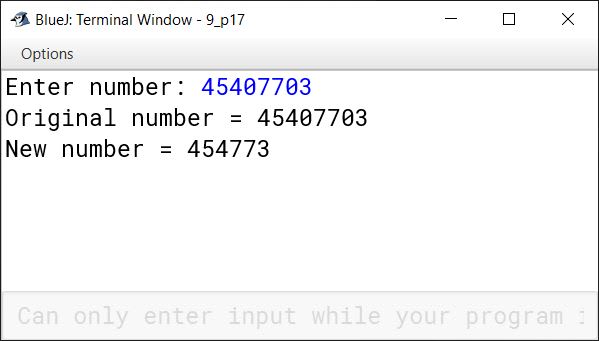
Write a program in Java to read a number, remove all zeros from it, and display the new number. For example,
Sample Input: 45407703 Sample Output: 454773
import java.util.Scanner;

public class KboatRemoveZeros
{
    public static void main(String args[]) {
        Scanner in = new Scanner(System.in);
        System.out.print("Enter number: ");
        int num = in.nextInt();
        int idx = 0;
        int newNum = 0;
        int n = num;

        while (n != 0) {
            int d = n % 10;
            if (d != 0) {
                newNum += (int)(d * Math.pow(10, idx));
                idx++;
            }
            n /= 10;
        }

        System.out.println("Original number = " + num);
        System.out.println("New number = " + newNum);
    }
}
Solution not available in the source paper.
18Assignment questions
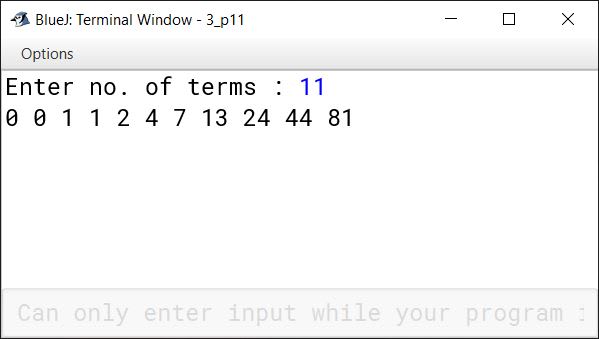
Write a program to read the number n using the Scanner class and print the Tribonacci series: 0, 0, 1, 1, 2, 4, 7, 13, 24, 44, 81 ...and so on. Hint: The Tribonacci series is a generalisation of the Fibonacci sequence where each term is the sum of the three preceding terms.
import java.util.Scanner;

public class KboatTribonacci
{
    public static void main(String args[]) {
        Scanner in = new Scanner(System.in);
        System.out.print("Enter no. of terms : ");
        int n = in.nextInt();

        if(n < 3)
            System.out.print("Enter a number greater than 2");
        else    {
            int a = 0, b = 0, c = 1;
            System.out.print(a + " " + b + " " + c);

            for (int i = 4; i <= n; i++) {
                int term = a + b + c;
                System.out.print(" " + term);
                a = b;
                b = c;
                c = term;
            }
        }
    }
}
Solution not available in the source paper.
19Assignment questions
Write a program to calculate the value of Pi with the help of the following series: Pi = (4/1) - (4/3) + (4/5) - (4/7) + (4/9) - (4/11) + (4/13) - (4/15) ... Hint: Use while loop with 100000 iterations.
public class KboatValOfPi
{
        public static void main(String args[]) {
            double pi = 0.0d, j = 1.0d;
            int i = 1;
            while(i <= 100000)  {
                if(i % 2 == 0)
                    pi -= 4/j;
                else
                    pi += 4/j;
                j += 2;
                i++;
            }
            System.out.println("Pi = " + pi);

    }
}
Solution not available in the source paper.
20Assignment questions
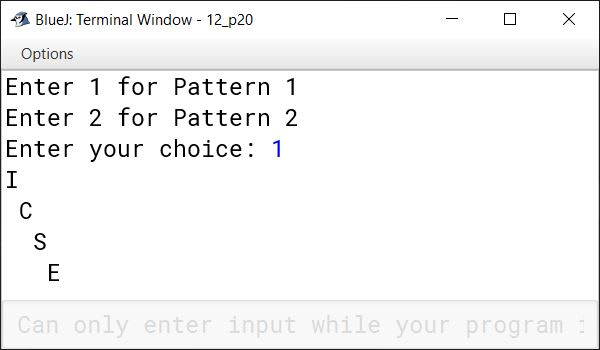
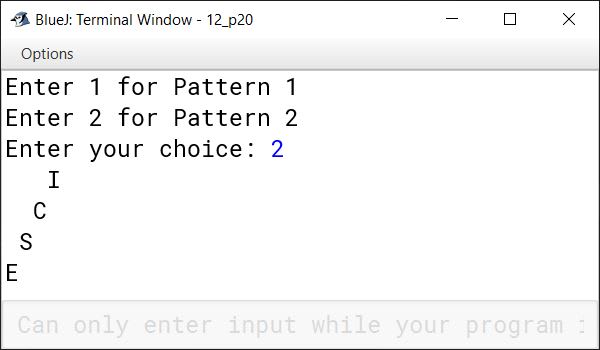
Write a program to display the following patterns as per the user's choice.
Pattern 1
I
 C
   S
     E

Pattern 2
      I
    C
  S
E
import java.util.Scanner;

public class KboatMenuPattern
{
    public static void main(String args[]) {
        Scanner in = new Scanner(System.in);
        System.out.println("Enter 1 for Pattern 1");
        System.out.println("Enter 2 for Pattern 2");
        System.out.print("Enter your choice: ");
        int ch = in.nextInt();
        String str = "ICSE";
        int len = str.length();
        switch (ch) {
            case 1:
                for (int i = 0; i < len; i++) {
                    for (int j = 0; j < i; j++) {
                        System.out.print(" ");
                    }
                    System.out.println(str.charAt(i));
                }
                break;

            case 2:
                for (int i = len - 1; i >= 0; i--) {
                    for (int j = 0; j < i; j++) {
                        System.out.print(" ");
                    }
                    System.out.println(str.charAt(len - 1 - i));
                }
                break;

            default:
            System.out.println("Incorrect choice");
            break;

        }
    }
}
Solution not available in the source paper.
21Assignment questions
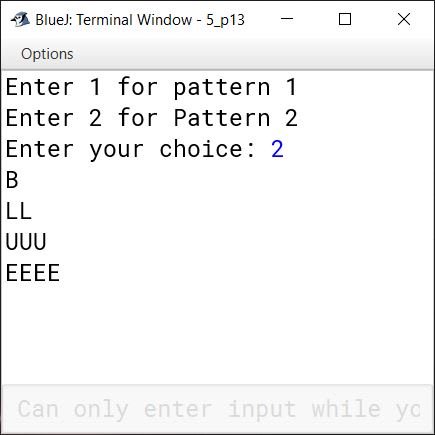
Write a menu-driven program to display the pattern as the per user's choice:
Pattern 1
ABCDE
ABCD
ABC
AB
A

Pattern 2
B
LL
UUU
EEEE
For an incorrect option, an appropriate error message should be displayed.
import java.util.Scanner;

public class KboatMenuPattern
{
    public static void main(String args[]) {
        Scanner in = new Scanner(System.in);
        System.out.println("Enter 1 for pattern 1");
        System.out.println("Enter 2 for Pattern 2");
        System.out.print("Enter your choice: ");
        int choice = in.nextInt();
        switch (choice) {
            case 1:
            for (int i = 69; i >= 65; i--) {
                for (int j = 65; j <= i; j++) {
                    System.out.print((char)j);
                }
                System.out.println();
            }
            break;

            case 2:
            String word = "BLUE";
            int len = word.length();
            for(int i = 0; i < len; i++) {
                for(int j = 0; j <= i; j++) {
                    System.out.print(word.charAt(i));
                }
                System.out.println();
            }
            break;

            default:
            System.out.println("Incorrect choice");
            break;

        }
    }
}
Solution not available in the source paper.
22Assignment questions
Write a program to input a number and check and print whether it is a Pronic number or not. (Pronic number is a number which is the product of two consecutive integers.) Example: 12 = 3 x 4 20 = 4 x 5 42 = 6 x 7
import java.util.Scanner;

public class KboatPronicNumber
{
    public static void main(String args[]) {
        Scanner in = new Scanner(System.in);
        System.out.print("Enter the number to check: ");
        int num = in.nextInt();

        boolean isPronic = false;

        for (int i = 1; i <= num - 1; i++) {
            if (i * (i + 1) == num) {
                isPronic = true;
                break;
            }
        }

        if (isPronic)
            System.out.println(num + " is a pronic number");
        else
            System.out.println(num + " is not a pronic number");
    }
}
Solution not available in the source paper.
23Assignment questions
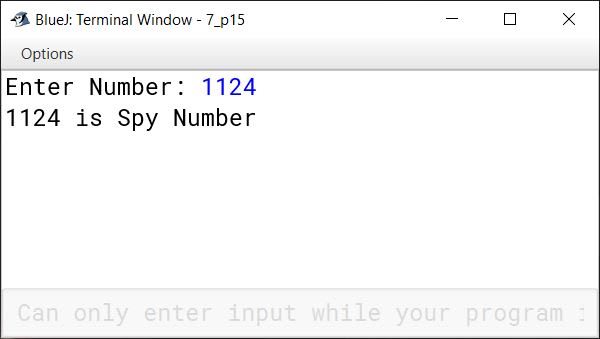
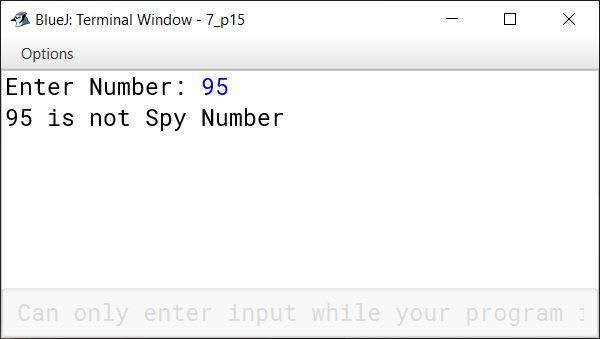
Write a program to accept a number and check and display whether it is a spy number or not. (A number is called a spy number if the sum of its digits equals the product of the digits.) Example: Consider the number 1124. Sum of the digits = 1 + 1 + 2 + 4 = 8. Product of the digits = 1 * 1 * 2 * 4 = 8. Refer to Program 9.44 for the solution.
import java.util.Scanner;

public class KboatSpyNumber
{
    public static void main(String args[]) {

        Scanner in = new Scanner(System.in);

        System.out.print("Enter Number: ");
        int num = in.nextInt();

        int digit, sum = 0;
        int orgNum = num;
        int prod = 1;

        while (num > 0) {
            digit = num % 10;

            sum += digit;
            prod *= digit;
            num /= 10;
        }

        if (sum == prod)
            System.out.println(orgNum + " is Spy Number");
        else
            System.out.println(orgNum + " is not Spy Number");

    }
}
Solution not available in the source paper.
24Assignment questions
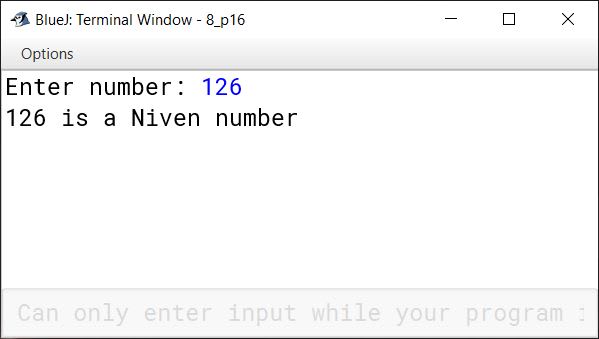
Write a program to accept a number and check and display whether it is a Niven number or not. (Niven number number which is divisible by the sum of its digits). Example: Consider the number 126. Sum of its digits is 1 + 2 + 6 = 9 and 126 is divisible by 9. Refer to Program 9.45 for the solution.
import java.util.Scanner;

public class KboatNivenNumber
{
    public static void main(String args[]) {
        Scanner in = new Scanner(System.in);
        System.out.print("Enter number: ");
        int num = in.nextInt();
        int orgNum = num;

        int digitSum = 0;

        while (num != 0) {
            int digit = num % 10;
            num /= 10;
            digitSum += digit;
        }

        /*
         * digitSum != 0 check prevents
         * division by zero error for the
         * case when users gives the number
         * 0 as input
         */
        if (digitSum != 0 && orgNum % digitSum == 0)
            System.out.println(orgNum + " is a Niven number");
        else
            System.out.println(orgNum + " is not a Niven number");
    }
}
Solution not available in the source paper.
25Assignment questions
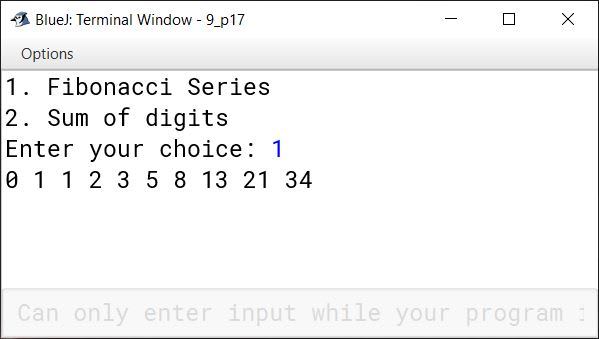
Using the switch statement, write a menu driven program to:
import java.util.Scanner;

public class KboatFibonacciNDigitSum
{
    public static void main(String args[]) {
        Scanner in = new Scanner(System.in);
        System.out.println("1. Fibonacci Series");
        System.out.println("2. Sum of digits");
        System.out.print("Enter your choice: ");
        int ch = in.nextInt();

        switch (ch) {
            case 1:
            int a = 0, b = 1;
            System.out.print(a + " " + b);
            /*
             * i is starting from 3 below
             * instead of 1 because we have
             * already printed 2 terms of
             * the series. The for loop will
             * print the series from third
             * term onwards.
             */
            for (int i = 3; i <= 10; i++) {
                int term = a + b;
                System.out.print(" " + term);
                a = b;
                b = term;
            }
            break;

            case 2:
            System.out.print("Enter number: ");
            int num = in.nextInt();
            int sum = 0;
            while (num != 0) {
                sum += num % 10;
                num /= 10;
            }
            System.out.println("Sum of Digits " + " = " + sum);
            break;

            default:
            System.out.println("Incorrect choice");
            break;
        }
    }
}
(a)Generate and display the first 10 terms of the Fibonacci series 0, 1, 1, 2, 3, 5.... The first two Fibonacci numbers are 0 and 1, and each subsequent number is the sum of the previous two.
(b)Find the sum of the digits of an integer that is input. Sample Input: 15390 Sample Output: Sum of the digits = 18 For an incorrect choice, an appropriate error message should be displayed.
Solution not available in the source paper.
26Assignment questions
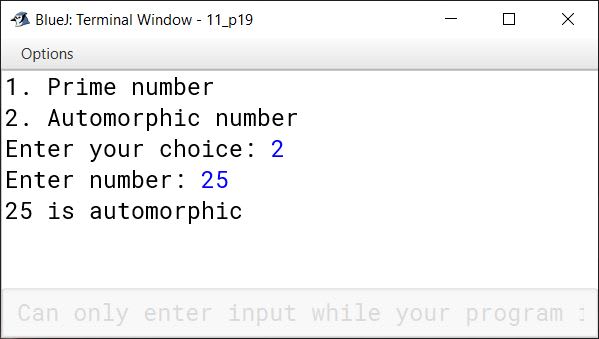
Write a menu driven program to accept a number and check and display whether (i) it is a Prime Number or not (ii) it is an Automorphic Number or not. (Use switch-case statement).
import java.util.Scanner;

public class KboatPrimeAutomorphic
{
    public static void main(String args[]) {
        Scanner in = new Scanner(System.in);
        System.out.println("1. Prime number");
        System.out.println("2. Automorphic number");
        System.out.print("Enter your choice: ");
        int choice = in.nextInt();
        System.out.print("Enter number: ");
        int num = in.nextInt();

        switch (choice) {
            case 1:
            int c = 0;
            for (int i = 1; i <= num; i++) {
                if (num % i == 0) {
                    c++;
                }
            }
            if (c == 2)
                System.out.println(num + " is Prime");
            else
                System.out.println(num + " is not Prime");
            break;

            case 2:
            int numCopy = num;
            int sq = num * num;
            int d = 0;

            /*
             * Count the number of
             * digits in num
             */
            while(num > 0) {
                d++;
                num /= 10;
            }

            /*
             * Extract the last d digits
             * from square of num
             */
            int ld = (int)(sq % Math.pow(10, d));

            if (ld == numCopy)
                System.out.println(numCopy + " is automorphic");
            else
                System.out.println(numCopy + " is not automorphic");
            break;

            default:
            System.out.println("Incorrect Choice");
            break;
        }
    }
}
(a)Prime number: A number is said to be a prime number if it is divisible only by 1 and itself and not by any other number. Example: 3, 5, 7, 11, 13 etc.
(b)Automorphic number: An automorphic number is the number which is contained in the last digit(s) of its square. Example: 25 is an automorphic number as its square is 625 and 25 is present as the last two digits.
Solution not available in the source paper.
27Assignment questions
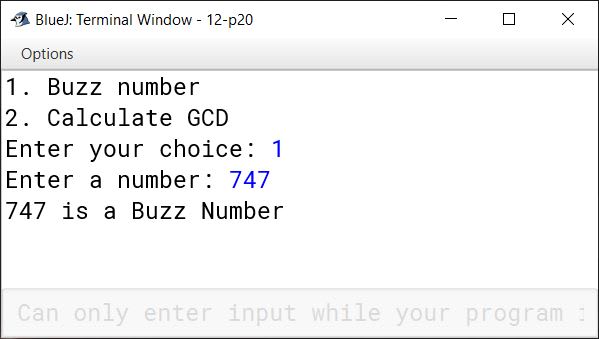
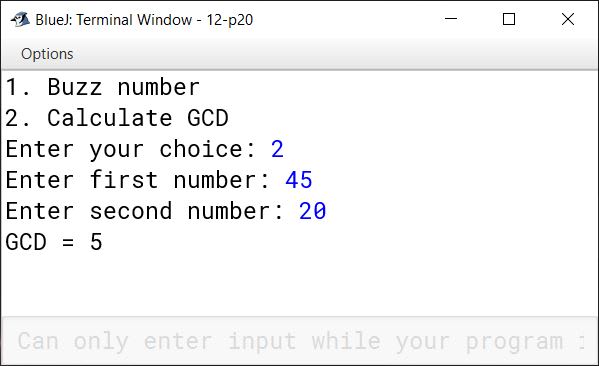
Write a menu driven program to accept a number from the user and check whether it is a BUZZ number or to accept any two numbers and to print the GCD of them.
A BUZZ number is the number which either ends with 7 or is divisible by 7.
GCD (Greatest Common Divisor) of two integers is calculated by continued division method. Divide the larger number by the smaller; the remainder then divides the previous divisor. The process is repeated till the remainder is zero. The divisor then results the GCD.
import java.util.Scanner;

public class KboatBuzzGCD
{
    public static void main(String args[]) {
        Scanner in = new Scanner(System.in);
        System.out.println("1. Buzz number");
        System.out.println("2. Calculate GCD");
        System.out.print("Enter your choice: ");
        int choice = in.nextInt();

        switch (choice) {
            case 1:
                System.out.print("Enter a number: ");
                int num = in.nextInt();
                if (num % 10 == 7 || num % 7 == 0)
                    System.out.println(num + " is a Buzz Number");
                else
                    System.out.println(num + " is not a Buzz Number");
            break;

            case 2:
                System.out.print("Enter first number: ");
                int a = in.nextInt();
                System.out.print("Enter second number: ");
                int b = in.nextInt();
                while (b != 0) {
                    int t = b;
                    b = a % b;
                    a = t;
                }
                System.out.println("GCD = " + a);
                break;

            default:
            System.out.println("Incorrect Choice");
            break;
        }
    }
}
Solution not available in the source paper.
28Assignment questions
Write a program to read the number x using the Scanner class and compute the series:
Sum = x/2 + x/5 + x/8 + x/11+ ..... + x/20
The output should look like as shown below:
Enter the value of x: 10 Sum of the series is: 10.961611917494269
import java.util.Scanner;

public class KboatSeries
{
    public static void main(String args[]) {
        Scanner in = new Scanner(System.in);
        System.out.print("Enter x: ");
        int x = in.nextInt();
        double sum = 0.0;
        for (int i = 2; i <= 20; i += 3)
            sum += (double)x / i;
        System.out.println("Sum = " + sum);
    }
}
Solution not available in the source paper.
29Assignment questions
Write a program in Java to compute and display factorial of numbers up to a number entered via the Scanner class. The output should look like as shown below when 7 is input.
Enter a number: 7 1! (=1) = 1 2! (= 1 x 2) = 2 3! (= 1 x 2 x 3) = 6 4! (= 1 x 2 x 3 x 4) = 24 5! (= 1 x 2 x 3 x 4 x 5) = 120 6! (= 1 x 2 x 3 x 4 x 5 x 6) = 720 7! (= 1 x 2 x 3 x 4 x 5 x 6 x 7) = 5040
import java.util.Scanner;

public class KboatFactorial
{
    public static void main(String args[]) {
        Scanner in = new Scanner(System.in);
        System.out.print("Enter a number: ");
        int num = in.nextInt();

        for (int i = 1; i <= num; i++)  {
            int f = 1;
            System.out.print(i + "! ( = ");
            for (int j = 1; j <= i; j++)    {
                if (j == 1)
                    System.out.print(j);
                else
                    System.out.print(" x " + j);
                f *= j;
            }
            System.out.print(" ) = " + f);
            System.out.println();
        }
    }
}
Solution not available in the source paper.
30(i)Assignment questions
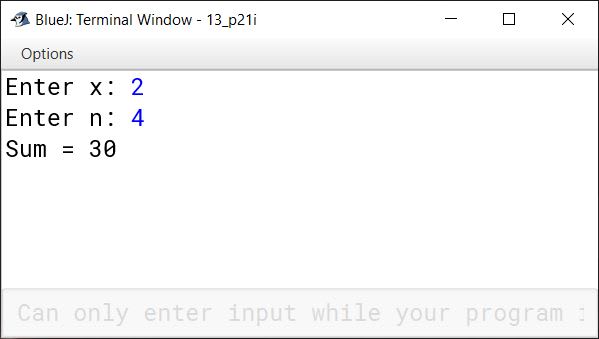
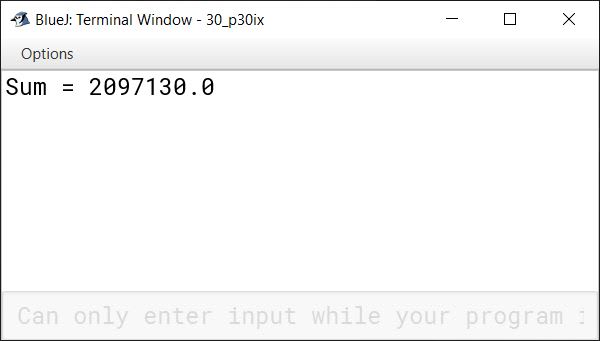
Write a program in Java to find the sum of the given series:
x1 + x2 + x3 + x4 + ..... + xn
import java.util.Scanner;

public class KboatSeries
{
    public static void main(String args[]) {
        Scanner in = new Scanner(System.in);
        System.out.print("Enter x: ");
        int x = in.nextInt();
        System.out.print("Enter n: ");
        int n = in.nextInt();
        long sum = 0;
        for (int i = 1; i <= n; i++)
            sum += Math.pow(x, i);
        System.out.println("Sum = " + sum);
    }
}
Solution not available in the source paper.
30(ii)Assignment questions
Write a program in Java to find the sum of the given series:
x1 - x2 + x3 - x4 + ..... - xn , where x = 3
import java.util.Scanner;

public class KboatSeries
{
    public static void main(String args[]) {
        Scanner in = new Scanner(System.in);
        System.out.print("Enter n: ");
        int n = in.nextInt();
        int x = 3;
        double sum = 0;

        for (int i = 1; i <= n; i++) {
                double term = Math.pow(x, i);
                if (i % 2 == 0)
                    sum -= term;
                else
                    sum += term;
            }
            System.out.println("Sum = " + sum);
    }
}
Solution not available in the source paper.
30(iii)Assignment questions
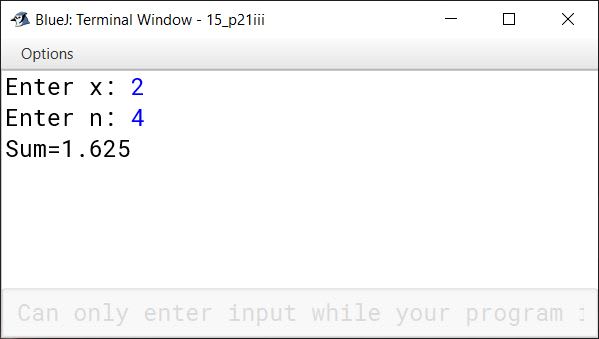
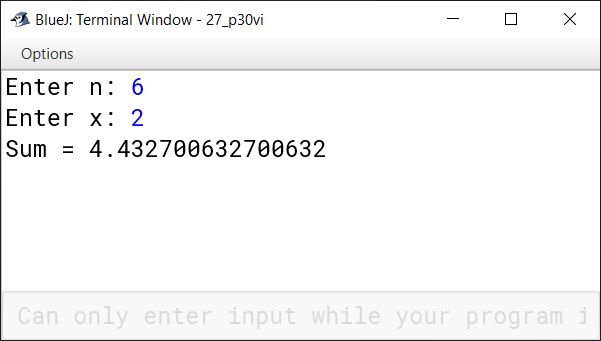
Write a program in Java to find the sum of the given series:
import java.util.Scanner;

public class KboatSeries
{
    public static void main(String args[]) {

        Scanner in = new Scanner(System.in);
        System.out.print("Enter x: ");
        int x = in.nextInt();
        System.out.print("Enter n: ");
        int n = in.nextInt();
        double sum = 0;

        for (int i = 1; i <= n; i++) {
            sum += (i / Math.pow(x, i));
        }

        System.out.println("Sum=" + sum);
    }
}
Solution not available in the source paper.
30(iv)Assignment questions
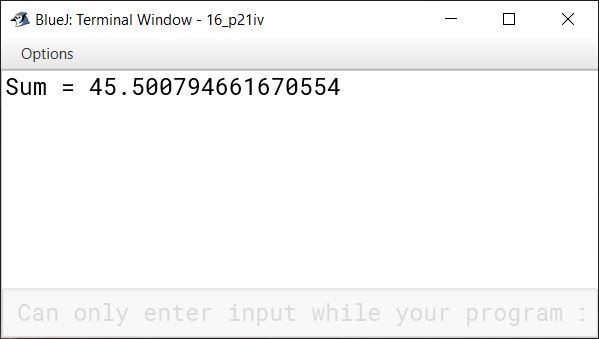
Write a program in Java to find the sum of the given series:
import java.util.Scanner;

public class KboatSeries
{
    public static void main(String args[]) {
        double sum = 0;
        for (int i = 1; i <= 49; i++)
            sum += i / (double)(i + 1);
        System.out.println("Sum = " + sum);
    }
}
Solution not available in the source paper.
30(v)Assignment questions
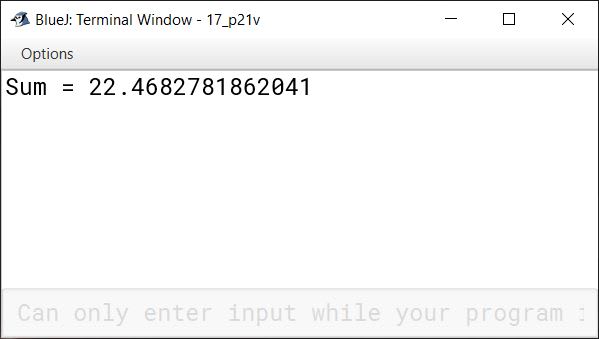
Write a program in Java to find the sum of the given series:
public class KboatSeries
{
    public static void main(String args[]) {
        double sum = 0;
        for (int i = 1; i <= 10; i++)
            sum += i / Math.sqrt(i);
        System.out.println("Sum = " + sum);
    }
}
Solution not available in the source paper.
30(vi)Assignment questions
Write a program in Java to find the sum of the given series:
import java.util.Scanner;

public class KboatSeries
{
    public static void main(String args[]) {
        Scanner in = new Scanner(System.in);
        System.out.print("Enter n: ");
        int n = in.nextInt();
        System.out.print("Enter x: ");
        int x = in.nextInt();

        double sum = 0;
        for (int i = 1, j = 3; i <= n; i++, j += 2) {
            sum += (x + i) / (double)j;
        }
        System.out.println("Sum = " + sum);
    }
}
Solution not available in the source paper.
30(vii)Assignment questions
Write a program in Java to find the sum of the given series:
import java.util.Scanner;

public class KboatSeries
{
    public static void main(String args[]) {
        Scanner in = new Scanner(System.in);
        System.out.print("Enter x: ");
        int x = in.nextInt();
        double sum = 0;

        for (int i = 2; i <= 20; i++) {
            double f = 1;
            for (int j = 1; j <= i; j++) {
                f *= j;
            }
            sum += x / f;
        }
        System.out.println("Sum = " + sum);

    }
}
Solution not available in the source paper.
30(viii)Assignment questions
Write a program in Java to find the sum of the given series:
import java.util.Scanner;

public class KboatSeries
{
    public static void main(String args[]) {
        Scanner in = new Scanner(System.in);
        System.out.print("Enter x: ");
        int x = in.nextInt();
        double sum = 0;

        for (int i = 2; i <= 10; i++) {
            double f = 1;
            for (int j = 1; j <= i; j++) {
                f *= j;
            }
            double term = Math.pow(x,i) / f;
            sum += term;
        }
        System.out.println("Sum = " + sum);

    }
}
Solution not available in the source paper.
30(ix)Assignment questions
Write a program in Java to find the sum of the given series:
1 + 3 + 7 + 15 + 31 + ..... + (220 - 1)
public class KboatSeries
{
    public static void main(String args[]) {

        double sum = 0;

        for (int i = 1; i <= 20; i++) {
            double term = Math.pow(2,i) - 1;
            sum += term;
        }

        System.out.println("Sum = " + sum);

    }
}
Solution not available in the source paper.
30(x)Assignment questions
Write a program in Java to find the sum of the given series:
1 * 2 * 4 * 8 * ..... * 220
public class KboatSeries
{
    public static void main(String args[]) {

        double sum = 0;

        for (int i = 0; i <= 20; i++) {
            double term = Math.pow(2,i);
            sum += term;
        }

        System.out.println("Sum = " + sum);

    }
}
Solution not available in the source paper.
31Assignment questions
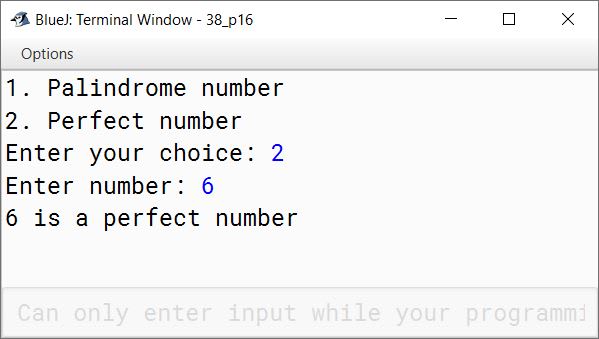
Write a menu driven class to accept a number from the user and check whether it is Palindrome or a Perfect number.
import java.util.Scanner;

public class KboatPalinOrPerfect
{
    public static void main(String args[]) {
        Scanner in = new Scanner(System.in);
        System.out.println("1. Palindrome number");
        System.out.println("2. Perfect number");
        System.out.print("Enter your choice: ");
        int choice = in.nextInt();
        System.out.print("Enter number: ");
        int num = in.nextInt();

        switch (choice) {
            case 1:
            int copyNum = num;
            int revNum = 0;

            while(copyNum != 0) {
                int digit = copyNum % 10;
                copyNum /= 10;
                revNum = revNum * 10 + digit;
            }

            if (revNum == num)
                System.out.println(num + " is palindrome");
            else
                System.out.println(num + " is not palindrome");
            break;

            case 2:
            int sum = 0;

            for (int i = 1; i <= num / 2; i++) {
                if (num % i == 0) {
                    sum += i;
                }
            }

            if (num == sum)
                System.out.println(num + " is a perfect number");
            else
                System.out.println(num + " is not a perfect number");
            break;

            default:
            System.out.println("Incorrect Choice");
            break;
        }
    }
}
(a)Palindrome number: A number is a Palindrome which when read in reverse order is same as read in the right order Example: 11, 101, 151, etc.
(b)Perfect number: A number is called Perfect if it is equal to the sum of its factors other than the number itself. Example: 6 = 1 + 2 + 3
Solution not available in the source paper.
32Assignment questions
Write a program to print the sum of negative numbers, sum of positive even numbers and sum of positive odd numbers from a list of n numbers entered by the user. The program terminates when the user enters a zero.
import java.util.Scanner;

public class KboatNumberSum
{
    public static void main(String args[]) {
        Scanner in = new Scanner(System.in);
        int nSum = 0, eSum = 0, oSum = 0;
        System.out.println("Enter Numbers:");
        while (true) {
            int n = in.nextInt();

            if (n == 0) {
                break;
            }

            if (n < 0) {
                nSum += n;
            }
            else if (n % 2 == 0) {
                eSum += n;
            }
            else {
                oSum += n;
            }
        }

        System.out.println("Negative No. Sum = " + nSum);
        System.out.println("Positive Even No. Sum = " + eSum);
        System.out.println("Positive Odd No. Sum = " + oSum);
    }
}