ICSE Class 10 Geography · Total Geography · 45 solved questions
Exercise
1Choose the correct option
What is an aquifer?
(a)An underground well that readily gives out water on digging the land.
(b)An underground pond that was once a source of water and is now buried under rocks.
(c)An underground stream saturated with water that is transmitted readily on to the surface.
(d)None of the above.
Show SolutionHide Solution↓
An underground stream saturated with water that is transmitted readily on to the surface.
Reason — An aquifer is an underground layer of permeable rock, sand, or gravel that stores and transmits groundwater, making it available through wells and springs.
2Choose the correct option
Which of the following does not conserve water?
(a)Rainwater harvesting
(b)Using only bottled drinking water
(c)Water recycling
(d)Drip irrigation
Show SolutionHide Solution↓
Using only bottled drinking water
Reason — Rainwater harvesting, water recycling, and drip irrigation conserve water by reducing wastage and increasing its availability. Using bottled drinking water does not conserve water, as it only changes the source of water without reducing its consumption or replenishing water resources.
3Choose the correct option
Assertion (A): Many states have recorded a sharp fall in the groundwater levels, ranging from 70 to 80 per cent.
Reason (R): With the increase in population the demand for water has risen.
(a)Both A and R are true and R is the correct explanation of A.
(b)Both A and R are true but R does not explain A.
(c)A is true but R is false.
(d)A is false but R is true.
Show SolutionHide Solution↓
Both A and R are true and R is the correct explanation of A.
Explanation — Increase in population means an increase in the demand for water. This in turn leads to decline in groundwater levels in many states.
4Choose the correct option
Which of the following is a cause for the decline in groundwater levels?
(a)Irregular and erratic rainfall
(b)Urbanisation
(c)Loss of vegetative cover
(d)All of the above.
Show SolutionHide Solution↓
All of the above.
Reason — Irregular and erratic rainfall reduces the recharge of groundwater, urbanisation and industrialisation increase the demand for water and lead to overexploitation of groundwater, and the loss of vegetative cover reduces infiltration and lowers the water table. Therefore, all of these contribute to the decline in groundwater levels.
5Choose the correct option
Drip irrigation is also known as ............... .
(a)Seepage irrigation
(b)Trickle irrigation
(c)Protected irrigation
(d)Nozzle irrigation
Show SolutionHide Solution↓
Trickle irrigation
Reason — In drip irrigation, water is supplied drop by drop directly to the roots of plants through perforated pipes or emitters. Since water trickles slowly to the root zone, drip irrigation is also known as trickle irrigation.
6Choose the correct option
Tanks form the main source of irrigation in ............... .
(a)Punjab and Haryana
(b)the Deccan Plateau
(c)Madhya Pradesh and Gujarat
(d)All of the above.
Show SolutionHide Solution↓
the Deccan Plateau
Reason — The hard crystalline rocks of the Deccan Plateau do not absorb much water, making wells difficult to construct. Moreover, the uneven terrain has many natural depressions where tanks can be easily built, making them the main source of irrigation in the region.
7Choose the correct option
Assertion (A): Cherrapunji, which receives about 11,000 mm of rainfall annually, suffers from acute shortage of drinking water.
Reason (R): Most of the rain falling on the surface tends to flow away rapidly, leaving very little for the recharge of groundwater.
(a)Both A and R are true and R is the correct explanation of A.
(b)Both A and R are true but R does not explain A.
(c)A is true but R is false.
(d)A is false but R is true.
Show SolutionHide Solution↓
Both A and R are true and R is the correct explanation of A.
Explanation — Cherrapunji receives very heavy rainfall, but most of it flows away rapidly due to its high intensity and steep slopes, leaving very little water to recharge groundwater. As a result, despite receiving abundant rainfall, Cherrapunji faces an acute shortage of drinking water.
8Choose the correct option
................ is not a conventional means of irrigation.
(a)Furrow irrigation
(b)Wells
(c)Tanks
(d)Inundation canals
Show SolutionHide Solution↓
Furrow irrigation
Reason — The conventional means of irrigation include wells, tanks and inundation canals, whereas furrow irrigation is a modern irrigation method; hence furrow irrigation is not a conventional means of irrigation.
9Choose the correct option
Rahul is constructing a house in Mathura. Of the following methods select those that he can use to ensure rainwater harvesting.
(i) A garden (ii) Porous tiles in his driveway (iii) Rooftop rainwater harvesting (iv) Borewell
(a)(i), (ii), (iii), (iv)
(b)(i), (ii), (iii)
(c)(i), (ii), (iv)
(d)None of them.
Show SolutionHide Solution↓
(i), (ii), (iii), (iv)
Reason — A garden acts as a permeable surface, porous tiles can be laid on the driveway, rooftop rainwater harvesting diverts water falling on the roof for storage or recharge, and a borewell can be used as a recharge structure to channel filtered rainwater into underground aquifers. Therefore, all four can be used to promote rainwater harvesting.
10Choose the correct option
Assertion (A): Runoff from only paved surfaces is used for storing rainwater.
Reason (R): It is relatively free of bacteriological contamination.
(a)Both A and R are true and R is the correct explanation of A.
(b)Both A and R are true but R does not explain A.
(c)A is true but R is false.
(d)A is false but R is true.
Show SolutionHide Solution↓
Both A and R are true and R is the correct explanation of A.
Explanation — Paved surfaces are relatively free of bacteriological contamination due to lack of direct contact with soil and organic matter, limited microbial activity, and less exposure to pollutants.
11Choose the correct option
Most of the canals in India belong to which category?
(a)Perennial canals
(b)Inundation canals
(c)Navigation canals
(d)None of the above.
Show SolutionHide Solution↓
Perennial canals
Reason — Most of the canals in India are taken out from perennial rivers by constructing barrages or dams so that they can draw water throughout the year and irrigate large areas; therefore they belong to the category of perennial canals.
12Choose the correct option
Which of the following least irrigated state of India is solely dependent on canals?
(a)Assam
(b)Mizoram
(c)Tripura
(d)Arunachal Pradesh
Show SolutionHide Solution↓
Mizoram
Reason — Mizoram is the least irrigated state in India and is solely dependent on canals for irrigation. There are no significant sources of irrigation such as wells or tanks in the state due to its hilly terrain.
13Choose the correct option
Assertion (A): For farmers rainfall is still the most important source of water.
Reason (R): Irrigation canals and tanks have been constructed by rulers since ancient times.
(a)Both A and R are true and R is the correct explanation of A.
(b)Both A and R are true but R does not explain A.
(c)A is true but R is false.
(d)A is false but R is true.
Show SolutionHide Solution↓
Both A and R are true but R does not explain A.
Explanation — Farmers make use of irrigation canals and tanks, as well as rely on rainfall. However, they are two separate facts.
14Choose the correct option
You have to maintain one public park in your colony. Which method of irrigation would you prefer?
(a)Furrow irrigation
(b)Spray irrigation
(c)Drip irrigation
(d)Sprinkler irrigation
Show SolutionHide Solution↓
Sprinkler irrigation
Reason — Sprinkler irrigation sprays water directly over the plants like overhead rainfall and is well suited to a small area such as a park.
1(a)Answer the following questions
What do you understand by the term 'water resource'?
Show SolutionHide Solution↓
The term 'water resource' refers to any of the entire range of natural waters that occur on the earth and are of potential use to living beings.
1(b)Answer the following questions
Give two points of difference between 'surface water' and 'ground water'.
Show SolutionHide Solution↓
Surface water
Ground water
Surface water forms streams, lakes, rivers and ponds flowing on land.
The water which seeps through the cracks and crevices under the surface of the land is known as ground water.
It can be used directly without pumping.
It needs to be pumped out of the ground before it can be used.
1(c)Answer the following questions
Give a geographical reason for each of the following:
(i) Need to adopt different means of irrigation.
(ii) Need for conserving water.
(iii) Man is responsible for water crisis.
Show SolutionHide Solution↓
(i) There is a need to adopt different means of irrigation because of uncertainty of rainfall, uneven distribution of rainfall, crop requirements, nature of the soil, effective utilisation of river water and to maximise production.
(ii) There is a need for conserving water for the following reasons-
Overexploitation of groundwater lowers the water table.
Loss of vegetation reduces rainfall and groundwater recharge.
Irrigation uses more than 90% of the total freshwater.
Rapid population growth has increased the demand for water.
Pollution of water resources has reduced the availability of usable freshwater.
(iii) Man is responsible for water crisis in India because due to increase in population, irrigation and industrialisation, the demand for water has risen. This has led to a decline in groundwater levels in various parts of the country.
1(d)Answer the following questions
Rajasthan faces water scarcity, particularly in dry areas. The government has initiated water harvesting projects to enhance water availability.
(i) What is meant by water harvesting?
(ii) State the objectives of water harvesting schemes.
Show SolutionHide Solution↓
(i) Rainwater harvesting is the process of increasing the recharge of groundwater by capturing and storing rainwater locally in sub-surface water reservoirs.
(ii) The main objectives of rainwater harvesting are the following:
Meeting the ever increasing demand for water.
Reducing the run-off which chokes drains.
Avoiding the flooding of roads.
Augmenting the groundwater storage and raise the water table.
Reducing groundwater pollution.
Improving the quality of groundwater.
Reducing the soil erosion.
Supplementing domestic water requirement during summer and drought.
2(a)Answer the following questions
What is meant by the term irrigation?
Show SolutionHide Solution↓
Irrigation refers to the process of watering of agricultural plants through artificial means from wells, tanks, tube wells, canals, etc.
2(b)Answer the following questions
What is meant by the term 'water scarcity'? What has caused this scarcity in India?
Show SolutionHide Solution↓
Water scarcity is the lack of sufficient available water resources to meet the demands of water usage within a region.
Growing population, over-exploitation and unequal distribution of water among social groups are the main causes of water scarcity in India.
2(c)Answer the following questions
Give a geographical reason for each of the following:
(i) Inundation canals are being converted to perennial canals.
(ii) Tank irrigation is preferred over other means of irrigation in Peninsular India.
(iii) Groundwater reserves are depleting at a fast rate.
Show SolutionHide Solution↓
(i) Inundation canals are being converted to perennial canals because inundation canals get supply of water only when the rivers are in flood while perennial canals can draw water throughout the year and irrigate large areas.
(ii) Tank irrigation is preferred over other means of irrigation in Peninsular India because-
The rivers of Deccan are mainly dependent on the rainwater.
Many streams become torrential during the rainy season but dry up when the rain ceases.
The hard rocks in the area do not absorb waters, wells cannot be made there.
The terrain is uneven with many natural depressions where tanks can be easily built.
(iii) Groundwater reserves are depleting at a fast rate due to increase in population, irrigation and industrialisation, the demand for water has risen. This has led to a decline in groundwater level in various parts of the country.
2(d)Answer the following questions
(i) What is meant by traditional or conventional methods of irrigation?
(ii) Name any two conventional methods of irrigation.
Show SolutionHide Solution↓
(i) Traditional methods of irrigation means to supply water to the plant zone by pumped water from surface or subsurface sources like ponds, rivers, channels or groundwater through earthen channels or pipes with gravitational force.
(ii) Two conventional methods of irrigation are wells and tanks.
3(a)Answer the following questions
State any two drawbacks of conventional methods of irrigation.
Show SolutionHide Solution↓
Two drawbacks of conventional methods of irrigation are-
A large quantity of water is not properly utilised.
The fields situated in low areas always get excess water causing prolonged water logging.
3(b)Answer the following questions
Give two advantages and two disadvantages of well irrigation.
Show SolutionHide Solution↓
Two advantages of well irrigation are-
Wells can be dug at a very low cost which is well within the means of poor farmers.
By the use of pumps and tubewells, water can be lifted even from great depths.
Two disadvantages of well irrigation are-
Wells depend on underground water resources whose distribution varies from region to region.
The traditional wells dry up due to over withdrawal of the ground water and lowering of the water table.
3(c)Answer the following questions
Give a geographical reason for each of the following:
(i) Well irrigation is confined mainly to the alluvial plains.
(ii) In Tamil Nadu, nearly one-third of the net irrigated area is under canal irrigation.
(iii) Drip irrigation reduces loss of water through evaporation.
Show SolutionHide Solution↓
(i) Well irrigation is confined mainly to the alluvial plains as owing to the soft nature of the soil, wells can be easily dug and the yield of crops from the land after irrigation is considerably high.
(ii) In Tamil Nadu, nearly one-third of the net irrigated area is under canal irrigation because Tamil Nadu receives rainfall during the winter season while summer season remains dry. Thus, irrigation is needed in summer to make up the lack of rainfall.
(iii) Drip irrigation reduces loss of water through evaporation as this system consists of perforated pipes that are placed between rows of crops or buried along their root lines and give water directly on to the crops.
3(d)Answer the following questions
(i) Name any two states where well irrigation is practised.
(ii) Give one advantage and one disadvantage of tubewell irrigation.
Show SolutionHide Solution↓
(i) Two states where well irrigation is practised are Punjab and Uttar Pradesh.
(ii) One advantage of tubewell irrigation is that it brings up clean water. One disadvantage of tubewell irrigation is that it is useless if the water is brackish.
4(a)Answer the following questions
Name the two types of canals. Name two states where perennial canals are widely used.
Show SolutionHide Solution↓
Two types of canals are-
Inundation canals
Perennial canals
Two states where perennial canals are widely used are Uttar Pradesh and Madhya Pradesh.
4(b)Answer the following questions
How are the fields irrigated using the Persian wheel method?
Show SolutionHide Solution↓
Persian wheel method is a partly submerged vertical wheel with buckets attached to the rim. As the wheel is turned by draught animals rotating a geared horizontal wheel, the buckets are filled and emptied into a trough above, which carries the water to crop-sown fields.
4(c)Answer the following questions
Give a geographical reason for each of the following:
(i) Canals make the soil infertile.
(ii) Tubewell irrigation is quite expensive.
(iii) Excessive accumulation of salts make the soils unsuitable for cultivation.
Show SolutionHide Solution↓
(i) Canals make the soil infertile because in canal irrigation, where water table is a few feet below the ground, the alkaline salts come to the surface, mix with the soil and make it unproductive.
(ii) Tubewell irrigation is quite expensive as it requires continuous supply of electricity.
(iii) Excessive accumulation of salts make the soils unsuitable for cultivation because when salt concentrations in the soil are high, the movement of water from the soil to the root is slowed down. When the salt concentrations in the soil are higher than inside the root cells, the soil will draw water from the root, and the plant will wilt and die. Hence, the soil becomes unsuitable for cultivation.
4(d)Answer the following questions
Canals are a channel for supply of water from rivers to the farm fields. The perennial canals are not only an advantage but can be disadvantageous too. The perennial canals are functional in the state of Punjab due to the favourable situations available there.
(i) What conditions favour the development of canal irrigation in the mentioned area?
(ii) State two disadvantages of it.
Show SolutionHide Solution↓
(i) The following conditions favour the development of canal irrigation in Punjab:
Presence of rivers (like Sutlej, Beas, and Ravi)
Gentle slope of land
Extensive farmlands
Low rainfall
Alluvial soil
(ii) Two disadvantages of Canal irrigation (perennial) are as follows:
In areas where perennial unlined canals flow at ground level and between raised high banks, the water table may rise excessively, leading to waterlogging and swamp formation, rendering the soil uncultivable.
Waterlogging reduces the soil's ability to absorb water, so even slight excess rainfall can flood the land, damaging crops, homes, and stored goods due to poor drainage.
5(a)Answer the following questions
Briefly explain why groundwater levels are dropping rapidly in India.
Show SolutionHide Solution↓
The groundwater levels are dropping rapidly in India due to the following reasons:
The over-exploitation of groundwater is mainly responsible for the lowering of water table.
Excessive extraction for agriculture, especially through borewells, has led to a significant decline in the water table.
This issue is further worsened by a reduction in rainfall, which limits the natural recharge of groundwater.
Industrial use and the growing demand from a rising population also contribute to this rapid depletion.
5(b)Answer the following questions
How can groundwater be recharged? Name a method to recharge groundwater.
Show SolutionHide Solution↓
Groundwater can be recharged by allowing rainwater to seep into the ground. One effective method is rainwater harvesting, where rainwater is collected and directed into the soil through pits, trenches, or wells, helping to refill underground water reserves.
5(c)Answer the following questions
Give a geographical reason for each of the following:
(i) Many farmers in India still use wells.
(ii) There is very little recharge of groundwater.
(iii) Tubewells are important in Punjab.
Show SolutionHide Solution↓
(i) Many farmers in India still use wells because wells can be dug at a very low cost and the oxen which are kept for ploughing the land can be utilised for drawing water from the well.
(ii) There is very little recharge of groundwater because rapid urbanisation has reduced open spaces and natural surfaces, preventing rainwater from seeping into the ground and replenishing the water table.
(iii) Tubewells are important in Punjab because the state has fertile alluvial soil and a high demand for irrigation to support intensive farming, especially of wheat and rice. The presence of abundant groundwater makes tubewells a reliable source of irrigation.
5(d)Answer the following questions
(i) What is watershed management?
(ii) How is it beneficial for farmers in the long run?
Show SolutionHide Solution↓
(i) Watershed management refers to the efficient management and conservation of both the surface and groundwater resources. It includes the prevention of run-off as well as storage and recharge of groundwater by various methods like percolation pits, recharge wells, borewells, dugwells etc.
(ii) Watershed management is beneficial for farmers as it is aimed at conserving both soil and water. Since both soil and water are indispensible for the cultivation of crops, watershed management helps farmers to maximize their crop production and income.
6(a)Answer the following questions
What is meant by furrow irrigation? What is its advantage?
Show SolutionHide Solution↓
Furrow irrigation is a type of flood irrigation in which the water poured on the field is directed to flow through narrow channels dug between the rows of crops, instead of evenly distributing the water throughout the whole field.
The advantage of furrow irrigation it reduces water wastage by supplying water directly to the root zone of crops and prevents waterlogging of the entire field.
6(b)Answer the following questions
Explain briefly the need to conserve water.
Show SolutionHide Solution↓
We need to conserve water for the following reasons-
The over exploitation of ground water often results in the lowering of water table.
The loss of vegetation causes drought and reduction of rainfall and lowering of the water table.
Irrigation utilises more than 90% of the total freshwater.
The increase in population results in water scarcity.
Our water resources are polluted and their water can hardly be used without adequate treatment.
6(c)Answer the following questions
Give a geographical reason for each of the following:
(i) Modern means of irrigation are gaining popularity.
(ii) Sprinkler irrigation helps in conserving water.
(iii) Drip irrigation is quite expensive.
Show SolutionHide Solution↓
(i) Modern means of irrigation are gaining popularity because of the following reasons-
No loss of water due to seepage or evaporation
Conserve water
Prevent soil erosion
Suitable for areas where the rainfall is low
High efficiency
(ii) Sprinkler irrigation helps in conserving water as water is sprayed directly to the required plants so there is no loss of water through seepage or evaporation.
(iii) Drip irrigation is quite expensive because it requires an elaborate network of perforated pipes to be laid between the rows of crops or buried along their root lines, along with the associated equipment, which makes its installation costly.
6(d)Answer the following questions
What is 'drip irrigation'? How is it versatile?
Show SolutionHide Solution↓
Drip irrigation is the most advanced and efficient method of irrigation. This system consists of perforated pipes that are placed between rows of crops or buried along their root lines and give water directly on to the crops.
It is versatile because it can be used for a wide variety of crops, especially fruits and vegetables, and is suitable for different types of soils and land conditions. By delivering water directly to the root zone, it minimises evaporation and water wastage, making it highly efficient.
7(a)Answer the following questions
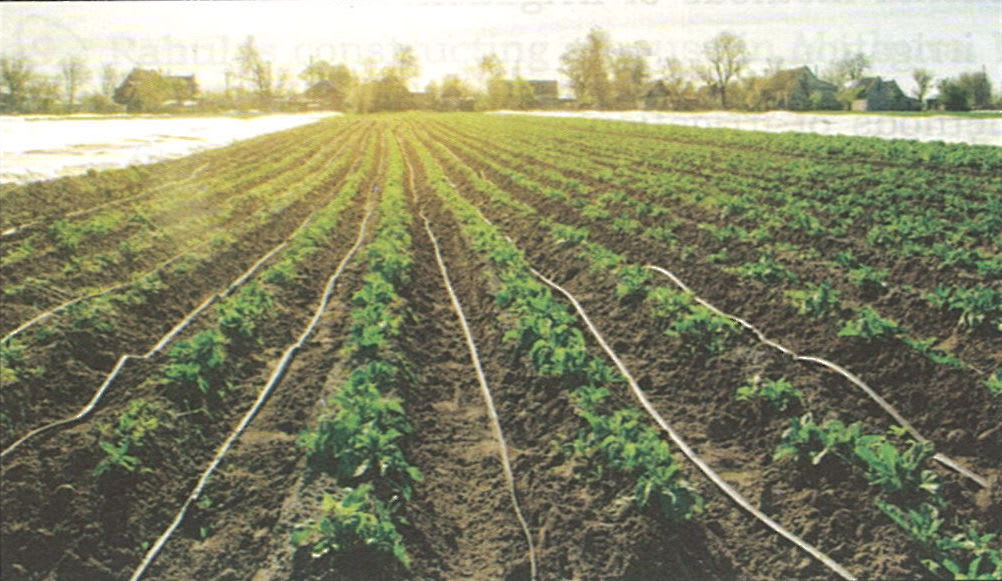
Picture 7(a) shows drip irrigation in a field. List its advantages.
Show SolutionHide Solution↓
The advantages of Drip irrigation are as follows:
It is the most advanced and efficient method of irrigation.
This system consists of perforated pipes that are placed between rows of crops or buried along their root lines and give water directly on to the crops.
As a result, evaporation is drastically reduced and irrigation water is conserved.
Drip irrigation allows the grower to customise an irrigation programme most beneficial to each crop.
7(b)Answer the following questions
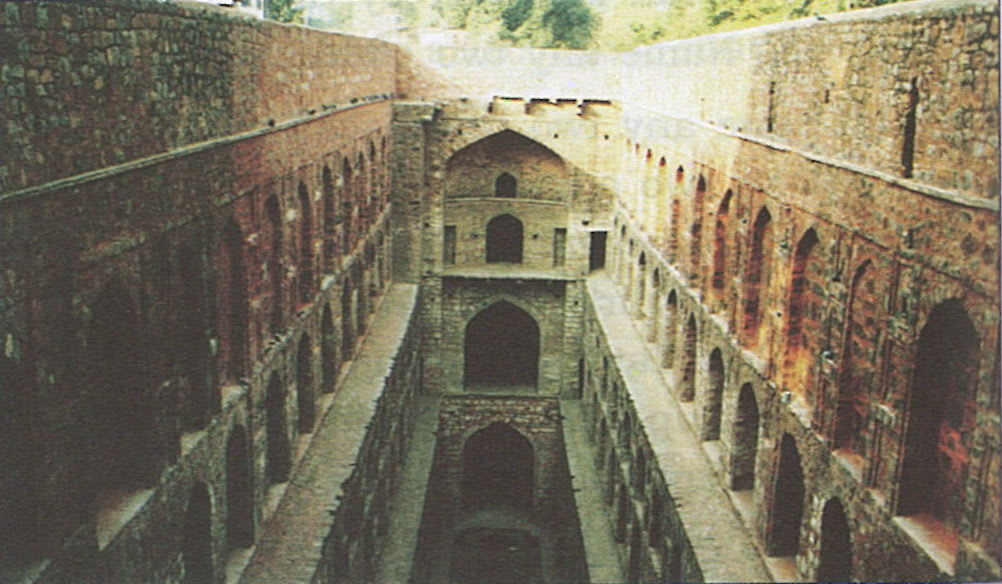
Picture 7(b) is Agrasen ki Baoli (New Delhi) — a step-well whose current form is believed to be constructed in the 14th century. The water level varies seasonally. It is designed to ensure water availability throughout the year with all fluctuations. Write a short note on any traditional irrigation method.
Show SolutionHide Solution↓
One of the traditional methods of irrigation include Well Irrigation.
A well is a small hole dug in the surface of the earth to obtain water from the water table for irrigation and other purposes. Wells are usually of two types: Lined wells (manmade), and Unlined wells (formed by different natural phenomena).
Well irrigation is a cheap, simple and dependable source of irrigation. It is practised in areas where plenty of groundwater is available and the depth of the water table does not exceed 15m.
7(c)Answer the following questions
Give a geographical reason for each of the following:
(i) Loss of water due to evaporation is highest in tanks.
(ii) Many cities have banned construction of tubewells.
(iii) Rabi crops are grown in areas with irrigation facilities.
Show SolutionHide Solution↓
(i) Loss of water due to evaporation is highest in tanks due to large area coverage and its shallow depth.
(ii) Many cities in India have banned the construction of tubewells because excessive extraction of groundwater lowers the water table, leading to water scarcity. It can also cause the ground to sink which can damage buildings and infrastructure.
(iii) Rabi crops are grown in areas with irrigation facilities because they are sown in winter when rainfall is low. These crops, like wheat and barley, need a regular water supply, which is provided through irrigation.
7(d)Answer the following questions
Given a choice which modern method of irrigation would you use to irrigate your farm? Give reasons to support your answer.
Show SolutionHide Solution↓
If given a choice, I would use the drip irrigation method to irrigate my farm. This is due to the following reasons:
It is one of the most advanced and efficient method of irrigation.
The system uses perforated pipes placed between crop rows or along root lines, delivering water directly to the plant roots.
This reduces evaporation significantly and helps conserve irrigation water.
Drip irrigation allows farmers to customise irrigation programme according to the specific needs of each crop, improving yield and resource efficiency.
1Thinking Skills
Nature has endowed India with plentiful water resources. Despite this, acute shortage of water is noticed in some states. What could be the reasons for this shortage?
Show SolutionHide Solution↓
Although India is endowed with abundant water resources, some states face an acute shortage of water due to the following reasons:
Uneven distribution of rainfall — Rainfall is highly seasonal and unevenly distributed. While some regions receive heavy rainfall and floods, others experience droughts.
Rapid population growth — Increasing population, urbanisation, industrialisation, and agricultural activities have greatly increased the demand for water.
Overexploitation of groundwater — Excessive withdrawal of groundwater for irrigation, domestic, and industrial purposes has lowered the water table in many regions.
Pollution of water resources — Rivers, lakes, and groundwater have become polluted, reducing the availability of clean and usable water.
Poor water management — Inadequate storage facilities, inefficient irrigation practices, and improper management of water resources have further aggravated water scarcity.
2Thinking Skills
In your city, critical shortage of water has been reported due to a sharp fall in the groundwater level. What steps you will take to check this scarcity of water?
Show SolutionHide Solution↓
To overcome the scarcity of water caused by the sharp fall in the groundwater level, the following measures should be adopted:
Promote rainwater harvesting to collect rainwater and recharge groundwater.
Construct recharge structures such as borewells, dugwells, recharge pits, percolation pits, and recharge trenches to increase groundwater recharge.
Use permeable surfaces like gardens and porous tiles on pavements and driveways to allow rainwater to seep into the ground.
Reduce overexploitation of groundwater by using water judiciously and adopting efficient irrigation methods such as drip irrigation.
Create public awareness about water conservation and implement effective policies to protect groundwater resources.
These measures will help increase groundwater recharge and reduce water scarcity
3Thinking Skills
Our country has a long history of water conservation techniques like (i) Surangam (Kerela): A horizontal well dug in laterite rock until a significant amount of water is struck. This water seeps out of the hard rock. Outside of the Surangam, the water is gathered in an open pit. (ii) Bawaris/Baolis (Rajasthan): A system of layered steps was created around the reservoirs to narrow and deepen the wells, reducing water loss through evaporation harvesting the scanty rainfall received by the region. (iii) Eri/ Ooranis (Tamil Nadu): A tank system that manages floods, minimises soil erosion and runoff during heavy rains. Thus recharging groundwater. (iv) Ahar Pynes (Bihar) are reservoirs with three-sided embankments (Ahar) constructed at the end of man-made diversion channels (Pynes). (v) Zing (Ladakh): Tank used to harvest water from glaciers. As the glacier melts during the day, a network of channels fill up with water. By the afternoon the water in the channels turns into a flowing stream which collects in the tank by evening and is used the next day.
Which one would be suitable for your city? Have you observed any of these traditional systems? If you have, briefly describe it.
Show SolutionHide Solution↓
The most suitable traditional water conservation system for my city would be Ahar Pynes.
My city is located on the Indo-Gangetic plains in North India, a region known for its fertile soil and agriculture-based economy. This area receives seasonal rainfall and has several rivers and natural drainage channels. The Ahar Pynes system is ideal here because it helps in managing excess rainwater during the monsoon by diverting it through pynes (channels) into ahars (reservoirs), preventing flooding and soil erosion. It also ensures water is stored for irrigation during dry periods, supporting sustainable farming and groundwater recharge.
Yes, I have observed Chand Baori in Rajasthan. It is a stunning architectural marvel and one of India's deepest and largest stepwells. It features a square shape with multiple tiers of steps arranged in a precise geometrical pattern. It has 3,500 narrow steps leading down to a depth of about 20 meters (65 feet). The steps are constructed without mortar or iron clips, relying on a precise design for stability. It is strategically positioned to capture and store rainwater, ensuring a reliable water supply for the surrounding community, especially during dry periods.