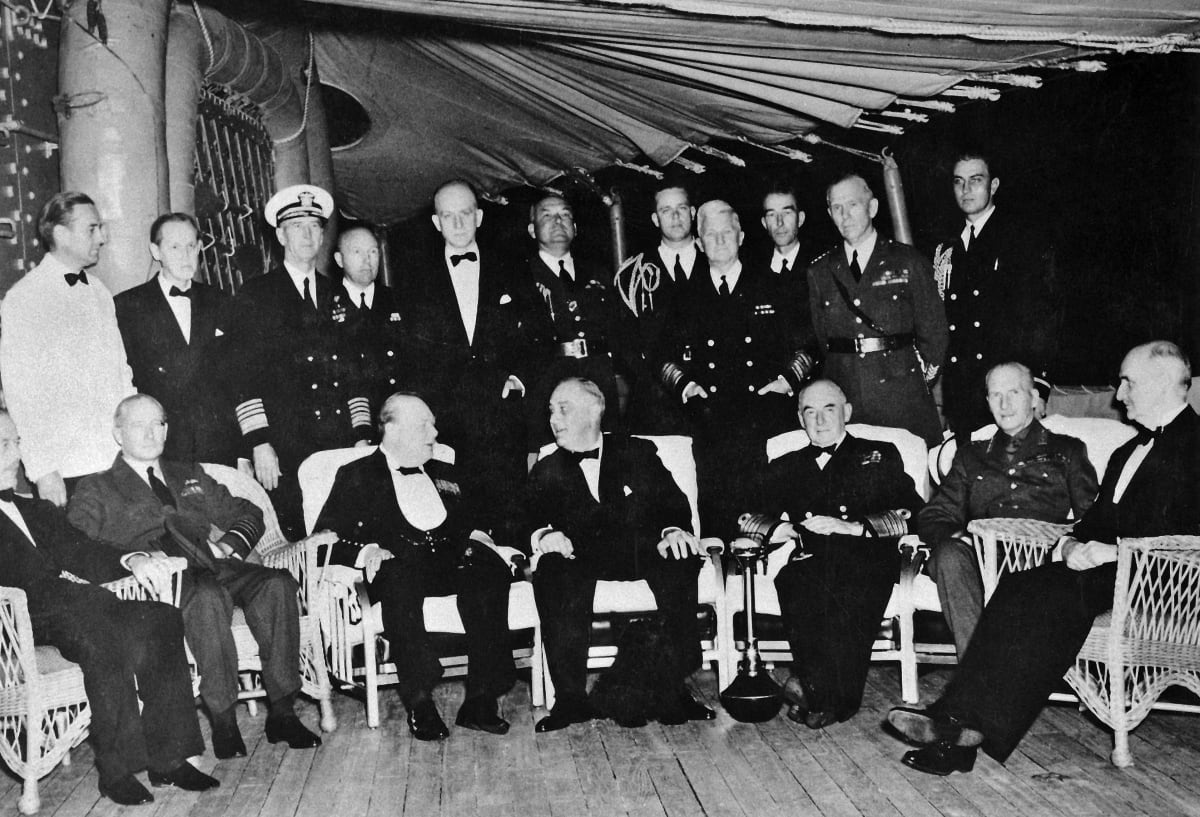
The historic event depicted in the image is the Atlantic Conference of August 1941, which resulted in the signing of the Atlantic Charter. The Atlantic Charter laid out Allied goals for the post-World War II world.
(a) The Treaty of Versailles was imposed on Germany after the First World War. It was a dictated peace which Germany was forced to sign. Germany had to cede many of her territories and all her colonies were taken away from her. She was burdened with a huge war-indemnity which she could never pay and her military power was considerably reduced. The treaty was based on the spirit of revenge and created deep hatred in the minds of the Germans, which ultimately became one of the chief causes of the Second World War.
(b) After witnessing the great destruction caused by the Second World War, all the countries of the world realised the importance of peace. Encouraged by the desire of establishing peace, the United Nations Organisation (UNO) was established in 1945. Every country of the world became prepared to give every sort of help to the UNO for the establishment of peace in the world.
(c) Cold War is defined as an atmosphere of a war-like situation in which there is no actual armed struggle, but the danger of another war is always looming large. This was the situation between the USA and the Soviet Union after the Second World War, because of ideological differences between the two superpowers. The whole world remained under turmoil and the people were always afraid of another war.
(d) After the fall of Germany and Italy, the Allies asked Japan to surrender. When Japan refused, America dropped an atom bomb on Hiroshima in August 1945. As Japan still did not surrender, another atom bomb was dropped on Nagasaki on 9 August 1945. Japan surrendered unconditionally on 2 September 1945, bringing the Second World War to an end.