Geometric Progression

ICSE Class 10 Mathematics · Selina Concise Mathematics · 73 solved questions

Exercise
1(a)Exercise 11(A)

If the first term of a G.P. is 8 and its common ratio is -2. The 3rd term of this G.P. is :

Show SolutionHide Solution↓

Given,

First term of G.P. = 8

Common ratio = -2

By formula,

⇒ an = arn - 1

Substituting values we get :

⇒ a3 = 8 × (-2)3 - 1

⇒ a3 = 8 × (-2)2

⇒ a3 = 8 × 4

⇒ a3 = 32.

Hence, Option 3 is the correct option.

1(b)Exercise 11(A)

The 4th term of a G.P. is 16 and the 7th term is 128, then its common ratio is equal to :

Show SolutionHide Solution↓

Let first term of G.P. be a and common ratio be r.

By formula,

⇒ an = arn - 1

Given,

4th term of a G.P. is 16.

⇒ a4 = 16

⇒ ar4 - 1 = 16

⇒ ar3 = 16 .........(1)

Given,

7th term of a G.P. is 128.

⇒ a7 = 128

⇒ ar7 - 1 = 128

⇒ ar6 = 128 .........(2)

Dividing equation (2) by (1), we get :

$$\begin{aligned}\Rightarrow \frac{ar^6}{ar^3} = \frac{128}{16} \\[1em] \Rightarrow r^3 = 8 \\[1em] \Rightarrow r^3 = 2^3 \\[1em] \Rightarrow r = 2.\end{aligned}$$

Hence, Option 1 is the correct option.

1(c)Exercise 11(A)

(2x + 2) and (3x + 3) are two consecutive terms of a G.P. The common ratio of the G.P. is :

Show SolutionHide Solution↓

By formula,

Common ratio = $\frac{a_{n + 1}}{a_n}$

Given,

(2x + 2) and (3x + 3) are two consecutive terms of a G.P.

$$\begin{aligned}\therefore \text{Common ratio } = \frac{3x + 3}{2x + 2} \\[1em] = \frac{3(x + 1)}{2(x + 1)} \\[1em] = \frac{3}{2}.\end{aligned}$$

Hence, Option 3 is the correct option.

1(d)Exercise 11(A)

The third term of a G.P. is 3. The product of its first five terms is :

Show SolutionHide Solution↓

Let first five terms of G.P. be

$\frac{a}{r^2}, \frac{a}{r}, a, ar, ar^2$

Given,

3rd term of G.P. is 3.

∴ a = 3

Product of first five terms are

$$\begin{aligned}\Rightarrow \frac{a}{r^2} \times \frac{a}{r} \times a \times ar \times ar^2 \\[1em] \Rightarrow a^5 \\[1em] \Rightarrow 3^5.\end{aligned}$$

Hence, Option 3 is the correct option.

1(e)Exercise 11(A)

The 8th term of a G.P. is 192 and its common ratio is 2, then the first term of the G.P. is :

Show SolutionHide Solution↓

Let first term of G.P. be a and common ratio be r.

By formula,

⇒ an = arn - 1

Given,

8th term of a G.P. is 192.

⇒ a8 = 192

⇒ ar8 - 1 = 192

⇒ ar7 = 192

Substituting value of common ratio (r) = 2 in above equation, we get :

⇒ a(2)7 = 192

⇒ 128a = 192

⇒ a = $\frac{192}{128} = \frac{3}{2}$.

Hence, Option 4 is the correct option.

2Exercise 11(A)

Find the 9th term of the series :

1, 4, 16, 64, ........

Show SolutionHide Solution↓

Since,

$\frac{4}{1} = \frac{16}{4} = 4$.

Hence, the above sequence is a G.P. with r = 4 and a = 1.

We know that nth term of G.P.,

an = arn - 1

a9 = 1.(4)9 - 1

= (4)8

= 65536.

Hence, 9th term of the series = 65536.

3Exercise 11(A)

Find the seventh term of the G.P. :

1, $\sqrt{3}, 3, 3\sqrt{3}, ........$

Show SolutionHide Solution↓

Since,

$\frac{\sqrt{3}}{1} = \frac{3\sqrt{3}}{3} = \sqrt{3}$

Hence, the above sequence is a G.P. with r = $\sqrt{3}$ and a = 1.

We know that nth term of G.P.,

an = arn - 1

a7 = 1.$(\sqrt{3})^{7 - 1}$

= $(\sqrt{3})^6$

= 27.

Hence, 7th term of the G.P. = 27.

4Exercise 11(A)

Find the 8th term of the sequence :

$\frac{3}{4}, 1\frac{1}{2}, 3, .........$

Show SolutionHide Solution↓

Sequence = $\frac{3}{4}, \frac{3}{2}, 3, ........$

Calculating ratio between terms,

$\frac{\frac{3}{2}}{\frac{3}{4}} = \frac{3 \times 4}{2 \times 3} = 2, \frac{3}{\frac{3}{2}} = 2$.

Since,

$\frac{\frac{3}{2}}{\frac{3}{4}} = \frac{3}{\frac{3}{2}} = 2$.

Hence, the sequence is a G.P. with r = 2 and a = $\frac{3}{4}$

We know that nth term of G.P.,

an = arn - 1

a8 = $\frac{3}{4} \times (2)^{8 - 1}$

= $\frac{3}{4} \times 2^7$

= $\frac{3}{4} \times 128$

= 3 × 32

= 96.

Hence, a8 = 96.

5Exercise 11(A)

Find the next three terms of the sequence :

$\sqrt{5}, 5, 5\sqrt{5}, .......$

Show SolutionHide Solution↓

Since,

$\frac{5}{\sqrt{5}} = \frac{5\sqrt{5}}{5} = \sqrt{5}$

Hence, the sequence $\sqrt{5}, 5, 5\sqrt{5}, .......$ is a G.P. with r = $\sqrt{5} \text{ and } a = \sqrt{5}.$

Next three terms are = 4th, 5th and 6th.

We know that nth term of G.P.,

an = arn - 1

⇒ a4 = ar(4 - 1)

= ar3

= $\sqrt{5}(\sqrt{5})^3 = \sqrt{5}(5\sqrt{5})$

= 25.

⇒ a5 = ar(5 - 1)

= ar4

= $\sqrt{5}(\sqrt{5})^4 = \sqrt{5}(25)$

= $25\sqrt{5}$.

⇒ a6 = ar(6 - 1)

= ar5

= $\sqrt{5}(\sqrt{5})^5 = \sqrt{5}(25\sqrt{5})$

= 125.

Hence, next three terms of the G.P. are = 25, 25√5 and 125.

6Exercise 11(A)

Find the seventh term of the G.P. :

$\sqrt{3} + 1, 1, \frac{\sqrt{3} - 1}{2},$ ...........

Show SolutionHide Solution↓

Rationalising the term, $\frac{\sqrt{3} - 1}{2}$ we get,

$$\begin{aligned}\Rightarrow \frac{\sqrt{3} - 1}{2} \times \frac{\sqrt{3} + 1}{\sqrt{3} + 1} \\[1em] = \frac{\sqrt{3}^2 - 1^2}{2(\sqrt{3} + 1)} \\[1em] = \frac{3 - 1}{2(\sqrt{3} + 1)} \\[1em] = \frac{2}{2(\sqrt{3} + 1)} \\[1em] = \frac{1}{\sqrt{3} + 1}.\end{aligned}$$

So, Sequence = $\sqrt{3} + 1, 1, \frac{1}{\sqrt{3} + 1},$ ...........

Common ratio(r) = $\frac{1}{\sqrt{3} + 1}$.

We know that nth term of G.P.,

an = arn - 1

$$\begin{aligned}\Rightarrow a_7 = (\sqrt{3} + 1)\Big(\frac{1}{\sqrt{3} + 1}\Big)^{7 - 1} \\[1em] = (\sqrt{3} + 1)\Big(\frac{1}{\sqrt{3} + 1}\Big)^{6} \\[1em] = \Big(\frac{1}{\sqrt{3} + 1}\Big)^{5} \\[1em] = \Big(\frac{1}{\sqrt{3} + 1} \times \frac{\sqrt{3} - 1}{\sqrt{3} - 1}\Big)^{5} \\[1em] = \Big(\frac{\sqrt{3} - 1}{\sqrt{3}^2 - (1)^2}\Big)^5 \\[1em] = \Big(\frac{\sqrt{3} - 1}{3 - 1}\Big)^5 \\[1em] = \Big(\frac{\sqrt{3} - 1}{2}\Big)^5 \\[1em] = \frac{1}{32}(\sqrt{3} - 1)^5.\end{aligned}$$

Hence, seventh term of the G.P. = $\frac{1}{32}(\sqrt{3} - 1)^5.$

7Exercise 11(A)

Find the next two terms of the series :

2 - 6 + 18 - 54 .............

Show SolutionHide Solution↓

Since,

$\frac{-6}{2} = \frac{18}{-6}$ = -3.

Hence, the above series is a G.P. with r = -3 and a = 2.

We know that nth term of G.P.,

an = arn - 1

Next two terms of the series are 5th and 6th.

⇒ a5 = ar4

= 2.(-3)4

= 2 × 81

= 162.

⇒ a6 = ar5

= 2.(-3)5

= 2 × -243

= -486.

Hence, the next two terms are 162 and -486.

8Exercise 11(A)

Which term of the G.P. :

$-10, \frac{5}{\sqrt{3}}, -\frac{5}{6}, ........ \text{ is } -\frac{5}{72}?$

Show SolutionHide Solution↓

Common ratio (r) = $\frac{\frac{5}{\sqrt{3}}}{-10} = -\frac{5}{10\sqrt{3}} = -\frac{1}{2\sqrt{3}}$.

Let nth term of G.P. be $-\frac{5}{72}$.

$$\begin{aligned}\therefore ar^{n - 1} = -\frac{5}{72} \\[1em] \Rightarrow -10 \times \Big(-\frac{1}{2\sqrt{3}}\Big)^{n - 1} = -\frac{5}{72} \\[1em] \Rightarrow \Big(-\frac{1}{2\sqrt{3}}\Big)^{n - 1} = -\frac{5}{72} \times -\frac{1}{10} \\[1em] \Rightarrow \Big(-\frac{1}{2\sqrt{3}}\Big)^{n - 1} = \frac{1}{144} \\[1em] \Rightarrow \Big(-\frac{1}{2\sqrt{3}}\Big)^{n - 1} = \Big(-\frac{1}{2\sqrt{3}}\Big)^4 \\[1em] \Rightarrow n - 1 = 4 \\[1em] \Rightarrow n = 5.\end{aligned}$$

Hence, 5th term of the G.P. is $-\frac{5}{72}.$

9Exercise 11(A)

The fifth term of a G.P. is 81 and its second term is 24. Find the geometric progression.

Show SolutionHide Solution↓

Let first term of the G.P. be a and it's common ratio be r.

Given,

⇒ a5 = 81

⇒ ar4 = 81 ........(i)

Also,

⇒ a2 = 24

⇒ ar = 24 ........(ii)

Dividing (i) by (ii) we get,

$$\begin{aligned}\Rightarrow \frac{ar^4}{ar} = \frac{81}{24} \\[1em] \Rightarrow r^3 = \frac{27}{8} \\[1em] \Rightarrow r^3 = \Big(\frac{3}{2}\Big)^3 \\[1em] \Rightarrow r = \frac{3}{2}.\end{aligned}$$

Substituting value of r in (ii) we get,

$$\begin{aligned}\Rightarrow a \times \frac{3}{2} = 24 \\[1em] \Rightarrow a = \frac{2}{3} \times 24 \\[1em] \Rightarrow a = 16.\end{aligned}$$

⇒ a3 = ar2

= $16 \times \Big(\frac{3}{2}\Big)^2$

= $16 \times \frac{9}{4}$

= 4 × 9

= 36.

⇒ a4 = ar3

= $16 \times \Big(\frac{3}{2}\Big)^3$

= $16 \times \frac{27}{8}$

= 2 × 27

= 54.

G.P. = 16, 24, 36, 54, 81, ...........

Hence, G.P. = 16, 24, 36, 54, 81, ...........

10Exercise 11(A)

Fourth and seventh terms of a G.P. are $\frac{1}{18} \text{ and } -\frac{1}{486}$ respectively. Find the G.P.

Show SolutionHide Solution↓

Let first term of the G.P. be a and it's common ratio be r.

Given,

⇒ a4 = $\frac{1}{18}$

⇒ ar3 = $\frac{1}{18}$ ........(i)

Also,

⇒ a7 = $-\frac{1}{486}$

⇒ ar6 = $-\frac{1}{486}$ ........(ii)

Dividing (ii) by (i) we get,

$$\begin{aligned}\Rightarrow \frac{ar^6}{ar^3} = \frac{-\frac{1}{486}}{\frac{1}{18}} \\[1em] \Rightarrow r^3 = -\frac{18}{486} \\[1em] \Rightarrow r^3 = -\frac{1}{27} \\[1em] \Rightarrow r^3 = \Big(-\frac{1}{3}\Big)^3 \\[1em] \Rightarrow r = -\frac{1}{3}.\end{aligned}$$

Substituting value of r in (i) we get,

$$\begin{aligned}\Rightarrow a \times \Big(-\frac{1}{3}\Big)^3 = \frac{1}{18} \\[1em] \Rightarrow a \times -\frac{1}{27} = \frac{1}{18} \\[1em] \Rightarrow a = -\frac{27}{18} = -\frac{3}{2}.\end{aligned}$$

⇒ a2 = ar

= $-\frac{3}{2} \times \Big(-\frac{1}{3}\Big)$

= $\frac{1}{2}$.

⇒ a3 = ar2

= $-\frac{3}{2} \times \Big(-\frac{1}{3}\Big)^2$

= $-\frac{3}{2} \times \frac{1}{9}$

= $-\frac{1}{6}.$

G.P. = $-\frac{3}{2}, \frac{1}{2}, -\frac{1}{6}, \frac{1}{18} ...........$

Hence, G.P. = $-\frac{3}{2}, \frac{1}{2}, -\frac{1}{6}, \frac{1}{18} ...........$

11Exercise 11(A)

If the first and the third terms of a G.P. are 2 and 8 respectively, find its second term.

Show SolutionHide Solution↓

Let first term of the G.P. be a and it's common ratio be r.

Given,

⇒ a = 2

⇒ a3 = 8

⇒ ar2 = 8

⇒ 2r2 = 8

⇒ r2 = 4

⇒ r =√4 = ±2

a2 = ar

Let r = -2

⇒ a2 = 2(-2) = -4

Let r = 2

⇒ a2 = 2(2) = 4.

Hence, a2 = 4 or -4.

12Exercise 11(A)

The product of 3rd term and 8th terms of a G.P. is 243. If its 4th term is 3, find its 7th term.

Show SolutionHide Solution↓

Let first term of the G.P. be a and it's common ratio be r.

Given,

⇒ a3.a8 = 243

⇒ ar2.ar7 = 243

⇒ a2r9 = 243 ..........(i)

Also,

⇒ a4 = 3

⇒ ar3 = 3

⇒ a = $\frac{3}{r^3}$ ........(ii)

Substituting value of a from (ii) in (i) we get,

$$\begin{aligned}\Rightarrow \Big(\frac{3}{r^3}\Big)^2 \times r^9 = 243 \\[1em] \Rightarrow \frac{9}{r^6} \times r^9 = 243 \\[1em] \Rightarrow 9r^3 = 243 \\[1em] \Rightarrow r^3 = 27 \\[1em] \Rightarrow r = \sqrt[3]{27} \\[1em] \Rightarrow r = 3.\end{aligned}$$

Substituting value of r in (ii),

$$\begin{aligned}\Rightarrow a = \frac{3}{r^3} \\[1em] = \frac{3}{3^3} \\[1em] = \frac{1}{3^2} \\[1em] = \frac{1}{9}.\end{aligned}$$

a7 = ar6

= $\frac{1}{9} \times 3^6$

= $\frac{1}{9} \times 729$

= 81.

Hence, 7th term = 81.

13Exercise 11(A)

Find the geometric progression with fourth term = 54 and seventh term = 1458.

Show SolutionHide Solution↓

Let first term of the G.P. be a and it's common ratio be r.

Given,

⇒ a4 = 54

⇒ ar3 = 54 ........(i)

Also,

⇒ a7 = 1458

⇒ ar6 = 1458 ........(ii)

Dividing (ii) by (i) we get

$$\begin{aligned}\Rightarrow \frac{ar^6}{ar^3} = \frac{1458}{54} \\[1em] \Rightarrow r^3 = 27 \\[1em] \Rightarrow r = \sqrt[3]{27} \\[1em] \Rightarrow r = 3.\end{aligned}$$

Substituting value of r in (i) we get,

⇒ a(3)3 = 54

⇒ 27a = 54

⇒ a = $\frac{54}{27}$ = 2.

a2 = ar

= 2.(3) = 6.

a3 = ar2

= 2.(3)2

= 2.(9) = 18.

G.P. = 2, 6, 18, 54, ......

Hence, G.P. = 2, 6, 18, 54, ......

14Exercise 11(A)

Second term of a geometric progression is 6 and its fifth term is 9 times of its third term. Find the geometric progression. Consider that each term of the G.P. is positive.

Show SolutionHide Solution↓

Let first term of the G.P. be a and it's common ratio be r.

Given,

⇒ a2 = 6

⇒ ar = 6 ........(i)

Also,

⇒ a5 = 9a3

⇒ ar4 = 9ar2

⇒ $\frac{\text{ar}^4}{\text{ar}^2}$ = 9

⇒ r2 = 9

⇒ r = √9

⇒ r = ±3

As all terms of G.P. are positive so, r ≠ -3

∴ r = 3

Substituting r in (i),

⇒ 3a = 6

⇒ a = 2.

G.P. = a, ar, ar2, ar3, ......

= 2, 6, 18, 54, .......

Hence, G.P. = 2, 6, 18, 54, .......

15Exercise 11(A)

The fourth term, the seventh term and the last term of a geometric progression are 10, 80 and 2560 respectively. Find its first term, common ratio and number of terms.

Show SolutionHide Solution↓

Let first term of the G.P. be a and it's common ratio be r.

Given,

⇒ a4 = 10

⇒ ar3 = 10 ........(i)

Also,

⇒ a7 = 80

⇒ ar6 = 80 .........(ii)

Dividing (ii) by (i) we get,

$$\begin{aligned}\Rightarrow \frac{ar^6}{ar^3} = \frac{80}{10} \\[1em] \Rightarrow r^3 = 8 \\[1em] \Rightarrow r = \sqrt[3]{8} \\[1em] \Rightarrow r = 2.\end{aligned}$$

Substituting r in (i) we get,

$$\begin{aligned}\Rightarrow a(2)^3 = 10 \\[1em] \Rightarrow 8a = 10 \\[1em] \Rightarrow a = \frac{10}{8} \\[1em] \Rightarrow a = \frac{5}{4}.\end{aligned}$$

Let n be no. of terms,

arn - 1 = 2560

$$\begin{aligned}\Rightarrow \frac{5}{4}\times (2)^{n - 1} = 2560 \\[1em] \Rightarrow (2)^{n - 1} = \frac{4}{5} \times 2560 \\[1em] \Rightarrow (2)^{n - 1} = 4 \times 512 \\[1em] \Rightarrow (2)^{n - 1} = 2048 \\[1em] \Rightarrow (2)^{n - 1} = (2)^{11} \\[1em] \Rightarrow n - 1 = 11 \\[1em] \Rightarrow n = 12.\end{aligned}$$

Hence, first term = $\frac{5}{4}$, common ratio = 2 and number of terms = 12.

16Exercise 11(A)

If the fourth and ninth terms of a G.P. are 54 and 13122 respectively, find the G.P. Also, find its general term.

Show SolutionHide Solution↓

Let first term of the G.P. be a and it's common ratio be r.

Given,

⇒ a4 = 54

⇒ ar3 = 54 ........(i)

Also,

⇒ a9 = 13122

⇒ ar8 = 13122 .........(ii)

Dividing (ii) by (i) we get,

$$\begin{aligned}\Rightarrow \frac{ar^8}{ar^3} = \frac{13122}{54} \\[1em] \Rightarrow r^5 = 243 \\[1em] \Rightarrow r^5 = 3^5 \\[1em] \Rightarrow r = 3.\end{aligned}$$

Substituting r in (i) we get,

$$\begin{aligned}\Rightarrow a(3)^3 = 54 \\[1em] \Rightarrow 27a = 54 \\[1em] \Rightarrow a = 2.\end{aligned}$$

nth term of a G.P. = arn - 1

= 2(3)n - 1

= 2 × 3n - 1

2nd term of a G.P. = 2 × 32 - 1

= 2 × 3

= 6.

3rd term of a G.P. = 2 × 33 - 1

= 2 × 32

= 18.

G.P. = 2, 6, 18, 54, .........

Hence, G.P. = 2, 6, 18, 54, ......... and general term = 2 × 3n - 1

17Exercise 11(A)

The fifth, eighth and eleventh terms of a geometric progression are p, q and r respectively. Show that : q2 = pr.

Show SolutionHide Solution↓

Let first term of the G.P. be A and it's common ratio be R.

Given,

⇒ a5 = p

⇒ AR4 = p ........(i)

Also,

⇒ a8 = q

⇒ AR7 = q .........(ii)

⇒ a11 = r

⇒ AR10 = r .........(iii)

Multiplying (i) by (iii) we get,

AR4 x AR10 = pr

⇒ A2R14 = pr .........(iv)

Squaring eq. (ii) we get,

(AR7)2 = q2

A2R14 = q2 .........(v)

L.H.S. of eq. (iv) and (v) are equal so, R.H.S. will also be equal.

∴ q2 = pr.

Hence, proved that q2 = pr.

18Exercise 11(A)

Find the seventh term from the end of the series :

$\sqrt{2}, 2, 2\sqrt{2}, .........., 32$

Show SolutionHide Solution↓

Since,

$\frac{2}{\sqrt{2}} = \frac{2\sqrt{2}}{2} = \sqrt{2}$.

So, the above sequence is a G.P. with r = $\sqrt{2}$.

Let there be n terms.

$$\begin{aligned}\Rightarrow ar^{n - 1} = 32 \\[1em] \Rightarrow \sqrt{2} \times (\sqrt{2})^{n - 1} = 32 \\[1em] \Rightarrow \sqrt{2}^{n - 1 + 1} = 32 \\[1em] \Rightarrow (\sqrt{2})^n = (\sqrt{2})^{10} \\[1em] \Rightarrow n = 10.\end{aligned}$$

mth term from end is (n - m + 1)th term from starting.

So, 7th term from end is (10 - 7 + 1) = 4th term from starting.

a4 = ar3

= $\sqrt{2}(\sqrt{2})^3$

= $\sqrt{2} \times 2\sqrt{2}$

= 4.

Hence, 7th term from end is 4.

19Exercise 11(A)

Find the third term from the end of the G.P.

$\frac{2}{27}, \frac{2}{9}, \frac{2}{3}, ........, 162.$

Show SolutionHide Solution↓

Common ratio,

$\frac{\frac{2}{9}}{\frac{2}{27}} = \frac{2 \times 27}{2 \times 9} = 3$.

So, the above sequence is a G.P. with r = 3.

Let there be n terms.

$$\begin{aligned}\Rightarrow ar^{n - 1} = 162 \\[1em] \Rightarrow \frac{2}{27} \times (3)^{n - 1} = 162 \\[1em] \Rightarrow \frac{2}{3^3} \times 3^{n - 1} = 162 \\[1em] \Rightarrow 3^{n - 1 - 3} = \frac{162}{2} \\[1em] \Rightarrow 3^{n - 4} = 81 \\[1em] \Rightarrow 3^{n - 4} = 3^4 \\[1em] \Rightarrow n - 4 = 4 \\[1em] \Rightarrow n = 8.\end{aligned}$$

mth term from end is (n - m + 1)th term from starting.

So, 3rd term from end is (8 - 3 + 1) = 6th term from starting.

a6 = ar5

= $\frac{2}{27} \times (3)^5$

= $\frac{2}{27} \times 243$

= 2 × 9

= 18.

Hence, 3rd term from end is 18.

20Exercise 11(A)

For the G.P. $\frac{1}{27}, \frac{1}{9}, \frac{1}{3}, ........., 81$;

find the product of fourth term from the beginning and the fourth term from the end.

Show SolutionHide Solution↓

Common ratio,

$\frac{\frac{1}{9}}{\frac{1}{27}} = \frac{27}{9} = 3$.

So, the above sequence is a G.P. with r = 3.

Let there be n terms.

$$\begin{aligned}\Rightarrow ar^{n - 1} = 81 \\[1em] \Rightarrow \frac{1}{27} \times (3)^{n - 1} = 81 \\[1em] \Rightarrow 3^{n - 1} = 81 \times 27 \\[1em] \Rightarrow 3^{n - 1} = 3^4 \times 3^3 \\[1em] \Rightarrow 3^{n - 1} = 3^7 \\[1em] \Rightarrow n - 1 = 7 \\[1em] \Rightarrow n = 8.\end{aligned}$$

a4 = ar3

= $\frac{1}{27} \times (3)^3$

= $\frac{1}{27} \times 27$

= 1.

mth term from end is (n - m + 1)th term from starting.

So, 4th term from end is (8 - 4 + 1) = 5th term from starting.

a5 = ar4

= $\frac{1}{27} \times (3)^4$

= $\frac{1}{27} \times 81$

= 3.

a4.a5 = 1 × 3 = 3.

Hence, product of fourth term from the beginning and the fourth term from the end = 3.

21Exercise 11(A)

If a, b and c are in G.P. and a, x, b, y, c are in A.P. prove that :

(i) $\frac{1}{x} + \frac{1}{y} = \frac{2}{b}$

(ii) $\frac{a}{x} + \frac{c}{y} = 2.$

Show SolutionHide Solution↓

Given,

a, b and c are in G.P.

⇒ b2 = ac .............(i)

a, x, b, y, c are in A.P.

⇒ 2x = a + b and 2y = b + c.

⇒ $x = \frac{a + b}{2} \text{ and } y = \frac{b + c}{2}$ ........(ii)

(i) Substituting value of x and y from (ii) in L.H.S. of $\frac{1}{x} + \frac{1}{y} = \frac{2}{b}$,

$$\begin{aligned}\text{L.H.S}. = \frac{1}{\frac{a + b}{2}} + \frac{1}{\frac{b + c}{2}} \\[1em] = \frac{2}{a + b} + \frac{2}{b + c} \\[1em] = \frac{2(b + c) + 2(a + b)}{(a + b)(b + c)} \\[1em] = \frac{2b + 2c + 2a + 2b}{(a + b)(b + c)}\\[1em] = \frac{2a + 2c + 4b}{ab + ac + b^2 + bc} \\[1em] = \frac{2(a + c + 2b)}{ab + b^2 + b^2 + bc} \text{from (i)} \\[1em] = \frac{2(a + c + 2b)}{b(a + b + b + c)} \\[1em] = \frac{2(a + c + 2b)}{b(a + c + 2b)} \\[1em] = \frac{2}{b} = \text{R.H.S.}\end{aligned}$$

Hence, proved that $\frac{1}{x} + \frac{1}{y} = \frac{2}{b}$.

(ii) Substituting value of x and y from (ii) in L.H.S. of $\frac{a}{x} + \frac{c}{y} = 2$,

$$\begin{aligned}\text{L.H.S.} = \frac{a}{\frac{a + b}{2}} + \frac{c}{\frac{b + c}{2}} \\[1em] = \frac{2a}{a + b} + \frac{2c}{b + c} \\[1em] = 2\Big(\frac{a}{a + b} + \frac{c}{b + c}\Big) \\[1em] = 2\Big[\frac{a(b + c) + c(a + b)}{(a + b)(b + c)}\Big] \\[1em] = 2\Big(\frac{ab + ac + ac + bc}{ab + ac + b^2 + bc}\Big) \\[1em] = 2\Big(\frac{ab + b^2 + b^2 + bc}{ab + b^2 + b^2 + bc}\Big) ......\text{from (i)} \\[1em] = 2 = \text{R.H.S.}\end{aligned}$$

Hence, proved that $\frac{a}{x} + \frac{c}{y} = 2$.

22Exercise 11(A)

If a, b and c are in A.P. and also in G.P., show that : a = b = c.

Show SolutionHide Solution↓

Since, a, b and c are in A.P.

⇒ 2b = a + c

⇒ b = $\frac{a + c}{2}$ .......(i)

Since, a, b and c are also in G.P.

⇒ b2 = ac

Substituting value of b from (i) in above equation we get,

$$\begin{aligned}\Rightarrow \Big(\frac{a + c}{2}\Big)^2 = ac \\[1em] \Rightarrow \frac{a^2 + c^2 + 2ac}{4} = ac \\[1em] \Rightarrow a^2 + c^2 + 2ac = 4ac \\[1em] \Rightarrow a^2 + c^2 - 2ac = 0 \\[1em] \Rightarrow (a - c)^2 = 0\\[1em] \Rightarrow a - c = 0 \\[1em] \Rightarrow a = c .......(ii)\end{aligned}$$

Substituting value of a from (ii) in (i) we get,

b = $\frac{c + c}{2} = \frac{2c}{2}$ = c .......(iii)

From (ii) and (iii) we get,

a = b = c.

Hence, proved that a = b = c.

1(a)Exercise 11(B)

The sum of first four terms of the G.P. 2, 6, 18, ........., is :

Show SolutionHide Solution↓

By formula,

Common ratio = $\frac{a_{n + 1}}{a_n}$

r = $\frac{6}{2}$ = 3.

By formula,

⇒ an = arn - 1

⇒ a4 = 2 × (3)4 - 1

⇒ a4 = 2 × 33

⇒ a4 = 2 × 27 = 54.

Sum of first four terms of G.P. = 2 + 6 + 18 + 54 = 80.

Hence, Option 2 is the correct option.

1(b)Exercise 11(B)

The 4th term of a G.P. is 54 and its 7th term is 1458, the common ratio of this G.P. is :

Show SolutionHide Solution↓

Let first term of G.P. be a and common ratio be r.

By formula,

⇒ an = arn - 1

Given,

4th term of a G.P. is 54.

⇒ a4 = 54

⇒ ar4 - 1 = 54

⇒ ar3 = 54 .........(1)

7th term of a G.P. is 1458.

⇒ a7 = 1458

⇒ ar7 - 1 = 1458

⇒ ar6 = 1458 .........(2)

Dividing equation (2) by (1), we get :

$$\begin{aligned}\Rightarrow \frac{ar^6}{ar^3} = \frac{1458}{54} \\[1em] \Rightarrow r^3 = 27 \\[1em] \Rightarrow r^3 = 3^3 \\[1em] \Rightarrow r = 3.\end{aligned}$$

Hence, Option 2 is the correct option.

1(c)Exercise 11(B)

8, x and 32 are in G.P., then the value of x is :

Show SolutionHide Solution↓

Given,

8, x and 32 are in G.P.

$$\begin{aligned}\Rightarrow \frac{x}{8} = \frac{32}{x} \\[1em] \Rightarrow x^2 = 8 \times 32 \\[1em] \Rightarrow x^2 = 256 \\[1em] \Rightarrow x = \sqrt{256} = 16.\end{aligned}$$

Hence, Option 4 is the correct option.

1(d)Exercise 11(B)

The sum of three terms (numbers) of a G.P. is $3\frac{1}{2}$ and their product is 1; the numbers are :

Show SolutionHide Solution↓

Let three terms of G.P. be $\frac{a}{r}, a, ar$.

Given,

Product of three terms of G.P. = 1

$$\begin{aligned}\therefore \frac{a}{r} \times a \times ar = 1 \\[1em] \Rightarrow a^3 = 1 \\[1em] \Rightarrow a^3 = 1^3 \\[1em] \Rightarrow a = 1.\end{aligned}$$

Given,

Sum of three terms of G.P. = $3\frac{1}{2}$

$$\begin{aligned}\Rightarrow \frac{a}{r} + a + ar = 3\frac{1}{2} \\[1em] \Rightarrow \frac{1}{r} + 1 + 1(r) = \frac{7}{2} \quad [\because a = 1] \\[1em] \Rightarrow \frac{1}{r} + 1 + r = \frac{7}{2} \\[1em] \Rightarrow \frac{1 + r + r^2}{r} = \frac{7}{2} \\[1em] \Rightarrow 2(r^2 + r + 1) = 7r \\[1em] \Rightarrow 2r^2 + 2r + 2 = 7r \\[1em] \Rightarrow 2r^2 + 2r - 7r + 2 = 0 \\[1em] \Rightarrow 2r^2 - 5r + 2 = 0 \\[1em] \Rightarrow 2r^2 - 4r - r + 2 = 0 \\[1em] \Rightarrow 2r(r - 2) - 1(r - 2) = 0 \\[1em] \Rightarrow (2r - 1)(r - 2) = 0 \\[1em] \Rightarrow 2r - 1 = 0 \text{ or } r - 2 = 0 \\[1em] \Rightarrow 2r = 1 \text{ or } r = 2 \\[1em] \Rightarrow r = \frac{1}{2} \text{ or } r = 2.\end{aligned}$$

Let r = $\frac{1}{2}$

Terms :

⇒ $\frac{a}{r}$, a, ar

⇒ $\frac{1}{\frac{1}{2}}, 1, 1 \times \frac{1}{2}$

⇒ 2, 1, $\frac{1}{2}$.

Let r = 2

Terms :

⇒ $\frac{a}{r}$, a, ar

⇒ $\frac{1}{2}, 1, 1 \times 2$

⇒ $\frac{1}{2}$, 1, 2.

Hence, Option 1 is the correct option.

1(e)Exercise 11(B)

The sum of 20 terms of the G.P. 10, 20, 40, ...... is :

Show SolutionHide Solution↓

By formula,

Common ratio = $\frac{a_{n + 1}}{a_n}$

Given,

G.P. = 10, 20, 40, ......

a = 10 and r = $\frac{20}{10}$ = 2.

We know that,

If | r | > 1

Sum of n terms of G.P. (Sn) = $\frac{a(r^n - 1)}{(r - 1)}$

Substituting values we get :

$$\begin{aligned}\Rightarrow S_{20} = \frac{10(2^{20} - 1)}{2 - 1} \\[1em] = \frac{10(2^{20} - 1)}{1} \\[1em] = 10(2^{20} - 1).\end{aligned}$$

Hence, Option 3 is the correct option.

2(i)Exercise 11(B)

Find the sum of G.P. :

1 + 3 + 9 + 27 + ........ to 12 terms

Show SolutionHide Solution↓

Common ratio (r) = $\frac{3}{1}$ = 3.

$$\begin{aligned}S = \frac{a(r^n - 1)}{(r - 1)} ..........(As |r| \gt 1)\\[1em] = \frac{1(3^{12} - 1)}{3 - 1} \\[1em] = \frac{531441 - 1}{2} \\[1em] = \frac{531440}{2} \\[1em] = 265720.\end{aligned}$$

Hence, sum = 265720.

2(ii)Exercise 11(B)

Find the sum of G.P. :

0.3 + 0.03 + 0.003 + 0.0003 + ...... to 8 terms.

Show SolutionHide Solution↓

Common ratio (r) = $\frac{0.03}{0.3}$ = 0.1

$$\begin{aligned}S = \frac{a(1 - r^n)}{(1 - r)} ..........(As |r| \lt 1)\\[1em] = \frac{0.3\Big[1 - (0.1)^8\Big]}{1 - 0.1} \\[1em] = \frac{0.3\Big[1 - \Big(\frac{1}{10}\Big)^8\Big]}{0.9} \\[1em] = \frac{1}{3}\Big(1 - \frac{1}{10^8}\Big).\end{aligned}$$

Hence, sum = $\frac{1}{3}\Big(1 - \frac{1}{10^8}\Big)$.

2(iii)Exercise 11(B)

Find the sum of G.P. :

$1 - \frac{1}{2} + \frac{1}{4} - \frac{1}{8} + .......$ to 9 terms

Show SolutionHide Solution↓

Common ratio (r) = $\frac{-\frac{1}{2}}{1} = -\frac{1}{2}$

$$\begin{aligned}S = \frac{a(1 - r^n)}{(1 - r)} ..........(As |r| \lt 1) \\[1em] = \frac{1\Big[1 - \Big(-\frac{1}{2}\Big)^9\Big]}{1 - \Big(-\frac{1}{2}\Big)} \\[1em] = \frac{\Big[1 +\Big(\frac{1}{2^9}\Big)\Big]}{1 + \frac{1}{2}} \\[1em] = \frac{\Big(1 + \frac{1}{2^9}\Big)}{\frac{3}{2}} \\[1em] = \frac{2}{3}\Big(1 + \frac{1}{2^9}\Big)\end{aligned}$$

Hence, sum = $\frac{2}{3}\Big(1 + \frac{1}{2^9}\Big)$.

3Exercise 11(B)

How many terms of the geometric progression 1 + 4 + 16 + 64 + ........ must be added to get sum equal to 5461 ?

Show SolutionHide Solution↓

Let n terms be added.

Common ratio = $\frac{4}{1}$ = 4.

$$\begin{aligned}\Rightarrow S = \frac{a(r^n - 1)}{(r - 1)} ..........(As |r| \gt 1)\\[1em] \Rightarrow 5461 = \frac{1[(4)^n - 1]}{4 - 1} \\[1em] \Rightarrow \frac{4^n - 1}{3} = 5461 \\[1em] \Rightarrow 4^n - 1 = 16383 \\[1em] \Rightarrow 4^n = 16384 \\[1em] \Rightarrow 4^n = 4^7 \\[1em] \Rightarrow n = 7.\end{aligned}$$

Hence, 7 terms must be added to get a sum of 5461.

4Exercise 11(B)

The first term of a G.P. is 27 and its 8th term is $\frac{1}{81}$. Find the sum of its first 10 terms.

Show SolutionHide Solution↓

Given , a = 27 and a8 = $\frac{1}{81}$.

$$\begin{aligned}\therefore ar^7 = \frac{1}{81} \\[1em] \Rightarrow 27r^7 = \frac{1}{81} \\[1em] \Rightarrow r^7 = \frac{1}{81 \times 27} \\[1em] \Rightarrow r^7 = \frac{1}{3^4 \times 3^3} \\[1em] \Rightarrow r^7 = \Big(\frac{1}{3}\Big)^7 \\[1em] \Rightarrow r = \frac{1}{3}.\end{aligned}$$

Since, r < 1

$$\begin{aligned}S = \frac{a(1 - r^n)}{(1 - r)} \\[1em] = \frac{27\Big[1 - \Big(\frac{1}{3}\Big)^{10}\Big]}{1 - \frac{1}{3}} \\[1em] = \frac{27\Big(1 - \frac{1}{3^{10}}\Big)}{\frac{2}{3}} \\[1em] = \frac{81}{2}\Big(1 - \frac{1}{3^{10}}\Big).\end{aligned}$$

Hence, sum upto 10 terms = $\frac{81}{2}\Big(1 - \frac{1}{3^{10}}\Big).$

5Exercise 11(B)

A boy spends ₹ 10 on first day, ₹ 20 on second day, ₹ 40 on third day and so on. Find how much in all, will he spend in 12 days?

Show SolutionHide Solution↓

G.P. formed = 10 + 20 + 40 + ........

Common ratio (r) = $\frac{20}{10}$ = 2.

$$\begin{aligned}\Rightarrow S = \frac{a(r^n - 1)}{(r - 1)} ..........(As |r| \gt 1)\\[1em] = \frac{10(2^{12} - 1)}{2 - 1} \\[1em] = 10(2^{12} - 1).\end{aligned}$$

Hence, ₹10(212 - 1).

6Exercise 11(B)

The 4th and the 7th terms of a G.P. are $\frac{1}{27} \text{ and } \frac{1}{729}$ respectively. Find the sum of n terms of this G.P.

Show SolutionHide Solution↓

Given,

$a_4 = \frac{1}{27}$

$ar^3 = \frac{1}{27}$ .........(i)

$a_7 = \frac{1}{729}$

$ar^6 = \frac{1}{729}$ ........(ii)

Dividing (ii) by (i) we get,

$$\begin{aligned}\Rightarrow \frac{ar^6}{ar^3} = \frac{\frac{1}{729}}{\frac{1}{27}} \\[1em] \Rightarrow r^3 = \frac{27}{729} \\[1em] \Rightarrow r^3 = \frac{1}{27} \\[1em] \Rightarrow r = \frac{1}{3}.\end{aligned}$$

Substituting value of r in (i) we get,

$$\begin{aligned}\Rightarrow a\Big(\frac{1}{3}\Big)^3 = \frac{1}{27} \\[1em] \Rightarrow a \times \frac{1}{27} = \frac{1}{27} \\[1em] \Rightarrow a = 1.\end{aligned}$$

Since, r < 1

$$\begin{aligned}S = \frac{a(1 - r^n)}{(1 - r)} \\[1em] = \frac{1\Big[1 - \Big(\frac{1}{3}\Big)^n \Big]}{1 - \frac{1}{3}} \\[1em] = \frac{\Big[1 - \Big(\frac{1}{3}\Big)^n \Big]}{\frac{2}{3}} \\[1em] = \frac{3}{2}\Big[1 - \Big(\frac{1}{3}\Big)^n \Big] \\[1em] = \frac{3}{2}\Big(1 - \frac{1}{3^n} \Big)\end{aligned}$$

Hence, sum = $\frac{3}{2}\Big(1 - \frac{1}{3^n} \Big).$

7Exercise 11(B)

A geometric progression has common ratio = 3 and last term = 486. If the sum of its terms is 728; find its first term.

Show SolutionHide Solution↓

Let nth term be the last term.

⇒ arn - 1 = 486

⇒ a(3)n - 1 = 486

⇒ a.3n.3-1 = 486

⇒ $3^n = \frac{486 \times 3}{a} = \frac{1458}{a}$

Since, r > 1

$$\begin{aligned}\Rightarrow S = \frac{a(r^n - 1)}{(r - 1)} \\[1em] \Rightarrow 728 = \frac{a \times (3^n - 1)}{3 - 1} \\[1em] \Rightarrow 728 = \frac{a \times \Big(\frac{1458}{a} - 1\Big)}{2} \\[1em] \Rightarrow 728 = \frac{a \times (1458 - a)}{2a} \\[1em] \Rightarrow \frac{1458 - a}{2} = 728 \\[1em] \Rightarrow 1458 - a = 1456 \\[1em] \Rightarrow a = 1458 - 1456 \\[1em] \Rightarrow a = 2.\end{aligned}$$

Hence, first term = 2.

8Exercise 11(B)

Find the sum of G.P. : 3, 6, 12, ......., 1536.

Show SolutionHide Solution↓

Common ratio = $\frac{6}{3}$ = 2.

Let 1536 be nth term

$$\begin{aligned}\therefore ar^{n - 1} = 1536 \\[1em] \Rightarrow 3.(2)^{n - 1} = 1536 \\[1em] \Rightarrow (2)^{n - 1} = 512 \\[1em] \Rightarrow (2)^{n - 1} = (2)^{9} \\[1em] \Rightarrow n - 1 = 9 \\[1em] \Rightarrow n = 10.\end{aligned}$$

Since, r > 1

$$\begin{aligned}S = \frac{a(r^n - 1)}{(r - 1)} \\[1em] = \frac{3 \times (2^{10} - 1)}{2 - 1} \\[1em] = 3(2^{10} - 1) \\[1em] = 3(1024 - 1) \\[1em] = 3 \times 1023 \\[1em] = 3069.\end{aligned}$$

Hence, sum = 3069.

9Exercise 11(B)

How many terms of the series 2 + 6 + 18 + ...... must be taken to make the sum equal to 728?

Show SolutionHide Solution↓

Common ratio = $\frac{6}{2}$ = 3.

Let n be no. of terms taken.

Since, r > 1

$$\begin{aligned}\Rightarrow S = \frac{a(r^n - 1)}{(r - 1)} \\[1em] \Rightarrow 728 = \frac{2 \times (3^n - 1)}{3 - 1} \\[1em] \Rightarrow 728 = \frac{2(3^n - 1)}{2} \\[1em] \Rightarrow 3^n - 1 = 728 \\[1em] \Rightarrow 3^n = 729 \\[1em] \Rightarrow 3^n = 3^6 \\[1em] \Rightarrow n = 6.\end{aligned}$$

Hence, 6 terms must be taken to make the sum equal to 728.

10Exercise 11(B)

In a G.P., the ratio between the sum of first three terms and that of the first six terms is 125 : 152. Find its common ratio.

Show SolutionHide Solution↓

Given,

$$\begin{aligned}\Rightarrow \frac{S_3}{S_6} = \frac{125}{152} \\[1em] \Rightarrow \frac{\frac{a(r^3 - 1)}{r - 1}}{\frac{a(r^6 - 1)}{r - 1}} = \frac{125}{152} \\[1em] \Rightarrow \frac{r^3 - 1}{r^6 - 1} = \frac{125}{152} \\[1em] \Rightarrow \frac{r^3 - 1}{(r^3 - 1)(r^3 + 1)} = \frac{125}{152} \\[1em] \Rightarrow \frac{1}{r^3 + 1} = \frac{125}{152} \\[1em] \Rightarrow r^3 + 1 = \frac{152}{125} \\[1em] \Rightarrow r^3 = \frac{152}{125} - 1 \\[1em] \Rightarrow r^3 = \frac{152 - 125}{125} \\[1em] \Rightarrow r^3 = \frac{27}{125} \\[1em] \Rightarrow r^3 = \Big(\frac{3}{5}\Big)^3 \\[1em] \Rightarrow r = \frac{3}{5}.\end{aligned}$$

Hence, common ratio = $\frac{3}{5}$.

11Exercise 11(B)

If the sum of 1 + 2 + 22 + ........ + 2n - 1 is 255, find the value of n.

Show SolutionHide Solution↓

Common ratio = 2.

Since, |r| > 1

$$\begin{aligned}\Rightarrow S = \frac{a(r^n - 1)}{(r - 1)} \\[1em] \Rightarrow 255 = \frac{1(2^n - 1)}{(2 - 1)} \\[1em] \Rightarrow 2^n - 1 = 255 \\[1em] \Rightarrow 2^n = 256 \\[1em] \Rightarrow 2^n = 2^8 \\[1em] \Rightarrow n = 8.\end{aligned}$$

Hence, n = 8.

12Exercise 11(B)

The sum of three numbers in G.P. is $\frac{39}{10}$ and their product is 1. Find the numbers.

Show SolutionHide Solution↓

Let the numbers be $\frac{a}{r}, a, ar$.

Given,

Product = 1.

$$\begin{aligned}\therefore \frac{a}{r} \times a \times ar = 1 \\[1em] \Rightarrow a^3 = 1 \\[1em] \Rightarrow a = 1.\end{aligned}$$

Sum = $\frac{39}{10}$

$$\begin{aligned}\therefore \frac{a}{r} + a + ar = \frac{39}{10} \\[1em] \Rightarrow \frac{1}{r} + 1 + r = \frac{39}{10} \\[1em] \Rightarrow \frac{1 + r + r^2}{r} = \frac{39}{10} \\[1em] \Rightarrow 10(1 + r + r^2) = 39r \\[1em] \Rightarrow 10 + 10r + 10r^2 = 39r \\[1em] \Rightarrow 10r^2 - 29r + 10 = 0 \\[1em] \Rightarrow 10r^2 - 25r - 4r + 10 = 0 \\[1em] \Rightarrow 5r(2r - 5) - 2(2r - 5) = 0 \\[1em] \Rightarrow (5r - 2)(2r - 5) = 0 \\[1em] \Rightarrow 5r - 2 = 0 \text{ or } 2r - 5 = 0 \\[1em] \Rightarrow r = \frac{2}{5} \text{ or } r = \frac{5}{2}\end{aligned}$$

Let r = $\frac{2}{5}$

Numbers = $\frac{a}{r} = \frac{1}{\frac{2}{5}} = \frac{5}{2}$

a = 1

ar = $1 \times \frac{2}{5} =\frac{2}{5}$.

Let r = $\frac{5}{2}$

Numbers = $\frac{a}{r} = \frac{1}{\frac{5}{2}} = \frac{2}{5}$

a = 1

ar = $1 \times \frac{5}{2} =\frac{5}{2}$.

Hence, numbers = $\frac{5}{2}, 1, \frac{2}{5} \text{ or } \frac{2}{5}, 1, \frac{5}{2}$.

13Exercise 11(B)

The first term of a G.P. is -3 and the square of the second term is equal to its 4th term. Find its 7th term.

Show SolutionHide Solution↓

Given, a = -3 and,

(a2)2 = a4

(ar)2 = ar3

(-3r)2 = -3r3

9r2 = -3r3

r = -3.

a7 = ar6 = (-3)(-3)6

= -3 × 729

= -2187.

Hence, 7th term = -2187.

14Exercise 11(B)

Find the 5th term of the G.P. $\frac{5}{2}, 1, .......$

Show SolutionHide Solution↓

Common ratio = $\frac{1}{\frac{5}{2}} = \frac{2}{5}$

a5 = ar4

= $\frac{5}{2} \times \Big(\frac{2}{5}\Big)^4$

= $\frac{5}{2} \times \frac{16}{625}$

= $\frac{8}{125}$.

Hence, 5th term = $\frac{8}{125}$.

15Exercise 11(B)

The first two terms of a G.P. are 125 and 25 respectively. Find the 5th and the 6th terms of the G.P.

Show SolutionHide Solution↓

Given,

⇒ a = 125

⇒ a2 = 25

⇒ ar = 25

⇒ 125r = 25

⇒ r = $\frac{25}{125} = \frac{1}{5}$.

a5 = ar4

= $125 \times \Big(\frac{1}{5}\Big)^4$

= $125 \times \frac{1}{625}$

= $\frac{1}{5}.$

a6 = ar5

= $125 \times \Big(\frac{1}{5}\Big)^5$

= $125 \times \frac{1}{3125}$

= $\frac{1}{25}.$

Hence, $a_5 = \frac{1}{5} \text{ and } a_6 = \frac{1}{25}.$

16Exercise 11(B)

Find the sum of the sequence $-\frac{1}{3}, 1, -3, 9, .....$ upto 8 terms.

Show SolutionHide Solution↓

Common ratio = $\frac{1}{-\frac{1}{3}} = -3$.

Since, |r| > 1

$$\begin{aligned}S = \frac{a(r^n - 1)}{(r - 1)} \\[1em] = \frac{-\frac{1}{3}[(-3)^8 - 1]}{-3 - 1} \\[1em] = -\frac{1}{3} \times \frac{[(-1)^8(3)^8 - 1]}{-4} \\[1em] = \frac{1}{12}(3^8 - 1).\end{aligned}$$

Hence, sum = $\frac{1}{12}(3^8 - 1).$

17Exercise 11(B)

The first term of a G.P. is 27. If the 8th term be $\frac{1}{81}$, what will be the sum of 10 terms?

Show SolutionHide Solution↓

Given,

⇒ a = 27

⇒ a8 = ar7 = $\frac{1}{81}$

⇒ 27r7 = $\frac{1}{81}$

⇒ r7 = $\frac{1}{81 \times 27}$

⇒ r7 = $\frac{1}{3^7}$

⇒ r7 = $\Big(\frac{1}{3}\Big)^7$

⇒ r = $\frac{1}{3}$.

Since, r < 1

$$\begin{aligned}S = \frac{a(1 - r^n)}{(1 - r)} \\[1em] = \frac{27\Big[1 - \Big(\frac{1}{3}\Big)^{10}\Big]}{1 - \frac{1}{3}} \\[1em] = \frac{27\Big[1 - \Big(\frac{1}{3}\Big)^{10}\Big]}{ \frac{2}{3}} \\[1em] = \frac{81}{2}\Big[1 - \Big(\frac{1}{3}\Big)^{10}\Big] \\[1em] = \frac{81}{2}(1 - 3^{-10}).\end{aligned}$$

Hence, sum = $\frac{81}{2}(1 - 3^{-10}).$

18Exercise 11(B)

Find a G.P. for which the sum of first two terms is -4 and the fifth term is 4 times the third term.

Show SolutionHide Solution↓

Given,

⇒ a + a2 = -4

⇒ a + ar = -4

⇒ a(1 + r) = -4 ........(i)

⇒ a5 = 4a3

⇒ ar4 = 4ar2

⇒ r2 = 4

⇒ r = ± 2

Let r = 2.

Substituting value of r in (i) we get,

⇒ a(1 + 2) = -4

⇒ 3a = -4

⇒ a = $-\frac{4}{3}$.

G.P. = a, ar, ar2, ........

= $-\frac{4}{3}, -\frac{8}{3}, -\frac{16}{3}$........

Let r = -2.

Substituting value of r in (i) we get,

⇒ a(1 + (-2)) = -4

⇒ -a = -4

⇒ a = 4.

G.P. = a, ar, ar2, ........

= 4, -8, 16, -32,........

Hence, G.P. = $-\frac{4}{3}, -\frac{8}{3}, -\frac{16}{3}$........ or 4, -8, 16, -32.

1(a)Test Yourself

-1, k and -1 are three consecutive terms of a G.P., then

(i) k = 1

(ii) k = -1

Which of the following is valid ?

Show SolutionHide Solution↓

Given,

-1, k and -1 are three consecutive terms of a G.P.

$$\begin{aligned}\therefore \frac{k}{-1} = \frac{-1}{k} \\[1em] \Rightarrow k \times k = -1 \times -1 \\[1em] \Rightarrow k^2 = 1 \\[1em] \Rightarrow k = \sqrt{1} = \pm 1.\end{aligned}$$

Hence, Option 4 is the correct option.

1(b)Test Yourself

x + 9, 10 and 4 are in G.P. The value of x is :

Show SolutionHide Solution↓

Given,

x + 9, 10 and 4 are in G.P.

$$\begin{aligned}\therefore \frac{10}{x + 9} = \frac{4}{10} \\[1em] \Rightarrow 4(x + 9) = 10 \times 10 \\[1em] \Rightarrow 4x + 36 = 100 \\[1em] \Rightarrow 4x = 100 - 36 \\[1em] \Rightarrow 4x = 64 \\[1em] \Rightarrow x = \frac{64}{4} = 16.\end{aligned}$$

Hence, Option 1 is the correct option.

1(c)Test Yourself

The common ratio of a G.P. is 2 and its 6th term is 48. The first term is :

Show SolutionHide Solution↓

Given,

Common ratio of G.P. (r) = 2

By formula,

⇒ an = arn - 1

Given,

6th term of G.P. is 48.

⇒ a6 = 48

⇒ a × (2)6 - 1 = 48

⇒ a × 25 = 48

⇒ 32a = 48

⇒ a = $\frac{48}{32} = \frac{3}{2}$.

Hence, Option 1 is the correct option.

1(d)Test Yourself

Three terms are in G.P., whose product is 27. The middle term is :

Show SolutionHide Solution↓

Let three terms be $\frac{a}{r}$, a and ar.

Given,

Product of three terms = 27

$$\begin{aligned}\therefore \frac{a}{r} \times a \times ar = 27 \\[1em] \Rightarrow a^3 = 3^3 \\[1em] \Rightarrow a = 3.\end{aligned}$$

Hence, Option 2 is the correct option.

1(e)Test Yourself

The common ratio of a G.P., whose 4th term is 27 and 6th term is 243; is :

Show SolutionHide Solution↓

Let first term of G.P. be a and common ratio be r.

By formula,

⇒ an = arn - 1

Given,

4th term of G.P. is 27.

⇒ a4 = 27

⇒ ar4 - 1 = 27

⇒ ar3 = 27 ........(1)

Given,

6th term of G.P. is 243.

⇒ a6 = 243

⇒ ar6 - 1 = 243

⇒ ar5 = 243 ........(2)

Dividing equation (2) by (1), we get :

$$\begin{aligned}\Rightarrow \frac{ar^5}{ar^3} = \frac{243}{27} \\[1em] \Rightarrow r^2 = 9 \\[1em] \Rightarrow r = \sqrt{9} = 3.\end{aligned}$$

Hence, Option 2 is the correct option.

1(f)Test Yourself

The third term of a G.P. = 18, the product of its first five terms is :

Show SolutionHide Solution↓

Let first five terms of G.P. be

$\frac{a}{r^2}, \frac{a}{r}, a, ar, ar^2$

Given,

Third term of a G.P. = 18.

∴ a = 18

Product of first five terms = $\frac{a}{r^2} \times \frac{a}{r} \times a \times ar \times ar^2$

= a5

= 185.

Hence, Option 2 is the correct option.

1(g)Test Yourself

G.P. : $\frac{2}{9}, \frac{1}{3}, \frac{1}{2},..............$

Assertion (A): 5th term of the given G.P. is $1\frac{1}{8}$.

Reason (R): If for a G.P., the first term is a, the common ratio is r and the number of terms = n, then sum of the first n terms Sn = $\frac{a(r^n - 1)}{r - 1}$ for all r.

Show SolutionHide Solution↓

Given, the sequence = $\frac{2}{9}, \frac{1}{3}, \frac{1}{2},..............$

First term (a) = $\frac{2}{9}$

Common ratio (r) = $\frac{\frac{1}{3}}{\frac{2}{9}} = \frac{1 \times 9}{2 \times 3} = \frac{3}{2}$

Using the formula; Tn = a.rn - 1

$$\begin{aligned}T_5 = \frac{2}{9} × \Big(\frac{3}{2}\Big)^{5 - 1}\\[1em] = \frac{2}{9} × \Big(\frac{3}{2}\Big)^4\\[1em] = \frac{2}{9} × \frac{81}{16}\\[1em] = \frac{9}{8}\\[1em] = 1\frac{1}{8}.\end{aligned}$$

So, assertion (A) is true.

According to reason :

Sum of first n terms (Sn) = $\frac{a(r^n - 1)}{r - 1}$, for all r.

But this is not the case when r = 1.

Thus,

Reason (R) is false.

Hence, option 1 is the correct option.

1(h)Test Yourself

For a G.P., its fourth term = x, seventh term = y and tenth term = z.

Assertion (A): x, y and z are in G.P.

Reason (R): y2 = (ar6)2 = ar3 × ar9 = xz.

Show SolutionHide Solution↓

Let first term of the G.P. be a and common ratio be r.

By formula :

⇒ Tn = a.rn - 1

Given, fourth term = x, seventh term = y and tenth term = z

⇒ a4 = x, a7 = y and a10 = z

⇒ ar4 - 1 = x, ar7 - 1 = y and ar10 - 1 = z

⇒ ar3 = x, ar6 = y and ar9 = z

If x, y and z are in G.P., then the ratio between the consecutive terms will be equal.

Ratio between y and x :

$\Rightarrow \frac{y}{x} = \frac{ar^6}{ar^3} = r^3.$

Ratio between z and y :

$\Rightarrow \frac{z}{y} = \frac{ar^9}{ar^6} = r^3.$

Since, the ratio between the consecutive terms are equal.

Thus, x, y and z are in G.P.

∴ Assertion (A) is true.

⇒ y2 = (ar6)2

⇒ y2 = ar12

⇒ y2 = ar3 × ar9

⇒ y2 = xz.

∴ Reason (R) is true.

Hence, option 3 is the correct option.

1(i)Test Yourself

G.P. : = 3 - 6 + 12 - 24 + ............. - 384

Statement (1): Product of 5th term from the beginning and 5th term from the end of the G.P. is -1152.

Statement (2): In an G.P. the product of nth term from the beginning and nth term from the end is

1st term + last term

Show SolutionHide Solution↓

Given, G.P.: = 3 - 6 + 12 - 24 + ............. - 384

Here, a = 3

common ratio, r = $\frac{-6}{3}$ = -2

an = -384

Using the formula; Tn = a.rn - 1

⇒ 3 x (-2)n - 1 = -384

⇒ (-2)n - 1 = $-\frac{384}{3}$

⇒ (-2)n - 1 = -128

⇒ (-2)n - 1 = (-2)7

⇒ n - 1 = 7

⇒ n = 7 + 1 = 8

5th term from the beginning,

⇒ T5 = 3 x (-2)5 - 1

= 3 x (-2)4

= 3 x 16 = 48

5th term from the last = (8 - 5 + 1) = 4th term from the beginning,

⇒ T4 = 3 x (-2)4 - 1

= 3 x (-2)3

= 3 x (-8) = -24

Product of 5thterm from the beginning and 5thterm from the end = 48 x (-24) = -1152.

So, statement 1 is true.

Let in a G.P.

a be the first term and N be the total number of terms.

nth term from the beginning,

⇒ Tn = a.rn - 1 ........(1)

nth term from the end,

⇒ TN - n + 1 = a.rN - n + 1 - 1

⇒ TN - n + 1 = arN - n .....(2)

Multiplying equation (1) and (2), we get :

⇒ Tn x TN - n + 1 = a.rn - 1 x a.rN - n

= a2.r(n - 1) + (N - n)

= a2.rN - 1 ....................(3)

Now, first term + last term = a + a.rn - 1

= a(1 + rn - 1) ....................(4)

From equation (3) and (4),

The product of nth term from the beginning and nth term from the end is not equal to 1st term + last term.

So, statement 2 is false.

Hence, option 3 is the correct option.
1(j)Test Yourself

In a G.P., common ratio = 2, first term = 3 and last term = 96.

Statement (1): The number of terms in this G.P. = 96 - 3.

Statement (2): a : arn - 1 = 3 : 96

Show SolutionHide Solution↓

Given,

First term, a = 3

Common ratio, r = 2

Last term = 96

Using the formula;

⇒ Tn = a.rn - 1

⇒ 3 x 2n - 1 = 96

⇒ 2n - 1 = $\frac{96}{3}$

⇒ 2n - 1 = 32

⇒ 2n - 1 = 25

⇒ n - 1 = 5

⇒ n = 5 + 1 = 6

And, according to statement 1, the number of terms in this G.P. = 96 - 3 = 93, which is not correct.

So, statement 1 is false.

$$\begin{aligned}\Rightarrow \frac{a}{ar^{n - 1}} = \frac{\text{first term}}{\text{last term}}\\[1em] = \frac{3}{96} = 3 : 96.\end{aligned}$$

So, statement 2 is true.

Hence, option 4 is the correct option.

2Test Yourself

The 5th and the 8th terms of a G.P. are 32 and 256 respectively. Find its first term and the common ratio.

Show SolutionHide Solution↓

Let first term of G.P. be a and common ratio be r.

By formula,

⇒ an = arn - 1

Given,

5th term of G.P. = 32

⇒ a5 = 32

⇒ ar5 - 1 = 32

⇒ ar4 = 32 ..........(1)

Given,

8th term of G.P. = 256

⇒ a8 = 256

⇒ ar8 - 1 = 256

⇒ ar7 = 256 ..........(2)

Dividing equation (2) by (1), we get :

$$\begin{aligned}\Rightarrow \frac{ar^7}{ar^4} = \frac{256}{32} \\[1em] \Rightarrow r^3 = 8 \\[1em] \Rightarrow r^3 = 2^3 \\[1em] \Rightarrow r = 2.\end{aligned}$$

Substituting value of r in equation (1), we get :

⇒ a × (2)4 = 32

⇒ 16a = 32

⇒ a = $\frac{32}{16}$ = 2.

Hence, first term = 2 and common ratio = 2.

3Test Yourself

The third term of a G.P. is greater than its first term by 9 whereas its second term is greater than the fourth term by 18. Find the G.P.

Show SolutionHide Solution↓

Let first term be a and common ratio be r.

By formula,

⇒ an = arn - 1

Given,

The third term of a G.P. is greater than its first term by 9.

∴ a3 - a = 9

⇒ ar3 - 1 - a = 9

⇒ ar2 - a = 9

⇒ a(r2 - 1) = 9

⇒ a = $\frac{9}{r^2 - 1}$ .......(1)

Given,

Second term is greater than the fourth term by 18.

∴ a2 - a4 = 18

⇒ ar2 - 1 - ar4 - 1 = 18

⇒ ar - ar3 = 18

⇒ ar(1 - r2) = 18

Substituting value of a from equation (1) in above equation, we get :

$$\begin{aligned}\Rightarrow \frac{9}{r^2 - 1} \times r(1 - r^2) = 18 \\[1em] \Rightarrow \frac{9}{r^2 - 1} \times -r(r^2 - 1) = 18 \\[1em] \Rightarrow -9r = 18 \\[1em] \Rightarrow r = -\frac{18}{9} = -2.\end{aligned}$$

Substituting value of r in equation (1), we get :

$$\begin{aligned}\Rightarrow a = \frac{9}{(-2)^2 - 1} \\[1em] = \frac{9}{4 - 1} \\[1em] = \frac{9}{3} \\[1em] = 3.\end{aligned}$$

G.P. = a, ar, ar2, ar3, .......

= 3, 3 × -2, 3 × (-2)2, 3 × (-2)3, .......

= 3, -6, 3 × 4, 3 × -8, ........

= 3, -6, 12, -24, ........

Hence, required G.P. = 3, -6, 12, -24, ........

4Test Yourself

x, 2x + 2, 3x + 3, G are four consecutive terms of a G.P. Find the value of G.

Show SolutionHide Solution↓

Given,

x, 2x + 2, 3x + 3, G are four consecutive terms of a G.P.

$$\begin{aligned}\therefore \frac{2x + 2}{x} = \frac{3x + 3}{2x + 2} \\[1em] \Rightarrow (2x + 2)^2 = x(3x + 3) \\[1em] \Rightarrow (2x)^2 + 2^2 + 2 \times 2x \times 2 = 3x^2 + 3x \\[1em] \Rightarrow 4x^2 + 4 + 8x = 3x^2 + 3x \\[1em] \Rightarrow 4x^2 - 3x^2 + 8x - 3x + 4 = 0 \\[1em] \Rightarrow x^2 + 5x + 4 = 0 \\[1em] \Rightarrow x^2 + 4x + x + 4 = 0 \\[1em] \Rightarrow x(x + 4) + 1(x + 4) = 0 \\[1em] \Rightarrow (x + 1)(x + 4) = 0 \\[1em] \Rightarrow x + 1 = 0 \text{ or } x + 4 = 0 \\[1em] \Rightarrow x = -1 \text{ or } x = -4.\end{aligned}$$

Substituting value of x = -1, in terms we get :

Terms : -1, 2(-1) + 2, 3(-1) + 3, G

= -1, -2 + 2, -3 + 3, G

= -1, 0, 0, G

This is not possible as in this case common ratio is different.

Substituting value of x = -4, in terms we get :

Terms : -4, 2(-4) + 2, 3(-4) + 3, G

= -4, -8 + 2, -12 + 3, G

= -4, -6, -9, G

Here, common difference = $\frac{-6}{-4} = \frac{3}{2}$.

G = $-9 \times \frac{3}{2} = -\frac{27}{2}$.

Hence, G = $-\frac{27}{2}$.

5Test Yourself

The third term of a G.P. is 2. Find the product of the first five terms of this G.P.

Show SolutionHide Solution↓

Let first five terms of G.P. be $\frac{a}{r^2}, \frac{a}{r}, a, ar, ar^2$.

Given,

Third term of the G.P. is 2.

∴ a = 2

Product of terms = $\frac{a}{r^2} \times \frac{a}{r} \times a \times ar \times ar^2 = a^5$

= 25

= 32.

Hence, product of the first five terms of this G.P. = 32.

6Test Yourself

The 10th, 16th and 22nd terms of a G.P. are x, y and z respectively. Show that x, y and z are in G.P.

Show SolutionHide Solution↓

Let first term of G.P. be a and common ratio be r.

By formula,

⇒ an = arn - 1

Given,

The 10th, 16th and 22nd terms of a G.P. are x, y and z respectively.

⇒ a10 = x

⇒ x = ar10 - 1

⇒ x = ar9 ...........(1)

⇒ a16 = y

⇒ y = ar16 - 1

⇒ y = ar15 ...........(2)

⇒ a22 = z

⇒ z = ar22 - 1

⇒ z = ar21 ...........(3)

Dividing equation (2) by (1), we get :

$$\begin{aligned}\Rightarrow \frac{y}{x} = \frac{ar^{15}}{ar^9} \\[1em] \Rightarrow \frac{y}{x} = \frac{r^{15}}{r^9} \\[1em] \Rightarrow \frac{y}{x} = r^{15 - 9} \\[1em] \Rightarrow \frac{y}{x} = r^6.\end{aligned}$$

Dividing equation (3) by (2), we get :

$$\begin{aligned}\Rightarrow \frac{z}{y} = \frac{ar^{21}}{ar^{15}} \\[1em] \Rightarrow \frac{z}{y} = \frac{r^{21}}{r^{15}} \\[1em] \Rightarrow \frac{z}{y} = r^{21 - 15} \\[1em] \Rightarrow \frac{z}{y} = r^6.\end{aligned}$$

Since, $\frac{y}{x} = \frac{z}{y}$ = r6.

Hence, proved that x, y and z are in G.P.

7Test Yourself

Which term of the G.P. $2, 2\sqrt{2}, 4, ........ \text{ is } 128\sqrt{2} ?$

Show SolutionHide Solution↓

Given,

G.P. : $2, 2\sqrt{2}, 4, ........$

In above G.P.,

First term (a) = 2

Common ratio (r) = $\frac{2\sqrt{2}}{2} = \sqrt{2}$

Let nth term of G.P. be $128\sqrt{2}$.

$$\begin{aligned}\Rightarrow ar^{n-1} = 128\sqrt{2} \\[1em] \Rightarrow 2 \times (\sqrt{2})^{n - 1} = 128\sqrt{2} \\[1em] \Rightarrow 2 \times (2^{\frac{1}{2}})^{n - 1} = (2)^7.\sqrt{2} \\[1em] \Rightarrow 2 \times (2)^{\frac{n - 1}{2}} = 2^7.2^{\frac{1}{2}} \\[1em] \Rightarrow (2)^{1 + \frac{n - 1}{2}} = (2)^{7 + \frac{1}{2}} \\[1em] \Rightarrow (2)^{\frac{n - 1 + 2}{2}} = (2)^{\frac{14 + 1}{2}} \\[1em] \Rightarrow (2)^{\frac{n + 1}{2}} = (2)^{\frac{15}{2}} \\[1em] \Rightarrow \frac{n + 1}{2} = \frac{15}{2} \\[1em] \Rightarrow n + 1 = 15 \\[1em] \Rightarrow n = 15 - 1 = 14.\end{aligned}$$

Hence, 14th term of G.P. = $128\sqrt{2}$.

8Test Yourself

Find the 8th term of a G.P., if its common ratio is 2 and 10th term is 768.

Show SolutionHide Solution↓

Given,

Common ratio (r) = 2

By formula,

⇒ an = arn - 1

Given,

10th term of G.P. = 768

⇒ a10 = 768

⇒ ar10 - 1 = 768

⇒ ar9 = 768

⇒ a × 29 = 768

⇒ a × 512 = 768

⇒ a = $\frac{768}{512} = \frac{3}{2}$.

8th term of G.P. is given by :

⇒ a8 = ar8 - 1

⇒ a8 = ar7

⇒ a8 = $\frac{3}{2} \times 2^7$

⇒ a8 = 3 × 26

⇒ a8 = 3 × 64 = 192.

Hence, 8th term of a G.P. is given by 192.

9Test Yourself

In a G.P., the 4th term is 48 and 7th term is 384. Find its 6th term.

Show SolutionHide Solution↓

Let first term of G.P. be a and common ratio be r.

By formula,

⇒ an = arn - 1

Given,

4th term of G.P. = 48

⇒ a4 = 48

⇒ ar4 - 1 = 48

⇒ ar3 = 48 ..........(1)

Given,

7th term of G.P. = 384

⇒ a7 = 48

⇒ ar7 - 1 = 384

⇒ ar6 = 384 ..........(2)

Dividing equation (2) by (1), we get :

$$\begin{aligned}\Rightarrow \frac{ar^6}{ar^3} = \frac{384}{48} \\[1em] \Rightarrow r^3 = 8 \\[1em] \Rightarrow r^3 = 2^3 \\[1em] \Rightarrow r = 2.\end{aligned}$$

Substituting value of r in equation (1), we get :

⇒ a(2)3 = 48

⇒ a × 8 = 48

⇒ a = $\frac{48}{8}$ = 6.

⇒ a6 = ar6 - 1

⇒ a6 = ar5

⇒ a6 = 6 × 25

⇒ a6 = 6 × 32

⇒ a6 = 192.

Hence, 6th term of G.P. = 192.

10Test Yourself

$-\frac{5}{3}, x \text{ and } -\frac{3}{5}$ are three consecutive terms of a G.P. Find the value(s) of x.

Show SolutionHide Solution↓

Given,

$-\frac{5}{3}, x \text{ and } -\frac{3}{5}$ are three consecutive terms of a G.P.

$$\begin{aligned}\therefore \frac{x}{-\frac{5}{3}} = \frac{-\frac{3}{5}}{x} \\[1em] \Rightarrow x^2= -\frac{3}{5} \times -\frac{5}{3} \\[1em] \Rightarrow x^2 = 1 \\[1em] \Rightarrow x = \sqrt{1} = \pm 1.\end{aligned}$$

Hence, x = +1 or -1.

11Test Yourself

Rohit writes a letter to four of his friends. He asks each one of them to copy the letter and mail to four different persons with the instructions that they move the chain similarly. Assuming that the chain is not broken and that it costs ₹ 10 to mail one letter, determine the amount spent on postage when the fourth set of letters is mailed.

Show SolutionHide Solution↓

Rohit writes a letter to four of his friends, and each of them copies the letter and mail it to four different persons and the chain continues. Thus, the above sequence is :

4, 16, 64, .......

The above sequence is a G.P., with first term (a) = 4 and r = 4.

By formula,

Sum of G.P. = $\frac{a(r^n - 1)}{(r - 1)}$

Thus,

$$\begin{aligned}S_4 = \frac{4 \times (4^4 - 1)}{4 - 1} \\[1em] = \frac{4 \times (256 - 1)}{3} \\[1em] = \frac{4 \times 255}{3} \\[1em] = 4 \times 85 \\[1em] = 340.\end{aligned}$$

Thus, total 340 letters are mailed till fourth set.

If, it costs ₹ 10 to mail one letter.

Total cost = No. of letters × 10 = 340 × ₹ 10 = ₹ 3,400.

Hence, amount spent on postage = ₹ 3,400.

12Test Yourself

The fourth term of a G.P. is eight times its seventh term. The fifth term of then G.P. is $\frac{3}{16}$, then find its 12th term.

Show SolutionHide Solution↓

By formula,

an = arn - 1

Given,

The fourth term of a G.P. is eight times its seventh term.

a4 = 8a7

ar4 - 1 = 8ar7 - 1

ar3 = 8ar6

$\frac{r^6}{r^3} = \frac{a}{8a}$

$r^3 = \frac{1}{8}$

r = $\sqrt[3]{\frac{1}{8}} = \frac{1}{2}$.

Given,

Fifth term = $\frac{3}{16}$

$$\begin{aligned}\Rightarrow ar^4 = \frac{3}{16} \\[1em] \Rightarrow a \times \Big(\frac{1}{2}\Big)^4 = \frac{3}{16} \\[1em] \Rightarrow a \times \frac{1}{16} = \frac{3}{16} \\[1em] \Rightarrow a = 3.\end{aligned}$$

12th term :

a12 = ar12 - 1

= ar11

= $3 \times \Big(\frac{1}{2}\Big)^{11}$.

Hence, 12th term = $3 \times \Big(\frac{1}{2}\Big)^{11}$.

13Test Yourself

Richard borrows ₹ 10,000 from his friend Ramesh. Ramesh asks him to return the money just by repaying ₹ 10 at first day and double the amount in the subsequent days than the each previous day continuously for 10 days. Richard thanks Ramesh for his help. Determine whether Ramesh was in loss or profit.

Show SolutionHide Solution↓

Sequence :

10 + 20 + 40 + ......... upto 10 terms.

The above is a G.P. with first term (a) = 10 and common ratio (r) = 2.

By formula,

Sn = $\frac{a(r^n - 1)}{(r - 1)}$

Substituting values we get :

$$\begin{aligned}\Rightarrow S_{10} = \frac{10 \times (2^{10} - 1)}{2 - 1} \\[1em] = 10 \times (1024 - 1) \\[1em] = 10 \times 1023 \\[1em] = 10,230.\end{aligned}$$

Since, Ramesh lent ₹ 10,000 but received ₹ 10,230 thus he is in profit of ₹ 230.

Hence, Ramesh makes a profit of ₹ 230.

1Case-Study Based Question

Case study:
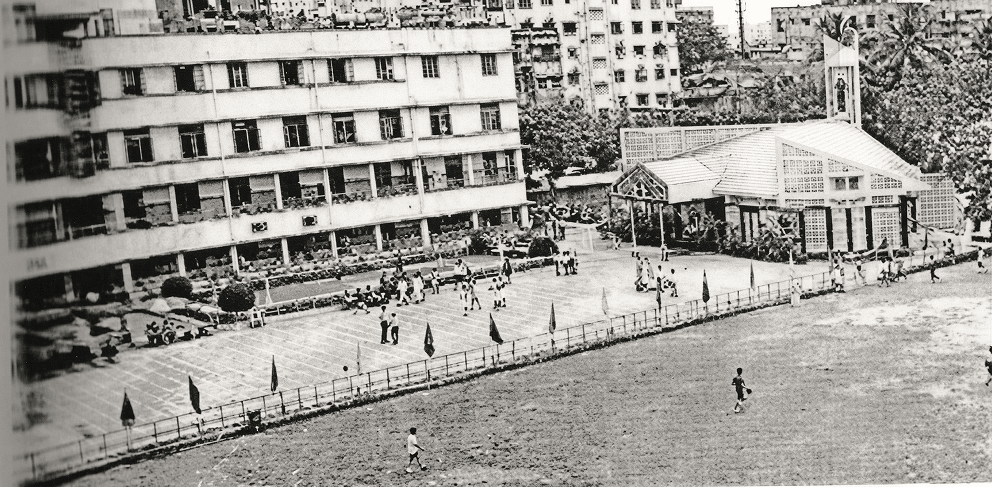
The students of a school decided to beautify the school on the Annual Day by fixing colourful flags on the straight passage of the school. A total of 27 flags have to be fixed at intervals of every 3 m. All the flags are kept at the position of the middle most flag. Rohan was given the responsibility of placing the flags on both the sides of the middle most flag. Rohan could carry only one flag at a time. So he carries one flag from the middle most point, places the flag at the designated place and comes back to the middle most point. He continues this for all the flags on both sides.

The students of a school decided to beautify the school on the Annual Day by fixing colourful flags on the straight passage of the school. A total of 27 flags have to be fixed at intervals of every 3 m. All the flags are kept at the position of the middle most flag. Rohan was given the responsibility of placing the flags on both the sides of the middle most flag. Rohan could carry only one flag at a time. So he carries one flag from the middle most point, places the flag at the designated place and comes back to the middle most point. He continues this for all the flags on both sides. Concise Mathematics Solutions ICSE Class 10.

Based on the above information, answer the following questions:

(i) The distance covered by Rohan in placing the flags on one side of the middle most flag forms a sequence. Identify the type of sequence by writing at least the first 4 terms of the sequence.

(ii) Find the distance covered by Rohan in placing the 10th flag and coming back to the middle most flag.

(iii) Find the total distance travelled by Rohan in fixing all the 27 flags.

Show SolutionHide Solution↓

(i) There are 27 flags in total. The middle-most flag is the 14th flag.

This means there are 13 flags to the left and 13 flags to the right of the starting point.

The first flag on either side is 3 meters away. Rohan travels 3 m to place it and 3 m to return.

The second flag is 6 m away. Rohan travels 6 m to place it and 6 m to return.

The first 4 terms (round-trip distances) are :

1st flag = 2 × 3 = 6 m

2nd flag = 2 × 6 = 12 m

3rd flag = 2 × 9 = 18 m

4th flag = 2 × 12 = 24 m

The above terms form an A.P. with common difference = 6.

Hence, the required sequence is an A.P.

(ii) By formula,

an = a + (n - 1)d

a10 = 6 + 6(10 - 1)

= 6 + 6 × 9

= 6 + 54

= 60 m.

Hence, the distance covered by Rohan in placing the 10th flag and returning back to the middle most flag = 60 m.

(iii) By formula,

Sn = $\frac{n}{2}[2a + (n - 1)d]$

On each side 13 flags are placed.

$$\begin{aligned}S_{13} = \frac{13}{2}[2 \times 6 + (13 - 1) \times 6] \\[1em] = \frac{13}{2} \times [12 + 12 \times 6] \\[1em] = \frac{13}{2} \times [12 + 72] \\[1em] = \frac{13}{2} \times 84 \\[1em] = 13 \times 42 \\[1em] = 546 \text{ m}.\end{aligned}$$

Thus, distance covered on one side = 546 m.

Total distance = 2 × 546 = 1092 m.

Hence, total distance travelled by Rohan in fixing all the 27 flags = 1092 m.

Press ↓ to reveal a solution and move to the next question. Back to Selina Concise Mathematics.

Free sample bank