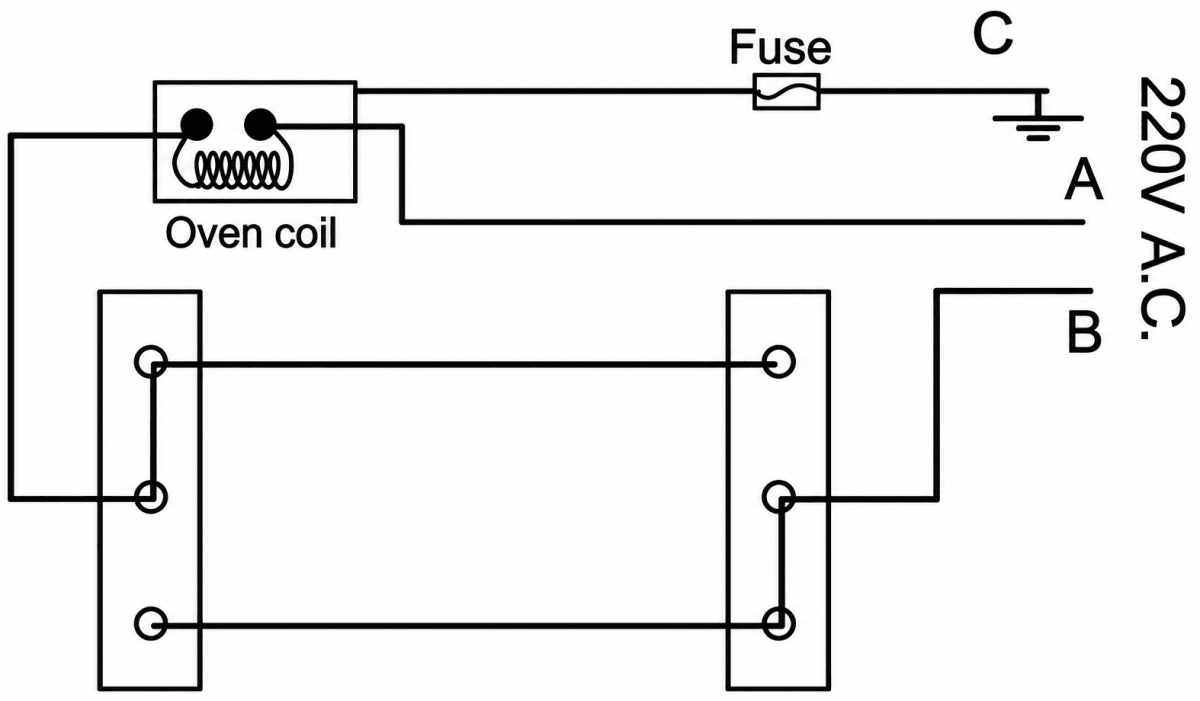
(a) Ravi wants to install a fuse to the circuit of an oven and wants to control the oven from two different locations. Shown below is the circuit diagram which he used.
(b) What does the statement 'A bulb is rated 600W, 220 V' mean?
- (a)Which one of the two, A or B, should be a live wire? Why?
- (b)In the event of an overload, will the fuse serve its purpose?
Show SolutionHide Solution↓
(a) 1. B should be the live wire.
Reason — From the diagram, the two dual control (two-way) switches used to operate the oven from two different places are connected in the wire that leads to the terminal B. A switch must always be connected in the live wire, so that when the oven is switched off, it gets disconnected from the high potential point of the supply and it is then safe to touch the appliance. If the switches were in the neutral wire, the oven would remain connected to the live wire even when switched off, which is dangerous.
- No, the fuse will not serve its purpose.
Reason — In the given circuit the fuse has been connected in the wire joining the metal body of the oven to the earth terminal C, and not in the live wire. During an overload, the excessive current flows through the live wire and the oven coil, while the earth wire normally carries no current. Hence this fuse will not melt and the circuit will not be broken. A fuse is always connected in the live wire before the appliance, so that when the current exceeds the rated value, the fuse melts and prevents the heavy current from reaching the appliance.
(b) The statement 'A bulb is rated 600 W, 220 V' means that if the bulb is connected across a supply of 220 V, it will consume 600 W of electrical power, i.e., it will consume 600 joule of electrical energy in one second.