A bar of length 120 cm is used as a lever to raise a load placed at point P. Seven equidistant points are marked along the bar: P, Q, R, S, T, U, and V, each 20 cm apart. You are permitted to place the fulcrum at any of the marked points and exert the effort at a different point.
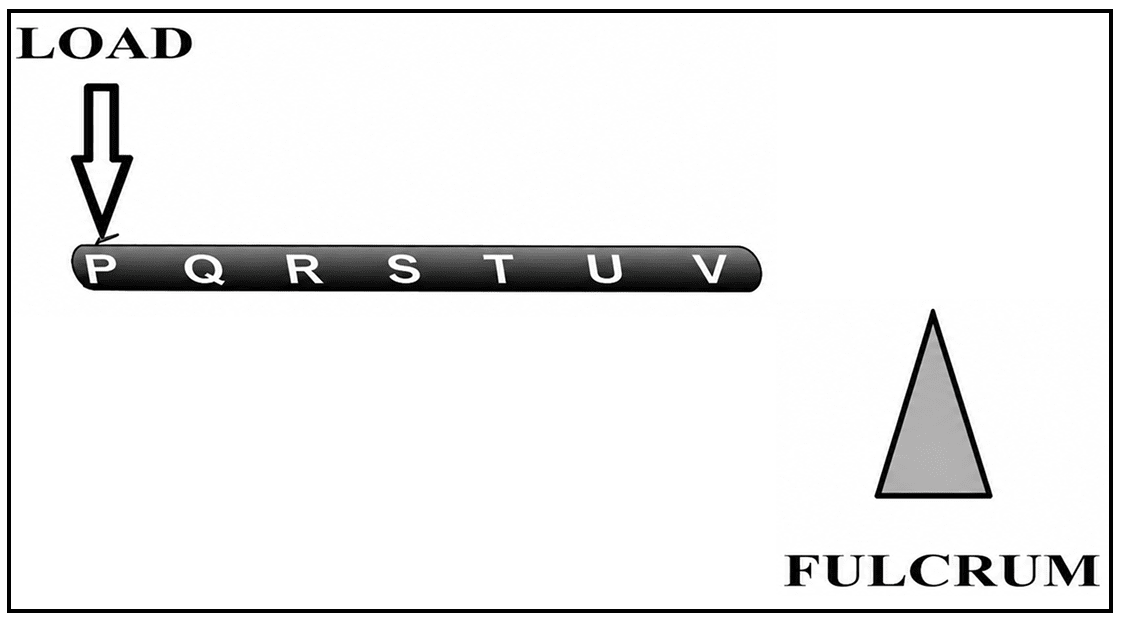
(a) Specify the fulcrum and effort points that yield the greatest mechanical advantage.
(b) Based on the lever arrangement identified in part (a), calculate the maximum mechanical advantage using the distances shown in the diagram.
(c) To which class of lever does this arrangement belong?
Show SolutionHide Solution↓
(a) For a lever,
$\text {M.A.} = \frac{\text {effort arm}}{\text {load arm}}$
So the mechanical advantage is greatest when the load arm is as small as possible and the effort arm as large as possible. The load is at P, so the fulcrum must be at the point nearest to P and the effort must be applied at the farthest point.
Hence, the fulcrum should be at Q and the effort should be applied at V.
(b) Load arm = PQ = 20 cm
Effort arm = QV = 120 − 20 = 100 cm
$\text {M.A.} = \frac{\text {effort arm}}{\text {load arm}} = \frac{100}{20} = 5$
Hence, the maximum mechanical advantage is 5.
(c) In this arrangement the fulcrum Q lies in between the load at P and the effort at V.
Hence, it is a class I (first class) lever.