1
Look at the images given below. Mark the images of a machine with 'M' and the images of a robot with 'R'.
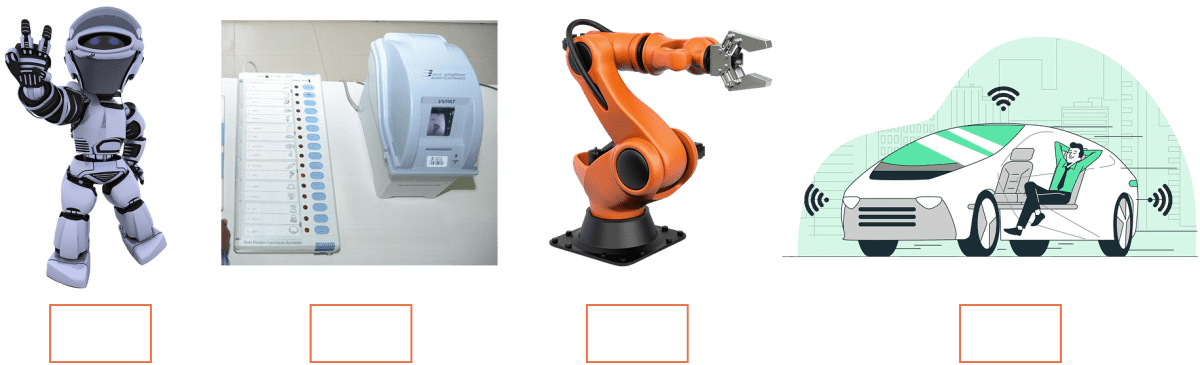
Show SolutionHide Solution↓
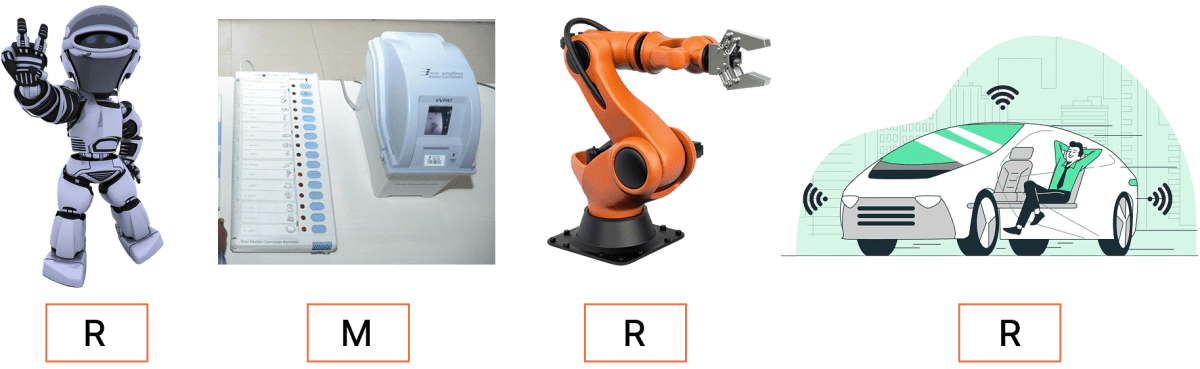
The images are marked below:
ICSE Class 10 Robotics & AI · KIPS Robotics & AI · 41 solved questions
Look at the images given below. Mark the images of a machine with 'M' and the images of a robot with 'R'.
The images are marked below:
Classify the following tasks as per their suitability on the basis of machines, robots, or cobots.
The given tasks are classified below:
| Machines | Robots | Cobots |
|---|---|---|
| Printing newspaper | Motion recognition | Medical surgery |
| Managing disaster | Fitting equipment | |
| Creative thinking |
Consider the scenario of a multi-robot system used to distribute food and medicine to people in war affected areas. Write down all steps of action.
The steps of action for distributing food and medicine in war-affected areas are:
Identify two robots and two cobots and list their key distinctions.
Robots:
Cobots:
| Feature | Robot | Cobot |
|---|---|---|
| Purpose | To automate tasks that are dangerous, repetitive, or tedious | To work with humans in a safe and collaborative way |
| Design | Typically large, heavy, and enclosed | Typically smaller, lighter, and open |
| Speed | Can be very fast | Typically slower than robots |
| Strength | Can be very strong | Generally not as strong as robots |
| Cost | More expensive | Less expensive than robots |
A robot is able to take decision and interact with its environment.
True
Reason — A robot is a machine that can sense its surroundings, take decisions, and interact with the environment using sensors, actuators, and a controller.
Machines and robots are the same.
False
Reason — Machines and robots are not the same. Machines are designed to perform specific predefined tasks, whereas robots can sense their surroundings, take decisions, and interact with the environment.
The meaning of the word 'cobot' is collaborative robot.
True
Reason — The term 'cobot' is derived from collaborative robot, meaning robots that are specifically designed to work safely alongside humans.
Machines are designed to perform specific tasks.
True
Reason — Machines are designed to perform a specific task, and their operations are predefined based on mechanical, electrical, or software design.
Sensors are an essential component of a robot.
True
Reason — Sensors are an essential component of a robot because they enable the robot to learn about its environment, which helps it sense surroundings, take decisions, and perform tasks.
Cobots are lighter and more flexible version of robots.
True
Reason — Cobots are smaller, lighter, and more flexible than robots, which enables them to be utilised in a larger range of applications.
Cobots are standalone robotic systems.
False
Reason — Cobots are designed to work with humans in a safe and collaborative environment and operate with a human operator, therefore they are not standalone robotic systems.
Cobots are designed to consider human safety.
True
Reason — Cobots include built-in safety features that prevent them from harming people, and they are designed to work safely alongside humans.
Robots are non-adaptable.
False
Reason — Robots are more versatile and adaptable than machines because they can sense their surroundings, make decisions, and change their actions.
Cobots require constant human supervision.
False
Reason — Cobots are designed to work with humans in a safe and collaborative environment and do not require constant human supervision.
Which of the following statements best describes a robot?
An advanced machine capable of sensing, decision-making, and interaction
Reason — A robot is a system that uses sensors to perceive its environment, controllers to process information and make decisions, and actuators to interact with the environment to perform a specific task. This shows that a robot is an advanced machine capable of sensing, decision-making, and interaction.
What distinguishes a cobot from a traditional robot?
Cobots emphasise collaboration and interaction with humans, while traditional robots often work autonomously.
Reason — Cobots, or collaborative robots, are made specifically to work safely alongside humans with a focus on cooperation and involvement, whereas traditional robots often work autonomously.
Which of the following is an essential characteristic of a machine?
Specific functionality for a particular task
Reason — Machines are designed to perform a specific task, and their operations are predefined based on their mechanical, electrical, or software design.
How do cobots contribute to the progress from robots to more collaborative systems?
By providing human interaction and safer work environments
Reason — Cobots are designed to work with humans in a safe and collaborative environment and include built-in safety features that prevent them from harming people, which supports the progress from robots to more collaborative systems.
Which of the following is a characteristic of a machine?
Performing tasks based on programmed instructions
Reason — Machines perform operations that are predefined and based on their mechanical, electrical, or software design.
A sewing machine is an example of which of the following options?
Machine
Reason — A sewing machine is designed to perform a specific task and requires human intervention, and it cannot sense or adjust itself according to the environment. Hence, it is a machine.
Why are cobots important in industrial settings?
They provide a safer working environment and enable human-robot collaboration.
Reason — Cobots are designed to work with humans in a safe manner and have built-in safety mechanisms that prevent them from injuring humans, enabling human-robot collaboration in industrial settings.
Which of the following is an example of a multi-robot system?
All of these
Reason — A multi-robot system consists of multiple robots connected through a network, and such systems can be used in smart homes, smart offices, and firefighting scenarios.
Which is not true for a multi-robot system?
No human interaction
Reason — A multi-robot system consists of multiple robots that are connected through a network, and it involves human interaction where a human operator gives commands and receives information from the robots.
Which is not an example of a machine?
None of these
Reason — A washing device, a printing device, and an automatic floor cleaning device are all machines designed to perform specific tasks.
Fill in the blanks:
Write and explain any two examples of machines.
Two examples of machines are:
Washing machine — A washing machine is designed to clean clothes and is controlled by a small program written on it. It performs a specific predefined task and requires human intervention.
Sewing machine — A sewing machine is designed to stitch clothes. It cannot sense or adjust itself according to the environment and requires a human to operate it.
Write and explain any two examples of robots.
Two examples of robots are:
Roomba vacuum cleaner — The Roomba vacuum cleaner uses sensors to detect objects and walls and follows a set of programmed instructions to clean a room automatically. It can move around its surroundings and perform its task without continuous human control.
Robot arm used in manufacturing — A manufacturing robot arm uses sensors to determine the position of objects and follows given instructions to pick up and place items. It can perform tasks with precision and accuracy in industrial environments.
Write and explain any two examples of cobots.
Two examples of cobots are:
What are the various characteristics of a cobot?
The various characteristics of a cobot are:
Write some application areas of robots.
Some application areas of robots are:
How do cobots contribute to increase efficiency as compared to conventional robots?
Cobots increase efficiency (vs conventional robots) because:
Why is a washing machine not a robot? Explain.
A washing machine is not a robot because it does not have the ability to sense, take decisions, or interact with its environment. A washing machine is designed to perform a specific task, that is, cleaning clothes. Its operations are predefined and controlled by a small program written on it. It requires human intervention to start, stop, and select modes of operation.
Unlike robots, a washing machine cannot sense its surroundings, cannot adjust itself according to the environment, and cannot perform multiple tasks. It also cannot move on its own or learn from its environment. Therefore, a washing machine is considered a machine and not a robot.
What do you understand by multi-robot systems? Explain with the help of an example.
A multi-robot system is a system in which there are various robots present in the environment. These robots are connected to each other and the human operator via a network. The operator can give commands to the robots, and the robots can send information back to the operator.
Example:
Let us assume we are a firefighter responding to a sizeable building fire. We have a squad of robots that have various sensors and tools. These robots can assist us in searching for survivors, extinguishing the fire, and rescuing trapped humans.
Robots and we are all connected through a network. This enables us to issue commands to the robots and get data from them in real time. The human operator is vital to the multi-robot system, as the operator is responsible for sending commands, interpreting the information provided by the robots, and deciding how to use the robots to complete the goal.
Explain the different types of robots and cobots.
Types of Robots:
Types of Cobots (Collaborative Robots):
How do machines differ from robots in terms of adaptability? Explain with the help of an example.
Machines differ from robots in terms of adaptability because machines are designed to perform a specific task, whereas robots can sense their surroundings and adapt their actions accordingly.
Machines have predefined operations based on their mechanical, electrical, or software design and cannot adjust or modify themselves as per the environment. They usually require human intervention or control.
Example: A sewing machine is designed only to stitch clothes. It cannot sense the material or adjust its functioning on its own and needs a human to operate it.
On the other hand, robots are adaptable. A robot is a machine that can move around, sense its surroundings, and do various jobs using sensors, actuators, and a controller. Robots can change their actions based on sensor input.
Example: A Roomba vacuum cleaner uses sensors to find objects and walls and changes its movement to clean a room.
Thus, machines lack adaptability, while robots are adaptable because they can sense and respond to their environment.
What are the challenges associated with designing interfaces for efficient human engagement in multi-robot systems?
The challenges associated with designing interfaces for efficient human engagement in multi-robot systems are:
What are the different components that enable a robot to perform tasks?
The different components that enable a robot to perform tasks are:
Why is the role of the human operator considered vital in operating a multi-robot system?
The role of the human operator is considered vital in operating a multi-robot system because:
How do cobots foster human skills development and job enrichment in the workplace?
Cobots foster human skills development and job enrichment by creating a human–robot collaboration where each does what it is best at:
What are the key challenges in implementing cobots in industries, and how can they be addressed?
The key challenges in implementing cobots in industries and the ways to address them are explained below:
How do cobots enhance the quality and precision of manufacturing processes?
Cobots enhance quality and precision in manufacturing by:
Press ↓ to reveal a solution and move to the next question. Back to KIPS Robotics & AI.