ICSE Class 10 History & Civics — All Questions

309 solved questions from 10 papers. Filter by year, section or marks, or search the full bank.

Year
Section
Marks
Insight
1(i)1 Mark · 2027 · Part I · 2027 SpecimenFull page

Choose the correct answers to the questions from the given options.

Identify the exclusive powers of the Rajya Sabha from the following:

P: Can introduce a new All India Service
Q: Can impeach the President
R: Can never be dissolved as a whole
S: Can introduce a Money Bill

Show SolutionHide Solution↓

P and R

Reason — The Rajya Sabha has the exclusive power to declare, by a resolution supported by not less than two-thirds of the members present and voting, that it is necessary in the national interest to create a new All India Service. It is also a permanent House and cannot be dissolved as a whole; one-third of its members retire every two years.


1(iii)1 Mark · 2027 · Part I · 2027 SpecimenFull page

Cabinet : inner core :: ............... : junior-most ministers

Show SolutionHide Solution↓

Deputy Ministers

Reason — The Cabinet is a small body of senior leaders who hold important portfolios and form the nucleus of the administration, that is, the inner core of the Council of Ministers. Deputy Ministers form the third and lowest category of Ministers. They are junior ministers placed under senior ministers whom they assist, and they take no part in Cabinet deliberations.

1(iv)1 Mark · 2027 · Part I · 2027 SpecimenFull page

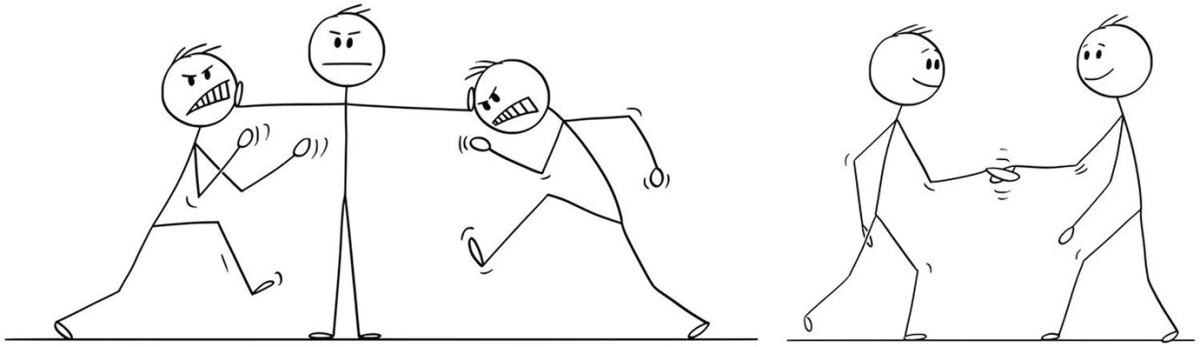
Which option best describes the picture given below?

Which option best describes the picture given below. ICSE Specimen 2027 History Solved Question Paper.
Show SolutionHide Solution↓

The ministers work together like a team.

Reason — The picture shows a group of people jointly fitting together the pieces of a single puzzle. This illustrates the principle of collective responsibility, under which all Ministers jointly share the responsibility for the government's policies and performance, and must function as a team in supporting and defending government policies inside as well as outside Parliament.

1(v)1 Mark · 2027 · Part I · 2027 SpecimenFull page

Choose the correct option to replace the underlined word:
The Council of Ministers is individually responsible to the Lok Sabha.

Show SolutionHide Solution↓

President

Reason — The Ministers are individually responsible to the President, that is, they hold office during the pleasure of the President and may be dismissed by him/her on the advice of the Prime Minister, even when they enjoy the confidence of the Legislature. It is collective responsibility, and not individual responsibility, that is owed to the Lok Sabha.

1(vi)1 Mark · 2027 · Part I · 2027 SpecimenFull page

Ravi, a college student, was taken into police custody without being informed of the reasons for his arrest. His family was not told where he was detained, and he was not produced before a magistrate within 24 hours. Ravi's parents filed a case in the Supreme Court requesting that the police produce Ravi before the court. Which writ will the court issue in this case?

Show SolutionHide Solution↓

Habeas Corpus

Reason — Habeas Corpus means 'to have the body'. By issuing this writ, the Supreme Court or a High Court can get the body of a person produced before it and order his release if he has been unlawfully detained. It is thus a great safeguard for the personal freedom of a citizen, which is exactly the relief sought by Ravi's parents.

1(vii)1 Mark · 2027 · Part I · 2027 SpecimenFull page

Assertion (A): The Muslim League was formed in 1906.

Reason (R): The Congress split into two factions in 1907.

Show SolutionHide Solution↓

Both (A) and (R) are true, but (R) is not the correct explanation of (A).

Explanation — Both statements are true. The Muslim League was formed in 1906, whereas the Congress split took place at the Surat Session in 1907. Therefore, the Congress split cannot be the reason for the formation of the Muslim League.

1(viii)1 Mark · 2027 · Part I · 2027 Specimen · 🔁 also 2026Full page

Identify the option which shows the correct chronology of the following events:
1. The Dandi March
2. The Second Round Table Conference
3. The Simon Commission

Show SolutionHide Solution↓

3-1-2

Reason — The Simon Commission was appointed in 1927 and arrived in India in 1928, the Dandi March took place in 1930, and the Second Round Table Conference was held in 1931. Hence, the correct chronology is 3-1-2.

1(ix)1 Mark · 2027 · Part I · 2027 SpecimenFull page

Mira notices that the children in her apartment are writing on the newly painted walls. If she decides to address this issue using methods inspired by the Early Nationalists, which approach is she MOST LIKELY to follow?

Show SolutionHide Solution↓

Write a letter to the welfare association highlighting the problem

Reason — The Early Nationalists followed the method of Constitutional Agitation. They made use of the three P's — Petitions, Prayers and Protests — and sent memorandums and petitions to the authorities, working peacefully within the legal framework. Writing a letter to the welfare association matches this approach, whereas fighting or boycott were methods they did not approve of.

1(x)1 Mark · 2027 · Part I · 2027 SpecimenFull page

Choose the option which shows the correct match:

Column AColumn B
1. MilitarismA. Intense pride in one's nation
2. Alliance SystemB. Glorification of military power
3. NationalismC. Division of nations into rival groups
Show SolutionHide Solution↓

1-B, 2-C, 3-A

Reason — Militarism made military strength synonymous with national prestige, so every country began to increase her military power and glorify it. The Alliance System divided Europe into two hostile groups — the Triple Alliance and the Triple Entente. Nationalism, in its extreme form, meant intense pride in one's own nation and the belief that one's country is superior to others.

1(xi)1 Mark · 2027 · Part I · 2027 SpecimenFull page

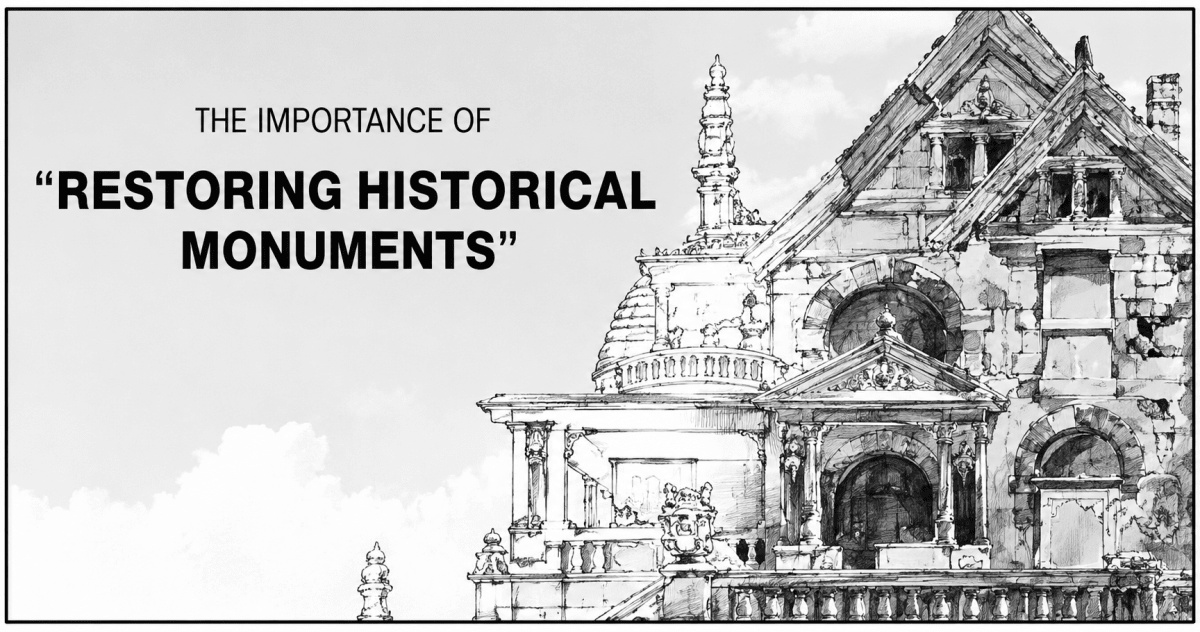
Which of the following organisations is connected to the given picture?

Which of the following organisations is connected to the given picture. ICSE Specimen 2027 History Solved Question Paper.
Show SolutionHide Solution↓

UNESCO

Reason — The picture speaks of the importance of restoring historical monuments. UNESCO provides technical advice, assistance, equipment and funds for the preservation of monuments and other works of art, and has prepared a World Heritage List to identify the monuments and sites which are to be protected. UNICEF works for the welfare of children, WHO for health and UNDP for development.

1(xii)1 Mark · 2027 · Part I · 2027 SpecimenFull page

Who among the following is NOT an Assertive Nationalist Leader?

Show SolutionHide Solution↓

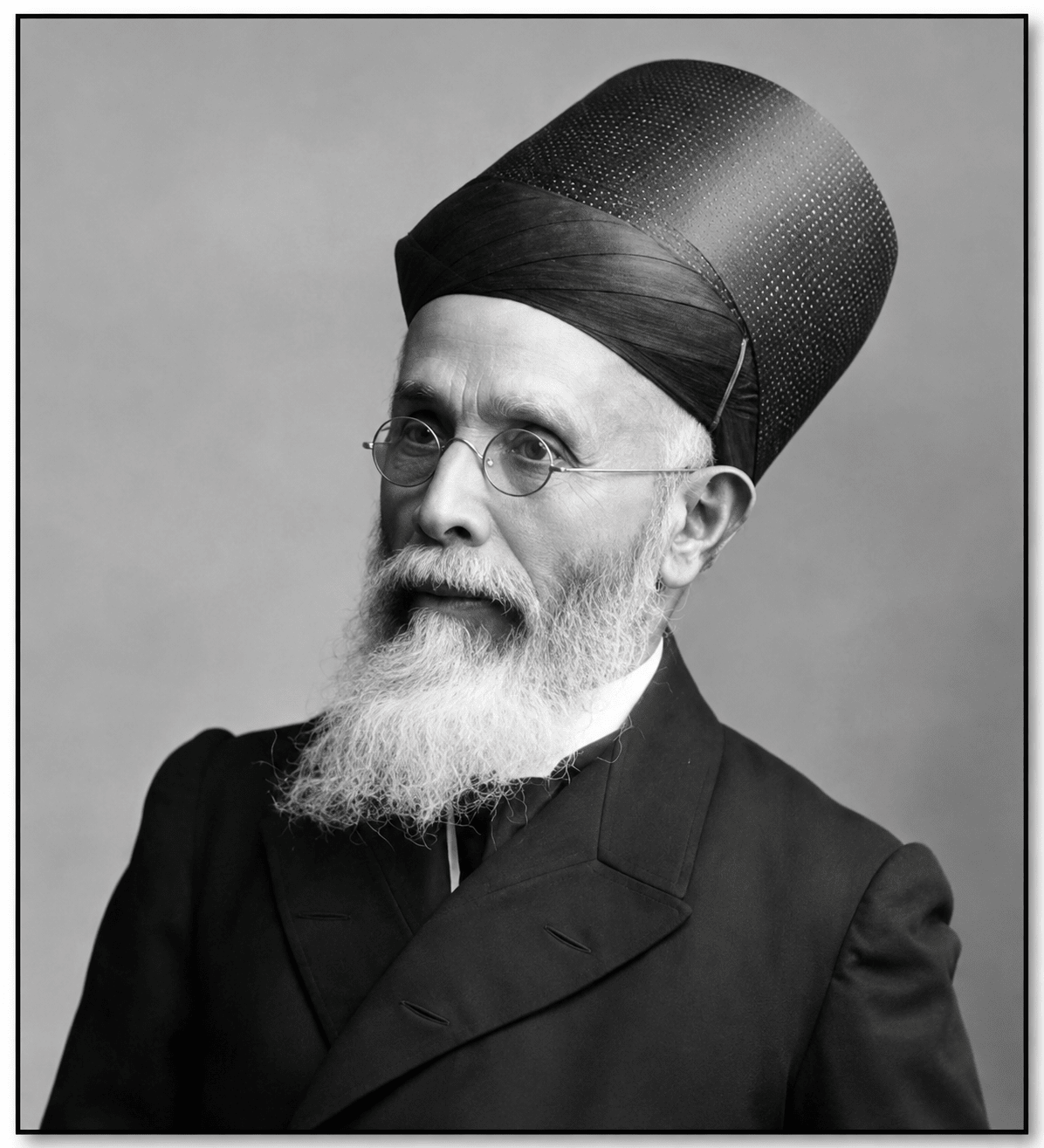
Dadabhai Naoroji

Reason — Bal Gangadhar Tilak, Bipin Chandra Pal and Lala Lajpat Rai were the leaders of Assertive Nationalism, who believed in aggressively demanding political rights. Dadabhai Naoroji, the 'Grand Old Man of India', was an Early Nationalist who believed that the British were basically just and good and relied on constitutional methods.

1(xiii)1 Mark · 2027 · Part I · 2027 SpecimenFull page

Read the description and choose the correct option:

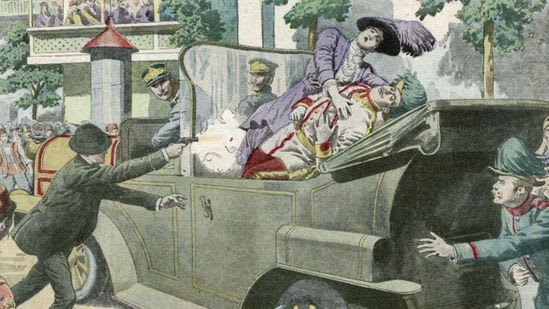
A major global conflict broke out in the early twentieth century, beginning in Europe and soon spreading to other parts of the world. Powerful nations formed rival alliances, and an assassination triggered widespread fighting. The war reshaped political boundaries and weakened old empires. Its immediate cause was ............... .

Show SolutionHide Solution↓

Sarajevo Crisis

Reason — The description refers to the First World War. Nationalism, imperialism and the division of Europe into rival alliances were its long term causes. Its immediate cause was the Sarajevo Crisis — the assassination of Archduke Francis Ferdinand at Sarajevo on June 28, 1914 by the secret society 'Black Hand', after which Austria declared war on Serbia.

1(xiv)1 Mark · 2027 · Part I · 2027 SpecimenFull page

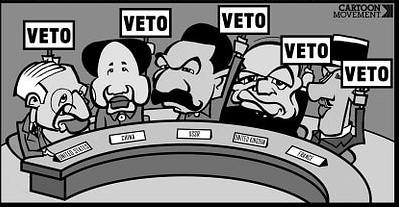
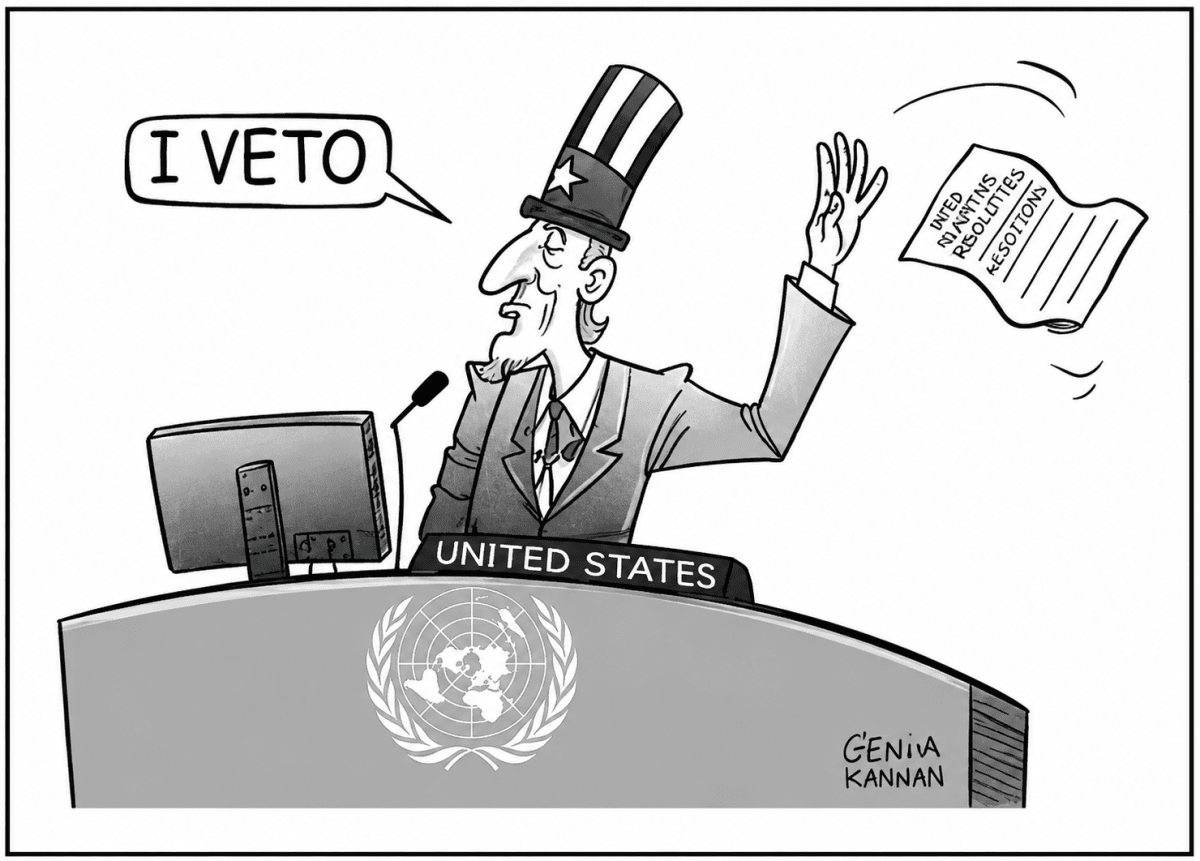
Which of the following countries will NOT be a part of the cartoon given below?

Which of the following countries will NOT be part of this cartoon?, ICSE Specimen 2026 History Solved Question Paper.
Show SolutionHide Solution↓

Japan

Reason — Veto power is enjoyed by the five permanent members of the United Nations Security Council. Japan is not a permanent member of the Security Council and therefore does not possess veto power.

1(xv)1 Mark · 2027 · Part I · 2027 Specimen · 🔁 also 2026Full page

Identify the correct pair from the given options:

Show SolutionHide Solution↓

Jyotiba Phule – Women's Education

Reason — Jyotiba Phule was a strong advocate for the education of women and the upliftment of lower castes. He and his wife, Savitribai Phule, were pioneers in setting up schools for girls in 19th-century Maharashtra.

1(xvi)1 Mark · 2027 · Part I · 2027 SpecimenFull page

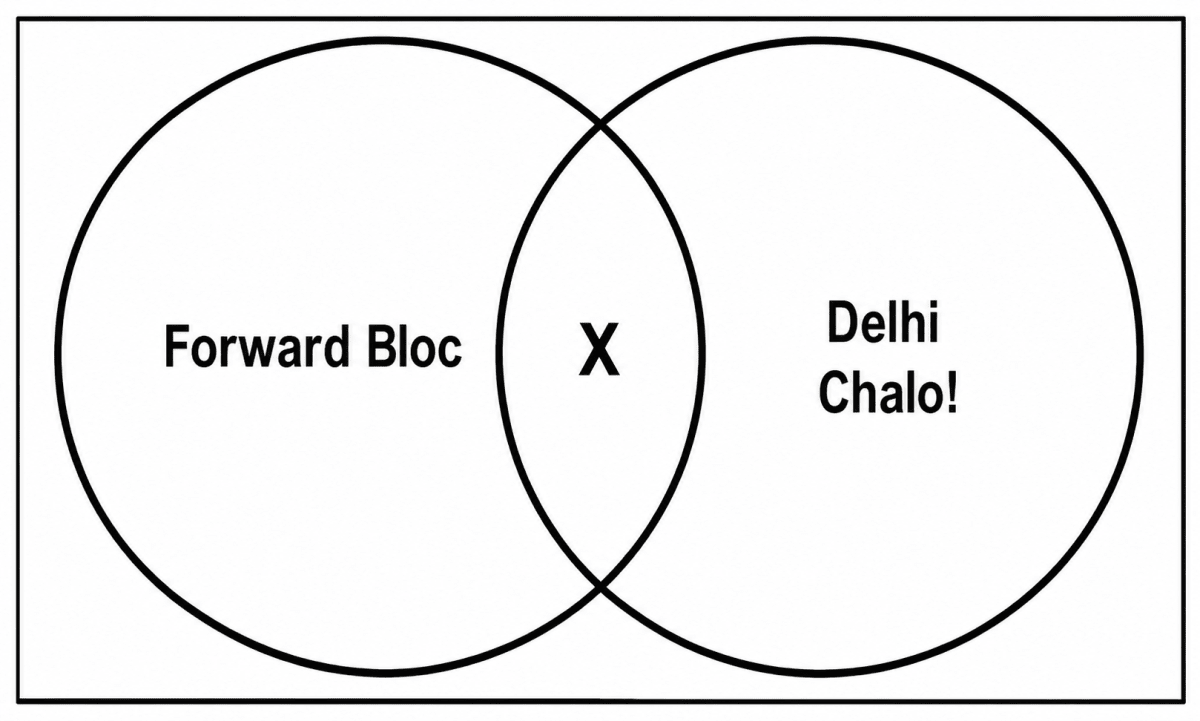
Connect the information given in the diagram below and identify X.

Connect the information given in the diagram below and identify. ICSE Specimen 2027 History Solved Question Paper.
Show SolutionHide Solution↓

Subhash Chandra Bose

Reason — After resigning from the Presidentship of the Congress in 1939, Subhash Chandra Bose laid the foundation of the Forward Bloc on May 3, 1939 to bring the entire left wing under one banner. 'Delhi Chalo' was the stirring call he later gave to the soldiers of the Indian National Army. Both are therefore associated with him.

2(i)1 Mark · 2027 · Part I · 2027 SpecimenFull page

Read the extract given below and answer the question that follows:

In India, the Supreme Court can exercise advisory jurisdiction under Article 143 of the Constitution. With regard to the President, these opinions are purely advisory.

Mention any two points about the Supreme Court that can be inferred from the given extract.

Show SolutionHide Solution↓

In India, the Supreme Court can exercise advisory jurisdiction under Article 143 of the Constitution. This means that:

  1. The Supreme Court can give its opinion on any question of law or fact of public importance as may be referred to it for consideration by the President.
  2. The opinion given by the Supreme Court in such a case is purely advisory and is not binding on the President.
2(ii)1 Mark · 2027 · Part I · 2027 SpecimenFull page

Which category of power is being exercised by the President in the following?

Show SolutionHide Solution↓

(a) Appointment of Cabinet ministers — Executive power.

(b) Approval of a Money Bill — Financial power.

2(iii)1 Mark · 2027 · Part I · 2027 Specimen · 🔁 also 2026Full page

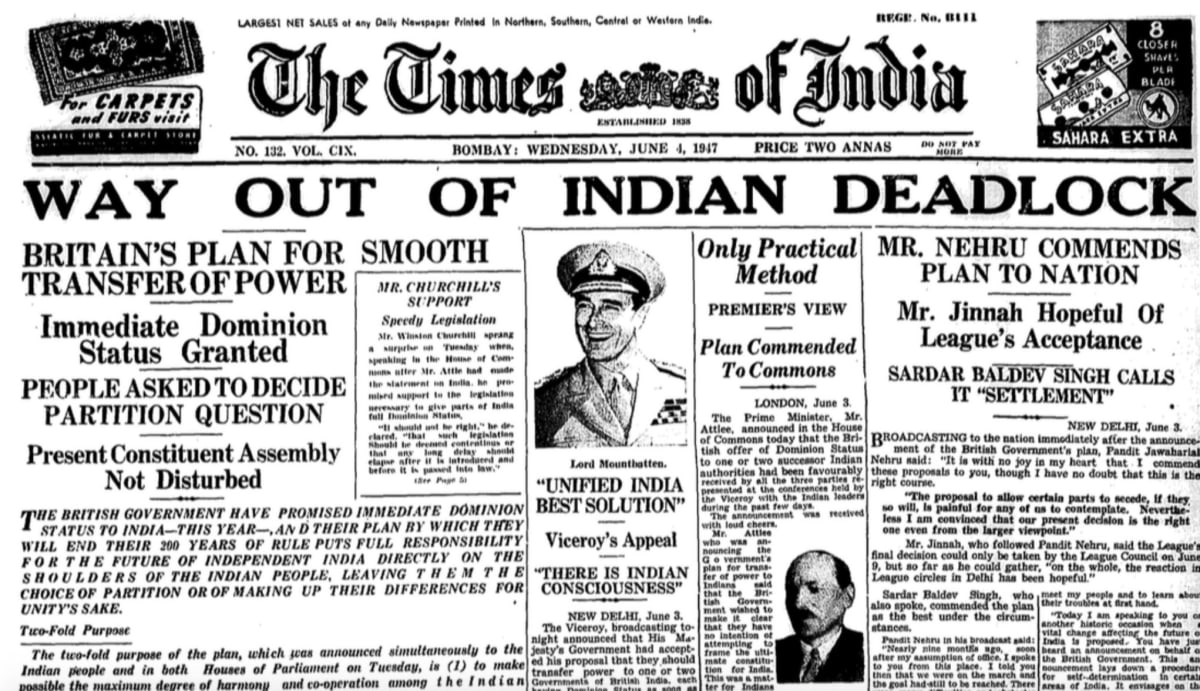
The whole plan may not be perfect but like all plans, its success will depend on the spirit of goodwill with which it is carried out.

— Lord Mountbatten

Give two reasons for the acceptance of the above plan by the Congress.

Show SolutionHide Solution↓

The Mountbatten Plan was accepted by the Congress because of the following two key reasons:

  1. Large-Scale Communal Riots — The large-scale communal riots that engulfed the whole country convinced the Congress leaders that the only solution to the communal problem lay in the Partition of India.
  2. Avoidance of Civil War — The leaders felt that any further delay in the transfer of power could lead to a civil war in India. They believed that it was better to have a smaller India with a strong central authority than a larger State with a weak Centre.
2(iv)1 Mark · 2027 · Part I · 2027 Specimen · 🔁 also 2025 & 2026Full page

Imagine you were an artisan in the year 1856. Mention any two ways in which the economic policies of the British would have affected you.

Show SolutionHide Solution↓

As an artisan in 1856, I would have been affected in the following ways:

  1. Cheap machine-made British goods were imported into India, while Indian goods faced heavy duties in England. This reduced the demand for Indian handicrafts and caused artisans to lose their livelihood.
  2. The annexation of Indian States led to the disappearance of royal courts and nobles who had traditionally patronised artisans. This further reduced employment and income for craftsmen.
2(v)1 Mark · 2027 · Part I · 2027 SpecimenFull page

Look at the picture given below and answer the question that follows:

Look at the picture given below and answer the question that follows. ICSE Specimen 2027 History Solved Question Paper.

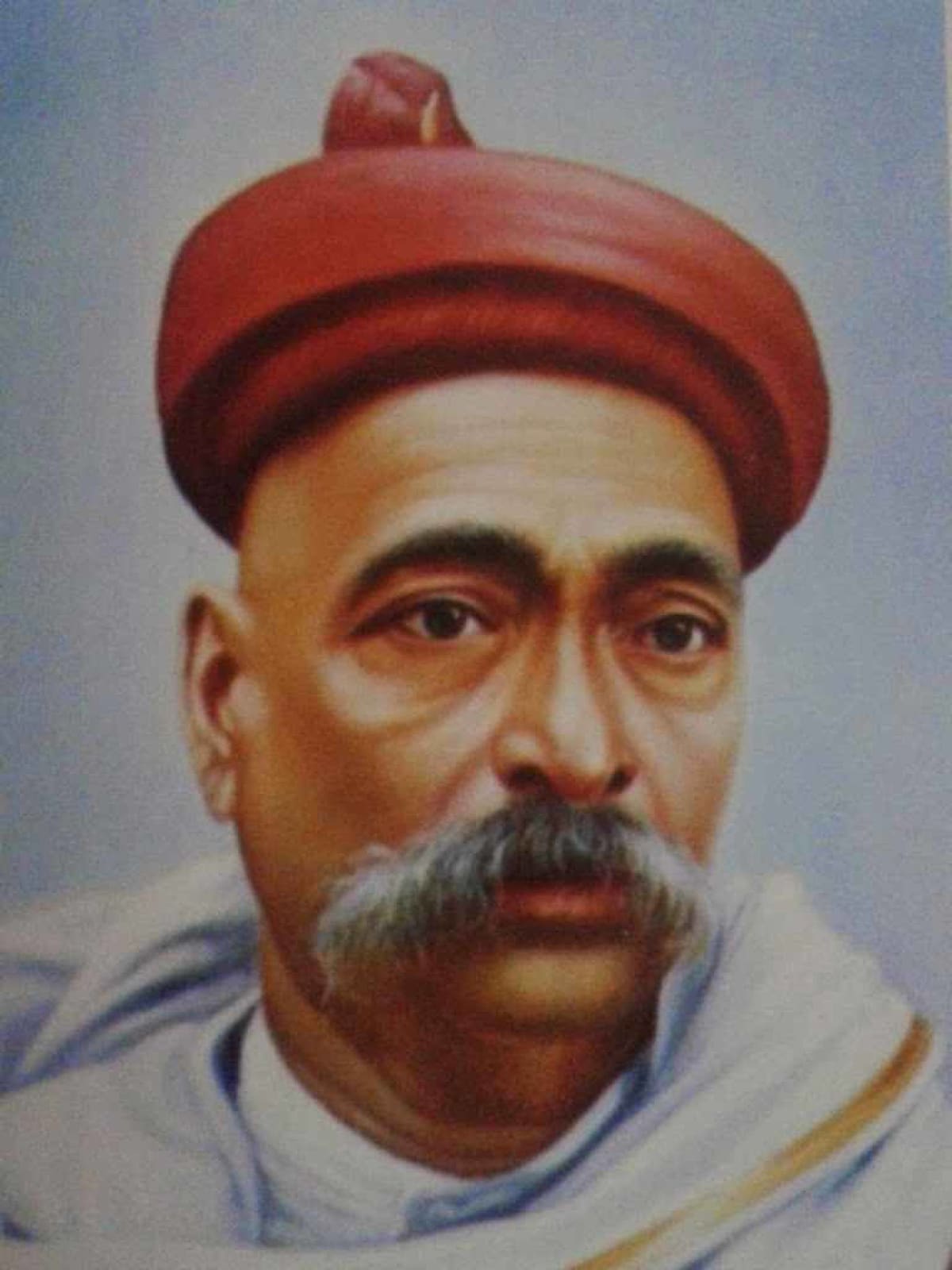
Identify the leader seen in the picture. Mention any one of his contributions.

Show SolutionHide Solution↓

The leader seen in the picture is Bipin Chandra Pal, an Assertive Nationalist known as the 'Father of the Revolutionary Thought in India'.

One key contribution of Bipin Chandra Pal:

  • Role as a Journalist: He worked for the Bengal Public Opinion, The Tribune and New India to propagate his brand of nationalism. The British Government found his writings seditious, and he was arrested and sentenced to six months' imprisonment.
2(vi)1 Mark · 2027 · Part I · 2027 Specimen · 🔁 also 2024, 2025 & 2026Full page

Mention any two objectives of the League of Nations.

Show SolutionHide Solution↓

Two objectives of the League of Nations were:

  1. All States were to refer their mutual disputes, if any, to the League of Nations for a peaceful settlement.
  2. The member-States were to take necessary action as directed by the League against any State which tried to disturb world peace and order.
2(vii)1 Mark · 2027 · Part I · 2027 SpecimenFull page

Mention any two ideologies of dictators.

Show SolutionHide Solution↓

Two ideologies of the dictators were:

  1. They believed in one-party, one-leader totalitarian rule.
  2. They believed in aggressive nationalism and regarded the State as supreme over individual rights.
3Written · 2027 · Part II A · 2027 SpecimenFull page

The Union Legislature of India is the law-making body of the country. With reference to the Parliament, answer the following questions:

(i) Mention any three key differences in power between the Lok Sabha and the Rajya Sabha that make the Lok Sabha more influential.

(ii) Rajya Sabha adjourned sine die, overall productivity at 79 percent.

— Deccan Herald, 21 December 2023

Who can adjourn the above session? Explain the composition of this house.

(iii) Mention any four legislative powers of the Parliament.

Show SolutionHide Solution↓

(i) The Lok Sabha has special powers which make it more powerful than the Rajya Sabha. These special powers are:

  1. A Motion of No-Confidence against the government can be introduced and passed only in the Lok Sabha. If it is passed, the Prime Minister and the Council of Ministers resign collectively. The Rajya Sabha cannot remove the Council of Ministers through such a motion.
  2. A Money Bill can be introduced only in the Lok Sabha. The Rajya Sabha cannot reject or amend it and can only make recommendations within 14 days.
  3. In case of a deadlock between the two Houses over an Ordinary Bill, the decision of the Lok Sabha normally prevails in a joint sitting because of its greater numerical strength.

(ii) The Chairman of the Rajya Sabha, who is the Vice-President of India, can adjourn the House or its sitting sine die.

Composition of the Rajya Sabha —
The maximum strength of the Rajya Sabha is 250 members, of whom:

  1. 12 members are nominated by the President from among persons having special knowledge or practical experience in literature, science, art and social service.
  2. Up to 238 members represent the States and Union Territories. Seats are allocated to the States and Union Territories on the basis of their population.

(iii) Four legislative powers of the Union Parliament are:

  1. Matters in the Union List — Parliament has exclusive power to make laws on subjects in the Union List, such as Defence, Banking, Communications and Foreign Affairs.
  2. Matters in the Concurrent List — Parliament and the State Legislatures can both make laws on subjects in the Concurrent List. In case of a conflict, the Union law generally prevails.
  3. Residuary Powers — Parliament can make laws on subjects that are not included in the Union, State or Concurrent Lists.
  4. Matters in the State List under special circumstances — Parliament can legislate on subjects in the State List during a National Emergency, when the Rajya Sabha passes a resolution by a two-thirds majority in the national interest, or when two or more States request Parliament to make a law on a State subject.
4Written · 2027 · Part II A · 2027 SpecimenFull page

The President is the nominal head of the executive and the first citizen of the country. With reference to this statement, answer the following questions:

(i) Mention any three legislative powers of the President which justify his nominal position.

(ii) Mention any three points to enumerate the financial powers vested in the President of India.

(iii) Describe the constitutional procedure to remove the President.

Show SolutionHide Solution↓

(i) Three legislative powers of the President which justify his/her nominal position are:

  1. Dissolve the Lok Sabha: He/She can dissolve the Lok Sabha and order fresh elections.

  2. Assent to Bills: Once a Bill is passed by both the Houses, it is sent to the President for his/her approval. The President may give his/her assent, or withhold the Bill or send it back to the House concerned with recommendations. If the same bill is passed again, the President has to give his/her assent.

  3. Promulgate Ordinances: The President can promulgate an Ordinance when immediate action is necessary and both Houses of Parliament are not simultaneously in session. An Ordinance may also be issued when one House is in session. It has the same force as an Act of Parliament and must be laid before both Houses when Parliament reassembles. It ceases to operate six weeks after reassembly unless approved by Parliament.

(ii) Three financial powers of the President are:

  1. Money Bills can be introduced only on the recommendation of the President.

  2. The President can authorise withdrawal of advances from the Contingency Fund of India to meet unforeseen expenditure. Such expenditure should be subsequently approved by Parliament.

  3. Every five years, the President appoints a Finance Commission comprising a Chairman and four other members to give recommendations on financial matters.

(iii) PROCEDURE FOR IMPEACHMENT OF THE PRESIDENT

  1. In case of violation of the Constitution or grave misconduct, either House may frame charges against the President as follows:

    1. Resolution which is moved after at least fourteen days' notice in writing signed by not less than one-fourth of the total number of members of the House; and
    2. The resolution is passed by a majority of not less than two-thirds of the total membership of the House.
  2. The other House investigates the charges and the President has the right to appear and to be represented at such an investigation.

  3. If the President is found guilty, a resolution is passed by a majority of not less than two-thirds of the total membership of the investigating House, and the President is removed from his/her office.

5Written · 2027 · Part II A · 2027 SpecimenFull page

The High Courts and Subordinate Courts are part of the integrated judicial system. With reference to the statement, answer the following questions:

(i) Mention three cases which fall under the Original Jurisdiction of the High Court.

(ii) Who appoints the High Court Judges? Mention any two qualifications required for a person to be appointed as a High Court Judge.

(iii) Lok Adalat brings justice to the doorstep of the common.
Justify this statement with any four points.

Show SolutionHide Solution↓

(i) Original Jurisdiction means the power to hear and decide cases at the first instance. Three such cases before a High Court are:

  1. Matters relating to State revenue and its collection.
  2. Cases regarding wills, divorce, marriage, company law and contempt of court, which may be brought before the High Court directly.
  3. Election petitions challenging the election of Members of Parliament, of a State Legislative Assembly or of other local bodies.

(ii) The Judges of a High Court are appointed by the President of India. The Chief Justice of a High Court is appointed in consultation with the Chief Justice of the Supreme Court and the Governor of the concerned State.

Two qualifications required for appointment as a Judge of a High Court are:

  1. He/She should be a citizen of India and should not be over 62 years of age.
  2. He/She should have held a judicial office in the territory of India for at least ten years, or should have been an advocate of a High Court for at least ten years.

(iii) Lok Adalat means 'People's Court'. It is an alternative dispute redressal mechanism where cases pending in a court of law, or at the pre-litigation stage, are settled amicably. It brings justice to the doorstep of the common man in the following ways:

  1. Spirit of compromise — Lok Adalats settle family feuds, disputes between neighbours and minor cases of assault and injury through compromise and understanding, so that both the parties feel satisfied.
  2. Speedy and inexpensive justice — There is no court fee. Any person can move a Lok Adalat by an application on plain paper and expect quick justice.
  3. Relief to other courts — They reduce the workload of the regular courts, enabling them to deal with more serious matters, and thus reduce delays in the higher courts.
  4. Social justice — They provide legal aid and quick justice to the weaker sections of society who cannot afford the delay or the cost involved in ordinary court procedures. Mobile Lok Adalats travel from one place to another to resolve petty cases and spread legal awareness.
6Written · 2027 · Part II B · 2027 SpecimenFull page

Read the excerpt given below and answer the questions that follow:

The Indian Rebellion of 1857, also known as the Indian Mutiny, the Sepoy Mutiny, or the First War of Indian Independence, was a widespread uprising against British rule in India that began in May, 1857. The rebellion was sparked by the sepoys' mutiny in Meerut on May 10, 1857, and quickly spread to other parts of India. On May 10, 1857, Indian soldiers, known as sepoys, rebelled against their British officers in the town of Meerut, triggering a rebellion. The rebellion quickly spread to other parts of India with many Indian princes and soldiers joining the uprising.

— timesofindia.com, May 10, 2023 [edited]

(i) What was the immediate cause for the rebellion?

(ii) Mention any three socio-religious causes of the Revolt.

(iii) The Subsidiary Alliance proved to be disastrous to the Indian Kingdoms. Justify this statement by stating any four clauses of this alliance.

Show SolutionHide Solution↓

(i) The immediate cause of the rebellion was the introduction of the Enfield rifle.

  1. In 1856, the British decided to replace the old musket by the new Enfield rifle, the loading of which involved biting off the top greased paper of the cartridge with the teeth.
  2. In January 1857, a rumour spread in the Bengal regiments that the grease used on the cartridges contained the fat of the cow and the pig.
  3. Since the cow is sacred to the Hindus and the pig is a taboo to the Muslims, the sepoys were convinced that this was a deliberate move to defile their religions. They refused to use the cartridges and staged an uprising when they were forced to use them.

(ii) Three socio-religious causes of the Revolt of 1857 were:

  1. Interference with social customs — Reforms such as the Abolition of Sati (1829), the Widow Remarriage Act (1856) and the opening of Western education to girls were introduced without considering the feelings of the people, and were not welcomed by the masses.
  2. Apprehensions about modern innovations — People were suspicious of the railways and the telegraph. There were rumours that telegraph poles were erected to hang those who opposed British rule, and orthodox Indians resented that in railway compartments the higher and the lower castes had to sit side by side.
  3. Activities of the missionaries — The Charter Act of 1813 led to an increase in the number and activities of Christian missionaries. The Indians began to feel that the Government was supporting the missionaries in order to convert them to Christianity.

(iii) The Subsidiary Alliance was introduced by Lord Wellesley. Under this system, the Indian rulers who agreed to it:

  1. Accepted the British as the supreme power.
  2. Surrendered their foreign relations to the East India Company and agreed that they would not enter into any alliance with any other power and would not wage wars.
  3. Accepted a British Resident at their headquarters and agreed not to employ any European in their service without consulting the Company.
  4. Agreed to maintain British troops at their own cost.

In this manner the Indian States lost their sovereignty and virtually lost their independence, which proved disastrous for them.

7Written · 2027 · Part II B · 2027 SpecimenFull page

Nationalism refers to the feeling of oneness that emerges when people consider themselves as one nation. With reference to the growth of nationalism, answer the following questions:

(i) Name the first President of the Congress. Mention any two objectives of the Congress.

(ii) Whether it is fiction, non-fiction, or periodical, all kinds of literature contributed at large in the national consciousness of India in pre-independence times. Mention any three points to analyse the role of the press in the growth of nationalism.

(iii) Explain any four policies of Lord Lytton that showcased his attitude of racial superiority, eventually leading to the growth of nationalism.

Show SolutionHide Solution↓

(i) The first President of the Indian National Congress was W.C. Bonnerjee. Two objectives of the Congress are given below:

  1. To promote friendly relations between nationalist political workers from different parts of the country.
  2. To formulate popular demands and present them before the government.

(ii) The press played an important role in the growth of nationalism in the following ways:

  1. It was through the press that the message of patriotism and the modern liberal ideals of liberty, freedom, equality, home rule and independence spread among the people.
  2. The press carried on a daily criticism of the unjust policies of the British Government and exposed the true nature of British rule in India.
  3. It made possible the exchange of views among different social groups from different parts of the country, and thus helped in creating a united public opinion.

(iii) Four policies of Lord Lytton that reflected his attitude of racial superiority were:

  1. The Vernacular Press Act (1878) — It forbade vernacular papers from publishing any material that might incite feelings of dissatisfaction against the British Government. The Act was not applicable to English newspapers.
  2. The Indian Arms Act (1878) — It made it a criminal offence for Indians to carry arms without a licence. This Act too was not applicable to the British.
  3. Reduction in the age limit for the I.C.S. examination — The maximum age for appearing in the Indian Civil Service examination was reduced from 21 to 19 years. As the examination was held in London, this made it far more difficult for Indians to compete.
  4. Removal of import duties on cotton textiles — This was done for the benefit of the British cloth industry at the cost of the growing Indian textile industry.
8Written · 2027 · Part II B · 2027 SpecimenFull page

Mahatma Gandhi led the freedom movement using non-violent methods. With reference to the Gandhian movements, answer the following questions:

(i) Name the march led by Mahatma Gandhi to break the salt law. Which movement did this march lead to? In which year was that movement launched?

(ii) The movement which began with this march made a considerable impact on the social and political surroundings of the country.
Analyse this statement by mentioning any three such impacts.

(iii) Mention any four clauses of the pact which led to the suspension of this movement.

Show SolutionHide Solution↓

(i) The march led by Mahatma Gandhi to break the salt law was the Dandi March, which he began from the Sabarmati Ashram to Dandi on the Gujarat coast. This march led to the Civil Disobedience Movement, which was launched in 1930.

(ii) The Civil Disobedience Movement made a considerable impact on the social and political surroundings of the country in the following ways:

  1. It widened the base of the freedom struggle, as a large number of social groups like merchants, shopkeepers, peasants, tribals and workers in different parts of the country were mobilised for the national movement.
  2. It brought women out of their homes to participate in politics and made them equal partners in the freedom struggle.
  3. It improved the social conditions of the depressed classes, who were given entry into temples and access to wells, which was earlier denied to them.

(iii) The movement was suspended by the Gandhi-Irwin Pact, signed in March 1931. Four of its clauses were:

  1. The Government agreed to withdraw all ordinances and end prosecutions.
  2. The Government agreed to release all political prisoners, except those guilty of violence.
  3. The Government agreed to permit the free collection or manufacture of salt by persons near the seacoast.
  4. The Congress agreed to suspend the Civil Disobedience Movement and to participate in the second session of the Round Table Conference.
9Written · 2027 · Part II B · 2027 SpecimenFull page

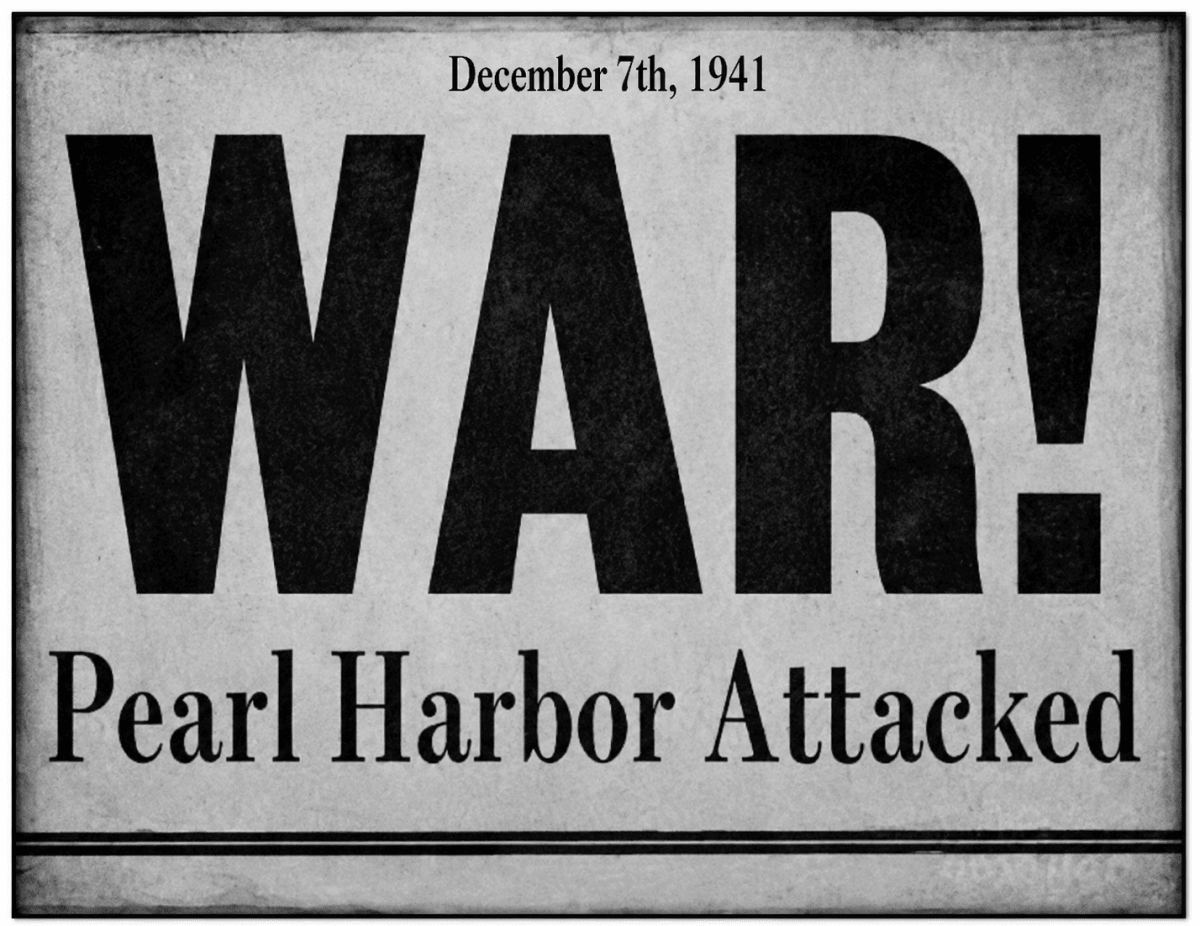
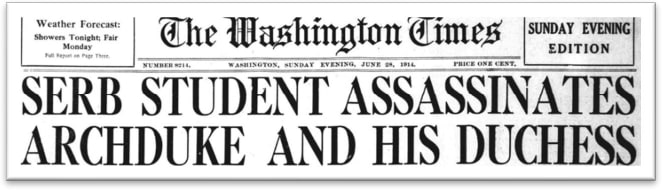
Observe the picture given below and answer the following questions:

Observe the picture given below and answer the following questions. ICSE Specimen 2027 History Solved Question Paper.

(i) Which country was responsible for the bombing referred to in the headline? Mention any two consequences of the World War associated with this incident.

(ii) Explain the Policy of Appeasement which led to the Second World War.

(iii) The unfair Treaty of Versailles led to the rise of dictatorship in Germany. Mention any four clauses of this treaty to justify this statement.

Show SolutionHide Solution↓

(i) Japan was responsible for the attack on Pearl Harbor on December 7, 1941. Two consequences of the Second World War were:

  1. Defeat of the Axis Powers — Germany, Italy and Japan were defeated, bringing the war to an end.
  2. Formation of the United Nations — The United Nations Organisation was established in 1945 to maintain international peace and security and prevent another world war.

(ii) Appeasement meant accepting the hostile demands of an aggressive nation in order to maintain peace. Britain and France followed this policy towards Germany and Italy because they felt that the dictators had genuine grievances against the harsh Treaty of Versailles and that satisfying these grievances would preserve peace. They also wanted to check the spread of Communism and the influence of Soviet Russia. As a result, Germany was allowed to rearm, remilitarise the Rhineland and annex Austria and Czechoslovakia. This encouraged Hitler's aggression and helped lead to the Second World War.

(iii) The unfair Treaty of Versailles led to the rise of dictatorship in Germany. Four clauses of the Treaty of Versailles are:

  1. Germany was declared guilty of aggression and had to pay war reparation of 33 billion dollars.
  2. The Saar coal mines were given to France for 15 years and the area was to be governed by the League of Nations.
  3. The area of the Rhine valley was demilitarised and the German territory west of Rhine was to be occupied by the Allied troops for 15 years.
  4. The German Army was restricted to a force of 1,00,000 soldiers and the Navy was limited to 15,000 men and 24 ships. The Air Force and submarines were banned.
10Written · 2027 · Part II B · 2027 SpecimenFull page

The United Nations Organisation aims to maintain international peace. With reference to its organs and agencies, answer the following questions:

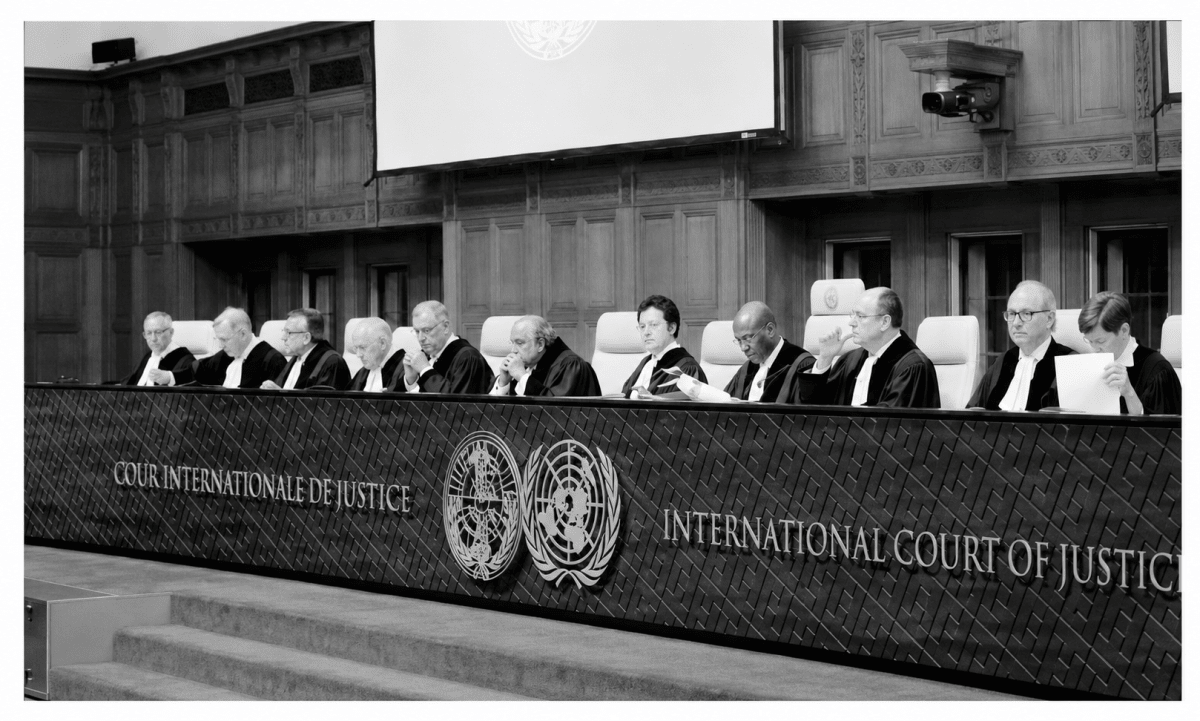
(i) What is the composition of the International Court of Justice?

(ii) Mention any three exclusive functions of the General Assembly.

(iii) Kolkata's famous Durga Puja received the intangible heritage tag.
Which agency of the United Nations is authorised to give this tag? Mention any three other contributions of that agency in the preservation of culture.

Show SolutionHide Solution↓

(i) Composition of the International Court of Justice —

  1. The Court is composed of 15 judges, each of different nationality elected to nine-year terms of office by the United Nations General Assembly and Security Council sitting independently of each other. Elections are held every three years for one-third of the seats, and retiring judges may be re-elected.

  2. The Members of the Court do not represent their governments but are independent magistrates. The judges must possess the qualifications required in their respective countries for appointment to the highest judicial offices, or be jurists of recognised competence in international law. The composition of the Court has also to reflect the main forms of civilisation and the principal legal systems of the world.

  3. The Court elects its President and Vice-President for a three-year term. They may, when their term expires, be re-elected. The Court has the power to appoint its Registrar.

(ii) Three functions of the General Assembly are:

  1. To consider and make recommendations on the principles of cooperation, in the maintenance of international peace and security.
  2. To consider and approve the budget of the United Nations and to apportion the contributions among members.
  3. To elect the non-permanent members of the Security Council, the Economic and Social Council and the Trusteeship Council, and to elect the judges of the International Court of Justice.

(iii) The United Nations Educational, Scientific and Cultural Organization (UNESCO) is the agency authorised to give the intangible cultural heritage tag.
Three contributions of UNESCO in the preservation of culture are:

  1. UNESCO provides technical advice and assistance, equipment and funds for the preservation of monuments and other works of art. It has prepared a World Heritage List to identify the monuments and sites which are to be protected.
  2. It aims to protect the world inheritance of books, works of art and rare manuscripts.
  3. It gives encouragement to artistic creations in literature and fine arts.
1(i)1 Mark · 2026 · Part I · 2026 PaperFull page

Choose the correct option to replace the underlined word:
The collection of State Revenue falls under the Consultative Jurisdiction of the High Court.

Show SolutionHide Solution↓

Original

Reason — Matters relating to State revenue and its collection fall under the Original Jurisdiction of the High Court, as such cases can be heard and decided by it in the first instance.

1(ii)1 Mark · 2026 · Part I · 2026 PaperFull page

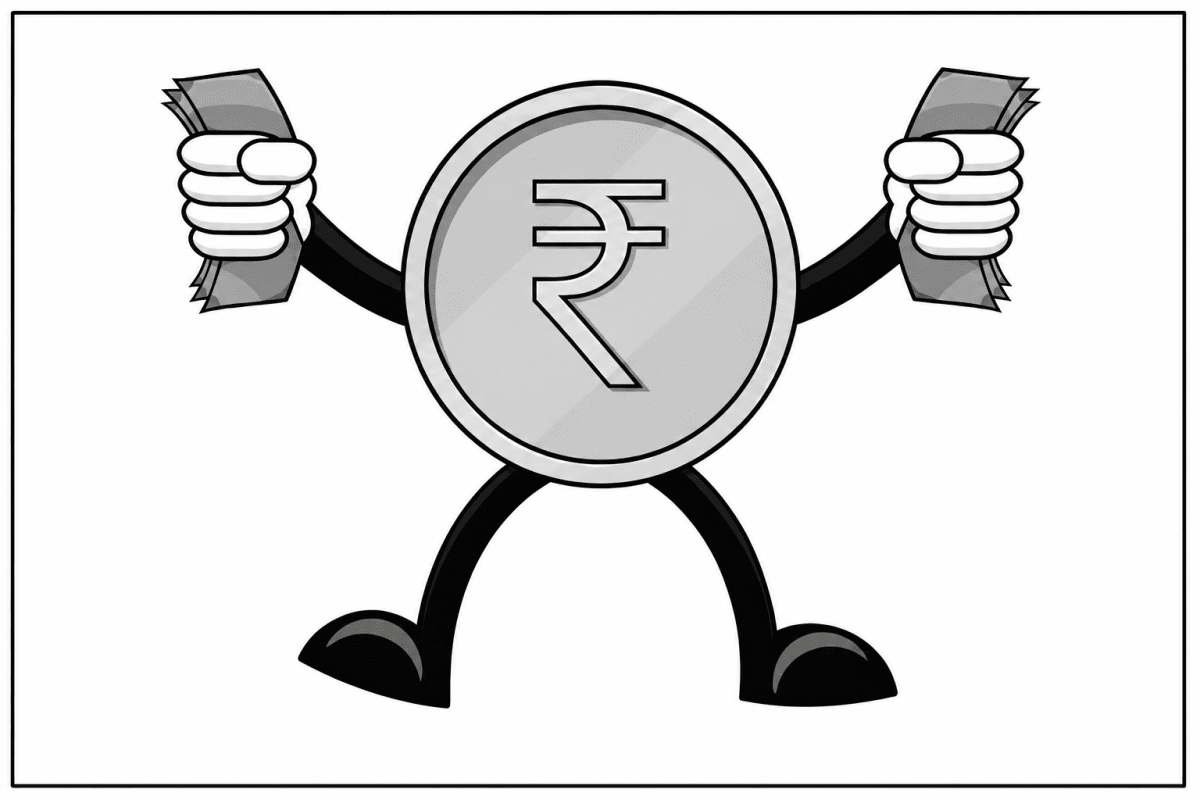
Which session of the Parliament is most associated with this picture?

Which session of the Parliament is most associated with this picture? 2026, ICSE 2026 History Solved Question Paper.
Show SolutionHide Solution↓

Budget Session

Reason — The picture symbolises the finances of the country. The Union Budget, containing the estimates of receipts and expenditure of the Government for a financial year, is introduced and considered during the Budget Session of Parliament.

1(iii)1 Mark · 2026 · Part I · 2026 PaperFull page

Given below are the details of a few Indian Citizens.

PersonAge (In years)Description
W30Is an army officer
X25Is a Union Leader
Y34Is a school Principal
Z69Is a retired Professor

Select the one who is eligible to be a Vice President.

Show SolutionHide Solution↓

Z

Reason — To be eligible for election as Vice-President, a person must be a citizen of India, must have completed 35 years of age, must be qualified for election as a member of the Rajya Sabha and must not hold any office of profit under the government. W (30 years), X (25 years) and Y (34 years) are all below the required age of 35 years. Z, aged 69 and retired, fulfils the age criterion and holds no office of profit. Hence, only Z is eligible.

1(iv)1 Mark · 2026 · Part I · 2026 PaperFull page

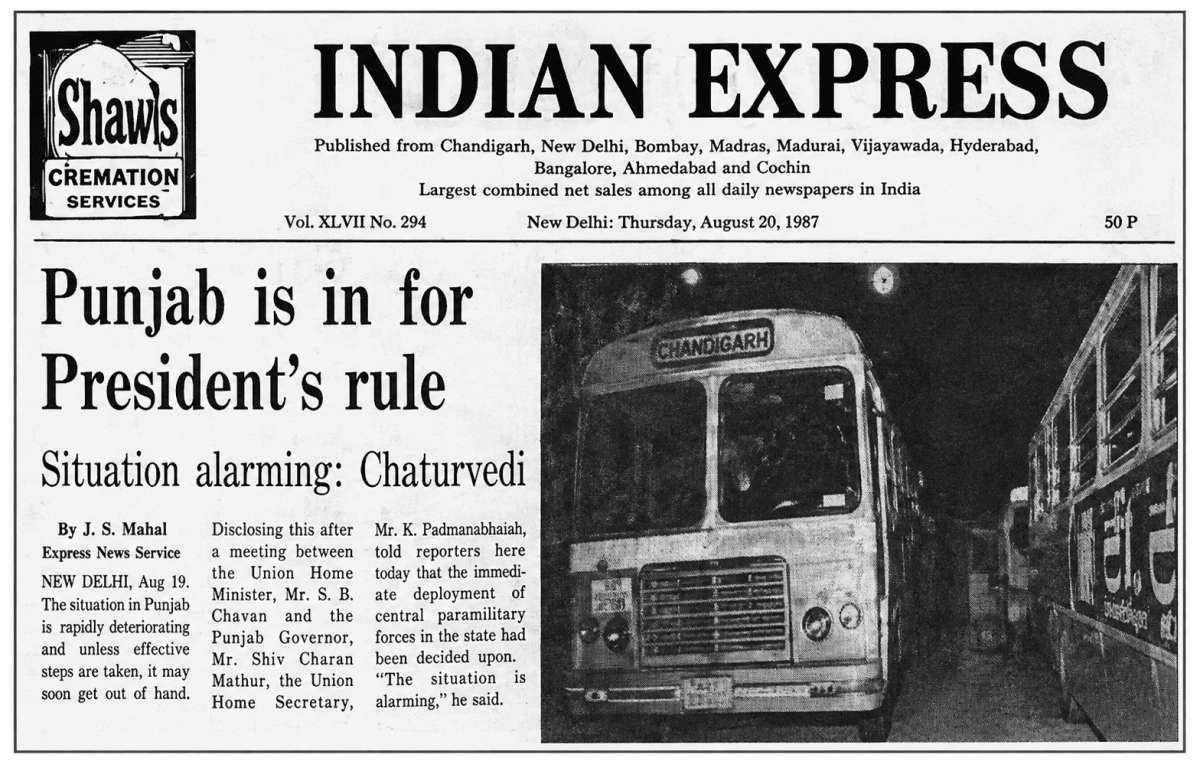
The rule mentioned in the headline below can be proclaimed in a state on the recommendation of ............... .

The rule mentioned in the headline below can be proclaimed in a state on the recommendation of................ 2026, ICSE 2026 History Solved Question Paper.
Show SolutionHide Solution↓

The Governor

Reason — The headline refers to President's Rule, which is proclaimed when there is a breakdown of the constitutional machinery in a State. On receipt of a report from the Governor of the State, if the President is satisfied that the governance of the State cannot be carried on in accordance with the provisions of the Constitution, he/she declares an emergency in that State. The President proclaims the rule but does not recommend it, while the Vice-President and the Chief Justice of India have no role in it.

1(v)1 Mark · 2026 · Part I · 2026 PaperFull page

Mr. Anand has been illegally detained by the police, and his family has not been able to meet him. The family members have approached the High Court for help. Which writ will the court issue in this case?

Show SolutionHide Solution↓

Habeas Corpus

Reason — Habeas Corpus means 'to have the body'. By issuing this writ, the High Court can order that a person who has been unlawfully detained be produced before it and released. It is therefore a safeguard for the personal freedom of a citizen.

1(vi)1 Mark · 2026 · Part I · 2026 PaperFull page

Identify the correct statements about the Lok Sabha.

P: Has no nominated members.
Q: Term can be extended during emergency.
R: Has two members nominated by the President.
S: Can be dissolved by the Speaker.

Show SolutionHide Solution↓

P and Q

Reason — The 104th Constitutional Amendment Act (2020) did away with the nomination of Anglo-Indians, so the Lok Sabha now has no nominated members. Hence P is correct and R is wrong. During the proclamation of an emergency, the term of the Lok Sabha may be extended by Parliament for one year at a time, so Q is correct. The Lok Sabha is dissolved by the President on the advice of the Prime Minister and not by the Speaker, so S is wrong.

1(vii)1 Mark · 2026 · Part I · 2026 PaperFull page

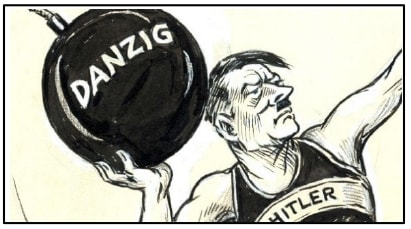
Assertion (A): Hitler attacked Poland to capture the Danzig Port.

Reason (R): Poland was accused of committing atrocities against the Germans.

Show SolutionHide Solution↓

Both (A) and (R) are true but (R) is not the correct explanation of (A).

Explanation — By the Treaty of Versailles, Germany was divided into two parts to give Poland a land-route to the sea and the Port of Danzig was given to Poland. As Danzig was inhabited mainly by Germans, Hitler invaded Poland in September 1939 to regain these lost territories. So (A) is true. Poland was also accused of committing atrocities against the Germans living there, so (R) is true as well. However, this accusation was a separate excuse put forward by Hitler and does not explain his aim of capturing the Danzig Port.

1(viii)1 Mark · 2026 · Part I · 2026 PaperFull page

Identify the option which shows the correct chronology of the following events:
1. The Lucknow Pact
2. The Surat Split
3. The establishment of the Muslim League

Show SolutionHide Solution↓

3-2-1

Reason — The All-India Muslim League was established on December 30, 1906, the Surat Split took place in 1907 and the Lucknow Pact was signed in 1916.

1(ix)1 Mark · 2026 · Part I · 2026 PaperFull page

Identify the odd one out of the following signatories of the Triple Entente.

Show SolutionHide Solution↓

Japan

Reason — The Triple Entente consisted of France, Russia and Britain. Japan was not a member of the Triple Entente, although it later fought on the Allied side during the First World War.

1(x)1 Mark · 2026 · Part I · 2026 PaperFull page

In the town of Sundar Nagar, the local government decided to cut down a large number of trees to build a shopping mall. The children were upset because the trees provided a place to play. A group of school students, decided to take action based on the lesson they had studied about the Early Nationalists.
Which of the following actions are they NOT likely to adopt?

Show SolutionHide Solution↓

Forcibly prevent workers sent by the Government.

Reason — The Early Nationalists followed Constitutional Agitation and relied on peaceful and lawful methods such as petitions, prayers, protests, meetings and the press. Forcibly preventing the workers would therefore be contrary to the methods followed by them.

1(xi)1 Mark · 2026 · Part I · 2026 PaperFull page

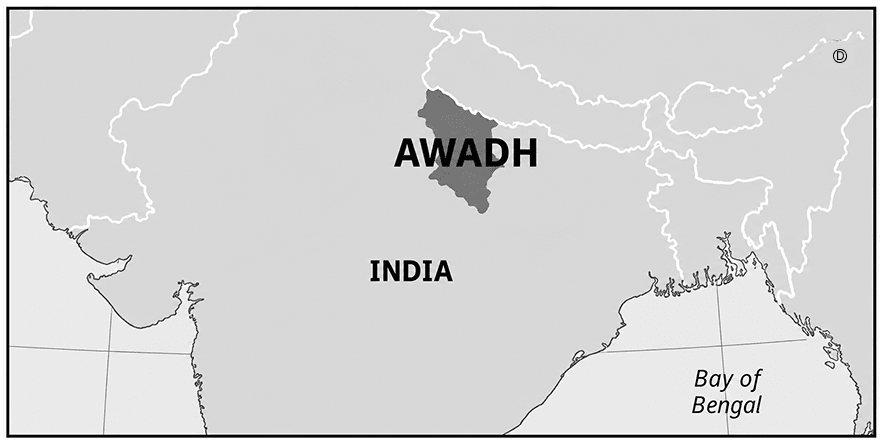
Under which policy of expansion was the place marked in the map annexed by the British?

Under which policy of expansion was the place marked in the map annexed by the British? 2026, ICSE 2026 History Solved Question Paper.
Show SolutionHide Solution↓

Pretext of misgovernance

Reason — The area marked on the map is Awadh. In 1856, Lord Dalhousie annexed Awadh to the Company's dominions on the pretext of alleged misrule. He declared that Awadh was being misgoverned and that British rule was needed to ensure proper administration.

1(xii)1 Mark · 2026 · Part I · 2026 PaperFull page

Identify the correct pair of words from the given options:

Show SolutionHide Solution↓

Subsidiary Alliance – Lord Wellesley

Reason — The Subsidiary Alliance was introduced in India by Lord Wellesley, so this pair is correct. The Doctrine of Lapse was applied by Lord Dalhousie and not by Lord Canning, while the Arms Act and the Vernacular Press Act (both 1878) were passed by Lord Lytton and not by Lord Curzon or Lord Dalhousie.

1(xiii)1 Mark · 2026 · Part I · 2026 Paper · 🔁 also 2024Full page

Which of the following is NOT a consequence of the Second World War?

Show SolutionHide Solution↓

Formation of the League of Nations

Reason — The League of Nations was established after the First World War. The defeat of the Axis Powers, the formation of the United Nations and the beginning of the Cold War were consequences of the Second World War.

1(xiv)1 Mark · 2026 · Part I · 2026 PaperFull page

Read the description and choose the correct option:
He was an Early Nationalist leader who presided over the second session of the Indian National Congress.

Show SolutionHide Solution↓

Dadabhai Naoroji

Reason — The second session of the Indian National Congress was held at Kolkata in 1886 under the Presidentship of Dadabhai Naoroji, an Early Nationalist leader. Gopal Krishna Gokhale was also an Early Nationalist but did not preside over this session, while Bipin Chandra Pal and Lokmanya Tilak were Assertive Nationalists.

1(xv)1 Mark · 2026 · Part I · 2026 PaperFull page

Which organ of the United Nations Organisation gives this special power to its permanent members?

Which organ of the United Nations Organisation gives this special power to its permanent members? 2026, ICSE 2026 History Solved Question Paper.
Show SolutionHide Solution↓

The Security Council

Reason — The cartoon shows the veto power. The Security Council has five permanent members and the negative vote of any one of them is called a veto. The Council is powerless to act if any permanent member uses this power. The General Assembly, the International Court of Justice and the Trusteeship Council do not have permanent members enjoying such a power.

1(xvi)1 Mark · 2026 · Part I · 2026 PaperFull page

The International Court of Justice has ............... judges.

Show SolutionHide Solution↓

15

Reason — The International Court of Justice is composed of 15 judges, each of a different nationality, elected for a term of nine years by the General Assembly and the Security Council sitting independently of each other. Elections are held every three years for one-third of the seats.

2(i)1 Mark · 2026 · Part I · 2026 PaperFull page

Mention any two reasons for the indirect election of the President.

Show SolutionHide Solution↓

Two reasons for the indirect election of the President are:

  1. If the President were to be elected directly by the people, he/she could become a rival centre of power to the Council of Ministers. This would go against the parliamentary system of government based on ministerial responsibility.
  2. If the President were elected only by the members of Parliament, he/she might become a nominee of the ruling party like the Prime Minister and would not adequately represent the States of the Union. Election through an Electoral College of elected MPs and MLAs ensures that the President represents the entire nation, including the States.
2(ii)1 Mark · 2026 · Part I · 2026 PaperFull page

Imagine you were part of the Indian National Army. Mention any two objectives of the army.

Show SolutionHide Solution↓

As a soldier of the Indian National Army, two of our main objectives were:

  1. To organise an armed revolution and to fight the British army with modern arms.
  2. To organise a Provisional Government of Free India so that all the forces could be mobilised effectively for the liberation of the country.
2(iii)1 Mark · 2026 · Part I · 2026 PaperFull page

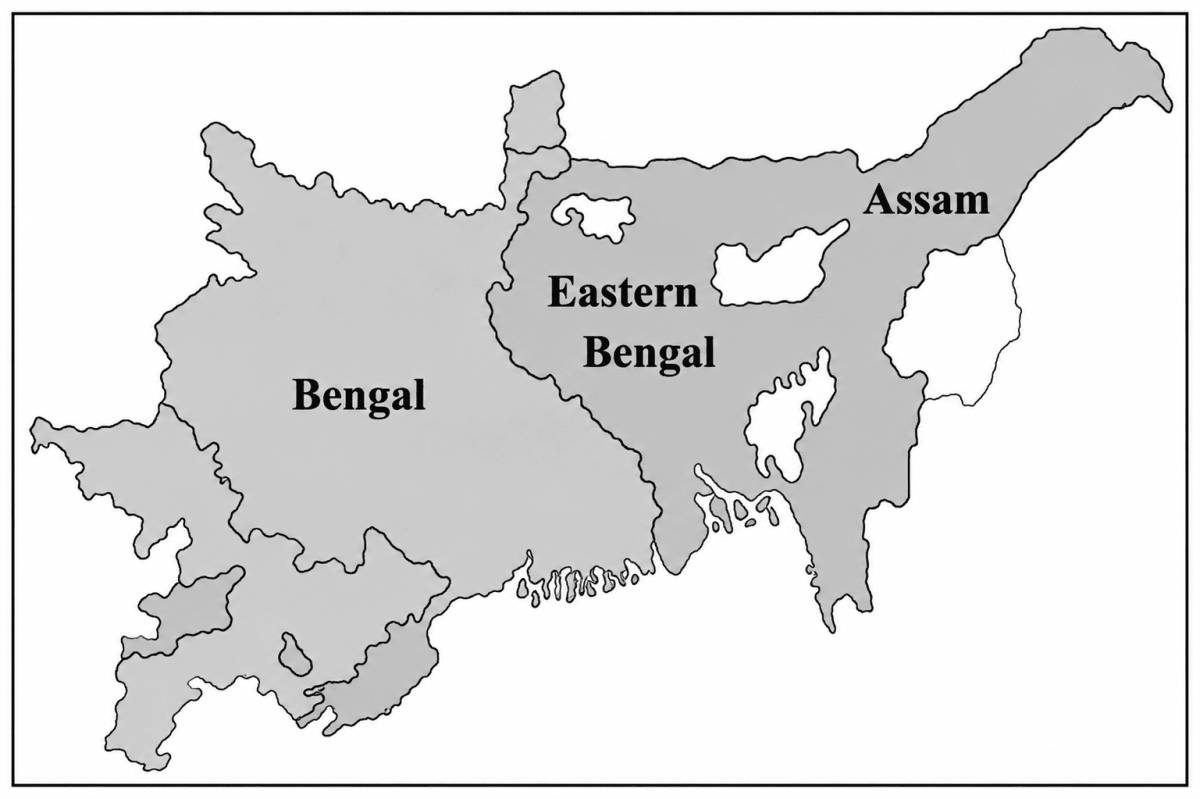
Look at the picture given and answer the question that follow.

Look at the picture given and answer the question that follow. In which year did this Partition happen? Who was responsible for this Partition? 2026, ICSE 2026 History Solved Question Paper.

In which year did this Partition happen? Who was responsible for this Partition?

Show SolutionHide Solution↓

The map shows the Partition of Bengal, which took place in the year 1905.

Lord Curzon, the then Viceroy of India, was responsible for this Partition.

2(iv)1 Mark · 2026 · Part I · 2026 PaperFull page

Mention any two objectives of the Muslim League.

Show SolutionHide Solution↓

Two objectives of the Muslim League were:

  1. To promote among the Muslims of India support for the British government and to remove any misconceptions regarding the intentions of the government in relation to Indian Muslims.
  2. To protect and advance the political rights and interests of the Muslims and to represent their needs and aspirations to the government in mild and moderate language.
2(v)1 Mark · 2026 · Part I · 2026 PaperFull page

UNESCO provides protection for great cultural institutions.
Mention any two ways in which it works towards the preservation of cultural heritage.

Show SolutionHide Solution↓

Two ways in which UNESCO works towards the preservation of cultural heritage are:

  1. It provides technical advice and assistance, equipment and funds for the preservation of monuments and other works of art. It has also prepared a World Heritage List to identify the monuments and sites which are to be protected.
  2. It aims to protect the world inheritance of books, works of art and rare manuscripts, and gives encouragement to artistic creations in literature and fine arts.
2(vi)1 Mark · 2026 · Part I · 2026 PaperFull page

Mention any two causes for the Second World War.

Show SolutionHide Solution↓

Two causes of the Second World War were:

  1. Dissatisfaction with the Treaty of Versailles — Its harsh and humiliating terms created resentment and a desire for revenge in Germany.
  2. Rise of Fascism and Nazism — Extreme nationalism under Mussolini and Hitler resulted in aggressive and expansionist policies.
2(vii)1 Mark · 2026 · Part I · 2026 PaperFull page

President Ramnath Kovind promulgates an Ordinance which will legally allow the farmers to sell their produce without restrictions across the country.

— The Times of India, 5th June 2020

When can the President introduce an Ordinance? When does an Ordinance become inoperative?

Show SolutionHide Solution↓

The President can promulgate an Ordinance when Parliament is not in session and circumstances make it necessary to take immediate action.

An Ordinance must be laid before Parliament when it reassembles. It becomes inoperative six weeks after the reassembly of Parliament, unless it is approved by Parliament before that period.

3Written · 2026 · Part II A · 2026 PaperFull page

The Union Parliament comprises the President and the two houses. With reference to this, answer the following questions:

(i) Mention any three powers which are common to both the houses of the Parliament.

(ii) Who elects the members of the Rajya Sabha? Mention any two exclusive powers to analyse the advantages of the Rajya Sabha.

(iii) The Parliament controls the functioning of the Executive. Mention any four ways in which it exercises control.

Show SolutionHide Solution↓

(i) The two Houses of Parliament enjoy equal power and status in the following matters:

  1. Legislative Powers — All Bills other than Money Bills may originate in either House, and no Bill can become a law unless it is passed by both the Houses.
  2. Judicial Powers — Both Houses have equal powers in the impeachment of the President and in the removal of the Judges of the Supreme Court and the High Courts. Impeachment can be initiated in either House and the other House has an equal say in the judgement.
  3. Amendment of the Constitution — An amendment must be passed by each House by a majority of its total membership and by a two-thirds majority of the members present and voting.

(ii) The members of the Rajya Sabha are elected by the elected members of the Legislative Assemblies of the States, in accordance with the system of proportional representation by means of a single transferable vote. The representatives of the Union Territories are chosen in such a manner as Parliament may prescribe.

Two exclusive powers of the Rajya Sabha are:

  1. The Rajya Sabha may, by a resolution supported by not less than two-thirds of the members present and voting, declare that Parliament should make laws on a matter in the State List in the national interest. This resolution can be passed only by the Rajya Sabha.
  2. The Rajya Sabha may similarly declare, by a two-thirds majority, that it is necessary in the national interest to create a new All-India Service, after which Parliament may create such a service.

(iii) Parliament exercises control over the Executive in the following ways:

  1. Interpellation — Devices such as the Question Hour, Calling Attention Notices and Half-an-Hour Discussion enable members to seek information from the government about its policies and performance.
  2. Vote of No-Confidence — The Council of Ministers is collectively responsible to the Lok Sabha. If a No-Confidence Motion is passed, the government has to resign.
  3. Other Motions of Censure — An Adjournment Motion, a censure motion against a minister, the rejection of a Government Bill or the passing of a private member's Bill against the wishes of the Government all amount to no-confidence in the government.
  4. Monetary Control — During the budget session a cut motion may be moved. The Parliamentary Committee on Public Accounts examines the reports of the Comptroller and Auditor-General of India and ensures that public money is spent in accordance with Parliament's decisions.
4Written · 2026 · Part II A · 2026 PaperFull page

The Prime Minister is the executive head of the country. With reference to the Prime Minister and his Cabinet, answer the following questions:

(i) On whose advice are the Cabinet Ministers appointed? Name the other two categories of the Council of Ministers.

(ii) What is meant by the term collective responsibility of the Council of Ministers?

(iii) The Prime Minister is central to the life of the Cabinet.
Justify this statement by mentioning any four powers of the Prime Minister with reference to the Cabinet.

Show SolutionHide Solution↓

(i) The Cabinet Ministers are appointed by the President on the advice of the Prime Minister. The Prime Minister selects his/her senior and trustworthy colleagues and advises the President to appoint them.

The other two categories of the Council of Ministers are Ministers of State and Deputy Ministers.

(ii) Under Article 75(3) of the Constitution, the Council of Ministers is collectively responsible to the Lok Sabha. The principle of collective responsibility implies the following:

  1. The decisions taken in the meetings of the Cabinet are equally applicable to all the Ministers, even though they may differ among themselves on a particular policy.
  2. All Ministers jointly share the responsibility for the government's policies and performance. They must function as a team in supporting and defending government policies inside as well as outside Parliament.
  3. A Vote of No-Confidence against one Minister is a vote against the whole Ministry. A Ministry that has lost the confidence of the Lok Sabha has to resign.

(iii) The Prime Minister is central to the life of the Cabinet because of the following powers:

  1. Leader of the Cabinet — The Prime Minister is the head of the Cabinet. The Constitution makes no provision for the appointment of different categories of Ministers, so it is the Prime Minister who decides these matters.
  2. Power to Select and Dismiss Ministers — The Prime Minister chooses the Ministers and recommends their names to the President. He/She can also ask an erring Minister to resign.
  3. Power to Allocate Portfolios and Reshuffle the Council of Ministers — It is the Prime Minister who allocates departments or portfolios to the Ministers and he/she can reshuffle the Council of Ministers whenever he/she pleases.
  4. Power to Direct and Coordinate Policy — The Prime Minister coordinates the working of the various departments so that administration is carried on smoothly. Moreover, the Prime Minister's resignation implies the resignation of the whole Cabinet.
5Written · 2026 · Part II A · 2026 PaperFull page

The single integrated system of judiciary has the Supreme Court at the apex. With reference to the Supreme Court, answer the following questions:

(i) What is the term of the Supreme Court Judge? Mention any two qualifications required for a person to be a Supreme Court Judge.

(ii) Mention any three ways in which the Constitution ensures the independence of the Judiciary.

(iii) Explain the following terms:

Show SolutionHide Solution↓

(i) A Judge of the Supreme Court holds office until he/she attains the age of 65 years.

Two qualifications required for a person to be appointed as a Judge of the Supreme Court are — he/she must be a citizen of India, and:

  1. He/She should have been a Judge of a High Court, or of two or more such courts in succession, for at least five years; or
  2. He/She should have been an advocate of a High Court, or of two or more such courts in succession, for at least ten years.

(ii) The Constitution ensures the independence of the Judiciary in the following ways:

  1. Security of Tenure — A Judge remains in office till the age of 65 years and can be removed by the President only on the ground of proved misbehaviour or incapacity, through the difficult process of impeachment.
  2. Security of Salaries and Service Conditions — The salaries and allowances of the Judges are charged on the Consolidated Fund of India and are not subject to the vote of Parliament. They cannot be changed to the disadvantage of the Judges during their term of office.
  3. Prohibition of Practice after Retirement — The Judges are not allowed to practise after their retirement, so that they are not obliged during their tenure to any prospective employer and cannot influence their former colleagues.

(iii)
(a) Advisory Jurisdiction — The Supreme Court has the power to give its opinion on any question of law or fact of public importance which is referred to it by the President of India. Such an opinion is only advisory; it is not binding on the government, nor is it executable as a judgement of the Supreme Court.

(b) Judicial Review — The Supreme Court has the power to review the laws passed by the Union or the State legislatures and the orders of the executive. It can declare a law 'ultra vires', i.e., null and void, if it goes against the letter and spirit of the Constitution or contravenes any of its provisions.

6Written · 2026 · Part II B · 2026 PaperFull page

The 1857 Revolt is also referred to as the Sepoy Mutiny by the British. With reference to the role played by the soldiers, answer the following questions:

(i) What was the General Service Enlistment Act? Why were soldiers unhappy with it?

(ii) How did the introduction of the new Enfield Rifle become an immediate cause of the revolt?

(iii) The British reformed the army after the revolt ended.
Mention any four changes made in the army.

Show SolutionHide Solution↓

(i) The General Service Enlistment Act was passed by the British Parliament in 1856. According to this Act, Indian soldiers could be sent overseas on duty.

The soldiers were unhappy with it because, according to traditional belief, crossing the seas was a taboo, especially for a Brahmin. The Act did not take into account the religious sentiments of the Indian soldiers. The Brahmin soldiers saw in it a danger to their caste, and this led to a strong feeling of resentment among them.

(ii) In 1856, the British authorities decided to replace the old-fashioned musket, called the Brown Bess, with the new Enfield rifle. The loading process of the Enfield rifle involved bringing the cartridge to the mouth and biting off the top greased paper with the teeth.

In January 1857, a rumour spread in the Bengal regiments that the greased cartridge contained the fat of the cow and the pig. As the cow is sacred to the Hindus and the pig is a taboo for the Muslims, the sepoys were convinced that the introduction of the greased cartridges was a deliberate move to defile Hindu and Muslim religions. Both Hindu and Muslim soldiers refused to use these cartridges and staged an uprising when they were forced to use them. Thus, it became the immediate cause of the Revolt.

(iii) Four changes made in the Indian army after the Revolt were:

  1. The strength of European troops in India was increased and the ratio of European to Indian troops was fixed at 1:2 in the Bengal army and 2:5 in the Madras and Bombay armies. The general principle adopted was that the number of Indian sepoys should not exceed twice that of the European troops.
  2. European troops were kept in key geographical and military positions.
  3. Sophisticated weapons and ammunition were never placed under the charge of Indians, and all Indian artillery units, with the exception of a few mountain units, were disbanded.
  4. Newspapers, journals and nationalist publications were prevented from reaching the soldiers, so as to keep the Indian army separated from the life of the rest of the population.
7Written · 2026 · Part II B · 2026 PaperFull page

Mahatma Gandhi with his principle of Non-violence, changed the direction of the freedom movement. With reference to the Gandhian Movements, answer the following:

(i) Who launched the Khilafat Movement in India? Mention two other causes of the Non-Cooperation Movement.

(ii) Mention any three points to analyse the impact of the Non-Cooperation Movement.

(iii) Mention any four clauses of the Gandhi-Irwin Pact.

Show SolutionHide Solution↓

(i) The Khilafat Movement was launched in India by the Ali Brothers — Maulana Mohammed Ali and Maulana Shaukat Ali.

Two other causes of the Non-Cooperation Movement were:

  1. The Rowlatt Act (1919) — This Act authorised the Government to arrest a person without a warrant, hold trials in seclusion and imprison a person without trial. It came as a sudden blow to the Indians who were expecting self-governance.
  2. The Jallianwala Bagh Tragedy — On April 13, 1919, General Dyer ordered his troops to fire on a large but peaceful crowd gathered at Jallianwala Bagh in Amritsar. About a thousand innocent people were killed. The British government further refused to annul the Rowlatt Act or make amends for the atrocities in Punjab.

(ii) The Non-Cooperation Movement made a deep impact in the following ways:

  1. The National Movement Became a Mass Movement — For the first time in history, the national movement acquired a real mass base, with the participation of peasants, workers, students, teachers and women.
  2. It Instilled Confidence Among the People — The movement generated a desire for freedom and gave the people a new sense of self-confidence and self-esteem to openly defy the foreign rulers.
  3. It Fostered Hindu-Muslim Unity — The merger of the Khilafat issue with the Non-Cooperation Movement brought Hindus and Muslims together in the national struggle.

(iii) Four clauses of the Gandhi-Irwin Pact, signed in March 1931, were:

  1. The Government agreed to withdraw all ordinances and end prosecutions.
  2. The Government agreed to release all political prisoners, except those guilty of violence.
  3. The Government agreed to permit the free collection or manufacture of salt by persons living near the seacoast.
  4. The Congress agreed to suspend the Civil Disobedience Movement.
8Written · 2026 · Part II B · 2026 PaperFull page

Read the passage given below and answer the questions that follow:

India's last Viceroy released a plan on the country's independence from the British on June 3, 1947. The plan came to be celebrated as the 'last plan for independence'. He was appointed Viceroy to India to speed up the process of transfer of power by the then British Prime Minister Clement Atlee.

hindustantimes.com, June 3, 2021 [edited]

(i) Identify the Viceroy. Mention any two terms of his plan with reference to the Princely States.

(ii) Mention any three reasons given by the Congress to justify the acceptance of the plan.

(iii) Mention any four provisions of the Indian Independence Act of 1947.

Show SolutionHide Solution↓

(i) The Viceroy referred to in the passage is Lord Mountbatten.

Two terms of his plan with reference to the Princely States were:

  1. The treaties which the British had made with the Princely States would come to an end, i.e., British paramountcy over them would lapse.
  2. The Princely States would be free to associate themselves with either of the two Dominions — India or Pakistan — or to remain independent.

(ii) Three reasons given by the Congress to justify the acceptance of the Mountbatten Plan were:

  1. The large-scale communal riots that engulfed the whole country convinced the leaders that the only solution to the communal problem lay in the Partition of India.
  2. The Muslim League had joined the Interim Government to obstruct and not to cooperate. The experience of working with the League had convinced the Congress that it could not have a joint administration with it.
  3. The only alternative to Partition was a federation with a weak Centre. The leaders felt that a smaller India with a strong central authority was better than a bigger State with a weak Centre, and that any further delay in the transfer of power could find India in the midst of a civil war.

(iii) Four provisions of the Indian Independence Act, 1947 were:

  1. Two New Dominions — India would be partitioned and two independent Dominions, India and Pakistan, would be created from August 15, 1947. The exact boundaries of the two Dominions would be determined by a Boundary Commission.
  2. Governor-General for Each Dominion — There would be a Governor-General for each Dominion, appointed by the British King on the advice of the Cabinet of the concerned Dominion. This arrangement would work till the framing of the Constitutions.
  3. Constituent Assemblies to Serve as Central Legislatures — The Constituent Assemblies of both the Dominions were to act as the Central Legislatures with full powers to make laws for their respective Dominions, and would act as sovereign bodies for legislative purposes.
  4. End of the Jurisdiction of the British Parliament — The legislative authority of the British Parliament would cease from August 15, 1947, and the British monarch would give up the use of the title 'Emperor of India'.
9Written · 2026 · Part II B · 2026 PaperFull page

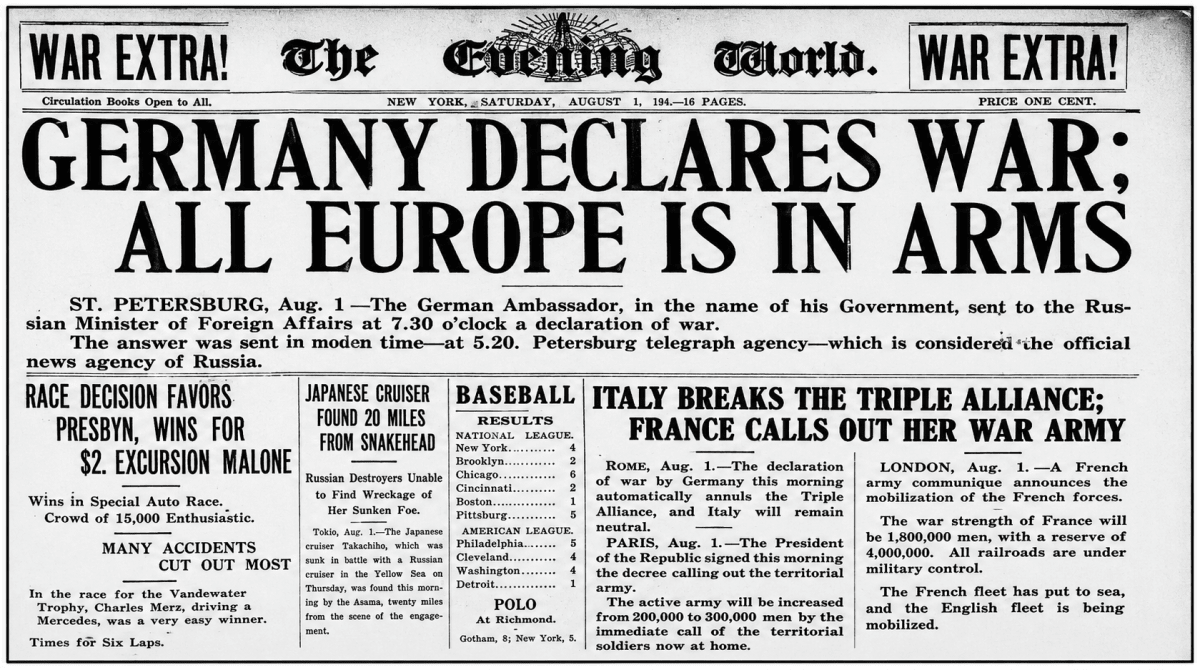
Look at the picture given and answer the following questions:

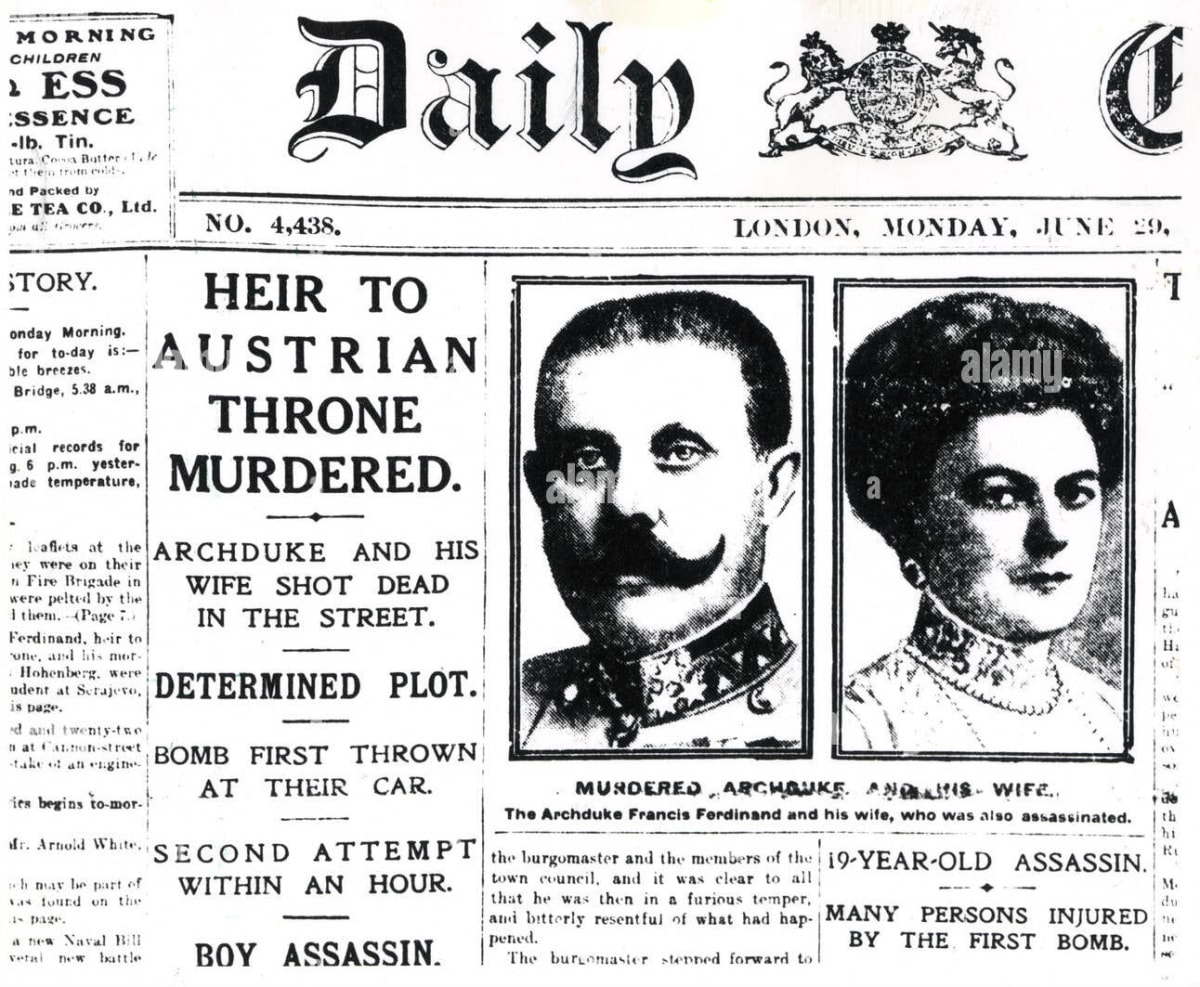
Look at the picture given and answer the following questions:. 2026, ICSE 2026 History Solved Question Paper.

(i) Explain the immediate cause of the war associated with this headline.

(ii) According to the Treaty of Versailles, mention the following:

(iii) Name the two dictators who rose in Europe after this war. Mention any two common causes for the rise of dictatorship.

Show SolutionHide Solution↓

(i) The immediate cause of the First World War was the Sarajevo Crisis. Archduke Francis Ferdinand, heir to the throne of Austria-Hungary, was assassinated at Sarajevo on June 28, 1914. Austria served an ultimatum on Serbia, and when Serbia did not accept all its demands, Austria declared war on Serbia on July 28, 1914. The alliance system soon drew the other European powers into the war.

(ii)
(a) The war reparation imposed on Germany was fixed at 33 billion US dollars.

(b) Two ways in which France benefitted from the Treaty were:

  1. Germany lost Alsace-Lorraine to France.
  2. The coal mines in the German area called Saar were ceded to France for 15 years, the area itself being governed by the League of Nations.

(iii) The two dictators who rose in Europe after this war were Benito Mussolini in Italy and Adolf Hitler in Germany.

Two common causes for the rise of dictatorship were:

  1. Discontentment after the Treaty of Versailles — Italy did not receive the territories she had hoped for, while Germany was humiliated by the harsh terms of the Treaty. This bitterness gave rise to a spirit of revenge and aggressive nationalism in both countries.
  2. Economic Crisis — Both countries suffered heavy losses of life and property in the First World War. Trade and commerce were ruined, leading to large-scale unemployment and a shortage of food grains. The people therefore looked towards a strong leader who could solve their problems.
10Written · 2026 · Part II B · 2026 PaperFull page

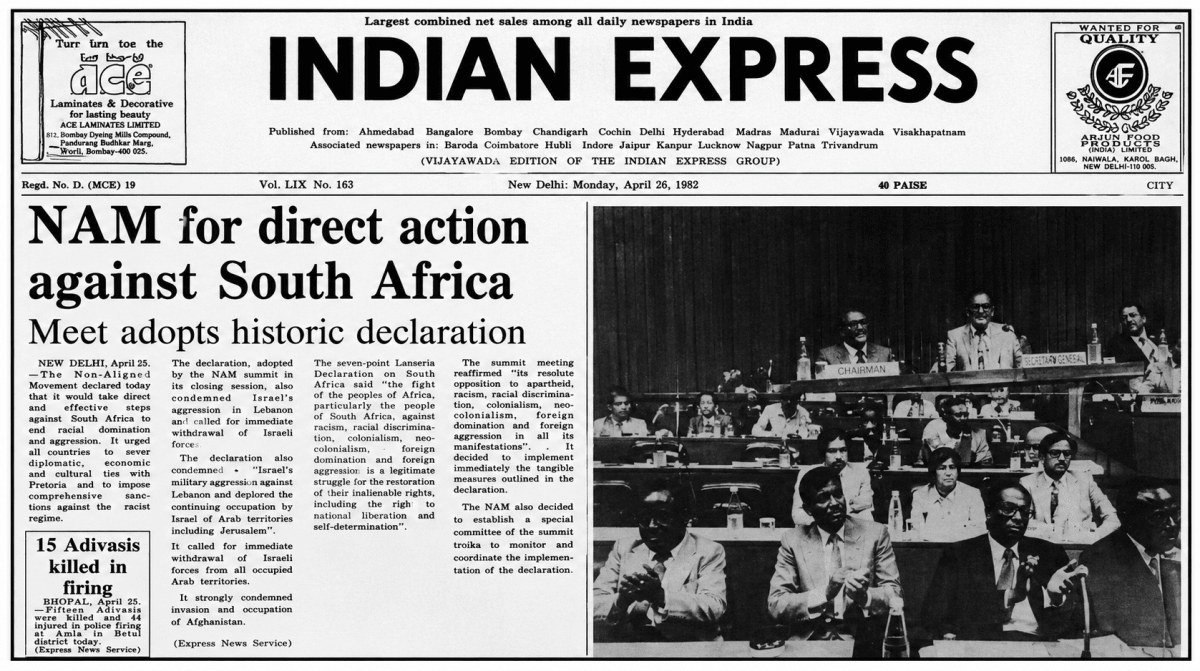
The United Nations Organisation and the Non-Aligned Movement emerged after the Second World War. With reference to these, answer the following questions:

(i) Mention any three objectives of the United Nations Organisation.

(ii) The General Assembly is the deliberative organ of the United Nations. Mention any three functions of the General Assembly to analyse this statement.

(iii) With reference to the Non-Aligned Movement, mention:

Show SolutionHide Solution↓

(i) Three objectives of the United Nations Organisation are:

  1. To maintain international peace and security, and to take collective measures for the prevention and removal of threats to peace and for the suppression of acts of aggression.
  2. To develop friendly relations among nations based on respect for the principle of equal rights and self-determination of people.
  3. To achieve international cooperation in solving international economic, social, cultural or humanitarian problems, and to encourage respect for human rights and fundamental freedoms.

(ii) The General Assembly is the main deliberative organ of the United Nations, as is shown by the following functions:

  1. It discusses any question relating to international peace and security and, except where the dispute is currently being discussed by the Security Council, makes recommendations on it.
  2. It discusses and makes recommendations on any question within the scope of the Charter or affecting the powers and functions of any organ of the United Nations.
  3. It considers and makes recommendations on the principles of cooperation in the maintenance of international peace and security, and initiates studies to promote international political, social and economic cooperation.

(iii)
(a) Two architects of the Non-Aligned Movement were Pandit Jawaharlal Nehru of India and President Joseph Broz Tito of Yugoslavia. (President Gamal Abdel Nasser of Egypt was the third founding father.)

(b) Two objectives of the Non-Aligned Movement were:

  1. To oppose colonialism, imperialism and racial discrimination, and to protect the newly won freedom of the independent countries of Asia and Africa from colonial domination.
  2. To advocate the peaceful settlement of international disputes and to oppose the use of force and of nuclear weapons.
1(i)1 Mark · 2026 · Part I · 2026 ImprovementFull page

Choose the correct option to replace the underlined word:

The Sessions Court deals with civil cases.

Show SolutionHide Solution↓

criminal

Reason — The Sessions Court belongs to the criminal courts of the district. The same judge is called the District Judge when he decides civil cases and the Sessions Judge when he decides criminal cases. Cases relating to land, property, money transactions, marriage and divorce go to the civil courts, while the assessment and collection of land revenue is dealt with by the courts of revenue.

1(ii)1 Mark · 2026 · Part I · 2026 ImprovementFull page

In which months will the session associated with the picture given below be conducted?

In which months will the session associated with the picture given below be conducted? Improvement 2026, ICSE 2026 Improvement History Solved Question Paper.
Show SolutionHide Solution↓

February-May

Reason — The picture refers to the Budget, which is passed during the Budget session held from February to May. Of the three sessions normally held each year, the Monsoon session is conducted in July-August and the Winter session in November-December.

1(iii)1 Mark · 2026 · Part I · 2026 ImprovementFull page

Given below are details of a few Indian citizens.
Select the person who fulfils the eligibility criteria to become a member of the Rajya Sabha.

PersonAge [In years]Description
W53Is holding an office of profit
X25Is a famous sports personality
Y29Is a teacher
Z59Is a famous musician
Show SolutionHide Solution↓

Z

Reason — A member of the Rajya Sabha must be an Indian citizen, must be at least 30 years of age and must not hold any office of profit under the government. Z, aged 59, satisfies all these conditions. W is disqualified because he holds an office of profit, while X and Y are both below the minimum age of 30 years.

1(iv)1 Mark · 2026 · Part I · 2026 ImprovementFull page

Identify the type of Emergency declared in the article given below.

Identify the type of Emergency declared in the article given below. Improvement 2026, ICSE 2026 Improvement History Solved Question Paper.
Show SolutionHide Solution↓

General Emergency

Reason — A National or General Emergency is declared when the security of India or a part of it is threatened by war, external aggression or armed rebellion. It is different from an Emergency caused by the failure of constitutional machinery in a State.

1(v)1 Mark · 2026 · Part I · 2026 ImprovementFull page

Identify the correct statements about the sessions of the Parliament.

P: There are three sessions of the Parliament.
Q: The gap between two sessions must be seven months.
R: The house has to meet at least twice a year.
S: The house has to compulsorily meet thrice a year.

Show SolutionHide Solution↓

P and R

Reason — Normally there are three sessions of Parliament in a year — the Budget, the Monsoon and the Winter Session — and each House must meet at least twice a year. Q is incorrect because the interval between two consecutive sessions must not be more than six months. S is incorrect because meeting three times a year is the usual practice and not a constitutional requirement.

1(vi)1 Mark · 2026 · Part I · 2026 ImprovementFull page

A High Court judge retires at the age of ............... years.

Show SolutionHide Solution↓

62

Reason — A judge of a High Court enjoys security of tenure and can remain in office till he/she attains the age of 62 years. Neither an additional nor an acting judge can hold office beyond this age. The age of 65 years is the retirement age for a judge of the Supreme Court.

1(vii)1 Mark · 2026 · Part I · 2026 ImprovementFull page

Assertion (A): Gandhi suspended the Non-Cooperation Movement.
Reason (R): The protesting mob turned violent at Chauri Chaura.

Show SolutionHide Solution↓

Both (A) and (R) are true and (R) is the correct explanation of (A).

Explanation — At Chauri Chaura in Gorakhpur district, on February 4, 1922, a procession of peasants was fired upon by the police. The infuriated demonstrators set the police station on fire, killing 22 policemen. Gandhiji, a firm believer in Ahimsa, was greatly shocked and called off the whole movement on February 12, 1922. The violence at Chauri Chaura was therefore the direct reason for the suspension of the Non-Cooperation Movement.

1(viii)1 Mark · 2026 · Part I · 2026 ImprovementFull page

Identify the ODD one out of the countries which were part of the Axis Powers.

Show SolutionHide Solution↓

Austria

Reason — Germany, Italy and Japan formed the Berlin-Rome-Tokyo Axis and were known as the Axis Powers during the Second World War. Austria was not a member of the Axis Powers; it was annexed by Germany in 1938.

1(ix)1 Mark · 2026 · Part I · 2026 ImprovementFull page

Identify the option which shows the correct chronology of the following events:
1. The Annexation of Awadh
2. The Cabinet Mission Proposal
3. The Formation of Congress

Show SolutionHide Solution↓

1-3-2

Reason — Awadh was annexed by the British on the pretext of misrule in 1856, the Indian National Congress was formed in 1885, and the Cabinet Mission came to India with its proposals in 1946.

1(x)1 Mark · 2026 · Part I · 2026 ImprovementFull page

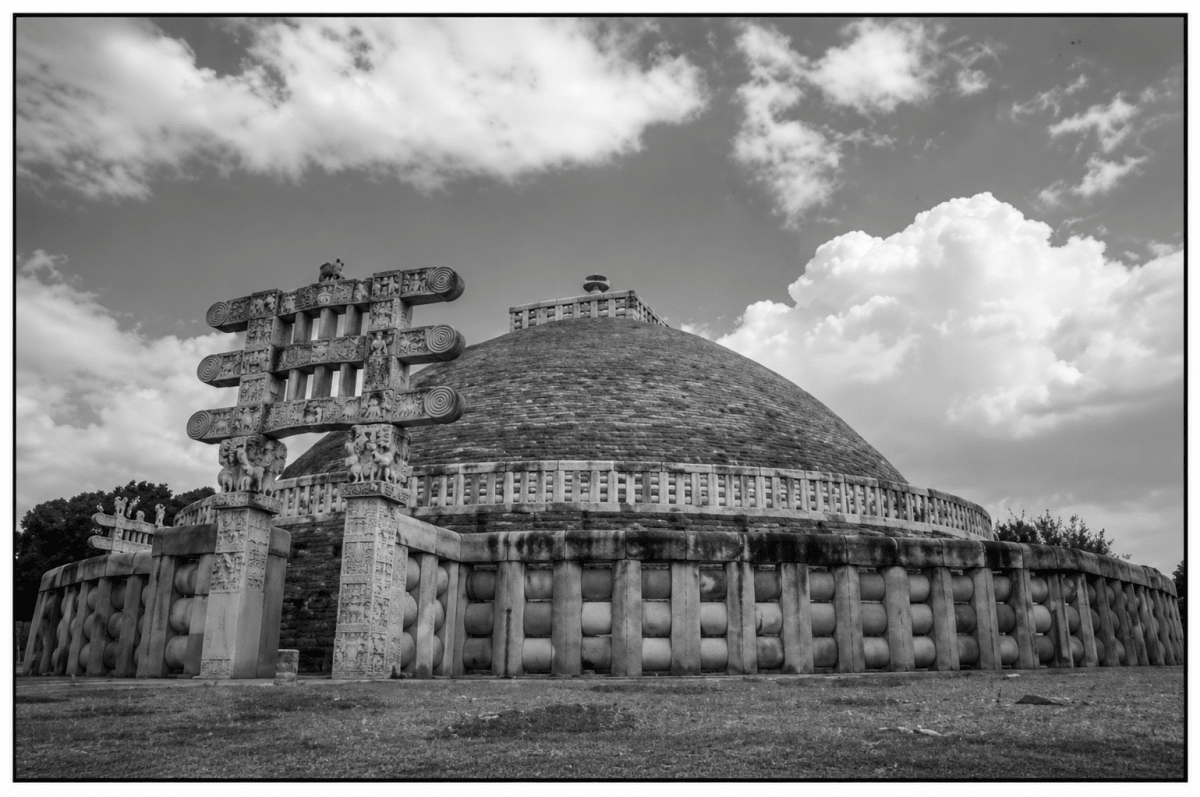
Which of the following organisations is connected with the given picture?

Which of the following organisations is connected with the given picture? Improvement 2026, ICSE 2026 Improvement History Solved Question Paper.
Show SolutionHide Solution↓

UNESCO

Reason — The picture shows the Sanchi Stupa, a site of cultural heritage. UNESCO prepares the World Heritage List to identify monuments and sites that are to be protected, and provides technical advice, assistance, equipment and funds for their preservation.

1(xi)1 Mark · 2026 · Part I · 2026 ImprovementFull page

In the riverside town of Kamalpur, British traders had recently taken control of the textile market after the colonial government introduced heavy taxes on locally produced goods. As a result, Indian weavers began losing their livelihood, and imported British products became cheaper and more widely used. A young college student named Anita began encouraging people to stop buying foreign cloth and instead support local artisans. She also helped set up small groups where villagers learned to spin yarn and produce homemade goods.
Which of the following principles of the Assertive Nationalists is Anita following?

Show SolutionHide Solution↓

Swadeshi and Boycott

Reason — Swadeshi encouraged the use of goods produced in India, while Boycott meant refusing to buy foreign goods. Anita follows both principles by promoting homemade goods and asking people to stop buying foreign cloth.

1(xii)1 Mark · 2026 · Part I · 2026 ImprovementFull page

Identify the correct pair of words from the given options.

Show SolutionHide Solution↓

Nehru – Non-Aligned Movement

Reason — Jawaharlal Nehru was one of the architects and leading advocates of the Non-Aligned Movement. The Indian National Army is associated with Subhas Chandra Bose, the last Viceroy of India was Lord Mountbatten, and the League of Nations was formed after the First World War.

1(xiii)1 Mark · 2026 · Part I · 2026 ImprovementFull page

Read the description and identify the person.
He was a famous early nationalist also known as the mentor of Gandhi.

Show SolutionHide Solution↓

Gopal Krishna Gokhale

Reason — Gopal Krishna Gokhale was an Early Nationalist and Gandhiji regarded him as his political mentor. Lala Lajpat Rai was an Assertive Nationalist, W. C. Bonnerjee was the first President of the Congress, and A. O. Hume was the founder of the Indian National Congress.

1(xiv)1 Mark · 2026 · Part I · 2026 ImprovementFull page

Which one of the following countries was part of the Triple Alliance?

Show SolutionHide Solution↓

Germany

Reason — Germany entered into an alliance with Austria-Hungary, and in 1882 Italy joined it, forming the Triple Alliance. France, Russia and England came together in the Triple Entente in 1907 to counter this alliance.

1(xv)1 Mark · 2026 · Part I · 2026 ImprovementFull page

What is the term of the judges of the organisation seen in the picture given below?

What is the term of the judges of the organisation seen in the picture given below? Improvement 2026, ICSE 2026 Improvement History Solved Question Paper.
Show SolutionHide Solution↓

9 years

Reason — The picture shows the International Court of Justice, which is composed of 15 judges elected to nine-year terms of office by the United Nations General Assembly and the Security Council sitting independently of each other. Elections are held every three years for one-third of the seats, and retiring judges may be re-elected.

1(xvi)1 Mark · 2026 · Part I · 2026 ImprovementFull page

Which of the following statements describes the composition of the General Assembly?

Show SolutionHide Solution↓

All member nations

Reason — All members of the United Nations are members of the General Assembly. Each State has five representatives in the Assembly, but each State has only one vote. It is the Security Council which consists of fifteen members, of whom five are permanent and ten are non-permanent.

2(i)1 Mark · 2026 · Part I · 2026 ImprovementFull page

What are the two benefits of the establishment of the Lok Adalat?

Show SolutionHide Solution↓

Two benefits of the establishment of the Lok Adalat are:

  1. Lok Adalats deliver fast and inexpensive justice. There is no court fee payable, and any person can move a Lok Adalat by an application on plain paper and expect speedy justice.
  2. Lok Adalats reduce the workload of the other courts, enabling them to deal with more serious matters. This reduces delays in the higher courts.
2(ii)1 Mark · 2026 · Part I · 2026 ImprovementFull page

Imagine your country was a member of the League of Nations in 1920. Mention any two objectives you would have to follow.

Show SolutionHide Solution↓

As a member of the League of Nations in 1920, my country would have to follow these two objectives:

  1. All States were to refer their mutual disputes, if any, to the League of Nations for a peaceful settlement.
  2. The member-States were to take necessary action as directed by the League against any State which tried to disturb world peace and order.
2(iii)1 Mark · 2026 · Part I · 2026 ImprovementFull page

It was a mere adjustment of boundaries for better administration.

— Lord Curzon

What event is this above statement explaining? In which year did it happen?

Show SolutionHide Solution↓

The statement is explaining the Partition of Bengal, which Lord Curzon justified on the ground of administrative convenience.

It happened in the year 1905.

2(iv)1 Mark · 2026 · Part I · 2026 ImprovementFull page

Mention any two objectives of the Forward Bloc.

Show SolutionHide Solution↓

Two objectives of the Forward Bloc are:

  1. Liberation of India with the support of workers, peasants, youth, and other organizations.
  2. After independence, establishment of a socialist state through measures such as reorganisation of agriculture and industry on socialist lines and abolition of the Zamindari system.
2(v)1 Mark · 2026 · Part I · 2026 ImprovementFull page

Hitler wanted to capture the Danzig Port. Give two reasons for the same.

Show SolutionHide Solution↓

Two reasons why Hitler wanted to capture the Danzig Port are:

  1. The Treaty of Versailles separated Germany from East Prussia by giving Poland a corridor to the Baltic Sea and placed Danzig under a separate arrangement. Hitler wanted to recover the territories lost by Germany.
  2. Danzig had a predominantly German population, and Hitler wanted to bring Danzig back under German control.
2(vi)1 Mark · 2026 · Part I · 2026 ImprovementFull page

Identify the leader shown in the given image. Which group of Congress did he belong to?

Identify the leader shown in the given image. Which group of Congress did he belong to? Improvement 2026, ICSE 2026 Improvement History Solved Question Paper.
Show SolutionHide Solution↓

The leader shown in the image is Dadabhai Naoroji.

He belonged to the Early Nationalists (Moderates) group of the Congress.

2(vii)1 Mark · 2026 · Part I · 2026 ImprovementFull page

No confidence motions have been moved in Lok Sabha 27 times in the past, and all of them have either been defeated or remained inconclusive, data compiled by a think tank shows.

— The Times of India, July 26, 2023

Who can move the above motion? What happens if this motion is passed?

Show SolutionHide Solution↓

A No-Confidence Motion can be moved by a member of the Opposition in the Lok Sabha.

If the motion is passed, the Government loses the confidence of the Lok Sabha and the Prime Minister along with the entire Council of Ministers has to resign.

3Written · 2026 · Part II A · 2026 ImprovementFull page

With reference to the Parliament, answer the following questions:

(i) What is meant by the term quorum? What is the quorum of the Indian Parliament? What action can the Speaker take if the quorum is not met?

(ii) Mention the three legislative powers of the Parliament.

(iii) Mention any four exclusive powers of the Lok Sabha.

Show SolutionHide Solution↓

(i) Quorum — The quorum means the minimum number of members required to be present in the House to enable it to transact its business.

The quorum of the Lok Sabha and the Rajya Sabha is one-tenth of the total membership of each House. This means that the House cannot conduct its proceedings and pass Bills and resolutions without the presence of at least one-tenth of its total membership.

If the quorum is not met, the Speaker may adjourn the House or suspend the sitting until there is a requisite quorum.

(ii) Three legislative powers of the Parliament are:

  1. Matters in the Union List — The Parliament has exclusive powers to make laws on all the subjects mentioned in the Union List, including important subjects like Defence, Banking, Communications and Foreign Affairs.
  2. Matters in the Concurrent List — Along with the State Legislative Assemblies, the Parliament can make laws on subjects listed in the Concurrent List, such as education, forests, adoption, succession and trade unions. If there is a conflict between the two, the Union law prevails.
  3. Residuary Powers — The Parliament can make laws with respect to all those matters which are not mentioned in any of the three Lists — the Union List, the State List and the Concurrent List.

(iii) Four exclusive powers of the Lok Sabha are:

  1. No-confidence Motion — Motions of No-confidence against the Government can only be introduced and passed in the Lok Sabha. If passed by a majority vote, the Prime Minister and the Council of Ministers resign collectively.
  2. Money Bill — A Money Bill can only be introduced in the Lok Sabha. It is sent to the Rajya Sabha after being passed, and the Rajya Sabha can deliberate on it for up to 14 days.
  3. Deadlock over an Ordinary Bill — In case of a deadlock between the two Houses over an Ordinary Bill, a joint sitting may be summoned. At such a sitting, the Lok Sabha normally has an advantage because of its greater numerical strength.
  4. Adjournment Motion — An Adjournment Motion indicating strong disapproval of the policy of the Government is moved only in the Lok Sabha. The Council of Ministers is responsible only to the Lok Sabha.
4Written · 2026 · Part II A · 2026 ImprovementFull page

With reference to the powers of the Prime Minister and his Council of Ministers, answer the following questions:

(i) Who appoints the Cabinet Ministers? Mention any two financial powers of the Cabinet.

(ii) To whom are the ministers individually responsible? What is meant by the term individual responsibility?

(iii) Mention any four functions of the Prime Minister inside the Parliament.

Show SolutionHide Solution↓

(i) The Cabinet Ministers are appointed by the President on the advice of the Prime Minister.

Two financial powers of the Cabinet are:

  1. Budget — The Finance Minister prepares the Annual Budget containing the estimates of income and expenditure for the ensuing year. Though the budget is passed by Parliament, usually no changes are made in the budget figures against the wishes of the Cabinet.
  2. Finances of the Government — The Cabinet is responsible for the expenditure of the government, for presenting the demand for grants and also for raising the necessary income by various means including taxation.

(ii) The ministers are individually responsible to the President.

Individual Responsibility — Each Minister is individually responsible for the functioning of his/her department and is answerable for its acts, omissions and lapses. The Ministers also hold office during the pleasure of the President and may be dismissed by him/her on the advice of the Prime Minister.

(iii) Four functions of the Prime Minister inside the Parliament are:

  1. Leader of the Lok Sabha — As the Prime Minister is the leader of the majority party in Parliament, he/she is said to be the leader of the House.
  2. Spokesperson of the Government — The Prime Minister is the chief spokesman of the Government in the Parliament and makes all important announcements on national policies on the floor of the House.
  3. Defender of Government Policies — The Prime Minister defends the Government in the Parliament. When a policy or a Minister comes under attack, the Prime Minister comes to defend the issue involved.
  4. Intervention in case of Controversial Issues — On controversial issues such as the language issue, Centre-State relations or price-rise, if an ugly situation arises in any of the Houses, the matter generally ends with the intervention of the Prime Minister.
5Written · 2026 · Part II A · 2026 ImprovementFull page

With reference to the Supreme Court of India, answer the following questions:

(i) Mention the three categories of cases under Appellate jurisdiction.

(ii) Name any three writs issued by the Supreme Court to protect Fundamental Rights.

(iii) What is the composition of the Supreme Court? Why is it called a Court of Record?

Show SolutionHide Solution↓

(i) The three categories of cases under the Appellate Jurisdiction of the Supreme Court are:

  1. Constitutional Cases
  2. Civil Cases
  3. Criminal Cases

(ii) Three writs issued by the Supreme Court to protect Fundamental Rights are:

  1. Habeas Corpus
  2. Mandamus
  3. Certiorari

(iii) Composition of the Supreme Court — The Supreme Court of India consists of a Chief Justice of India and not more than 33 other judges, until Parliament by law prescribes a larger number of judges.

Court of Record — The Supreme Court is called a Court of Record for the following reasons:

  1. Its judgements are recorded for evidence and testimony, and these records are of evidentiary value and cannot be questioned in any court.
  2. Its judgements are in the nature of precedents, i.e., the High Courts and other courts are bound to follow them while deciding similar cases.
  3. As a Court of Record, it has the power to punish for contempt of court those who disobey its orders or show disrespect to it.
6Written · 2026 · Part II B · 2026 ImprovementFull page

The First War of Independence 1857 was a rebellion against the British. With reference to this, answer the following questions:

(i) Mention any three conditions of the Subsidiary Alliance.

(ii) Mention any three economic causes of the war.

(iii) With reference to the consequences of the war, mention the following:

Show SolutionHide Solution↓

(i) The Subsidiary Alliance was introduced by Lord Wellesley. Under this system, the Indian rulers who agreed to it:

  1. Accepted the British as the supreme power.
  2. Surrendered their foreign relations to the East India Company and agreed that they would not enter into any alliance with any other power and would not wage wars.
  3. Accepted a British Resident at their headquarters and agreed not to employ any European in their service without consulting the Company.

(ii) Three economic causes of the First War of Independence were:

  1. Exploitation of Economic Resources — The British made agricultural India an economic colony to serve the interests of industrial England. India was forced to export raw materials such as raw cotton and raw silk at low prices, while British manufactured goods were imported into India duty-free or at nominal duties.
  2. Drain of Wealth — After the conquest of Bengal, the British began to purchase raw material for their industries in England out of the revenues of Bengal itself. The transfer of wealth from India to England, for which India got no proportionate economic return, is called the Drain of Wealth.
  3. Decay of Cottage Industries and Handicrafts — Heavy duties on Indian silk and cotton textiles in Britain and the import of cheap British manufactured goods into India led to the decline of Indian cottage industries and caused unemployment among artisans.

(iii)
(a) Two changes made in the administration were:

  1. The rule of the East India Company came to an end and the Government of India was taken over directly by the Crown through the Government of India Act of 1858. The Company's Board of Control and Court of Directors were abolished.
  2. A member of the British Cabinet was appointed Secretary of State for India, assisted by a Council called the Indian Council. The Governor-General was also given the title of Viceroy, and Lord Canning was appointed the first Viceroy under this Act.

(b) Two points of Queen Victoria's Proclamation were:

  1. The Government of India would follow a policy of non-intervention in the social and religious matters of Indians.
  2. All subjects — Indians and Europeans — would be treated as equals, education and ability being the basis of all appointments.
7Written · 2026 · Part II B · 2026 ImprovementFull page

Read the passage given below and answer the questions that follow:

The one call that pushed India towards its ultimate freedom call was the rebel cry of the Congress between early August 1942 and September 1944. The resolution taken by Gandhi at the Gowalia Tank Maidan in Bombay was by far the strongest and most vociferous appeal made by the Congress, asking the British to leave India once and for all. Gandhi's call of "do or die" infused the masses with a life of its own.

Express web desk, August 9, 2017 [edited]

(i) Identify the above movement. Mention any two causes which led to the movement.

(ii) Mention any three impacts of the above movement.

(iii) Why did Gandhi launch the Dandi March? From where did he begin the march? Mention any two impacts of the Civil Disobedience Movement.

Show SolutionHide Solution↓

(i) The movement identified in the passage is the Quit India Movement.

Two causes which led to the movement were:

  1. Failure of the Cripps Mission — The Cripps' Mission did not promise independence in the near future and did not propose any immediate transfer of power. Gandhiji described the proposals as a 'post-dated cheque on a failing bank'. Its failure left no further meeting ground between the British Government and the Congress.
  2. Japanese Threat — The Japanese Army had attacked Burma and was marching towards Assam. Gandhiji observed that the presence of the British in India was an invitation to Japan to invade India and that their withdrawal would remove the bait.

(ii) Three impacts of the Quit India Movement were:

  1. Though the movement was short-lived, its importance lay in the fact that it demonstrated the depth that nationalist feeling had reached in the country and the great capacity for struggle and sacrifice that the people had developed.
  2. It became evident that the British would no longer find it possible to rule India against the wishes of the people.
  3. It developed into a widespread mass uprising. People from different parts of India and from various communities participated in processions and demonstrations, and people in the Princely States also joined the movement.

(iii) Gandhiji launched the Dandi March to violate the Salt Law. The government had a monopoly over the manufacture and sale of salt, and Gandhiji chose the Salt Law because the salt tax affected all sections of society, especially the poor.

He began the march from the Sabarmati Ashram, from where he marched to Dandi, a village on the Gujarat sea coast.

Two impacts of the Civil Disobedience Movement were:

  1. It widened the base of the freedom struggle. A large number of social groups like merchants and shopkeepers, peasants, tribals and workers in different parts of the country were mobilised for the Indian national movement.
  2. It brought women out of their homes to participate in politics and to make them equal partners in the freedom struggle.
8Written · 2026 · Part II B · 2026 ImprovementFull page

With reference to the events leading to the Partition of India, answer the following questions:

(i) Mention any three proposals of the Cabinet Mission.

(ii) What did the Mountbatten Plan decide about the following?

(iii) Why did the Congress accept this plan of Mountbatten?

Show SolutionHide Solution↓

(i) Three proposals of the Cabinet Mission were:

  1. Provincial Autonomy — The Provinces would enjoy full autonomy for all subjects other than the Union Subjects, which were Foreign Affairs, Defence and Communication.
  2. Grouping of Provinces — The British Provinces would be divided into three groups — Group A of six Hindu-majority provinces, Group B of three Muslim-majority provinces, and Group C consisting of Bengal and Assam.
  3. Formation of a Constituent Assembly — A Constituent Assembly of 389 members would be set up to frame the new Constitution of the Indian Union, of which 296 members were to be elected from the British Provinces and 93 from the Princely States.

(ii)
(a) The Date of Independence — The transfer of power, originally proposed for June 1948, was to be advanced and completed at the earliest possible date.

(b) The boundaries between dominions — The Plan provided for the creation of a Boundary Commission to settle the boundaries of the two Dominions in case partition was decided upon.

(c) The North-West Frontier Province — A plebiscite was to be held in the North-West Frontier Province to ascertain whether the people wanted to join India or Pakistan.

(iii) The Congress accepted the Mountbatten Plan for the following reasons:

  1. The large-scale communal riots that engulfed the country convinced the Congress leaders that Partition was the only practical solution to the communal problem.
  2. The Muslim League had joined the Interim Government to obstruct and not to cooperate. The experience of working with the League convinced the Congress that it could not have a joint administration with it.
  3. The only alternative to Partition was a Federation with a weak Centre. A smaller India with a strong central authority was better than a bigger State with a weak Centre.
  4. The leaders felt that further delay in the transfer of power could find India in the midst of a Civil War.
9Written · 2026 · Part II B · 2026 ImprovementFull page

The devastating First World War led to death and devastation. With reference to this war, answer the following questions:

(i) Name the countries of the Triple Entente.

(ii) Mention any three ways in which the territories were rearranged after the war.

(iii) Mention any four common ideologies of Hitler and Mussolini.

Show SolutionHide Solution↓

(i) The countries of the Triple Entente, formed in 1907, were France, Russia and England.

(ii) Three ways in which the territories were rearranged after the First World War were:

  1. Austria-Hungary was broken up — Austria and Hungary became separate independent States, while Czechoslovakia and Yugoslavia emerged as new States.
  2. New States emerged in Europe — Finland, Estonia, Latvia and Lithuania became independent States.
  3. Territories were restored to neighbouring countries — Alsace-Lorraine was restored to France and Schleswig was ceded to Denmark.

(iii) Four common ideologies of Hitler and Mussolini were:

  1. To have faith in totalitarian rule and to despise democratic political systems.
  2. To hold that the State is supreme and that it could suppress the fundamental rights and freedoms of individuals.
  3. To uphold One-Party rule and one leader.
  4. To believe in aggressive nationalism and imperialism, and to regard war as an instrument for furthering national interests.
10Written · 2026 · Part II B · 2026 ImprovementFull page

Look at the picture given and answer the questions that follow:

Look at the picture given and answer the questions that follow:. Improvement 2026, ICSE 2026 Improvement History Solved Question Paper.

(i) Name any three objectives of the organisation mentioned in the above headline.

(ii) How many permanent members does the Security Council have? Name them.

(iii) Mention any four functions of the WHO.

Show SolutionHide Solution↓

(i) The organisation mentioned in the headline is the Non-Aligned Movement (NAM). Three of its objectives are:

  1. To eliminate all those causes which could lead to war and to advocate the peaceful settlement of international disputes.
  2. To oppose colonialism, imperialism and racial discrimination, and to protect the nascent freedom of the new-born independent countries of Asia and Africa from colonial domination.
  3. To advocate the sovereign equality of all states and to encourage friendly relations among countries.

(ii) The Security Council has five permanent members.

They are China, France, Russia, Britain and the United States of America.

(iii) Four functions of the WHO are:

  1. It helps countries to improve their health systems by building up infrastructure, especially manpower, institutions and services for the individual and the community.
  2. It gives important drugs needed for medical care. The WHO launched a programme to immunise children against six major diseases — Measles, Diphtheria, Tetanus, Tuberculosis, Polio and Whooping Cough.
  3. It promotes research to cure and prevent diseases. For example, it arranged for the investigation of cancer and heart diseases in laboratories in many countries to identify disease-causing organisms, to improve vaccines and to train research workers.
  4. It works towards providing safe drinking water and adequate waste disposal, and it aims at fighting diseases and preventing them from spreading.
1(i)1 Mark · 2026 · Part I · 2026 SpecimenFull page

Identify the exclusive powers of the Rajya Sabha.

P: Can introduce a new All India Service
Q: Can impeach the President
R: Can never be dissolved as a whole
S: Can introduce a Money Bill

Show SolutionHide Solution↓

P and R

Reason — The Rajya Sabha has the exclusive power to declare the creation of new All India Services in accordance with national interest. Also, it is a permanent house and cannot be dissolved as each member is elected for a period of six years, which means that one-third of the total members retire after every two years.
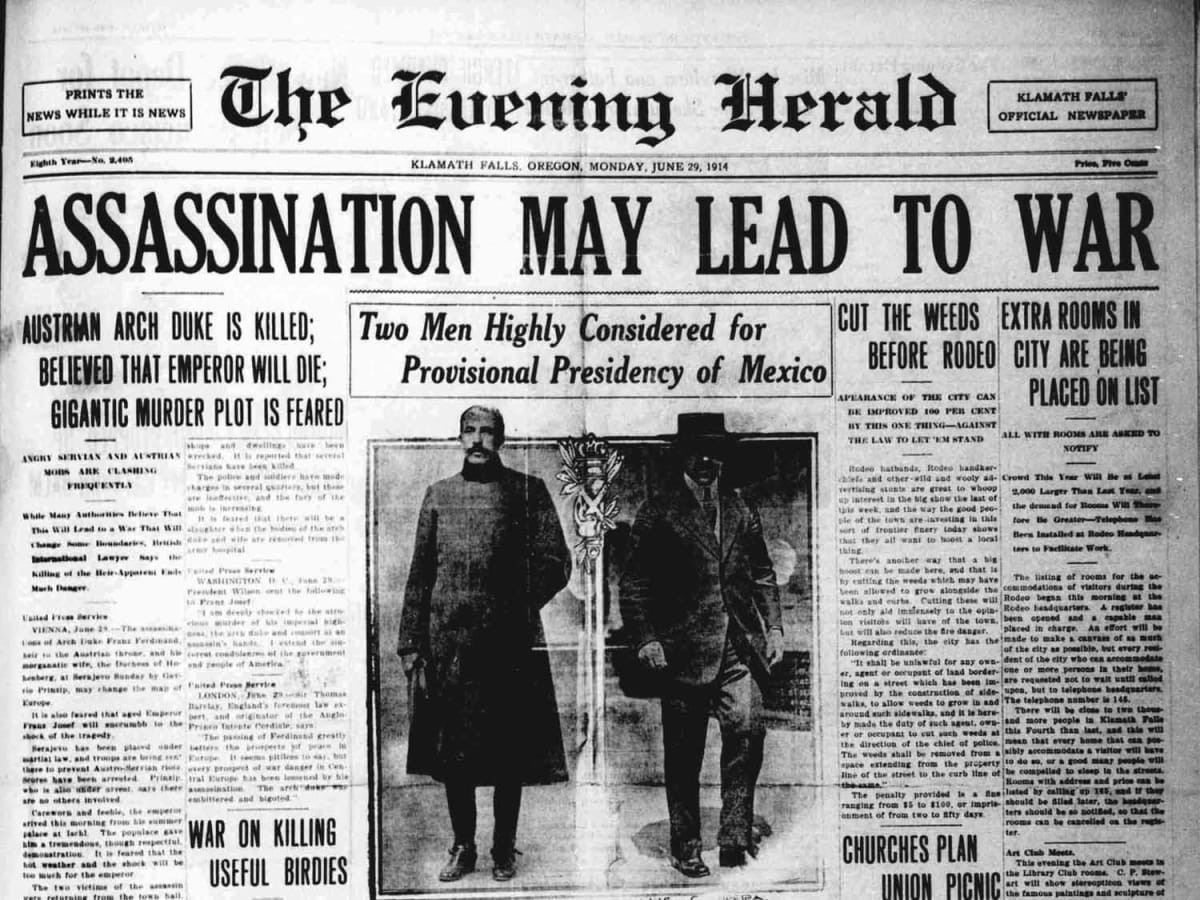
1(ii)1 Mark · 2026 · Part I · 2026 SpecimenFull page

Who made the amendment which resulted in the headline given below?

Who made the amendment which resulted in the below headline?, ICSE Specimen 2026 History Solved Question Paper.
Show SolutionHide Solution↓

The Parliament

Reason — The Central Government took an important political and constitutional step on August 5, 2019 by abrogating Article 370 and bifurcating Jammu and Kashmir into two separate Union Territories (UTs), i.e., Jammu and Kashmir with a Legislative Assembly and Ladakh without a Legislative Assembly.

1(iii)1 Mark · 2026 · Part I · 2026 SpecimenFull page

Given below are details of few Indian citizens:

PersonAge [In years]Description
W34Is a Professor in a Government College
X35Has taken up citizenship of the United States of America
Y27Is a reputed sportsperson
Z36Is a scientist

Select the person who fulfils the eligibility criteria to become the President of India.

Show SolutionHide Solution↓

Z

Reason — To become the President of India, one must be a citizen of India, must have completed 35 years of age, and should not hold an office of profit under the government. Thus, Person Z fulfills the eligibility criteria to become the President of India.

1(iv)1 Mark · 2026 · Part I · 2026 Specimen · 🔁 also 2025Full page

Observe the given picture. In case of a similar unruly situation in the Lok Sabha, choose the action that may be taken by the Speaker.

Observe the given picture. In case of a similar unruly situation in the Lok Sabha, choose the action that may be taken by the Speaker. ICSE Specimen 2026 History Solved Question Paper.
Show SolutionHide Solution↓

adjourn the house for lack of discipline.

Reason — It is the duty of the Speaker to maintain order and discipline in the Lok Sabha. He can adjourn the House for lack of discipline.

1(v)1 Mark · 2026 · Part I · 2026 SpecimenFull page

Choose the correct option to replace the underlined word:
The Union ministers are collectively responsible to the Prime Minister.

Show SolutionHide Solution↓

Lok Sabha

Reason — In the Indian parliamentary system, the Union ministers (including the Prime Minister) are collectively responsible to the Lok Sabha (the lower house of Parliament). This means that if the Lok Sabha passes a vote of no-confidence against the government, all ministers, including the Prime Minister, must resign.

1(vi)1 Mark · 2026 · Part I · 2026 SpecimenFull page

Residents of Jodhpur, X and Y got married in the year 2014 and after 4 months of wedlock, petty family issues and arguments resulted in their separation for 6 years. The matter was placed before the Bench of Lok Adalat Family Court, Jodhpur wherein all efforts were made to reunite the family again. With constant efforts of counselling, parties agreed to live together and withdraw their Divorce Petition.

Case Study, Lok Adalat, District – Jodhpur

Which advantage of the Lok Adalat is highlighted in the above case?

Show SolutionHide Solution↓

Works on the spirit of compromise

Reason — Lok Adalat works on the spirit of compromise as shown in the given case. The counselling parties agreed to put aside their differences and came to a mutual agreement.

1(vii)1 Mark · 2026 · Part I · 2026 SpecimenFull page

Assertion (A): The Indian National Congress was formed in 1885.
Reason (R): The main aim of the Indian National Congress at its inception was to demand complete independence for India.

Show SolutionHide Solution↓

(A) is true and (R) is false.

Explanation — The early aim of the Congress was to promote moderate reforms, seek greater representation for Indians in the British administration, and advocate for social and economic improvements. It was only later with the growing dissatisfaction with British rule, that the Congress started demanding full independence.

1(viii)1 Mark · 2026 · Part I · 2026 Specimen · 🔁 also 2027Full page

Identify the option which shows the correct chronology of the following events:
1. The Dandi March
2. The Second Round Table Conference
3. The Simon Commission

Show SolutionHide Solution↓

3-1-2

Reason — The Simon Commission came first (1928), followed by the Dandi March (1930), and then the Second Round Table Conference (1931). Hence, the correct sequence is 3-1-2.

1(ix)1 Mark · 2026 · Part I · 2026 Specimen · 🔁 also 2025Full page

The area in which Anand stays has had no water supply for three days in spite of repeated complaints. The residents have a meeting and discuss a few methods to resolve this problem. Being a follower of the beliefs and methods of the Early Nationalists, which of the following methods is Anand NOT LIKELY to approve?

Show SolutionHide Solution↓

Follow the method of boycott

Reason — The Early Nationalists believed in moderate politics. They believed in the British government and relied on constitutional and peaceful methods to achieve their aims. They believed in patience and reconciliation rather than in violence and confrontation. So, Anand is unlikely to follow the assertive method of boycott.

1(x)1 Mark · 2026 · Part I · 2026 Specimen · 🔁 also 2025Full page

Identify the cities most affected by American action in World War II.

Show SolutionHide Solution↓

Hiroshima, Nagasaki

Reason — During World War II, the United States dropped atomic bombs on the Japanese cities of Hiroshima (on August 6, 1945) and Nagasaki (on August 9, 1945). These two bombings were the most significant American military actions in terms of civilian impact and destruction, ultimately leading to Japan’s surrender and the end of World War II.

1(xi)1 Mark · 2026 · Part I · 2026 SpecimenFull page

Which repressive policy of Lord Lytton is depicted in the picture given?

Which repressive policy of Lord Lytton is this picture associated with? ICSE Specimen 2026 History Solved Question Paper.
Show SolutionHide Solution↓

The Vernacular Press Act

Reason — The Vernacular Press Act tried to control the press and forbade vernacular papers to publish any material that might excite feelings of dissatisfaction against the British Government. This act was not applicable to English newspapers.

1(xii)1 Mark · 2026 · Part I · 2026 Specimen · 🔁 also 2025Full page

Identify the odd one out of the following Assertive Nationalists Leaders.

Show SolutionHide Solution↓

Dadabhai Naoroji

Reason — Lala Lajpat Rai, Bal Gangadhar Tilak, and Bipin Chandra Pal were Assertive Nationalist leaders, whereas Dadabhai Naoroji was a leader of the Early Nationalists (Moderates).

1(xiii)1 Mark · 2026 · Part I · 2026 SpecimenFull page

Read the description and choose the correct option -

This was a significant event in Indian history. Many underlying causes of the revolt included economic exploitation, social reforms, and political annexations by the British. Even in its failure it ignited nationalism in the people of India. Its immediate cause was ............... .

Show SolutionHide Solution↓

use of greased cartridges in Enfield rifles

Reason — It was rumoured that the greased cartridge had the fat of cow or pig. The sepoys felt that the introduction of greased cartridges were a deliberate move to defile Hindu and Muslim religions. So, the soldiers refused to use these cartridges and staged an uprising when they were forced to use them.

1(xiv)1 Mark · 2026 · Part I · 2026 Specimen · 🔁 also 2025Full page

Which of the following countries will NOT be part of this cartoon?

Which of the following countries will NOT be part of this cartoon?, ICSE Specimen 2026 History Solved Question Paper.
Show SolutionHide Solution↓

Japan

Reason — VETO power is enjoyed by the permanent members of the UN. Since, Japan is not a permanent member of the UN, it does not enjoy VETO power.

1(xv)1 Mark · 2026 · Part I · 2026 Specimen · 🔁 also 2027Full page

Identify the correct pair from the given options.

Show SolutionHide Solution↓

Jyotiba Phule – Women’s Education

Reason — Jyotiba Phule was a strong advocate for the education of women and the upliftment of lower castes. He and his wife, Savitribai Phule, were pioneers in setting up schools for girls in 19th-century Maharashtra.

1(xvi)1 Mark · 2026 · Part I · 2026 Specimen · 🔁 also 2024 & 2025Full page

Which of the following scenarios describes the Non-Alignment Policy (NAM)?

Show SolutionHide Solution↓

A country maintains relations with both factions during the Cold War and does not take sides.

Reason — Non-alignment is the international policy of a sovereign state according to which it does not align itself with any of the power blocs and at the same time actively participates in the world affairs to promote international peace, harmony and cooperation.

2(i)1 Mark · 2026 · Part I · 2026 SpecimenFull page

Read the extract given below and answer the question which follow:

Congress member's adjournment motion disallowed. The notice, along with another moved demanding a discussion on China, was disallowed in the Lok Sabha.

The Times of India, Feb 10, 2023

Who can allow or disallow the above motion? What does this motion mean?

Show SolutionHide Solution↓

The Speaker of the Lok Sabha has the right to allow or disallow an Adjournment motion.

An Adjournment Motion means a proposal to lay aside all other business and take up a 'definite matter of urgent importance'. Such a motion leads to the interruption of normal business of the House.

2(ii)1 Mark · 2026 · Part I · 2026 Specimen · 🔁 also 2025Full page

Which category of power is being exercised by the President in the following:

(a) Approval of Bills
(b) Appointment of the Supreme Court judges

Show SolutionHide Solution↓

(a) Approval of bills — Legislative power.

(b) Appointment of the Supreme Court judges — Executive power.

2(iii)1 Mark · 2026 · Part I · 2026 Specimen · 🔁 also 2027Full page

The whole plan may not be perfect but like all plans, its success will depend on the spirit of goodwill with which it is carried out.

-Lord Mountbatten

Give two reasons for the acceptance of the above plan by the Congress.

Show SolutionHide Solution↓

The Mountbatten Plan was accepted by the Congress because of following two key reasons:

  1. Large-Scale Communal Riots — The large-scale communal riots that engulfed the whole country convinced the Congress leaders that the only solution to the communal problem lay in the Partition of India.
  2. Avoidance of Civil War — The leaders felt that any further delay in the transfer of power could lead to a civil war in India. They believed that it was better to have a smaller India with a strong central authority than a larger state with a weak center.
2(iv)1 Mark · 2026 · Part I · 2026 Specimen · 🔁 also 2025 & 2027Full page

Imagine you were an artisan in the year 1856. Mention any two ways in which the economic policies of the British would have affected you.

Show SolutionHide Solution↓

The economic exploitation at the hands of the British made my life very difficult as an artisan in the year 1856. Some of the difficulties I faced were:

  1. British rule had a damaging effect on Indian handicrafts. Heavy duties were imposed on goods exported into England from India. On the other hand, the cheaper machine-made products were imported from Britain almost duty free. This forced me into unemployment.
  2. Due to British economic policies, India became a source of raw material for the British industries and a market for its finished products. This destroyed the business of Artisans like me.
2(v)1 Mark · 2026 · Part I · 2026 SpecimenFull page

Look at the picture given and answer.

Look at the picture given and answer. ICSE Specimen 2026 History Solved Question Paper.

Identify the leader seen in the picture above. Mention any one of his contributions.

Show SolutionHide Solution↓

The person shown in the picture is Bal Gangadhar Tilak, an assertive nationalist leader.

One key contribution of Bal Gangadhar Tilak:

  • Demand for Swaraj: Tilak was the first to openly declare the demand for Swaraj. "Swaraj is my birth right," he said, "and I shall have iť".
2(vi)1 Mark · 2026 · Part I · 2026 Specimen · 🔁 also 2024, 2025 & 2027Full page

Mention any two objectives of the League of Nations.

Show SolutionHide Solution↓

Two objectives of the League of Nations were:

  1. All States were to refer their mutual disputes, if any, to the League of Nations for a peaceful settlement.
  2. The member-States were to take necessary action as directed by the League against any state which tried to disturb world peace and order.
2(vii)1 Mark · 2026 · Part I · 2026 SpecimenFull page

Mention any two ideologies of the dictators.

Show SolutionHide Solution↓

Two ideologies of the dictators are:

  1. Dictators supported one party and one ruler.
  2. They led stress on nationalism and not on individual institutions.
3Written · 2026 · Part II A · 2026 SpecimenFull page

The Union Legislature of India is the law-making body of the country. With reference to the Parliament, answer the following questions:

(i) Mention any three key differences in power between the Lok Sabha and the Rajya Sabha that make the Lok Sabha more influential.

(ii) Rajya Sabha adjourned sine die, overall productivity at 79 percent.

- Deccan Herald, 21 December 2023.

(iii) Mention any four legislative powers of the Parliament.

Show SolutionHide Solution↓

(i) The Lok Sabha has special powers which make it more powerful than the Rajya Sabha. These special powers are:

  1. Motions of No-confidence against the government can only be introduced and passed in the Lok Sabha. If passed by a majority vote, the Prime Minister and the Council of Ministers resign collectively. The Rajya Sabha has no power over such a motion, and hence no real power over the executive.
  2. Money bills can only be introduced in the Lok Sabha, and upon being passed, are sent to the Rajya Sabha, where it can be deliberated on for up to 14 days.
  3. In case of a deadlock between the two Houses over a non-financial (ordinary) bill, the will of the Lok Sabha normally prevails, as its strength is more than double that of the Rajya Sabha.

(ii) The Chairman of the Rajya Sabha, who is the Vice President of India, has the authority to adjourn a Rajya Sabha session.

Composition of the Rajya Sabha — The maximum strength of the Rajya Sabha can be 250 members, out of which-

  1. 12 members are nominated by the President from among persons having special knowledge or practical experience in matters such as literature, science, art and social service.
  2. 238 members are elected by the States in the Union. Seats are allocated to the States and the Union Territories on the basis of their population.

(iii) Four legislative powers of the Union Parliament are-

  1. Matters in the Union List — The Parliament has exclusive powers to make laws on all the subjects mentioned in the Union List, including important subjects like Defence, Banking, Communications, Foreign Affairs, etc.
  2. Matters in the Concurrent List — Parliament and State Legislative Assemblies can both make laws on Concurrent List subjects like education, forests, succession, etc. In case of a conflict, the Union law overrides the State law.
  3. Residuary Powers — Parliament can make laws on subjects not listed in the Union, State, or Concurrent Lists.
  4. Powers during Emergency — When a State faces a breakdown of Constitutional machinery, Parliament takes over its legislative and financial powers, including passing the State budget.
4Written · 2026 · Part II A · 2026 SpecimenFull page

The President is the nominal head of the executive and the first citizen of the country.
With reference to this, answer the following questions:

(i) The President is the nominal head of the country and cannot act independently. Mention any three legislative powers of the President which justify the nominal position.

(ii) Mention any three points to enumerate the financial powers vested in the President of India.

(iii) Describe the constitutional procedure to remove the President.

Show SolutionHide Solution↓

(i) Three legislative powers of the President which justifies his/her nominal position are:

  1. Dissolve the Lok Sabha: He/She can dissolve the Lok Sabha and order fresh elections.

  2. Assent to Bills: Once a Bill is passed by both the Houses, it is sent to the President for his/her approval. The President may give his/her assent, or withhold the Bill or send it back to the House concerned with recommendations. If the same bill is passed again, the President has to give his/her assent.

  3. Promulgate Ordinances: The President can promulgate an Ordinance, which has the same status as an Act of Parliament when:

    1. Certain circumstances need immediate action.
    2. Both Houses of Parliament are not in session.
    3. All Ordinances must be put up before both the Houses for their approval. Ordinances cease to operate after six weeks from the re-assembly of Parliament, unless they are approved by the Houses.
    4. The Ordinance lapses if it is replaced by an Act of Parliament.

(ii) Three financial powers of the President are:

  1. Money Bills can be introduced only on the recommendation of the President.

  2. The President can authorise withdrawal of advances from the Contingency Fund of India to meet unforeseen expenditure. Such expenditure should be subsequently approved by Parliament.

  3. Every five years, the President appoints a Finance Commission comprising a Chairman and four other members to give recommendations on financial matters.

(iii) PROCEDURE FOR IMPEACHMENT OF THE PRESIDENT

  1. In case of violation of the Constitution or grave misconduct, either House may frame charges against the President as follows:

    1. Resolution which is moved after at least fourteen days' notice in writing signed by not less than one-fourth of the total number of members of the House; and
    2. The resolution is passed by a majority of not less than two-thirds of the total membership of the House.
  2. The other House investigates the charges and the President has the right to appear and to be represented at such an investigation.

  3. If the President is found guilty, a resolution is passed by a majority of not less than two-thirds of the total membership of the investigating House, and the President is removed from his/her office.

5Written · 2026 · Part II A · 2026 SpecimenFull page

The Supreme Court of India is the highest court of the Republic of India. With reference to the Supreme Court, answer the following questions:

(i) Who appoints the judges of the Supreme Court?
What is the composition of the Supreme Court?

(ii) Under Article 129, the Supreme Court of India is called a Court of Record. Justify this statement with any three points.

(iii) Explain the following terms:
(a) Revisory Jurisdiction
(b) Original Jurisdiction

Show SolutionHide Solution↓

(i) The President of India appoints the judges of the Supreme Court.

COMPOSITION OF THE SUPREME COURT —

The Supreme Court of India consists of a Chief Justice of India and not more than 33 other judges, until Parliament by law prescribes a larger number of judges.

(ii) Under Article 129, the Supreme Court is called a Court of Record. This can be justified in the following ways—

  1. Permanent Records of Judgments – The Supreme Court maintains records of its decisions and proceedings. These serve as legal references for future cases and cannot be questioned in any court.
  2. Power to Punish for Contempt – As a Court of Record, the Supreme Court has the authority to punish individuals for contempt of court if they disobey its orders or show disrespect.
  3. Precedent Value – The decisions of the Supreme Court act as precedents. Lower courts are bound to follow its judgments, helping maintain uniformity in the application of law.

(iii)
(a) Revisory Jurisdiction — The Supreme Court has the power to review its own judgments to correct any mistakes, as its decisions are treated as laws.

(b) Original Jurisdiction — Original Jurisdiction means the power to hear and determine a dispute in the first instance; i.e., those cases which cannot be moved in any court other than the Supreme Court.

6Written · 2026 · Part II B · 2026 SpecimenFull page

The Indian Rebellion of 1857 was a major uprising against the rule of the British East India Company. With reference to this, answer the following questions:

(i) The British used many policies of expansion. Mention any three such policies.

(ii) Analyse the impact of the failure of the Revolt of 1857 on the Mughals and the Peshwas.

(iii) The Indian army was reorganised after 1858, to prevent the reoccurrence of another uprising. Justify this statement by stating any four changes made in the army after the Revolt.

Show SolutionHide Solution↓

(i) The British tried to expand their political power in India by many ways, such as:

  1. By outright wars
  2. By the system of Subsidiary Alliance
  3. By adopting the Doctrine of Lapse.

(ii) The uprising of 1857 ended the Mughal and Peshwa rule in India. The Mughal dynasty came to an end with the death of Bahadur Shah II and Nana Saheb, the last Peshwa, fled to Nepal after the failure of the uprising.

(iii) The India army was reorganised after 1858, to prevent the reoccurrence of another uprising, in the following manner:

  1. The strength of European troops in India was increased. The ratio of European to Indian troops was fixed at 1:2 (Bengal army) and 2:5 (Madras and Bombay armies). Practically the same ratio was maintained till the First World War. The general principle adopted was that the number of Indian sepoys should not exceed twice that of the European troops.
  2. European troops were kept in key geographical and military positions.
  3. To desist the Indian soldiers from rising again against the British rule, the sophisticated weapons and ammunition were never placed under the charge of Indians. All Indian artillery units, with the exceptions of a few mountain units, were disbanded.
  4. Newspapers, journals and nationalist publications were prevented from reaching the soldiers to keep the Indian army separated from the life of the rest of the population.
7Written · 2026 · Part II B · 2026 SpecimenFull page

Nationalism refers to the feeling of oneness that emerges when people consider themselves as one nation. With reference to the growth of nationalism, answer the following:

(i) Name the first President of the Congress. Mention any two objectives of the Congress.

(ii) Whether it is fiction, non-fiction, or periodical, all kinds of literature contributed at large in the national consciousness of India in pre-independence times. Mention any three points to analyse the role of the press in the growth of nationalism.

(iii) Explain any two policies of Lord Lytton that showcased his attitude of racial superiority, eventually leading to the growth of nationalism.

Show SolutionHide Solution↓

(i) The first President of the Indian National Congress was W.C. Bonnerjee. Two objectives of the Indian National Congress are given below:

  1. To promote friendly relations between nationalist political workers from different parts of the country.
  2. To formulate popular demands and present them before the government.

(ii) The press played an important role in the growth of Indian Nationalism in the following ways:

  1. The press helped spread the ideals of patriotism, modern liberal ideas of liberty, freedom, and equality.
  2. The Press criticised the British policies, and made the Indians aware of the happenings in the world.
  3. The Press helped Indians exchange views, and played an important role in the Indian freedom struggle.

(iii) Two repressive policies enforced by Lord Lytton that led to the rise of nationalism were:

  1. Vernacular Press Act (1878) – This Act banned Indian-language newspapers from publishing anti-British content, curbing freedom of expression. English newspapers were exempt.
  2. Indian Arms Act (1878) – Indians were prohibited from possessing arms without a licence, while Europeans faced no such restriction, highlighting racial discrimination.
8Written · 2026 · Part II B · 2026 SpecimenFull page

Read the excerpt given below and answer the questions that follow -

The March, which took place in India, was led by Mohandas Gandhi to protest British rule in India. During the march, thousands of Indians followed Gandhi from his religious retreat near Ahmedabad to the Arabian Sea coast, a distance of some 240 miles. The march resulted in the arrest of nearly 60,000 people, including Gandhi himself.

— The Marion (Ohio) Star [Edited]

(1) Name the March being discussed above. Which movement did this March lead to? In which year was that movement launched?

(ii) The movement which began with this March made a considerable impact on the social and political surroundings of the country. Analyse this statement by mentioning any three impacts.

(iii) Mention any four clauses of the treaty which led to the suspension of this movement.

Show SolutionHide Solution↓

(i) The march being discussed in the given excerpt is known as the Dandi March. This march led to the beginning of the Civil Disobedience Movement of 1930.

(ii) The Civil Disobedience Movement made a considerable impact on the social and political surroundings of the country, in the following ways:

  1. It widened the base of freedom struggle by mobilising various social groups like merchants, peasants, tribals, and workers across the country.
  2. It inspired the youth to follow Gandhi's path of non-violence in the freedom struggle instead of using violence as a political weapon.
  3. It marked greater participation of women in politics, inspiring many to step out and join the freedom struggle.

(iii) Four clauses of Gandhi Irwin Pact were:

  1. The government agreed to release all political prisoners, except those guilty of violence.
  2. The government agreed to permit the free collection or manufacture of salt by persons near the sea coast.
  3. The Congress agreed to suspend the Civil Disobedience Movement.
  4. The Congress agreed to participate in the second session of the Round Table Conference.
9Written · 2026 · Part II B · 2026 SpecimenFull page

Look at the picture given below and answer the following questions:

Look at the picture given below and answer the following questions, ICSE Specimen 2026 History Solved Question Paper.

(i) How did the assassination mentioned above become a cause for the First World War?

(ii) Mention any three points to analyse how Europe was reorganised because of the war triggered by this incident.

(iii) The Germans described the Treaty of Versailles as harsh and humiliating. Give any four reasons that justify this statement.

Show SolutionHide Solution↓

(i) The incident depicted in the cartoon is known as the Sarjevo Crisis, which was the immediate cause of the World War I.
Archduke Francis Ferdinand was assassinated on June 28, 1914, in Sarajevo by members of the Serbian secret society 'Union of Death'. Austria sent an ultimatum with 11 demands to Serbia; Serbia accepted most but rejected those affecting its sovereignty. Austria declared war on Serbia on July 28, 1914, marking the start of the First World War.

(ii) The World War I gave a serious blow to the autocratic monarchial system and led to the development of democracy in Europe.

  1. Austria and Hungary became separate independent States. Czechoslovakia and Yugoslavia emerged as independent States.

  2. European supremacy came to an end. The United States surpassed Europe economically and militarily. Ruling dynasties of Europe were destroyed, the Hohenzollern in Germany and the Hapsburg in Austria-Hungary.

  3. The political instability and economic crisis in post-war Europe led to the rise of dictatorships in countries like Germany and Italy, where people turned to totalitarian rule for stability and national revival.

(iii) The Treaty of Versailles was signed to prevent Germany from going to war again. So, its terms were extremely harsh and humiliating towards Germany.

  1. Germany was declared guilty of aggression and had to pay war reparation of 33 billion dollars.
  2. The Saar coal mines were given to France for 15 years and the area was to be governed by the League of Nations.
  3. The area of the Rhine valley was demilitarized and the German territory west of Rhine was to be occupied by the Allied troops for 15 years.
  4. The German Army was restricted to a force of 1,00,000 soldiers and the Navy was limited to 15,000 men and 24 ships. The Air Force and submarines were banned.
10Written · 2026 · Part II B · 2026 SpecimenFull page

The United Nations Organisation aims to maintain international peace. With reference to its organs and agencies, answer the following:

(i) What is the composition of the International Court of Justice?

(ii) Mention any three exclusive functions of the General Assembly.

(iii) Kolkata's famous Durga Puja received the intangible heritage tag. Which agency of the United Nations is authorised to give this tag? Mention any three other contributions of that agency in the preservation of culture.

Show SolutionHide Solution↓

(i) Composition of the International Court of Justice —

  1. The Court is composed of 15 judges, each of different nationality elected to nine-year terms of office by the United Nations General Assembly and Security Council sitting independently of each other. Elections are held every three years for one-third of the seats, and retiring judges may be re-elected.

  2. The Members of the Court do not represent their governments but are independent magistrates. The judges must possess the qualifications required in their respective countries for appointment to the highest judicial offices, or be jurists of recognised competence in international law. The composition of the Court has also to reflect the main forms of civilisation and the principal legal systems of the world.

  3. The Court elects its President and Vice-President for a three-year term. They may, when their term expires, be re-elected. The Court has the power to appoint its Registrar.

(ii) Three functions of the General Assembly are:

  1. To consider and make recommendations on the principles of cooperation, in the maintenance of international peace and security.
  2. To consider and approve the budget of the United Nations and to apportion the contributions among members.
  3. To elect the non-permanent members of the Security Council, the Economic and Social Council and the Trusteeship Council, and to elect the judges of the International Court of Justice.

(iii) The United Nations Educational, Scientific and Cultural Organization (UNESCO) is the agency authorized to designate intangible cultural heritage tag.
Three contributions of UNESCO in the preservation of culture are:

  1. UNESCO provides technical advice and assistance, equipment and funds for the preservation of monuments and other works of art. It has prepared a World Heritage List to identify the monuments and sites which are to be protected.
  2. It aims to protect the world inheritance of books, works of art and rare manuscripts.
  3. It gives encouragement to artistic creations in literature and fine arts.
1(i)1 Mark · 2025 · Part I · 2025 PaperFull page

The Council of Ministers is collectively responsible to the ............... .

Show SolutionHide Solution↓

Lok Sabha

Reason — The ministers remain in office until they enjoy the confidence of majority of members in the Lok Sabha. If a vote of no-confidence is passed in the Lok Sabha against the Prime Minister, or the Ministry as a whole or any of its members, the whole Ministry has to resign.

1(ii)1 Mark · 2025 · Part I · 2025 PaperFull page

Given below are details of a few Indian Citizens.

PersonAge (In years)Description
W25Is a famous journalist
X45Is an industrialist
Y35Has declared insolvency
Z50Has taken citizenship of another country

Select the one who is eligible to be a member of the Rajya Sabha.

Show SolutionHide Solution↓

X

Reason — In order to seek membership of the Rajya Sabha, a person :
(a) must be a citizen of India.
(b) must not be less than 30 years of age and an industrialist.
(c) must not be a proclaimed criminal.
(d) must have his/her name in the electoral list.
(e) must not hold any office of profit under the Government of India.
(f) should not be in debt.
(g) should not be of unsound mind.

Person X is 45 years old, a citizen of India, and has no disqualifications. Hence, X is eligible.

1(iii)1 Mark · 2025 · Part I · 2025 PaperFull page

With reference to the Supreme Court of India, complete the following:

Advisory Jurisdiction : Advice the President : : Judicial Review : ...............

Show SolutionHide Solution↓

Review the laws passed by the Parliament.

Reason — The Supreme Court is the guardian and sole interpreter of the Constitution. The Supreme Court can declare law passed by the Parliament null and void if found unconstitutional.

1(iv)1 Mark · 2025 · Part I · 2025 Paper · 🔁 also 2026Full page

Observe the given picture. In case of a similar unruly situation in the Lok Sabha, choose the action that may be taken by the Speaker.

Observe the given picture. In case of a similar unruly situation in the Lok Sabha, choose the action that may be taken by the Speaker. ICSE 2025 History Solved Question Paper.
Show SolutionHide Solution↓

adjourn the house for lack of discipline.

Reason — It is the duty of the Speaker to maintain order and discipline in the Lok Sabha. He can adjourn the House for lack of discipline.

1(v)1 Mark · 2025 · Part I · 2025 PaperFull page

If an Adjournment Motion is passed in the Lok Sabha ............... .

Show SolutionHide Solution↓

the House will discuss a matter of urgent public importance.

Reason — An Adjournment Motion is passed by the Lok Sabha to discuss a matter of urgent public importance. Such a Motion leads to the interruption of the normal business of the House.

1(vi)1 Mark · 2025 · Part I · 2025 PaperFull page

Which emergency will be declared by the President if the security of the Nation is under threat?

Show SolutionHide Solution↓

General Emergency

Reason — The President can declare a national or general emergency in case of danger of foreign aggression or danger to the peace and security of the country because of a civil war, insurgency or any other such cause.

1(vii)1 Mark · 2025 · Part I · 2025 PaperFull page

Read the statements given below and select the option that shows the correct relationship between (A) and (R).

Assertion (A): Lord Curzon partitioned Bengal in 1905.

Reason (R): The Nationalists felt that the British wanted to divide the Hindus and the Muslims.

Show SolutionHide Solution↓

(A) is the reason for (R).

Explanation — Lord Curzon partitioned Bengal in 1905. The nationalists believed that the real motive behind the partition was to divide the Hindus and Muslims and weaken Indian nationalism. Therefore, the partition mentioned in (A) led to the belief expressed in (R).

1(viii)1 Mark · 2025 · Part I · 2025 PaperFull page

Read the description and identify the person.

He introduced the Subsidiary Alliance to expand the British control over India.

Show SolutionHide Solution↓

Lord Wellesley

Reason — Subsidiary alliance was an agreement between the British East India Company and the Indian Princely States by virtue of which these states lost their sovereignty to the British. This policy was introduced by Lord Wellesley.

1(ix)1 Mark · 2025 · Part I · 2025 Paper · 🔁 also 2026Full page

Identify the odd one out of the following Assertive Nationalists Leaders.

Show SolutionHide Solution↓

Dadabhai Naoroji

Reason — Lala Lajpat Rai, Bal Gangadhar Tilak, and Bipin Chandra Pal were Assertive Nationalist leaders, whereas Dadabhai Naoroji was a leader of the Early Nationalists (Moderates).

1(x)1 Mark · 2025 · Part I · 2025 PaperFull page

Who among the following is MOST associated with this picture?

Who among the following is MOST associated with this picture? ICSE 2025 History Solved Question Paper.
Show SolutionHide Solution↓

Jyotiba Phule

Reason — Jyotiba Phule played a crucial role in advancing girls' education in India. He established the first school for girls in Pune in 1848.

1(xi)1 Mark · 2025 · Part I · 2025 PaperFull page

Identify the contributions of Subhash Chandra Bose:

P. Was the Supreme Commander of INA
Q. Signed the Lucknow Pact
R. Led the Quit India Movement
S. Founded the Forward Bloc

Show SolutionHide Solution↓

P and S

Reason — Statements P and S are correct: Subhas Chandra Bose was the Supreme Commander of the INA and founded the Forward Bloc in 1939. Statement Q is wrong, as he did not sign the Lucknow Pact, and Statement R is wrong, as the Quit India Movement was led by Gandhiji, not Bose.

1(xii)1 Mark · 2025 · Part I · 2025 PaperFull page

The market of a small industrial town X has been dominated by many products of foreign companies. The local residents decide to save the Indian industries by helping them increase their sales. Which method of the Assertive Nationalists must they follow to become self-reliant?

Show SolutionHide Solution↓

Swadeshi

Reason — Swadeshi meant producing and using goods made in one's own country in preference to imported goods. It encouraged Indians to support indigenous industries and boycott foreign goods.

1(xiii)1 Mark · 2025 · Part I · 2025 PaperFull page

Which of the following is NOT an objective of the United Nations Organisation?

Show SolutionHide Solution↓

Disengage

Reason — Disengagement, meaning to withdraw or detach, is contrary to the UN’s objective of fostering collaboration and resolving conflicts.

1(xiv)1 Mark · 2025 · Part I · 2025 PaperFull page

Which agency of the United Nations Organisation is associated with this picture?

Which agency of the United Nations Organisation is associated with this picture? ICSE 2025 History Solved Question Paper.
Show SolutionHide Solution↓

UNESCO

Reason — UNESCO is responsible for preserving heritage sites worldwide by ensuring their protection and conservation.

1(xv)1 Mark · 2025 · Part I · 2025 PaperFull page

Which of the following is a common cause for the rise of dictatorship?

Show SolutionHide Solution↓

Economic Crisis

Reason — Financial instability leading to economic crisis often creates conditions for the rise of dictatorship. Dictatorship provides strong leadership to the citizens.

1(xvi)1 Mark · 2025 · Part I · 2025 PaperFull page

Which of the following causes of the First World War is connected to this headline?

Which of the following causes of the First World War is connected to this headline? ICSE 2025 History Solved Question Paper.
Show SolutionHide Solution↓

Sarajevo Crisis

Reason — The headline refers to the assassination of Archduke Francis Ferdinand by a Serbian at Sarajevo, which is connected to the Sarajevo Crisis — the immediate cause of the First World War.

2(i)1 Mark · 2025 · Part I · 2025 PaperFull page

Mention any two powers of the Prime Minister with reference to the Cabinet.

Show SolutionHide Solution↓

Two powers of the Prime Minister with reference to the Cabinet are:

  1. The Prime Minister is the head of the Cabinet.
  2. His resignation implies the resignation of the whole Cabinet.
  3. He appoints and removes ministers, calls meetings of Cabinet, allots portfolios, co-ordinates all departments and presides over Cabinet meetings.
2(ii)1 Mark · 2025 · Part I · 2025 PaperFull page

Imagine you are an Early Nationalist leader. Mention any two methods you would follow to fight against the British.

Show SolutionHide Solution↓

As an Early Nationalist leader, the two methods I would follow to fight against the British are:

  1. I would draft petitions and memorandums and submit them to the Government to gradually bring the authorities around to our point of view.
  2. I would organise annual sessions, processions and public meetings to educate the people, arouse political consciousness and create a powerful public opinion in favour of our demands.
2(iii)1 Mark · 2025 · Part I · 2025 PaperFull page

Mention any two factors that led to the formation of the Muslim League.

Show SolutionHide Solution↓

Two factors that led to the formation of the Muslim League are given below:

  1. British Policy of 'Divide and Rule': After the uprising of 1857, the British treated the Muslims with suspicion and encouraged communalism to sow the seeds of disunity between the Hindus and the Muslims.
  2. Economic Backwardness of the Muslims: The Muslims were not recruited to civil and military services and remained poor and unemployed. This economic backwardness gave birth to feelings of resentment and separatism among them.
2(iv)1 Mark · 2025 · Part I · 2025 PaperFull page

Mention any two objectives of the Forward Bloc.

Show SolutionHide Solution↓

Two objectives of the Forward Bloc were:

  1. Liberation of India with the support of workers, peasants, youth, and other organizations.
  2. After independence, establishment of a socialist state through measures such as reorganisation of agriculture and industry on socialist lines and abolition of the Zamindari system.
2(v)1 Mark · 2025 · Part I · 2025 PaperFull page

Mention any two ways in which the Treaty of Versailles affected the German Military Force.

Show SolutionHide Solution↓

Two ways in which the Treaty of Versailles affected the German Military Force are:

  1. The German Army was restricted to a force of 1,00,000 soldiers and the Navy was limited to 15,000 men and 36 ships.
  2. The Air Force and submarines of German Navy were banned.
2(vi)1 Mark · 2025 · Part I · 2025 PaperFull page

What is meant by the term Non-Alignment?

Show SolutionHide Solution↓

Non-Alignment means a country does not align itself with any major power blocs, while actively participating in world affairs to promote international peace and cooperation.

2(vii)1 Mark · 2025 · Part I · 2025 PaperFull page

When a judicial system is correctly calibrated, the law is applied by judges fearlessly, without favour or fear and with respect. That is why judicial security of tenure is so fundamental. It is also why judges must be properly paid without any interference from the Executive or Legislature.

— (The Need for Independent Judiciary) UNODC

From the passage, deduce and mention any two ways in which the Constitution ensures the independence of the Judiciary.

Show SolutionHide Solution↓

Two ways in which the Constitution ensures the independence of the Judiciary are:

  1. Security of Service — Judges cannot be removed by the President at his pleasure. They can be removed only by impeachment by Parliament on the grounds laid down in the Constitution.
  2. Security of Pay and Allowances — Their salaries and allowances are charged on the Consolidated Fund of India and cannot be changed to their disadvantage during their term of office.
3Written · 2025 · Part II A · 2025 PaperFull page

The Parliament of India comprises the President and the two houses. With reference to the Indian Parliament, answer the following questions:

(i) Mention any three circumstances under which the Parliament can make laws on subjects in the state list.

(ii) Explain the following terms:

(a) Question Hour
(b) Quorum
(c) No Confidence Motion

(iii) When can the term of the Lok Sabha be extended?
Mention any three powers of the Lok Sabha which show its superiority over the Rajya Sabha.

Show SolutionHide Solution↓

(i) Three circumstances under which the Parliament can make laws on subjects in the state list are:

  1. During a National Emergency: During a national emergency, Parliament has the power to make laws on any matter in the State List for the whole or any part of the territory of India.
  2. When Two or More States Pass a Resolution: If two or more states pass a resolution requesting Parliament to legislate on a subject in the State List, Parliament can make laws regulating that matter. Such laws apply only to the states that have passed the resolution.
  3. Agreement Between States: If two or more states request Parliament to legislate on a State List subject, the Parliament can make laws on that particular subject.

(ii) (a) Question Hour — The first hour of a sitting in both Houses is allotted for asking and answering of questions. The questions are asked to obtain information on a matter of public importance or to highlight a grievance. It is a valuable device against injustice and slackness of the government.

(b) Quorum — The Quorum means the minimum number of members required to be present in order to conduct a sitting or enable the business of the House. It is fixed at 1/10th of the total membership of each House.

(c) No Confidence Motion — If a Government acts against the Constitutional provisions, it can be voted out of office by passing a vote of no-confidence against the Prime Minister, or the Ministry as a whole or any of its members. In such a case, the whole Ministry has to resign.

(iii) During the proclamation of an emergency the period of the Lok Sabha may be extended by Parliament for one year at a time.

Three powers of the Lok Sabha which show its superiority over the Rajya Sabha are:

  1. The Prime Minister and his Council of Ministers are responsible to the Lok Sabha. If the Lok Sabha passes a vote of no-confidence against the Council of Ministers, they must resign. However, the Rajya Sabha (Upper House) cannot pass a vote of no-confidence against the Council of Ministers. The no-confidence motion is exclusively a power of the Lok Sabha.
  2. A Money Bill can only be introduced in the Lok Sabha. The Rajya Sabha may only offer suggestions which may or may not be accepted by Lok Sabha. If the Money Bill is not returned by the Rajya Sabha within 14 days, it is taken as it has been passed by the Rajya Sabha.
  3. Any ordinary law needs to be passed by both the Houses, but in case of conflict, the view of Lok Sabha prevails because it has a large number of members.
4Written · 2025 · Part II A · 2025 PaperFull page

The Executive Power of the country is vested in the President and Vice President. With reference to this answer the following questions:

(i) Explain the impeachment process through which the Parliament can remove the President from power.

(ii) Mention any three powers of the Vice President in her/his role as the Chairman of the Rajya Sabha.

(iii) With reference to the powers of President, mention:
(a) Any two Financial Powers
(b) Any two Executive Powers

Show SolutionHide Solution↓

(i) The President can be impeached and removed from office for violation of the Constitution by the process of Impeachment.

  1. Charges can be introduced in either House of the Parliament. A 14 days notice should be given to the President in writing, signed by at least one–fourth of the total members of the House that framed the charges.
  2. After the lapse of 14 days, a resolution is moved which is to be passed by a majority of not less than two-third of the total strength of the House.
  3. The resolution then moves to the other House, which should investigate the charges during the process. The impeached President has the right to appear and to represent himself during investigation. If the resolution is passed by the second House with a majority of not less than two-thirds of its total membership of the House (investigating), the President will stand impeached and removed from office.

(ii) Three powers of the Vice President as the Chairman of the Rajya Sabha are:

  1. The Vice-President is the ex-officio Chairman of the Rajya Sabha.
  2. The Vice-President of India performs similar functions in the Rajya Sabha as the Speaker in the Lok Sabha. His/her salary is also paid in this capacity.
  3. In case of a tie on any issue or motion, the Vice President, as Chairman, has the casting vote. This means that the Chairman can cast a vote to break the deadlock.

(iii) (a) Two financial powers of the President are:

  1. Money bills can be introduced in the Parliament only with President’s recommendation.
  2. He/she can withdraw money out of the Contingency Fund of India to meet any unforeseen expenditure. Such expenditure should be subsequently approved by the Parliament.

(b) Two executive powers of the President are:

  1. The President is the executive head of the country and executive authority vested in him, and all executive orders are issued in his/her name.
  2. The administration of Union Territories and Border Areas is the responsibility of the President.
5Written · 2025 · Part II A · 2025 PaperFull page

The High Courts of India are the highest courts of appeal in each state. With reference to the High Courts of India, answer the following questions:

(i) What is meant by the term Original Jurisdiction of the High Court? Mention any two cases which fall under this jurisdiction.

(ii) Mention any two advantages of the Lok Adalat. Mention any one difference between the Sessions Court and the Court of the District Judge.

(iii) Explain the following with reference to the High Court:
(a) Revisory Jurisdiction
(b) Court of Record

Show SolutionHide Solution↓

(i) High Courts have original jurisdiction, that is, the power to hear and decide cases at the first instance. It has original jurisdiction in the following cases:

  1. Matters relating to State revenue and its collection.
  2. Cases regarding wills, divorce, marriage, company law and contempt of court may be referred or brought before the High Court directly.

(ii) Two advantages of the Lok Adalat are:

  1. Lok Adalats deliver fast and inexpensive justice. Any person can move Lok Adalat by an application on a plain paper or using the format available with Legal Service Authorities and expect speedy justice.
  2. The Lok Adalats reduce the workload of other courts enabling them to deal with more serious matters. This reduces delays in higher courts.

Sessions Court decides Criminal cases while the Court of the District Judge decides civil cases.

(iii) (a) Revisory Jurisdiction — Revisory Jurisdiction means that the High Court can call for the record of a case which has been decided by a subordinate court. This is done because the High Court feels that the Subordinate Court has exercised a jurisdiction not vested in it or the latter has not followed proper procedure.
Therefore, the High Court can review the case and take appropriate action on it. This is known as the Revisory Jurisdiction of the High Court.

(b) Court of Record — The High Court is a 'Court of Record' like the Supreme Court. It means:

  1. All the judgements and orders are preserved as a record to be referred to by its courts in future cases. They can be produced as precedents.
  2. The law laid down by the High Court is binding on all subordinate courts in the State concerned. But it does not bind the other High Courts, although it is of great significance and can be produced in support of an argument.
  3. The High Court can punish anyone who commits a contempt of its orders.
6Written · 2025 · Part II B · 2025 PaperFull page

The Revolt of 1857 was conscious beginning of the independence struggle against the British. With reference to this, answer the following questions:

(i) What was the Doctrine of Lapse? Who introduced it?

(ii) The British Government interfered in the social and religious matters of the Indians. Mention any three socio religious causes to justify this statement.

(iii) Mention any four military causes which led to this Revolt.

Show SolutionHide Solution↓

(i) According to Doctrine of Lapse, if an Indian ruler died without a male heir his kingdom would come under the Company's territory in India. It was introduced by Lord Dalhousie.

(ii) Three socio-religious causes that show that the British Government interfered in the social and religious matters of the Indians are:

  1. The reforms like the Abolition of Sati (1829), the introduction of the Widow Remarriage Act (1856) and the opening of Western education to girls were not welcomed by the masses.
  2. In the 19th century, the British began to interfere with the local religious and social customs. They denounced idol worship and dubbed local beliefs as ignorance. The Indians did not like this interference in their religious matters.
  3. Religious sentiments of the Indians were hurt by the official policy of taxing lands belonging to the temples and mosques.

(iii) Four military causes that led to the Great Uprising of 1857 were:

  1. Ill-treatment of Indian soldiers — Indian soldiers were poorly paid, ill-fed and badly housed. British military authorities forbade the sepoys from wearing caste or sectarian marks, beards or turbans; and they showed disregard for the sentiments of the sepoys.

  2. General Service Enlistment Act (1856) — As per this Act, Indian soldiers could be sent overseas on duty. The Act did not take into account the sentiment of the Indian soldiers. This led to a feeling of resentment among them.

  3. Lower Salaries — The wages of the Indian soldiers were inadequate to support their families. On the other hand, the British soldiers received more than eight times the salary of the Indian soldiers.

  4. Bleak Prospects of Promotion — No Indian soldier could rise above the rank of a Subedar. All high positions were reserved for the British soldiers only.

7Written · 2025 · Part II B · 2025 PaperFull page

The oppressive British colonial rule led to the growth of nationalism in India. With reference to this, answer the following questions:

(i) The repressive policies of Lord Lytton became a catalyst to the growth of nationalism. Mention any three of his repressive policies to justify this statement.

(ii) Mention any three ways in which the Press promoted nationalism.

(iii) Who presided over the second session of the Indian National Congress?
Mention any three objectives of the Congress.

Show SolutionHide Solution↓

(i) Three repressive policies of Lord Lytton are:

  1. Vernacular Press Act — This act, enacted in 1878, forbade vernacular papers to publish any material that might incite feelings of dissatisfaction against the British Government. This act was not applicable to English newspapers.
  2. Arms Act — The Arms Act of 1878 made it a criminal offence for Indians to carry arms without licence. This act did not apply to British.
  3. Famine Policies — Lord Lytton’s handling of the Great Indian Famine of 1876-1878 has been heavily criticized. Despite the famine, he convened a grand durbar to proclaim Queen Victoria as the Empress of India.

(ii) Three ways in which the Press promoted nationalism are:

  1. It served as a crucial medium for disseminating information and raising awareness about socio-political issues.
  2. It helped spread modern ideas of self-government, democracy, civil rights etc.
  3. The press fostered national unity by spreading ideas and information that united people towards the common goal of independence. It popularized the ideas of nationalist organizations and leader.

(iii) Dadabhai Naoroji presided over the second session of the Indian National Congress in 1886 at Kolkata.

Three objectives of the Indian National Congress were:

  1. To promote friendly relations between nationalist political workers from different parts of the country.
  2. To formulate popular demands and present them before the government.
  3. To train and organise public opinion in the country.
8Written · 2025 · Part II B · 2025 PaperFull page

Look at the given picture and answer the questions that follows:

Look at the given picture and answer the questions that follows:ICSE 2025 History Solved Question Paper.

(i) Identify the above incident. Which Gandhian movement did it lead to? Which incident led to the suspension of that movement?

(ii) Mention any three repressive provisions of the Rowlatt Act.

(iii) Mention the following:
(a) Any two causes of the Quit India Movement.
(b) Any two causes of the Civil Disobedience Movement.

Show SolutionHide Solution↓

(i) The given picture shows the Jallianwala Bagh Tragedy that happened on April 13, 1919 in Amritsar. It led to the start of the Non-Cooperation Movement in 1920, and was suspended by Gandhiji after the Chauri-Chaura incident.

(ii) The Rowlatt Act authorised the Government to imprison any person without trial and convict him in a court. It implied:

  1. Arrest of a person without warrant.
  2. In camera trial (trial in seclusion).
  3. Restrictions on movements of individuals.

(iii) (a) Two causes of the Quit India Movement were:

  1. Failure of the Cripps Mission — The Cripps Mission was a complete failure as almost all the parties and all sections of the society rejected it.
  2. Japanese threat of Invasion — There was a growing threat of Japanese invasion on India. The Congress leaders believed that to save India, the British must handover power to the Indians and quit the country.

(b) Two causes of the Civil Disobedience Movement were:

  1. Opposition to the Salt Tax — The British imposed the salt tax, which made salt production and sale by Indians illegal. The tax was seen as deeply unfair because it affected all sections of society, especially the poor, who relied on salt for everyday consumption. Gandhi’s Salt March (Dandi March) in 1930 directly challenged this oppressive tax.
  2. Demand for Poorna Swaraj (Complete Freedom) — When the British Government gave no positive response to the Nehru Report, then the Congress, under the presidentship of Jawaharlal Nehru in 1929 (at Lahore Session), passed a resolution declaring Poorna Swaraj (Complete Freedom) as the ultimate objective of the Congress.
9Written · 2025 · Part II B · 2025 PaperFull page

Read the passage given and answer the following questions:

In an effort to secure resources for its expanding industries, Japan invaded the northern Chinese province of Manchuria. Although many Western nations protested the Japanese action, most members of the League of Nations, including Canada, opposed any form of military intervention to defend Chinese sovereignty. A League of Nations commission, headed by the British diplomat Lord Lytton, was dispatched to Manchuria to investigate.

— Loyal Edmonton Regiment Museum

(i) How did the incident being described above become a cause for the Second World War?

(ii) Mention any three reasons for Hitler’s attack on Poland.

(iii) Mention any four reasons for the failure of the League of Nations.

Show SolutionHide Solution↓

(i) Japan's expansionist policy after World War I was a key cause of the Second World War. In 1931, Japan invaded Manchuria, defying the League of Nations, and later waged an undeclared war on China. Despite China's appeal for sanctions, Britain and France, key League members, ignored it. Japan then joined the Berlin-Rome-Tokyo Axis to further its ambitions. In 1933, Japan left the League and began occupying British and American properties in China. Britain and France followed a policy of appeasement, hoping Japan would weaken China, which contributed to the inevitability of war.

(ii) Hitler invaded Poland in September 1939 for the following reasons:

  1. By the Treaty of Versailles, Germany was divided into two parts in order to give a land-route to Poland upto the sea and the Port of Danzing was also given to Poland. Germany wanted to regain her lost territories.
  2. The city of Danzing was inhabited mainly by the Germans and by occupying Danzing Corridor, Germany could connect with East Prussia.
  3. Germany signed a Non-Aggression Pact with Russia in August 1939, Poland was left vulnerable because of the pact, enabling Germany to invade without fear of Soviet opposition.

(iii) Four reasons for the failure of the League of Nations were:

  1. The League suffered an early blow when the USA did not join the League. Even those who joined the League were not interested in the principle of collective security.
  2. The League did nothing when Poland, with the backing of France, seized a part of Lithuania in 1920.
  3. In 1923, there was a threat of war between Italy and Greece. Italy refused to submit to the League's intervention and the dispute was settled by direct mediation of Great Britain and France. Thereafter, in every crisis, the League was either defied or ignored.
  4. The authority of the League was flouted by Japan when it seized Manchuria; and by Italy when it conquered Ethiopia.
  5. Moreover, the member states were not willing to apply economic sanctions as it affected their economy as well.

Hence, the League failed to maintain international peace and the countries of Europe lost faith in its usefulness.

10Written · 2025 · Part II B · 2025 PaperFull page

The organs and the agencies of the United Nation Organisation work towards the development of the world. With reference to this answer the following questions:

(i) What is the composition of the General Assembly?

(ii) Mention any three functions of the International Court of Justice.

(iii) Give the full form of UNICEF. Mention any three of its functions.

Show SolutionHide Solution↓

(i) All members of the United Nations are members of the General Assembly.

  1. Each State has five representatives in the General Assembly, but each State has one vote.
  2. At the start of each regular session, the Assembly elects a new President, 21 Vice-Presidents and the Chairmen of the Assembly's six Main Committees.
  3. To ensure equitable geographical representation, the presidency of the Assembly rotates each year among five groups of States: Africa, Asia, Eastern Europe, Latin America and Caribbean, and Western Europe and other States.
  4. Decisions on important matters are made by a two-third majority.

(ii) Three functions of the International Court of Justice are:

  1. The International Court of Justice is the principal judicial organ of the United Nations.
  2. The Court settles, in accordance with international law, the legal disputes submitted to it by the States.
  3. It gives advisory opinions on legal questions referred to it by duly authorised international organs and agencies.

(iii) UNICEF stands for United Nations International Children’s Emergency Fund. Three functions of UNICEF are:

  1. UNICEF works for the protection of children in respect of their survival, health, and well-being. This is done in cooperation with individuals, civic groups, governments and the private sector.
  2. It provides funds for training personnel, including health and sanitation workers, teachers and nutritionists. Universal Child Immunisation against preventable diseases was one of the leading goals of UNICEF.
  3. It assists governments to plan, develop and extend community-based services in the fields of maternal and child health, nutrition, clean water and sanitation.
  4. It provides help to children and mothers in emergencies arising from natural calamities, civil strifes and epidemics.
1(i)1 Mark · 2025 · Part I · 2025 ImprovementFull page

A Supreme Court judge can continue in office till the age of:

Show SolutionHide Solution↓

65 years

Reason — A Supreme Court judge in India can continue in office until the age of 65 years.

1(ii)1 Mark · 2025 · Part I · 2025 ImprovementFull page

Given below are details of a few Indian Citizens.

PersonAge (In years)Description
W20Is a famous actor
X48Has been convicted by court for corruption
Y35Has accepted a foreign citizenship
Z50Is a scientist

Select the one who is eligible to be appointed as the Prime Minister of India.

Show SolutionHide Solution↓

Z

Reason — The President invites the leader of the majority party in the Lok Sabha to form the Government, and to be a member of the Lok Sabha, a person must be an Indian citizen, with at least 25 years of age, and not a proclaimed criminal. Only Person Z meets the required criteria.

1(iii)1 Mark · 2025 · Part I · 2025 ImprovementFull page

How can Mr. Amit, a non-member of the Parliament be appointed to the Union Cabinet?

Show SolutionHide Solution↓

He has to become a member of either house within six months of appointment.

Reason — Mr. Amit can be appointed to the Union Cabinet, but he has to become a member of either house within six months of appointment.

1(iv)1 Mark · 2025 · Part I · 2025 ImprovementFull page

Which feature of collective responsibility of the Cabinet is depicted in the picture given below?

Which feature of collective responsibility of the Cabinet is depicted in the picture given below? ICSE 2025 History Solved Question Paper.
Show SolutionHide Solution↓

All the ministers must function as a team and discuss policies.

Reason — The given picture shows all ministers sitting together around a table, arranging puzzle pieces, which represents teamwork, unity, and joint policy discussions.

1(v)1 Mark · 2025 · Part I · 2025 ImprovementFull page

How many elected members are there in the Rajya Sabha?

Show SolutionHide Solution↓

238

Reason — The maximum strength of the Rajya Sabha can be 250 members. Of these, 238 are elected by the States of the Union and 12 members are nominated by the President.

1(vi)1 Mark · 2025 · Part I · 2025 ImprovementFull page

Choose the correct option with regard to an Ordinance.

Show SolutionHide Solution↓

It must be approved within six weeks of re-assembly of Parliament.

Reason — If the Parliament does not approve the Ordinance within six months of its re-assembly, it lapses. If an ordinance is not disapproved, it will automatically cease to operate at the end of six weeks from the date the Parliament re-assembles.

1(vii)1 Mark · 2025 · Part I · 2025 ImprovementFull page

Read the statements given below and select the option that shows the correct relationship between (A) and (R).

Assertion (A): The Congress accepted the Mountbatten Plan.

Reason (R): The only alternate to Partition was a Federation with a weak centre.

Show SolutionHide Solution↓

(R) is the reason for (A).

Explanation — The Congress leaders realised that its better to have a smaller India with strong centre rather than having a big India with weak centre, due to internal conflicts.

1(viii)1 Mark · 2025 · Part I · 2025 ImprovementFull page

Identify the leader in the given picture:

Identify the leader in the given picture: ICSE 2025 History Solved Question Paper.
Show SolutionHide Solution↓

Bal Gangadhar Tilak

Reason — The given picture shows Bal Gangadhar Tilak, an assertive nationalist leader.

1(ix)1 Mark · 2025 · Part I · 2025 ImprovementFull page

Anita wants to do a project on the Governor General who introduced the Subsidiary Alliance. Who among the following will she choose?

Show SolutionHide Solution↓

Lord Wellesley

Reason — The policy of Subsidiary Alliance was introduced by Lord Wellesley.

1(x)1 Mark · 2025 · Part I · 2025 ImprovementFull page

From the given descriptions of the Cold War, choose the odd one out.

Show SolutionHide Solution↓

Two countries joined hands to fight Britain and France.

Reason — The Cold War was a period of ideological and political tension between the U.S. and the Soviet Union, but there was no direct military conflict. Instead, it involved proxy wars, nuclear arms race, and diplomatic struggles.

1(xi)1 Mark · 2025 · Part I · 2025 ImprovementFull page

Which repressive policy of Lord Lytton is this picture associated with?

Which repressive policy of Lord Lytton is this picture associated with? ICSE 2025 History Solved Question Paper.
Show SolutionHide Solution↓

The Vernacular Press Act

Reason — The Vernacular Press Act, enacted in 1878, forbade vernacular papers to publish any material that might incite feelings of dissatisfaction against the British Government. This act was not applicable to English newspapers.

1(xii)1 Mark · 2025 · Part I · 2025 ImprovementFull page

Which of the following countries suffered due to the atom bomb during World War II?

Show SolutionHide Solution↓

Japan

Reason — The USA dropped atom bombs on the Japanese cities of Hiroshima and Nagasaki when they refused to surrender in August, 1945.

1(xiii)1 Mark · 2025 · Part I · 2025 ImprovementFull page

Which of the following statements about the composition of the General Assembly is NOT true?

Show SolutionHide Solution↓

Permanent members have the Veto Power.

Reason — Veto power refers to the Security Council, not the General Assembly. The five permanent members of the Security Council (China, France, Russia, the United Kingdom, and the United States) do have veto power over substantive decisions.

1(xiv)1 Mark · 2025 · Part I · 2025 ImprovementFull page

Identify the Early Nationalists Leaders

P: Dadabhai Naoroji
Q: Bipin Chandra Pal
R: Surendranath Banerjee
S: Aurobindo Ghosh

Show SolutionHide Solution↓

P & R

Reason — The Early Nationalists are Dadabhai Naoroji and Surendranath Banerjee, while Bipin Chandra Pal and Aurobindo Ghosh are Assertive nationalists.

1(xv)1 Mark · 2025 · Part I · 2025 ImprovementFull page

Which of the following has influenced the objectives of the Non-Aligned Movement?

Show SolutionHide Solution↓

The Panchsheel

Reason — The Panchsheel or the five principles of peaceful co-existence formed the basis of the Bandung Conference of 1955 and were a great contribution to the development of the NAM, thus shaping its objectives. NATO, SEATO and the Warsaw Pact were military alliances formed by the two power blocs.

1(xvi)1 Mark · 2025 · Part I · 2025 ImprovementFull page

Which agency of the United Nations Organisation is connected to this picture?

Which agency of the United Nations Organisation is associated with this picture? ICSE 2025 History Solved Question Paper.
Show SolutionHide Solution↓

WHO

Reason — The picture is connected with polio vaccination. WHO makes a worldwide campaign in providing effective immunisation for all children to prevent six major communicable diseases of childhood, poliomyelitis being one of them.

2(i)1 Mark · 2025 · Part I · 2025 ImprovementFull page

Mention any two powers of the Prime Minister with reference to the President.

Show SolutionHide Solution↓

Two powers of the Prime Minister with reference to the President are:

  1. It is on the advice of the Prime Minister that the President summons and prorogues the Parliament and dissolves the Lok Sabha.
  2. The PM advises the President on various appointments to important posts such as the Judges of the Supreme Court, the Governors and Ambassadors.
2(ii)1 Mark · 2025 · Part I · 2025 ImprovementFull page

Imagine you are a young member of the Forward Bloc, how would you and your party work towards establishing a socialist state?

Show SolutionHide Solution↓

Me and my party would work for the establishment of a Socialist State through:

  1. Reorganisation of agriculture and industry on socialist lines.
  2. Abolition of the Zamindari system.
  3. Introduction of a new monetary and credit system.
2(iii)1 Mark · 2025 · Part I · 2025 ImprovementFull page

Mention any two points to highlight the significance of the Lucknow Pact.

Show SolutionHide Solution↓

Two points highlighting the significance of the Lucknow Pact are:

  1. Hindu-Muslim Unity — It was a marvellous step in achieving Hindu-Muslim unity. The joint demands of the Congress and the Muslim League could now impress upon the Government the urgency of their demands.
  2. Unity within the Congress — It brought about unity between the Assertive/Radical Nationalists and the Early Nationalists, who had been pursuing different paths since the Surat Session of 1907, thereby strengthening the Congress.
2(iv)1 Mark · 2025 · Part I · 2025 ImprovementFull page

Mention any two methods of the Early Nationalists.

Show SolutionHide Solution↓

Two methods of the Early Nationalists were:

  1. They drafted petitions and memorandums and submitted them to the Government.
  2. They organised annual sessions, processions and meetings to educate the people, to arouse political consciousness and to create a powerful public opinion in favour of their demands.
2(v)1 Mark · 2025 · Part I · 2025 ImprovementFull page

Name any two countries of the Triple Entente.

Show SolutionHide Solution↓

Two countries of the Triple Entente were — France and Russia.

2(vi)1 Mark · 2025 · Part I · 2025 ImprovementFull page

Name any two objectives of the Non-Aligned Movement.

Show SolutionHide Solution↓

Two objectives of NAM are as follows:

  1. To oppose colonialism, imperialism and racial discrimination.
  2. To advocate sovereign equality of all states.
2(vii)1 Mark · 2025 · Part I · 2025 ImprovementFull page

In India, the Supreme Court can exercise advisory jurisdiction under Article 143 of the Constitution. With regard to the President, these opinions are purely advisory.

Mention any two points about the Supreme Court that you can deduce from the passage.

Show SolutionHide Solution↓

In India, the Supreme Court can exercise advisory jurisdiction under Article 143 of the Constitution. This means that:

  1. The Supreme Court can give its opinion on any question of law or fact of public importance as may be referred to it for consideration by the President.
  2. This advice is not binding on the Government and cannot be enforced like a judgment.
3Written · 2025 · Part II A · 2025 ImprovementFull page

India has a parliamentary system of governance. With reference to the Indian Parliament, answer the following questions:

(i) State any three ways in which the legislature controls the executive.

(ii) How and by whom is the Speaker of the Lok Sabha elected?

(iii) Mention any four financial powers of the Parliament.

Show SolutionHide Solution↓

(i) Three ways in which the Legislature controls the Executive are:

  1. Interpellation: The Question Hour, Calling Attention Notices and Half-an-Hour Discussion are some of the devices to seek information from the government about its policies and performance.
    For example - The first hour of a sitting in both Houses is allotted for asking and answering of questions related to matters of public importance or to highlight a grievance. It is a valuable device against injustice and slackness of the government.

  2. Vote of No-confidence: If a Government acts against the Constitutional provisions, it can be voted out of office by passing a vote of no-confidence against the Prime Minister, or the Ministry as a whole or any of its members. In such a case, the whole Ministry has to resign.

  3. Monetary Controls: During the budget session a cut motion may be moved. Parliamentary Committee on Public Accounts ensures that public money is spent in accordance with Parliament's decision. It examines reports of the Comptroller and Auditor-General of India.

(ii) The Speaker of the Lok Sabha is elected from among its own members soon after the newly elected House meets for the first time. The previous Speaker does not vacate his/her office till a new speaker is elected by the new Lok Sabha in its first meeting. The Speaker is elected for a period of five years, and can seek re-election for any number of times, if he/she is elected as a member of the Lok Sabha.

(iii) The Union Parliament has following four financial powers:

  1. Passing the Union Budget — The Parliament has the power to pass the annual Union Budget.
  2. Making Supplementary Grants — If the amount authorized by the budget is insufficient, the Parliament can make supplementary grants.
  3. Vote on Account — If the Budget is not passed before April, then there would be no money for the executive to spend. To provide money to the executive for day-to-day expenditure till the passage of the budget, a “Vote on Account” is passed.
  4. Salaries — The salaries and allowances of MPs and Ministers are determined by Parliament.
4Written · 2025 · Part II A · 2025 ImprovementFull page

The President of India works on the advice of the Prime Minister and his Cabinet. With reference to the Prime Minister, answer the following questions:

(i) Mention any three qualifications required for a person to be elected as the President of India.

(ii) Mention any three types of emergencies that can be declared by the President.

(iii) Mention any four legislative powers of the President.

Show SolutionHide Solution↓

(i) A person shall be eligible for election as Vice-President, if he -

  1. is a citizen of India.
  2. has completed the age of thirty-five.
  3. is qualified for election as a member of the Council of States.

(ii) Three types of emergencies that can be declared by the President are:

  1. National or General Emergency — The President can proclaim National Emergency if there is a danger of foreign aggression, civil war, insurgency or any other such cause.
  2. Breakdown of Constitutional Machinery — If the President, on receipt of a report from the Governor or otherwise, is satisfied that the governance of a State cannot be carried on in accordance with the provisions of the Constitution, he/she may declare an emergency in the State. This is called President's rule because the President may assume to himself all or any of the functions of the Government of the State.
  3. Financial Emergency — The President can proclaim Financial Emergency if there is a setback to the financial stability or credit feasibility of the country.

(iii) Four legislative powers of the President are-

  1. Addresses Sessions of Parliament — The President addresses both Houses of Parliament assembled together for the first session after each General Election to the Lok Sabha and at the commencement of the first session of each year. In this address he lays emphasis on the internal and external policies of the Government. The President has the power to address either House of Parliament or their joint sitting at any time.
  2. Messages to Parliament — He has the power to send messages to either House of Parliament either in the regard to any pending Bill or to any other matter.
  3. Dissolve the Lok Sabha — He can dissolve the Lok Sabha and order fresh elections. Rajya Sabha is a permanent body, not subject to dissolution.
  4. Nomination of Members — The President nominates 12 members to the Rajya Sabha from among persons having special knowledge or practical experience in these matters-literature, science, art and social service.
5Written · 2025 · Part II A · 2025 ImprovementFull page

The High Courts and Subordinate Courts are part of the integrated judicial system. With reference to the statement, answer the following questions:

(i) Mention three cases which fall under the Original Jurisdiction of the High Court.

(ii) Who appoints the High Court Judges? Mention any two qualifications required for a person to be appointed as a High Court Judge.

(iii) (a) How do Lok Adalats help the Superior Courts?
(b) Name any three writs issued by the High Court.

Show SolutionHide Solution↓

(i) High Courts have original jurisdiction, that is, the power to hear and decide cases at the first instance. It has original jurisdiction in the following cases:

  1. Matters relating to State revenue and its collection.
  2. Cases regarding wills, divorce, marriage, company law and contempt of court may be referred or brought before the High Court directly.
  3. To interpret the Constitution.

(ii) The President appoints the High Court Judges in consultation with the Chief Justice of India, the Governor of the State and the Chief Justice of the High Court.

According to the Constitution, a person shall be qualified for appointment as a Judge of a High Court under the following conditions:

  1. He should be a citizen of India.
  2. He should not be over 62 years.
  3. He has held a judicial office in the territory of India for at least ten years or he has been an advocate of a High Court for at least ten years.

(iii) (a) The Lok Adalats reduce the workload of other courts enabling them to deal with more serious matters. This reduces delays in higher courts. They provide fast and inexpensive justice and helps in reducing the huge backlog of the higher courts.

(b) Three writs issued by the High Court are:

  1. Habeas Corpus
  2. Mandamus
  3. Prohibition.
6Written · 2025 · Part II B · 2025 ImprovementFull page

Read the excerpt given below and answer the questions that follow:

The Indian Rebellion of 1857, also known as the Indian Mutiny, the Sepoy Mutiny, or the First War of Indian Independence, was a widespread uprising against British rule in India that began in May 1857. The rebellion was sparked by the sepoys' mutiny in Meerut on May 10, 1857, and quickly spread to other parts of India. On May 10, 1857, Indian soldiers, known as sepoys, rebelled against their British officers in the town of Meerut, triggering a rebellion. The rebellion quickly spread to other parts of India with many Indian princes and soldiers joining the uprising.

— [Edited] TIMESOFINDIA.COM / May 10, 2023

(i) What was the immediate cause for the rebellion?

(ii) Mention any three political causes of the Revolt.

(iii) Mention any four changes made in the army after the Revolt.

Show SolutionHide Solution↓

(i) The immediate cause of the First War of Independence was the introduction of the Enfield rifle. The loading process of the Enfield rifle involved bringing the cartridge to the mouth and biting off the top greased paper with the teeth.

In January 1857, there was a rumour in the Bengal regiments that the greased cartridge had the fat of cow or pig. The sepoys were now convinced that the introduction of greased cartridges was a deliberate move to defile Hindu and Muslim religions. So, the soldiers refused to use these cartridges and staged an uprising when they were forced to use them.

(ii) Three political causes of the First War of Independence were —

  1. Policy of Expansion — The British policy of territorial expansion and gradual annexation of the native Indian states was one of the major grievances of the Indian rulers.
  2. Absentee Sovereignty of the British — Indians felt they were being ruled from England and India's wealth was drained to England and not utilised for their welfare.
  3. Treatment given to Nana Saheb — Nana Saheb was the adopted son of Baji Rao II, the last Peshwa. The British refused to grant Nana Saheb the pension they were paying to Baji Rao II. This treatment was widely resented in the Maratha region. Nana Saheb sent emissaries to different parts of the country for generating awareness among the Indians about the British policies. Nana Saheb also traveled - between Delhi and Lucknow to gather support for the movement.

Other Indian rulers, who were not adversely affected, also became suspicious of their future.

(iii) The India army was reorganised after 1858, to prevent the reoccurrence of another uprising, in the following manner:

  1. The strength of European troops in India was increased. The ratio of European to Indian troops was fixed at 1:2 (Bengal army) and 2:5 (Madras and Bombay armies). Practically the same ratio was maintained till the First World War. The general principle adopted was that the number of Indian sepoys should not exceed twice that of the European troops.
  2. European troops were kept in key geographical and military positions.
  3. To desist the Indian soldiers from rising again against the British rule, the sophisticated weapons and ammunition were never placed under the charge of Indians. All Indian artillery units, with the exceptions of a few mountain units, were disbanded.
  4. Newspapers, journals and nationalist publications were prevented from reaching the soldiers to keep the Indian army separated from the life of the rest of the population.
7Written · 2025 · Part II B · 2025 ImprovementFull page

The First War of Independence led to the growth of Nationalism in India. With reference to this, answer the following questions:

(i) Who was the founder of Congress? Mention any two organisations which were precursors to the Congress.

(ii) Mention any three objectives of the Congress.

(iii) Mention any two contributions each of:
(a) Jyotiba Phule
(b) Raja Ram Mohan Roy

Show SolutionHide Solution↓

(i) The Indian National Congress (INC) was founded by Allan Octavian Hume in 1885. Two organisations which were precursors to the Congress are:

  1. East India Association (1866)
  2. Indian Association (1876).

(ii) Three objectives of the Indian National Congress are:

  1. To promote friendly relations between nationalist political workers from different parts of the country.
  2. To develop and consolidate the feelings of national unity irrespective of caste, religion or province.
  3. To train and organise public opinion in the country.

(iii) (a) Two contributions of Jyotiba Phule are:

  1. Caste Abolition: Phule fought against the caste system and founded the Satya Shodhak Samaj in 1873 to uplift the lower castes and promote social equality.
  2. Education for Women and Lower Castes: He opened the first school for girls in Pune in 1848 and advocated for education among the oppressed.

(b) Two contributions of Raja Ram Mohan Roy are:

  1. Founder of Brahmo Samaj: Roy founded the Brahmo Samaj in 1828, promoting monotheism and social reform, challenging idol worship and caste discrimination.
  2. Abolition of Sati: He campaigned against the practice of Sati, leading to its prohibition by the British in 1829.
8Written · 2025 · Part II B · 2025 ImprovementFull page

Mahatma Gandhi launched three major movements in his fight against the British. With reference to the Gandhian Movements answer the following:

(i) Mention any three causes of the Non-cooperation Movement.

(ii) What were the causes of the Civil Disobedience Movement? Which march marked the beginning of this movement?

(iii) The Gandhi Irwin Pact was an attempt to end political tensions in India. Mention any four clauses of this Pact to justify this statement.

Show SolutionHide Solution↓

(i) There were three main reasons behind the Non-cooperation movement:

  1. Rowlatt Act: The Rowlatt Act authorised the Government to imprison any person without trial and convict him in a court. It implied:
    1. Arrest of a person without warrant.
    2. In camera trial (trial in seclusion).
    3. Restrictions on movements of individuals.
    4. Suspension of the Right of Habeas Corpus.

Gandhiji appealed to the Viceroy to withhold his consent to the Rowlatt Act. However his appeal was ignored. He started 'Satyagraha' as a challenge to the government.

  1. Jallianwala Bagh Tragedy: Jallianwala Bagh Tragedy happened in Amritsar on April 13, 1919. On that day, peaceful gathering had assembled at Jallianwala Bagh to protest against the Rowlatt Act. Without any warning, General Dyer ordered his troops to open fire on the unarmed crowd, resulting in hundreds of deaths and thousands of injuries. It was made clear to the Indians that the British had no intention of parting with political power or sharing it with Indians.

  2. Khilafat Movement: In the First World War Turkey was defeated and the Sultan of Turkey, who was the Caliph was deprived of all authority. The Muslim population in India started a powerful agitation known as the Khilafat Movement, under the leadership of the Ali Brothers. 'Khilafat Day' was observed on October 17, 1919 on an all-India scale. Gandhiji took the chance to unite Hindus and Muslims. Mahatma Gandhi was elected as President of the All-India Khilafat Conference in November 1919. He advised the Khilafat Committee to adopt a policy of Non-Cooperation with the Government.

(ii) The causes of the Civil Disobedience Movement are given below:

  1. Opposition to the Salt Tax — The British imposed the salt tax, which made salt production and sale by Indians illegal. The tax was seen as deeply unfair because it affected all sections of society, especially the poor, who relied on salt for everyday consumption. Gandhi’s Salt March (Dandi March) in 1930 directly challenged this oppressive tax.
  2. Simon Commission — In November 1927, the British Government appointed the Simon Commission to assess the need for constitutional reforms. Composed of seven British MPs, it had no Indian members, which was seen as an insult to India's self-respect and a violation of self-determination. The Congress, Muslim League, and Hindu Mahasabha decided to boycott the commission in all forms.
  3. Nehru Report (1928) — Lord Birkenhead justified the exclusion of Indians from the Simon Commission by claiming they were divided on reforms. To counter this, an All Parties Conference was held in 1928, uniting leaders from various groups. Motilal Nehru chaired the committee, with Tej Bahadur Sapru and N.C. Kelkar as key members. Their report became known as the Nehru Report. The Nehru Report proposed:
    1. Dominion Status for India.
    2. A Parliament with a Senate (200 members, elected for 7 years) and a House of Representation (500 members, elected for 5 years through adult franchise).
    3. Joint electorates with minority seat reservations (except in Punjab and Bengal), based on population.
    4. Creation of new provinces on a linguistic basis.
    5. 19 Fundamental Rights, including voting rights, freedom from arbitrary arrest, and freedom of conscience.
  4. Demand for Poorna Swaraj (Complete Freedom) — When the British Government gave no positive response to the Nehru Report, then the Congress, under the presidentship of Jawaharlal Nehru in 1929 (at Lahore Session), passed a resolution declaring Poorna Swaraj (Complete Freedom) as the ultimate objective of the Congress.

On 12th March, Mahatma Gandhi began the historic march from Sabarmati Ashram to Dandi, a village on the Gujarat sea coast to break the Salt law. This Dandi March marked the beginning of this movement.

(iii) The Gandi-Irwin Pact was signed by Gandhiji and Lord Irwin, the then Viceroy, in March 1931. Four clauses of this Pact are:

  1. The government agreed to release all political prisoners, except those guilty of violence.
  2. The government agreed to permit the free collection or manufacture of salt by persons near the seacoast.
  3. The Congress areed to suspend the Civil Disobedience Movement.
  4. The Congress areed to participate in the second session of the Round Table Conference.
9Written · 2025 · Part II B · 2025 ImprovementFull page

Look at the picture given below and answer the questions that follow:

Look at the picture given below and answer the questions that follow: ICSE 2025 History Solved Question Paper.

(i) Which country was responsible for the bombing? Mention any two consequences of the World War associated with this incident.

(ii) Explain the Policy of Appeasement which led to the Second World War.

(iii) The unfair Treaty of Versailles led to the rise of dictatorship in Germany. Mention any four clauses of this treaty to support this statement.

Show SolutionHide Solution↓

(i) Japan was responsible for the ariel attacks on the Pearl Harbor on December 7, 1941. Two consequences associated with this incident are:

  1. The USA joined the war to halt Japanese advance. They wanted to liberate the islands in the South West Pacific.
  2. The USA dropped atomic bombs on the Japanese cities Hiroshima and Nagasaki in 1945 to make Japan surrender. This caused mass destruction of life and property in Japan.

(ii) Appeasement meant accepting the hostile demands of an aggressive nation to gain peace.

  1. Britain and France followed the policy of appeasement towards dictatorial countries like Germany and Italy because they felt that the dictators had a real cause of grievance due to the humiliating terms of the Treaty of Versailles and if their grievances were removed they would not disturb world peace.
  2. Further, they wanted to check the rising tide of Communism and Russian Bolshevism.
  3. Britain and France feared that Germany would divert towards Russian Bolshevism.
  4. They, therefore, allowed Germany to rearm and to re-militarise the Rhineland and capture Austria and Czechoslovakia.
  5. So without the Western countries' policy of appeasement, Fascism or Nazism could not have survived so long and would not have been able to unleash the Second World War.

(iii) The unfair Treaty of Versailles led to the rise of dictatorship in Germany. Four clauses of the Treaty of Versailles are:

  1. Germany was declared guilty of aggression and had to pay war reparation of 33 billion dollars.
  2. The Saar coal mines were given to France for 15 years and the area was to be governed by the League of Nations.
  3. The area of the Rhine valley was demilitarized and the German territory west of Rhine was to be occupied by the Allied troops for 15 years.
  4. The German Army was restricted to a force of 1,00,000 soldiers and the Navy was limited to 15,000 men and 24 ships. The Air Force and submarines were banned.
10Written · 2025 · Part II B · 2025 ImprovementFull page

The United Nations maintains international peace and security. With reference to its organs and agencies, answer the following questions:

(i) What is the composition of the Security Council?

(ii) Mention any three functions of the International Court of Justice.

(iii) Mention any four functions of the WHO.

Show SolutionHide Solution↓

(i) The Security Council consists of 15 members.

  1. It has five permanent members —
    1. China
    2. France
    3. Russia
    4. Britain
    5. The United States of America
  2. The regional representation of the ten non-permanent members is:
    • Afro-Asian countries — 5
    • Latin American countries — 2
    • West European and other countries — 2
    • East European countries — 1.
  3. The ten non-permanent members are elected by the General Assembly by a two-third majority for a term of two years.
  4. A retiring member is not eligible for immediate re-election.
  5. The Presidency of the Council rotates monthly, according to the English alphabetical listing of its member States.

(ii) Three functions of the International Court of Justice are:

  1. The International Court of Justice is the principal judicial organ of the United Nations.
  2. The Court settles, in accordance with international law, the legal disputes submitted to it by the States.
  3. It gives advisory opinions on legal questions referred to it by duly authorised international organs and agencies.

(iii) Four functions of WHO are as follows:

  1. It helps countries to improve their health system by building up infrastructure especially manpower, institutions and services for the individual and community.
  2. It gives important drugs needed for medical care. The WHO launched a programme to immunise children against six major diseases - Measles, Diphtheria, Tetanus, Tuberculosis, Polio and Whooping Cough.
  3. It promotes research to cure and prevent diseases. For example, it arranged for the investigation of cancer and heart diseases in laboratories in many countries to identify disease-causing organisms, to improve vaccines and to train research workers.
  4. It works towards providing safe drinking water and adequate waste disposal. The decade 1981-1990 was declared as the International Drinking Water Supply and Sanitation Decade.
1(i)1 Mark · 2025 · Part I · 2025 SpecimenFull page

On May 19, 2023, the President of India exercised legislative power under Article 123 of the Constitution, during the period Parliament was in recess, to promulgate The Government of National Capital Territory of Delhi Ordinance, 2023.

- The Hindu, May 26, 2023

What information about an ordinance can we obtain from the above passage?

Show SolutionHide Solution↓

It is issued when the Parliament is not functioning.

Reason — As mentioned in the given excerpt, The Government of National Capital Territory of Delhi Ordinance, 2023 was promulgated by the President of India as the Parliament was in the recess period.

1(ii)1 Mark · 2025 · Part I · 2025 SpecimenFull page

Given below are details of few Indian citizens:

PersonAge [In years]Description
W34Is a Professor in the Government College
X35Has taken up the citizenship of the United States of America
Y27Is a reputed sportsperson
Z36Is a scientist

Select the person who fulfils the eligibility criteria to become the President of India.

Show SolutionHide Solution↓

Z

Reason — To become the President of India, one must be a citizen of India, must have completed 35 years of age, and should not hold an office of profit under the government. Thus, Person Z fulfills the eligibility criteria to become the President of India.

1(iii)1 Mark · 2025 · Part I · 2025 SpecimenFull page

Who made the amendment which resulted in the below headline?

Who made the amendment which resulted in the below headline?, ICSE 2025 History Solved Question Paper.
Show SolutionHide Solution↓

The Parliament

Reason — The Central Government took an important political and constitutional step on August 5, 2019 by abrogating Article 370 and bifurcating Jammu and Kashmir into two separate Union Territories (UTs), i.e., Jammu and Kashmir with a Legislative Assembly and Ladakh without a Legislative Assembly.

1(iv)1 Mark · 2025 · Part I · 2025 SpecimenFull page

Residents of Jodhpur, X and Y got married in the year 2014 and after 4 months of wedlock, petty family issues and arguments resulted in their separation for 6 years. The matter was placed before the Bench of Lok Adalat Family Court, Jodhpur wherein all efforts were made to reunite the family again. With constant efforts of counselling parties agreed to live together and withdraw their Divorce Petition

Case Study, Lok Adalat, District — Jodhpur

Show SolutionHide Solution↓

Works on the spirit of compromise

Reason — Lok Adalat works on the spirit of compromise as shown in the given case. The counselling parties agreed to put aside their differences and came to a mutual agreement.

1(v)1 Mark · 2025 · Part I · 2025 SpecimenFull page

District Judge : ............... cases :: Sessions Judge : Criminal Cases

Show SolutionHide Solution↓

Civil

Reason — When a judge decides civil cases, he is called the District judge, and when he decides criminal cases, he is called the Sessions judge.

Identify the exclusive powers of the Rajya Sabha

P: Can introduce a new All India Service
Q: Can impeach the President
R: Can never be dissolved as a whole
S: Can introduce a Money Bill

  1. P and Q
  2. R and S
  3. P and R
  4. Q and S

P and R

Reason — The Rajya Sabha has the exclusive power to declare the creation of new All India Services in accordance with national interest. Also, it is a permanent house and cannot be dissolved as each member is elected for a period of six years, which means that one-third of the total members retire after every two years.

1(vii)1 Mark · 2025 · Part I · 2025 SpecimenFull page

Read the two statements given below about the Civil Disobedience Movement and select the option that shows the correct relationship between (A) and (R).

Assertion (A): The Civil Disobedience Movement was renewed by Mahatma Gandhi.

Reason (R): The Second Round Table Conference was a failure.

Show SolutionHide Solution↓

(R) is the reason for (A).

Explanation — Since the Second Round Table Conference was a failure and the British government refused to concede the immediate grant of dominion status, Gandhiji returned to India disappointed. Paired up with the fact that Viceroy Willingham refused an interview demand put up by Gandhiji during the Great Depression of 1930s, the Civil Disobedience Movement was renewed by Mahatma Gandhi.

1(viii)1 Mark · 2025 · Part I · 2025 SpecimenFull page

The government of Country X has introduced a law similar to Ilbert Bill introduced in 1883. Who will be impacted by this Bill?

Show SolutionHide Solution↓

The Judges

Reason — Ilbert Bill (1883) provided for the trial of British or European persons by Indians. By this Act, the British tried to introduce equality between British and Indian judges in India.

1(ix)1 Mark · 2025 · Part I · 2025 Specimen · 🔁 also 2026Full page

The area in which Anand stays has had no water supply for three days in spite of repeated complaints. The residents have a meeting and discuss a few methods to resolve this problem. Being a follower of the beliefs and methods of the Early Nationalists, which of the following methods is Anand NOT LIKELY to approve?

Show SolutionHide Solution↓

Follow the method of boycott

Reason — The Early Nationalists believed in moderate politics. They believed in the British government and relied on constitutional and peaceful methods to achieve their aims. They believed in patience and reconciliation rather than in violence and confrontation. So, Anand is unlikely to follow the assertive method of boycott.

1(x)1 Mark · 2025 · Part I · 2025 SpecimenFull page

Which of the given policies is NOT aligned with the ideologies of the leader seen in the picture?

Which of the given policies is NOT aligned with the ideologies of the leader seen in the picture?, ICSE 2025 History Solved Question Paper.
Show SolutionHide Solution↓

holding pro-democracy rallies

Reason — The given picture shows Hitler. He opposed democracy and suppressed opposition, banning free speech, and eliminating democratic institutions. Therefore, holding pro-democracy rallies is not aligned with his ideologies.

1(xi)1 Mark · 2025 · Part I · 2025 SpecimenFull page

Identify the ODD ONE out of the following objectives of the Muslim League:

Show SolutionHide Solution↓

To promote cultural and socio-economic cooperation among Muslims

Reason — To promote cultural and socio-economic cooperation among Muslims is not an objective for the formation of the Muslim League.

1(xii)1 Mark · 2025 · Part I · 2025 SpecimenFull page

Your school has organized a poster making competition on the topic Education empowerment for Girls in India. Which of the following leaders would MOST LIKELY be part of the poster?

Show SolutionHide Solution↓

Jyotiba Phule

Reason — Jyotiba Phule worked for the upliftment of women. In 1848, Jyotiba Phule along with his wife, Savitribai Phule started one of the first girls school in Pune. Over the years, he opened more schools for girls.

1(xiii)1 Mark · 2025 · Part I · 2025 SpecimenFull page

Read the description and identify the person —
He established the Forward Bloc and coined the slogan, 'Delhi Chalo'.

Show SolutionHide Solution↓

Subash Chandra Bose

Reason — Subash Chandra Bose laid the formation of a new party within the Congress, called the Forward Bloc on May 3, 1939. He also coined the slogan, 'Delhi Chalo'.

1(xiv)1 Mark · 2025 · Part I · 2025 Specimen · 🔁 also 2026Full page

Which of the following countries will NOT be part of this cartoon?

Which of the following countries will NOT be part of this cartoon?, ICSE 2025 History Solved Question Paper.
Show SolutionHide Solution↓

Japan

Reason — VETO power is enjoyed by the permanent members of the UN. Since, Japan is not the permanent member of the UN, it does not enjoy VETO power.

1(xv)1 Mark · 2025 · Part I · 2025 Specimen · 🔁 also 2026Full page

Identify the cities most affected by American action in World War II.

Show SolutionHide Solution↓

Hiroshima, Nagasaki

Reason — During World War II, the United States dropped atomic bombs on the Japanese cities of Hiroshima (on August 6, 1945) and Nagasaki (on August 9, 1945). These two bombings were the most significant American military actions in terms of civilian impact and destruction, ultimately leading to Japan’s surrender and the end of World War II.

1(xvi)1 Mark · 2025 · Part I · 2025 Specimen · 🔁 also 2024 & 2026Full page

Which of the following scenarios describes the Non-Alignment Policy (NAM)?

Show SolutionHide Solution↓

A country maintains relations with both factions during the Cold War and does not take sides.

Reason — Non-alignment is the international policy of a sovereign state according to which it does not align itself with any of the power blocs and at the same time actively participates in the world affairs to promote international peace, harmony and cooperation.

2(i)1 Mark · 2025 · Part I · 2025 SpecimenFull page

Read the extract given below and answer the question which follows:

Congress member's adjournment motion disallowed. The notice, along with another moved demanding a discussion on China, was disallowed in the Lok Sabha.

The Times of India, Feb 10, 2023

Who can allow or disallow the above motion? What does this motion mean?

Show SolutionHide Solution↓

The Speaker of the Lok Sabha has the right to allow or disallow an Adjournment motion.

An Adjournment Motion means a proposal to lay aside all other business and take up a 'definite matter of urgent importance'. Such a motion leads to the interruption of normal business of the House.

2(ii)1 Mark · 2025 · Part I · 2025 Specimen · 🔁 also 2026Full page

Which category of power is being exercised by the President in the following:

(a) Approval of Bills
(b) Appointment of the Supreme Court judges

Show SolutionHide Solution↓

(a) Approval of bills — Legislative power.

(b) Appointment of the Supreme Court judges — Executive power.

2(iii)1 Mark · 2025 · Part I · 2025 Specimen · 🔁 also 2026 & 2027Full page

Imagine you were an artisan, in the year 1856. Mention any two ways in which the economic policies of the British would have affected you.

Show SolutionHide Solution↓

The economic exploitation at the hands of the British made my life very difficult as an artisan in the year 1856. Some of the difficulties I faced were:

  1. British rule had a damaging effect on Indian handicrafts. Heavy duties were imposed on goods exported into England from India. On the other hand, the cheaper machine-made products were imported from Britain almost duty free. This forced me into unemployment.
  2. Due to British economic policies, India became a source of raw material for the British industries and a market for its finished products. This destroyed the business of Artisans like me.
2(iv)1 Mark · 2025 · Part I · 2025 Specimen · 🔁 also 2023 & 2024Full page

Give two reasons for the acceptance of the Mountbatten Plan by the Congress.

Show SolutionHide Solution↓

Two reasons for the acceptance of the Mountbatten Plan were:

  1. Large scale communal riots engulfed the whole country. The only solution to the communal problem was the Partition of India.
  2. The only alternative to Partition was a Federation with a weak centre. A smaller India with a strong central authority was better than a bigger state with a weak centre.
2(v)1 Mark · 2025 · Part I · 2025 SpecimenFull page

Mention any two leaders of the Assertive Nationalists.

Show SolutionHide Solution↓

Bal Gangadhar Tilak and Lala Lajpat Rai.

2(vi)1 Mark · 2025 · Part I · 2025 Specimen · 🔁 also 2024, 2026 & 2027Full page

Mention any two objectives of the League of Nations.

Show SolutionHide Solution↓

Two objectives of the League of Nations were:

  1. All States were to refer their mutual disputes, if any, to the League of Nations for a peaceful settlement.
  2. The member-States were to take necessary action as directed by the League against any state which tried to disturb world peace and order.
2(vii)1 Mark · 2025 · Part I · 2025 Specimen · 🔁 also 2023 & 2024Full page

Name the two alliances formed in Europe before the beginning of the First World War.

Show SolutionHide Solution↓

Before the beginning of the First World War, two major alliances formed in Europe were:

  1. Triple Alliance which included Germany, Austria-Hungary, and Italy.
  2. Triple Entente which included France, Russia, and the United Kingdom.
3Written · 2025 · Part II A · 2025 SpecimenFull page

The Union Legislature of India is not only the law-making body, but the center of all democratic political process. With reference to the Parliament, answer the following questions:

(i) The Lok Sabha is more powerful than the Rajya Sabha. Justify this by mentioning any three points.

(ii) Rajya Sabha adjourned sine die, overall productivity at 79 percent.
- Deccan Herald, 21 December 2023.

Who can adjourn the above session? Explain the composition of this house.

(iii) Mention any four legislative powers of the Parliament.

Show SolutionHide Solution↓

(i) The Lok Sabha has special powers which make it more powerful than the Rajya Sabha. These special powers are:

  1. Motions of No-confidence against the government can only be introduced and passed in the Lok Sabha. If passed by a majority vote, the Prime Minister and the Council of Ministers resign collectively. The Rajya Sabha has no power over such a motion, and hence no real power over the executive.
  2. Money bills can only be introduced in the Lok Sabha, and upon being passed, are sent to the Rajya Sabha, where it can be deliberated on for up to 14 days.
  3. In case of a deadlock between the two Houses over a non-financial (ordinary) bill, the will of the Lok Sabha normally prevails, as its strength is more than double that of the Rajya Sabha.

(ii) The Chairman of the Rajya Sabha, who is the Vice President of India, has the authority to adjourn a Rajya Sabha session.

Composition of the Rajya Sabha — The maximum strength of the Rajya Sabha can be 250 members, out of which-

  1. 12 members are nominated by the President from among persons having special knowledge or practical experience in matters such as literature, science, art and social service.
  2. 238 members are elected by the States in the Union. Seats are allocated to the States and the Union Territories on the basis of their population.

(iii) Four legislative powers of the Union Parliament are-

  1. Matters in the Union List — The Parliament has exclusive powers to make laws on all the subjects mentioned in the Union List, including important subjects like Defence, Banking, Communications, Foreign Affairs, etc.
  2. Matters in the Concurrent List — Parliament and State Legislative Assemblies can both make laws on Concurrent List subjects like education, forests, succession, etc. In case of a conflict, the Union law overrides the State law.
  3. Residuary Powers — Parliament can make laws on subjects not listed in the Union, State, or Concurrent Lists.
  4. Powers during Emergency — When a State faces a breakdown of Constitutional machinery, Parliament takes over its legislative and financial powers, including passing the State budget.
4Written · 2025 · Part II A · 2025 SpecimenFull page

The President is the nominal head of the executive, the first citizen of the country, as well as the commander-in-chief of the Indian Armed Forces. With reference to this, answer the following questions:

(i) The President is the nominal head of the country and cannot act independently. Mention any three legislative powers of the President which justifies the nominal position.

(ii) Mention any three financial powers of the President.

(iii) Describe the procedure of impeachment of the President.

Show SolutionHide Solution↓

(i) Three legislative powers of the President which justifies his/her nominal position are:

  1. Dissolve the Lok Sabha: He/She can dissolve the Lok Sabha and order fresh elections.

  2. Assent to Bills: Once a Bill is passed by both the Houses, it is sent to the President for his/her approval. The President may give his/her assent, or withhold the Bill or send it back to the House concerned with recommendations. If the same bill is passed again, the President has to give his/her assent.

  3. Promulgate Ordinances: The President can promulgate an Ordinance, which has the same status as an Act of Parliament when:

    1. Certain circumstances need immediate action.
    2. Both Houses of Parliament are not in session.
    3. All Ordinances must be put up before both the Houses for their approval. Ordinances cease to operate after six weeks from the re-assembly of Parliament, unless they are approved by the Houses.
    4. The Ordinance lapses if it is replaced by an Act of Parliament.

(ii) Three financial powers of the President are:

  1. Money Bills can be introduced only on the recommendation of the President.

  2. The President can authorise withdrawal of advances from the Contingency Fund of India to meet unforeseen expenditure. Such expenditure should be subsequently approved by Parliament.

  3. Every five years, the President appoints a Finance Commission comprising a Chairman and four other members to give recommendations on financial matters.

(iii) PROCEDURE FOR IMPEACHMENT OF THE PRESIDENT

  1. In case of violation of the Constitution or grave misconduct, either House may frame charges against the President as follows:

    1. Resolution which is moved after at least fourteen days' notice in writing signed by not less than one-fourth of the total number of members of the House; and
    2. The resolution is passed by a majority of not less than two-thirds of the total membership of the House.
  2. The other House investigates the charges and the President has the right to appear and to be represented at such an investigation.

  3. If the President is found guilty, a resolution is passed by a majority of not less than two-thirds of the total membership of the investigating House, and the President is removed from his/her office.

5Written · 2025 · Part II A · 2025 SpecimenFull page

The Supreme Court of India is the supreme judicial authority and the highest court of the Republic of India. It is the final court of appeal for all civil and criminal cases. With reference to the Supreme Court, answer the following questions:

(i) Who appoints the judges of the Supreme Court?
Mention any two qualifications required for a person to be appointed as a judge of the Supreme Court.

(ii) Under Article 129, the Supreme Court of India is called a Court of Record. Justify this statement with any three points.

(iii) Explain the following terms:
     (a) Revisory Jurisdiction
     (b) Advisory Jurisdiction

Show SolutionHide Solution↓

(i) The President of India appoints the judges of the Supreme Court.
Two qualifications required for a person to be appointed as a judge of the Supreme Court are:

  1. He/she should be a citizen of India.
  2. He/she has been for at least five years a Judge of a High Court or of two or more such courts in succession.

(ii) Under Article 129, the Supreme Court is called a Court of Record. This can be justified in the following ways—

  1. Permanent Records of Judgments – The Supreme Court maintains records of its decisions and proceedings. These serve as legal references for future cases and cannot be questioned in any court.
  2. Power to Punish for Contempt – As a Court of Record, the Supreme Court has the authority to punish individuals for contempt of court if they disobey its orders or show disrespect.
  3. Precedent Value – The decisions of the Supreme Court act as precedents. Lower courts are bound to follow its judgments, helping maintain uniformity in the application of law.

(iii)
(a) Revisory Jurisdiction — The Supreme Court has the power to review its own judgments to correct any mistakes, as its decisions are treated as laws.

(b) Advisory Jurisdiction — The Supreme Court can give its opinion on any question of law or fact of public importance as may be referred to it for consideration by the President. This advice is not binding on the Government and cannot be enforced like a judgment.

6Written · 2025 · Part II B · 2025 SpecimenFull page

The Indian Rebellion of 1857 was a major uprising against the rule of the British East India Company, which functioned as a sovereign power on behalf of the British Crown. With reference to this, answer the following questions:

(i) The British used many policies of expansion. Mention any three such policies.

(ii) How did the failure of this Revolt impact the Mughals and the Peshwas?

(iii) The India army was reorganised after 1858, to prevent the reoccurrence of another uprising. Analyse this statement by stating any four changes made in the army after the Revolt.

Show SolutionHide Solution↓

(i) The British tried to expand their political power in India by many ways, such as:

  1. By outright wars
  2. By the system of Subsidiary Alliance
  3. By adopting the Doctrine of Lapse.

(ii) The uprising of 1857 ended the Mughal and Peshwa rule in India. The Mughal dynasty came to an end with the death of Bahadur Shah II and Nana Saheb, the last Peshwa, fled to Nepal after the failure of the uprising.

(iii) The India army was reorganised after 1858, to prevent the reoccurrence of another uprising, in the following manner:

  1. The strength of European troops in India was increased. The ratio of European to Indian troops was fixed at 1:2 (Bengal army) and 2:5 (Madras and Bombay armies). Practically the same ratio was maintained till the First World War. The general principle adopted was that the number of Indian sepoys should not exceed twice that of the European troops.
  2. European troops were kept in key geographical and military positions.
  3. To desist the Indian soldiers from rising again against the British rule, the sophisticated weapons and ammunition were never placed under the charge of Indians. All Indian artillery units, with the exceptions of a few mountain units, were disbanded.
  4. Newspapers, journals and nationalist publications were prevented from reaching the soldiers to keep the Indian army separated from the life of the rest of the population.
7Written · 2025 · Part II B · 2025 SpecimenFull page

Nationalism refers to the feeling of oneness that emerges when people consider themselves as one nation. With reference to the growth of nationalism, answer the following:

(i) Name the first President of the Congress. Mention any two of its objectives.

(ii) The press played an important role in the growth of Indian Nationalism. Thus, the British saw the need for curbs on the press. Mention any three points to analyse the role of the press in the growth of nationalism.

(iii) Lord Lytton's repressive policies led to the growth of Nationalism. Mention any four policies enforced by him.

Show SolutionHide Solution↓

(i) The first President of the Indian National Congress was W.C. Bonnerjee. Two objectives of the Indian National Congress are given below:

  1. To promote friendly relations between nationalist political workers from different parts of the country.
  2. To formulate popular demands and present them before the government.

(ii) The press played an important role in the growth of Indian Nationalism in the following ways:

  1. The press helped spread the ideals of patriotism, modern liberal ideas of liberty, freedom, and equality.
  2. The Press criticised the British policies, and made the Indians aware of the happenings in the world.
  3. The Press helped Indians exchange views, and played an important role in the Indian freedom struggle.

(iii) Four repressive policies enforced by Lord Lytton that led to the rise of nationalism were:

  1. Vernacular Press Act (1878) – This Act banned Indian-language newspapers from publishing anti-British content, curbing freedom of expression. English newspapers were exempt.
  2. Indian Arms Act (1878) – Indians were prohibited from possessing arms without a licence, while Europeans faced no such restriction, highlighting racial discrimination.
  3. ICS Age Limit Reduction – The maximum age limit for the Indian Civil Service exam was reduced from 21 to 19. Since the exam was held in London, this move made it harder for Indians to qualify.
  4. Removal of Cotton Import Duties – Import duties on British cotton textiles were abolished, harming India's textile industry and causing economic distress among Indian weavers.
8Written · 2025 · Part II B · 2025 SpecimenFull page

Read the excerpt given below and answer the questions that follow-

The March, which took place in India, was led by Mohandas Gandhi to protest British rule in India. During the march, thousands of Indians followed Gandhi from his religious retreat near Ahmedabad to the Arabian Sea coast, a distance of some 240 miles. The march resulted in the arrest of nearly 60,000 people, including Gandhi himself."

— The Marion (Ohio) Star [Edited]

(i) Name the march being discussed above. Which movement did this march lead to? In which year was that movement launched?

(ii) The movement which began with this march made a considerable impact on the social and political surroundings of the country. Analyse this statement by mentioning any three impacts.

(iii) Mention any four clauses of the Gandhi Irwin Pact.

Show SolutionHide Solution↓

(i) The march being discussed in the given excerpt is known as the Dandi March. This march led to the beginning of the Civil Disobedience Movement of 1930.

(ii) The Civil Disobedience Movement made a considerable impact on the social and political surroundings of the country, in the following ways:

  1. It widened the base of freedom struggle by mobilising various social groups like merchants, peasants, tribals, and workers across the country.
  2. It inspired the youth to follow Gandhi's path of non-violence in the freedom struggle instead of using violence as a political weapon.
  3. It marked greater participation of women in politics, inspiring many to step out and join the freedom struggle.

(iii) Four clauses of Gandhi Irwin Pact were:

  1. The government agreed to release all political prisoners, except those guilty of violence.
  2. The government agreed to permit the free collection or manufacture of salt by persons near the sea coast.
  3. The Congress agreed to suspend the Civil Disobedience Movement.
  4. The Congress agreed to participate in the second session of the Round Table Conference.
9Written · 2025 · Part II B · 2025 SpecimenFull page

Look at the picture given and answer the following questions:

Look at the picture given and answer the following questions:,ICSE 2025 History Solved Question Paper..

(i) Describe the incident depicted in the cartoon.

(ii) Mention any three points to analyse how Europe was rearranged as a consequence of the war caused by this incident.

(iii) The Germans described the Treaty of Versailles as harsh and humiliating. Give any four reasons that justify this statement.

Show SolutionHide Solution↓

(i) The incident depicted in the cartoon is known as the Sarjevo Crisis, which was the immediate cause of the World War I.
Archduke Francis Ferdinand was assassinated on June 28, 1914, in Sarajevo by members of the Serbian secret society 'Union of Death'. Austria sent an ultimatum with 11 demands to Serbia; Serbia accepted most but rejected those affecting its sovereignty. Austria declared war on Serbia on July 28, 1914, marking the start of the First World War.

(ii) The World War I gave a serious blow to the autocratic monarchial system and led to the development of democracy in Europe.

  1. Austria and Hungary became separate independent States. Czechoslovakia and Yugoslavia emerged as independent States.

  2. European supremacy came to an end. The United States surpassed Europe economically and militarily. Ruling dynasties of Europe were destroyed, the Hohenzollern in Germany and the Hapsburg in Austria-Hungary.

  3. The political instability and economic crisis in post-war Europe led to the rise of dictatorships in countries like Germany and Italy, where people turned to totalitarian rule for stability and national revival.

(iii) The Treaty of Versailles was signed to prevent Germany from going to war again. So, its terms were extremely harsh and humiliating towards Germany.

  1. Germany was declared guilty of aggression and had to pay war reparation of 33 billion dollars.
  2. The Saar coal mines were given to France for 15 years and the area was to be governed by the League of Nations.
  3. The area of the Rhine valley was demilitarized and the German territory west of Rhine was to be occupied by the Allied troops for 15 years.
  4. The German Army was restricted to a force of 1,00,000 soldiers and the Navy was limited to 15,000 men and 24 ships. The Air Force and submarines were banned.
10Written · 2025 · Part II B · 2025 SpecimenFull page

The United Nations Organisation aims to maintain international peace. With reference to its organs and agencies, answer the following:

(i) What is the composition of the International Court of Justice?

(ii) Mention any three functions of the General Assembly.

(iii) Gujarat's famed garba dance received the intangible heritage tag. Which agency of the United Nations is authorized to give this tag? Mention any three other contributions of that agency in the preservation of culture.

Show SolutionHide Solution↓

(i) Composition of the International Court of Justice —

  1. The Court is composed of 15 judges, each of different nationality elected to nine-year terms of office by the United Nations General Assembly and Security Council sitting independently of each other. Elections are held every three years for one-third of the seats, and retiring judges may be re-elected.

  2. The Members of the Court do not represent their governments but are independent magistrates. The judges must possess the qualifications required in their respective countries for appointment to the highest judicial offices, or be jurists of recognised competence in international law. The composition of the Court has also to reflect the main forms of civilisation and the principal legal systems of the world.

  3. The Court elects its President and Vice-President for a three-year term. They may, when their term expires, be re-elected. The Court has the power to appoint its Registrar.

(ii) Three functions of the General Assembly are:

  1. To consider and make recommendations on the principles of cooperation, in the maintenance of international peace and security.
  2. To consider and approve the budget of the United Nations and to apportion the contributions among members.
  3. To elect the non-permanent members of the Security Council, the Economic and Social Council and the Trusteeship Council, and to elect the judges of the International Court of Justice.

(iii) The United Nations Educational, Scientific and Cultural Organization (UNESCO) is the agency authorized to designate intangible cultural heritage tag.
Three contributions of UNESCO in the preservation of culture are:

  1. UNESCO provides technical advice and assistance, equipment and funds for the preservation of monuments and other works of art. It has prepared a World Heritage List to identify the monuments and sites which are to be protected.
  2. It aims to protect the world inheritance of books, works of art and rare manuscripts.
  3. It gives encouragement to artistic creations in literature and fine arts.
1(i)1 Mark · 2024 · Part I · 2024 PaperFull page

The salaries and allowances of the ministers are decided by the:

Show SolutionHide Solution↓

Parliament

Reason — The Parliament decides the salaries and allowances of its members and other dignitaries such as the ministers.

1(ii)1 Mark · 2024 · Part I · 2024 PaperFull page

Civil Cases : Court of District Judge : : Criminal Cases :

Show SolutionHide Solution↓

Sessions Court

Reason — The Court of District Judge is the highest Civil Court of the district, whereas Sessions Court is the highest Criminal Court of the district.

1(iii)1 Mark · 2024 · Part I · 2024 PaperFull page

The Lok Adalat has many advantages. Which of the following statements about the advantages of the Lok Adalat is best described in the picture given below?

The Lok Adalat has many advantages. Which of the following statements about the advantages of the Lok Adalat is best described in the picture given below? ICSE 2024 History Solved Question Paper.
Show SolutionHide Solution↓

It works on the spirit of compromise

Reason — Lok Adalat works on the spirit of compromise as shown the given case, the counselling parties agreed to put aside their differences and came to a mutual agreement.

1(iv)1 Mark · 2024 · Part I · 2024 PaperFull page

Given below are details of Indian citizens. Select the ones who are eligible for appointment as a High Court Judge:

CandidateAgeDetails
P65Is a distinguished jurist
Q61Has been a High Court Advocate for 10 years
R67Has been a High Court Advocate for 5 years
S56Has held a judicial office for at least 10 years
Show SolutionHide Solution↓

Q and S

Reason — A person is eligible for appointment as a Judge of a High Court if he has held a judicial office in India for at least ten years or has been an advocate of a High Court (or High Courts) continuously for ten years. Therefore, Q and S satisfy the prescribed qualifications, whereas R has only five years' experience as an advocate.

1(v)1 Mark · 2024 · Part I · 2024 PaperFull page

The strength of the house is 550. On a particular day 50 members are present. The speaker decides to adjourn the house. Identify the MOST LIKELY reason for the adjournment.

Show SolutionHide Solution↓

Lack of quorum

Reason — The quorum of the Lok Sabha is one-tenth of its total membership. This means that the House cannot conduct its proceedings and pass Bills and resolutions without the presence of at least one-tenth of its total membership. In the given case, one-tenth of 550 is 55. Since the quorum is not met, the speaker decides to adjourn the house.

1(vi)1 Mark · 2024 · Part I · 2024 PaperFull page

During a hung assembly when no party gets the majority, the President appoints the Prime Minister. What power is the President exercising?

Show SolutionHide Solution↓

Discretionary

Reason — The President uses discretionary judgement to appoint the Prime Minister when no party has a clear majority in the Lok Sabha.

1(vii)1 Mark · 2024 · Part I · 2024 PaperFull page

Read the two statements given below and select the option that shows the correct relationship between (A) and (R):

Assertion (A): Forward Bloc had the objective of abolishing Zamindari System.
Reason (R): Subhash Chandra Bose wanted to establish a socialist state.

Show SolutionHide Solution↓

R is the reason for A

Explanation — Forward Bloc was founded by Subash Chandra Bose on May 3, 1939. It had the objective of abolishing Zamindari System to establish a socialist state.

1(viii)1 Mark · 2024 · Part I · 2024 PaperFull page

The ............... aimed to introduce equality between British and Indian Judges.

Show SolutionHide Solution↓

Ilbert Bill

Reason — Ilbert Bill (1883) provided for the trial of British or European persons by Indians. By this Act, the British tried to introduce equality between British and Indian judges in India.

1(ix)1 Mark · 2024 · Part I · 2024 PaperFull page

The Rowlatt Act was called the Black Act because the Indians:

Show SolutionHide Solution↓

could be arrested without a warrant

Reason — The Rowlatt Act (1919) authorised the Government to imprison any person without trial and convict him in a court. It implied:

  1. Arrest of a person without warrant.
  2. In camera trial (trial in seclusion).
  3. Restrictions on movements of individuals.
  4. Suspension of the Right of Habeas Corpus.
1(x)1 Mark · 2024 · Part I · 2024 PaperFull page

Who organised the Grand Delhi Durbar?

Show SolutionHide Solution↓

Lord Lytton

Reason — Lord Lytton organised a Grand Delhi Durbar in 1877 to proclaim Queen Victoria as the Empress of India.

1(xi)1 Mark · 2024 · Part I · 2024 PaperFull page

Tina is inspired by the methods of the Early Nationalists and wants to follow them. She notices that the road leading to her school is damaged and has many potholes. Which of the following methods is she MOST LIKELY to follow, to solve this problem?

Show SolutionHide Solution↓

Write a petition to the authorities highlighting the problem

Reason — The Early Nationalists believed in the British government and relied on constitutional and peaceful methods to achieve their aims. So, Tina will opt the peaceful approach, i.e. writing a petition to the authorities highlighting the problem.

1(xii)1 Mark · 2024 · Part I · 2024 PaperFull page

Given below are the objectives of the Indian National Army. Identify the odd one out of the following:

Show SolutionHide Solution↓

To train and organise public opinion in the country

Reason — To train and organise public opinion in the country is not the main objective of the Indian National Army.

1(xiii)1 Mark · 2024 · Part I · 2024 PaperFull page

Tahir is preparing to give a speech about the Sati system in India. Which of the following Indian leader’s contribution MUST he mention in his speech?

Show SolutionHide Solution↓

Raja Rammohan Roy

Reason — Due to the efforts made by Rammohan Roy that William Bentinck, the Governor-General of India, passed a law in 1829 making the practice of Sati illegal and punishable by law. He was a strong supporter of women's rights.

1(xiv)1 Mark · 2024 · Part I · 2024 Paper · 🔁 also 2026Full page

Which of the following is NOT a consequence of the Second World War?

Show SolutionHide Solution↓

Austria and Hungary became separate states

Reason — Austria and Hungary becoming separate independent states is a consequence of the First World War.

1(xv)1 Mark · 2024 · Part I · 2024 PaperFull page

Identify the principle of Panchsheel.

Show SolutionHide Solution↓

Mutual non-aggression

Reason — Mutual non-aggression is one of the five principles of Panchsheel. The other four are — mutual respect for sovereignty and territorial integrity, equality for mutual benefit, non-interference in each other's internal affairs and peaceful co-existence.

1(xvi)1 Mark · 2024 · Part I · 2024 PaperFull page

Which incident depicted in the below cartoon led to the beginning of the Second World War?

Which incident depicted in the below cartoon led to the beginning of the Second World War? ICSE 2024 History Solved Question Paper.
Show SolutionHide Solution↓

Hitler’s attack on Poland

Reason — In September 1939, Hitler attacked Poland to regain the Danzing port. Germany wanted to regain her lost territories.

2(i)1 Mark · 2024 · Part I · 2024 PaperFull page

Mention any two writs issued by the High Court.

Show SolutionHide Solution↓

Two writs issued by the High Court are —

  1. Habeas Corpus
  2. Mandamus
2(ii)1 Mark · 2024 · Part I · 2024 PaperFull page

Imagine you are an Indian ruler who has signed the Subsidiary Alliance. Mention any two conditions of this agreement which will affect you.

Show SolutionHide Solution↓

If I were an Indian ruler who had signed a Subsidiary Alliance with the British East India Company, two major conditions that would affect me are:

  1. Stationing of British Troops: I would be required to maintain a British army within my territory and bear the cost of its maintenance. This would strain my treasury and reduce my control over my own kingdom’s affairs.

  2. No Alliances or Wars Without British Consent: I would lose the right to negotiate treaties or go to war with any other power without the prior permission of the British. This would severely affect my sovereignty and independence in foreign affairs.

These terms would reduce me to a puppet ruler, dependent on British support, and erode my authority over both internal and external matters.

2(iii)1 Mark · 2024 · Part I · 2024 PaperFull page

Mention any two causes of the Quit India Movement.

Show SolutionHide Solution↓

Two causes of the Quit India Movement were:

  1. Failure of the Cripps Mission
  2. Japanese threat
2(iv)1 Mark · 2024 · Part I · 2024 PaperFull page

In which year did the Surat Split happen? What was the result of this split?

Show SolutionHide Solution↓

Surat Split happened in the year 1907. The Surat Split of the Indian National Congress (INC) resulted in the party’s division into two groups, i.e., the Early Nationalists and the Assertive Nationalists, due to different ideologies and methods. The Split in the Congress gave an opportunity to the British to exploit the situation and it weakened the national movement.

2(v)1 Mark · 2024 · Part I · 2024 PaperFull page

Mention any two common ideologies of Fascism and Nazism.

Show SolutionHide Solution↓

Two common ideologies of Fascism and Nazism are:

  1. To have faith in the totalitarian rule.
  2. To hold that the state is supreme and it could suppress the fundamental rights and freedoms of individuals.
2(vi)1 Mark · 2024 · Part I · 2024 PaperFull page

Name the two cities of Japan which were bombed by America in the year 1945.

Show SolutionHide Solution↓

The two cities of Japan bombed by America in 1945 were:

  1. Hiroshima
  2. Nagasaki
2(vii)1 Mark · 2024 · Part I · 2024 PaperFull page

Read the given news carefully and answer the question that follows:

Govt's power to promulgate, repromulgate Ordinances why and how

An Ordinance "shall have the same force and effect as an Act of Parliament". But the government is required to bring an Ordinance before Parliament for ratification and failure to do so will lead to its lapsing "at the expiration of six weeks from the reassembly of Parliament".

The Indian Express - May 25, 2023

Mention any two points regarding an ordinance that can be deduced from the above news.

Show SolutionHide Solution↓

From the given news excerpt, we can deduce that:

  1. The ordinances can only be promulgated when both Houses of the Parliament are not in session.
  2. All Ordinances must be put up before both the Houses for their approval. Ordinances cease to operate after six weeks from the re-assembly of Parliament, unless they are approved by the Houses.
3Written · 2024 · Part II A · 2024 PaperFull page

The Union Parliament is the supreme legislative body in the country. With reference to the Indian Parliament answer the following questions:

(i) The Rajya Sabha is called a Permanent House. Explain this statement.

(ii) Explain the composition of the Rajya Sabha.

(iii) Mention any two exclusive powers of the Lok Sabha and two powers exclusive to the Rajya Sabha.

Show SolutionHide Solution↓

(i) The Rajya Sabha is a permanent House as it cannot be dissolved like the Lok Sabha. Each member of the Rajya Sabha is elected for a period of six years. One-third of the total members of the House retire after every two years.
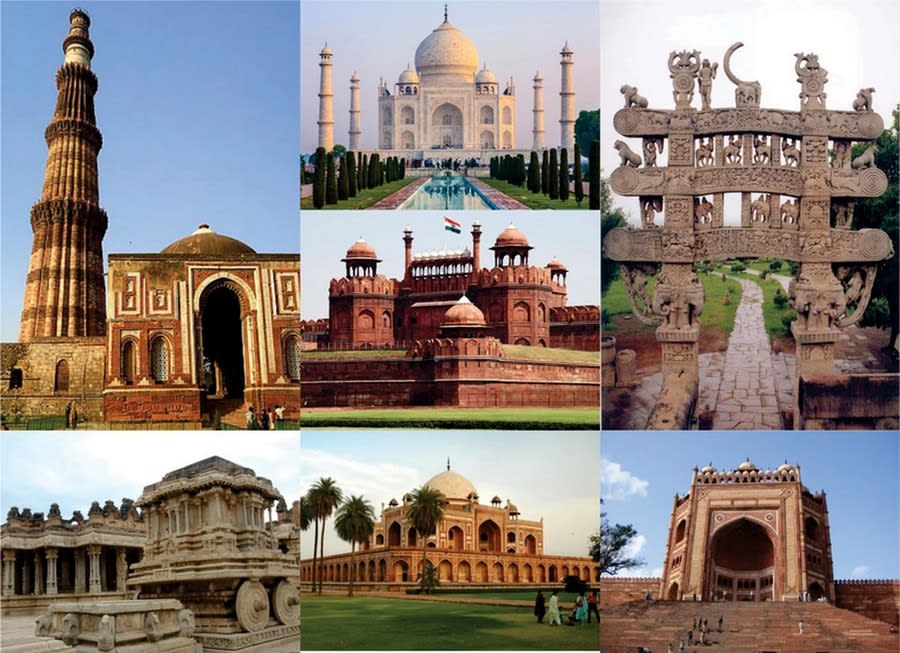
(ii) Composition of the Rajya Sabha — The maximum strength of the Rajya Sabha can be 250 members, out of which -

  1. 12 members are nominated by the President from among persons having special knowledge or practical experience in matters such as literature, science, art and social service.
  2. 238 members are elected by the States in the Union. Seats are allocated to the States and the Union Territories on the basis of their population.

(iii) Two exclusive powers of the Lok Sabha —

  1. Motions of No-confidence against the government can only be introduced and passed in the Lok Sabha. If passed by a majority vote, the Prime Minister and the Council of Ministers resign collectively. The Rajya Sabha has no power over such a motion, and hence no real power over the executive.
  2. Money bills can only be introduced in the Lok Sabha, and upon being passed, are sent to the Rajya Sabha, where it can be deliberated on for up to 14 days.

Two exclusive powers of the Rajya Sabha —

  1. Though the Parliament cannot, in normal times, make laws on a states subject, the Constitution states that under Article 249, the Rajya Sabha may, by resolution adopted by two-thirds majority empower the Parliament should make laws with respect to a matter in the State List. The Lok Sabha has no authority to assert itself in such matters.
  2. The other special power enjoyed by the Rajya Sabha is that it may declare that the creation of new All-India Services be made in the national interest. There upon Parliament may create new services.
4Written · 2024 · Part II A · 2024 PaperFull page

The Council of Ministers headed by the Prime Minister aids and advises the President. In this context, answer the following questions:

(i) Mention any three points to distinguish between the Council of Ministers and the Cabinet.

(ii) Who appoints the Cabinet Ministers? Mention any two administrative powers of the Cabinet.

(iii) The President is the nominal head of the Indian Union. Mention any four functions of the Prime Minister with reference to the President.

Show SolutionHide Solution↓

(i) Difference between the Council of Ministers and the Cabinet —

Council of MinistersCabinet
The Council of Ministers consists of all categories of Ministers Cabinet Ministers, Ministers of State and Deputy Ministers.The 'Cabinet' is a smaller group consisting of senior Ministers holding important portfolios such as Defence, Finance, Home, etc.
The Prime Minister may or may not consult the other Ministers, below the rank of Cabinet Ministers.They are the most trusted colleagues of the Prime Minister. The Prime Minister always consults them. The decisions of the Cabinet are binding on all the ministers.
In the day-to-day working of the government, the Council of Ministers as a whole rarely meets.The Cabinet is a small cohesive group of senior Ministers who determine the policy and programme of the Government; so they meet as frequently as possible.

(ii) The President appoints the Cabinet ministers as per the advice of the Prime Minister. Two administrative powers of the Cabinet are:

  1. Policy making: The Cabinet formulates both external and domestic policies and decides on crucial government matters concerning various domains like defense, economy and foreign affairs.
  2. Coordination: The Cabinet ensures smooth collaboration and coordination between different government departments for effective policy implementation.

(iii) The President of India is referred to as a nominal head of the Indian Union because of the following reasons -

  1. All authority vested in the President is exercised by the Prime Minister. He/She is the principal advisor of the President. Thus, the President is the nominal head and the Prime Minister is the real executive of the Indian Union.
  2. It is on the advice of the Prime Minister that the President summons and prorogues the Parliament and dissolves the Lok Sabha.
  3. The Prime Minister chooses the ministers and, on his/her advice, the President appoints them. The ministers may be dismissed on the advice of the Prime Minister.
  4. He/She advises the President on various appointments to important posts such as the Judges of the Supreme Court, the Governors and Ambassadors.
5Written · 2024 · Part II A · 2024 PaperFull page

The judiciary is the system of courts that interprets and guards the Indian Constitution. With reference to the Supreme Court of India, answer the following:

(i) What is the composition of the Supreme Court? Why is it called the Court of Record?

(ii) Explain the power of Judicial Review.

(iii) What is meant by the term Original Jurisdiction? Mention any three cases which come under this jurisdiction.

Show SolutionHide Solution↓

(i) The Supreme Court of India consists of a Chief Justice of India and not more than 33 other judges, until Parliament by law prescribes a larger number of judges.

A Court of Record is a court whose judgements are recorded for evidence and testimony.

  1. The judgements are in the nature of 'precedents', i.e., the High Courts and other Courts are bound to give a similar decision in a similar case. They are not to be questioned when they are produced before any subordinate court.
  2. The Supreme Court shall be a "Court of Record" and shall have all the powers of such a court including the power to punish for contempt of itself.
  3. The Court of Record has two implications:
    1. Its judgements and orders are preserved as record. These can be produced in any court as precedents.
    2. If a person commits a contempt of court, the court has the authority to punish him. No authority can deprive the court of this right.

(ii) The Supreme Court is the interpreter of the Constitution and its decision is final.

  1. It has the power to review laws passed by the Union or State legislatures.
  2. The Supreme Court can declare a law 'ultra vires' or null and void, if it is against the letter and spirit of the Constitution or contravenes any provision of the Constitution. This power is referred to as the power of judicial review.

(iii) Original Jurisdiction means the power to hear and determine a dispute in the first instance; i.e., those cases which cannot be moved in any court other than the Supreme Court.

The Supreme Court exercises the power of the Original jurisdiction in the following cases:

  1. The Supreme Court has original jurisdiction in all disputes between the Union and States as well as between the States.
  2. Protection of Fundamental Rights.
  3. Final Interpretation of the Constitution.
6Written · 2024 · Part II B · 2024 PaperFull page

The Revolt of 1857 was the beginning of the independence struggle against the colonial rule of the British. With reference to the consequences of the Revolt, answer the following:

(i) Mention any three changes made in the administration with the end of the Company's Rule.

(ii) State any three policies promised to Indians in Queen Victoria's Proclamation.

(iii) Mention any four changes made in the army after the Revolt.

Show SolutionHide Solution↓

(i) Three changes made in the administration with the end of the Company's Rule are:

  1. The Company's Board of Control and Court of Directors were abolished. A member of the British Cabinet was appointed Secretary of State for India and made responsible for all matters related to the governance of India. He was given a Council to advise him, called the Indian Council. Thus, the ultimate power over India remained with the British Parliament.
  2. Actual governance was to be carried on, as before, by the Governor-General who was also given the title of Viceroy, that is, a personal representative of the Crown. Lord Canning was appointed as the first Viceroy under this Act.
  3. Appointments to the Civil Service were to be made by open competition under rules made by the Secretary of State.

(ii) Queen Victoria's Proclamation promised that the government of India would — ;

  1. follow a policy of non-intervention in social and religious matters of Indians.
  2. treat all subjects-Indians and Europeans-as equals (education and ability would be the basis of all appointments).
  3. grant a general pardon to all those who had taken part in the War except those who were found guilty of murder of British subjects.

(iii) The India army was reorganised after 1858, to prevent the reoccurrence of another uprising, in the following manner:

  1. The strength of European troops in India was increased. The ratio of European to Indian troops was fixed at 1:2 (Bengal army) and 2:5 (Madras and Bombay armies). Practically the same ratio was maintained till the First World War. The general principle adopted was that the number of Indian sepoys should not exceed twice that of the European troops.
  2. European troops were kept in key geographical and military positions.
  3. To desist the Indian soldiers from rising again against the British rule, the sophisticated weapons and ammunition were never placed under the charge of Indians. All Indian artillery units, with the exceptions of a few mountain units, were disbanded.
  4. Newspapers, journals and nationalist publications were prevented from reaching the soldiers to keep the Indian army separated from the life of the rest of the population.
7Written · 2024 · Part II B · 2024 PaperFull page

The Indian National Movement is divided into three phases. With reference to the Second Phase of the Indian National Movement, answer the following questions:

(i) Who partitioned Bengal? Mention any two points to explain the perspective of the Nationalists regarding the actual motive behind the decision of Partition.

(ii) What was the objective of the Assertive Nationalists? Mention any two contributions of Bal Gangadhar Tilak.

(iii) In which year was the Muslim League formed? Mention any three objectives of the Muslim League.

Show SolutionHide Solution↓

(i) Lord Curzon, the Viceroy of India was responsible for the Partition of Bengal in 1905. The actual motives behind the partition from the perspective of the Nationalists were:

  1. The Partition of the state was intended to curb Bengali influence by not only placing Bengalis under two administrations but by reducing them to a minority in Bengal itself.
  2. The Partition was meant to foster division on the basis of religion. East Bengal would be predominantly a Muslim majority state and West Bengal would have a Hindu majority.

(ii) The main objective of the Assertive Nationalists was the immediate attainment of complete independence or 'Swaraj'. Two contributions of Bal Gangadhar Tilak are:

  1. Demand for Swaraj: Tilak was the first to openly declare the demand for Swaraj. "Swaraj is my birth right," he said, "and I shall have iť".
  2. Established Home Rule League: Tilak set up a Home Rule League at Pune in 1916 to attain home rule or a dominion status for India under the British Empire along the lines of countries like Canada and Australia.

(iii) Muslim League was formed in 1906.

Objectives of the Muslim League —

  1. To promote, among the Muslims of India, support for the British government and to remove any misconceptions regarding the intention of the government in relation to Indian Muslims.
  2. To protect and advance the political rights and interests of the Muslims and to represent their needs and aspirations to the government in mild and moderate language.
  3. To prevent the rise of feelings of hostility between the Muslims of India and other communities.
8Written · 2024 · Part II B · 2024 PaperFull page

Look at the picture given and answer the following questions:

Look at the picture given and answer the following questions:, ICSE 2024 History Solved Question Paper.

(i) Name the Viceroy who announced the plan for smooth transfer of power. Mention any two clauses of his plan with reference to the Princely States.

(ii) Mention any three reasons for the acceptance of his plan by the Congress.

(iii) Mention any four provisions of the Indian Independence Act of 1947.

Show SolutionHide Solution↓

(i) Lord Mountbatten announced the Mountbatten Plan on June 3, 1947, for smooth transfer of power.

Two clauses of Mountbatten Plan with reference to the Princely states are:

  1. The Mountbatten Plan stated that the treaties with them would come to an end.
  2. They would be free to associate themselves with either of the Dominions or to remain independent.

(ii) The reasons due to which All-India Congress Committee finally accepted the Mountbatten Plan may be summarised as follows:

  1. The large-scale communal riots that engulfed the whole country convinced all that the only solution to the communal problem lay in the Partition of India. In the words of Sardar Patel, "Refusal of the demand for Pakistan will amount to dividing the country into so many Pakistans."
  2. The League had joined the Interim Government to obstruct and not to cooperate. Experience of working with the League had convinced the Congress that it could not have a joint administration with the League.
  3. The only alternative to Partition was a Federation with a weak Centre. A smaller India with a strong central authority was better than a bigger State with a weak Centre.

(iii) Four provisions of the Indian Independence Act of 1947 are:

  1. Two New Dominions: India would be partitioned and two independent Dominions-India and Pakistan-would be created from August 15, 1947. The Act provided legislative supremacy of both the Dominions. The territories of the two Dominions were divided in such terms that Pakistan would comprise Sindh, British Baluchistan, North West Frontier Province, the West Punjab and East Bengal. India was to comprise all the remaining territories included in the British India. The exact boundaries of the Dominions would be determined by a Boundary Commission.

  2. Constituent Assemblies to Serve as Central Legislatures: The Constituent Assemblies of both the dominions were to act as the Central Legislatures and would have full powers to make laws for their respective Dominion. They would act as sovereign bodies for legislative purposes.

  3. Princely States: The Princely States would become independent and all the powers exercised by the British authority were to be terminated. All treaties and agreements made by the British with reference to States would lapse from August 15, 1947. They would be free to associate themselves with either Dominion or to remain independent.

  4. Division of the Army and the Assets: Provisions were made for the division of the Indian army between the two Dominions and steps were to be taken to share the assets and liabilities between the two Dominions.

9Written · 2024 · Part II B · 2024 PaperFull page

The final act of the long-drawn-out negotiations took place at Versailles on Saturday afternoon, and to-day Germany and the Allies - always with the exception of America - are at peace. Peace is a blessed word, and both the word and the fact are welcome to-day. So far as Germany is concerned there is for the present an end of strife, and at least a formal return to the decent relations of civilised states.

Editorial: Peace in force (12 January 1920)

The Guardian

(i) Mention any three causes of the World War which ended with the signing of the treaty being discussed in the passage above.

(ii) Name the organization which was established in 1920 to maintain peace after this war. Mention any two of its objectives.

(iii) Mention any four clauses of the Treaty which affected Germany.

Show SolutionHide Solution↓

(a) Three causes of the First World War were —

  1. Division of Europe into two hostile groups — the Triple Alliance and the Triple Entente.
  2. The armament race, in which every major power began stockpiling arms in the name of self-defence.
  3. Militant/aggressive nationalism and imperialism, which filled the atmosphere with mutual hatred and international rivalry. (The immediate cause was the Sarajevo Crisis.)

(b) The organisation established in 1920 to maintain peace after the war was the League of Nations. Two of its objectives were —

  1. To maintain international peace and security and establish international relations based on justice and honour.
  2. To promote material and intellectual co-operation between the nations of the world so that people's life may become happier and nobler.

(c) Four clauses of the Treaty of Versailles which affected Germany were —

  1. Germany and her allies were held guilty for aggression and hence she was forced to cede certain parts of her pre-war territories to Denmark, Belgium, Poland and Czechoslovakia.
  2. Alsace and Lorraine were returned to France, and the Saar Valley was ceded to France for 15 years.
  3. Germany had to lose all her colonial empire, which was divided among the victors.
  4. The German army was reduced to 1,00,000, she was deprived of any air force and submarines, and she was compelled to pay 33 billion dollars as war-indemnity.
10Written · 2024 · Part II B · 2024 PaperFull page

Both the United Nations Organisation and the Non-Aligned Movement aim to achieve international peace and security. In this context, answer the following:

(i) Mention any three functions of the Security Council.

(ii) Mention any three functions of the World Health Organisation.

(iii) Name any two founders of the Non-Aligned Movement. Mention any two of its objectives.

Show SolutionHide Solution↓

(i) The functions of the Security Council related to maintaining world peace are as follows:

  1. To maintain international peace and security in accordance with the principles and purposes of the United Nations.
  2. To investigate any dispute or situation which might lead to international friction and to take military action against an aggressor.
  3. To recommend methods of adjusting such disputes or the terms of settlement.

(ii) Three functions of the World Health Organisation are:

  1. It helps countries to improve their health system by building up infrastructure especially manpower, institutions and services for the individual and community.
  2. It gives important drugs needed for medical care. The WHO launched a programme to immunise children against six major diseases-Measles, Diphtheria, Tetanus, Tuberculosis, Polio and Whooping Cough.
  3. It promotes research to cure and prevent diseases. For example, it arranged for the investigation of cancer and heart diseases in laboratories in many countries to identify disease-causing organisms, to improve vaccines and to train research workers.

(iii) Two founders of the Non-Aligned Movement are — Prime Minister Nehru of India, and President Nasser of Egypt.

Two objectives of Non-Aligned Movement are:

  1. To oppose colonialism, imperialism and racial discrimination.
  2. To advocate peaceful settlement of international disputes.
1(i)1 Mark · 2024 · Part I · 2024 SpecimenFull page

An ordinance is called a temporary law. Which of the following statements correctly describes the same?

Show SolutionHide Solution↓

If the Parliament does not approve it within six weeks it becomes inoperative.

Reason — An Ordinance is called a temporary law, as it ceases to operate after six weeks from the re-assembly of Parliament, unless they are approved by the Houses. It also lapses if it is replaced by an Act of Parliament.

1(ii)1 Mark · 2024 · Part I · 2024 SpecimenFull page

Given below are details of a few Indian citizens.

CandidateAgeOther Details
W35recently declared bankrupt
X25a successful industrialist
Y30belongs to a socially and educationally backward class
Z31convicted of a criminal offence and sentenced to imprisonment for two years

Select the person who fulfils the eligibility criteria to become a member of the Rajya Sabha, the upper house of the Indian Parliament.

Show SolutionHide Solution↓

Y

Reason — The minimum age for election to the Rajya Sabha is 30 years. Also the candidate should not be in debt or be a proclaimed criminal. Therefore, only Person Y fulfills the eligibility criteria to become Rajya Sabha member.

1(iii)1 Mark · 2024 · Part I · 2024 SpecimenFull page

The opposition feels that the ruling government does not have the majority in the Lok Sabha and wants to bring down the Government.
Which of these motions will the Leader of the Opposition move?

Show SolutionHide Solution↓

No-confidence Motion

Reason — A No-confidence Motion is moved when the opposition believes that the ruling government has lost the confidence of the Lok Sabha. If the motion is passed by a majority, the Council of Ministers, including the Prime Minister, is obliged to resign.

1(iv)1 Mark · 2024 · Part I · 2024 Specimen · 🔁 also 2023Full page

When the Supreme Court reviews any judgement made by it to remove an error, it falls under ............... jurisdiction.

Show SolutionHide Solution↓

Revisory

Reason — The Supreme Court is empowered to review any judgement or order made by it with a view to removing any mistake or error that might have crept in the judgement or order.

1(v)1 Mark · 2024 · Part I · 2024 SpecimenFull page

Identify the officials who form the electoral college for the Presidential elections in India.

P: elected members of Parliament
Q: nominated members of Parliament
R: elected members of State Legislative Assemblies
S: nominated members of State Legislative Councils

Show SolutionHide Solution↓

P and R

Reason — The Electoral College consists of the elected members of both Houses of Parliament and the elected members of State Legislative Assemblies, including those of the National Capital Territory of Delhi and the Union Territory of Puducherry.

1(vi)1 Mark · 2024 · Part I · 2024 Specimen · 🔁 also 2023Full page

Court of District Judge : Civil Cases : : Sessions Court : ............... Cases

Show SolutionHide Solution↓

Criminal

Reason — The District Judge primarily handles civil cases, whereas the Sessions Court primarily handles criminal cases.

1(vii)1 Mark · 2024 · Part I · 2024 SpecimenFull page

Read the two statements given below about the Civil Disobedience Movement and select the option that shows the correct relationship between (A) and (B).

(A) Gandhi's Civil Disobedience was based on engaging in dialogue and negotiation with the British.
(B) Gandhi believed that violence and aggression are counterproductive to achieve any goal.

Show SolutionHide Solution↓

(B) is the reason for (A).

Reason — Gandhiji believed in peaceful negotiation and non-violent resistance through civil disobedience (such as the Salt March and boycotts) rather than violent confrontation, which is why his approach was based on dialogue and negotiation.

1(viii)1 Mark · 2024 · Part I · 2024 SpecimenFull page

The central government of a country named X has decided to enforce a law similar to the Vernacular Press Act, which was enacted by the British in India in 1878 to control and regulate the vernacular press.

Based on this information, who among the following is most likely to benefit from the enforcement of the law in X?

Show SolutionHide Solution↓

the ruling political party

Reason — The Vernacular Press Act aimed to control the press by forbidding vernacular newspapers from publishing material that could incite dissatisfaction against the British Government. Similarly, in country X, such a law would suppress critical reporting, keeping the public unaware of the ruling party's wrongdoings. Therefore, the ruling political party is most likely to benefit.

1(ix)1 Mark · 2024 · Part I · 2024 SpecimenFull page

In 1856, the British East India Company justified the annexation of Awadh, a princely state in northern India, on what grounds?

Show SolutionHide Solution↓

due to alleged misgovernance by the Nawab of Awadh

Reason — Awadh was annexed by Lord Dalhousie in 1856 on the pretext of alleged misrule by the Nawab.

1(x)1 Mark · 2024 · Part I · 2024 SpecimenFull page

Which of the following is an immediate impact of the below incident?

Which of the following is an immediate impact of the below incident?, ICSE Specimen 2024 History Solved Question Paper.

Source: Daily Express, 29th June, Monday 1914

Show SolutionHide Solution↓

It led to the First World War

Reason — The above incident, known as the Sarajevo Crisis, was the immediate cause of World War I. Archduke Francis Ferdinand, heir to the throne of Austria-Hungary, was assassinated at Sarajevo, the capital of Bosnia, on June 28, 1914 by members of the Serbian secret society "Union of Death".

1(xi)1 Mark · 2024 · Part I · 2024 SpecimenFull page

Identify the odd one out of the following objectives:

Show SolutionHide Solution↓

To abolish the zamindari system

Reason — The abolition of the zamindari system was not one of the objectives of the Muslim League.

1(xii)1 Mark · 2024 · Part I · 2024 SpecimenFull page

A college student named Roshni is doing a project on a prominent Indian leader whose core work revolved around Dalit rights.
Who is Roshni MOST LIKELY writing about?

Show SolutionHide Solution↓

Jyotiba Phule

Reason — Jyotiba Phule was a 19th-century Indian social reformer, best known for his pioneering work in Dalit upliftment, women's education, and social equality. He founded the Satya Shodhak Samaj in 1873 to fight for equality for the weaker sections of society.

1(xiii)1 Mark · 2024 · Part I · 2024 SpecimenFull page

............... was the cause for the renewal of the Civil Disobedience Movement.

Show SolutionHide Solution↓

Failure of the Second Round Table Conference

Reason — The Civil Disobedience Movement was renewed due to the failure of the Second Round Table Conference, the refusal of the British to grant immediate dominion status to India, and Viceroy Willingdon's refusal to grant an interview to Gandhiji during the Great Depression of the 1930s.

1(xiv)1 Mark · 2024 · Part I · 2024 SpecimenFull page

The non-permanent members of the Security Council have a term of ............... years.

Show SolutionHide Solution↓

2

Reason — The non-permanent members of the United Nations Security Council serve a term of two years.
1(xv)1 Mark · 2024 · Part I · 2024 SpecimenFull page

Which of the following policies of a dictator ruling over Country X is MOST aligned with the ideologies of Mussolini during his time in power?

Show SolutionHide Solution↓

prioritising military expansion

Reason — Mussolini followed an aggressive imperialist policy and believed in military strength to expand Italy's power and prestige. Therefore, prioritising military expansion best reflects his ideology.

1(xvi)1 Mark · 2024 · Part I · 2024 Specimen · 🔁 also 2025 & 2026Full page

Which of the following scenarios describes the Non-Alignment Policy (NAM)?

Show SolutionHide Solution↓

A country maintains relations with both factions during the Cold War and does not take sides.

Reason — Non-alignment is the international policy of a sovereign state whereby it does not align itself with any of the major power blocs, while actively participating in world affairs to promote peace, harmony, and international cooperation.

2(i)1 Mark · 2024 · Part I · 2024 SpecimenFull page

Read the given news carefully.

Headline: Mysuru Lok Adalat settles 53-year-old civil case involving Kannada poets' kin. This case went on for a total of 53 years in various courts and involved 10 advocates and 40 witnesses.

Source: news18.com published on March 14, 2022

State any two advantages of Lok Adalats that can be deduced from the above news headline.

Show SolutionHide Solution↓

Lok Adalats are an important part of the Indian legal system and offer following two advantages:

  1. Speedy Resolution — Lok Adalats are known for their ability to provide speedy resolution of disputes. The procedural flexibility contributes to the quick resolution of cases at Lok Adalats.
  2. Cost-Effectiveness — Another significant advantage of Lok Adalats is their cost-effectiveness. There is no court fee payable when a matter is filed in a Lok Adalat.
2(ii)1 Mark · 2024 · Part I · 2024 SpecimenFull page

Imagine you were part of the German military in the year 1919, mention any two terms of the Treaty of Versailles which would impact you.

Show SolutionHide Solution↓

As a member of the German military in 1919, two terms of the Treaty of Versailles that would significantly impact me are:

  1. Military Limitations — The treaty imposed severe restrictions on Germany’s military. The German army was restricted to 100,000 officers and men, and conscription was forbidden. This would mean a significant reduction in force size and potentially job losses within the military.
  2. Demilitarization of the Rhineland — All of Germany west of the Rhine and up to 30 miles east of it was to be a demilitarized zone. This would limit the military’s operational scope and strategic positioning.
2(iii)1 Mark · 2024 · Part I · 2024 SpecimenFull page

Mention any two contributions of Subash Chandra Bose.

Show SolutionHide Solution↓

Two contributions of Subash Chandra Bose to India's freedom struggle were:

  1. He led the freedom struggle outside India as the Supreme Commander of the INA. He set up the Provisional Government of Free India in Singapore.
  2. The INA gave a tough fight to the British forces in the Assam hills and succeeded in capturing Ukhral and Kohima. They raised the Tricolour Flag for the first time on the liberated Indian soil on March 19, 1944.
2(iv)1 Mark · 2024 · Part I · 2024 Specimen · 🔁 also 2023 & 2025Full page

Give two reasons for the acceptance of the Mountbatten Plan by the Congress.

Show SolutionHide Solution↓

The Mountbatten Plan was accepted by the Congress because of following two key reasons:

  1. Large-Scale Communal Riots — The large-scale communal riots that engulfed the whole country convinced the Congress leaders that the only solution to the communal problem lay in the Partition of India.
  2. Avoidance of Civil War — The leaders felt that any further delay in the transfer of power could lead to a civil war in India. They believed that it was better to have a smaller India with a strong central authority than a larger state with a weak center.
2(v)1 Mark · 2024 · Part I · 2024 SpecimenFull page

Mention any two methods of the Assertive Nationalists.

Show SolutionHide Solution↓

The two methods adopted by the Assertive Nationalists in the freedom struggle were:

  1. Swadeshi and Boycott — Economic boycott of British goods and use of Swadeshi was designed to encourage Indian industries and provide the people with more opportunities for employment.
  2. National Education — The national leaders advocated national universities that were free from government control. A large number of national schools were established in East Bengal.
2(vi)1 Mark · 2024 · Part I · 2024 Specimen · 🔁 also 2025, 2026 & 2027Full page

Mention any two objectives of the League of Nations.

Show SolutionHide Solution↓

Two objectives of the League of Nations ere:

  1. All States were to refer their mutual disputes, if any, to the League of Nations for a peaceful settlement.
  2. The member-States were to take necessary action as directed by the League against any state which tried to disturb world peace and order.
2(vii)1 Mark · 2024 · Part I · 2024 Specimen · 🔁 also 2023 & 2025Full page

Name the two alliances formed in Europe before the beginning of the First World War.

Show SolutionHide Solution↓

Before the beginning of the First World War, two major alliances formed in Europe were:

  1. Triple Alliance which included Germany, Austria-Hungary, and Italy.
  2. Triple Entente which included France, Russia, and the United Kingdom.
3Written · 2024 · Part II A · 2024 SpecimenFull page

The Union Legislature of India is not only the lawmaking body, but the center of all democratic political process. With reference to the Parliament, answer the following questions:

(i) Mention any three circumstances under which the Lok Sabha can make laws on a subject in the State list.

(ii) Mention any three financial powers of the Union Parliament.

(iii) The Speaker plays a key role in maintaining order and ensuring the smooth functioning of the Lok Sabha. Mention any four functions of the Speaker to support this statement.

Show SolutionHide Solution↓

(i) The Lok Sabha can make laws on a subject in the State list under the following three circumstances:

  1. When Rajya Sabha passes a resolution — The Rajya Sabha may, by resolution adopted by two-thirds majority, empower the Parliament to make laws with respect to a matter in the State List.
  2. During a National Emergency — If a National Emergency is in operation, or any state is placed under President’s Rule (Article 356), the Parliament can enact laws on items in the State List.
  3. When two or more states pass a resolution — If two or more states pass a resolution requesting Parliament to legislate on subjects under the State List, the Parliament can make laws on those subjects.

(ii) The Union Parliament has following three financial powers:

  1. Passing the Union Budget — The Parliament has the power to pass the annual Union Budget.
  2. Making Supplementary Grants — If the amount authorized by the budget is insufficient, the Parliament can make supplementary grants.
  3. Vote on Account — If the Budget is not passed before April, then there would be no money for the executive to spend. To provide money to the executive for day-to-day expenditure till the passage of the budget, a “Vote on Account” is passed.

(iii) The Speaker of the Lok Sabha plays a crucial role in maintaining order and ensuring the smooth functioning of the Lok Sabha. Here are four functions of the Speaker:

  1. The Speaker presides over the meetings of the house and conducts the business in the house.
  2. The Speaker decides whether a bill is a money bill or not.
  3. The Speaker maintains discipline and decorum in the house. He interprets the rules of procedure of house.
  4. The Speaker puts issues to vote and announces result.
4Written · 2024 · Part II A · 2024 SpecimenFull page

The President is the nominal head of the executive, the first citizen of the country, as well as the commander-in-chief of the Indian Armed Forces. With reference to this, answer the following questions:

(i) Mention any three qualifications required for a person to be nominated to the post of the President.

(ii) Mention any three discretionary powers of the President.

(iii) Describe the procedure of Impeachment of the President.

Show SolutionHide Solution↓

(i) The qualifications required for a person to be nominated to the post of the President of India are as follows:

  1. The candidate must be a citizen of India.
  2. The candidate must have completed the age of thirty-five years.
  3. The candidate must be qualified for election as a member of the Lok Sabha.

(ii) Three discretionary powers of the President are:

  1. When the ruling party who has lost majority support in the Lok Sabha or when a vote of no-confidence may have been passed against it, recommends to the President to dissolve the Lok Sabha, then it is at the discretion of the President to either dissolve the House or ask another party to prove its majority on the floor of the House.
  2. The President can dismiss Ministers in case the Council of Ministers loses the confidence of the House but refuses to resign.
  3. Appointment of a Prime minister in case of sudden death of working Prime minister where the ruling legislature party is unable to meet immediately to elect a leader.

(iii) PROCEDURE FOR IMPEACHMENT OF THE PRESIDENT

  1. In case of violation of the Constitution or grave misconduct, either House may frame charges against the President as follows:
    1. Resolution which is moved after at least fourteen days notice in writing signed by not less than one-fourth of the total number of members of the House.
    2. The resolution is passed by a majority of not less than two-thirds of the total membership of the House.
  2. The other House investigates the charges and the President has the right to appear and to be represented at such an investigation.
  3. If the President is found guilty, a resolution is passed by a majority of not less than two-thirds of the total membership of the investigating House, and the President is removed from his/her office.
5Written · 2024 · Part II A · 2024 SpecimenFull page

The Supreme Court of India is the supreme judicial authority and the highest court of the Republic of India. It is the final court of appeal for all civil and criminal cases. With reference to the Supreme Court, answer the following questions:

(i) Who appoints the judges of the Supreme Court?
Mention any two qualifications required for a person to be appointed as a judge of the Supreme Court.

(ii) Explain the term Original Jurisdiction of the Supreme Court with any two examples.

(iii) Name any four writs issued by the Supreme Court.

Show SolutionHide Solution↓

(i) The judges of the Supreme Court are appointed by the President of India. Two qualifications required for a person to be appointed as a judge of the Supreme Court are:

  1. The person must be a citizen of India.
  2. The person should either have been a judge of a High Court for at least five years or have been an advocate of a High Court for at least ten years

(ii) 'Original Jurisdiction' means the power to hear and determine a dispute in the first instance; i.e., those cases which cannot be moved in any court other than the Supreme Court. Following are two examples:

  1. Any dispute between the Government of India and one or more States.
  2. Any dispute between two or more States.

(iii) The Supreme Court of India has the power to issue following four writs:

  1. Habeas Corpus — This writ is used to enforce the fundamental right of individual liberty against unlawful detention.
  2. Mandamus — This writ is used by the court to order the public official who has failed to perform his duty or refused to do his duty, to resume his work.
  3. Certiorari — This writ is issued by a higher court to a lower court or tribunal either to transfer a case pending with the latter to itself or squash the order of the latter in a case.
  4. Prohibition — This writ is issued by a higher court to a lower court or tribunal to prevent the latter from exceeding its jurisdiction or usurping a jurisdiction that it does not possess.
6Written · 2024 · Part II B · 2024 SpecimenFull page

The Indian Rebellion of 1857 was a major uprising against the rule of the British East India Company, which functioned as a sovereign power on behalf of the British Crown.
With reference to this, answer the following questions:

(i) Mention any three administrative changes made in India as a consequence of the Revolt.

(ii) How did the failure of this Revolt impact the Mughals and the Peshwas?

(iii) Mention any four changes made in the army after the Revolt.

Show SolutionHide Solution↓

(i) The three administrative changes made in India as a consequence of the Revolt were:

  1. Transfer of Power — The Government of India Act of 1858 transferred the control of India from the East India Company to the British Crown. The power to govern India was vested in the Crown through the Secretary of State who was responsible to the British Parliament.
  2. Establishment of the Viceroy's Executive Council — In India, the Act of 1858 established an Executive Council, whose members would serve as heads of various departments and as official advisers to the Governor-General. The members of the Council occupied a position similar to that of Cabinet ministers.
  3. Foreign Policy — India's foreign policy was dictated by the interest of the British government.

(ii) The failure of the Revolt of 1857 had significant impacts on both the Mughals and the Peshwas:

  • Mughals — The Mughal dynasty, which had been in decline since the death of Aurangzeb, came to an end with the Revolt of 1857. The last Mughal emperor, Bahadur Shah Zafar II, was deported to Yangon in Myanmar. This marked the end of the Mughal rule in India.
  • Peshwas — Nana Saheb, the last Peshwa, fled to Nepal after the failure of the uprising. This marked the end of the Peshwaship.

(iii) Following are four significant changes were made in the Indian army after the Revolt of 1857:

  1. Increase in European Troops — The number of British soldiers in the Indian army was increased. This was done to ensure the dominance of the European branch of the army.
  2. Restructuring of the Artillery — The artillery, one of the most important branches of the army, was placed entirely in British hands.
  3. Change in Recruitment Policy — Discrimination on the basis of caste, region and religion was practised in the recruitment to the army.
  4. Isolating Indian army from Society — Newspaper, journals and nationalist publications were prevented from reaching the soldiers to keep the Indian army separated from the life of the rest of the population.
7Written · 2024 · Part II B · 2024 SpecimenFull page

Nationalism refers to the feeling of oneness that emerges when people consider themselves as one nation. With reference to the growth of nationalism, answer the following:

(i) Name the founder of the Indian National Congress. Mention any two of its objectives.

(ii) How did the press contribute to the growth of nationalism?

(iii) Mention any four repressive policies of Lord Lytton.

Show SolutionHide Solution↓

(i) Allan Octavian Hume was the founder of the Indian National Congress.

Two objectives of the Indian National Congress were:

  1. To develop and consolidate the feelings of national unity irrespective of caste, religion or province.
  2. To formulate popular demands and present them before the government.

(ii) Many Newspapers and magazines were brought out in vernacular languages. These played a significant role in developing a strong national sentiment among Indians. The press served as a crucial medium for disseminating information and raising awareness about socio-political issues. It helped spread modern ideas of self-government, democracy, civil rights etc. The press fostered national unity by spreading ideas and information that united people towards the common goal of independence. It popularized the ideas of nationalist organizations and leader.

(iii) Four repressive policies of Lord Lytton were:

  1. Vernacular Press Act — This act, enacted in 1878, forbade vernacular papers to publish any material that might incite feelings of dissatisfaction against the British Government. This act was not applicable to English newspapers.
  2. Arms Act — The Arms Act of 1878 made it a criminal offence for Indians to carry arms without licence. This act did not apply to British.
  3. Famine Policies — Lord Lytton’s handling of the Great Indian Famine of 1876-1878 has been heavily criticized. Despite the famine, he convened a grand durbar to proclaim Queen Victoria as the Empress of India.
  4. Removal of import duties — Lord Lytton removed import duties on cotton textiles for the benefit of British cloth industry at the cost of nascent Indian textile industry.
8Written · 2024 · Part II B · 2024 SpecimenFull page

Read the excerpt given below and answer the questions that follow -

The movement had generated worldwide publicity, and British were looking for a way to end it. Gandhiji was released from custody in January 1931, and the two men began negotiating the terms of the pact. For many conservatives in England, the meetings and talks seemed unacceptable. They thought it was inappropriate for the Viceroy, who was the representative of the British Monarch, to receive their arch-enemy. Gandhiji was authorised by the then President of the Congress, Sardar Vallabh Bhai Patel, to negotiate with the Viceroy. He advised the nation to wait, watch, pray and hope for a better prospect for India. He was full of admiration for the people, their heroic struggle and hard suffering. *

Source: The Hindu

(i) Who was the Viceroy who negotiated with Gandhiji? Name any two causes of the movement being discussed above.

(ii) Mention any three impacts of this movement.

(iii) As a consequence of this meeting, a pact was signed. Mention any four conditions that the Congress and the British Government agreed to according to this pact.

Show SolutionHide Solution↓

(i) The Viceroy who negotiated with Gandhiji was Lord Irwin. The movement being discussed in the excerpt is the Civil Disobedience Movement. Two causes of this movement were:

  1. The Salt Tax — The British salt tax was a severe burden on the Indian population, particularly the poor.
  2. Simon Commission — The commission, sent to India in 1928 to recommend constitutional reforms, was boycotted and widely criticized by Indians for its all-British composition.

(ii) The Civil Disobedience Movement had following three impacts:

  1. Popularised Non-violent Resistance — It made people understand the significance of the principles of non-violence. People could resist violence with tolerance and courage.
  2. Widened base of the freedom struggle — A large number of social groups like merchants and shopkeepers, peasants, tribals and workers in different parts of the country were mobilised for the Indian national movement.
  3. Participation of Women — It brought women out of their homes to participate in politics and to make them equal partners in the freedom struggle.

(iii) The pact signed as a consequence of this meeting is known as the Gandhi-Irwin Pact. Four conditions that the Congress and the British Government agreed to according to this pact were:

  1. Participation in Round Table Conference — The Indian National Congress agreed to take part in the second session of the Round Table Conference.
  2. Suspend Civil Disobedience Movement — The Congress agreed to suspend the Civil Disobedience Movement.
  3. Withdrawal of Ordinances — The British government agreed to withdraw all ordinances and end prosecution.
  4. Removal of Salt Tax — The British government permitted free collection or manufacture of salt by persons near the seacoast.
9Written · 2024 · Part II B · 2024 SpecimenFull page

Look at the picture given and answer the following questions:

Look at the picture given and answer the following questions:, ICSE Specimen 2024 History Solved Question Paper.

(i) Identify the leader in the above picture. Mention any two of his ideologies.

(ii) Mention any three causes for his rise to power.

(iii) What was the immediate cause of the Second World War?
Mention any three reasons given by this leader to justify his action.

Show SolutionHide Solution↓

(i) The leader in above picture is Hitler. Following are his two ideologies:

  1. Hitler believed in the superiority of German race and upheld its supremacy. He hated Jews.
  2. He stressed the subordination of the individual to the state and the necessity of strict obedience to leaders.

(ii) Three factors that led to the rise of Hitler were —

  1. Humiliating Treaty of Versailles — The conditions imposed on Germany by the Treaty of Versailles made the Germans feel humiliated and helpless. Hitler exploited these sentiments and encouraged the Germans to break the treaty and rebuild the empire of Germany by recapturing lost colonies.
  2. Hitler’s Oratorical Skills and Propaganda — Hitler was a powerful speaker and used propaganda effectively to gain support. His messages resonated with many Germans who felt disenfranchised or were dissatisfied with the current government.
  3. Growing Fear of Communism — After the Bolshevik Revolution in Russia, the Communist influence in Germany increased considerably as they succeeded in capturing a number of seats in Reichstag. Hitler warned the people that Communists of Germany would become the servants of their Russian masters and would follow the dictates of Communists. He persuaded the people that Nazism alone could check the growing influence of Communism.

(iii) The immediate cause of the Second World War was the invasion of Poland by Germany on September 1, 1939.

Adolf Hitler, provided following justifications for the invasion of Poland in 1939:

  1. By the Treaty of Versailles, Germany was divided into two parts in order to give a land-route to Poland upto the sea and the Port of Danzing was also given to Poland. Germany wanted to regain her lost territories.
  2. The city of Danzing was inhabited mainly by the Germans and by occupying Danzing Corridor, Germany could connect with East Prussia.
  3. Germany signed a Non-Aggression Pact with Russia in August 1939, Poland was accused of committing atrocities against Germans living there.
10Written · 2024 · Part II B · 2024 SpecimenFull page

The United Nations Organisation aims to maintain international peace. With reference to its organs and agencies, answer the following:

(i) What is the composition of the International Court of Justice?

(ii) Mention any three functions of the Security Council.

(iii) Give the full form of UNICEF. Mention any three of its functions.

Show SolutionHide Solution↓

(i) The International Court of Justice (ICJ) is composed of a panel of 15 judges. These judges are elected by the United Nations General Assembly and the Security Council for nine-year terms. No more than one judge of each nationality may be represented on the court at the same time.

(ii) Three functions of the Security Council are:

  1. Maintaining international peace and security in accordance with the principles and purposes of the United Nations.
  2. Investigating any dispute or situation which might lead to international friction.
  3. Recommending methods of adjusting such disputes or the terms of settlement.

(iii) UNICEF stands for the United Nations Children's Emergency Fund. Three of its functions are:

  1. It provides help to children and mothers in emergencies arising from natural calamities, civil strifes and epidemics.
  2. It helps governments to plan, develop and extend community based services in the fields of maternal and child health, clean water, nutrition and sanitation.
  3. It works to prevent diseases like Tuberculosis, Malaria, skin diseases and eye diseases.
1(i)1 Mark · 2023 · Part I · 2023 PaperFull page

An ordinance has to be approved by the Parliament within ............... weeks.

Show SolutionHide Solution↓

Six

Reason — All Ordinances must be put up before both the Houses for their approval. Ordinances cease to operate after six weeks from the re-assembly of Parliament, unless they are approved by the Houses.

1(ii)1 Mark · 2023 · Part I · 2023 PaperFull page

The junior category of ministers who assist senior ministers:

Show SolutionHide Solution↓

Deputy Ministers

Reason — Deputy Ministers assist the Cabinet Ministers and the Council of Ministers. They are junior ministers and are placed under senior ministers whom they have to assist.

1(iii)1 Mark · 2023 · Part I · 2023 PaperFull page

A major natural calamity has taken place and the opposition wants the house to lay aside all other business and take up this matter of urgent importance. Which motion should the house move to allow this?

Show SolutionHide Solution↓

Adjournment Motion

Reason — An Adjournment Motion means a proposal to lay aside all other business and take up a 'definite matter of urgent importance'. Such a Motion leads to the interruption of normal business of the House.

1(iv)1 Mark · 2023 · Part I · 2023 Paper · 🔁 also 2024Full page

When the Supreme Court reviews any judgement made by it to remove an error, it falls under ............... jurisdiction.

Show SolutionHide Solution↓

Revisory

Reason — The Supreme Court is empowered to review any judgement or order made by it with a view to removing any mistake or error that might have crept in the judgement or order. This decision is acceptable by all courts in India.

1(v)1 Mark · 2023 · Part I · 2023 PaperFull page

The ............... has the power to summon the Houses of Parliament.

Show SolutionHide Solution↓

President

Reason — The President has the power to summon the Houses of Parliament. There should not be a gap of more than six months between two sessions of each House.

1(vi)1 Mark · 2023 · Part I · 2023 Paper · 🔁 also 2024Full page

Court of District Judge : Civil Cases :: Sessions Court : ............... Cases

Show SolutionHide Solution↓

Criminal

Reason — The District Judge handles civil cases, while the Sessions Court handles criminal cases.

1(vii)1 Mark · 2023 · Part I · 2023 PaperFull page

Formation of Congress : 1885 :: Formation of Muslim League : ...............

Show SolutionHide Solution↓

1906

Reason — The All-India Muslim League was set up on December 30, 1906, under the presidency of Nawab Salimullah. Aga Khan was elected as the permanent president of the Muslim League.

1(viii)1 Mark · 2023 · Part I · 2023 PaperFull page

The plan of Partition of Bengal was proposed by ............... .

Show SolutionHide Solution↓

Lord Curzon

Reason — The plan for the Partition of Bengal was formulated by Lord Curzon in 1905, who believed that such an action would weaken the nationalist movement in Bengal. It was part of the Divide and Rule policy of the British.

1(ix)1 Mark · 2023 · Part I · 2023 PaperFull page

People protested against the ............... because it had seven British members and no Indian representation.

Show SolutionHide Solution↓

Simon Commission

Reason — The Simon Commission was composed of seven British members of Parliament and had no Indian members. This was seen as a violation of the principle of self-determination and a deliberate insult to the self-respect of Indians.

1(x)1 Mark · 2023 · Part I · 2023 PaperFull page

The main objective of the Assertive Nationalists was ............... .

Show SolutionHide Solution↓

Purna Swaraj

Reason — The main objective of the assertive nationalists was to attain Purna Swaraj from the British Government in India and establish their administration and government.

1(xi)1 Mark · 2023 · Part I · 2023 PaperFull page

Identify the Early Nationalist leader.

Show SolutionHide Solution↓

Gopal Krishna Gokhale

Reason — Gopal Krishna Gokhale was one of the earliest and most popular nationalist leaders who played an important role in raising the consciousness of the Indian people against British rule. Mahatma Gandhi even called him as his 'political mentor'.

1(xii)1 Mark · 2023 · Part I · 2023 PaperFull page

The Lucknow Pact was signed between ............... .

Show SolutionHide Solution↓

The Congress and the Muslim League

Reason — The Lucknow Pact was signed between the Congress and the Muslim League in 1916, bringing them together on a common platform to present joint constitutional demands before the Government.

1(xiii)1 Mark · 2023 · Part I · 2023 PaperFull page

............... was one of the causes of the Quit India Movement.

Show SolutionHide Solution↓

Failure of the Cripps Mission

Reason — The British Government in the year 1942 sent Sir Stafford Cripps to draw up a plan for India to decide its future after the war. However, this plan was not accepted by all the parties, and soon after it they started the Quit India Movement in August 1942.

1(xiv)1 Mark · 2023 · Part I · 2023 PaperFull page

The International Court of Justice has ............... judges.

Show SolutionHide Solution↓

15

Reason — The International Court of Justice (ICJ) has 15 judges from different countries. They are elected for nine-year terms by the United Nations General Assembly and the Security Council.

1(xv)1 Mark · 2023 · Part I · 2023 PaperFull page

Which of these leaders was an architect of the Non-Aligned Movement?

Show SolutionHide Solution↓

Abdel Nasser

Reason — President Abdel Nasser of Egypt, along with Prime Minister Jawaharlal Nehru of India and President Josip Broz Tito of Yugoslavia, were the main founders of the Non-Aligned Movement (NAM).

1(xvi)1 Mark · 2023 · Part I · 2023 PaperFull page

The immediate cause of the First World War was ............... .

Show SolutionHide Solution↓

Sarajevo Crisis

Reason — The immediate cause of the First World War was the Sarajevo Crisis. The murder of Prince Archduke Francis Ferdinand at Sarajevo on 28 June 1914 led Austria-Hungary to declare war on Serbia, which soon culminated in the First World War.

2(i)1 Mark · 2023 · Part I · 2023 PaperFull page

Mention any two ways in which the Constitution ensures the independence of the Judiciary from the Executive.

Show SolutionHide Solution↓

Two ways in which the Constitution ensures the independence of the Judiciary from the Executive are:

  1. A Judge can remain in office till he has attained the age of 65 years. He can be removed by the President on the ground of "proved misbehaviour or incapacity."
  2. The Supreme Court can punish for the contempt of court if a person or authority makes an attempt to lower its authority.
2(ii)1 Mark · 2023 · Part I · 2023 PaperFull page

State any two legislative powers of the Cabinet.

Show SolutionHide Solution↓

Two legislative powers of the Cabinet are:

  1. Amendment to the Constitution: The Cabinet is instrumental in planning and moving the Amendment to the Constitution.
  2. Issuing Ordinances: Cabinet also advises the President to issue ordinances when the Parliament is not in session.
2(iii)1 Mark · 2023 · Part I · 2023 PaperFull page

Mention any two repressive policies of Lord Lytton.

Show SolutionHide Solution↓

Two repressive policies of Lord Lytton are:

  1. Vernacular Press Act — This act, enacted in 1878, forbade vernacular papers to publish any material that might incite feelings of dissatisfaction against the British Government. This act was not applicable to English newspapers.
  2. Arms Act — The Arms Act of 1878 made it a criminal offence for Indians to carry arms without licence. This act did not apply to British.
2(iv)1 Mark · 2023 · Part I · 2023 Paper · 🔁 also 2024 & 2025Full page

Give two reasons for the acceptance of the Mountbatten Plan by the Congress.

Show SolutionHide Solution↓

Two reasons for the acceptance of the Mountbatten Plan by the Congress were:

  1. Large scale communal riots engulfed the whole country. The only solution to the communal problem was the Partition of India.
  2. The only alternative to Partition was a Federation with a weak centre. A smaller India with a strong central authority was better than a bigger state with a weak centre.
2(v)1 Mark · 2023 · Part I · 2023 PaperFull page

State any two objectives of the Muslim League.

Show SolutionHide Solution↓

Two objectives of the Muslim League were:

  1. To promote, among the Muslims of India, support for the British government and to remove any misconceptions regarding the intention of the government in relation to Indian Muslims.
  2. To protect and advance the political rights and interests of the Muslims and to represent their needs and aspirations to the government in mild and moderate language.
2(vi)1 Mark · 2023 · Part I · 2023 PaperFull page

Mention any two clauses of the Treaty of Versailles.

Show SolutionHide Solution↓

Two clauses of the Treaty of Versailles were:

  1. The area of the Rhine Valley was to be demilitarised and the German territory west of Rhine was to be occupied by the Allied Troops for 15 years.
  2. The German Army was restricted to a force of 1,00,000 soldiers and the Navy was limited to 15,000 men and 24 ships. The Air Force and submarines were banned.
2(vii)1 Mark · 2023 · Part I · 2023 Paper · 🔁 also 2024 & 2025Full page

Name the two alliances formed in Europe before the beginning of the First World War.

Show SolutionHide Solution↓

Before the First World War, the two major alliances in Europe were:

  1. Triple Alliance which included Germany, Austria-Hungary, and Italy.
  2. Triple Entente which included France, Russia, and the United Kingdom.
3Written · 2023 · Part II A · 2023 PaperFull page

The Union Legislature comprises the President and the two houses of the Parliament. With reference to the Parliament, answer the following questions:

(i) Mr. Raj wants to be a member of the Lok Sabha. Mention any three qualifications required to contest elections for the Lok Sabha.

(ii) Mention any three legislative powers of the Union Parliament.

(iii) The Parliament controls the Executive. Mention any four ways in which it exercises its control.

Show SolutionHide Solution↓

(a) Three qualifications required to contest elections for the Lok Sabha are:

  1. He should be a citizen of India.
  2. He should be at least 25 years old.
  3. He should have his name in the electoral rolls in any part of the country.

(b) Three legislative powers of the Union Parliament are:

  1. The Parliament is the law-making body at the central level. It frames new laws and amends or repeals them, if necessary, on all the 97 Subjects of the Union List and all the Residuary Subjects which have not found a place in any of the lists.
  2. As far as the 47 Subjects in the Concurrent List are concerned, both the Parliament and the State Legislatures have got the right to make laws. But if any State Law comes into conflict with the Central Law, the Central Law shall prevail.
  3. All ordinances issued by the President must be approved by Parliament within six weeks after its session has begun, failing which an ordinance lapses.

(c) The Parliament exercises control over the Executive in the following ways:

  1. Question Hour: An hour a day in the daily routine of the Parliament, when in session, is reserved for asking questions from the Government. The members can ask any questions relating to the administration and policies and the Ministers are obliged to answer them.
  2. Vote of No-Confidence: The Council of Ministers remains in office only so long as it enjoys the confidence of the Lok Sabha. If a No-Confidence Motion is passed, the Council of Ministers must resign.
  3. Other Motions of Censure: The Parliament exercises its control over the Government by a number of other motions also which, if passed, amount to no-confidence. They include adjournment motions, motions of censure against a minister or ministers, rejection of a Government Bill and passing of a private member's bill against the wishes of the Government.
  4. Monetary Controls: The Parliament can hold the strings of the Government tight by voting a cut in the annual or supplementary budget or a cut in the salaries of the Ministers. It also appoints the Public Accounts Committee to examine the mode of government expenditure.
4Written · 2023 · Part II A · 2023 PaperFull page

The President is the head of the State and exercises his / her powers on the advice of the Prime Minister and the Council of Ministers. With reference to this, answer the following questions:

(i) What are the three types of emergencies that can be proclaimed by the President?

(ii) Mention any three legislative powers of the President.

(iii) Give any two reasons to justify the need for indirect election of the President. What is the composition of the Electoral College which elects the President?

Show SolutionHide Solution↓

(i) An Emergency is "a sudden or unforeseen situation demanding immediate action." It is a situation in which the Head of State assumes extraordinary powers. The President can proclaim a state of Emergency in the following cases:

  1. National or General Emergency: There is a danger of foreign aggression or danger to the peace and security of the country because of a civil war, insurgency or any other such cause (Article 352).

  2. Breakdown of Constitutional Machinery: The Constitutional machinery in a State has broken down or there is a deadlock because of political uncertainties or otherwise (Article 356).

  3. Financial Emergency: A set-back to the financial stability or credit feasibility of the country is likely to occur or has occurred (Article 360).

(ii) Three legislative powers of the President are:

  1. Dissolve the Lok Sabha: He/She can dissolve the Lok Sabha and order fresh elections.

  2. Assent to Bills: Once a Bill is passed by both the Houses, it is sent to the President for his/her approval. The President may give his/her assent, or withhold the Bill or send it back to the House concerned with recommendations. If the same bill is passed again, the President has to give his/her assent.

  3. Promulgate Ordinances: The President can promulgate an Ordinance, which has the same status as an Act of Parliament when:

    1. Certain circumstances need immediate action.
    2. Both Houses of Parliament are not in session.
    3. All Ordinances must be put up before both the Houses for their approval. Ordinances cease to operate after six weeks from the re-assembly of Parliament, unless they are approved by the Houses.
    4. The Ordinance lapses if it is replaced by an Act of Parliament.

(iii) The President is elected by indirect elections because of the following reasons:

  1. If the President were to be elected directly by the people, he could become a rival centre of power to the Council of Ministers. This would be against the parliamentary system with ministerial responsibility.
  2. Since the membership in the two Houses of Parliament was likely to be dominated by one party, election of the President merely by a majority of members of the Union Parliament could make him a nominee of the ruling party like the Prime Minister. Such a President could not represent the constituent States of the Union.

COMPOSITION OF THE ELECTORAL COLLEGE

The President is elected indirectly by the members of an Electoral College consisting of:

  1. the elected members of both Houses of Parliament.

  2. the elected members of the Legislative Assemblies of the States including National Capital Territory of Delhi and the Union Territory of Puducherry.

Nominated members of Rajya Sabha and State Assemblies are not eligible to be included in the Electoral college.

5Written · 2023 · Part II A · 2023 PaperFull page

The Constitution of India provides for a High Court for each State. With reference to the High Courts and Subordinate Courts, answer the following questions:

(i) Who appoints the judges of the High Court? Mention any two qualifications required for a person to be appointed as a judge of a High Court.

(ii) Mention any three cases that come under the Original Jurisdiction of the High Court.

(iii) What are Lok Adalats? Mention any three advantages of the Lok Adalats.

Show SolutionHide Solution↓

(a) The judges of a High Court are appointed by the President of India. Two qualifications required for a person to be appointed as a judge of a High Court are:

  1. He/She should be a citizen of India.
  2. He/She should have held a judicial office in the territory of India for at least ten years, or should have been an advocate of a High Court (or of two or more such courts in succession) for at least ten years.

(b) Two cases that come under the Original Jurisdiction of the High Court are:

  1. Cases relating to the enforcement of the Fundamental Rights of citizens.
  2. Cases relating to wills, divorce, company law, admiralty and contempt of court.
  3. Under the power of Judicial Review, High Court can interpret the Constitution.

(c) 'Lok Adalat' means 'the People's Court'. It is a voluntary forum where disputes are settled amicably and speedily without formal court procedures. Three advantages are:

  1. It settles disputes speedily and saves much time.
  2. It delivers inexpensive justice and saves money.
  3. It reduces the workload of the regular courts, and its settlements leave no bitter taste as everything is decided in an atmosphere of harmony.
6Written · 2023 · Part II B · 2023 PaperFull page

The Indian Nationalists described the Great Uprising of 1857 as the First War of Independence. With reference to this, answer the following questions:

(i) Mention any three policies used by the British to expand their political power in India.

(ii) The Revolt of 1857 is also known as the Sepoy Mutiny. Mention any three military causes which led to the uprising.

(iii) Mention any four economic causes of the Revolt.

Show SolutionHide Solution↓

(i) Three policies used by the British to expand their political power in India are:

  1. By Outright Wars: To expand their territorial power in India and to safeguard their economic and political interests the British waged many wars against the Indian rulers of different states.
  2. By Subsidiary Alliance: Subsidiary Alliance, introduced by Lord Wellesley, was an agreement between the British East India Company and the Indian Princely States by virtue of which these states lost their sovereignty (the power of a ruler to rule independently without any outside interference) to the British.
  3. By Using the Doctrine of Lapse: Lord Dalhousie, the Governor-General of India, annexed many Indian States to the Company using the Doctrine of Lapse. According to this Doctrine, if an Indian ruler died without a male heir, his kingdom would lapse, that is, it would come under the Company's territory in India.

(ii) Three military causes which led to the uprising of 1857 are:

  1. Ill-treatment of Indian soldiers: Indian soldiers were poorly paid, ill-fed and badly housed. British military authorities forbade the sepoys from wearing caste or sectarian marks, beards or turbans, and they showed disregard for the sentiments of the sepoys.

  2. General Service Enlistment Act (1856): As per this Act, Indian soldiers could be sent overseas on duty. The Act did not take into account the sentiment of the Indian soldiers. This led to a feeling of resentment among them.

  3. Lower Salaries: The wages of the Indian soldiers were inadequate to support their families. On the other hand, the British soldiers received more than eight times the salary of the Indian soldiers.

(iii) Four economic causes which led to the uprising of 1857 are:

  1. The resources from India were exploited for the benefit of the British people and the growth of industries in Britain. The raw material was exported and finished goods were imported. It ruined the Indian industries and handicrafts.
  2. There was a gradual decline in Indian handicrafts which now began to compete with the textiles manufactured in England. The British put pressure on the East India Company to forbid the sale of Indian textiles in England. They impose heavy export duties on India’s export of handicraft products, but allowed free export of India’s raw material to Britain and free import of British finish goods into India. Machine made British cloth was cheaper and of better quality. This eventually led to the shutting down of looms in India.
  3. People moved to cities to find employment, which was very difficult to get. Peasants were forced to pay tax in cash, which pushed them into the hands of the moneylenders, as the tax was collected even during the famines.
  4. As the Indigo trade was highly profitable to the British, the peasants were forced to cultivate only indigo in the fields chosen by the British planters. If they planted anything else, their crops were destroyed, and their cattle were carried off as punishment.
7Written · 2023 · Part II B · 2023 PaperFull page

Look at the picture given below and answer the following questions:

Look at the picture given below and answer the following questions, ICSE 2023 History Solved Question Paper.

(i) Name the march being led by Gandhiji in the above picture. Which movement did this march launch?

(ii) What were the three causes of the Non-Cooperation Movement? Name the incident which led to the suspension of this movement.

(iii) Mahatma Gandhi and Lord Irwin signed a pact in 1931. Mention any two conditions that the Congress agreed to and two conditions that the British Government agreed to according to this pact.

Show SolutionHide Solution↓

(i) The march being led by Gandhiji in the given picture is known as the Dandi March. This march led to the beginning of the Civil Disobedience Movement of 1930.

(ii) There were three main reasons behind the Non-cooperation movement:

  1. Rowlatt Act: The Rowlatt Act authorised the Government to imprison any person without trial and convict him in a court. It implied:
    1. Arrest of a person without warrant.
    2. In camera trial (trial in seclusion).
    3. Restrictions on movements of individuals.
    4. Suspension of the Right of Habeas Corpus.

Gandhiji appealed to the Viceroy to withhold his consent to the Rowlatt Act. However his appeal was ignored. He started 'Satyagraha' as a challenge to the government.

  1. Jallianwala Bagh Tragedy: Jallianwala Bagh Tragedy happened in Amritsar on April 13, 1919. On that day, peaceful gathering had assembled at Jallianwala Bagh to protest against the Rowlatt Act. Without any warning, General Dyer ordered his troops to open fire on the unarmed crowd, resulting in hundreds of deaths and thousands of injuries. It was made clear to the Indians that the British had no intention of parting with political power or sharing it with Indians.

  2. Khilafat Movement: In the First World War Turkey was defeated and the Sultan of Turkey, who was the Caliph was deprived of all authority. The Muslim population in India started a powerful agitation known as the Khilafat Movement, under the leadership of the Ali Brothers. 'Khilafat Day' was observed on October 17, 1919 on an all-India scale. Gandhiji took the chance to unite Hindus and Muslims. Mahatma Gandhi was elected as President of the All-India Khilafat Conference in November 1919. He advised the Khilafat Committee to adopt a policy of Non-Cooperation with the Government.

Suspension of the Non-Cooperation Movement — The Non-Cooperation Movement was withdrawn by Mahatma Gandhi after the Chauri Chaura incident. Gandhiji believed in peaceful and non-violent protests, and the violent turn of events at Chauri Chaura deeply distressed him. Therefore, he withdrew the movement.

(iii) Mahatma Gandhi and Lord Irwin signed Gandhi-Irwin Pact pact in March, 1931.

Two conditions that the Congress agreed to are-

  1. Participation in Round Table Conference — The Indian National Congress agreed to take part in the second session of the Round Table Conference.
  2. Suspend Civil Disobedience Movement — The Congress agreed to suspend the Civil Disobedience Movement.

Two conditions that the British Government agreed to are-

  1. Withdrawal of Ordinances — The British government agreed to withdraw all ordinances and end prosecution.
  2. Removal of Salt Tax — The British government permitted free collection or manufacture of salt by persons near the seacoast.
8Written · 2023 · Part II B · 2023 PaperFull page

The heroism of the Indians was revealed by the courage of Subash Chandra Bose and the Indian National Army. With reference to this, answer the following questions:

(i) Mention any three objectives of the Forward Bloc.

(ii) Mention any three contributions of Subash Chandra Bose.

(iii) Who was the founder of the Indian National Army? Mention any three of its objectives.

Show SolutionHide Solution↓

(i) Three objectives of the Forward Bloc are:

  1. Forward Bloc's immediate objective was liberation of India with the support of workers, peasants, youth and other organisations.
  2. After attaining independence, Forward Bloc would work for the establishment of a Socialist State through reorganisation of agriculture and industry on socialist lines.
  3. After attaining independence, Forward Bloc would work for the establishment of a Socialist State through abolition of the Zamindari system.

(ii) Three contributions of Subash Chandra Bose are:

  1. He led the freedom struggle outside India as the Supreme Commander of the INA. He set up the Provisional Government of Free India in Singapore.
  2. He declared war on Britain and the USA and acquired its first stretch of territory in India when Japan handed over Andaman and Nicobar Islands.
  3. The INA gave a tough fight to the British forces in the Assam hills and succeeded in capturing Ukhrul and Kohima. However, the surrender of Japan in the Second World War sealed the fate of the INA. The INA set an inspiring example of patriotism.

(iii) Netaji Subhash Chandra Bose was the founder of the Indian National Army. Three objectives of INA are:

  1. To organise an armed revolution and to fight the British army with modern arms.
  2. Since it was not possible for the Indians to organise an armed revolution from their homeland, this task must be assigned to the Indians living abroad, particularly on Indians living in East Asia.
  3. To organise a provisional government of Free India in order to mobilise all the forces effectively.
9Written · 2023 · Part II B · 2023 PaperFull page

The world wars marked a turning point in the history of the world. With reference to this period, answer the following questions:

(i) Mention any three similarities between the ideologies of Fascism and Nazism.

(ii) State the three consequences of the Second World War.

(iii) Mention any four causes of the Second World War.

Show SolutionHide Solution↓

(a) Three similarities between the ideologies of Fascism and Nazism are given below:

  1. Both Fascism and Nazism were supporters of one party and one leader — Mussolini in Italy and Hitler in Germany.
  2. They were dictators through and through. No one could challenge the authority of the leader of the party. Both Mussolini and Hitler had all the military and civil powers and nobody could criticise them.
  3. Both Fascism and Nazism preferred the state as compared to the individual. The individual exists only for the State.

(b) Three consequences of the Second World War are given below:

  1. It caused a colossal loss of life and property and led to the end of dictatorship in Europe, as both Fascism in Italy and Nazism in Germany fell.
  2. It led to the rise of the USA and the USSR as two rival superpowers, which resulted in the Cold War.
  3. It led to the establishment of the United Nations Organisation (UNO) to maintain peace and security in the world.

(c) Four causes of the Second World War are given below:

  1. The harsh and humiliating Treaty of Versailles, which created bitterness among the Germans.
  2. The rise of dictatorship — Fascism in Italy and Nazism in Germany — with their aggressive and imperialist policies.
  3. The failure of the League of Nations to check aggression and maintain peace.
  4. The immediate cause was the invasion (conquest) of Poland by Hitler.
10Written · 2023 · Part II B · 2023 PaperFull page

The United Nations Organisation aims to maintain international peace. With reference to its organs and agencies, answer the following:

(i) What is the composition of the Security Council? What is the term of the non-permanent members?

(ii) Mention any three functions of the General Assembly.

(iii) Give the full form of UNESCO. Mention any three of its functions.

Show SolutionHide Solution↓

(i) The Security Council consists of 15 members.

  1. It has five permanent members —
    1. China
    2. France
    3. Russia
    4. Britain
    5. The United States of America
  2. The regional representation of the ten non-permanent members is:
    • Afro-Asian countries — 5
    • Latin American countries — 2
    • West European and other countries — 2
    • East European countries — 1.
  3. The ten non-permanent members are elected by the General Assembly by a two-third majority for a term of two years.
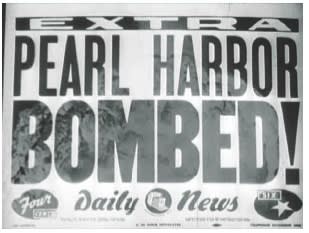
  4. A retiring member is not eligible for immediate re-election.
  5. The Presidency of the Council rotates monthly, according to the English alphabetical listing of its member States.

(ii) Three functions of the General Assembly are:

  1. To consider and make recommendations on the principles of cooperation, in the maintenance of international peace and security.
  2. To consider and approve the budget of the United Nations and to apportion the contributions among members.
  3. To elect the non-permanent members of the Security Council, the Economic and Social Council and the Trusteeship Council, and to elect the judges of the International Court of Justice.

(iii) UNESCO stands for United Nations Educational, Scientific and Cultural Organization.

Three functions of UNESCO are:

  1. Removal of illiteracy by encouragement to adult education, distance-education and the open school system.
  2. It promotes basic research in fields like geology, mathematics, physics and oceanography. As a result, it finances engineering and technology schemes in a number of developing countries.
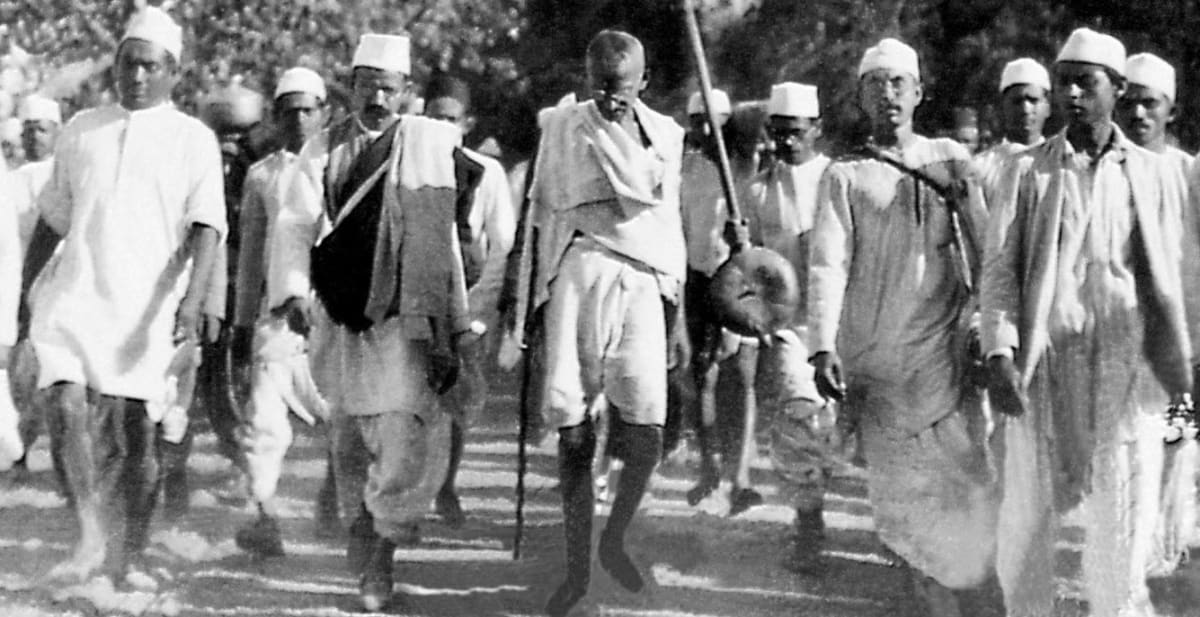
  3. It has set up regional networks, trained technicians and deals with both hardware and software aspects of informatics.

Use ↑ ↓ to move between questions. Press ↓ once to reveal a solution.

Free sample bank