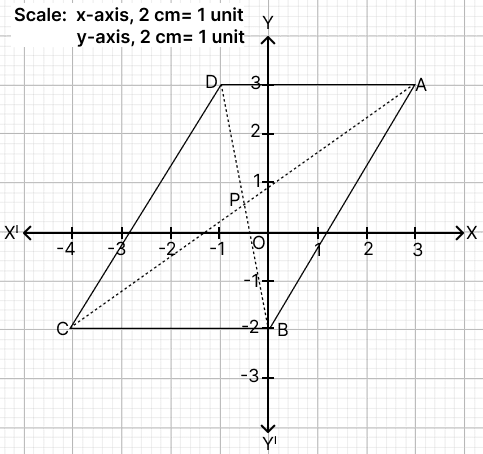
(a) From graph,
A(3, 3), B(0, −2), C(−4, −2), D(−1, 3).
Hence, A(3, 3), B(0, −2), C(−4, −2), D(−1, 3).
(b) Given,
The diagonals of a parallelogram bisect each other.
Hence, the intersection point P is the midpoint of both AC and BD.
By mid-point formula,
$\Rightarrow M = \Big(\frac{x_1+x_2}{2}, \frac{y_1+y_2}{2}\Big)$
Mid-point of AC :
$$\begin{aligned}\Rightarrow P = \Big(\frac{3 + (-4)}{2}\ , \frac{3 + (-2)}{2}\Big) \\[1em] \Rightarrow P = \Big(\frac{-1}{2}\ , \frac{1}{2}\Big) \\[1em] \Rightarrow P = (-0.5, 0.5).\end{aligned}$$
Hence, P = (-0.5, 0.5).
(c) By formula,
$\text{Slope (m)} = \frac{y_2 - y_1}{x_2 - x_1}$
Substituting values for line CB,
$$\begin{aligned}\Rightarrow m_{CB} = \frac{-2-(-2)}{0-(-4)} \\[1em] = \frac{0}{4} \\[1em] = 0.\end{aligned}$$
Substituting values for line DA,
$$\begin{aligned}\Rightarrow m_{DA} = \frac{3-3}{3-(-1)} \\[1em] = \frac{0}{4} \\[1em] = 0 .\end{aligned}$$
Since, slope of parallel lines are equal, thus CB || DA.
Hence, proved that CB || DA.
(d) By formula,
Slope of line = $\frac{y_2-y_1}{x_2-x_1}$
Slope of AC = $\frac{-2 - 3}{-4 - 3} = \frac{-5}{-7} = \frac{5}{7}$.
Using point-slope formula,
y - y1 = m(x - x1)
Equation of AC :
$$\begin{aligned}\Rightarrow y - 3 = \frac{5}{7}(x - 3) \\[1em] \Rightarrow 7(y - 3) = 5(x - 3) \\[1em] \Rightarrow 7y - 21 = 5x - 15 \\[1em] \Rightarrow 5x - 7y - 15 + 21 = 0 \\[1em] \Rightarrow 5x - 7y + 6 = 0.\end{aligned}$$
Hence, equation of the diagonal AC is 5x - 7y + 6 = 0.