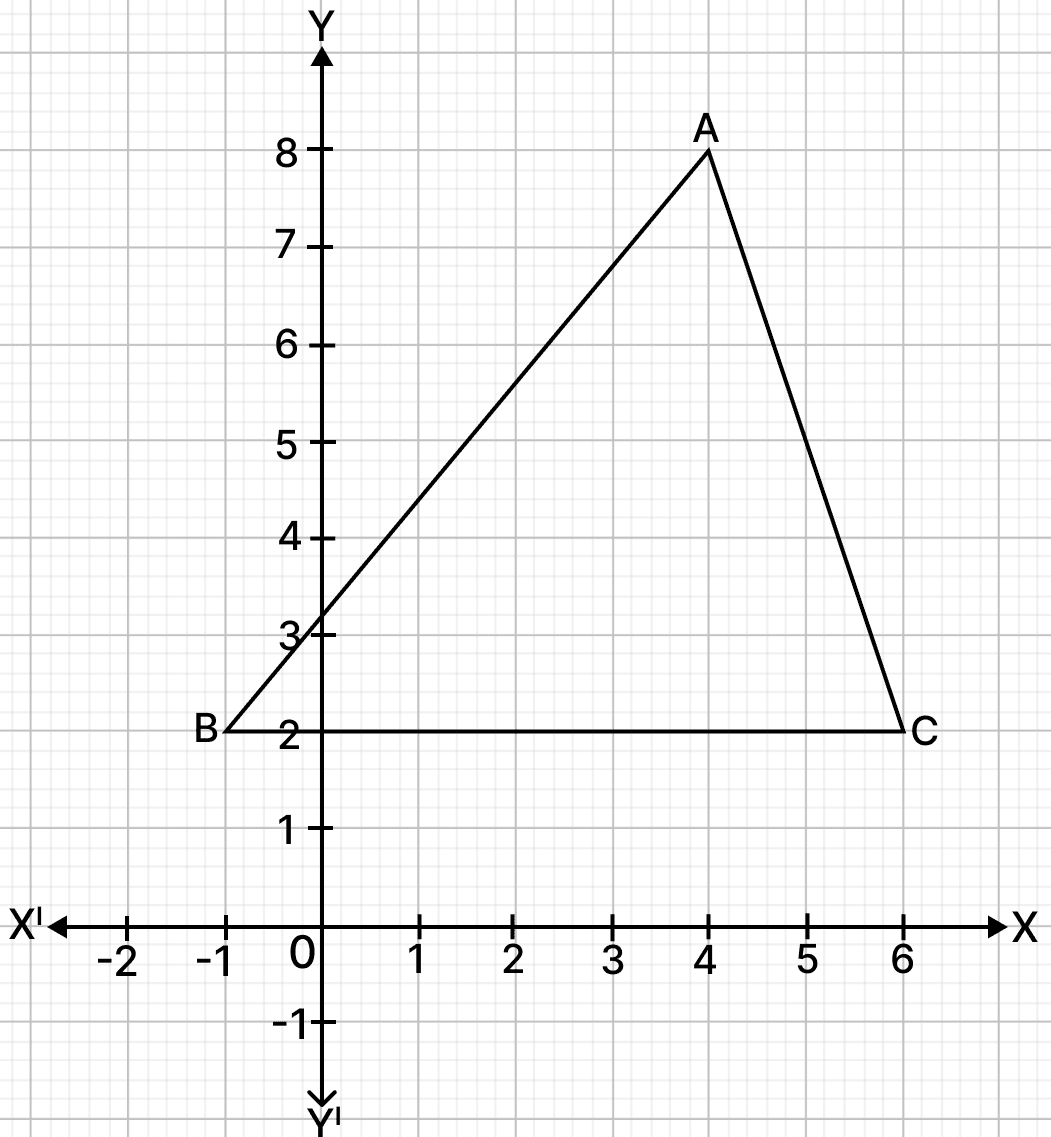
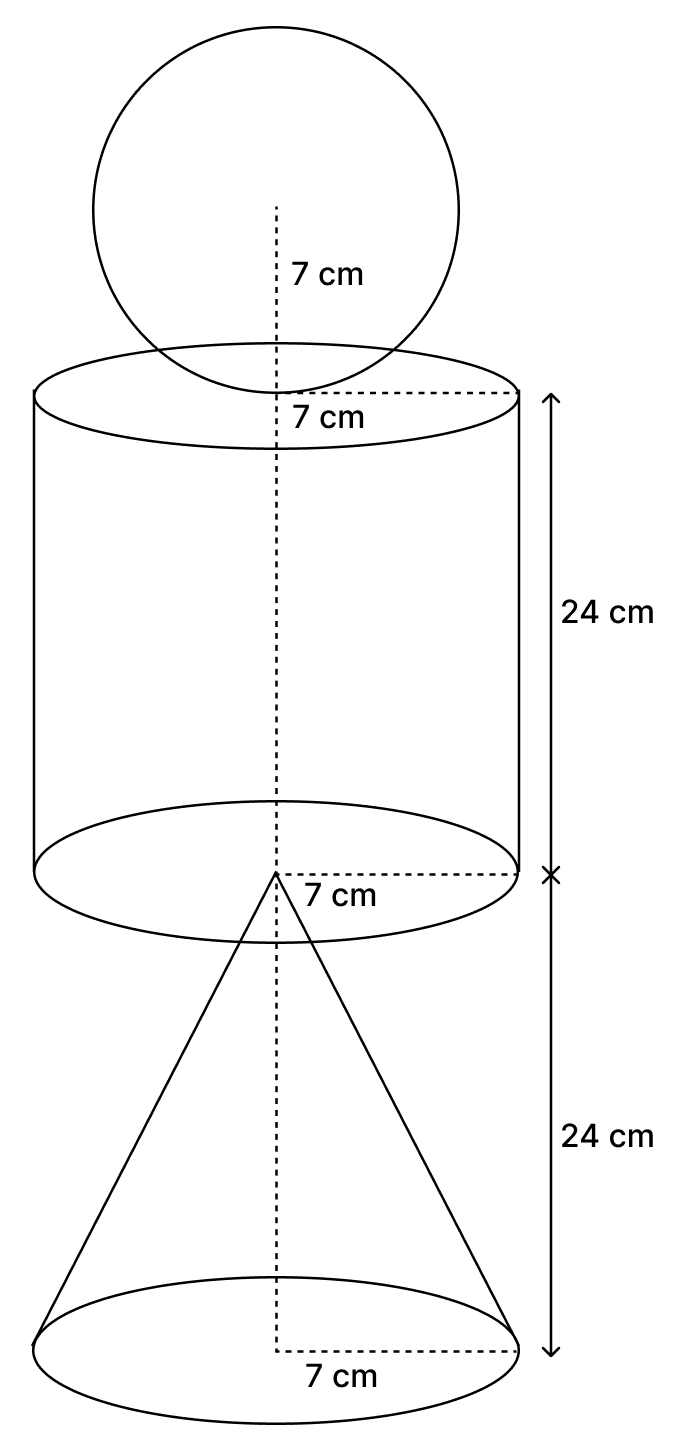
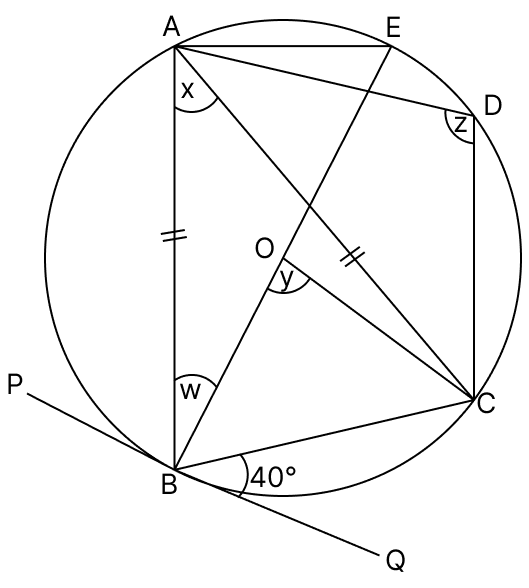
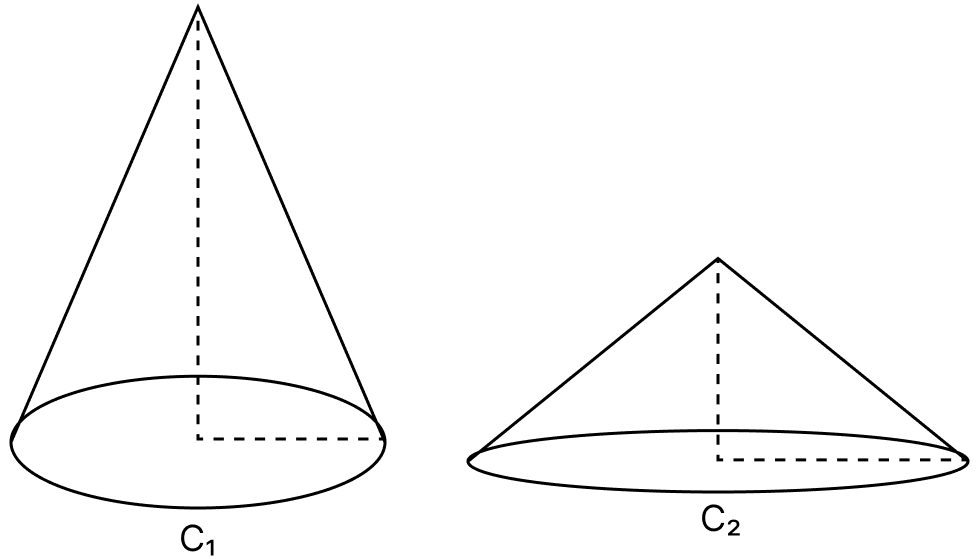
ICSE Class 10 Mathematics — All Questions

409 solved questions from 10 papers. Filter by year, section or marks, or search the full bank.

Year
Section
Marks
Insight
1(i)1 Mark · 2027 · Section A · 2027 SpecimenFull page

A customer pays a total GST of ₹ 600 on an article in an intra-state sale, and the tax rate is 12%. The price of the article is :

Show SolutionHide Solution↓

Given,

Total GST paid = ₹ 600

Rate of GST = 12%

Let the price of the article be ₹ $x$.

By formula,

GST = Rate of GST × Price of the article

$$\begin{aligned}\Rightarrow 600 = \frac{12}{100} \times x \\[1em] \Rightarrow x = \frac{600 \times 100}{12} \\[1em] \Rightarrow x = \frac{60000}{12} \\[1em] \Rightarrow x = 5000.\end{aligned}$$

Thus, the price of the article = ₹ 5,000.

Hence, option 3 is the correct option.

1(ii)1 Mark · 2027 · Section A · 2027 SpecimenFull page

Assertion (A): In a recurring deposit account, a man deposits ₹ 1000 per month for 1 year. On maturity he receives ₹ 13500. The amount of interest he earns is ₹ 1500.

Reason (R): Interest earned = Maturity value − Total amount deposited.

Show SolutionHide Solution↓

Given,

Deposit per month (P) = ₹ 1000

Time (n) = 1 year = 12 months

Maturity value = ₹ 13,500

Total amount deposited = P × n

= 1000 × 12

= ₹ 12,000

By formula,

Interest earned = Maturity value − Total amount deposited

= 13500 − 12000

= ₹ 1,500

So assertion (A) is true.

We know that,

Maturity value = Total amount deposited + Interest earned

⇒ Interest earned = Maturity value − Total amount deposited

So reason (R) is true and it correctly explains the assertion (A).

Thus, Both (A) and (R) are true, and (R) is the correct explanation for (A).

Hence, option 3 is the correct option.

1(iii)1 Mark · 2027 · Section A · 2027 SpecimenFull page

A man buys 50, ₹ 100 shares of a company at ₹ 125 paying 6% dividend per annum. At the end of the year, the company will pay a total dividend on :

Show SolutionHide Solution↓

Given,

Number of shares bought = 50

Nominal value (N.V.) of each share = ₹ 100

Market value (M.V.) of each share = ₹ 125

Rate of dividend = 6%

We know that,

Dividend is always paid by the company on the nominal value (face value) of the shares and not on their market value.

Total nominal value of the shares = No. of shares × N.V. of 1 share

= 50 × 100

= ₹ 5,000

Thus, the company will pay the total dividend on ₹ 5,000.

Hence, option 3 is the correct option.

1(iv)1 Mark · 2027 · Section A · 2027 SpecimenFull page

If the roots of the quadratic equation $x^2 − 8x + p^2$ = 0 are equal, then the positive value of $p$ is :

Show SolutionHide Solution↓

Given,

The roots of the quadratic equation $x^2 - 8x + p^2$ = 0 are equal.

Comparing the given equation with $ax^2 + bx + c$ = 0, we get :

$a = 1, b = -8 \text{ and } c = p^2$

We know that,

For equal roots, discriminant (D) = 0.

$$\begin{aligned}\Rightarrow b^2 - 4ac = 0 \\[1em] \Rightarrow (-8)^2 - 4 \times 1 \times p^2 = 0 \\[1em] \Rightarrow 64 - 4p^2 = 0 \\[1em] \Rightarrow 4p^2 = 64 \\[1em] \Rightarrow p^2 = 16 \\[1em] \Rightarrow p = \pm 4\end{aligned}$$

Since, the positive value of $p$ is required.

∴ $p = 4$.

Hence, option 3 is the correct option.

1(v)1 Mark · 2027 · Section A · 2027 SpecimenFull page

12, 18 and $x$ are in continued proportion. The value of $x$ is :

Show SolutionHide Solution↓

Given,

12, 18 and $x$ are in continued proportion.

We know that,

If $a, b$ and $c$ are in continued proportion, then $b^2 = ac$.

$$\begin{aligned}\Rightarrow 18^2 = 12 \times x \\[1em] \Rightarrow 324 = 12x \\[1em] \Rightarrow x = \frac{324}{12} \\[1em] \Rightarrow x = 27.\end{aligned}$$

Hence, option 2 is the correct option.

1(vi)1 Mark · 2027 · Section A · 2027 SpecimenFull page

$(x + 2)$ and $(x + 3)$ are the factors of $x^3 + 4x^2 + x - 6$. The third factor of the given polynomial is :

Show SolutionHide Solution↓

Given,

$(x + 2)$ and $(x + 3)$ are the factors of $x^3 + 4x^2 + x - 6$.

⇒ $(x + 2)(x + 3) = x^2 + 5x + 6$

Thus, $x^2 + 5x + 6$ is also the factor of $x^3 + 4x^2 + x - 6$.

$$\begin{array}{l} \phantom{x^2 + 5x + 6\big)\quad }\phantom{x^3 +} x - 1 \\ x^2 + 5x + 6\overline{\smash{\big)}\quad x^3 + 4x^2 + x - 6} \\ \phantom{+++++()}\underline{\underset{-}{+}x^3 \underset{-}{+}5x^2 \underset{-}{+}6x} \\ \phantom{+++++())}\phantom{x^3 +} -x^2 - 5x - 6 \\ \phantom{+++++())}\phantom{x^3 +} \underline{\underset{+}{-}x^2 \underset{+}{-}5x \underset{+}{-}6} \\ \phantom{x^2 + 5x + 6\big)\quad }\phantom{x^3 + 4x^2 +} \times \end{array}$$

Thus,

$$\begin{aligned}x^3 + 4x^2 + x - 6 = (x^2 + 5x + 6)(x - 1) \\[1em] = (x + 2)(x + 3)(x - 1).\end{aligned}$$

Thus, the third factor of the given polynomial is $(x - 1)$.

Hence, option 1 is the correct option.

1(vii)1 Mark · 2027 · Section A · 2027 SpecimenFull page

Given two matrices A and B, where $$A = \begin{bmatrix} -1 & 2 \end{bmatrix}$$ and $$B = \begin{bmatrix} 3 \\ 4 \end{bmatrix}$$, then product AB is :

Show SolutionHide Solution↓

Given,

Matrix A is of order 1 × 2 and matrix B is of order 2 × 1.

We know that,

If matrix A is of order $m \times n$ and matrix B is of order $n \times p$, then the order of the product AB is $m \times p$.

∴ Order of AB = 1 × 1

Calculating,

$$\Rightarrow AB = \begin{bmatrix*}[r] -1 & 2 \end{bmatrix*}\begin{bmatrix*}[r] 3 \\ 4 \end{bmatrix*} \\[1em] = \begin{bmatrix*}[r] -1 \times 3 + 2 \times 4 \end{bmatrix*} \\[1em] = \begin{bmatrix*}[r] -3 + 8 \end{bmatrix*} \\[1em] = \begin{bmatrix*}[r] 5 \end{bmatrix*}.$$

Hence, option 3 is the correct option.

1(viii)1 Mark · 2027 · Section A · 2027 SpecimenFull page

If the $n^{th}$ term of a Geometric Progression (G.P.) is given by $5 \times 2^n$ then the common ratio is :

Show SolutionHide Solution↓

Given,

$$\begin{aligned}n^{th} \text{ term of the G.P.} = 5 \times 2^n \\[1em] \therefore t_n = 5 \times 2^n\end{aligned}$$

Replacing $n$ by $(n + 1)$, we get :

⇒ $t_{n + 1} = 5 \times 2^{n + 1}$

By formula,

$$\begin{aligned}\text{Common ratio } (r) = \frac{t_{n + 1}}{t_n} \\[1em] = \frac{5 \times 2^{n + 1}}{5 \times 2^n} \\[1em] = 2^{n + 1 - n} \\[1em] = 2.\end{aligned}$$

Hence, option 1 is the correct option.

1(ix)1 Mark · 2027 · Section A · 2027 SpecimenFull page

The line $y = 2x$ passes through which pair of coordinates?

Show SolutionHide Solution↓

Given,

Equation of the line is $y = 2x$.

A point lies on the line only if its coordinates satisfy the equation of the line.

Substituting the coordinates (1, 2) in $y = 2x$, we get :

⇒ 2 = 2 × 1

⇒ 2 = 2

Since, L.H.S. = R.H.S., the point (1, 2) lies on the line.

Substituting the coordinates (−1, −2) in $y = 2x$, we get :

⇒ −2 = 2 × (−1)

⇒ −2 = −2

Since, L.H.S. = R.H.S., the point (−1, −2) lies on the line.

Thus, the line $y = 2x$ passes through the points (1, 2) and (−1, −2).

Hence, option 3 is the correct option.

1(x)1 Mark · 2027 · Section A · 2027 SpecimenFull page

On a map of scale 1 : 50,000, a rectangular plot has sides 4 cm by 3 cm. The actual area of the plot on ground is :

Show SolutionHide Solution↓

Given,

Scale of the map = 1 : 50,000

Length of the plot on the map = 4 cm

Breadth of the plot on the map = 3 cm

Actual length of the plot = 4 × 50000 = 2,00,000 cm

= $\frac{200000}{100000}$ = 2 km [∵ 1 km = 1,00,000 cm]

Actual breadth of the plot = 3 × 50000 = 1,50,000 cm

= $\frac{150000}{100000}$ = 1.5 km

Actual area of the plot = Actual length × Actual breadth

= 2 × 1.5

= 3 km2.

Hence, option 1 is the correct option.

1(xi)1 Mark · 2027 · Section A · 2027 Specimen · 🔁 also 2026Full page

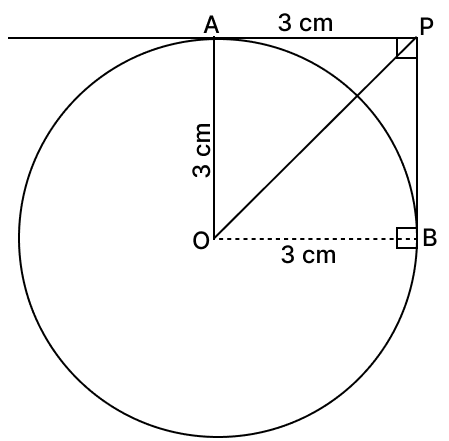
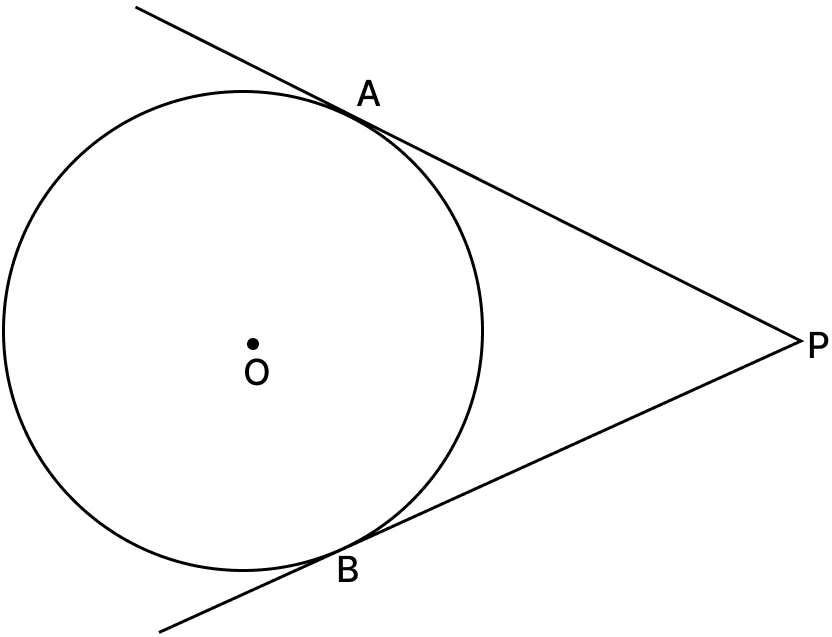
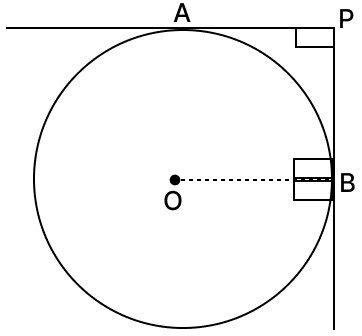
In the given diagram, the radius of the circle with centre O is 3 cm. PA and PB are the tangents to the circle which are at right angle to each other. The length of OP is:

In the given diagram, the radius of the circle with centre O is 3 cm. PA and PB are the tangents to the circle which are at right angle to each other. The length of OP is: ICSE 2026 Maths Solved Question Paper.
Show SolutionHide Solution↓

Join OA and OP.

In the given diagram, the radius of the circle with centre O is 3 cm. PA and PB are the tangents to the circle which are at right angle to each other. The length of OP is: ICSE 2026 Maths Solved Question Paper.

Given,

Radius of circle (OB) = 3 cm

PB and AP are at right angles.

We know that,

Radius and tangent at point of contact are perpendicular to each other.

OA ⊥ AP

From figure,

⇒ OA = OB = 3 cm [Radius of circle]

⇒ OB is perpendicular to PB

⇒ ∠OBP = 90°

This shows APBO is square.

OA = PB = AP = OB = 3 cm.

In right angled triangle OBP,

⇒ OP2 = OB2 + PB2

⇒ OP2 = 32 + 32

⇒ OP2 = 9 + 9

⇒ OP2 = 18

⇒ OP = $\sqrt{18}$

⇒ OP = $3\sqrt{2}$ cm.

Hence, option 3 is the correct option.

1(xii)1 Mark · 2027 · Section A · 2027 SpecimenFull page

A conical tent with a capacity of 616 m3 has a base area 154 m2. The height of the tent is :

Show SolutionHide Solution↓

Given,

Capacity (volume) of the conical tent = 616 m3

Base area of the conical tent = 154 m2

By formula,

Volume of cone = $\frac{1}{3} \times \text{Base area} \times \text{Height}$

Substituting values, we get :

$$\begin{aligned}\Rightarrow 616 = \frac{1}{3} \times 154 \times h \\[1em] \Rightarrow 154h = 616 \times 3 \\[1em] \Rightarrow h = \frac{1848}{154} \\[1em] \Rightarrow h = 12 \text{ m}.\end{aligned}$$

Thus, the height of the tent = 12 m.

Hence, option 4 is the correct option.

1(xiii)1 Mark · 2027 · Section A · 2027 SpecimenFull page

Assertion (A): If $\sec\theta + \tan\theta = a$ and $\sec\theta - \tan\theta = b$ then $ab = 1$.

Reason (R): $\sec^2\theta - \tan^2\theta = 1$

Show SolutionHide Solution↓

Given,

$$\begin{aligned}\Rightarrow \sec\theta + \tan\theta = a \\[1em] \Rightarrow \sec\theta - \tan\theta = b \\[1em] \Rightarrow ab = (\sec\theta + \tan\theta)(\sec\theta - \tan\theta) \\[1em] \Rightarrow ab = \sec^2\theta - \tan^2\theta \\[1em] \Rightarrow ab = 1\end{aligned}$$

So assertion (A) is true.

We know that,

⇒ $\sec^2\theta - \tan^2\theta = 1$

This is a fundamental trigonometric identity.

Thus, Both (A) and (R) are true and (R) is the correct explanation of (A).

Hence, option 3 is the correct option.

1(xiv)1 Mark · 2027 · Section A · 2027 SpecimenFull page

Consider the following distribution 30, 34, 35, 36, 37, 38, 39, 40. If the value 35 is removed from the given data, then the median changes by :

Show SolutionHide Solution↓

Given,

The distribution is 30, 34, 35, 36, 37, 38, 39, 40.

The data is already arranged in ascending order.

Here, $n = 8$, which is even.

By formula,

$$\begin{aligned}\text{Median} = \frac{1}{2}\Big[\Big(\frac{n}{2}\Big)^{th} \text{term} + \Big(\frac{n}{2} + 1\Big)^{th} \text{term}\Big] \\[1em] = \frac{1}{2}[4^{th} \text{ term} + 5^{th} \text{ term}] \\[1em] = \frac{36 + 37}{2} \\[1em] = \frac{73}{2} \\[1em] = 36.5\end{aligned}$$

On removing the value 35, the distribution becomes 30, 34, 36, 37, 38, 39, 40.

Here, $n = 7$, which is odd.

By formula,

$$\begin{aligned}\text{Median} = \Big(\frac{n + 1}{2}\Big)^{th} \text{ term} \\[1em] = 4^{th} \text{ term} \\[1em] = 37\end{aligned}$$

Change in median = 37 − 36.5 = 0.5.

Hence, option 1 is the correct option.

1(xv)1 Mark · 2027 · Section A · 2027 SpecimenFull page

A game of chance consists of spinning an arrow which is equally likely to come to rest pointing to one of the numbers 1, 2, 3……12. The probability that it will point to an odd number is :

Show SolutionHide Solution↓

Given,

The arrow can come to rest pointing to one of the numbers 1, 2, 3, ......, 12.

Total number of possible outcomes = 12

Favourable outcomes = Arrow pointing to an odd number

{1, 3, 5, 7, 9, 11}

Number of favourable outcomes = 6

By formula,

Probability = $\frac{\text{No. of favourable outcomes}}{\text{Total number of outcomes}}$

= $\frac{6}{12}$

= $\frac{1}{2}$.

Hence, option 3 is the correct option.

2(i)1 Mark · 2027 · Section A · 2027 SpecimenFull page

Three students A, B and C of Class 10 are each given an equal amount of Play-Dough to form different shaped solids for a mathematics project. A forms a cone of radius 7 cm and height 28 cm. B forms a sphere of radius $r$ and C forms a cylinder of radius 14 cm. Find the :

(a) radius $r$ of the sphere so formed.

(b) height of the cylinder so formed.

(c) Volume of the dough given to each of them.

Give your answers to (b) and (c) correct to the nearest whole number. $\left(\pi = \frac{22}{7}\right)$

Show SolutionHide Solution↓

Given,

For the cone formed by A,

Radius (R) = 7 cm

Height (H) = 28 cm

Since, all the three students are given an equal amount of Play-Dough, the volumes of the cone, the sphere and the cylinder are equal.

(a) Volume of sphere = Volume of cone

$$\begin{aligned}\Rightarrow \frac{4}{3}\pi r^3 = \frac{1}{3}\pi R^2 H \\[1em] \Rightarrow \frac{4}{3}\pi r^3 = \frac{1}{3} \times \pi \times 7^2 \times 28 \\[1em] \Rightarrow 4r^3 = 7^2 \times 28 \\[1em] \Rightarrow 4r^3 = 49 \times 28 \\[1em] \Rightarrow r^3 = \frac{1372}{4} \\[1em] \Rightarrow r^3 = 343 \\[1em] \Rightarrow r^3 = 7^3 \\[1em] \Rightarrow r = 7 \text{ cm}.\end{aligned}$$

Hence, radius of the sphere = 7 cm.

(b) Given,

Radius of the cylinder (R') = 14 cm

Let height of cylinder be H'.

Volume of cylinder = Volume of sphere

$$\begin{aligned}\Rightarrow \pi R'^2 H' = \frac{4}{3}\pi r^3 \\[1em] \Rightarrow 14^2 \times H' = \frac{4}{3} \times 7^3 \\[1em] \Rightarrow 196 \times H' = \frac{4 \times 343}{3} \\[1em] \Rightarrow H' = \frac{1372}{3 \times 196} \\[1em] \Rightarrow H' = \frac{7}{3} \\[1em] \Rightarrow H' = 2.33 \text{ cm} \approx 2 \text{ cm}.\end{aligned}$$

Hence, height of the cylinder = 2 cm.

(c) By formula,

Volume of the dough given to each of them = Volume of cone

$$\begin{aligned}= \frac{1}{3}\pi R^2 H \\[1em] = \frac{1}{3} \times \frac{22}{7} \times 7^2 \times 28 \\[1em] = \frac{1}{3} \times 22 \times 7 \times 28 \\[1em] = \frac{4312}{3}\\[1em] = 1437.33 \text{ cm}^3 ≈ 1437 \text{ cm}^3.\end{aligned}$$

Hence, volume of the dough given to each of them = 1437 cm3.

2(ii)1 Mark · 2027 · Section A · 2027 SpecimenFull page

Solve the quadratic equation $(x - 2)^2 + 11x - 7$ = 0 and give your answer correct to 3 significant figures.

Show SolutionHide Solution↓

Given,

$$\begin{aligned}\Rightarrow (x - 2)^2 + 11x - 7 = 0 \\[1em] \Rightarrow x^2 - 4x + 4 + 11x - 7 = 0 \\[1em] \Rightarrow x^2 + 7x - 3 = 0\end{aligned}$$

Comparing the above equation with $ax^2 + bx + c$ = 0, we get :

$a = 1, b = 7 \text{ and } c = -3$

By quadratic formula,

$$\begin{aligned}\Rightarrow x = \frac{-b \pm \sqrt{b^2 - 4ac}}{2a} \\[1em] \Rightarrow x = \frac{-7 \pm \sqrt{7^2 - 4 \times 1 \times (-3)}}{2 \times 1} \\[1em] \Rightarrow x = \frac{-7 \pm \sqrt{49 + 12}}{2} \\[1em] \Rightarrow x = \frac{-7 \pm \sqrt{61}}{2} \\[1em] \Rightarrow x = \frac{-7 \pm 7.8102}{2}\end{aligned}$$

Solving further,

$$\begin{aligned}\Rightarrow x = \frac{-7 + 7.8102}{2} \text{ or } x = \frac{-7 - 7.8102}{2} \\[1em] \Rightarrow x = \frac{0.8102}{2} \text{ or } x = \frac{-14.8102}{2} \\[1em] \Rightarrow x = 0.4051 \text{ or } x = -7.4051\end{aligned}$$

Correct to 3 significant figures,

$x = 0.405 \text{ or } x = -7.41$.

Hence, $\bm{x}$ = 0.405 or $\bm{x}$ = −7.41.

2(iii)1 Mark · 2027 · Section A · 2027 SpecimenFull page

A line is formed joining the two points P(−4, 1) and Q(11, −2). Straight line PQ intersects the x-axis at R. Find the :

(a) ratio PR : RQ.

(b) coordinates of the point R.

(c) equation of the line perpendicular to PQ at R.

Show SolutionHide Solution↓

(a) Since, R lies on the x-axis, its ordinate is zero.

Let the point R$(x, 0)$ divide the line segment joining P(−4, 1) and Q(11, −2) in the ratio $m : n$.

By section formula,

$y = \frac{my_2 + ny_1}{m + n}$

Substituting values, we get :

$$\begin{aligned}\Rightarrow 0 = \frac{m(-2) + n(1)}{m + n} \\[1em] \Rightarrow -2m + n = 0 \\[1em] \Rightarrow n = 2m \\[1em] \Rightarrow \frac{m}{n} = \frac{1}{2}.\end{aligned}$$

Hence, PR : RQ = 1 : 2.

(b) From part (a),

P(−4, 1), Q(11, −2) and $m : n$ = 1 : 2

By section formula,

$x = \frac{mx_2 + nx_1}{m + n}$

Substituting values, we get :

$$\begin{aligned}\Rightarrow x = \frac{1(11) + 2(-4)}{1 + 2} \\[1em] \Rightarrow x = \frac{11 - 8}{3} \\[1em] \Rightarrow x = \frac{3}{3} \\[1em] \Rightarrow x = 1.\end{aligned}$$

R = $(x, 0)$ = (1, 0).

Hence, the coordinates of the point R are (1, 0).

(c) By formula,

$m = \frac{y_2 - y_1}{x_2 - x_1}$

Substituting values, we get :

$$\begin{aligned}\Rightarrow m_{PQ} = \frac{-2 - 1}{11 - (-4)} \\[1em] \Rightarrow m_{PQ} = \frac{-3}{15} \\[1em] \Rightarrow m_{PQ} = -\frac{1}{5}\end{aligned}$$

We know that,

The product of the slopes of two perpendicular lines is −1.

∴ Slope of the line perpendicular to PQ = $\frac{-1}{-\frac{1}{5}}$ = 5

By point-slope form,

$y - y_1 = m(x - x_1)$

Equation of the line perpendicular to PQ and passing through R(1, 0) is :

$$\begin{aligned}\Rightarrow y - 0 = 5(x - 1) \\[1em] \Rightarrow y = 5x - 5 \\[1em] \Rightarrow 5x - y = 5.\end{aligned}$$

Hence, the equation of the line perpendicular to PQ at R is $\bm{5x − y = 5}$.

3(i)1 Mark · 2027 · Section A · 2027 SpecimenFull page

A shopkeeper marked an article at ₹ 2000. The rate of GST on the article is 18%. The customer has only ₹ 1888 with him and he requests the shopkeeper to reduce the price so that he can buy the article at ₹ 1888 including GST. What percent discount must the shopkeeper give to do so?

Show SolutionHide Solution↓

Given,

Marked price of the article = ₹ 2000

Rate of GST = 18%

Amount available with the customer = ₹ 1888 (including GST)

Let the reduced price of the article be ₹ $x$.

⇒ $x + 18% \text{ of } x = 1888$

$$\begin{aligned}\Rightarrow x + \frac{18}{100} \times x = 1888 \\[1em] \Rightarrow x\Big(1 + \frac{18}{100}\Big) = 1888 \\[1em] \Rightarrow x \times \frac{118}{100} = 1888 \\[1em] \Rightarrow x = \frac{1888 \times 100}{118} \\[1em] \Rightarrow x = 1600.\end{aligned}$$

Reduced price of the article = ₹ 1,600

Reduction in price = ₹ 2000 − ₹ 1600 = ₹ 400

By formula,

Discount % = $\frac{\text{Reduction in price}}{\text{Marked price}} \times 100$

= $\frac{400}{2000} \times 100$

= 20%.

Hence, the shopkeeper must give a discount of 20%.

3(ii)1 Mark · 2027 · Section A · 2027 SpecimenFull page

An Arithmetic Progression (A.P.) consists of all whole numbers which are divisible by 3 and 5.

(a) Write its first term and the common difference.

(b) Find the 10th term of the A.P.

(c) Find the sum of the first 10 terms of the A.P.

Show SolutionHide Solution↓

(a) Given,

The A.P. consists of all whole numbers which are divisible by 3 and 5.

A number which is divisible by both 3 and 5 is divisible by their L.C.M.

L.C.M. of 3 and 5 = 15

Thus, the A.P. is 15, 30, 45, 60, ......

First term (a) = 15

Common difference (d) = 30 − 15 = 15.

Hence, first term = 15 and common difference = 15.

(b) By formula,

tn = a + (n - 1)d

Substituting values, we get :

⇒ t10 = 15 + (10 − 1) × 15

⇒ t10 = 15 + 9 × 15

⇒ t10 = 15 + 135

⇒ t10 = 150.

Hence, the 10th term of the A.P. = 150.

(c) By formula,

$S_n = \frac{n}{2}[2a + (n - 1)d]$

Substituting values, we get :

⇒ S10 = $\frac{10}{2}[2 \times 15 + (10 - 1) \times 15]$

⇒ S10 = 5[30 + 9 × 15]

⇒ S10 = 5[30 + 135]

⇒ S10 = 5 × 165

⇒ S10 = 825.

Hence, the sum of the first 10 terms of the A.P. = 825.

3(iii)1 Mark · 2027 · Section A · 2027 SpecimenFull page

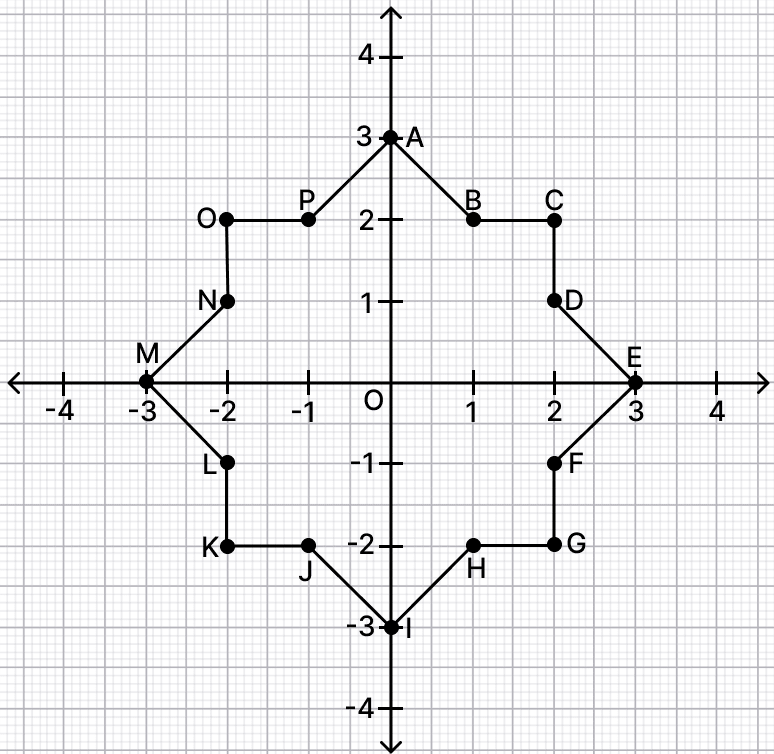
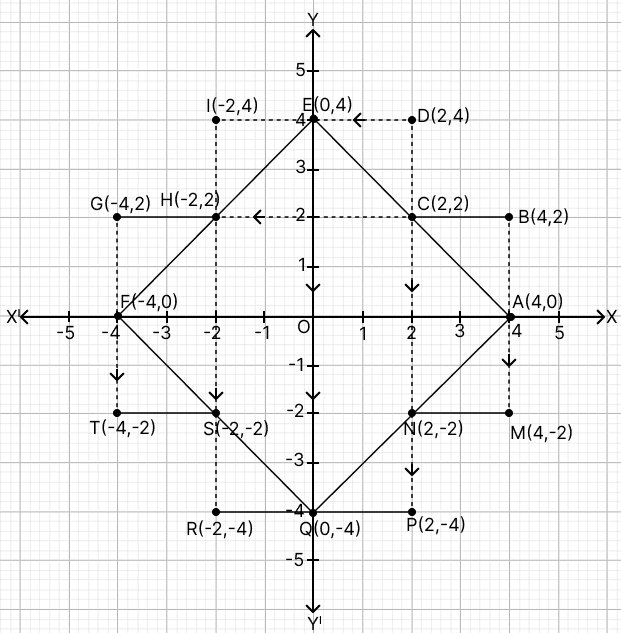
Study the graph and answer the given questions :

Study the graph and answer the given questions:. Specimen 2027, ICSE Specimen 2027 Maths Solved Question Paper.

(a) Write down the coordinates of A, B, C, D and E.

(b) Write down the image of A under reflection on the y-axis.

(c) Name the point, with its coordinates, which is the image of C under reflection through the origin.

(d) What is the image of the polygon ABCDEFGHI when reflected on the y-axis?

(e) Write down the equation of the line joining the points N and D.

Show SolutionHide Solution↓

(a) From the graph,

The coordinates of the points are A(0, 3), B(1, 2), C(2, 2), D(2, 1) and E(3, 0).

(b) We know that,

The image of a point $(x, y)$ under reflection on the y-axis is $(-x, y)$.

∴ Image of A(0, 3) on reflection in y-axis is (0, 3).

Since, A lies on the y-axis, it remains invariant under reflection on the y-axis.

Hence, the image of A under reflection on the y-axis is A(0, 3).

(c) We know that,

The image of a point $(x, y)$ under reflection through the origin is $(-x, -y)$.

∴ Image of C(2, 2) on reflection in origin is (−2, −2).

From the graph, the point (−2, −2) is the point K.

Hence, the image of C under reflection through the origin is K(−2, −2).

(d) We know that,

The image of a point $(x, y)$ under reflection on the y-axis is $(-x, y)$.

So, on reflecting the polygon ABCDEFGHI on the y-axis, each vertex is mapped to the point lying at the same distance from the y-axis but on the opposite side of it.

Since, the vertices A and I lie on the y-axis, they remain invariant under reflection on the y-axis.

From the graph, the images of the vertices of the polygon under reflection in y-axis are :

A → A, B → P, C → O, D → N, E → M, F → L, G → K, H → J and I → I

Thus, on joining these image points in order, we get the polygon APONMLKJI, which is the mirror image of the polygon ABCDEFGHI in the y-axis.

Hence, the image of the polygon ABCDEFGHI under reflection on the y-axis is the polygon APONMLKJI.

(e) From the graph,

N = (−2, 1) and D = (2, 1)

Since, both the points have the same ordinate (y-coordinate) equal to 1, the line joining them is parallel to the x-axis.

Hence, the equation of the line joining the points N and D is $\bm{y}$ = 1.
4(i)Written · 2027 · Section B · 2027 SpecimenFull page

A man opened a recurring deposit account in a bank. He deposits ₹ 1000 per month for 2 years. The matured value is equal to 26 times the amount he pays per month. Find the :

(a) interest paid by the bank.

(b) rate of interest per annum that the bank was paying for the recurring deposit account.

Show SolutionHide Solution↓

Given,

Deposit per month (P) = ₹ 1000

Time (n) = 2 years = 24 months

Maturity value = 26 × ₹ 1000 = ₹ 26,000

(a) Total amount deposited = P × n

= 1000 × 24

= ₹ 24,000

By formula,

Interest = Maturity value − Total amount deposited

= ₹ 26,000 − ₹ 24,000

= ₹ 2,000.

Hence, interest paid by the bank = ₹ 2,000.

(b) Let the rate of interest be r% per annum.

By formula,

$I = P \times \frac{n(n + 1)}{2 \times 12} \times \frac{r}{100}$

Substituting values, we get :

$$\begin{aligned}\Rightarrow 2000 = 1000 \times \frac{24(24 + 1)}{2 \times 12} \times \frac{r}{100} \\[1em] \Rightarrow 2000 = 1000 \times \frac{24 \times 25}{24} \times \frac{r}{100} \\[1em] \Rightarrow 2000 = 1000 \times 25 \times \frac{r}{100} \\[1em] \Rightarrow 2000 = 250r \\[1em] \Rightarrow r = \frac{2000}{250} \\[1em] \Rightarrow r = 8.\end{aligned}$$

Hence, rate of interest (r%) = 8% per annum.

4(ii)Written · 2027 · Section B · 2027 SpecimenFull page

Given, matrix $$A = \begin{bmatrix} x & 1 \\ 2 & 2 \end{bmatrix}$$ and $$B = \begin{bmatrix} x \\ x - 2 \end{bmatrix}$$, such that AB is a null matrix. Find the :

(a) order of the null matrix.

(b) value of $x$, given that $x \gt 0$.

Show SolutionHide Solution↓

(a) Given,

Matrix A is of order 2 × 2 and matrix B is of order 2 × 1.

We know that,

If matrix A is of order $m \times n$ and matrix B is of order $n \times p$, then the order of the product AB is $m \times p$.

∴ Order of AB = 2 × 1

Since, AB is a null matrix, the order of the null matrix is the same as the order of AB.

Hence, the order of the null matrix is 2 × 1.

(b) Calculating AB,

$$\Rightarrow AB = \begin{bmatrix*}[r] x & 1 \\ 2 & 2 \end{bmatrix*}\begin{bmatrix*}[r] x \\ x - 2 \end{bmatrix*} \\[1em] = \begin{bmatrix*}[r] x \times x + 1 \times (x - 2) \\ 2 \times x + 2 \times (x - 2) \end{bmatrix*} \\[1em] = \begin{bmatrix*}[r] x^2 + x - 2 \\ 2x + 2x - 4 \end{bmatrix*} \\[1em] = \begin{bmatrix*}[r] x^2 + x - 2 \\ 4x - 4 \end{bmatrix*}.$$

Since, AB is a null matrix,

$$\Rightarrow \begin{bmatrix*}[r] x^2 + x - 2 \\ 4x - 4 \end{bmatrix*} = \begin{bmatrix*}[r] 0 \\ 0 \end{bmatrix*}$$

Comparing the corresponding elements, we get :

$$\begin{aligned}\Rightarrow 4x - 4 = 0 \\[1em] \Rightarrow 4x = 4 \\[1em] \Rightarrow x = 1\end{aligned}$$

Also,

$$\begin{aligned}\Rightarrow x^2 + x - 2 = 0 \\[1em] \Rightarrow x^2 + 2x - x - 2 = 0 \\[1em] \Rightarrow x(x + 2) - 1(x + 2) = 0 \\[1em] \Rightarrow (x + 2)(x - 1) = 0 \\[1em] \Rightarrow (x + 2) = 0 \text{ or } (x - 1) = 0 \qquad [\text{Using zero product rule}] \\[1em] \Rightarrow x = -2 \text{ or } x = 1\end{aligned}$$

The value of $x$ which satisfies both the equations and is greater than 0 is 1.

Hence, $\bm{x}$ = 1.
4(iii)Written · 2027 · Section B · 2027 SpecimenFull page

Prove the following trigonometric identity :

$\frac{\cos^2\theta}{1 - \tan\theta} + \frac{\sin^2\theta}{1 - \cot\theta} = 1 + \cos\theta,\sin\theta$

Show SolutionHide Solution↓

Solving L.H.S.,

$$\begin{aligned}\Rightarrow \frac{\cos^2\theta}{1 - \tan\theta} + \frac{\sin^2\theta}{1 - \cot\theta} \\[1em] \Rightarrow \frac{\cos^2\theta}{1 - \frac{\sin\theta}{\cos\theta}} + \frac{\sin^2\theta}{1 - \frac{\cos\theta}{\sin\theta}} \\[1em] \Rightarrow \frac{\cos^2\theta}{\frac{\cos\theta - \sin\theta}{\cos\theta}} + \frac{\sin^2\theta}{\frac{\sin\theta - \cos\theta}{\sin\theta}} \\[1em] \Rightarrow \frac{\cos^3\theta}{\cos\theta - \sin\theta} + \frac{\sin^3\theta}{\sin\theta - \cos\theta} \\[1em] \Rightarrow \frac{\cos^3\theta}{\cos\theta - \sin\theta} - \frac{\sin^3\theta}{\cos\theta - \sin\theta} \\[1em] \Rightarrow \frac{\cos^3\theta - \sin^3\theta}{\cos\theta - \sin\theta} \\[1em] \Rightarrow \frac{(\cos\theta - \sin\theta)(\cos^2\theta + \cos\theta,\sin\theta + \sin^2\theta)}{\cos\theta - \sin\theta} \\[1em] \Rightarrow \cos^2\theta + \sin^2\theta + \cos\theta,\sin\theta \\[1em] \Rightarrow 1 + \cos\theta,\sin\theta \qquad [\because \sin^2\theta + \cos^2\theta = 1]\end{aligned}$$

Since, L.H.S. = R.H.S.

Hence, proved that $\mathbf{\frac{\cos^2\theta}{1 - \tan\theta} + \frac{\sin^2\theta}{1 - \cot\theta} = 1 + \cos\theta,\sin\theta}$.

5(i)Written · 2027 · Section B · 2027 Specimen · 🔁 also 2026Full page

Ms. Kaur invested ₹ 8,000 in buying ₹100 shares of a company paying 6% dividend at ₹ 80. After a year, she sold these shares at ₹75 each and invested the proceeds including the dividend received during the first year in buying ₹ 20 shares, paying 15% dividend at ₹ 27 each. Find the :

(a) dividend received by her during the first year.

(b) number of shares she purchased using the total proceeds including the dividend.

Show SolutionHide Solution↓

Given,

For initial investment,

Investment = ₹ 8,000

Face Value = ₹ 100

Market Value = ₹ 80

Dividend Rate = 6%

By formula,

Number of shares = $\frac{\text{Investment}}{\text{Market value of each share}}$

= $\frac{8000}{80}$

= 100

By formula,

Dividend for the first year = No. of shares × Rate of div. × N.V. of 1 share

= 100 × $\frac{6}{100}$ × 100

= ₹ 600

Hence, dividend for first year = ₹ 600.

(b) Given,

Number of shares sold = 100

Selling price per share = ₹ 75

Proceeds from sale = Number of shares × selling price

= 100 × 75

= ₹ 7,500

Total proceeds = Proceeds from sale + Dividend received = 7500 + 600 = ₹ 8,100

Total investment = ₹ 8,100

Market value per share = ₹ 27

Number of new shares = $\frac{\text{Investment}}{\text{Market value of each share}}$

= $\frac{8100}{27}$

= 300.

Hence, number of shares purchased by Ms. Kaur = 300.

5(ii)Written · 2027 · Section B · 2027 SpecimenFull page

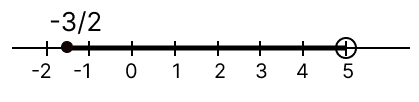
Solve the following inequation, write the solution set and represent it on the real number line.

$-6 + \frac{12x}{5} \leq \frac{7x}{5} - 3 \lt \frac{2}{5} + 2x, ; x \in R$

Show SolutionHide Solution↓

Solving L.H.S. of the inequation, we get :

$$\begin{aligned}\Rightarrow -6 + \frac{12x}{5} \le \frac{7x}{5} - 3 \\[1em] \Rightarrow \frac{12x}{5} - \frac{7x}{5} \le 6 - 3 \\[1em] \Rightarrow \frac{12x - 7x}{5} \le 3 \\[1em] \Rightarrow \frac{5x}{5} \le 3 \\[1em] \Rightarrow x \le 3 \text{ ......(1)}\end{aligned}$$

Solving R.H.S. of the inequation, we get :

$$\begin{aligned}\Rightarrow \frac{7x}{5} - 3 \lt \frac{2}{5} + 2x \\[1em] \Rightarrow \frac{7x}{5} - 2x \lt \frac{2}{5} + 3 \\[1em] \Rightarrow \frac{7x - 10x}{5} \lt \frac{2 + 15}{5} \\[1em] \Rightarrow \frac{-3x}{5} \lt \frac{17}{5} \\[1em] \Rightarrow -3x \lt 17 \\[1em] \Rightarrow x \gt \frac{-17}{3} \\[1em] \Rightarrow x \gt -5\frac{2}{3} \text{ ......(2)}\end{aligned}$$

From equation (1) and (2),

Solution set = ${x : -5\frac{2}{3} \lt x \le 3, x \in R}$

Solve the following inequation, write the solution set and represent it on the real number line. -6 + 12x/5 ≤ 7x/5 - 3 < 2/5 + 2x,; x in R. Specimen 2027, ICSE Specimen 2027 Maths Solved Question Paper.

Hence, solution set = {$\bm{x} : \mathbf{-5\frac{2}{3}} \lt \bm{x} \le 3, \bm{x}$ ∈ R}.

5(iii)Written · 2027 · Section B · 2027 SpecimenFull page

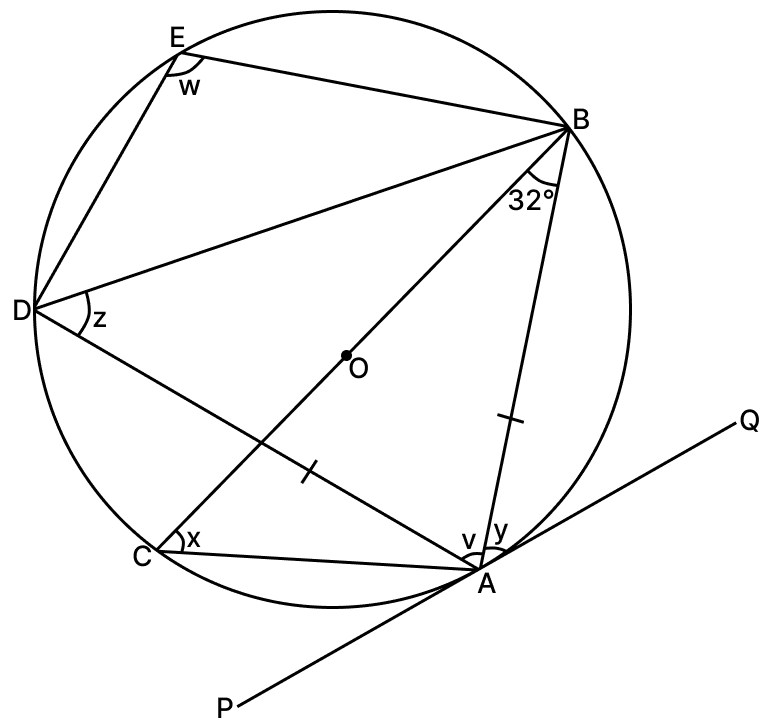
In the given figure, O is the centre of the circle and AD = AB. If ∠ABC = 32°, find the angles $x, y, z, v$ and $w$.

In the given figure, O is the centre of the circle and AD = AB. If ∠ABC = 32°, find the angles x, y, z, v and w. Specimen 2027, ICSE Specimen 2027 Maths Solved Question Paper.
Show SolutionHide Solution↓

Given,

O is the centre of the circle, AD = AB and ∠ABC = 32°.

From the figure, BC passes through the centre O and hence BC is a diameter of the circle.

We know that,

Angle in a semi-circle is a right angle.

∴ ∠BAC = 90°

In ∆ABC,

⇒ ∠ACB + ∠BAC + ∠ABC = 180° [Angle sum property of triangle]

$$\begin{aligned}\Rightarrow x + 90^{\circ} + 32^{\circ} = 180^{\circ} \\[1em] \Rightarrow x = 180^{\circ} - 122^{\circ} \\[1em] \Rightarrow x = 58^{\circ}.\end{aligned}$$

We know that,

The angle between a chord and a tangent at the point of contact is equal to the angle in the alternate segment.

$$\begin{aligned}\Rightarrow y = \angle ACB \\[1em] \Rightarrow y = x \\[1em] \Rightarrow y = 58^{\circ}.\end{aligned}$$

We know that,

Angles in the same segment of a circle are equal.

Here, ∠ADB and ∠ACB are the angles in the same segment subtended by the chord AB.

$$\begin{aligned}\Rightarrow z = \angle ADB = \angle ACB \\[1em] \Rightarrow z = x \\[1em] \Rightarrow z = 58°.\end{aligned}$$

In ∆ADB,

⇒ AD = AB [Given]

⇒ ∠ABD = ∠ADB [Angles opposite to equal sides are equal]

⇒ $\angle ABD = z = 58°$

By angle sum property of triangle,

$$\begin{aligned}\Rightarrow v + \angle ADB + \angle ABD = 180° \\[1em] \Rightarrow v + 58° + 58° = 180° \\[1em] \Rightarrow v = 180° - 116° \\[1em] \Rightarrow v = 64°.\end{aligned}$$

In cyclic quadrilateral ADEB,

We know that,

The sum of the opposite angles of a cyclic quadrilateral is 180°.

$$\begin{aligned}\Rightarrow v + w = 180° \\[1em] \Rightarrow 64° + w = 180° \\[1em] \Rightarrow w = 180° - 64° \\[1em] \Rightarrow w = 116°.\end{aligned}$$

Hence, $\bm{x = 58°}, \bm{y = 58°}, \bm{z = 58°}, \bm{v = 64°}$ and $\bm{w} = 116°$.

6(i)Written · 2027 · Section B · 2027 SpecimenFull page

Using Remainder and Factor Theorem, factorise the following polynomial :

$2x^3 + 5x^2 - 28x - 15$

Show SolutionHide Solution↓

Given,

$f(x) = 2x^3 + 5x^2 - 28x - 15$

Substituting $x = 3$ in $f(x)$, we get :

$$\begin{aligned}\Rightarrow f(3) = 2(3)^3 + 5(3)^2 - 28(3) - 15 \\[1em] \Rightarrow f(3) = 2 \times 27 + 5 \times 9 - 84 - 15 \\[1em] \Rightarrow f(3) = 54 + 45 - 84 - 15 \\[1em] \Rightarrow f(3) = 99 - 99 \\[1em] \Rightarrow f(3) = 0\end{aligned}$$

Since, the remainder is zero.

∴ $(x - 3)$ is a factor of $f(x)$.

Dividing $2x^3 + 5x^2 - 28x - 15$ by $(x - 3)$, we get :

$$\begin{array}{l} \phantom{x - 3\big)\quad } 2x^2 + 11x + 5 \\ x - 3\overline{\smash{\big)}\quad 2x^3 + 5x^2 - 28x - 15} \\ \phantom{+++(}\underline{\underset{-}{+}2x^3 \underset{+}{-}6x^2} \\ \phantom{x - 3\big)\quad }\phantom{2x^3 +} 11x^2 - 28x \\ \phantom{+++( }\phantom{2x^3 +} \underline{\underset{-}{+}11x^2 \underset{+}{-}33x} \\ \phantom{++++( }\phantom{2x^3 + 5x^2 -} 5x - 15 \\ \phantom{++++) }\phantom{2x^3 + 5x^2 -} \underline{\underset{-}{+}5x \underset{+}{-}15} \\ \phantom{x - 3\big)\quad }\phantom{2x^3 + 5x^2 - 28x} \times \end{array}$$

∴ $2x^3 + 5x^2 - 28x - 15 = (x - 3)(2x^2 + 11x + 5)$

Factorising $2x^2 + 11x + 5$, we get :

$$\begin{aligned}= (x - 3)[2x^2 + 10x + x + 5] \\[1em] = (x - 3)[2x(x + 5) + 1(x + 5)] \\[1em] = (x - 3)(x + 5)(2x + 1).\end{aligned}$$

Hence, $\bm{{2x^3} + 5x^2 − 28x − 15 = (x − 3)(x + 5)(2x + 1)}$.

6(ii)Written · 2027 · Section B · 2027 SpecimenFull page

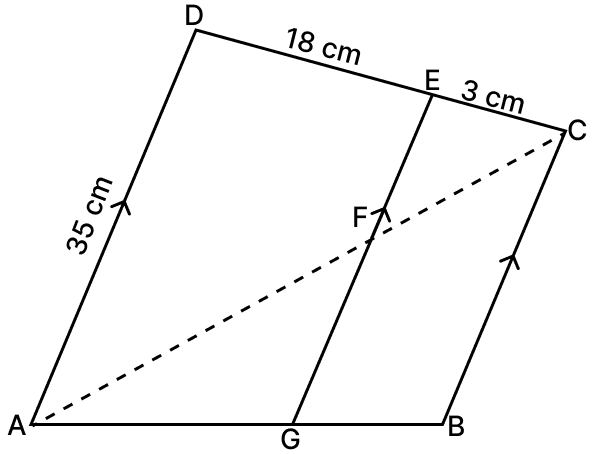
In the given diagram, AD ∥ GE ∥ BC, DE = 18 cm, EC = 3 cm, AD = 35 cm. Find :

In the given diagram, AD ∥ GE ∥ BC, DE = 18 cm, EC = 3 cm, AD = 35 cm. Find:. Specimen 2027, ICSE Specimen 2027 Maths Solved Question Paper.

(a) AF : FC and AG : GB

(b) length of EF

(c) area (trapezium ADEF) : area (∆ EFC)

Show SolutionHide Solution↓

Given,

AD ∥ GE ∥ BC, DE = 18 cm, EC = 3 cm and AD = 35 cm

(a) In ∆ADC,

Since, GE ∥ AD, we have FE ∥ AD.

By Basic Proportionality Theorem (B.P.T.),

$$\begin{aligned}\Rightarrow \frac{AF}{FC} = \frac{DE}{EC} \\[1em] \Rightarrow \frac{AF}{FC} = \frac{18}{3} \\[1em] \Rightarrow \frac{AF}{FC} = \frac{6}{1}.\end{aligned}$$

∴ AF : FC = 6 : 1

In ∆ABC,

Since, GE ∥ BC, we have GF ∥ BC.

By Basic Proportionality Theorem (B.P.T.),

$\frac{AG}{GB} = \frac{AF}{FC} = \frac{6}{1}$

∴ AG : GB = 6 : 1.

Hence, AF : FC = 6 : 1 and AG : GB = 6 : 1.

(b) In ∆ADC and ∆FEC,

⇒ ∠ADC = ∠FEC [Corresponding angles as AD ∥ FE]

⇒ ∠ACD = ∠FCE [Common angle]

∴ ∆ADC ~ ∆FEC (By A.A. axiom)

We know that,

Corresponding sides of similar triangles are proportional.

$$\begin{aligned}\therefore \frac{EF}{AD} = \frac{EC}{DC} \\[1em] \Rightarrow \frac{EF}{35} = \frac{3}{18 + 3} \\[1em] \Rightarrow \frac{EF}{35} = \frac{3}{21} \\[1em] \Rightarrow EF = \frac{35 \times 3}{21} \\[1em] \Rightarrow EF = 5 \text{ cm}.\end{aligned}$$

Hence, length of EF = 5 cm.

(c) We know that,

The ratio of the areas of two similar triangles is equal to the ratio of the squares of their corresponding sides.

⇒ $\frac{\text{Area of ∆ADC}}{\text{Area of ∆EFC}} = \frac{AD^2}{EF^2}$

From the figure,

Area of trapezium ADEF = Area of ∆ADC − Area of ∆EFC

Dividing each side by Area of ∆EFC,

$$\begin{aligned}\therefore \frac{\text{Area of trapezium ADEF}}{\text{Area of ∆EFC}} = \frac{\text{Area of ∆ADC} - \text{Area of ∆EFC}}{\text{Area of ∆EFC}} \\[1em] = \frac{\text{Area of ∆ADC}}{\text{Area of ∆EFC}} - \frac{\text{Area of ∆EFC}}{\text{Area of ∆EFC}}\\[1em] = \frac{AD^2}{EF^2} - 1 \\[1em] = \frac{35^2}{5^2} - 1 \\[1em] = \frac{1225}{25} - 1 \\[1em] = \frac{1225 - 25}{25} \\[1em] = \frac{1200}{25} \\[1em] = \frac{48}{1}.\end{aligned}$$

Hence, area (trapezium ADEF) : area (∆ EFC) = 48 : 1.

6(iii)Written · 2027 · Section B · 2027 SpecimenFull page

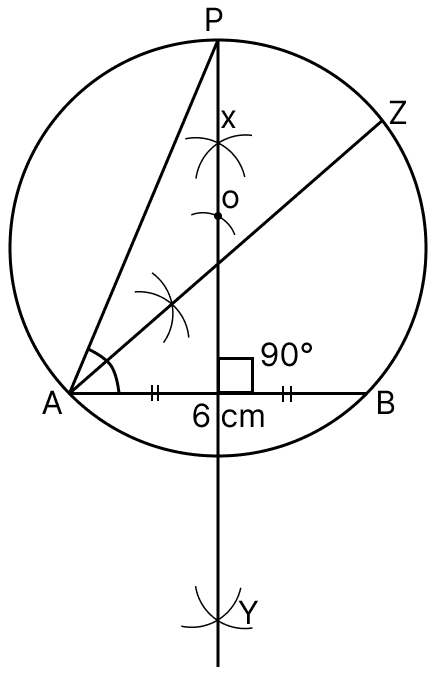
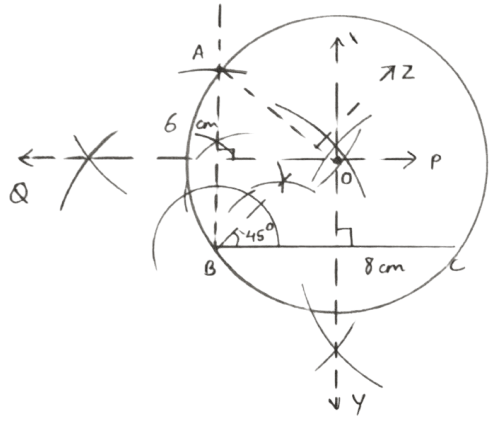
Use ruler and compass for this question :

(a) Draw line segment AB of length 6 cm.

(b) Construct the locus of points which are equidistant from A and B. Mark a point on the locus which is 4.5 cm from A. Name this point as O.

(c) Construct the locus of all points which are 4.5 cm from O.

(d) Mark the point of intersection of loci (b) and (c) as P, which is on the same side of AB as O.

(e) Construct the locus of points which are equidistant from AP and AB.

Show SolutionHide Solution↓

Steps of construction :

  1. Draw a line segment AB of length 6 cm.

  2. Draw XY, the perpendicular bisector of AB. XY is the locus of points which are equidistant from A and B.

  3. With A as centre and radius 4.5 cm, draw an arc cutting XY at the point O. Thus, O is the point on the locus which is 4.5 cm from A.

  4. With O as centre and radius 4.5 cm, draw a circle. This circle is the locus of all points which are 4.5 cm from O.

  5. Mark P, the point of intersection of the perpendicular bisector XY and the circle, which lies on the same side of AB as O.

  6. Join AP.

  7. Draw AZ, the bisector of ∠PAB. AZ is the locus of points which are equidistant from AP and AB.

Use ruler and compass for this question:. Specimen 2027, ICSE Specimen 2027 Maths Solved Question Paper.
7(i)Written · 2027 · Section B · 2027 SpecimenFull page

A bag contains identical cards numbered 1 to 50. A card is selected randomly. Find the probability that the card selected, is :

(a) divisible by 6.

(b) not divisible by 2 and 3.

Show SolutionHide Solution↓

Given,

The bag contains identical cards numbered 1 to 50.

Total number of possible outcomes = 50

(a) Favourable outcomes = Getting a card with a number divisible by 6.

Numbers divisible by 6 = {6, 12, 18, 24, 30, 36, 42, 48}

Number of favourable outcomes = 8

By formula,

Probability = $\frac{\text{No. of favourable outcomes}}{\text{Total number of outcomes}}$

P(card divisible by 6) = $\frac{8}{50} = \frac{4}{25}$.

Hence, probability that the card selected is divisible by 6 = $\mathbf{\frac{4}{25}}$.

(b) We know that,

A number which is divisible by both 2 and 3 is divisible by 6.

∴ P(card divisible by 2 and 3) = P(card divisible by 6) = $\frac{4}{25}$

By formula,

P(card not divisible by 2 and 3) = 1 − P(card divisible by 2 and 3)

$$\begin{aligned}= 1 - \frac{4}{25} \\[1em] = \frac{25 - 4}{25}\\[1em] = \frac{21}{25}.\end{aligned}$$

Hence, probability that the card selected is not divisible by 2 and 3 = $\mathbf{\frac{21}{25}}$.

7(ii)Written · 2027 · Section B · 2027 SpecimenFull page

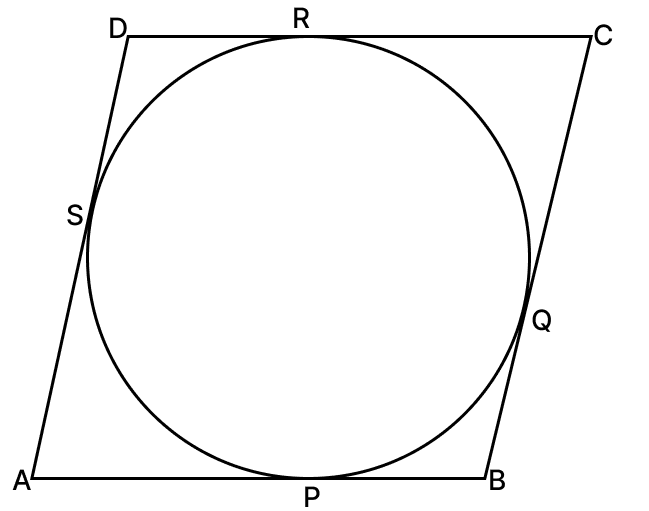
In the given figure, the parallelogram ABCD circumscribes a circle, touching the circle at P, Q, R and S. Prove that :

In the given figure, the parallelogram ABCD circumscribes a circle, touching the circle at P, Q, R and S. Prove that:. Specimen 2027, ICSE Specimen 2027 Maths Solved Question Paper.

(a) AB = BC

(b) diagonals AC and BD bisect each other at right angles.

Show SolutionHide Solution↓

Join AC and BD.

In the given figure, the parallelogram ABCD circumscribes a circle, touching the circle at P, Q, R and S. Prove that:. Specimen 2027, ICSE Specimen 2027 Maths Solved Question Paper.

(a) We know that,

If two tangents are drawn to a circle from an exterior point, the tangents are equal in length.

∴ AP = AS, BP = BQ, CR = CQ and DR = DS

Adding the equations, we get :

⇒ AP + BP + CR + DR = AS + BQ + CQ + DS

⇒ (AP + BP) + (CR + DR) = (AS + DS) + (BQ + CQ)

⇒ AB + CD = AD + BC ......(1)

We know that,

Opposite sides of a parallelogram are equal.

∴ AB = CD and AD = BC

Substituting the above values in equation (1), we get :

⇒ AB + AB = BC + BC

⇒ 2AB = 2BC

⇒ AB = BC.

Hence, proved that AB = BC.

(b) From part (a),

⇒ AB = BC

Also, AB = CD and AD = BC [Opposite sides of a parallelogram are equal]

∴ AB = BC = CD = AD

Since, all the four sides of the parallelogram ABCD are equal, ABCD is a rhombus.

We know that,

The diagonals of a rhombus bisect each other at right angles.

Hence, proved that the diagonals AC and BD bisect each other at right angles.

7(iii)Written · 2027 · Section B · 2027 SpecimenFull page

Given, $\frac{a + 2b + x}{a - 2b + x} = \frac{(a + b)^2}{(a - b)^2}, a \neq 0$

Using properties of proportion, find the value of $x$.

Show SolutionHide Solution↓

Given,

$\frac{a + 2b + x}{a - 2b + x} = \frac{(a + b)^2}{(a - b)^2}$

Applying componendo and dividendo, we get :

$$\begin{aligned}\Rightarrow \frac{(a + 2b + x) + (a - 2b + x)}{(a + 2b + x) - (a - 2b + x)} = \frac{(a + b)^2 + (a - b)^2}{(a + b)^2 - (a - b)^2} \\[1em] \Rightarrow \frac{2a + 2x}{4b} = \frac{2(a^2 + b^2)}{4ab} \\[1em] \Rightarrow \frac{2(a + x)}{4b} = \frac{2(a^2 + b^2)}{4ab} \\[1em] \Rightarrow a + x = \frac{a^2 + b^2}{a} \\[1em] \Rightarrow x = \frac{a^2 + b^2}{a} - a \\[1em] \Rightarrow x = \frac{a^2 + b^2 - a^2}{a} \\[1em] \Rightarrow x = \frac{b^2}{a}.\end{aligned}$$

Hence, $\bm{x} = \mathbf{\frac{b^2}{a}}$.

8(i)Written · 2027 · Section B · 2027 SpecimenFull page

The mean of the following distribution is 27 and the sum of all the frequencies is 50. Find the missing frequencies x and y.

ClassFrequency
0 – 108
10 – 20x
20 – 3012
30 – 4013
40 – 50y
Show SolutionHide Solution↓

Given,

Mean = 27 and sum of all the frequencies = 50

ClassClass Mark (xi)Frequency (fi)fixi
0 - 105840
10 - 2015x15x
20 - 302512300
30 - 403513455
40 - 5045y45y
TotalΣfi = 33 + x + yΣfixi = 795 + 15x + 45y

Given,

Sum of all the frequencies = 50

⇒ 33 + x + y = 50

⇒ x + y = 17 ......(1)

By formula,

Mean = $\frac{∑f_ix_i}{∑f_i}$

Substituting values, we get :

⇒ 27 = $\frac{(795 + 15x + 45y)}{50}$

⇒ 795 + 15x + 45y = 1350

⇒ 15x + 45y = 555

⇒ x + 3y = 37 ......(2)

Subtracting equation (1) from equation (2), we get :

⇒ (x + 3y) − (x + y) = 37 − 17

⇒ 2y = 20

⇒ y = 10

Substituting y = 10 in equation (1), we get :

⇒ x + 10 = 17

⇒ x = 7.

Hence, the missing frequencies are x = 7 and y = 10.

8(ii)Written · 2027 · Section B · 2027 SpecimenFull page

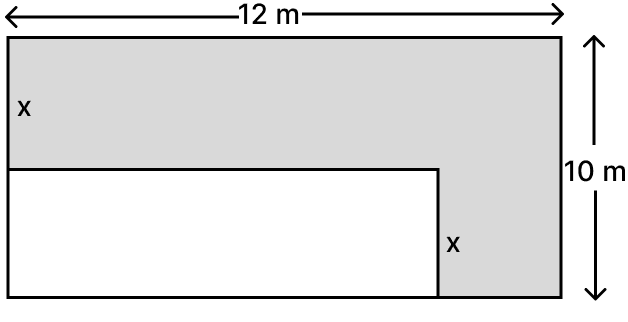
In the given diagram, the area of the shaded region is 57 m2. Form an equation in x and solve it to find the possible value of x.

In the given diagram, the area of the shaded region is 57 m 2. Form an equation in x and solve it to find the possible value of x. Specimen 2027, ICSE Specimen 2027 Maths Solved Question Paper.
Show SolutionHide Solution↓

Given,

Area of the shaded region = 57 m2

From the figure,

Length of the outer rectangle = 12 m

Breadth of the outer rectangle = 10 m

Area of the outer rectangle = 12 × 10 = 120 m2

Length of the inner (unshaded) rectangle = (12 − x) m

Breadth of the inner (unshaded) rectangle = (10 − x) m

Area of the inner rectangle = (12 − x)(10 − x) m2

From the figure,

Area of shaded region = Area of outer rectangle − Area of inner rectangle

⇒ 12 × 10 − (12 − x)(10 − x) = 57

⇒ 120 − (120 − 12x − 10x + x2) = 57

⇒ 120 − 120 + 22x − x2 = 57

⇒ 22x − x2 = 57

⇒ x2 − 22x + 57 = 0

⇒ x2 − 19x − 3x + 57 = 0

⇒ x(x − 19) − 3(x − 19) = 0

⇒ (x − 19)(x − 3) = 0

[Using zero product rule]

⇒ (x − 19) = 0 or (x − 3) = 0

⇒ x = 19 or x = 3

Since, the breadth of the rectangle is 10 m, the width x cannot be 19 m.

∴ x = 3 m.

Hence, the possible value of x = 3 m.

9(i)Written · 2027 · Section B · 2027 SpecimenFull page

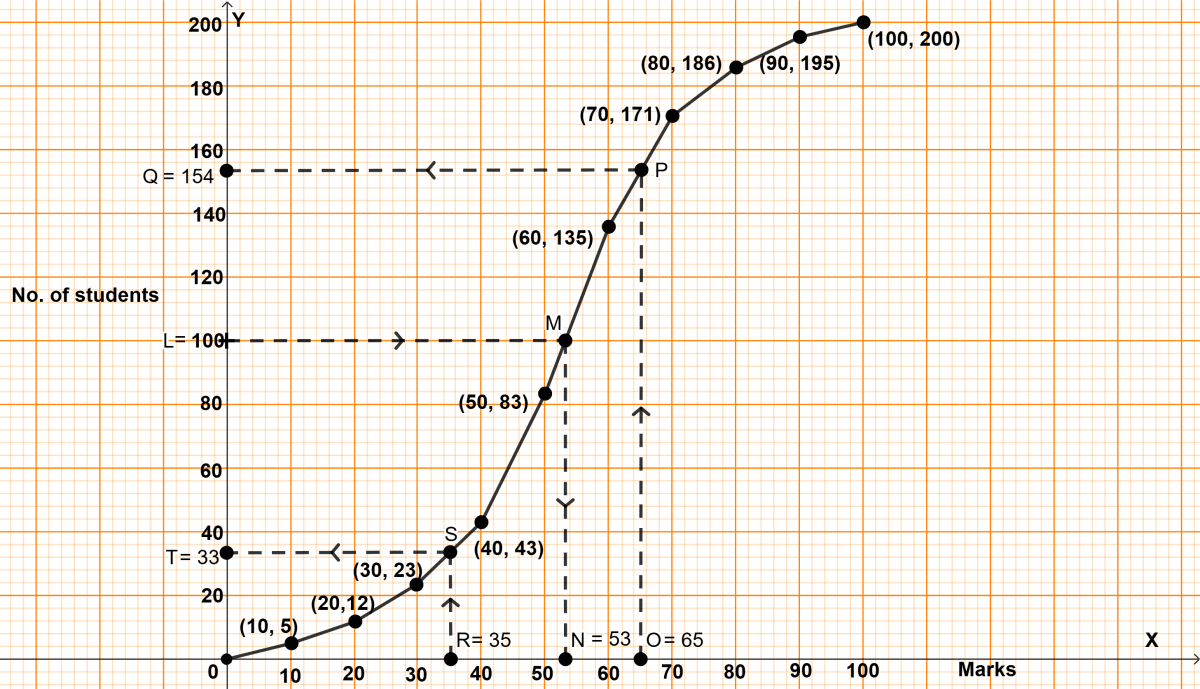
The distribution given below represents marks obtained by 200 students in a Mathematics Examination with maximum marks 80.

MarksNo. of students
0 – 108
10 – 2012
20 – 3016
30 – 4024
40 – 5029
50 – 6038
60 – 7042
70 – 8031

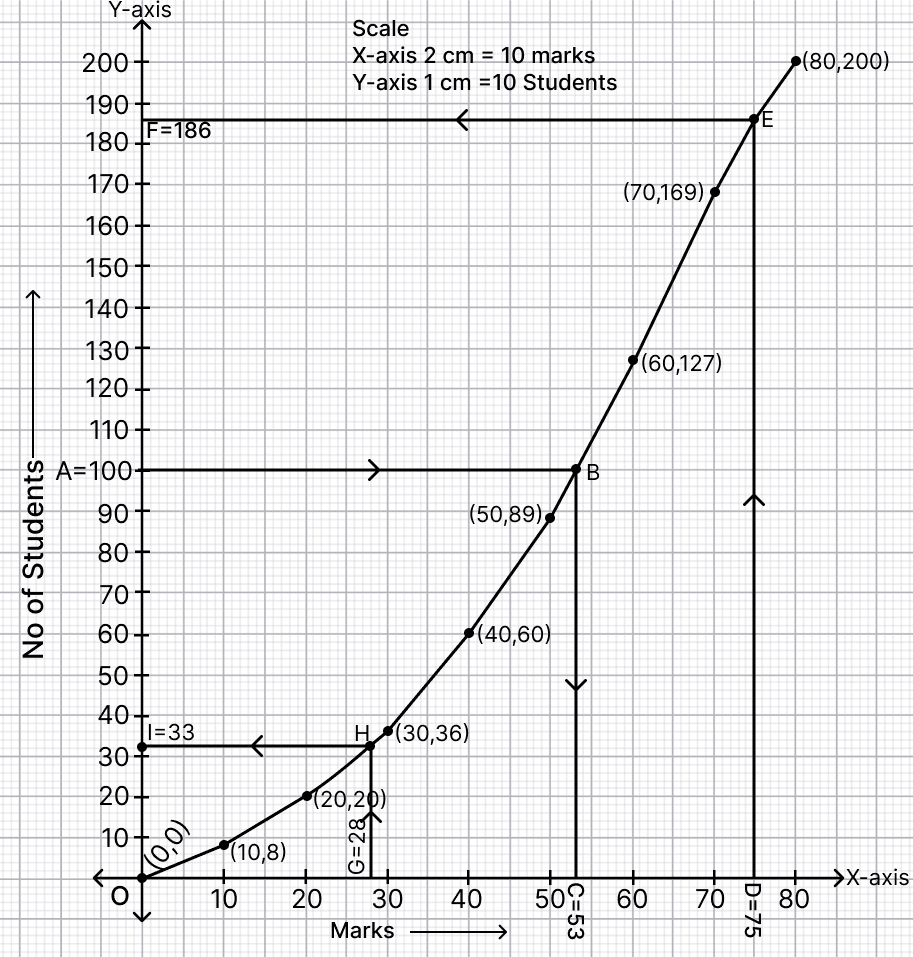
Using graph paper draw an ogive for the given distribution. Along one axis take 2 cm equal to 10 marks and along the other axis take 1 cm equal to 10 students.

Use your graph to find the following :

(a) Median

(b) Number of students who scored above 75 marks

(c) If the pass percentage is 35%, find the number of students who scored 35% and below.

Show SolutionHide Solution↓
MarksNo. of students (f)Cumulative frequency (cf)
0 - 1088
10 - 201220
20 - 301636
30 - 402460
40 - 502989
50 - 6038127
60 - 7042169
70 - 8031200

Steps :

  1. Take 2 cm = 10 marks on the x-axis.

  2. Take 1 cm = 10 students on the y-axis.

  3. Plot the points (0, 0), (10, 8), (20, 20), (30, 36), (40, 60), (50, 89), (60, 127), (70, 169) and (80, 200).

  4. Join the points by a free hand curve.

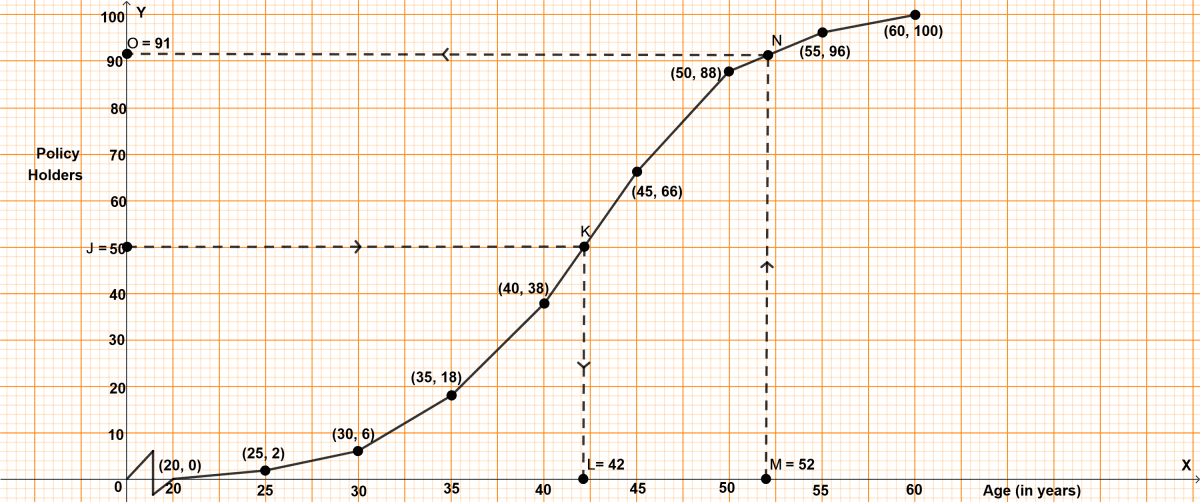
The distribution given below represents marks obtained by 200 students in a Mathematics Examination with maximum marks 80. Specimen 2027, ICSE Specimen 2027 Maths Solved Question Paper.

(a) Here, $n$ (no. of students) = 200, which is even.

Median = $\frac{n}{2} = \frac{200}{2}$ = 100th term.

Through point A = 100 on the y-axis draw a horizontal line parallel to the x-axis touching the graph at point B, through B draw a vertical line parallel to the y-axis touching the x-axis at point C = 53.

Hence, median = 53.

(b) Through point D = 75 on the x-axis draw a vertical line parallel to the y-axis touching the graph at point E, through E draw a horizontal line parallel to the x-axis touching the y-axis at point F = 186.

∴ 186 students scored 75 marks and below.

∴ Number of students who scored above 75 marks = 200 − 186 = 14.

Hence, 14 students scored above 75 marks.

(c) Maximum marks = 80

Pass marks = 35% of 80 = $\frac{35}{100} \times 80$ = 28 marks

Through point G = 28 on the x-axis draw a vertical line parallel to the y-axis touching the graph at point H, through H draw a horizontal line parallel to the x-axis touching the y-axis at point I = 33.

Hence, 33 students scored 35% and below.

9(ii)Written · 2027 · Section B · 2027 SpecimenFull page

Draw the necessary diagram for this question.

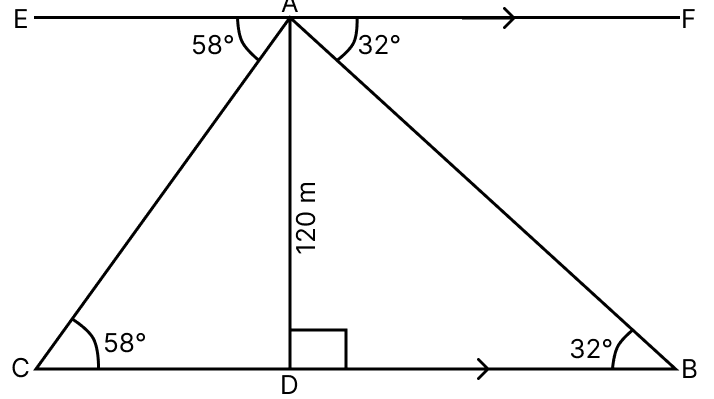
A man on the top of a lighthouse observes the angle of depression of two ships on the opposite sides of the lighthouse as 32° and 58° respectively. If the height of the lighthouse is 120 m, find the distance between the two ships. Give your answer correct to the nearest meter.

Show SolutionHide Solution↓

Let AD be the lighthouse and B and C be the two ships on the opposite sides of the lighthouse.

Draw the necessary diagram for this question. A man on the top of a lighthouse observes the angle of depression of two ships on the opposite sides of the lighthouse as 32° and 58° respectively. If the height of the lighthouse is 120 m, find the distance between the two ships. Give your answer correct to the nearest meter. Specimen 2027, ICSE Specimen 2027 Maths Solved Question Paper.

Given,

Height of the lighthouse (AD) = 120 m

The angles of depression of the two ships are 32° and 58°.

From figure,

⇒ ∠FAB = ∠ABD = 32° (alternate angles are equal)

⇒ ∠EAC = ∠ACD = 58° (alternate angles are equal)

In right angled triangle ABD,

$$\begin{aligned}\Rightarrow \tan 32° = \frac{\text{Perpendicular}}{\text{Base}} \\[1em] \Rightarrow \tan 32° = \frac{AD}{BD} \\[1em] \Rightarrow BD = \frac{AD}{\tan 32°} \\[1em] \Rightarrow BD = \frac{120}{0.6249} \\[1em] \Rightarrow BD = 192.03 \text{ m}.\end{aligned}$$

In right angled triangle ACD,

$$\begin{aligned}\Rightarrow \tan 58° = \frac{\text{Perpendicular}}{\text{Base}} \\[1em] \Rightarrow \tan 58° = \frac{AD}{CD} \\[1em] \Rightarrow CD = \frac{AD}{\tan 58°} \\[1em] \Rightarrow CD = \frac{120}{1.6003} \\[1em] \Rightarrow CD = 74.99 \text{ m}.\end{aligned}$$

From the figure,

Distance between the two ships (BC) = BD + CD

= 192.03 + 74.99

= 267.02 m ≈ 267 m.

Hence, the distance between the two ships = 267 m.

10(i)Written · 2027 · Section B · 2027 SpecimenFull page

A finite Geometric Proportion (G.P.) series contains 10 terms. The sum of the first three terms is 7 and that of the last three terms is 896. Find the first term and the common ratio.

Show SolutionHide Solution↓

Let the first term of the G.P. be $a$ and the common ratio be $r$.

Since, the G.P. contains 10 terms, the terms are $a, ar, ar^2, ......, ar^9$.

Given,

Sum of the first three terms = 7

$$\begin{aligned}\Rightarrow a + ar + ar^2 = 7 \\[1em] \Rightarrow a(1 + r + r^2) = 7 \text{ ......(1)}\end{aligned}$$

Sum of the last three terms = 896

$$\begin{aligned}\Rightarrow ar^7 + ar^8 + ar^9 = 896 \\[1em] \Rightarrow ar^7(1 + r + r^2) = 896 \text{ ......(2)}\end{aligned}$$

Dividing equation (2) by equation (1), we get :

$$\begin{aligned}\Rightarrow \frac{ar^7(1 + r + r^2)}{a(1 + r + r^2)} = \frac{896}{7} \\[1em] \Rightarrow r^7 = 128 \\[1em] \Rightarrow r^7 = 2^7 \\[1em] \Rightarrow r = 2.\end{aligned}$$

Substituting $r = 2$ in equation (1), we get :

$$\begin{aligned}\Rightarrow a(1 + 2 + 2^2) = 7 \\[1em] \Rightarrow a(1 + 2 + 4) = 7 \\[1em] \Rightarrow 7a = 7 \\[1em] \Rightarrow a = 1.\end{aligned}$$

Hence, first term = 1 and common ratio = 2.

10(ii)Written · 2027 · Section B · 2027 SpecimenFull page

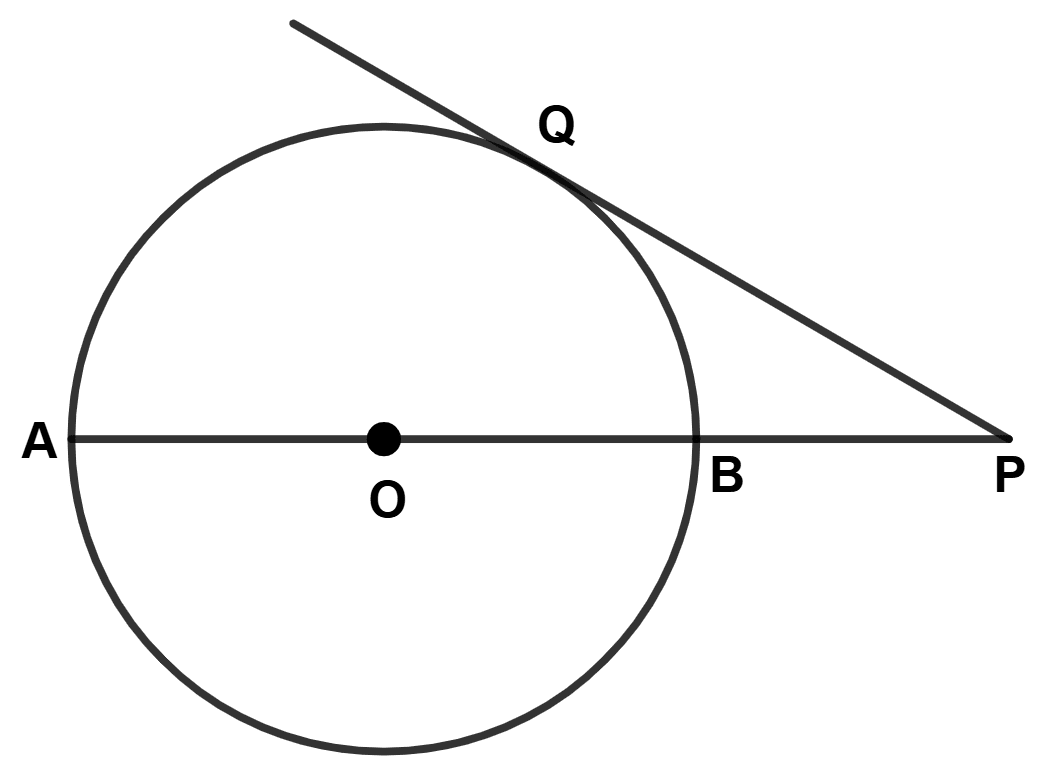
In a circle with centre O, PA and PB are tangents drawn from an external point P. If PA = 9 cm and ∠APB = 60°, find the :

In a circle with centre O, PA and PB are tangents drawn from an external point P. If PA = 9 cm and ∠APB = 60°, find the:. Specimen 2027, ICSE Specimen 2027 Maths Solved Question Paper.

(a) length of PB.

(b) radius of the circle.

Show SolutionHide Solution↓

(a) We know that,

The lengths of two tangents drawn from an external point to a circle are equal.

∴ PB = PA

⇒ PB = 9 cm.

Hence, length of PB = 9 cm.

(b) Join OA, OB and OP.

Figure unavailable in the source: In a circle with centre O, PA and PB are tangents drawn from an external point P. If PA = 9 cm and ∠APB = 60°, find the:. Specimen 2027, ICSE Specimen 2027 Maths Solved Question Paper.

We know that,

The tangents drawn from an external point are equally inclined to the line joining the centre of the circle and that point.

∴ OP bisects ∠APB.

⇒ ∠OPA = $\frac{1}{2} \times ∠APB = \frac{1}{2} \times 60° = 30°$

We know that,

Radius and tangent at the point of contact are perpendicular to each other.

∴ ∠OAP = 90°

In right angled triangle OAP,

$$\begin{aligned}\Rightarrow \tan 30° = \frac{OA}{PA} \\[1em] \Rightarrow OA = PA \times \tan 30° \\[1em] \Rightarrow OA = 9 \times \frac{1}{\sqrt{3}} \\[1em] \Rightarrow OA = \frac{9 \times \sqrt{3}}{\sqrt{3} \times \sqrt{3}} \\[1em] \Rightarrow OA = \frac{9\sqrt{3}}{3} \\[1em] \Rightarrow OA = 3\sqrt{3} \\[1em] \Rightarrow OA = 3 \times 1.7321 \\[1em] \Rightarrow OA = 5.1963 \\[1em] \Rightarrow OA = 5.2 \text{ cm}.\end{aligned}$$

Hence, radius of the circle = 5.2 cm.

10(iii)Written · 2027 · Section B · 2027 SpecimenFull page

The table given below shows a record of the weight in kilogram of 100 students of a school.

Weight (kg)No. of Students
30 – 355
35 – 407
40 – 4514
45 – 5021
50 – 5525
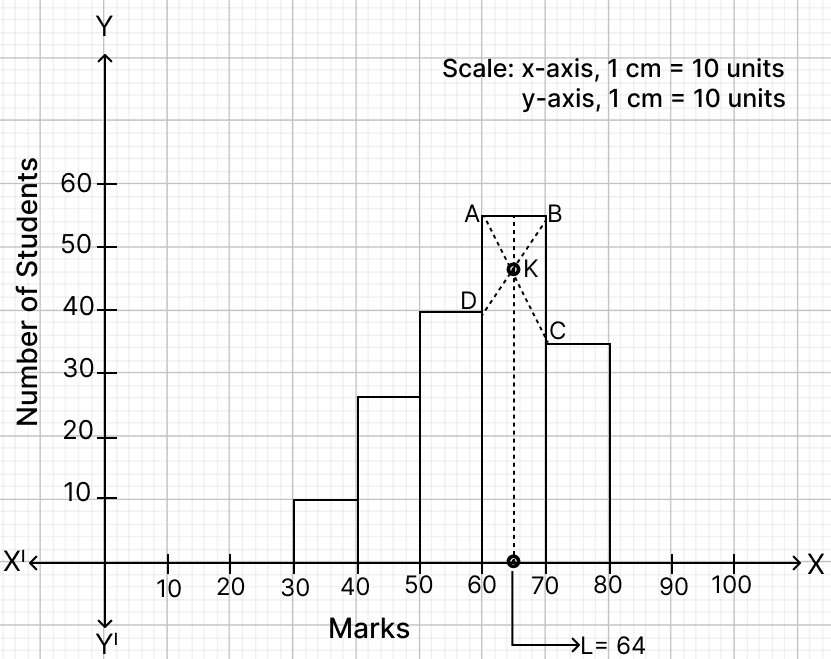
55 – 6015
60 – 657
65 – 706

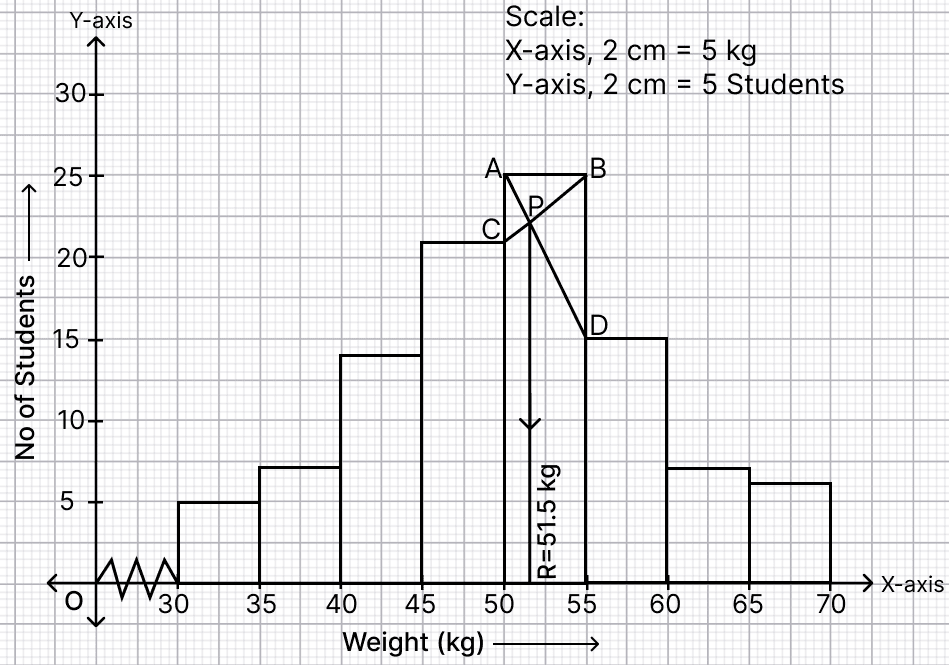
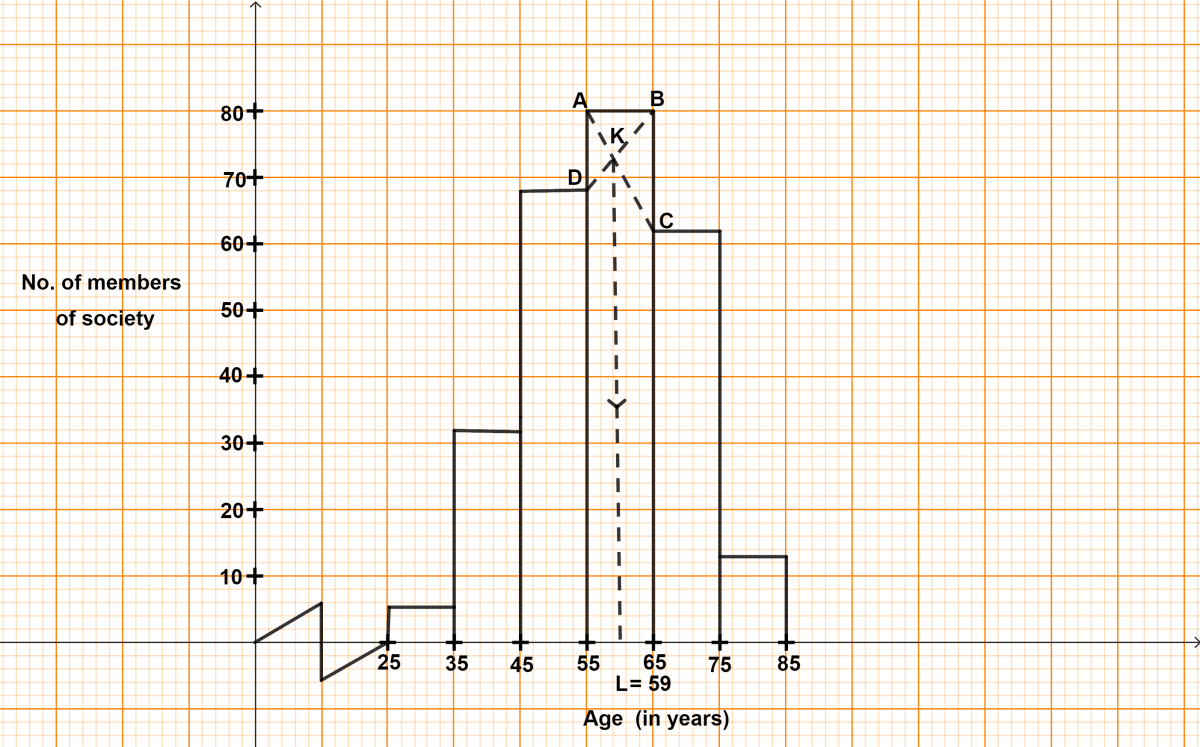
Draw a histogram and find the modal weight.

[Take 2 cm = 5 kg along one axis and 2 cm = 5 students along the other axis]

Show SolutionHide Solution↓

Steps :

  1. Take 2 cm = 5 kg along the x-axis.

  2. Take 2 cm = 5 students along the y-axis.

  3. Draw the rectangles (bars) for the given class intervals, taking the corresponding frequencies as their heights.

  4. The class interval 50 - 55 has the highest frequency 25, so 50 - 55 is the modal class.

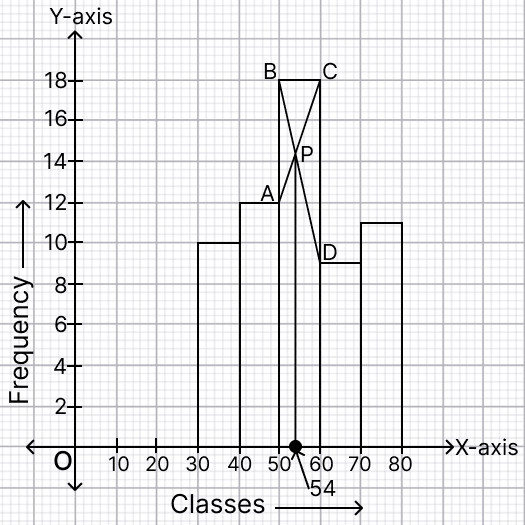
  5. In the highest rectangle, draw two lines AD and BC from corners of the rectangles on either side of the highest rectangle to the opposite corners of the highest rectangle. Let P be the point of intersection of AD and BC.

  6. From the point of intersection P, draw a perpendicular to the x-axis. The point R = 51.5, where this perpendicular meets the x-axis gives the mode.

The table given below shows a record of the weight in kilogram of 100 students of a school. Specimen 2027, ICSE Specimen 2027 Maths Solved Question Paper.

From the histogram,

Mode = 51.5 kg.

Hence, modal weight = 51.5 kg.

1(i)1 Mark · 2026 · Section A · 2026 PaperFull page

(x + 3), 1, (3x − 7) and −5 are in proportion. The value of x is :

Show SolutionHide Solution↓

Given,

(x + 3), 1, (3x − 7) and −5 are in proportion.

$$\begin{aligned}\therefore \frac{(x + 3)}{1} = \frac{(3x - 7)}{-5} \\[1em] \Rightarrow (x + 3)= \frac{(3x - 7)}{-5} \\[1em] \Rightarrow -5(x + 3) = (3x - 7) \\[1em] \Rightarrow -5x - 15 = 3x - 7 \\[1em] \Rightarrow -5x - 3x = 15 - 7 \\[1em] \Rightarrow -8x = 8 \\[1em] \Rightarrow x = -\frac{8}{8} \\[1em] \Rightarrow x = -1.\end{aligned}$$

Hence, option 1 is the correct option.

1(ii)1 Mark · 2026 · Section A · 2026 PaperFull page

The marked price of a refrigerator is ₹ 12,000 and GST paid by the customer is ₹ 2,160. The rate of GST is:

Show SolutionHide Solution↓

Let rate of GST be x.

Given,

Marked price of refrigerator = ₹ 12,000

GST paid = ₹ 2,160

GST amount = $\frac{\text{Rate}}{100}$ × Marked price

⇒ 2160 = $\frac{x}{100}$ × 12000

⇒ 2160 = 120x

⇒ x = $\frac{2160}{120}$

⇒ x = 18%

Hence, option 3 is the correct option.

1(iii)1 Mark · 2026 · Section A · 2026 PaperFull page

Rakhi’s mobile number has the following integers :
1, 6, 9, 8, 9, 1, 7, 8, 9

The mode of the above given data is :

Show SolutionHide Solution↓

Given,

1, 6, 9, 8, 9, 1, 7, 8, 9.

Mode = The value which occurs most frequently in the data.

The number 9 occurs 3 times, which is the highest.

Mode = 9

Hence, option 4 is the correct option.

1(iv)1 Mark · 2026 · Section A · 2026 PaperFull page

A and B opened a recurring deposit account in a bank which is paying simple interest at 9% per annum. A deposited ₹ 1,500 for one year and B deposited ₹ 1,200 for 15 months. The amount invested by :

Show SolutionHide Solution↓

Given,

For A,

P = ₹ 1,500

n = 12 months

r = 9%

We know that,

Amount Invested = P × n

= ₹ 1,500 × 12

= ₹ 18,000.

For B,

Amount Invested = P × n

= ₹ 1,200 × 15

= ₹ 18,000.

Both invested ₹ 18,000.

Hence, option 4 is the correct option.

1(v)1 Mark · 2026 · Section A · 2026 PaperFull page

Find the equation of a line whose y-intercept is 6 and is parallel to x-axis.

Show SolutionHide Solution↓

A line parallel to the x-axis has :

Slope (m) = 0

y-intercept (c) = 6

Substituting the values in equation y = mx + c, we get :

y = 0x + 6

y = 6.

Hence, option 1 is the correct option.

1(vi)1 Mark · 2026 · Section A · 2026 PaperFull page

Asha buys ₹ 20 shares of a company which pays 9% dividend at such a price that she gets a return of 12% on her investment. At what price did she buy each share?

Show SolutionHide Solution↓

Given,

Face Value (FV) of share = ₹ 20

Dividend = 9%

Return on investment = 12%

By formula,

Dividend % × N.V. = Return % × M.V.

$\frac{9}{100} \times 20 = \frac{12}{100}$ × M.V.

180 = 12 × M.V.

M.V. = $\frac{180}{12}$ = ₹ 15.

Hence, option 2 is the correct option.

1(vii)1 Mark · 2026 · Section A · 2026 PaperFull page

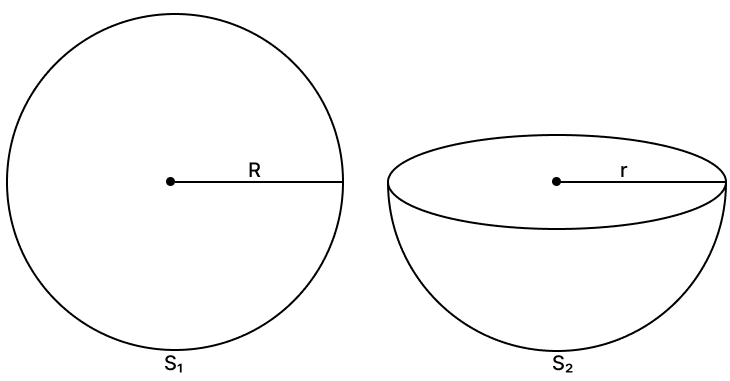
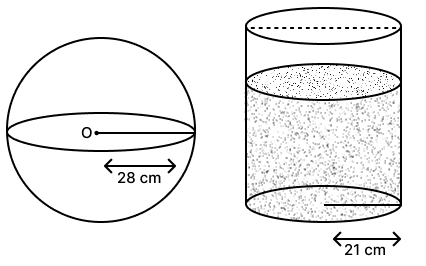
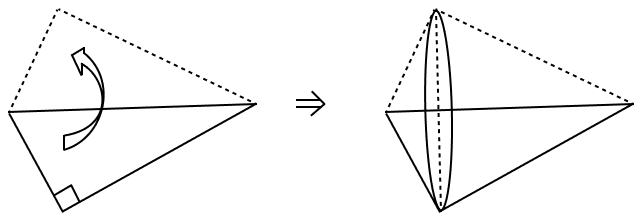
The total surface area of a solid sphere (S1) and a solid hemisphere (S2), as shown in the diagram, are equal. The ratio of radii R and r is :

The total surface area of a solid sphere and a solid hemisphere, as shown in the diagram, are equal. The ratio of radii R and r is. ICSE 2026 Maths Solved Question Paper.
Show SolutionHide Solution↓

Let the radius of the sphere (S1) be R and hemisphere (S2) be r.

Total surface area of sphere = 4πR2

Total surface area of hemisphere = 3πr2

Given,

Since, total surface area of sphere and hemisphere are equal,

4πR2 = 3πr2

$\frac{R^2}{r^2} = \frac{3}{4}$

$\frac{R}{r} = \sqrt{\frac{3}{4}} = \frac{\sqrt{3}}{2} = \sqrt{3} : 2$.

Hence, option 3 is the correct option.

1(viii)1 Mark · 2026 · Section A · 2026 PaperFull page

In the given diagram, O is the centre of the circle and ABCD is a cyclic quadrilateral. If ∠CDE = 65°, then the value of x is :

In the given diagram, O is the centre of the circle and ABCD is a cyclic quadrilateral. If ∠CDE = 65°, then the value of x is. ICSE 2026 Maths Solved Question Paper.
Show SolutionHide Solution↓

In a cyclic quadrilateral,

Exterior angle is equal to the interior opposite angle.

∠CBA = ∠CDE = 65°

We know that,

The angle subtended by an arc at the centre of a circle is twice the angle subtended by it at any point on the remaining part of the circle.

∠AOC = 2 × ∠ABC

x = 2 × 65°

x = 130°.

Hence, option 4 is the correct option.

1(ix)1 Mark · 2026 · Section A · 2026 PaperFull page

The nature of roots of quadratic equation 3x2 − 6x − 3 = 0 are :

Show SolutionHide Solution↓

Comparing 3x2 − 6x − 3 = 0 with ax2 + bx + c = 0, we get :

a = 3, b = -6, c = -3.

We know that,

⇒ D = b2 - 4ac

⇒ D = (-6)2 - 4 × (3) × (-3)

⇒ D = 36 + 36

⇒ D = 72.

∴ D > 0 and not a perfect square. Roots are real, distinct and irrational.

Hence, option 3 is the correct option.

1(x)1 Mark · 2026 · Section A · 2026 PaperFull page

Assertion (A): If a die is rolled, the probability of getting a number greater than 6 is $\frac{1}{6}$.

Reason (R): There are six possible outcomes when rolling a die, {1, 2, 3, 4, 5, 6}.

Show SolutionHide Solution↓

When a die is rolled,

Total number of possible outcomes = 6

S = {1, 2, 3, 4, 5, 6}

Let E be the event of getting number greater than 6,

Number of favorable outcomes = 0

P(E) = $\frac{\text{Number of favorable outcomes}}{\text{Total number of outcomes}} = \frac{0}{6} = 0$.

Assertion (A) is false.

There are six possible outcomes when a dice is rolled,

S = {1, 2, 3, 4, 5, 6}

Reason (R) is true.

(A) is false and (R) is true.

Hence, option 2 is the correct option.

1(xi)1 Mark · 2026 · Section A · 2026 PaperFull page

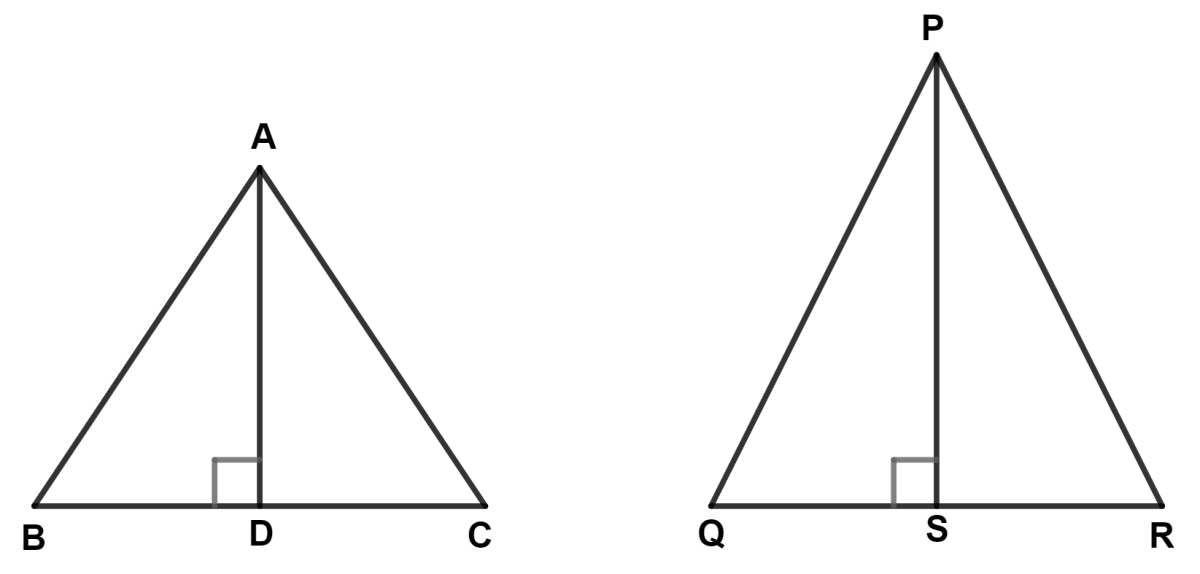
If the areas of two similar triangles are in the ratio 9 : 64, then the ratio of their corresponding altitudes is:

Show SolutionHide Solution↓

Let the areas be A1 and A2, and the altitudes be h1 and h2 respectively.

Since the triangles are similar,

The ratio of the areas of two similar triangles is equal to the square of the ratio of their corresponding sides (or altitudes).

$$\begin{aligned}\Rightarrow \frac{A_1}{A_2} = \Big(\frac{h_1}{h_2}\Big)^2 \\[1em] \Rightarrow \frac{9}{64} = \Big(\frac{h_1}{h_2}\Big)^2 \\[1em] \Rightarrow \frac{h_1}{h_2} = \sqrt{\frac{9}{64}} \\[1em] \Rightarrow \frac{h_1}{h_2} = \frac{3}{8} \\[1em] \Rightarrow h_1 : h_2 = 3 : 8.\end{aligned}$$

Hence, option 1 is the correct option.

1(xii)1 Mark · 2026 · Section A · 2026 PaperFull page

What must be added to x3 + 7x2 + 3x + 2 so that the result is completely divisible by (x + 2)?

Show SolutionHide Solution↓

Using remainder theorem,

If polynomial P(x) is divided by (x - a), the remainder is P(a).

Given,

x + 2 = 0

x = -2.

Substituting x = -2 into the polynomial x3 + 7x2 + 3x + 2, we get :

⇒ P(-2) = (-2)3 + 7(-2)2 + 3(-2) + 2

= -8 + 28 - 6 + 2

= 20 - 6 + 2

= 16.

For a polynomial to be completely divisible by x + 2, the remainder must be 0.

We have a remainder of 16, we need to add a number k such that the new remainder becomes zero i.e.,:

k + 16 = 0

k = -16.

Hence, option 2 is the correct option.

1(xiii)1 Mark · 2026 · Section A · 2026 PaperFull page

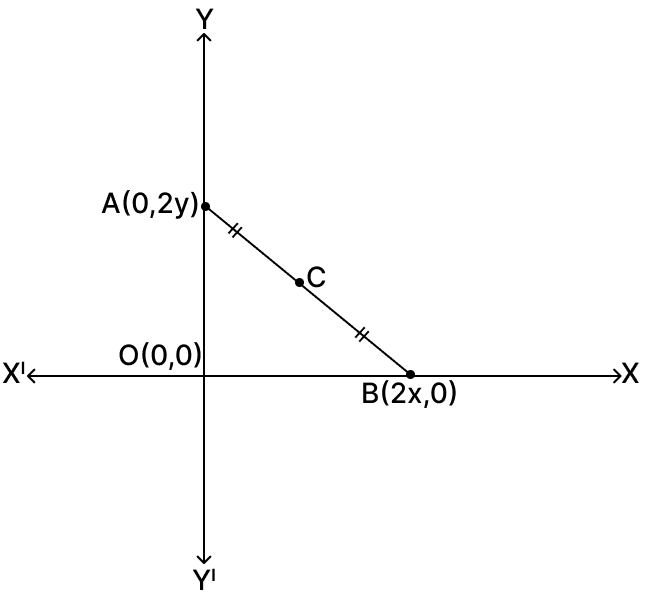
In the given diagram, ΔAOB is a right-angled triangle and C is the mid-point of AB. The coordinates of the point which is equidistant from the three vertices of ΔAOB is :

In the given diagram, ΔAOB is a right-angled triangle and C is the mid-point of AB. The coordinates of the point which is equidistant from the three vertices of ΔAOB is. ICSE 2026 Maths Solved Question Paper.
Show SolutionHide Solution↓

Given,

C is midpoint of AB.

We know that,

In a right-angled triangle, the point equidistant from all three vertices is the midpoint of the hypotenuse.

Using midpoint formula :

M = $\Big(\frac{x_1 + x_2}{2}, \frac{y_1 + y_2}{2}\Big)$

Substituting values, we get :

$$\begin{aligned}\Rightarrow C = \Big(\frac{0 + 2x}{2}, \frac{2y + 0}{2} \Big) \\[1em] \Rightarrow C = \Big(\frac{2x}{2}, \frac{2y}{2} \Big) \\[1em] \Rightarrow C = \text{(x, y)}.\end{aligned}$$

Hence, option 1 is the correct option.

1(xiv)1 Mark · 2026 · Section A · 2026 PaperFull page

Given matrix A = $$\begin{bmatrix} 2 & 3 \\ 1 & 2 \end{bmatrix}$$ and matrix B = [2 −4]. Product AB is a matrix of order:

Show SolutionHide Solution↓

For AB to exist :

Number of columns in A = Number of rows in B

Order of matrix A = 2 × 2

Order of matrix B = 1 × 2

Columns in A = 2

Rows in B = 1

∴ Product AB is not possible.

Hence, option 4 is the correct option.

1(xv)1 Mark · 2026 · Section A · 2026 PaperFull page

Assertion (A): The 9th term of a Geometric Progression (G.P.) 6, −12, 24, −48, ... is a positive term.

Reason (R): The value of (−2)8 is always positive.

Show SolutionHide Solution↓

Given,

6, −12, 24, −48... is a G.P.

a = 6

r = $\frac{-12}{6}$ = -2

By formula,

an = arn - 1

For 9th term,

⇒ a9 = (6).(-2)9 - 1

= 6.(-2)8

= 6.(256)

= 1536 > 0.

∴ Assertion (A) is true.

(-2)8

Any negative number raised to an even power is always positive.

∴ Reason (R) is true.

Thus, both (A) and (R) are true and (R) is the correct explanation of (A).

Hence, option 3 is the correct option.

2(i)1 Mark · 2026 · Section A · 2026 PaperFull page

The fourth and seventh terms of an Arithmetic Progression (A.P.) are 60 and 114 respectively. Find the :

(a) first term and common difference.

(b) sum of its first 10 terms.

Show SolutionHide Solution↓

(a) Given,

The fourth and seventh terms of an Arithmetic Progression (A.P.) are 60 and 114 respectively.

We know that,

an = a + (n - 1)d

Fourth term :

⇒ a4 = a + (4 - 1)d

⇒ a + 3d = 60 ....(1)

Seventh term :

⇒ a7 = a + (7 - 1)d

⇒ a + 6d = 114 ....(2)

Subtracting equation (1) from equation (2), we get :

⇒ (a + 6d) - (a + 3d) = 114 - 60

⇒ a + 6d - a - 3d = 54

⇒ 3d = 54

⇒ d = $\frac{54}{3}$ = 18.

Substituting value of d = 18 in equation (1), we get :

⇒ a + 3d = 60

⇒ a + 3(18) = 60

⇒ a + 54 = 60

⇒ a = 60 - 54

⇒ a = 6.

Hence, first term = 6 and common difference = 18.

(b) Sum of the first 10 terms :

By formula,

$S_n = \frac{n}{2}[2a + (n - 1)d]$

Substituting values, we get :

$$\begin{aligned}\Rightarrow S_{10} = \frac{10}{2}[2(6) + (10 - 1)18] \\[1em] = 5[12 + 162] \\[1em] = 5[174] \\[1em] = 870.\end{aligned}$$

Hence, sum of its first 10 terms = 870.

2(ii)1 Mark · 2026 · Section A · 2026 PaperFull page

Given, A = $$\begin{bmatrix} 3 & 1 \\ 5 & 3 \end{bmatrix}$$ and B = $$\begin{bmatrix} -1 & a \\ 3 & -5 \end{bmatrix}$$ and product AB = $$\begin{bmatrix} b & 7 \\ 4 & 5 \end{bmatrix}$$. Find the values of ‘a’ and ‘b’.

Show SolutionHide Solution↓

Given,

A = $$\begin{bmatrix} 3 & 1 \\ 5 & 3 \end{bmatrix}$$

B = $$\begin{bmatrix} -1 & a \\ 3 & -5 \end{bmatrix}$$

AB = $$\begin{bmatrix} b & 7 \\ 4 & 5 \end{bmatrix}$$

Solving,

$$\Rightarrow AB = \begin{bmatrix} 3 & 1 \\ 5 & 3 \end{bmatrix} \times \begin{bmatrix} -1 & a \\ 3 & -5 \end{bmatrix} \\[1em] \Rightarrow AB = \begin{bmatrix} 3(-1) + 1(3) & 3(a) + 1(-5) \\ 5(-1) + 3(3) & 5(a) + 3(-5) \end{bmatrix} \\[1em] \Rightarrow AB = \begin{bmatrix} -3 + 3 & 3a - 5 \\ -5 + 9 & 5a - 15 \end{bmatrix} \\[1em] \Rightarrow \begin{bmatrix} b & 7 \\ 4 & 5 \end{bmatrix} = \begin{bmatrix} 0 & 3a - 5 \\ 4 & 5a - 15 \end{bmatrix} \\[1em]$$

Comparing corresponding elements,

∴ b = 0

⇒ 3a - 5 = 7

⇒ 3a = 7 + 5

⇒ 3a = 12

⇒ a = $\frac{12}{3}$

⇒ a = 4

Hence, a = 4 and b = 0.

2(iii)1 Mark · 2026 · Section A · 2026 PaperFull page

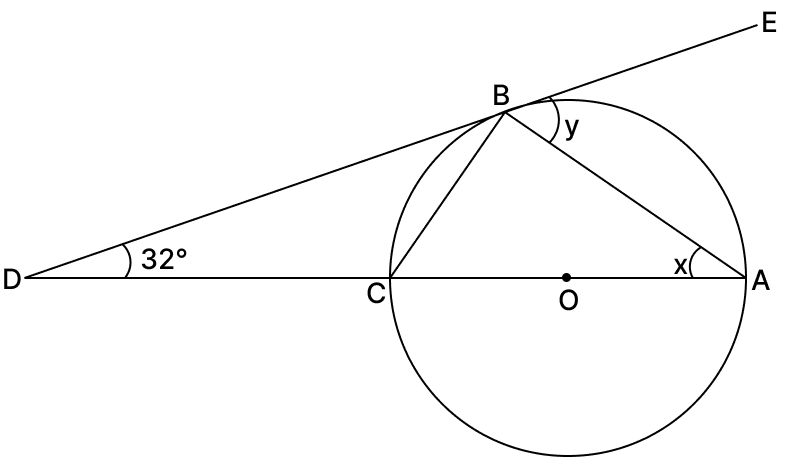
In the given diagram, O is the centre of the circle and the tangent DE touches the circle at B. If ∠ADB = 32°. Find the values of x and y.

In the given diagram, O is the centre of the circle and the tangent DE touches the circle at B. If ∠ADB = 32°. Find the values of x and y. ICSE 2026 Maths Solved Question Paper.
Show SolutionHide Solution↓

Given,

∠ADB = 32°

From figure,

∠ABC = 90° (Angle in a semicircle is a right angle)

We know that,

Angle between a tangent and a chord through point of contact is equal to an angle in the alternate segment.

∠BCA = ∠ABE = y

∠DBC = ∠BAC = x

Since, DE is a straight line, thus

⇒ ∠DBC + ∠ABC + ∠ABE = 180°

⇒ x + 90° + y = 180°

⇒ x + y = 180° - 90°

⇒ x + y = 90° ....(1)

In triangle ADB,

⇒ ∠ADB + ∠BAD + ∠ABD = 180°

⇒ 32° + x + (∠DBC + ∠ABC) = 180°

⇒ 32° + x + x + 90° = 180°

⇒ 2x + 122° = 180°

⇒ 2x = 180° - 122°

⇒ 2x = 58°

⇒ x = $\frac{58°}{2}$ = 29°.

Substituting value of x in equation (1), we get :

⇒ 29° + y = 90°

⇒ y = 90° - 29°

⇒ y = 61°.

Hence, x = 29° and y = 61°.

3(i)1 Mark · 2026 · Section A · 2026 PaperFull page

The polynomial kx3 + 3x2 − 11x − 6 when divided by (x + 1), leaves a remainder of 6.

(a) Find the value of k.

(b) Using the value of k factorise completely the polynomial kx3 + 3x2 − 11x − 6.

Show SolutionHide Solution↓

(a) Using remainder theorem,

If polynomial P(x) is divided by (x - a), the remainder is P(a).

x + 1 = 0

x = -1.

Given,

The polynomial kx3 + 3x2 − 11x − 6 when divided by (x + 1), leaves a remainder of 6.

Thus, on substituting value x = -1 in kx3 + 3x2 − 11x − 6, we get :

⇒ k(-1)3 + 3(-1)2 − 11(-1) − 6 = 6

⇒ -k + 3 + 11 − 6 = 6

⇒ -k + 8 = 6

⇒ -k = 6 - 8

⇒ k = 2.

Hence, the value of k = 2.

(b) P(x) = 2x3 + 3x2 − 11x − 6

Substituting value x = 2 in P(x), we get :

⇒ 2(2)3 + 3(2)2 − 11(2) − 6

⇒ 2(8) + 3(4) − 22 − 6

⇒ 16 + 12 − 22 − 6

⇒ 28 − 28

⇒ 0.

Since, P(2) = 0, thus (x − 2) is a factor of P(x).

$$\begin{array}{l} \phantom{x - 2)}{2x^2 + 7x + 3} \\ x - 2\overline{\smash{\big)}2x^3 + 3x^2 − 11x − 6} \\ \phantom{x - 2}\phantom{}\underline{\underset{-}{}2x^3 \underset{+}{-}4x^2} \\ \phantom{{x - 2}x^3,.-2}7x^2 - 11x \\ \phantom{{x - 2)}x^3-2}\underline{\underset{-}{}7x^2 \underset{+}{-} 14x} \\ \phantom{{x - 2)}{x^3-2x^{2}(3-.)}}3x - 6 \\ \phantom{{x - 2)}{x^3-2x^{2}(31),}}\underline{\underset{-}{}3x \underset{+}{-} 6} \\ \phantom{{x - 2)}{x^3-2x^{2}(31)}{-2x}}\times \end{array}$$

∴ 2x3 + 3x2 − 11x − 6 = (x - 2)(2x2 + 7x + 3)

= (x - 2)(2x2 + 6x + x + 3)

= (x - 2)[2x(x + 3) + 1(x + 3)]

= (x - 2)(2x + 1)(x + 3).

Hence, 2x3 + 3x2 − 11x − 6 = (x - 2)(2x + 1)(x + 3).

3(ii)1 Mark · 2026 · Section A · 2026 PaperFull page

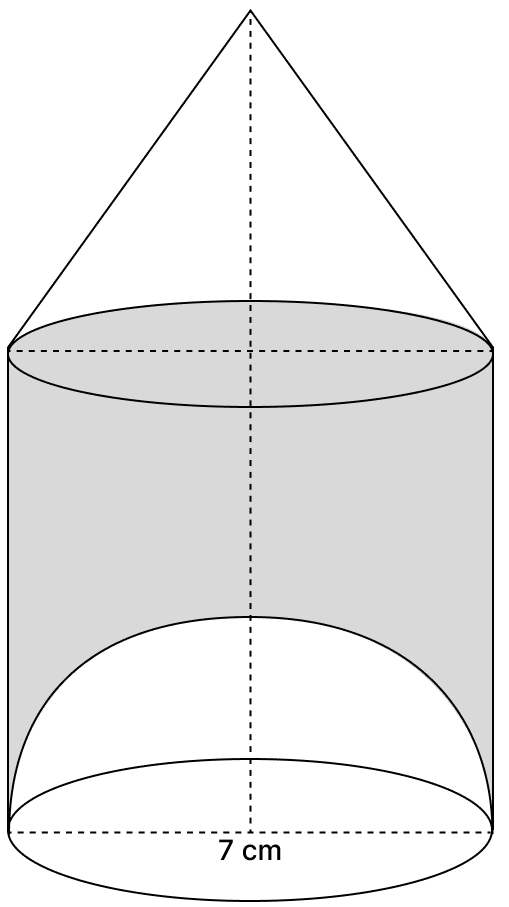
An eye drop bottle is prepared consisting of a hemisphere, a cylinder and a conical cap, as shown in the given diagram. Height of the cylindrical and conical parts are each, equal to the diameter (7 cm). Find the :

(a) minimum height of the cylindrical box required to pack this bottle.

(b) volume of the liquid medicine (shaded part) in the bottle. Give your answer to the nearest whole number. (Use π = $\frac{22}{7}$)

An eye drop bottle is prepared consisting of a hemisphere, a cylinder and a conical cap, as shown in the given diagram. Height of the cylindrical and conical parts are each, equal to the diameter (7 cm). Find the. ICSE 2026 Maths Solved Question Paper.
Show SolutionHide Solution↓

(a) Given,

Height of the cylindrical and conical parts = 7 cm

Minimum height of the cylindrical box required to pack this bottle = Height of cylindrical part + Height of conical part = 7 + 7 = 14 cm.

Hence, minimum height of the cylindrical box required to pack this bottle = 14 cm.

(b) From figure,

Diameter of cylindrical part = 7 cm

Radius of cylindrical part (r) = $\frac{7}{2}$ = 3.5 cm

Volume of Hemisphere = $\frac{2}{3}πr^3$

= $\frac{2}{3} \times \frac{22}{7} \times (3.5)^3$

= $\frac{2}{3} \times \frac{22}{7} \times 42.875$

= 89.83 cm3

Volume of cylinder = πr2h

= $\frac{22}{7} \times (3.5)^2 \times 7$

= 22 × 12.25

= 269.5 cm3

Total volume of liquid medicine (shaded part) = Volume of cylinder - Volume of hemisphere

= 269.5 - 89.83

= 179.67 ≈ 180 cm3

Hence, volume of liquid medicine = 180 cm3.

3(iii)1 Mark · 2026 · Section A · 2026 PaperFull page

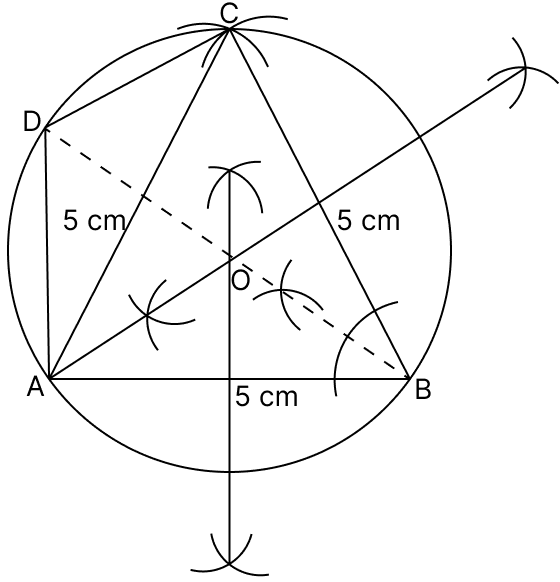
Use ruler and compass for the following construction:

(a) construct an equilateral triangle ABC of side 5 cm.

(b) construct the circumcircle of ΔABC.

(c) construct the locus of points which are equidistant from AB and BC. Mark the point where the circumcircle and locus meet, as D.

(d) give the geometrical name of quadrilateral ABCD.

Show SolutionHide Solution↓
Use ruler and compass for the following construction. ICSE 2026 Maths Solved Question Paper.

Steps of construction :

  1. Draw a line segment AB = 5 cm.

  2. At point A with radius = 5 cm draw an arc.

  3. At point B with radius = 5 cm draw another arc, cutting previous arc at point C.

  4. Join AC and BC.

  5. Construct perpendicular bisectors of AB and BC, let the bisectors meet at point O.

  6. With O as centre and OA as radius draw a circumcircle.

  7. Construct angle bisector of ∠ABC, mark the point as D where angle bisector intersects circumcircle.

  8. Join AD and CD.

Since, points A, B, C and D lie on the circumcircle, thus ABCD is a cyclic quadrilateral.

Hence, ABCD is a cyclic quadrilateral.

4(i)Written · 2026 · Section B · 2026 PaperFull page

Prove that :

(sec θ − cos θ)(cosec θ − sin θ) = sin θ cos θ

Show SolutionHide Solution↓

Solving,

$$\begin{aligned}\Rightarrow \Big(\frac{1}{\cos θ} - \cos θ\Big) \Big(\frac{1}{\sin θ} - \sin θ\Big) \\[1em] \Rightarrow \Big(\frac{1 - \cos^2 θ}{\cos θ}\Big) \Big(\frac{1 - \sin^2 θ}{\sin θ}\Big) \\[1em] \Rightarrow \Big(\frac{\sin^2 θ}{\cos θ}\Big) \Big(\frac{\cos^2 θ}{\sin θ}\Big) \\[1em] \Rightarrow \sin θ \cos θ.\end{aligned}$$

Hence, proved (sec θ − cos θ)(cosec θ − sin θ) = sin θ cos θ.

4(ii)Written · 2026 · Section B · 2026 PaperFull page

The cost price of a TV set is ₹ 20,000. The shopkeeper marked it for ₹ 24,000. He sells it to a customer at a discount of 10% on the marked price. If the sale is intra-state and the rate of GST is 12%, find the:

(a) discounted price of the TV set.

(b) amount paid by the customer to clear the bill.

Show SolutionHide Solution↓

(a) Given,

Cost price of T.V. = ₹ 20,000

Marked price = ₹ 24,000

Discount = 10%

GST = 12%

Discount provided by shopkeeper = 10% of ₹ 24,000

= $\frac{10}{100} \times 24000$

= ₹ 2,400

Discounted price of the TV set = ₹ 24,000 - ₹ 2,400 = ₹ 21,600

Hence, discounted price of the TV set = ₹ 21,600.

(b) GST = 12% of 21,600

= $\frac{12}{100} \times 21600$

= ₹ 2,592

Total amount paid by customer = ₹ 21,600 + ₹ 2,592 = ₹ 24,192

Hence, amount paid by customer = ₹ 24,192.

4(iii)Written · 2026 · Section B · 2026 PaperFull page

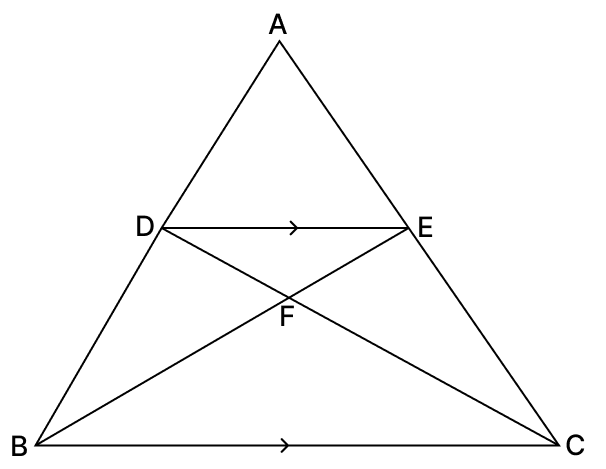
In the given diagram, DE || BC and AD : DB = 2 : 3.

(a) Prove that : ΔADE ~ ΔABC and hence find DE : BC.

(b) Prove : ΔDFE ~ ΔCFB

(c) Given, area of ΔDFE = 16 square units, find the area of ΔCFB.

In the given diagram, DE || BC and AD : DB = 2 : 3. ICSE 2026 Maths Solved Question Paper.
Show SolutionHide Solution↓

(a) Given,

DE ∥ BC

In triangle △ADE and △ABC,

∠ADE = ∠ABC (Corresponding angles are equal)

∠AED = ∠ACB (Corresponding angles are equal)

Therefore, △ADE ∼ △ABC (By AA similarity)

Given,

AD : DB = 2 : 3

Let AD = 2x and DB = 3x.

From figure,

AB = AD + DB = 2x + 3x = 5x.

We know that,

Corresponding sides of similar triangle are in proportion.

$\frac{DE}{BC} = \frac{AD}{AB} = \frac{2x}{5x} = \frac{2}{5}$.

DE : BC = 2 : 5.

Hence, proved ΔADE ~ ΔABC and DE : BC = 2 : 5.

(b) Given,

DE ∥ BC

In triangle ΔDFE and ΔCFB,

∠DFE = ∠CFB (Vertically opposite angles are equal)

∠DEF = ∠CBF (Alternate interior angles are equal)

ΔDFE ~ ΔCFB [By AA similarity]

Hence, proved that ΔDFE ~ ΔCFB.

(c) Let area of ΔCFB be x square units.

We know that,

The areas of two similar triangles are proportional to the squares of their corresponding sides.

$$\begin{aligned}\Rightarrow \frac{\text{Area of Δ DFE}}{\text{Area of Δ CFB}} = \Big(\frac{DE}{BC}\Big)^2 \\[1em] \Rightarrow \frac{\text{Area of Δ DFE}}{\text{Area of Δ CFB}} = \Big(\frac{2}{5}\Big)^2 \\[1em] \Rightarrow \frac{\text{Area of Δ DFE}}{\text{Area of Δ CFB}} = \frac{4}{25} \\[1em] \Rightarrow \frac{16}{x} = \frac{4}{25} \\[1em] \Rightarrow x = \frac{16 \times 25}{4} \\[1em] \Rightarrow x = \frac{400}{4} \\[1em] \Rightarrow x = 100.\end{aligned}$$

Hence, area of △CFB = 100 sq.units.

5(i)Written · 2026 · Section B · 2026 PaperFull page

The histogram drawn on the graph represents the number of students of different heights (in cm).

Using the graph, answer the following :

(a) the number of students whose height is 150 cm and above.

(b) the modal height.

(c) the total number of students.

The histogram drawn on the graph represents the number of students of different heights (in cm). ICSE 2026 Maths Solved Question Paper.
Show SolutionHide Solution↓

(a) From graph,

Students whose height is 150 cm and above :

150 - 160 = 9 students

160 - 170 = 4 students

Total number of students whose height is 150 cm and above = 9 + 4 = 13

Hence, number of students whose height is 150 cm and above = 13.

(b) From graph,

The vertical line intersects the x-axis at 137.

Hence, the modal height = 137 cm.

(c) Total number of students = 6 + 2 + 9 + 14 + 12 + 9 + 4 = 56.

Hence, total number of students = 56.

5(ii)Written · 2026 · Section B · 2026 PaperFull page

A(−10, −2) and B(2, 10) are two end points of a line segment. If AB intersects the x-axis at P, find the :

(a) ratio in which ‘P’ divides AB.

(b) coordinates of point P.

Show SolutionHide Solution↓

(a) Let point at which AB intersects x-axis be P(x, 0) and P divides AB in the ratio m : n.

Using section formula,

y = $\frac{my_2 + ny_1}{m + n}$

Substituting values we get :

$$\begin{aligned}\Rightarrow 0 = \frac{m \times 10 + n \times -2}{m + n} \\[1em] \Rightarrow 0 = \frac{10m - 2n}{m + n} \\[1em] \Rightarrow 10m - 2n = 0 \\[1em] \Rightarrow 10m = 2n \\[1em] \Rightarrow \frac{m}{n} = \frac{2}{10} \\[1em] \Rightarrow \frac{m}{n} = \frac{1}{5} \\[1em] \Rightarrow m : n = 1 : 5.\end{aligned}$$

Hence, P divides AB in the ratio 1 : 5.

(b) Using section formula,

x = $\frac{mx_2 + nx_1}{m + n}$

Substituting values we get :

$$\begin{aligned}\Rightarrow x = \frac{1 \times 2 + 5 \times -10}{1 + 5} \\[1em] \Rightarrow x = \frac{2 - 50}{6} \\[1em] \Rightarrow x = \frac{-48}{6} \\[1em] \Rightarrow x = -8.\end{aligned}$$

P = (x, 0) = (-8, 0).

Hence, coordinates of point P are (−8, 0).

5(iii)Written · 2026 · Section B · 2026 PaperFull page

Solve the quadratic equation (x − 2)2 − 5x − 3 = 0 and give your answer correct to 3 significant figures.

Show SolutionHide Solution↓

Given,

⇒ (x − 2)2 − 5x − 3 = 0

⇒ x2 - 4x + 4 − 5x − 3 = 0

⇒ x2 - 9x + 1 = 0

Comparing x2 - 9x + 1 = 0 with ax2 + bx + c = 0 , we get :

a = 1, b = -9 and c = 1

By formula,

$$\begin{aligned}\Rightarrow x = \frac{-b \pm \sqrt{b^2 - 4ac}}{2a} \\[1em] \Rightarrow x = \frac{-(-9) \pm \sqrt{(-9)^2 - 4(1)(1)}}{2(1)} \\[1em] \Rightarrow x = \frac{9 \pm \sqrt{81 - 4}}{2} \\[1em] \Rightarrow x = \frac{9 \pm \sqrt{77}}{2} \\[1em] \Rightarrow x = \frac{9 \pm 8.775}{2} \\[1em] \Rightarrow x = \frac{9 + 8.775}{2} \text{ or } \frac{9 - 8.775}{2} \\[1em] \Rightarrow x = \frac{17.775}{2} \text{ or } \frac{0.225}{2} \\[1em] \Rightarrow x = 8.8875 \text{ or } 0.1125 \\[1em] \Rightarrow x = 8.89 \text{ or } 0.113\end{aligned}$$

Hence, x = 8.89 or 0.113.

6(i)Written · 2026 · Section B · 2026 PaperFull page

Kabir bought 120 shares of a company with nominal value ₹100, available at a premium of ₹25. Find :

(a) the money invested by Kabir in buying these shares.

(b) the rate of dividend, if he received ₹ 1,080 as dividend from these shares after one year.

(c) his rate of return.

Show SolutionHide Solution↓

(a) Given,

Number of shares = 120

Nominal value = ₹ 100

Premium = ₹ 25

Market price per share = ₹100 + ₹25 = ₹125

Total money invested by Kabir = Number of shares × Market price per share

= 120 × 125 = ₹ 15,000.

Hence, the money invested by Kabir = ₹ 15,000.

(b) Given,

Total dividend = ₹ 1080

Let rate of dividend be R.

By formula,

Dividend = No. of shares × $\frac{\text{Rate of dividend}}{100}$ × N.V. of share

1080 = 120 × $\frac{R}{100}$ × 100

1080 = 120 × R

R = $\frac{1080}{120}$

R = 9%.

Hence, rate of dividend = 9%.

(c) Given,

Investment = ₹ 15,000

Rate of return = $\frac{\text{Total dividend}}{\text{Total investment}}$ x 100

= $\frac{1080}{15000} \times 100$

= 7.2%.

Hence, rate of return = 7.2%.

6(ii)Written · 2026 · Section B · 2026 PaperFull page

Find the mean of the following frequency distribution using step-deviation method.

Take assumed mean = 28

Class intervalFrequency
0 - 810
8 - 1620
16 - 2414
24 - 3216
32 - 4018
40 - 4822
Show SolutionHide Solution↓

Here, i = class size = 8 and assumed mean (A) = 28.

Class IntervalFrequency (f)Class mark (x)d = x - At = (x - A)/ift
0 - 8104-24-3-30
8 - 162012-16-2-40
16 - 241420-8-1-14
24 - 321628000
32 - 4018368118
40 - 48224416244
Total∑f = 100∑ft = -22

By formula,

Mean = $A + \Big(\frac{\sum ft}{\sum f} \Big) \times i$

= 28 + $\Big(-\frac{22}{100}\Big) \times 8$

= 28 + 8(-0.22)

= 28 - 1.76

= 26.24

Hence, mean = 26.24

6(iii)Written · 2026 · Section B · 2026 PaperFull page

The difference of two natural numbers is 5 and sum of their reciprocals is $\frac{3}{10}$. Find the two numbers.

Show SolutionHide Solution↓

Let the two natural numbers be: x and x + 5

Given,

The sum of the reciprocals of two numbers is $\frac{3}{10}$.

$$\begin{aligned}\Rightarrow \frac{1}{x} + \frac{1}{x + 5} = \frac{3}{10} \\[1em] \Rightarrow \frac{x + 5 + x}{x(x + 5)} = \frac{3}{10} \\[1em] \Rightarrow \frac{2x + 5}{x(x + 5)} = \frac{3}{10} \\[1em] \Rightarrow 10(2x + 5) = 3[x(x + 5)] \\[1em] \Rightarrow 20x + 50 = 3x^2 + 15x \\[1em] \Rightarrow 3x^2 + 15x - 20x - 50 = 0 \\[1em] \Rightarrow 3x^2 - 5x - 50 = 0 \\[1em] \Rightarrow 3x^2 + 10x - 15x - 50 = 0 \\[1em] \Rightarrow x(3x + 10) - 5(3x + 10) = 0 \\[1em] \Rightarrow (x - 5)(3x + 10) = 0 \\[1em] \Rightarrow (x - 5) = 0 \text{ or } (3x + 10) = 0 \\[1em] \Rightarrow x = 5 \text{ or } 3x = -10 \\[1em] \Rightarrow x = 5 \text{ or } x = -\frac{10}{3}\end{aligned}$$

Since, the numbers are natural numbers, thus x cannot be negative.

Thus, x = 5 and x + 5 = 5 + 5 = 10.

Hence, numbers are 5 and 10.

7(i)Written · 2026 · Section B · 2026 PaperFull page

A flagpole is erected at the top of a building. The angle of elevation of the top and foot of the flagpole from a point 100 m away, on the same level as that of the foot of the building, are 33° and 31° respectively. Find the height of the flagpole. Give your answer correct to the nearest metre.

A flagpole is erected at the top of a building. The angle of elevation of the top and foot of the flagpole from a point 100 m away, on the same level as that of the foot of the building, are 33° and 31° respectively. Find the height of the flagpole. Give your answer correct to the nearest metre. ICSE 2026 Maths Solved Question Paper.
Show SolutionHide Solution↓

Let height of building (BC) be h meters and height of flagpole (CD) be x meters.

Distance from point = 100 m

In triangle ABC,

$$\begin{aligned}\Rightarrow \tan 31° = \frac{BC}{AB} \\[1em] \Rightarrow \tan 31° = \frac{h}{100} \\[1em] \Rightarrow 0.6009 = \frac{h}{100} \\[1em] \Rightarrow h = 0.6009 \times 100 \\[1em] \Rightarrow h = 60.09 m\end{aligned}$$

In triangle ADB,

$$\begin{aligned}\Rightarrow \tan 33° = \frac{DB}{AB} \\[1em] \Rightarrow \tan 33° = \frac{h + x}{100} \\[1em] \Rightarrow h + x = 0.6494 \times 100 \\[1em] \Rightarrow h + x = 64.94 \\[1em] \Rightarrow 60.09 + x = 64.94 \\[1em] \Rightarrow x = 64.94 - 60.09 \\[1em] \Rightarrow x = 4.85 \text{ m} \approx 5 \text{ m}.\end{aligned}$$

Hence, the height of flagpole = 5 m.

7(ii)Written · 2026 · Section B · 2026 PaperFull page

Using a graph paper, draw an ogive for the following distribution which shows a record of weight in kilograms of 100 students.

Weight (in kg)Number of students
35 – 404
40 – 456
45 – 5010
50 – 5524
55 – 6026
60 – 6517
65 – 708
70 – 755

Use your ogive to estimate the following:

(a) the median weight of the students.

(b) percentage of students whose weight is 60 kg or more.

(c) the weight above which 20% of the students lie.

Show SolutionHide Solution↓

The cumulative frequency table for the given continuous distribution is :

Weight (in kg)Number of studentsCumulative frequency
35 – 4044
40 – 45610
45 – 501020
50 – 552444
55 – 602670
60 – 651787
65 – 70895
70 – 755100
Using a graph paper, draw an ogive for the following distribution which shows a record of weight in kilograms of 100 students. ICSE 2026 Maths Solved Question Paper.

(a) Steps of Construction :

  1. Since, the scale on x-axis starts at 35, a break (kink) is shown near the origin on x-axis to indicate that the graph is drawn to scale beginning at 35.

  2. Take 1 cm along x-axis = 5 kg (weight)

  3. Take 1 cm along y-axis = 10 (students)

  4. Plot the points (40, 4), (45, 10), (50, 20), (55, 44), (60, 70), (65, 87), (70, 95), (75, 100) representing upper class limits and the respective cumulative frequencies. Also plot the point representing lower limit of the first class i.e. 35 - 40.

  5. Join these points by a freehand drawing.

The required ogive is shown in figure above.

Here, n (no. of students) = 100.

To find the median :

Let B be the point on y-axis representing frequency = $\frac{n}{2} = \frac{100}{2} = 50$.

Through B draw a horizontal line to meet the ogive at Q. Through Q, draw a vertical line to meet the x-axis at N. The abscissa of the point N represents .

From graph, N = 56

Hence, the median weight = 56 kg.

(b) Percentage of students whose weight is 60 kg or more.

Let O be the point on x-axis representing weight = 60.

Through O draw a vertical line to meet the ogive at R. Through R, draw a horizontal line to meet the y-axis at C. The ordinate of the point C represents .

From graph,

C = 70

Students weighing more than 60 kg = 100 - 70 = 30.

Percentage of students weighing more than 60 kg = $\frac{30}{100} \times 100$ = 30%

Hence, students weighing more than 60 kg = 30%.

(c) The weight above which 20% of the students lie.

Total number of students = 100

20% of students = $\frac{20}{100}$ × 100 = 20.

So, 80 students are below that weight.

Let P be the point on y-axis representing number of students = 80.

Through P draw a horizontal line to meet the ogive at T. Through T, draw a vertical line to meet the x-axis at S. The ordinate of the point S represents weight above which 20% of the students lie.

From graph,

S = 63

Hence, weight above which 20% students lie = 63 kg.

8(i)Written · 2026 · Section B · 2026 PaperFull page

Rohit and Vinay both opened a recurring deposit account in a bank for 2 years at 8% simple interest. Vinay deposited ₹ 300 per month. On maturity, Rohit’s interest was ₹ 800 more than Vinay’s interest. Find:

(a) interest earned by Vinay.

(b) sum deposited by Rohit every month.

Show SolutionHide Solution↓

(a) Time = 2 years = 24 months

r = 8%

P = ₹ 300 for Vinay

By formula,

I = $\frac{P \times n(n + 1)}{2} \times \frac{r}{12 \times 100}$

Substituting values, we get :

$$\begin{aligned}\Rightarrow I = \frac{300 \times 24(24 + 1)}{2} \times \frac{8}{1200} \\[1em] = \frac{300 \times 24(25)}{2} \times \frac{8}{1200} \\[1em] = 300 \times 300 \times \frac{8}{1200} \\[1em] = 300 \times 2 \\[1em] = ₹ 600.\end{aligned}$$

Hence, interest earned by Vinay = ₹ 600.

(b) Rohit’s interest is ₹800 more than Vinay’s.

Interest earned by Rohit = ₹600 + ₹800 = ₹1400.

Let Rohit deposit ₹P per month.

By formula,

I = $\frac{P \times n(n + 1)}{2} \times \frac{r}{12 \times 100}$

Substituting values, we get :

$$\begin{aligned}\Rightarrow I = \frac{P \times 24(24 + 1)}{2} \times \frac{8}{1200} \\[1em] \Rightarrow 1400 = P \times 300 \times \frac{8}{1200} \\[1em] \Rightarrow 1400 = 2P \\[1em] \Rightarrow P = \frac{1400}{2} = ₹ 700.\end{aligned}$$

Hence, Rohit deposits ₹700 per month.

8(ii)Written · 2026 · Section B · 2026 PaperFull page

The fourth term of a Geometric Progression (G.P.) is 16 and its seventh term is 128. Find its:

(a) common ratio

(b) first term

Show SolutionHide Solution↓

(a) We know that,

an = arn - 1

Given,

a4 = ar3 = 16 ....(1)

a7 = ar6 = 128 .....(2)

Dividing equation (2) by equation (1), we get :

$$\begin{aligned}\Rightarrow \frac{ar^6}{ar^3} = \frac{128}{16} \\[1em] \Rightarrow r^3 = 8 \\[1em] \Rightarrow r = \sqrt[3]{8} = 2.\end{aligned}$$

Hence, common ratio = 2.

(b) The first term,

Substituting r = 2 in equation (1), we get :

⇒ a(2)3 = 16

⇒ a(8) = 16

⇒ a = $\frac{16}{8}$

⇒ a = 2.

Hence, first term = 2.

8(iii)Written · 2026 · Section B · 2026 PaperFull page

Use graph sheet for this question. Take 2 cm = 1 unit along both x and y axis. Graphically represent parallelogram OABC, where O(0, 0), A(2, 3), B(5, 3) and C(3, 0).

Reflect OABC :

(a) on the x-axis and name its image as ODEC.

(b) through the origin and name its image as OIJH.

(c) on the y-axis and name its image as OFGH.

Show SolutionHide Solution↓

(a) The point O(0, 0), A(2, 3), B(5, 3) and C(3, 0) are plotted on the graph below :

Use graph sheet for this question. Take 2 cm = 1 unit along both x and y axis. Graphically represent parallelogram OABC, where O(0, 0), A(2, 3), B(5, 3) and C(3, 0). ICSE 2026 Maths Solved Question Paper.

From graph, on reflecting O, A, B, C on x-axis we get,

O(0, 0) ⇒ O(0, 0)

A(2, 3) ⇒ D(2, -3)

B(5, 3) ⇒ E(5, -3)

C(3, 0) ⇒ C(3, 0)

(b) From graph, on reflecting O, A, B, C trough origin we get,

O(0, 0) ⇒ O(0, 0)

A(2, 3) ⇒ I(-2, -3)

B(5, 3) ⇒ J(-5, -3)

C(3, 0) ⇒ H(-3, 0)

(c) From graph, on reflecting O, A, B, C on y-axis we get,

O(0, 0) ⇒ O(0, 0)

A(2, 3) ⇒ F(-2, 3)

B(5, 3) ⇒ G(-5, 3)

C(3, 0) ⇒ H(-3, 0)

9(i)Written · 2026 · Section B · 2026 PaperFull page

Solve the following inequation, write the solution set and represent it on the real number line.

$-1 \lt \frac{2x - 3}{3} - \frac{x}{5} \le 1, x \in R$

Show SolutionHide Solution↓
Solve the following inequation, write the solution set and represent it on the real number line. ICSE 2026 Maths Solved Question Paper.

Given,

$-1 \lt \frac{2x - 3}{3} - \frac{x}{5} \le 1, x \in R$

Solving L.H.S of the inequation,

$$\begin{aligned}\Rightarrow -1 \lt \frac{2x - 3}{3} - \frac{x}{5} \\[1em] \Rightarrow -1 \lt \frac{10x - 15 - 3x}{15} \\[1em] \Rightarrow -1 \lt \frac{7x - 15}{15} \\[1em] \Rightarrow -15 \lt 7x - 15 \\[1em] \Rightarrow -15 + 15 \lt 7x \\[1em] \Rightarrow 0 \lt 7x \\[1em] \Rightarrow x \gt 0.\end{aligned}$$

Solving R.H.S of the inequation,

$$\begin{aligned}\Rightarrow \frac{2x - 3}{3} - \frac{x}{5} \le 1 \\[1em] \Rightarrow \frac{10x - 15 - 3x}{15} \le 1 \\[1em] \Rightarrow \frac{7x - 15}{15} \le 1 \\[1em] \Rightarrow 7x - 15 \le 15 \\[1em] \Rightarrow 7x \le 15 + 15 \\[1em] \Rightarrow 7x \le 30 \\[1em] \Rightarrow x \le \frac{30}{7}.\end{aligned}$$

∴ 0 < x ≤ $\frac{30}{7}$

Solution set = $\Big(0, \frac{30}{7}\Big]$

Hence, solution set = $\Big(0, \frac{30}{7}\Big]$.

9(ii)Written · 2026 · Section B · 2026 PaperFull page

Use the following graph and answer the given questions :

(a) Write the co-ordinates of points A, B and C.

(b) Find the equation of a line passing through the mid-point of AC and parallel to AB.

Use the following graph and answer the given questions. ICSE 2026 Maths Solved Question Paper.
Show SolutionHide Solution↓

(a) From graph,

Coordinates of :

A(4, 8), B(-1, 2), C(6, 2)

Hence, A(4, 8), B(-1, 2), C(6, 2).

(b) Midpoint of AC,

By formula,

Midpoint = $\Big(\frac{x_1 + x_2}{2}, \frac{y_1 + y_2}{2}\Big)$

Substituting values, we get :

Mid-point of AC = $\Big(\frac{4 + 6}{2}, \frac{8 + 2}{2}\Big)$ = (5, 5).

By formula,

Slope = $\frac{y_2 - y_1}{x_2 - x_1}$

Thus,

Slope of AB = $\frac{8 - 2}{4 - (-1)}$

= $\frac{6}{5}$.

Since, slope of parallel lines are equal, thus slope of required line (m) = $\frac{6}{5}$.

By point-slope form,

Equation : y - y1 = m(x - x1)

Equation of line parallel to AB and passing through mid-point of AC is given by,

⇒ y - 5 = $\frac{6}{5}(x - 5)$

⇒ 5(y - 5) = 6(x - 5)

⇒ 5y - 25 = 6x - 30

⇒ 5y - 25 + 30 = 6x - 30

⇒ 5y - 5 = 6x

⇒ 6x - 5y - 5 = 0.

Hence, equation of required line = 6x - 5y - 5 = 0.

9(iii)Written · 2026 · Section B · 2026 PaperFull page

A solid wooden toy is prepared by joining a cone, a cylinder and a sphere, as shown in the given diagram. The radius of each of the three solids is 7 cm and heights of each of the cone and the cylinder is 24 cm. Find :

(a) the total surface area of the given solid.

(b) the cost of painting the total surface at the rate of ₹ 0.50 per cm2.

A solid wooden toy is prepared by joining a cone, a cylinder and a sphere, as shown in the given diagram. The radius of each of the three solids is 7 cm and heights of each of the cone and the cylinder is 24 cm. Find. ICSE 2026 Maths Solved Question Paper.
Show SolutionHide Solution↓

(a) Given,

Radius of each solid (r) = 7 cm

Height of cone = Height of cylinder = h = 24 cm

Let slant height of cone be l.

By formula,

$$\begin{aligned}l = \sqrt{r^2 + h^2} \\[1em] = \sqrt{7^2 + 24^2} \\[1em] = \sqrt{49 + 576} \\[1em] = \sqrt{625} \\[1em] = 25.\end{aligned}$$

Total surface area of sphere = 4πr2

= 4 × $\frac{22}{7}$ × 72

= 616 cm2.

Total surface area of cylinder = 2πr(h + r)

= 2 × $\frac{22}{7}$ × 7 × (24 + 7)

= 2 × 22 × 31

= 1364 cm2.

Total surface area of cone = πr(r + l)

= $\frac{22}{7}$ × 7 × (7 + 25)

= 22 × 32

= 704 cm2

Total surface area of toy = Total surface area of (sphere + cylinder + cone)

= 616 + 1364 + 704

= 2684 cm2.

Hence, total surface area of toy = 2684 cm2.

(b) Given,

Cost of painting = ₹ 0.50 per cm2.

The cost of painting the total surface = 2684 × ₹ 0.50 = ₹ 1,342

Hence, total cost of painting = ₹ 1,342.

10(i)Written · 2026 · Section B · 2026 PaperFull page

If $x = \frac{5ab}{a - b}$, a ≠ b,

(a) Find : $\frac{x}{a}$

(b) Using properties of proportion, find: $\frac{x + a}{x - a}$

Show SolutionHide Solution↓

(a) Given,

$x = \frac{5ab}{a - b}$

Multiplying $\frac{1}{a}$ on both sides of equation :

$$\begin{aligned}\Rightarrow \frac{x}{a} = \frac{1}{a} \Big(\frac{5ab}{a - b}\Big) \\[1em] \Rightarrow \frac{x}{a} = \frac{5b}{a - b}.\end{aligned}$$

Hence, $\frac{x}{a} = \frac{5b}{a - b}.$

(b) Since,

$\frac{x}{a} = \frac{5b}{a - b}$

Applying componendo and dividendo, we get :

$$\begin{aligned}\Rightarrow \frac{x + a}{x - a} = \frac{5b + (a - b)}{5b - (a - b)} \\[1em] \Rightarrow \frac{x + a}{x - a} = \frac{a + 4b}{6b - a}.\end{aligned}$$

Hence, $\frac{x + a}{x - a} = \frac{a + 4b}{6b - a}.$

10(ii)Written · 2026 · Section B · 2026 PaperFull page

A survey was conducted on 300 families having 2 children each. The results obtained are given below.

Number of girl childNumber of families
295
1165
040
Total300

If one family is selected at random, find the probability that it will have:

(a) one girl child

(b) one or more girl child

(c) no boy child

Show SolutionHide Solution↓

(a) Total number of families = 300

Let E be the event of selecting family with one girl child,

∴ Number of favorable outcomes = 165

P(E) = $\frac{\text{Number of favorable outcomes}}{\text{Total number of outcomes}} = \frac{165}{300} = \frac{11}{20}.$

Hence, probability of selecting family with one girl child = $\frac{11}{20}.$

(b) Let A be the event of selecting family with one or more girl child,

∴ Number of favorable outcomes = 165 + 95 = 260

P(A) = $\frac{\text{Number of favorable outcomes}}{\text{Total number of outcomes}} = \frac{260}{300} = \frac{13}{15}.$

Hence, probability of selecting family with one or more girl child = $\frac{13}{15}.$

(c) Let B be the event of selecting family with no boy child.

A family will have no boy child, if there are 2 girl child in the family.

∴ Number of favorable outcomes = 95

P(B) = $\frac{\text{Number of favorable outcomes}}{\text{Total number of outcomes}} = \frac{95}{300} = \frac{19}{60}.$

Hence, probability of selecting family with no boy child = $\frac{19}{60}.$

10(iii)Written · 2026 · Section B · 2026 PaperFull page

In the given figure ‘O’ is the centre of the circle. PQ is a tangent to the circle at B and AB = AC. If ∠CBQ = 40°, find the unknown angles x, y, z and w.

In the given figure ‘O’ is the centre of the circle. PQ is a tangent to the circle at B and AB = AC. If ∠CBQ = 40°, find the unknown angles x, y, z and w. ICSE 2026 Maths Solved Question Paper.
Show SolutionHide Solution↓

Given,

∠CBQ = 40°

In a circle, the angle between a tangent and a chord through the point of contact is equal to the angle in the opposite (alternate) segment of the circle.

∠BAC = ∠CBQ = 40°

x = 40°

Since, AB = AC.

∠ABC = ∠BCA [Angles opposite to equal sides of a triangle are equal]

In triangle ABC,

∠ABC + ∠BAC + ∠BCA = 180°

2∠ABC + 40° = 180°

2∠ABC = 180° - 40°

2∠ABC = 140°

∠ABC = $\frac{140°}{2}$

∠ABC = 70°.

We know that,

The angle which an arc subtends at the center is double that which it subtends at any point on the remaining part of the circumference.

∠BOC = 2∠BAC

y = 2x

y = 80°.

In triangle OBC,

OB = OC (Radii of same circle)

∠OBC = ∠OCB (Angles opposite to equal sides in a triangle are equal)

By angle sum property of triangle,

∠OBC + ∠OCB + ∠BOC = 180°

2∠OBC + 80° = 180°

2∠OBC = 100°

∠OBC = 50°

From figure,

w = ∠ABC - ∠OBC = 70° - 50° = 20°.

We know that,

Sum of opposite angles of a cyclic quadrilateral is 180°.

In cyclic quadrilateral ABCD,

∠ABC + ∠ADC = 180°

70° + z = 180°

z = 180° - 70° = 110°.

Hence, x = 40°, y = 80°, z = 110°, w = 20°.

1(i)1 Mark · 2026 · Section A · 2026 ImprovementFull page

The marked price of a smart TV is ₹ 18,000. The rate of GST is 18%. The price paid by the customer for the smart TV is:

Show SolutionHide Solution↓

Given,

Marked price = ₹ 18,000

Rate of GST = 18%

GST = $\frac{18}{100} \times 18000$ = ₹ 3,240

Price paid by customer = Marked price + GST

= ₹ 18,000 + ₹ 3,240

= ₹ 21,240.

Hence, option 4 is the correct option.

1(ii)1 Mark · 2026 · Section A · 2026 ImprovementFull page

Two right circular cones, C1 and C2, have their heights in the ratio 2 : 1 and radii in the ratio 1 : 2. The ratio of their volumes is:

Two right circular cones, C 1 and C 2, have their heights in the ratio 2: 1 and radii in the ratio 1: 2. The ratio of their volumes is:. Improvement 2026, ICSE 2026 Improvement Maths Solved Question Paper.
Show SolutionHide Solution↓

Given,

Ratio of heights ($h_1 : h_2$) = 2 : 1

Ratio of radii ($r_1 : r_2$) = 1 : 2

By formula,

Volume of cone = $\frac{1}{3} \pi r^2 h$

$$\begin{aligned}\therefore \frac{V_1}{V_2} = \frac{\frac{1}{3} \pi r_1^2 h_1}{\frac{1}{3} \pi r_2^2 h_2} \\[1em] = \frac{r_1^2 h_1}{r_2^2 h_2} \\[1em] = \frac{1^2 \times 2}{2^2 \times 1} \\[1em] = \frac{2}{4} \\[1em] = \frac{1}{2}.\end{aligned}$$

Ratio of volumes = 1 : 2.

Hence, option 2 is the correct option.

1(iii)1 Mark · 2026 · Section A · 2026 ImprovementFull page

A person deposited ₹500 per month in a recurring deposit account for one year at $r$% per annum. The rate of interest is revised to $2r$%. The interest earned by the person compared to the original amount of interest will be:

Show SolutionHide Solution↓

By formula,

Interest = $P \times \frac{n(n + 1)}{2 \times 12} \times \frac{r}{100}$

In this formula, the interest is directly proportional to the rate of interest, as the principal (P) and the number of months ($n$) remain unchanged.

When the rate is revised from $r$% to $2r$%, the rate becomes double.

∴ The interest earned also becomes double.

Hence, option 4 is the correct option.

1(iv)1 Mark · 2026 · Section A · 2026 ImprovementFull page

A company declares 9% dividend on its shares of ₹100 available at ₹120. It means a person will receive annual dividend which is 9% of:

Show SolutionHide Solution↓

Dividend is always calculated on the face value (nominal value) of the shares.

Here, the face value of the share is ₹ 100.

∴ The person will receive an annual dividend which is 9% of the face value.

Hence, option 2 is the correct option.

1(v)1 Mark · 2026 · Section A · 2026 ImprovementFull page

The discriminant of the quadratic equation $2x^2 + 5x + c = 0$ is 1. The value of $c$ is:

Show SolutionHide Solution↓

Given,

Quadratic equation : $2x^2 + 5x + c = 0$

Comparing with $ax^2 + bx + c = 0$,

$a = 2, b = 5, c = c$

By formula,

Discriminant (D) = $b^2 - 4ac$

$$\begin{aligned}\Rightarrow 1 = 5^2 - 4 \times 2 \times c \\[1em] \Rightarrow 1 = 25 - 8c \\[1em] \Rightarrow 8c = 25 - 1 \\[1em] \Rightarrow 8c = 24 \\[1em] \Rightarrow c = 3.\end{aligned}$$

Hence, option 4 is the correct option.

1(vi)1 Mark · 2026 · Section A · 2026 ImprovementFull page

$(x + 3), (x + 6)$ and $(x + 10)$ are in continued proportion. The value of $x$ is:

Show SolutionHide Solution↓

Given,

$(x + 3), (x + 6)$ and $(x + 10)$ are in continued proportion.

We know that,

Three quantities $a, b$ and $c$ are said to be in continued proportion if the ratio of the first to the second is equal to the ratio of the second to the third.

i.e. $a : b = b : c$

$$\begin{aligned}\Rightarrow \frac{a}{b} = \frac{b}{c} \\[1em] \Rightarrow b^2 = ac.\end{aligned}$$

So, the square of the middle term is equal to the product of the first and the last terms.

Here,

$a = (x + 3), b = (x + 6)$ and $c = (x + 10)$

∴ $(x + 6)^2 = (x + 3)(x + 10)$

Expanding both sides,

$\Rightarrow x^2 + 12x + 36 = x^2 + 13x + 30$

Cancelling $x^2$ from both sides,

$\Rightarrow 12x + 36 = 13x + 30$

Transposing the like terms,

$$\begin{aligned}\Rightarrow 36 - 30 = 13x - 12x \\[1em] \Rightarrow 6 = x \\[1em] \Rightarrow x = 6.\end{aligned}$$

Hence, option 2 is the correct option.

1(vii)1 Mark · 2026 · Section A · 2026 ImprovementFull page

$(x – 1)$ is a factor of the polynomial $x^3 + 2x^2 – x – k$. The value of $k$ is:

Show SolutionHide Solution↓

Given,

$(x – 1)$ is a factor of $x^3 + 2x^2 – x – k$.

∴ On putting $x = 1$, the value of the polynomial is zero.

$$\begin{aligned}\Rightarrow (1)^3 + 2(1)^2 - (1) - k = 0 \\[1em] \Rightarrow 1 + 2 - 1 - k = 0 \\[1em] \Rightarrow 2 - k = 0 \\[1em] \Rightarrow k = 2.\end{aligned}$$

Hence, option 4 is the correct option.

1(viii)1 Mark · 2026 · Section A · 2026 ImprovementFull page

Matrix $$A = \begin{bmatrix} -1 & 2 \\ 3 & 0 \end{bmatrix}$$ and the Matrix $$mA = \begin{bmatrix} 3 & -6 \\ -9 & 0 \end{bmatrix}$$. The value of $m$ is:

Show SolutionHide Solution↓

Given,

$$mA = m\begin{bmatrix} -1 & 2 \\ 3 & 0 \end{bmatrix} = \begin{bmatrix} -m & 2m \\ 3m & 0 \end{bmatrix}$$

Comparing this with the given matrix $$\begin{bmatrix} 3 & -6 \\ -9 & 0 \end{bmatrix}$$,

$$\begin{aligned}\Rightarrow -m = 3\\[1em] \Rightarrow m = -3.\end{aligned}$$

Hence, option 2 is the correct option.

1(ix)1 Mark · 2026 · Section A · 2026 ImprovementFull page

The points A ($x$, 0), B (−1, −1) and C (0, $y$) are collinear. The value of $\frac{1}{x} + \frac{1}{y}$ is:

Show SolutionHide Solution↓

Given,

The points A ($x$, 0), B (−1, −1) and C (0, $y$) are collinear.

We know that,

Collinear points lie on the same straight line, so they cannot enclose a triangle.

∴ Area of the triangle formed by them = 0.

By formula,

Area of triangle = $\frac{1}{2}[x_1(y_2 - y_3) + x_2(y_3 - y_1) + x_3(y_1 - y_2)]$

Here,

$$\begin{aligned}\Rightarrow x_1 = x, y_1 = 0 \\[1em] \Rightarrow x_2 = −1, y_2 = −1 \\[1em] \Rightarrow x_3 = 0, y_3 = y\end{aligned}$$

Substituting values we get :

$\Rightarrow \frac{1}{2}[x(-1 - y) + (-1)(y - 0) + 0(0 - (-1))] = 0$

Multiplying both sides by 2,

$$\begin{aligned}\Rightarrow x(-1 - y) + (-1)(y - 0) + 0(0 - (-1)) = 0 \\[1em] \Rightarrow -x - xy - y + 0 = 0 \\[1em] \Rightarrow -(x + y + xy) = 0 \\[1em] \Rightarrow x + y + xy = 0 \\[1em] \Rightarrow x + y = -xy.\end{aligned}$$

Since $\frac{1}{x} + \frac{1}{y}$ is required, we divide both sides by $xy$ (where $x ≠ 0$ and $y ≠ 0$),

$$\begin{aligned}\Rightarrow \frac{x + y}{xy} = \frac{-xy}{xy} \\[1em] \Rightarrow \frac{x}{xy} + \frac{y}{xy} = -1 \\[1em] \Rightarrow \frac{1}{y} + \frac{1}{x} = -1 \\[1em] \Rightarrow \frac{1}{x} + \frac{1}{y} = -1.\end{aligned}$$

Hence, option 1 is the correct option.

1(x)1 Mark · 2026 · Section A · 2026 ImprovementFull page

In the given diagram, PQ // BC and ar∆APQ = ar quad BPQC. The value of AP : PB is:

In the given diagram, PQ // BC and ar∆APQ = ar quad BPQC. The value of AP: PB is:. Improvement 2026, ICSE 2026 Improvement Maths Solved Question Paper.
Show SolutionHide Solution↓

Given,

PQ // BC and ar ∆APQ = ar quad BPQC.

From figure,

ar ∆ABC = ar ∆APQ + ar quad BPQC = ar ∆APQ + ar ∆APQ = 2 ar ∆APQ.

$\Rightarrow \frac{\text{ar ∆APQ}}{\text{ar ∆ABC}} = \frac{1}{2}$

In ∆APQ and ∆ABC,

⇒ ∠PAQ = ∠BAC [Common]

⇒ ∠APQ = ∠ABC [Corresponding angles as PQ // BC]

∴ ∆APQ ~ ∆ABC (By A.A. axiom)

We know that,

The ratio of areas of similar triangles is equal to the ratio of the squares of their corresponding sides.

$$\begin{aligned}\therefore \frac{\text{ar ∆APQ}}{\text{ar ∆ABC}} = \frac{AP^2}{AB^2} \\[1em] \Rightarrow \frac{1}{2} = \frac{AP^2}{AB^2} \\[1em] \Rightarrow \frac{AP}{AB} = \frac{1}{\sqrt{2}}.\end{aligned}$$

Let AP = $k$, then AB = $\sqrt{2}k$.

$$\begin{aligned}\Rightarrow PB = AB - AP = \sqrt{2}k - k = (\sqrt{2} - 1)k \\[1em] \Rightarrow \frac{AP}{PB} = \frac{k}{(\sqrt{2} - 1)k} = \frac{1}{\sqrt{2} - 1}.\end{aligned}$$

Rationalizing the denominator,

$\Rightarrow \frac{AP}{PB} = \frac{1}{\sqrt{2} - 1} \times \frac{\sqrt{2} + 1}{\sqrt{2} + 1} = \frac{\sqrt{2} + 1}{2 - 1} = \frac{\sqrt{2} + 1}{1}.$

AP : PB = $(\sqrt{2} + 1)$ : 1.

Hence, option 4 is the correct option.

1(xi)1 Mark · 2026 · Section A · 2026 ImprovementFull page

In the given diagram, PA and PB are the tangents to the circle with centre O, such that PA = PB = AB. The value of ∠ACB is:

In the given diagram, PA and PB are the tangents to the circle with centre O, such that PA = PB = AB. The value of ∠ACB is:. Improvement 2026, ICSE 2026 Improvement Maths Solved Question Paper.
Show SolutionHide Solution↓

Given,

PA = PB = AB.

Since all three sides of ∆PAB are equal, ∆PAB is an equilateral triangle.

∴ ∠APB = 60°.

We know that,

Radius is perpendicular to the tangent at the point of contact.

∴ ∠OAP = ∠OBP = 90°.

In quadrilateral OAPB,

⇒ ∠AOB + ∠OAP + ∠APB + ∠OBP = 360°

⇒ ∠AOB + 90° + 60° + 90° = 360°

⇒ ∠AOB = 360° - 240° = 120°.

We know that,

The angle subtended by an arc at the centre is twice the angle subtended by it at any point on the remaining part of the circle.

$\Rightarrow \angle \text{ ACB }= \frac{1}{2} \angle \text{ AOB }= \frac{1}{2} \times 120° = 60°.$

Hence, option 3 is the correct option.

1(xii)1 Mark · 2026 · Section A · 2026 ImprovementFull page

A semi-circular sheet of paper having radius 7 cm is folded to form a right circular cone, as shown in the diagram. The slant height of the cone so formed is:

A semi-circular sheet of paper having radius 7 cm is folded to form a right circular cone, as shown in the diagram. The slant height of the cone so formed is:. Improvement 2026, ICSE 2026 Improvement Maths Solved Question Paper.
Show SolutionHide Solution↓

When a semi-circular sheet is folded to form a right circular cone, the radius of the semi-circle becomes the slant height of the cone.

Radius of semi-circular sheet = 7 cm.

∴ Slant height of the cone = 7 cm.

Hence, option 2 is the correct option.

1(xiii)1 Mark · 2026 · Section A · 2026 ImprovementFull page

Assertion (A): $\sec θ(1 + \sin θ)(\sec θ + \tan θ) = 1$

Reason (R): $\sec^2 θ - \tan^2 θ = 1$, for any value of $θ$.

Show SolutionHide Solution↓

Solving the L.H.S. of the Assertion,

$$\begin{aligned}\Rightarrow \sec θ(1 + \sin θ)(\sec θ + \tan θ) \\[1em] \Rightarrow \sec θ(1 + \sin θ)\Big(\frac{1}{\cos θ} + \frac{\sin θ}{\cos θ}\Big) \\[1em] \Rightarrow \sec θ(1 + \sin θ) \times \frac{1 + \sin θ}{\cos θ} \\[1em] \Rightarrow \frac{1}{\cos θ} \times \frac{(1 + \sin θ)^2}{\cos θ} \\[1em] \Rightarrow \frac{(1 + \sin θ)^2}{\cos^2 θ} \\[1em] \Rightarrow \frac{(1 + \sin θ)^2}{1 - \sin^2 θ} \\[1em] \Rightarrow \frac{(1 + \sin θ)^2}{(1 - \sin θ)(1 + \sin θ)} \\[1em] \Rightarrow \frac{1 + \sin θ}{1 - \sin θ}.\end{aligned}$$

Since, $\frac{1 + \sin θ}{1 - \sin θ} \ne 1$, the Assertion (A) is false.

Now, $\sec^2 θ - \tan^2 θ = 1$ is a fundamental trigonometric identity which is true.

So, Reason (R) is true.

Thus, (A) is false, (R) is true.

Hence, option 2 is the correct option.

1(xiv)1 Mark · 2026 · Section A · 2026 ImprovementFull page

Assertion (A): The probability of Sun rising from the west is 0.

Reason (R): The probability of an impossible event is always 0.

Show SolutionHide Solution↓

The Sun rising from the west is an impossible event, so its probability is 0.

∴ Assertion (A) is true.

The probability of an impossible event is always 0.

∴ Reason (R) is true.

Also, Reason (R) correctly explains why the probability of the Sun rising from the west (an impossible event) is 0.

Thus, both (A) and (R) are true and (R) is the correct explanation of (A).

Hence, option 3 is the correct option.

1(xv)1 Mark · 2026 · Section A · 2026 ImprovementFull page

The mean of $x_1, x_2, x_3, ……, x_n$ is $m$. The value of each variate is increased by 2. The mean of the new data is:

Show SolutionHide Solution↓

Given,

Mean of $x_1, x_2, x_3, ……, x_n$ = $m$

$\Rightarrow \frac{x_1 + x_2 + \dots + x_n}{n} = m$

When each variate is increased by 2, the new mean is:

$$\begin{aligned}\Rightarrow \frac{(x_1 + 2) + (x_2 + 2) + \dots + (x_n + 2)}{n} \\[1em] \Rightarrow \frac{(x_1 + x_2 + \dots + x_n) + 2n}{n} \\[1em] \Rightarrow \frac{x_1 + x_2 + \dots + x_n}{n} + \frac{2n}{n} \\[1em] \Rightarrow m + 2.\end{aligned}$$

Hence, option 3 is the correct option.

2(i)1 Mark · 2026 · Section A · 2026 ImprovementFull page

A solid sphere completely fits into a cylindrical container of radius 3.5 cm and height 7 cm as shown in the figure below. Find the volume of water required to fill the remaining (unshaded) space of the container to the nearest of a whole number. $\left(\pi = \frac{22}{7}\right)$

A solid sphere completely fits into a cylindrical container of radius 3.5 cm and height 7 cm as shown in the figure below. Find the volume of water required to fill the remaining (unshaded) space of the container to the nearest of a whole number. ( pi = 22/7 ). Improvement 2026, ICSE 2026 Improvement Maths Solved Question Paper.
Show SolutionHide Solution↓

Given,

Radius of cylinder (R) = 3.5 cm

Height of cylinder (H) = 7 cm

Since the sphere completely fits into the cylinder,

Radius of sphere ($r$) = 3.5 cm

By formula,

Volume of cylinder = $\pi R^2 H$

$$\begin{aligned}= \frac{22}{7} \times (3.5)^2 \times 7 \\[1em] = \frac{22}{7} \times 12.25 \times 7 \\[1em] = 22 \times 12.25 \\[1em] = 269.5 \text{ cm}^3.\end{aligned}$$

By formula,

Volume of sphere = $\frac{4}{3} \pi r^3$

$$\begin{aligned}= \frac{4}{3} \times \frac{22}{7} \times (3.5)^3 \\[1em] = \frac{4}{3} \times \frac{22}{7} \times 42.875 \\[1em] = \frac{4312}{24} \\[1em] = 179.67 \text{ cm}^3.\end{aligned}$$

Volume of water required = Volume of cylinder − Volume of sphere

= 269.5 − 179.67

= 89.83

≈ 90 cm3.

Hence, the volume of water required = 90 cm3.

2(ii)1 Mark · 2026 · Section A · 2026 ImprovementFull page

A car covers a distance of 400 km at a certain speed. Had the speed been 12 km/h more, the time taken for the journey would have been 1 hour 40 minutes less. Find the:

(a) original speed of the car.

(b) time taken with the increased speed.

Show SolutionHide Solution↓

(a) Given,

Distance covered = 400 km

Let the original speed of the car be $x$ km/h.

Since the speed is 12 km/h more in the second case,

Increased speed = $(x + 12)$ km/h.

By formula,

Time = $\frac{\text{Distance}}{\text{Speed}}$

∴ Time taken with the original speed = $\frac{400}{x}$ hours

∴ Time taken with the increased speed = $\frac{400}{x + 12}$ hours

Converting the given difference of time into hours,

1 hour 40 minutes = $1\frac{40}{60}$ hours = $\frac{5}{3}$ hours.

The question says that with the increased speed the journey takes 1 hour 40 minutes less. So the time taken with the increased speed is smaller, and subtracting it from the time taken with the original speed must give $\frac{5}{3}$ hours.

∴ Time with original speed − Time with increased speed = $\frac{5}{3}$

According to the question,

$$\begin{aligned}\Rightarrow \frac{400}{x} - \frac{400}{x + 12} = \frac{5}{3} \\[1em] \Rightarrow 400\Big[\frac{(x + 12) - x}{x(x + 12)}\Big] = \frac{5}{3} \\[1em] \Rightarrow 400 \times \frac{12}{x^2 + 12x} = \frac{5}{3} \\[1em] \Rightarrow \frac{4800}{x^2 + 12x} = \frac{5}{3} \\[1em] \Rightarrow 5(x^2 + 12x) = 14400 \\[1em] \Rightarrow x^2 + 12x = 2880 \\[1em] \Rightarrow x^2 + 12x - 2880 = 0 \\[1em] \Rightarrow x^2 + 60x - 48x - 2880 = 0 \\[1em] \Rightarrow x(x + 60) - 48(x + 60) = 0 \\[1em] \Rightarrow (x - 48)(x + 60) = 0 \\[1em] \Rightarrow x = 48 \text{ or } x = -60.\end{aligned}$$

Since speed cannot be negative, $x = 48$.

Hence, the original speed of the car = 48 km/h.

(b) Increased speed = $x + 12 = 48 + 12 = 60$ km/h.

By formula,

Time taken with increased speed = $\frac{\text{Distance}}{\text{Speed}}$

$$\begin{aligned}= \frac{400}{60} \\[1em] = \frac{20}{3} \\[1em] = 6\frac{2}{3} \text{ hours}.\end{aligned}$$

= 6 hours 40 minutes.

Hence, the time taken with the increased speed = 6 hours 40 minutes.

2(iii)1 Mark · 2026 · Section A · 2026 ImprovementFull page

The coordinates of the vertex of ∆ABC are A ($a, b$), B (5, −3) and C (−5, 3). The coordinates of the centroid G of ∆ABC is $G\left(\frac{2}{3}, \frac{1}{3}\right)$. Find the:

(a) coordinates of the vertex A.

(b) equation of median through the vertex C.

Show SolutionHide Solution↓

(a) Given,

Vertices of ∆ABC are A ($a, b$), B (5, −3) and C (−5, 3).

Centroid G = $\Big(\frac{2}{3}, \frac{1}{3}\Big)$

By formula,

Centroid = $\Big(\frac{x_1 + x_2 + x_3}{3}, \frac{y_1 + y_2 + y_3}{3}\Big)$

Here,

$x_1 = a, y_1 = b$

$x_2 = 5, y_2 = -3$

$x_3 = -5, y_3 = 3$

Substituting values we get :

$$\begin{aligned}\Rightarrow \Big(\frac{2}{3}, \frac{1}{3}\Big) = \Big(\frac{a + 5 + (-5)}{3}, \frac{b + (-3) + 3}{3}\Big) \\[1em] \Rightarrow \Big(\frac{2}{3}, \frac{1}{3}\Big) = \Big(\frac{a}{3}, \frac{b}{3}\Big).\end{aligned}$$

Comparing the coordinates,

$$\begin{aligned}\Rightarrow \frac{a}{3} = \frac{2}{3} \\[1em] \Rightarrow a = 2 \\[1em] \Rightarrow \frac{b}{3} = \frac{1}{3} \\[1em] \Rightarrow b = 1.\end{aligned}$$

Hence, the coordinates of vertex A are (2, 1).

(b) Let CM be the median, passing through C, here M is the mid-point of AB.

The coordinates of the vertex of ∆ABC are A ( a, b ), B (5, −3) and C (−5, 3). The coordinates of the centroid G of ∆ABC is G (2/3, 1/3 ). Find the:. Improvement 2026, ICSE 2026 Improvement Maths Solved Question Paper.

A = (2, 1) and B = (5, −3)

By formula,

Mid-point of AB = $\Big(\frac{x_1 + x_2}{2}, \frac{y_1 + y_2}{2}\Big)$

Here,

$x_1 = 2, y_1 = 1$

$x_2 = 5, y_2 = -3$

Substituting values we get :

$$\begin{aligned}\text{ M }= \Big(\frac{2 + 5}{2}, \frac{1 + (-3)}{2}\Big) \\[1em] = \Big(\frac{7}{2}, \frac{-2}{2}\Big) \\[1em] = \Big(\frac{7}{2}, -1\Big).\end{aligned}$$

Hence, M = $\Big(\frac{7}{2}, -1\Big)$.

The median through C is the line joining C (−5, 3) and M $\Big(\frac{7}{2}, -1\Big)$.

By formula,

Slope of a line = $\frac{y_2 - y_1}{x_2 - x_1}$

Here,

$x_1 = -5, y_1 = 3$

$x_2 = \frac{7}{2}, y_2 = -1$

Substituting values we get :

$$\begin{aligned}\text{Slope (m)} = \frac{-1 - 3}{\frac{7}{2} - (-5)} \\[1em] = \frac{-4}{\frac{7 + 10}{2}} \\[1em] = \frac{-4}{\frac{17}{2}} \\[1em] = \frac{-8}{17}.\end{aligned}$$

By point-slope form,

Equation of a line : $y - y_1 = m(x - x_1)$

Substituting values we get :

$$\begin{aligned}\Rightarrow y - 3 = \frac{-8}{17}(x - (-5)) \\[1em] \Rightarrow 17(y - 3) = -8(x + 5) \\[1em] \Rightarrow 17y - 51 = -8x - 40 \\[1em] \Rightarrow 8x + 17y - 51 + 40 = 0 \\[1em] \Rightarrow 8x + 17y - 11 = 0.\end{aligned}$$

Hence, the equation of the median through vertex C is $\bm{8x + 17y - 11 = 0}$.

3(i)1 Mark · 2026 · Section A · 2026 ImprovementFull page

Anamika deposited ₹300 per month in a cumulative deposit account with a bank for 3 years. Her brother Sanjeev started depositing ₹500 per month for 2 years in the same scheme. The banks paid 10% simple interest per annum to both. At the time of maturity, find:

(a) the interest earned by Anamika.

(b) who got more money as interest and how much?

Show SolutionHide Solution↓

(a) For Anamika,

P = ₹ 300, $n$ = 3 years = 36 months, $r$ = 10%

By formula,

Interest = $P \times \frac{n(n + 1)}{2 \times 12} \times \frac{r}{100}$

Substituting values we get :

$$\begin{aligned}= 300 \times \frac{36(36 + 1)}{2 \times 12} \times \frac{10}{100} \\[1em] = 300 \times \frac{36 \times 37}{24} \times \frac{10}{100} \\[1em] = 300 \times 55.5 \times \frac{10}{100} \\[1em] = 1665.\end{aligned}$$

Hence, the interest earned by Anamika = ₹ 1,665.

(b) For Sanjeev,

P = ₹ 500, $n$ = 2 years = 24 months, $r$ = 10%

By formula,

Interest = $P \times \frac{n(n + 1)}{2 \times 12} \times \frac{r}{100}$

Substituting values we get :

$$\begin{aligned}= 500 \times \frac{24(24 + 1)}{2 \times 12} \times \frac{10}{100} \\[1em] = 500 \times \frac{24 \times 25}{24} \times \frac{10}{100} \\[1em] = 500 \times 25 \times \frac{10}{100} \\[1em] = 1250.\end{aligned}$$

Interest earned by Anamika = ₹ 1,665

Interest earned by Sanjeev = ₹ 1,250

Difference = ₹ 1,665 − ₹ 1,250 = ₹ 415.

Hence, Anamika got more interest, by an amount of ₹ 415.

3(ii)1 Mark · 2026 · Section A · 2026 ImprovementFull page

$\sqrt{2}, \sqrt{8}, \sqrt{18}$ …… forms a progression.

(a) Identify the type of progression.

(b) The sum of its first 10 terms is $p\sqrt{2}$. Find the value of $p$.

Show SolutionHide Solution↓

(a) Given,

$\sqrt{2}, \sqrt{8}, \sqrt{18}$ ......

Simplifying the terms,

$\sqrt{2}, 2\sqrt{2}, 3\sqrt{2}$ ......

Second term − First term = $2\sqrt{2} - \sqrt{2} = \sqrt{2}$

Third term − Second term = $3\sqrt{2} - 2\sqrt{2} = \sqrt{2}$

Since the difference between consecutive terms is constant, the progression is an Arithmetic Progression (A.P.) with first term $a = \sqrt{2}$ and common difference $d = \sqrt{2}$.

Hence, the progression is an Arithmetic Progression.

(b) Given,

$a = \sqrt{2}, d = \sqrt{2}, n = 10$

By formula,

Sum of first $n$ terms = $\frac{n}{2}[2a + (n - 1)d]$

Substituting values we get :

$$\begin{aligned}= \frac{10}{2}[2\sqrt{2} + (10 - 1)\sqrt{2}] \\[1em] = 5[2\sqrt{2} + 9\sqrt{2}] \\[1em] = 5 \times 11\sqrt{2} \\[1em] = 55\sqrt{2}.\end{aligned}$$

Given, the sum of first 10 terms = $p\sqrt{2}$.

$$\begin{aligned}\Rightarrow p\sqrt{2} = 55\sqrt{2} \\[1em] \Rightarrow p = 55.\end{aligned}$$

Hence, the value of $\bm{p}$ = 55.

3(iii)1 Mark · 2026 · Section A · 2026 ImprovementFull page

Use graph sheet for this question. Take 2 cm = 1 unit along the axes. Plot and write coordinates of:

(a) A (2, 3) and B (4, 5).

(b) image of A and B in the x-axis as A′ and B′.

(c) image of A′ in the y-axis as A″.

(d) name the single transformation that maps A to A″.

Show SolutionHide Solution↓

(a) The points A (2, 3) and B (4, 5) are plotted on the graph :

Use graph sheet for this question. Take 2 cm = 1 unit along the axes. Plot and write coordinates of:. Improvement 2026, ICSE 2026 Improvement Maths Solved Question Paper.

(b) From figure,

On reflecting points A and B in the x-axis, we get :

A′ = (2, −3) and B′ = (4, −5).

(c) From figure,

On reflecting point A' in y-axis, we get :

A″ = (−2, −3).

(d) Point A (2, 3) is mapped to A″ (−2, −3).

Since both the coordinates change their signs, the single transformation that maps A to A″ is a reflection in the origin.

Hence, the single transformation that maps A to A″ is reflection in the origin.

4(i)Written · 2026 · Section B · 2026 ImprovementFull page

A computer mechanic charges repairing cost of different components as tabulated below:

ComponentRepairing cost (₹)Discount (%)
A₹500020%
B₹650030%

The rate of GST is 18%. Find the total:

(a) discount

(b) amount of GST

Show SolutionHide Solution↓

(a) For Component A,

Repairing cost = ₹ 5,000, Discount = 20%

Discount = $\frac{20}{100} \times 5000$ = ₹ 1,000

For Component B,

Repairing cost = ₹ 6,500, Discount = 30%

Discount = $\frac{30}{100} \times 6500$ = ₹ 1,950

Total discount = ₹ 1,000 + ₹ 1,950 = ₹ 2,950.

Hence, the total discount = ₹ 2,950.

(b) For Component A,

Cost after discount = ₹ 5,000 − ₹ 1,000 = ₹ 4,000

For Component B,

Cost after discount = ₹ 6,500 − ₹ 1,950 = ₹ 4,550

Total taxable amount = ₹ 4,000 + ₹ 4,550 = ₹ 8,550

GST = $\frac{18}{100} \times 8550$ = ₹ 1,539.

Hence, the total amount of GST = ₹ 1,539.

4(ii)Written · 2026 · Section B · 2026 ImprovementFull page

Given, matrix $$A = \begin{bmatrix} 3 & -5 \\ -4 & 2 \end{bmatrix}$$ and I is a unit matrix of order 2 × 2.

(a) Find the matrix, A2 and 5A

(b) value of $k$, such that $A^2 - 5A = k.I$

Show SolutionHide Solution↓

(a) Calculating A2,

$$A^2 = \begin{bmatrix} 3 & -5 \\ -4 & 2 \end{bmatrix}\begin{bmatrix} 3 & -5 \\ -4 & 2 \end{bmatrix} \\[1em] = \begin{bmatrix} 3 \times 3 + (-5)(-4) & 3 \times (-5) + (-5)(2) \\ (-4)(3) + 2(-4) & (-4)(-5) + 2 \times 2 \end{bmatrix} \\[1em] = \begin{bmatrix} 9 + 20 & -15 - 10 \\ -12 - 8 & 20 + 4 \end{bmatrix} \\[1em] = \begin{bmatrix} 29 & -25 \\ -20 & 24 \end{bmatrix}.$$

Calculating 5A,

$$5A = 5\begin{bmatrix} 3 & -5 \\ -4 & 2 \end{bmatrix} = \begin{bmatrix} 15 & -25 \\ -20 & 10 \end{bmatrix}.$$

Hence, $$A^2 = \begin{bmatrix} 29 & -25 \\ -20 & 24 \end{bmatrix}$$ and $$5A = \begin{bmatrix} 15 & -25 \\ -20 & 10 \end{bmatrix}$$.

(b) Calculating A2 − 5A,

$$A^2 - 5A = \begin{bmatrix} 29 & -25 \\ -20 & 24 \end{bmatrix} - \begin{bmatrix} 15 & -25 \\ -20 & 10 \end{bmatrix} \\[1em] = \begin{bmatrix} 29 - 15 & -25 - (-25) \\ -20 - (-20) & 24 - 10 \end{bmatrix} \\[1em] = \begin{bmatrix} 14 & 0 \\ 0 & 14 \end{bmatrix} \\[1em] = 14\begin{bmatrix} 1 & 0 \\ 0 & 1 \end{bmatrix} \\[1em] = 14 \cdot I.$$

Comparing with $A^2 - 5A = k.I$,

$\Rightarrow k = 14.$

Hence, the value of $\bm{k}$ = 14.

4(iii)Written · 2026 · Section B · 2026 ImprovementFull page

Prove that:

$\sqrt{\frac{\sec\theta + 1}{\sec\theta - 1}} + \sqrt{\frac{\sec\theta - 1}{\sec\theta + 1}} = 2,\text{cosec},\theta$

Show SolutionHide Solution↓

Solving the L.H.S.,

$$\begin{aligned}\Rightarrow \sqrt{\frac{\sec θ + 1}{\sec θ - 1}} + \sqrt{\frac{\sec θ - 1}{\sec θ + 1}} \\[1em] \Rightarrow \frac{\sqrt{\sec θ + 1}}{\sqrt{\sec θ - 1}} + \frac{\sqrt{\sec θ - 1}}{\sqrt{\sec θ + 1}} \\[1em] \Rightarrow \frac{\sqrt{\sec θ + 1} \times \sqrt{\sec θ + 1} + \sqrt{\sec θ - 1} \times \sqrt{\sec θ - 1}}{\sqrt{\sec θ - 1} \times \sqrt{\sec θ + 1}} \\[1em] \Rightarrow \frac{(\sec θ + 1) + (\sec θ - 1)}{\sqrt{(\sec θ + 1)(\sec θ - 1)}} \\[1em] \Rightarrow \frac{\sec θ + 1 + \sec θ - 1}{\sqrt{\sec^2 θ - 1}} \\[1em] \Rightarrow \frac{2\sec θ}{\sqrt{\sec^2 θ - 1}} \\[1em] \Rightarrow \frac{2\sec θ}{\sqrt{\tan^2 θ}} \\[1em] \Rightarrow \frac{2\sec θ}{\tan θ} \\[1em] \Rightarrow \frac{\frac{2}{\cos θ}}{\frac{\sin θ}{\cos θ}} \\[1em] \Rightarrow 2 \times \frac{1}{\cos θ} \times \frac{\cos θ}{\sin θ} \\[1em] \Rightarrow \frac{2}{\sin θ} \\[1em] \Rightarrow \text{2 cosec θ}.\end{aligned}$$

Since, L.H.S. = R.H.S.

Hence, proved that $\bm{\sqrt{\frac{\sec θ + 1}{\sec θ - 1}} + \sqrt{\frac{\sec θ - 1}{\sec θ + 1}} = 2,\text{cosec},θ}$.

5(i)Written · 2026 · Section B · 2026 ImprovementFull page

Prasoon invests ₹7500 in a company paying 6% dividend annually. ₹100 shares of this company are available at ₹150.

(a) Find the number of shares he purchased.

(b) Find his annual income.

(c) After one year, he sold 50% of his original shares at ₹175 each. Find his gain on the shares he sold.

Show SolutionHide Solution↓

(a) Given,

Investment = ₹ 7,500, Market value of each share = ₹ 150

By formula,

Number of shares = $\frac{\text{Investment}}{\text{Market value of each share}}$

$= \frac{7500}{150}$

= 50.

Hence, the number of shares purchased = 50.

(b) Given,

Face value = ₹ 100, Dividend rate = 6%, Number of shares = 50

By formula,

Annual income = Number of shares × Rate of dividend × Face value

$= 50 \times \frac{6}{100} \times 100$

= ₹ 300.

Hence, his annual income = ₹ 300.

(c) Number of shares sold = 50% of 50 = $\frac{50}{100} \times 50$ = 25 shares.

Selling price of each share = ₹ 175

Cost price of each share = ₹ 150

Gain on each share = ₹ 175 − ₹ 150 = ₹ 25

Total gain = 25 × ₹ 25 = ₹ 625.

Hence, his gain on the shares he sold = ₹ 625.

5(ii)Written · 2026 · Section B · 2026 ImprovementFull page

Solve the following inequation, write the solution set and represent it on the real number line.

$3x + \frac{14}{3} \gt \frac{4x}{3} - 2 \geq 3x - 4, ; x \in R$

Show SolutionHide Solution↓

Given,

$3x + \frac{14}{3} \gt \frac{4x}{3} - 2 \geq 3x - 4, ; x \in R$

Solving the L.H.S. of the inequation, we get:

$$\begin{aligned}\Rightarrow 3x + \frac{14}{3} \gt \frac{4x}{3} - 2 \\[1em] \Rightarrow 3x - \frac{4x}{3} \gt -2 - \frac{14}{3} \\[1em] \Rightarrow \frac{9x - 4x}{3} \gt \frac{-6 - 14}{3} \\[1em] \Rightarrow \frac{5x}{3} \gt \frac{-20}{3} \\[1em] \Rightarrow 5x \gt \frac{-20}{3} \times 3 \\[1em] \Rightarrow 5x \gt -20 \\[1em] \Rightarrow x \gt \frac{-20}{5} \\[1em] \Rightarrow x \gt -4 \text{ ......(1)}\end{aligned}$$

Solving the R.H.S. of the inequation, we get:

$$\begin{aligned}\Rightarrow \frac{4x}{3} - 2 \geq 3x - 4 \\[1em] \Rightarrow \frac{4x}{3} - 3x \ge -4 + 2 \\[1em] \Rightarrow \frac{4x - 9x}{3} \ge -2 \\[1em] \Rightarrow \frac{-5x}{3} \ge -2 \\[1em] \Rightarrow \frac{-5x}{3} \times 3 \ge -2 \times 3 \\[1em] \Rightarrow -5x \ge -6 \\[1em] \Rightarrow -5x \times -1 \le -6 \times (-1) \\[1em] \Rightarrow 5x \le 6 \\[1em] \Rightarrow x \le \frac{6}{5} \text{ ......(2)}\end{aligned}$$

From equations (1) and (2),

Solution set = $\Big\lbrace x : -4 \lt x \le \frac{6}{5}, x \in R\Big\rbrace$

Representing on the real number line :

Solve the following inequation, write the solution set and represent it on the real number line. 3x + 14/3 gt 4x/3 - 2 ≥ 3x - 4,; x in R. Improvement 2026, ICSE 2026 Improvement Maths Solved Question Paper.

Hence, solution set = $\bm{\Big\lbrace x : -4 \lt x \le \frac{6}{5}, x \in R\Big\rbrace}$.

5(iii)Written · 2026 · Section B · 2026 ImprovementFull page

In the given diagram, lines AE and BD intersect each other at C such that ∆ABC ~ ∆DEC.

In the given diagram, lines AE and BD intersect each other at C such that ∆ABC ~ ∆DEC. Improvement 2026, ICSE 2026 Improvement Maths Solved Question Paper.

(a) Complete the equation with corresponding sides of ∆ABC and ∆DEC.

$\frac{AB}{DE} = \frac{AC}{?} = \frac{?}{EC}$

(b) ∠ABC is equal to which angle of ∆DEC?

(c) If, AB : DE = 2 : 3, find the ratio of ar (∆ABC) : ar (∆DEC).

Show SolutionHide Solution↓

(a) Since ∆ABC ~ ∆DEC, their corresponding sides are proportional.

$\frac{AB}{DE} = \frac{AC}{DC} = \frac{BC}{EC}$

Hence, $\mathbf{\frac{AB}{DE} = \frac{AC}{DC} = \frac{BC}{EC}}$.

(b) Since ∆ABC ~ ∆DEC, their corresponding angles are equal.

∴ ∠ABC = ∠DEC.

Hence, ∠ABC is equal to ∠DEC.

(c) We know that,

The ratio of areas of similar triangles is equal to the ratio of the squares of their corresponding sides.

$$\begin{aligned}\therefore \frac{\text{ar (∆ABC)}}{\text{ar (∆DEC)}} = \frac{AB^2}{DE^2} \\[1em] = \Big(\frac{2}{3}\Big)^2 \\[1em] = \frac{4}{9} \\[1em] = 4 : 9.\end{aligned}$$

Hence, ar (∆ABC) : ar (∆DEC) = 4 : 9.

6(i)Written · 2026 · Section B · 2026 ImprovementFull page

In the given diagram, AB is a tangent to the circle at P. If ∠PQR = 112° and PS = SR, find:

In the given diagram, AB is a tangent to the circle at P. If ∠PQR = 112° and PS = SR, find:. Improvement 2026, ICSE 2026 Improvement Maths Solved Question Paper.

(a) ∠PSR

(b) ∠BPR

(c) ∠PTS

Show SolutionHide Solution↓

(a) PQRS is a cyclic quadrilateral.

We know that,

The sum of opposite angles of a cyclic quadrilateral is 180°.

$$\begin{aligned}\Rightarrow \angle PQR + \angle PSR = 180° \\[1em] \Rightarrow 112° + \angle PSR = 180° \\[1em] \Rightarrow \angle PSR = 180° - 112° = 68°.\end{aligned}$$

Hence, ∠PSR = 68°.

(b) We know that,

By the alternate segment theorem, the angle between the tangent and a chord equals the angle subtended by the chord in the alternate segment.

∠BPR is the angle between tangent PB and chord PR, and its alternate segment contains Q.

∴ ∠BPR = ∠PQR = 112°.

Hence, ∠BPR = 112°.

(c) Given, PS = SR.

Equal chords subtend equal arcs.

∴ arc PS = arc SR.

We know that,

The angle subtended by an arc at the centre is twice the angle subtended by it on the circumference.

∠PQR is the inscribed angle standing on arc PSR.

$\Rightarrow \text{arc PSR} = 2 \times \angle PQR = 2 \times 112° = 224°.$

Since arc PS = arc SR,

$\Rightarrow \text{arc PS} = \frac{224°}{2} = 112°.$

∠PTS is the inscribed angle standing on arc PS.

$\Rightarrow \angle PTS = \frac{1}{2} \times \text{arc PS} = \frac{1}{2} \times 112° = 56°.$

Hence, ∠PTS = 56°.

6(ii)Written · 2026 · Section B · 2026 ImprovementFull page

Using step – deviation method, find mean for the following data. Give your answer to the nearest of a whole number.

MarksNo. of Students
20 – 2510
25 – 307
30 – 359
35 – 4013
40 – 455
45 – 506
Show SolutionHide Solution↓
MarksClass Mark (x)d = x - Au = d/iFrequency (f)fu
20 – 2522.5−10−210−20
25 – 3027.5−5−17−7
30 – 35A = 32.50090
35 – 4037.5511313
40 – 4542.5102510
45 – 5047.5153618
TotalΣf = 50Σfu = 14

Let assumed mean A = 32.5 and class size $i = 5$.

By formula,

Mean = A + $\frac{Σfu}{Σf} \times i$

$$\begin{aligned}= 32.5 + \frac{14}{50} \times 5 \\[1em] = 32.5 + \frac{70}{50} \\[1em] = 32.5 + 1.4 \\[1em] = 33.9 \\[1em] ≈ 34.\end{aligned}$$

Hence, the mean = 34.

6(iii)Written · 2026 · Section B · 2026 ImprovementFull page

The remainder obtained by dividing the polynomial $mx^2 - 3x + 6$ by $(x - 2)$ is twice the remainder obtained by dividing the polynomial $3x^2 + 5x - m$ by $(x + 3)$.

(a) Find the value of '$m$'.

(b) Using the value of '$m$', find the remainder when $mx^2 − 3x + 6$ is divided by $(x − 2)$.

Show SolutionHide Solution↓

(a) By the Remainder Theorem, the remainder when a polynomial is divided by $(x − a)$ is the value of the polynomial at $x = a$.

Let R1 be the remainder when $mx^2 − 3x + 6$ is divided by $(x − 2)$. Put $x = 2$ :

$$\begin{aligned}\Rightarrow R_1 = m(2)^2 - 3(2) + 6 \\[1em] \Rightarrow R_1 = 4m - 6 + 6 \\[1em] \Rightarrow R_1 = 4m.\end{aligned}$$

Let R2 be the remainder when $3x^2 + 5x − m$ is divided by $(x + 3)$. Put $x = −3$ :

$$\begin{aligned}\Rightarrow R_2 = 3(-3)^2 + 5(-3) - m \\[1em] \Rightarrow R_2 = 27 - 15 - m \\[1em] \Rightarrow R_2 = 12 - m.\end{aligned}$$

According to the question, R1 = 2R2.

$$\begin{aligned}\Rightarrow 4m = 2(12 - m) \\[1em] \Rightarrow 4m = 24 - 2m \\[1em] \Rightarrow 4m + 2m = 24 \\[1em] \Rightarrow 6m = 24 \\[1em] \Rightarrow m = 4.\end{aligned}$$

Hence, the value of $\bm{m}$ = 4.

(b) The remainder when $mx^2 − 3x + 6$ is divided by $(x − 2)$ is R1 = $4m$.

$\Rightarrow R_1 = 4 \times 4 = 16.$

Hence, the remainder = 16.

7(i)Written · 2026 · Section B · 2026 ImprovementFull page

Each of the letters of the word 'BINOCULARS' is written on identical cards and put in a bag. They are well shuffled. If a card is drawn at random from the bag, find the probability that the letter is:

(a) a vowel

(b) one of the first 8 letters of the English alphabet which appears in the given word.

(Support your working with at least one sample space)

Show SolutionHide Solution↓

The word 'BINOCULARS' has 10 letters, all distinct.

Sample space = {B, I, N, O, C, U, L, A, R, S}

Total number of outcomes = 10.

(a) The vowels in the word are I, O, U, A.

Number of vowels = 4.

By formula,

Probability = $\frac{\text{No. of favourable outcomes}}{\text{Total number of outcomes}}$

$\Rightarrow P(\text{vowel}) = \frac{4}{10} = \frac{2}{5}.$

Hence, the probability that the letter is a vowel = $\mathbf{\frac{2}{5}}$.

(b) The first 8 letters of the English alphabet are A, B, C, D, E, F, G, H.

The letters among these which appear in 'BINOCULARS' are B, C and A.

Number of favourable outcomes = 3.

$\Rightarrow P = \frac{3}{10}.$

Hence, the required probability = $\mathbf{\frac{3}{10}}$.

7(ii)Written · 2026 · Section B · 2026 ImprovementFull page

Using properties of proportion, solve for $x$:

$\frac{\sqrt{2x + 3} + \sqrt{2x - 3}}{\sqrt{2x + 3} - \sqrt{2x - 3}} = 3$

Show SolutionHide Solution↓

Given,

$\frac{\sqrt{2x + 3} + \sqrt{2x - 3}}{\sqrt{2x + 3} - \sqrt{2x - 3}} = \frac{3}{1}$

Applying componendo and dividendo,

$$\begin{aligned}\Rightarrow \frac{(\sqrt{2x + 3} + \sqrt{2x - 3}) + (\sqrt{2x + 3} - \sqrt{2x - 3})}{(\sqrt{2x + 3} + \sqrt{2x - 3}) - (\sqrt{2x + 3} - \sqrt{2x - 3})} = \frac{3 + 1}{3 - 1} \\[1em] \Rightarrow \frac{2\sqrt{2x + 3}}{2\sqrt{2x - 3}} = \frac{4}{2} \\[1em] \Rightarrow \frac{\sqrt{2x + 3}}{\sqrt{2x - 3}} = 2.\end{aligned}$$

Squaring both sides,

$$\begin{aligned}\Rightarrow \frac{2x + 3}{2x - 3} = 4 \\[1em] \Rightarrow 2x + 3 = 4(2x - 3) \\[1em] \Rightarrow 2x + 3 = 8x - 12 \\[1em] \Rightarrow 3 + 12 = 8x - 2x \\[1em] \Rightarrow 15 = 6x \\[1em] \Rightarrow x = \frac{15}{6} = \frac{5}{2}.\end{aligned}$$

Hence, $\bm{x = \frac{5}{2}}$.

7(iii)Written · 2026 · Section B · 2026 ImprovementFull page

In the given diagram, PT is a tangent to the circle and QT is a secant meeting the circle at R, such that QR = 9 cm and RT = 16 cm.

In the given diagram, PT is a tangent to the circle and QT is a secant meeting the circle at R, such that QR = 9 cm and RT = 16 cm. Improvement 2026, ICSE 2026 Improvement Maths Solved Question Paper.

(a) Prove that: ∆PTR ~ ∆QTP.

(b) Find the length of PT.

Show SolutionHide Solution↓

(a) In ∆PTR and ∆QTP,

⇒ ∠PTR = ∠QTP [Common angle]

⇒ ∠TPR = ∠TQP [Angle between tangent and chord is equal to the angle in the alternate segment]

∴ ∆PTR ~ ∆QTP (By A.A. axiom)

Hence, proved that ∆PTR ~ ∆QTP.

(b) Since, ∆PTR ~ ∆QTP, their corresponding sides are proportional.

$$\begin{aligned}\Rightarrow \frac{PT}{QT} = \frac{TR}{TP} \\[1em] \Rightarrow PT^2 = QT \times TR.\end{aligned}$$

From figure,

QT = QR + RT = 9 + 16 = 25 cm.

Substituting the values,

$$\begin{aligned}\Rightarrow PT^2 = 25 \times 16 \\[1em] \Rightarrow PT^2 = 400 \\[1em] \Rightarrow PT = \sqrt{400} \\[1em] \Rightarrow PT = 20 \text{ cm}.\end{aligned}$$

Hence, the length of PT = 20 cm.

8(i)Written · 2026 · Section B · 2026 ImprovementFull page

Use graph paper for this question; draw the histogram and estimate mode for the following data. Use 2 cm = 10 units along the x-axis, and 2 cm = 2 units along the y-axis.

ClassFrequency
30 – 4010
40 – 5012
50 – 6018
60 – 709
70 – 8011
Show SolutionHide Solution↓

Steps of construction :

  1. Take 2 cm = 10 units along the x-axis and 2 cm = 2 units along the y-axis.

  2. Draw the rectangles (bars) for each class with heights equal to their frequencies.

  3. The modal class is the class with the highest frequency, i.e. 50 – 60 (frequency 18).

  4. In the highest rectangle, draw two lines AC and BD from corners of the rectangles on either side of the highest rectangle to the opposite corners of the highest rectangle. Let P be the point of intersection of AC and BD.

  5. From the point of intersection of AC and BD, draw a vertical line to meet the x-axis. The point where it meets the x-axis gives the mode.

Use graph paper for this question; draw the histogram and estimate mode for the following data. Use 2 cm = 10 units along the x-axis, and 2 cm = 2 units along the y-axis. Improvement 2026, ICSE 2026 Improvement Maths Solved Question Paper.

From the graph, the mode = 54.

Hence, the mode = 54.

8(ii)Written · 2026 · Section B · 2026 ImprovementFull page

Solve the quadratic equation $x^2 - 6x - 8 = 0$ and give your answer correct to three significant figures.

Show SolutionHide Solution↓

Given,

$x^2 - 6x - 8 = 0$

Comparing with $ax^2 + bx + c = 0$,

$a = 1, b = -6, c = -8$

By formula,

$x = \frac{-b \pm \sqrt{b^2 - 4ac}}{2a}$

Substituting values we get :

$$\begin{aligned}\Rightarrow x = \frac{-(-6) \pm \sqrt{(-6)^2 - 4(1)(-8)}}{2(1)} \\[1em] \Rightarrow x = \frac{6 \pm \sqrt{36 + 32}}{2} \\[1em] \Rightarrow x = \frac{6 \pm \sqrt{68}}{2} \\[1em] \Rightarrow x = \frac{6 \pm 8.2462}{2}.\end{aligned}$$

Case 1:

$\Rightarrow x = \frac{6 + 8.2462}{2} = \frac{14.2462}{2} = 7.1231 ≈ 7.12.$

Case 2:

$\Rightarrow x = \frac{6 - 8.2462}{2} = \frac{-2.2462}{2} = -1.1231 ≈ -1.12.$

Hence, $\bm{x}$ = 7.12 or $\bm{x}$ = −1.12.

8(iii)Written · 2026 · Section B · 2026 ImprovementFull page

The surface area of a solid metallic sphere is 616 cm2. It is melted and recast into solid right circular cones of diameter 3.5 cm and height 3.5 cm. Find the:

(a) radius of the sphere.

(b) number of cones formed.

$\left(\pi = \frac{22}{7}\right)$

Show SolutionHide Solution↓

(a) Given,

Surface area of the solid metallic sphere = 616 cm2

Let the radius of the sphere be $r$ cm.

By formula,

Surface area of sphere = $4\pi r^2$

Equating this to the given surface area and substituting $\pi = \frac{22}{7}$, we get :

$$\begin{aligned}\Rightarrow 4 \times \frac{22}{7} \times r^2 = 616 \\[1em] \Rightarrow \frac{88}{7} \times r^2 = 616 \\[1em] \Rightarrow r^2 = \frac{616 \times 7}{88} \\[1em] \Rightarrow r^2 = 49 \\[1em] \Rightarrow r = 7 \text{ cm}.\end{aligned}$$

Hence, the radius of the sphere = 7 cm.

(b) We know that,

When a solid is melted and recast into a number of smaller solids, the material only changes its shape and no material is lost.

∴ Volume of the sphere = Number of cones × Volume of one cone

$\Rightarrow \text{Number of cones} = \frac{\text{Volume of sphere}}{\text{Volume of one cone}}$

So, we first find the volume of the sphere and the volume of one cone.

Volume of the sphere :

From part (a), radius of the sphere ($r$) = 7 cm.

By formula,

Volume of sphere = $\frac{4}{3} \pi r^3$

Substituting values we get :

$$\begin{aligned}= \frac{4}{3} \times \frac{22}{7} \times 7^3 \\[1em] = \frac{4}{3} \times \frac{22}{7} \times 343 \\[1em] = \frac{4}{3} \times 22 \times 49 \\[1em] = \frac{4312}{3} \text{ cm}^3.\end{aligned}$$

Volume of one cone :

Given,

Diameter of cone = 3.5 cm

$\Rightarrow \text{Radius of cone (r)} = \frac{\text{Diameter}}{2} = \frac{3.5}{2} = \frac{7}{4} \text{ cm}$

Height of cone ($h$) = 3.5 cm = $\frac{7}{2}$ cm

By formula,

Volume of cone = $\frac{1}{3} \pi r^2 h$

Substituting values we get :

$$\begin{aligned}= \frac{1}{3} \times \frac{22}{7} \times \Big(\frac{7}{4}\Big)^2 \times \frac{7}{2} \\[1em] = \frac{1}{3} \times \frac{22}{7} \times \frac{49}{16} \times \frac{7}{2} \\[1em] = \frac{22 \times 49 \times 7}{3 \times 7 \times 16 \times 2} \\[1em] = \frac{539}{48} \text{ cm}^3.\end{aligned}$$

Number of cones :

$$\begin{aligned}\text{Number of cones} = \frac{\text{Volume of sphere}}{\text{Volume of one cone}} \\[1em] = \frac{\frac{4312}{3}}{\frac{539}{48}} \\[1em] = \frac{4312}{3} \times \frac{48}{539} \\[1em] = \frac{4312}{539} \times \frac{48}{3} \\[1em] = 8 \times 16 \\[1em] = 128.\end{aligned}$$

Hence, the number of cones formed = 128.

9(i)Written · 2026 · Section B · 2026 ImprovementFull page

As observed from the top of a light house, 80 m above sea level, the angle of depression of a ship, sailing directly towards it, changes from 35° to 55°.

(a) Draw a free hand sketch representing the given information.

(b) Find the distance travelled by the ship during the period of observation. Give your answer to the nearest meter.

Show SolutionHide Solution↓

(a) Let T be the top of the lighthouse and L be its foot. Let A and B be the two positions of the ship, where the angles of depression are 35° and 55° respectively.

As observed from the top of a light house, 80 m above sea level, the angle of depression of a ship, sailing directly towards it, changes from 35° to 55°. Improvement 2026, ICSE 2026 Improvement Maths Solved Question Paper.

(b) From figure,

∠TAL = ∠ATX = 35° (alternate angles are equal)

∠TBL = ∠BTX = 55° (alternate angles are equal)

Height of lighthouse, TL = 80 m.

In right-angled triangle TLA,

$$\begin{aligned}\Rightarrow \tan 35° = \frac{TL}{LA} \\[1em] \Rightarrow LA = \frac{TL}{\tan 35°} \\[1em] \Rightarrow LA = \frac{80}{0.7002} \\[1em] \Rightarrow LA = 114.25 \text{ m}.\end{aligned}$$

In right-angled triangle TLB,

$$\begin{aligned}\Rightarrow \tan 55° = \frac{TL}{LB} \\[1em] \Rightarrow LB = \frac{TL}{\tan 55°} \\[1em] \Rightarrow LB = \frac{80}{1.4281} \\[1em] \Rightarrow LB = 56.02 \text{ m}.\end{aligned}$$

Distance travelled by the ship (AB) = LA − LB

= 114.25 − 56.02

= 58.23 m

≈ 58 m.

Hence, the distance travelled by the ship = 58 m.

9(ii)Written · 2026 · Section B · 2026 ImprovementFull page

Use graph sheet for this question. Take 2 cm = 10 students along one axis and 2 cm = 5 cm of height along the other axis.

The following table shows the height of 80 students in a class.

Height (in cm)No. of students
150 – 1558
155 – 16015
160 – 16524
165 – 17017
170 – 17511
175 – 1805

Draw the cumulative frequency curve for the above distribution and find the:

(a) median height.

(b) lower – quartile height.

(c) number of students whose height is more than 173 cm.

Show SolutionHide Solution↓

Forming the cumulative frequency table :

Height (in cm)No. of studentsCumulative frequency (cf)
150 – 15588
155 – 1601523
160 – 1652447
165 – 1701764
170 – 1751175
175 – 180580

Steps :

  1. Take 2 cm = 10 students on the y-axis and 2 cm = 5 cm of height on the x-axis.

  2. Plot the points (150, 0), (155, 8), (160, 23), (165, 47), (170, 64), (175, 75) and (180, 80).

  3. Join the points with a free hand smooth curve to obtain the ogive.

Use graph sheet for this question. Take 2 cm = 10 students along one axis and 2 cm = 5 cm of height along the other axis. The following table shows the height of 80 students in a class. Improvement 2026, ICSE 2026 Improvement Maths Solved Question Paper.

(a) Here, $n$ = 80.

Median = $\frac{n}{2} = \frac{80}{2}$ = 40th term.

Through the point A = 40 on the y-axis, draw a horizontal line to meet the curve at B, then a vertical line down to meet the x-axis at point C = 163.5.

Hence, the median height = 163.5 cm.

(b) Lower quartile = $\frac{n}{4} = \frac{80}{4}$ = 20th term.

Through the point D = 20 on the y-axis, draw a horizontal line to meet the curve at E, then a vertical line down to meet the x-axis at point F = 159.

Hence, the lower-quartile height = 159 cm.

(c) Through the point G = 173 on the x-axis, draw a vertical line to meet the curve at H, then a horizontal line to meet the y-axis at point I = 71.

Thus, 71 students have a height less than or equal to 173 cm..

∴ Number of students with height more than 173 cm = 80 − 71 = 9.

Hence, the number of students whose height is more than 173 cm = 9.

10(i)Written · 2026 · Section B · 2026 ImprovementFull page

The sum of first three terms of a Geometric Progression (G.P.) is $\frac{21}{2}$ and their product is 27. Given $r \lt 1$, find its:

(a) common ratio.

(b) first three terms.

Show SolutionHide Solution↓

Let the first three terms of the G.P. be $\frac{a}{r}, a$ and $ar$.

(a) Given,

Product of the terms = 27.

$$\begin{aligned}\Rightarrow \frac{a}{r} \times a \times ar = 27 \\[1em] \Rightarrow a^3 = 27 \\[1em] \Rightarrow a = 3.\end{aligned}$$

Given,

Sum of the terms = $\frac{21}{2}$.

$$\begin{aligned}\Rightarrow \frac{a}{r} + a + ar = \frac{21}{2} \\[1em] \Rightarrow a\Big(\frac{1}{r} + 1 + r\Big) = \frac{21}{2} \\[1em] \Rightarrow 3\Big(\frac{1}{r} + 1 + r\Big) = \frac{21}{2} \\[1em] \Rightarrow \frac{1}{r} + 1 + r = \frac{7}{2} \\[1em] \Rightarrow \frac{1}{r} + r = \frac{7}{2} - 1 \\[1em] \Rightarrow \frac{1}{r} + r = \frac{5}{2}.\end{aligned}$$

Multiplying both sides by $2r$,

$$\begin{aligned}\Rightarrow 2 + 2r^2 = 5r \\[1em] \Rightarrow 2r^2 - 5r + 2 = 0 \\[1em] \Rightarrow 2r^2 - 4r - r + 2 = 0 \\[1em] \Rightarrow 2r(r - 2) - 1(r - 2) = 0 \\[1em] \Rightarrow (2r - 1)(r - 2) = 0 \\[1em] \Rightarrow r = \frac{1}{2} \text{ or } r = 2.\end{aligned}$$

Since $r \lt 1, r = \frac{1}{2}$.

Hence, the common ratio = $\mathbf{\frac{1}{2}}$.

(b) With $a = 3$ and $r = \frac{1}{2}$,

First term = $\frac{a}{r} = \frac{3}{\frac{1}{2}} = 6$

Second term = $a = 3$

Third term = $ar = 3 \times \frac{1}{2} = \frac{3}{2}$.

Hence, the first three terms are 6, 3 and $\mathbf{\frac{3}{2}}$.

10(ii)Written · 2026 · Section B · 2026 ImprovementFull page

The equation of a line is $3x - 4y + 7 = 0$. Find the:

(a) slope of the line.

(b) equation of a line perpendicular to the given line and having a y-intercept equals to 2.

Show SolutionHide Solution↓

(a) Given,

$3x - 4y + 7 = 0$

Writing in the form $y = mx + c$,

$$\begin{aligned}\Rightarrow 4y = 3x + 7 \\[1em] \Rightarrow y = \frac{3}{4}x + \frac{7}{4}.\end{aligned}$$

Comparing with $y = mx + c$, slope $m = \frac{3}{4}$.

Hence, the slope of the line = $\mathbf{\frac{3}{4}}$.

(b) We know that,

The product of the slopes of two perpendicular lines is −1.

Slope of the required line = $-\frac{1}{m} = -\frac{1}{\frac{3}{4}} = -\frac{4}{3}$.

Given, y-intercept $c = 2$.

By slope-intercept form, $y = mx + c$,

$$\begin{aligned}\Rightarrow y = -\frac{4}{3}x + 2 \\[1em] \Rightarrow 3y = -4x + 6 \\[1em] \Rightarrow 4x + 3y - 6 = 0.\end{aligned}$$

Hence, the equation of the required line is $\bm{4x + 3y - 6 = 0}$.

10(iii)Written · 2026 · Section B · 2026 ImprovementFull page

Using a ruler and compass only, construct:

(a) ∆ABC such that AB = 5 cm, AC = 6.3 cm and ∠ABC = 60°.

(b) the circumcircle of ∆ABC.

(c) the locus of points which are equidistant from AB and BC.

Show SolutionHide Solution↓
Using a ruler and compass only, construct:. Improvement 2026, ICSE 2026 Improvement Maths Solved Question Paper.

(a) Steps of construction :

  1. Draw a line segment AB = 5 cm.

  2. At B, construct ∠ABX = 60°.

  3. With A as centre and radius 6.3 cm, draw an arc cutting the ray BX at C.

  4. Join AC. Thus, ∆ABC is constructed.

  5. In ∆ABC, draw the perpendicular bisectors of any two sides (say AC and BC). Let them intersect at O.

  6. With O as centre and radius OA, draw a circle. This is the circumcircle of ∆ABC passing through A, B and C.

  7. In ∆ABC, draw the bisector of ∠ABC. This bisector is the locus of points equidistant from AB and BC.

Hence, the required construction is completed, where the bisector of ∠ABC is the locus of points equidistant from AB and BC.

1(i)1 Mark · 2026 · Section A · 2026 SpecimenFull page

(x - 2) and (x + 2) are the factors of x3 + x2 - 4x - 4. The third factor of the given polynomial is :

Show SolutionHide Solution↓

Given,

(x - 2) and (x + 2) are the factors of x3 + x2 - 4x - 4.

⇒ (x - 2)(x + 2) = x2 - 4

Thus, x2 - 4 is also the factor of x3 + x2 - 4x - 4.

$$\begin{array}{l} \phantom{x - 3x)}{\quad x + 1} \\ x^2 - 4\overline{\smash{\big)}\quad x^3 + x^2 - 4x - 4 } \\ \phantom{x^2 + n}\phantom(\underline{\underset{-}{+}x^3 \underset{+}{-}4x} \\ \phantom{x^2 + 3x -])7 + o)()} x^2 - 4 \\ \phantom{x^2 + 3x - ((5) + )}\underline{\underset{-}{+}x^2 \underset{+}{-}4} \\ \phantom{x^2 + 3x - 5) + 24x )}\times \end{array}$$

Thus, x3 + x2 - 4x - 4 = (x2 - 4)(x + 1)

= (x + 2)(x - 2)(x + 1).

Hence, option 3 is the correct option.

1(ii)1 Mark · 2026 · Section A · 2026 Specimen · 🔁 also 2025Full page

Radha deposited ₹400 per month in a recurring deposit account for 18 months. The qualifying sum of money for the calculation of interest is∶

Show SolutionHide Solution↓

Given,

P = ₹ 400

n = 18 months

By formula,

Qualifying Sum = $P \times \frac{n(n + 1)}{2}$

= $400 \times \frac{18(18 + 1)}{2}$

= 400 × 9 × 19

= 400 × 171

= ₹ 68,400

Hence, option 3 is the correct option.

1(iii)1 Mark · 2026 · Section A · 2026 SpecimenFull page

In the figure given below, AC is a diameter of the circle.

AP = 3 cm and PB = 4 cm and QP ⊥ AB. If the area of ∆APQ is 18 cm2, then the area of shaded portion QPBC is :

In the adjoining figure, AC is a diameter of the circle, AP = 3 cm and PB = 4 cm and QP ⊥ AB. If the area of △ APQ is 18 cm2, then the area of shaded portion QPBC is : ICSE 2026 Maths Solved Question Paper.
Show SolutionHide Solution↓

Given,

We know that,

Angle in a semi-circle is a right angle.

∴ ∠ABC = 90°.

In ∆APQ and ∆ABC,

⇒ ∠APQ = ∠ABC [Both equal to 90°]

⇒ ∠BAC = ∠PAQ [Common angles]

∴ ∆APQ ∼ ∆ABC (By A.A. axiom)

We know that,

The ratio of area of similar triangles is equal to the ratio of the square of the corresponding sides.

$$\begin{aligned}\Rightarrow \frac{\text{Area of ∆APQ}}{\text{Area of ∆ABC}} = \frac{AP^2}{AB^2} \\[1em] \Rightarrow \frac{18}{\text{Area of ∆ABC}} = \frac{AP^2}{AB^2} \\[1em] \Rightarrow \text{Area of ∆ABC} = \frac{AB^2}{AP^2} \times 18 \\[1em] \Rightarrow \text{Area of ∆ABC}= \frac{(4 + 3)^2}{3^2} \times 18 \\[1em] \Rightarrow \text{Area of ∆ABC} = \frac{7^2}{3^2} \times 18 \\[1em] \Rightarrow \text{Area of ∆ABC} = \frac{49}{9} \times 18 = 98 \text{ cm}^2.\end{aligned}$$

From figure,

Area QPBC = Area of ∆ABC − Area of ∆APQ

= 98 - 18 = 80 cm2.

Hence, option 3 is the correct option.

1(iv)1 Mark · 2026 · Section A · 2026 Specimen · 🔁 also 2027Full page

In the given diagram, the radius of the circle with centre O is 3 cm. PA and PB are the tangents to the circle which are at right angle to each other. The length of OP is:

In the given diagram, the radius of the circle with centre O is 3 cm. PA and PB are the tangents to the circle which are at right angle to each other. The length of OP is: ICSE 2026 Maths Solved Question Paper.
Show SolutionHide Solution↓

Join OA and OP.

In the given diagram, the radius of the circle with centre O is 3 cm. PA and PB are the tangents to the circle which are at right angle to each other. The length of OP is: ICSE 2026 Maths Solved Question Paper.

Given,

Radius of circle (OB) = 3 cm

PB and AP are at right angles.

We know that,

Radius and tangent at point of contact are perpendicular to each other.

OA ⊥ AP

From figure,

⇒ OA = OB = 3 cm [Radius of circle]

⇒ OB is perpendicular to PB

⇒ ∠OBP = 90°

This shows APBO is square.

OA = PB = AP = OB = 3 cm.

In right angled triangle OBP,

⇒ OP2 = OB2 + PB2

⇒ OP2 = 32 + 32

⇒ OP2 = 9 + 9

⇒ OP2 = 18

⇒ OP = $\sqrt{18}$

⇒ OP = $3\sqrt{2}$ cm.

Hence, option 3 is the correct option.

1(v)1 Mark · 2026 · Section A · 2026 SpecimenFull page

Assertion (A): If sec θ + tan θ = a and sec θ − tan θ = b then ab = 1.

Reason (R): sec2 θ - tan2 θ = 1

Show SolutionHide Solution↓

Given,

⇒ sec θ + tan θ = a

⇒ sec θ − tan θ = b

⇒ ab = (sec θ + tan θ)(sec θ - tan θ)

⇒ ab = sec2 θ - tan2 θ

⇒ ab = 1

So assertion (A) is true.

We know that,

⇒ sec2 θ - tan2 θ = 1

This is a fundamental trigonometric identity.

Thus, Both (A) and (R) are true and (R) is the correct explanation of (A).

Hence, option 3 is the correct option.

1(vi)1 Mark · 2026 · Section A · 2026 SpecimenFull page

A solid sphere is cut into two identical hemispheres.

Assertion (A): The total volume of two hemispheres is equal to the volume of the original sphere.

Reason (R): The total surface area of two hemispheres together is equal to the surface area of the original sphere.

Show SolutionHide Solution↓

By formula,

Volume of sphere = $\frac{4}{3} \pi r^3$

Given,

A solid sphere is cut into two identical hemispheres.

Volume of hemisphere = $\frac{2}{3} \pi r^3$

Volume of two identical hemispheres = $2 \times \frac{2}{3} \pi r^3$

= $\frac{4}{3} \pi r^3$

Thus, volume of a sphere = volume of two identical hemispheres.

So assertion (A) is true.

We know that,

Surface area of sphere = 4πr2

When a sphere is cut into two hemispheres, two new flat circular surfaces are created,

Surface area of a single hemisphere = Curved surface area + Area of its flat circular face

= 2πr2 + πr2

= 3πr2

Total surface area of two hemispheres = 2 × 3πr2 = 6πr2.

Thus, surface area of a single hemisphere ≠ surface area of two hemispheres.

So reason (R) is false.

(A) is true, (R) is false.

Hence, option 1 is the correct option.

1(vii)1 Mark · 2026 · Section A · 2026 Specimen · 🔁 also 2025Full page

Given that the sum of the squares of the first seven natural numbers is 140, then their mean is :

Show SolutionHide Solution↓

Given,

N = 7

Sum of the squares of the first seven natural numbers = 140.

By formula,

Mean = $\frac{\text{Sum of observations}}{\text{Number of observations}}$

= $\frac{140}{7}$

= 20.

Hence, option 1 is the correct option.

1(viii)1 Mark · 2026 · Section A · 2026 Specimen · 🔁 also 2025Full page

A bag contains 3 red and 2 blue marbles. A marble is drawn at random. The probability of drawing a black marble is ∶

Show SolutionHide Solution↓

Given,

Number of red marbles = 3

Number of blue marbles = 2

The total number of marbles in the bag is 3 + 2 = 5.

Number of black marbles in the bag = 0

Probability = $\frac{\text{No of favorable outcomes}}{\text{Total number of outcomes}}$.

= $\frac{0}{5}$

= 0.

Hence, option 1 is the correct option.

1(ix)1 Mark · 2026 · Section A · 2026 SpecimenFull page

If matrix A = $$\begin{bmatrix*}[r] -1 & 2 \end{bmatrix*}$$ and matrix B = $$\begin{bmatrix*}[r] 3 \\ 4 \end{bmatrix*}$$, then matrix AB is equal to:

$$1. \begin{bmatrix*}[r] -3 \end{bmatrix*}$$

$$2. \begin{bmatrix*}[r] 8 \end{bmatrix*}$$

$$3. \begin{bmatrix*}[r] 5 \end{bmatrix*}$$

$$4. \begin{bmatrix*}[r] -1 & 2 \\ 3 & 4 \end{bmatrix*}$$

Show SolutionHide Solution↓

Calculating,

$$\Rightarrow AB = \begin{bmatrix*}[r] -1 & 2 \\ \end{bmatrix*}\begin{bmatrix*}[r] 3 \\ 4 \end{bmatrix*} \\[1em] = \begin{bmatrix*}[r] -1 \times 3 + 2 \times 4 \\ \end{bmatrix*} \\[1em] = \begin{bmatrix*}[r] -3 + 8 \\ \end{bmatrix*} \\[1em] = \begin{bmatrix*}[r] 5 \end{bmatrix*}.$$

Hence, option 3 is the correct option.

1(x)1 Mark · 2026 · Section A · 2026 SpecimenFull page

A mixture of paint is prepared by mixing 2 parts of red pigments with 5 parts of the base. Using the given information in the following table, find the values of a, b & c to get the required mixture of paint.

Parts of red pigmentParts of base
25
4a
b12.5
6c
Show SolutionHide Solution↓

Given,

2 parts of red pigments is mixed with 5 parts of the base.

$$\begin{aligned}\therefore \frac{4}{a} = \frac{2}{5} \\[1em] \Rightarrow a = \frac{4 \times 5}{2} = \frac{20}{2} = 10. \\[1em] \therefore \frac{b}{12.5} = \frac{2}{5} \\[1em] \Rightarrow b = \frac{2}{5} \times 12.5 = 5. \\[1em] \therefore \frac{6}{c} = \frac{2}{5} \\[1em] \Rightarrow c = \frac{6 \times 5}{2} = 3 \times 5 = 15.\end{aligned}$$

Hence, option 4 is the correct option.

1(xi)1 Mark · 2026 · Section A · 2026 Specimen · 🔁 also 2025Full page

An article which is marked at ₹ 1,200 is available at a discount of 20% and the rate of GST is 18%. The amount of SGST is :

Show SolutionHide Solution↓

Market price = ₹ 1,200

Discount = 20% = $\frac{20}{100} \times 1200$ = ₹ 240

Price after discount = ₹ 1200 - ₹ 240 = ₹ 960.

GST = 18%

SGST = $\frac{GST}{2} = \frac{18}{2} = 9%$

= $\frac{9}{100} \times 960$

= 9 × 9.6

= ₹ 86.40

Hence, option 4 is the correct option.

1(xii)1 Mark · 2026 · Section A · 2026 Specimen · 🔁 also 2025Full page

The sum of money required to buy 50, ₹ 40 shares at ₹ 38.50 is:

Show SolutionHide Solution↓

M.V of share = ₹ 38.50

No of shares bought = 50

Money required = ₹ 38.50 × 50 = ₹ 1925.

Hence, option 3 is the correct option.

1(xiii)1 Mark · 2026 · Section A · 2026 SpecimenFull page

The roots of quadratic equation x2 – 1 = 0 are :

Show SolutionHide Solution↓

⇒ x2 – 1 = 0

⇒ x2 – 12 = 0

⇒ (x + 1)(x - 1) = 0

⇒ (x + 1) = 0 or (x - 1) = 0 [Using zero product rule]

⇒ x = -1 or x = 1.

Hence, option 4 is the correct option.

1(xiv)1 Mark · 2026 · Section A · 2026 SpecimenFull page

Which of the following equations represents a line equally inclined to the axes?

Show SolutionHide Solution↓

Equation:

⇒ x - y = 7

⇒ y = x - 7

Comparing above equation with y = mx + c, we get :

m = 1.

A line is equally inclined to the axes if slope = 1.

Hence, option 2 is the correct option.

1(xv)1 Mark · 2026 · Section A · 2026 Specimen · 🔁 also 2025Full page

Given, x + 2 ≤ $\frac{x}{3}$ + 3 and x is a prime number. The solution set for x is :

Show SolutionHide Solution↓

Solving the given equation :

$$\begin{aligned}\Rightarrow x + 2 \le \frac{x}{3} + 3 \\[1em] \Rightarrow x - \frac{x}{3} \le 3 - 2 \\[1em] \Rightarrow \frac{3x - x}{3} \le 1 \\[1em] \Rightarrow \frac{2x}{3} \le 1 \\[1em] \Rightarrow x \le \frac{3}{2} \\[1em] \Rightarrow x \le 1.5\end{aligned}$$

Since, x is a prime number less than 1.5

Solution set is empty.

Hence, option 1 is the correct option.

2(i)1 Mark · 2026 · Section A · 2026 SpecimenFull page

While factorizing a given polynomial, using remainder & factor theorem, a student finds that (2x + 1) is a factor of 2x3 + 7x2 + 2x – 3.

(a) Is the student’s solution correct stating that (2x + 1) is a factor of the given polynomial?

(b) Give a valid reason for your answer.

Also factorize the given polynomial completely.

Show SolutionHide Solution↓

Given,

⇒ 2x + 1 = 0

⇒ 2x = -1

⇒ x = $-\frac{1}{2}$

Substituting x = $-\frac{1}{2}$ in 2x3 + 7x2 + 2x – 3, we get:

$$\begin{aligned}\Rightarrow 2 \times \Big(-\frac{1}{2}\Big)^3 + 7 \times \Big(-\frac{1}{2}\Big)^2 + 2 \times \Big(-\frac{1}{2}\Big) - 3 \\[1em] \Rightarrow 2 \times -\frac{1}{8} + 7 \times \frac{1}{4} + (-1) - 3 \\[1em] \Rightarrow -\frac{1}{4} + \frac{7}{4} - 4 \\[1em] \Rightarrow \frac{-1 + 7}{4} - 4 \\[1em] \Rightarrow \frac{6}{4} - 4 \\[1em] \Rightarrow \frac{6 - 16}{4} \\[1em] \Rightarrow \frac{-10}{4} \\[1em] \Rightarrow \frac{-5}{2}.\end{aligned}$$

Since, remainder is not equal to zero.

Hence, (2x + 1) is not a factor of the given polynomial.

Substituting x = $\frac{1}{2}$ in 2x3 + 7x2 + 2x – 3, we get:

$$\begin{aligned}\Rightarrow 2 \times \Big(\frac{1}{2}\Big)^3 + 7 \times \Big(\frac{1}{2}\Big)^2 + 2 \times \Big(\frac{1}{2}\Big) - 3 \\[1em] \Rightarrow 2 \times \frac{1}{8} + 7 \times \frac{1}{4} + 1 - 3 \\[1em] \Rightarrow \frac{1}{4} + \frac{7}{4} - 2 \\[1em] \Rightarrow \frac{1 + 7}{4} - 2 \\[1em] \Rightarrow \frac{8}{4} - 2 \\[1em] \Rightarrow 2 - 2 \\[1em] \Rightarrow 0.\end{aligned}$$

Since, remainder is equal to zero. Thus, x - $\frac{1}{2}$ is the factor of the polynomial.

$$\begin{aligned}\Rightarrow x - \frac{1}{2} = 0 \\[1em] \Rightarrow x = \frac{1}{2} \\[1em] \Rightarrow 2x = 1 \\[1em] \Rightarrow 2x - 1.\end{aligned}$$

2x - 1 is factor of polynomial.

Dividing 2x3 + 7x2 + 2x – 3 by 2x - 1, we get:

$$\begin{array}{l} \phantom{x - 3x)}{\quad x^2 + 4x + 3} \\ 2x - 1\overline{\smash{\big)}\quad 2x^3 + 7x^2 + 2x – 3} \\ \phantom{x^2 +o 4}\phantom(\underline{\underset{-}{+}2x^3 \underset{+}{-}x^2} \\ \phantom{x^2 + 3x - 7)[][]} 8x^2 + 2x \\ \phantom{x^2 + 3x - 5))}\underline{\underset{-}{+}8x^2 \underset{+}{-}4x} \\ \phantom{x^2 + 3x - 5) + (24)}6x - 3 \\ \phantom{{x^2 + 3x - 5) + 24}}\underline{\underset{-}{+}6x \underset{+}{-}3} \\ \phantom{{x^2 + 3x - 54)} + 2x ,k}\times\ \end{array}$$

2x3 + 7x2 + 2x – 3 by 2x - 1 = (2x - 1)(x2 + 4x + 3)

= (2x - 1)[x2 + 3x + x + 3]

= (2x - 1)[x(x + 3) + 1(x + 3)]

= (2x - 1)(x + 1)(x + 3).

Hence, 2x3 + 7x2 + 2x – 3 = (2x - 1)(x + 1)(x + 3).

2(ii)1 Mark · 2026 · Section A · 2026 SpecimenFull page

P is a point on the x-axis which divides the line joining A(-6, 2) and B (9, -4). Find:

(a) the ratio in which P divides the line segment AB.

(b) the coordinates of the point P.

(c) equation of a line parallel to AB and passing through (-3, -2).

Show SolutionHide Solution↓

(a) Let the point P(x, 0) divide the line segment joining A(-6, 2) and B(9, -4) in the ratio m : n.

By section formula,

$y = \frac{my_2 + ny_1}{m + n}$

Substituting the values we get :

$$\begin{aligned}\Rightarrow 0 = \frac{m(-4) + n(2)}{m+n} \\[1em] \Rightarrow 0 = -4m + 2n \\[1em] \Rightarrow 4m = 2n \\[1em] \Rightarrow \frac{m}{n} = \frac{2}{4} \\[1em] \Rightarrow \frac{m}{n} = \frac{1}{2}.\end{aligned}$$

Hence, the ratio in which P divides the line segment AB is 1 : 2.

(b) From part (a),

A (-6, 2) and B (9, - 4)

m : n = 1 : 2

By section-formula,

$x = \frac{mx_2 + nx_1}{m + n}$

$$\begin{aligned}\Rightarrow x = \frac{1(9) + 2(-6)}{1+2} \\[1em] \Rightarrow x = \frac{9 - 12}{3} \\[1em] \Rightarrow x = \frac{-3}{3} \\[1em] \Rightarrow x = -1.\end{aligned}$$

P = (x, 0) = (-1, 0).

Hence, the coordinates of the point P are (-1, 0).

(c) By formula,

$m = \frac{y_2 - y_1}{x_2 - x_1}$

Substituting values we get :

$$\begin{aligned}\Rightarrow m_{AB} = \frac{-4 - 2}{9 - (-6)} \\[1em] \Rightarrow m_{AB} = \frac{-6}{15} \\[1em] \Rightarrow m_{AB} = \frac{-2}{5}\end{aligned}$$

Line parallel to AB will have the same slope, so the slope of the new line is also m = $\frac{-2}{5}$.

By point-slope formula,

y - y1 = m(x - x1)

Line passing through (-3, -2) and parallel to AB is :

$$\begin{aligned}\Rightarrow y - (-2) = \frac{-2}{5}(x - (-3)) \\[1em] \Rightarrow y + 2 = \frac{-2}{5}(x + 3) \\[1em] \Rightarrow 5(y + 2) = -2(x + 3) \\[1em] \Rightarrow 5y + 10 = -2x - 6 \\[1em] \Rightarrow 5y + 10 + 2x + 6 = 0 \\[1em] \Rightarrow 2x + 5y + 16 = 0 \\[1em]\end{aligned}$$

Hence, the equation of the line is 2x + 5y + 16 = 0.

2(iii)1 Mark · 2026 · Section A · 2026 SpecimenFull page

In the given figure, AC is the diameter of the circle with centre O. CD is parallel to BE. ∠AOB = 80⁰ and ∠ACE = 20⁰.

In the given figure AC is the diameter of the circle with center O. CD is parallel to BE. ICSE 2026 Maths Solved Question Paper.

Calculate:

(a) ∠BEC

(b) ∠BCD

(c) ∠CED

Show SolutionHide Solution↓

(a) Join AE.

We know that,

The angle subtended by a chord at the centre is twice the angle subtended on the circumference.

∴ ∠AOB = 2∠AEB

⇒ 80° = 2∠AEB

⇒ ∠AEB = $\frac{80^\circ}{2} = 40°$

We know that,

Angle in a semi-circle is a right angle.

⇒ ∠AEC = 90°

From figure,

⇒ ∠BEC = ∠AEC - ∠AEB = 90° - 40° = 50°.

Hence, ∠BEC = 50°.

(b) From figure,

⇒ ∠ECD = ∠CEB = 50° (Alternate angles are equal)

We know that,

The angle subtended by a chord at the centre is twice the angle subtended on the circumference.

⇒ ∠AOB = 2∠BCA

⇒ 80° = 2∠BCA

⇒ ∠BCA = $\frac{80^\circ}{2}$ = 40°.

From figure,

⇒ ∠BCD = ∠BCA + ∠ACE + ∠ECD = 40° + 20° + 50° = 110°.

Hence, ∠BCD = 110°.

(c) As sum of opposite angles of cyclic quadrilateral = 180°.

⇒ ∠BED + ∠BCD = 180°

⇒ ∠BED = 180° - ∠BCD = 180° - 110° = 70°.

From figure,

⇒ ∠BED = ∠BEC + ∠CED

⇒ 70° = 50° + ∠CED

⇒ ∠CED = 70° - 50° = 20°.

Hence, ∠CED = 20°.

3(i)1 Mark · 2026 · Section A · 2026 SpecimenFull page

-11, -7, -3, .......,49, 53 are the terms of a progression.

Answer the following:

(a) What is the type of progression?

(b) How many terms are there in all?

(c) Calculate the value of middle most term.

Show SolutionHide Solution↓

(a) Given,

-11, -7, -3, ......,49, 53

Second term - First term : −7 − (−11) = 4

Third term - Second term : −3 − (−7) = 4

Last term - Second last term : 53 − 49 = 4

Since the difference between consecutive terms is constant, the progression is an Arithmetic Progression (AP) with first term (a) = -11 and common difference (d) = 4.

Hence, the progression is an Arithmetic Progression.

(b) Let 53 be the nth term.

By formula,

⇒ tn = a + (n - 1)d

⇒ 53 = -11 + (n - 1)4

⇒ 53 = -11 + 4n - 4

⇒ 53 = -15 + 4n

⇒ 4n = 53 + 15

⇒ 4n = 68

⇒ n = $\frac{68}{4}$

⇒ n = 17.

Hence, there are a total of 17 terms in the progression.

(c) Since, n = 17, is odd.

By formula,

Middle term = $\frac{n + 1}{2}$

= $\frac{17 + 1}{2}$

= $\frac{18}{2}$

= 9.

Thus, 9th term is middle term.

By formula,

⇒ t9 = a + (n - 1)d

= -11 + (9 - 1) × 4

= -11 + 8 × 4

= -11 + 32

= 21.

Hence, the value of the middle most term is 21.

3(ii)1 Mark · 2026 · Section A · 2026 SpecimenFull page

In the diagram given below, a tilted right circular cylindrical vessel with base diameter 7 cm contains a liquid. When placed vertically, the height of the liquid in the vessel is the mean of two heights shown in the diagram.

Find the area of wet surface, when the cylinder is placed vertically on a horizontal surface.

(Use π = $\frac{22}{7}$).

In the adjoining diagram, a tilted right circular cylindrical vessel with base diameter 7 cm contains a liquid. When placed vertically, the height of the liquid in the vessel is the mean of two heights shown in the diagram. Find the area of wet surface, when the cylinder is placed vertically on a horizontal surface. ICSE 2026 Maths Solved Question Paper.
Show SolutionHide Solution↓

When vertically placed,

Height of liquid (h) = $\frac{1 + 6}{2} = \frac{7}{2}$ cm

Diameter of base = 7 cm

Radius (r) = $\frac{7}{2}$ cm

Area of wet surface = πr2 + 2πrh

= πr(r + 2h)

= $\frac{22}{7} \times \frac{7}{2} \Big(\frac{7}{2} + 2 \times \frac{7}{2}\Big)$

= 11 × (3.5 + 7)

= 11 × 10.5

= 115.5 cm2.

Hence, area of wet surface = 115.5 cm2.

3(iii)1 Mark · 2026 · Section A · 2026 SpecimenFull page

Use a ruler and compass to answer this question.

(a) Construct a circle of radius 4.5 cm and draw a chord AB of length 6.5 cm.

(b) At A, construct ∠CAB = 75°, where C lies on the circumference of the circle.

(c) Construct the locus of all points equidistant from A and B.

(d) Construct the locus of all points equidistant from CA and BA.

(e) Mark the point of intersection of the two loci as P. Measure and write down the length of CP.

Show SolutionHide Solution↓

Steps of construction :

  1. With O as center draw a circle of radius 4.5 cm.

  2. Take a point A on the circumference with A as center cut an arc of radius 6.5 cm, intersecting circumference at point B.

  3. Construct ∠CAB = 75°, where C lies on the circumference of the circle.

  4. Draw XY, the perpendicular bisector of AB.

  5. Draw AZ, the angular bisector of angle A.

  6. Mark point P as the intersection of AZ and XY.

  7. Measure CP.

Use a ruler and compass to answer this question. ICSE 2026 Maths Solved Question Paper.

Hence, the length of CP = 5.2 cm.

4(i)Written · 2026 · Section B · 2026 Specimen · 🔁 also 2027Full page

Ms. Kaur invested ₹ 8,000 in buying ₹100 shares of a company paying 6% dividend at ₹ 80. After a year, she sold these shares at ₹75 each and invested the proceeds including the dividend received during the first year in buying ₹ 20 shares, paying 15% dividend at ₹ 27 each. Find the :

(a) dividend received by her during the first year.

(b) number of shares she purchased using the total proceeds including the dividend.

Show SolutionHide Solution↓

Given,

For initial investment,

Investment = ₹ 8,000

Face Value = ₹ 100

Market Value = ₹ 80

Dividend Rate = 6%

By formula,

Number of shares = $\frac{\text{Investment}}{\text{Market value of each share}}$

= $\frac{8000}{80}$

= 100

By formula,

Dividend for the first year = No. of shares × Rate of div. × N.V. of 1 share

= 100 × $\frac{6}{100}$ × 100

= ₹ 600

Hence, dividend for first year = ₹ 600.

(b) Given,

Number of shares sold = 100

Selling price per share = ₹ 75

Proceeds from sale = Number of shares × selling price

= 100 × 75

= ₹ 7,500

Total proceeds = Proceeds from sale + Dividend received = 7500 + 600 = ₹ 8,100

Total investment = ₹ 8,100

Market value per share = ₹ 27

Number of new shares = $\frac{\text{Investment}}{\text{Market value of each share}}$

= $\frac{8100}{27}$

= 300.

Hence, number of shares purchased by Ms. Kaur = 300.

4(ii)Written · 2026 · Section B · 2026 SpecimenFull page

Solve the following inequation, write the solution set, and represent it on the real number line.

5x - 21 < $\frac{5x}{7}$ - 6 ≤ $-3\frac{3}{7}$ + x, x ∈ R.

Show SolutionHide Solution↓

Solving L.H.S of inequation : 5x - 21 < $\frac{5x}{7}$ - 6 ≤ $-3\frac{3}{7}$ + x, we get:

$$\begin{aligned}\Rightarrow 5x - 21 \lt \frac{5x}{7} - 6 \\[1em] \Rightarrow 5x - \frac{5x}{7} \lt 21 - 6 \\[1em] \Rightarrow \frac{35x - 5x}{7} \lt 15 \\[1em] \Rightarrow \frac{30x}{7} \lt 15 \\[1em] \Rightarrow x \lt \frac{7 \times 15}{30} \\[1em] \Rightarrow x \lt \frac{7}{2}\text{ ......(1)}\end{aligned}$$

Solving R.H.S of inequation 5x - 21 < $\frac{5x}{7}$ - 6 ≤ $-3\frac{3}{7}$ + x, we get:

$$\begin{aligned}\Rightarrow \frac{5x}{7} - 6 \le -3\frac{3}{7} + x \\[1em] \Rightarrow \frac{5x}{7} - 6 \le -\frac{24}{7} + x \\[1em] \Rightarrow x - \frac{5x}{7} \ge \frac{24}{7} - 6 \\[1em] \Rightarrow \frac{7x - 5x}{7} \ge \frac{24 - 42}{7} \\[1em] \Rightarrow \frac{2x}{7} \ge \frac{-18}{7} \\[1em] \Rightarrow 2x \ge -18 \\[1em] \Rightarrow x \ge \frac{-18}{2} \\[1em] \Rightarrow x \ge -9 \text{ .....(2)}\end{aligned}$$

From equation (1) and (2),

Solution set = {x : -9 ≤ x < $\frac{7}{2}$ , x ∈ R}

Solve the following inequation, write the solution set and represent it on the real number line. ICSE 2026 Maths Solved Question Paper.

Hence, solution set = {x : -9 ≤ x < $\frac{7}{2}$ , x ∈ R}.

4(iii)Written · 2026 · Section B · 2026 Specimen · 🔁 also 2025Full page

Prove the following trigonometry identity :

(sin θ + cos θ)(cosec θ – sec θ) = cosec θ.sec θ – 2 tan θ

Show SolutionHide Solution↓

Solving,

(sin θ + cos θ)(cosec θ - sec θ)

$$\begin{aligned}\Rightarrow (\sin θ + \cos θ) \times \Big(\frac{1}{\sin θ} - \frac{1}{\cos θ}\Big) \\[1em] \Rightarrow (\sin θ + \cos θ) \times \Big(\frac{\cos θ - \sin θ }{\sin θ \cos θ}\Big) \\[1em] \Rightarrow \frac{\cos^2 θ - \sin^2 θ }{\sin θ \cos θ} \\[1em] \Rightarrow \frac{1- \sin^2 θ - \sin^2 θ}{\sin θ \cos θ} \\[1em] \Rightarrow \frac{1 - 2\sin^2 θ }{\sin θ \cos θ} \\[1em] \Rightarrow \frac{1}{\sin θ. \cos θ} - \frac{2 \sin^2 θ}{\sin θ.\cos θ} \\[1em] \Rightarrow \cosec θ.\sec θ - \frac{2 \sin θ}{\cos θ} \\[1em] \Rightarrow \cosec θ.\sec θ - 2\tan θ \\[1em]\end{aligned}$$

Hence, proved that (sin θ + cos θ)(cosec θ - sec θ) = cosec θ.sec θ - 2 tan θ.

5(i)Written · 2026 · Section B · 2026 SpecimenFull page

In the given figure (not drawn to scale) chords AD and BC intersect at P, where AB = 9 cm, PB = 3 cm and PD = 2 cm.

In the given figure (drawn not to scale) chords AD and BC intersect at P, where AB = 9 cm, PB = 3 cm and PD = 2 cm. ICSE 2026 Maths Solved Question Paper.

(a) Prove that ∆APB ~ ∆CPD.

(b) Find the length of CD.

(c) Find area ∆APB : area ∆CPD.

Show SolutionHide Solution↓

(a) In ∆APB and ∆CPD,

⇒ ∠APB = ∠CPD (Vertically opposite angles are equal)

⇒ ∠BAP = ∠DCP (Angles in same segment are equal)

∴ ∆APB ~ ∆CPD (By A.A. axiom)

Hence, proved that ∆APB ~ ∆CPD.

(b) We know that,

Corresponding sides of similar triangles are proportional.

$$\begin{aligned}\therefore \frac{CD}{AB} = \frac{PD}{PB} \\[1em] \Rightarrow \frac{CD}{9} = \frac{2}{3} \\[1em] \Rightarrow CD = \frac{2}{3} \times 9 \\[1em] \Rightarrow CD = 6 \text{ cm}.\end{aligned}$$

Hence, CD = 6 cm.

(c) We know that,

Ratio of area of similar triangles is equal to the ratio of square of their corresponding sides.

$$\begin{aligned}\therefore \frac{\text{Area of ∆APB}}{\text{Area of ∆CDP}} = \frac{PB^2}{PD^2} \\[1em] = \frac{3^2}{2^2} \\[1em] = \frac{9}{4} \\[1em] = 9 : 4.\end{aligned}$$

Hence, area ∆APB : area ∆CPD = 9 : 4.

5(ii)Written · 2026 · Section B · 2026 SpecimenFull page

Mr. Sam has a recurring deposit account and deposits ₹ 600 per month for 2 years. If he gets ₹ 15,600 at the time of maturity, find the rate of interest earned by him.

Show SolutionHide Solution↓

Let rate of interest be r%.

Given,

P = ₹ 600/month

n = 2 years or 24 months

M.V. = ₹ 15,600

By formula,

M.V = $P \times n + P \times \frac{n(n + 1)}{2 \times 12} \times \frac{r}{100}$

Substituting values we get :

$\Rightarrow 15600 = 600 \times 24 + 600 \times \frac{24(24 + 1)}{2 \times 12} \times \frac{r}{100}$

⇒ 15600 = 14400 + 6 × 25 × r

⇒ 15600 − 14400 = 6 × 25 × r

⇒ 150r = 1200

⇒ r = $\frac{1200}{150}$ = 8%.

Hence, rate of interest = 8%.

5(iii)Written · 2026 · Section B · 2026 Specimen · 🔁 also 2025Full page

Using step-deviation method, find mean for the following frequency distribution :

ClassFrequency
0 - 153
15 - 304
30 - 457
45 - 606
60 - 758
75 - 902
Show SolutionHide Solution↓

In the given table i is the class interval which is equal to 15.

ClassClass Mark (x)d = (x - A)u = d/iFrequency (f)fu
0 - 157.5-45-33-9
15 - 3022.5-30-24-8
30 - 4537.5-15-17-7
45 - 60A = 52.50060
60 - 7567.515188
75 - 9082.530224
TotalΣf = 30Σfu = -12

By formula,

Mean = A + $\frac{Σfu}{Σf} \times i$

= 52.5 + $\frac{-12}{30}$ × 15

= = 52.5 - $\frac{180}{30}$

= 52.5 - 6

= 46.50

Hence, mean = 46.50.

6(i)Written · 2026 · Section B · 2026 Specimen · 🔁 also 2025Full page

Find the coordinates of the centroid P of the ∆ABC, whose vertices are A(–1, 3), B(3, –1) and C(0, 0). Hence, find the equation of a line passing through P and parallel to AB.

Show SolutionHide Solution↓

By formula,

Centroid of triangle = $\Big(\frac{x_1 + x_2 + x_3}{3}, \frac{y_1 + y_2 + y_3}{3}\Big)$

Substituting values we get:

⇒ Centroid of △ ABC = $\Big(\frac{-1 + 3 + 0}{3}, \frac{3 + (-1) + 0}{3}\Big)$

⇒ P = $\Big(\frac{2}{3}, \frac{2}{3}\Big)$

By formula,

Slope = $\frac{y_2 - y_1}{x_2 - x_1}$

$$\begin{aligned}\text{Slope of AB} = \frac{-1 - 3}{3 - (-1)} \\[1em] = \frac{-4}{4} \\[1em] = -1.\end{aligned}$$

We know that,

Slope of parallel lines are equal.

By point-slope form,

Equation of line : y - y1 = m(x - x1 )

Substituting values we get :

Equation of line passing through P and parallel to AB :

$$\begin{aligned}\Rightarrow y - \frac{2}{3} = -1 \Big(x - \frac{2}{3}\Big) \\[1em] \Rightarrow \frac{3y - 2}{3} = -1 \times \Big(\frac{3x - 2}{3}\Big) \\[1em] \Rightarrow 3y - 2 = -1 \times (3x - 2) \\[1em] \Rightarrow 3y - 2 = -3x + 2 \\[1em] \Rightarrow 3x + 3y = 2 + 2 \\[1em] \Rightarrow 3x + 3y = 4.\end{aligned}$$

Hence, equation of a line passing through P and parallel to AB is 3x + 3y = 4.

6(ii)Written · 2026 · Section B · 2026 SpecimenFull page

In the given figure, the parallelogram ABCD circumscribe a circle, touching circle at P, Q, R and S.

In the given figure, the parallelogram ABCD circumscribe a circle, touching circle at P, Q, R and S. ICSE 2026 Maths Solved Question Paper.

(a) Prove that: AB = BC

(b) What special name can be given to the parallelogram ABCD?

Show SolutionHide Solution↓

(a) We know that,

If two tangents are drawn to a circle from an exterior point the tangents are equal length.

AP = AS, BP = BQ, CQ = CR, DR = DS

From figure,

⇒ AB + CD = (AP + BP) + (DR + CR)

⇒ AB + CD = (AS + BQ) + (DS + CQ)

⇒ AB + CD = (AS + DS) + (BQ + CQ)

⇒ AB + CD = AD + BC .......(1)

We know that,

Opposite sides of parallelogram are equal.

∴ AB = CD and AD = BC

Substituting above values in equation (1), we get :

⇒ AB + AB = BC + BC

⇒ 2AB = 2BC

⇒ AB = BC.

Hence, proved that AB = BC.

(b) Since, AB = BC, AB = CD and AD = BC.

∴ AB = BC = CD = AD.

A parallelogram with all four sides equal is a rhombus.

Hence, ABCD is a rhombus.

6(iii)Written · 2026 · Section B · 2026 SpecimenFull page

The following bill shows the GST rate and the marked price of articles:

S.No.ItemMarked pricediscountRate of GST
(a)Dry fruits (1Kg)₹ 1200₹ 10012%
(b)Packed Wheat flour (5kg)₹ 286Nil5%
(c)Bakery products₹ 50010%12%

Find the total amount to be paid (including GST) for the above bill.

Show SolutionHide Solution↓

For Dry fruits :

M.P. = ₹ 1,200

Discount = ₹ 100

Discounted price = ₹ 1200 - ₹ 100 = ₹ 1,100

GST = 12%

Tax = $\frac{12}{100} \times 1100$ = ₹ 132

Price including tax = ₹ 1,100 + ₹ 132 = ₹ 1,232.

For Wheat flour :

M.P. = ₹ 286

Discount = Nil

GST = 5%

Tax = $\frac{5}{100} \times 286$ = ₹ 14.30

Price including tax = ₹ 286 + ₹ 14.30 = 300.30

For bakery products :

M.P. = ₹ 500

Discount = 10% = $\frac{10}{100} \times 50$ = ₹ 50.

Discounted price = ₹ 500 - ₹ 50 = ₹ 450

GST = 12%

Tax = $\frac{12}{100} \times 450$ = ₹ 54

Price including tax = ₹ 450 + ₹ 54 = ₹ 504.

Total price = ₹ 1,232 + ₹ 300.30 + ₹ 504 = ₹ 2,036.30

Hence, total amount to be paid = ₹ 2,036.30.

7(i)Written · 2026 · Section B · 2026 SpecimenFull page

Draw the necessary diagram for this question.

A man on the top of a lighthouse observes the angle of depression of two ships on the opposite sides of the lighthouse as 30° and 50° respectively. If the height of the lighthouse is 80 m, find the distance between the two ships.

Give your answer correct to the nearest meter.

Show SolutionHide Solution↓

From figure,

Let the top of the lighthouse be T, the base of the lighthouse be L, and the two ships be A and B.

A man on the top of a lighthouse observes the angle of depression of two ships on the opposite sides of the lighthouse as 30° and 50° respectively. If the height of the lighthouse is 80 m, find the distance between the two ships. ICSE 2026 Maths Solved Question Paper.

Given,

The height of the lighthouse, TL, is 80 m.

The angles of depression are 30° and 50°.

These are equal to the alternate interior angles of elevation at the ships.

∠TBL = 50° and ∠TAL = 30°

In triangle TLA,

$$\begin{aligned}\Rightarrow \tan 30° = \frac{\text{Perpendicular}}{\text{Base}} \\[1em] \Rightarrow \tan 30° = \frac{TL}{LA} \\[1em] \Rightarrow LA = \frac{TL}{\tan 30°} \\[1em] \Rightarrow LA = \frac{80}{0.577} \\[1em] \Rightarrow LA = 138.65 \text{ m}.\end{aligned}$$

In triangle TLB,

$$\begin{aligned}\Rightarrow \tan 50° = \frac{\text{Perpendicular}}{\text{Base}} \\[1em] \Rightarrow \tan 50° = \frac{TL}{LB} \\[1em] \Rightarrow LB = \frac{TL}{\tan 50°} \\[1em] \Rightarrow LB = \frac{80}{1.192} \\[1em] \Rightarrow LB = 67.11 \text{ m}.\end{aligned}$$

Distance between ships = LA + LB

= 138.65 m + 67.11 m = 205.76 m.

Hence, the distance between the two ships is 206 m.

7(ii)Written · 2026 · Section B · 2026 SpecimenFull page

The marks of 200 students in a test were recorded as follows:

Marks %No.of students
0 - 105
10 - 207
20 - 3011
30 - 4020
40 - 5040
50 - 6052
60 - 7036
70 - 8015
80 - 909
90 - 1005

Using a graph sheet draw ogive for the given data and use it to find the:

(a) median.

(b) number of students who obtained more than 65% marks.

(c) number of students who did not pass, if the pass percentage was 35.

Show SolutionHide Solution↓
Marks %No.of studentscf
0 - 1055
10 - 20712
20 - 301123
30 - 402043
40 - 504083
50 - 6052135
60 - 7036171
70 - 8015186
80 - 909195
90 - 1005200

Steps :

  1. Take 1 cm = 10 marks on x-axis.

  2. Take 1 cm = 20 students on y-axis.

  3. Plot the points (10, 5), (20, 12), (30, 23), (40, 43), (50, 83), (60, 135), (70, 171), (80, 186), (90, 195) and (100, 200).

  4. Join the points by free hand curve.

The marks of 200 students in a test were recorded as follows : ICSE 2026 Maths Solved Question Paper.

(a) Here, n (no. of students) = 200, which is even.

Median = $\frac{n}{2} = \frac{200}{2}$ = 100th term.

Through point L = 100 draw a horizontal line parallel to x-axis touching the graph at point M, through M draw a vertical line parallel to y-axis touching x-axis at point N = 53.

Hence, median = 53.

(b) Total marks = 100

65% of 100 = 65

Through point O = 65 draw a vertical line parallel to y-axis touching the graph at point P, through P draw a horizontal line parallel to x-axis touching y-axis at point Q = 154.

∴ 154 students score less than or equal to 65%.

∴ 46 (200 - 154) students score more than 65%.

Hence, 46 students score more than 65%.

(c) Total marks = 100

35% of 100 = 35

Through point R = 35 draw a vertical line parallel to y-axis touching the graph at point S, through S draw a horizontal line parallel to x-axis touching y-axis at point T = 33.

Hence, 33 students did not pass the exam.

8(i)Written · 2026 · Section B · 2026 SpecimenFull page

A box containing cards numbered between 0 and 100 are shuffled and a card is picked at random. Find the probability of getting a card which is:

(a) divisible by 6.

(b) not divisible by 6.

Show SolutionHide Solution↓

The cards are numbered from 0 to 100.

Total number of cards = 101 (as there is no. zero card also)

(a) Favorable outcome = Getting a card having a number which is divisible by 6.

{0, 6, 12, 18, 24, 30, 36, 42, 48, 54, 60, 66, 72, 78, 84, 90, 96}

Probability $=\frac{\text{No of favorable outcomes}}{\text{Total number of outcomes}} = \frac{17}{101}$.

Hence, probability of getting a card which is divisible by 6 = $\frac{17}{101}$.

(b) Favorable outcome = Getting a card having a number which is not divisible by 6.

P(getting a card not divisible by 6) = 1 - P(getting a card divisible by 6)

= $1 - \frac{17}{101}$

= $\frac{101 - 17}{101}$

= $\frac{84}{101}$.

Hence, probability of getting a card which is not divisible by 6 = $\frac{84}{101}$.

8(ii)Written · 2026 · Section B · 2026 Specimen · 🔁 also 2025Full page

If x, y and z are in continued proportion, prove that :

$\frac{x}{y^2.z^2} + \frac{y}{z^2.x^2} + \frac{z}{x^2.y^2} = \frac{1}{x^3} + \frac{1}{y^3} + \frac{1}{z^3}$

Show SolutionHide Solution↓

Given,

x, y and z are in continued proportion.

$\therefore \frac{x}{y} = \frac{y}{z}$

⇒ y2 = xz

To prove :

$\frac{x}{y^2.z^2} + \frac{y}{z^2.x^2} + \frac{z}{x^2.y^2} = \frac{1}{x^3} + \frac{1}{y^3} + \frac{1}{z^3}$

Solving L.H.S,

$$\begin{aligned}\Rightarrow \frac{x}{y^2.z^2} + \frac{y}{z^2.x^2} + \frac{z}{x^2.y^2} \\[1em] \Rightarrow \frac{x^3 + y^3 + z^3}{x^2.y^2.z^2} \\[1em] \Rightarrow \frac{x^3 + y^3 + z^3}{x^2.xz.z^2} \\[1em] \Rightarrow \frac{x^3 + y^3 + z^3}{x^3.z^3} \\[1em] \Rightarrow \frac{x^3}{x^3.z^3} + \frac{y^3}{x^3.z^3} + \frac{z^3}{x^3.z^3} \\[1em] \Rightarrow \frac{1}{z^3} + \frac{y^3}{(xz)^3} + \frac{1}{x^3} \\[1em] \Rightarrow \frac{1}{z^3} + \frac{y^3}{(y^2)^3} + \frac{1}{x^3} \\[1em] \Rightarrow \frac{1}{z^3} + \frac{y^3}{y^6} + \frac{1}{x^3} \\[1em] \Rightarrow \frac{1}{z^3} + \frac{1}{y^3} + \frac{1}{x^3}.\end{aligned}$$

Since, L.H.S. = R.H.S.

Hence, proved that $\frac{x}{y^2.z^2} + \frac{y}{z^2.x^2} + \frac{z}{x^2.y^2} = \frac{1}{x^3} + \frac{1}{y^3} + \frac{1}{z^3}$.

8(iii)Written · 2026 · Section B · 2026 SpecimenFull page

A manufacturing company prepares spherical ball bearings, each of radius 7 mm and mass 4 gm. These ball bearings are packed into boxes. Each box can have a maximum of 2156 cm3 of ball bearings. Find the :

(a) maximum number of ball bearings that each box can have.

(b) mass of each box of ball bearings in kg.

Show SolutionHide Solution↓

(a) Given,

Radius of ball bearings = 7 mm

Volume of box = 2156 cm3 = 2156 × 103 mm3

Number of ball bearings that each box can have (N)

= $\frac{\text{Volume of box}}{\text{Volume of each ball}}$

Substituting values we get :

$$\begin{aligned}\Rightarrow N = \frac{2156 \times 10^3}{\frac{4}{3} \times \frac{22}{7} \times 7^3} \\[1em] = \frac{2156 \times 10^3}{\frac{88}{3} \times 7^2} \\[1em] = \frac{2156 \times 3 \times 1000}{88 \times 49} \\[1em] = \frac{6468000}{4312} \\[1em] = 1500.\end{aligned}$$

Hence, maximum no. of ball bearings in a box = 1500.

(b) Mass of each box = No. of balls × Mass of each ball

= 1500 × 4 gm

= 6000 gm

= $\frac{6000}{1000}$

= 6 kg.

Hence, mass of each box = 6 kg.

9(i)Written · 2026 · Section B · 2026 SpecimenFull page

Study the graph given below and answer the following:

Study the graph given below and answer the following: ICSE 2026 Maths Solved Question Paper.

(a) Number of batsmen who scored 500 to 700 runs

(b) Modal class interval

(c) The value of mode

Show SolutionHide Solution↓

(a) From histogram,

The number of batsmen who scored between 500 and 600 runs is 3.

The number of batsmen who scored between 600 and 700 runs is 2.

Thus, the total number of batsmen who scored 500 to 700 runs is 3 + 2 = 5.

Hence, number of batsmen who scored 500 to 700 runs = 5.

(b) The modal class is the class with the highest frequency.

Hence, the modal class interval is 400 - 500.

(c) From graph,

Mode = 430.

Hence, mode = 430.

9(ii)Written · 2026 · Section B · 2026 Specimen · 🔁 also 2025Full page

An arithmetic Progression (A.P.) has 3 as its first term. The sum of the first 8 terms is twice the sum of the first 5 terms. Find the common difference of the A.P.

Show SolutionHide Solution↓

Let common difference be d.

First term (a) = 3

By formula,

Sum of first n terms of an A.P. = $\frac{n}{2}[2a + (n - 1)d]$

Given,

The sum of the first 8 terms is twice the sum of the first 5 terms.

⇒ S8 = 2 × S5

$\therefore \frac{8}{2}[2 \times a + (8 - 1) \times d] = \frac{5}{2}[2 \times a + (5 - 1) \times d]$

⇒ 4[2a + 7d] = 5[2a + 4d]

⇒ 4[2 × 3 + 7d] = 5[2 × 3 + 4d]

⇒ 4[6 + 7d] = 5[6 + 4d]

⇒ 24 + 28d = 30 + 20d

⇒ 28d - 20d = 30 - 24

⇒ 8d = 6

⇒ d = $\frac{6}{8} = \frac{3}{4}$.

Hence, common difference = $\frac{3}{4}$.

9(iii)Written · 2026 · Section B · 2026 SpecimenFull page

The roots of equation (q - r)x2 + (r - p)x + (p - q) = 0 are equal. Prove that: 2q = p + r, that is, p, q & r are in A.P.

Show SolutionHide Solution↓

Given,

The roots of the equation (q - r)x2 + (r - p)x + (p - q) = 0 are equal.

∴ Discriminant (D) = 0

⇒ b2 - 4ac = 0

⇒ (r - p)2 - 4 × (q - r) × (p - q) = 0

⇒ r2 + p2 - 2pr - 4(qp - q2 - rp + qr) = 0

⇒ r2 + p2 - 2pr - 4qp + 4q2 + 4rp - 4qr = 0

⇒ r2 + p2 + 2pr - 4qp - 4qr + 4q2 = 0

⇒ (r + p)2 - 4q(p + r) + 4q2 = 0

Let p + r = y,

⇒ y2 - 4qy + 4q2 = 0

⇒ (y - 2q)2 = 0

⇒ y - 2q = 0

⇒ y = 2q

⇒ p + r = 2q.

Hence, proved that p + r = 2q.

10(i)Written · 2026 · Section B · 2026 SpecimenFull page

The sum of the squares of three consecutive even numbers is 596. Find the numbers.

Show SolutionHide Solution↓

Let the three consecutive even numbers be represented as x, x + 2, and x + 4.

Given,

The sum of their squares is 596.

⇒ x2 + (x + 2)2 + (x + 4)2 = 596

⇒ x2 + x2 + 4x + 4 + x2 + 8x + 16 = 596

⇒ 3x2 + 12x + 20 = 596

⇒ 3x2 + 12x + 20 - 596 = 0

⇒ 3x2 + 12x - 576 = 0

⇒ 3(x2 + 4x − 192) = 0

⇒ x2 + 4x − 192 = 0

⇒ x2 + 16x - 12x − 192 = 0

⇒ x(x + 16) - 12(x + 16) = 0

⇒ (x - 12)(x + 16) = 0

⇒ (x - 12) = 0 or (x + 16) = 0 [Using zero product rule]

⇒ x = 12 or x = -16.

Case 1 : x = 12

The three consecutive even numbers are:

⇒ x = 12

⇒ x + 2 = 12 + 2 = 14

⇒ x + 4 = 12 + 4 = 16

Case 2: x = −16

The three consecutive even numbers are:

⇒ x = −16

⇒ x + 2 = −16 + 2 = −14

⇒ x + 4 = −16 + 4 = −12

Hence, the two possible sets of three consecutive even numbers are 12, 14, 16 and -16, -14, -12.

10(ii)Written · 2026 · Section B · 2026 SpecimenFull page

Given matrix, X = $$\begin{bmatrix*}[r] 1 & 1 \\ 8 & 3 \end{bmatrix*}$$ and I = $$\begin{bmatrix*}[r] 1 & 0 \\ 0 & 1 \end{bmatrix*}$$,

Prove that X2 = 4X + 5I.

Show SolutionHide Solution↓

Given,

X2 = 4X + 5I

Solving for L.H.S.,

$$X^2 = \begin{bmatrix*}[r] 1 & 1 \\ 8 & 3 \end{bmatrix*} \begin{bmatrix*}[r] 1 & 1 \\ 8 & 3 \end{bmatrix*} \\[1em] = \begin{bmatrix*}[r] 1 \times 1 + 1 \times 8 & 1 \times 1 + 1 \times 3 \\ 8 \times 1 + 3 \times 8 & 8 \times 1 + 3 \times 3 \end{bmatrix*} \\[1em] = \begin{bmatrix*}[r] 1 + 8 & 1 + 3 \\ 8 + 24 & 8 + 9 \end{bmatrix*} \\[1em] = \begin{bmatrix*}[r] 9 & 4 \\ 32 & 17 \end{bmatrix*}.$$

Solving for R.H.S.,

$$4X + 5I = 4\begin{bmatrix*}[r] 1 & 1 \\ 8 & 3 \end{bmatrix*} + 5\begin{bmatrix*}[r] 1 & 0 \\ 0 & 1 \end{bmatrix*} \\[1em] = \begin{bmatrix*}[r] 4 & 4 \\ 32 & 12 \end{bmatrix*} + \begin{bmatrix*}[r] 5 & 0 \\ 0 & 5 \end{bmatrix*} \\[1em] = \begin{bmatrix*}[r] 4 + 5 & 4 + 0 \\ 32 + 0 & 12 + 5 \end{bmatrix*} \\[1em] = \begin{bmatrix*}[r] 9 & 4 \\ 32 & 17 \end{bmatrix*}.$$

Since, L.H.S. = R.H.S.

Hence, proved that X2 = 4X + 5I.

10(iii)Written · 2026 · Section B · 2026 SpecimenFull page

Use a graph sheet for this question. Take 1 cm = 1 unit along both the x and y axis. Plot ABCDE, where A(4, 0), B(4, 2), C(2, 2), D(2, 4) and E(0, 4).

(a) Reflect the points A, B, C and D on the y-axis and name them as F, G, H and I respectively.

(b) Join the points A, B, C, D, E, I, H, G and F in order. Reflect the figure ABCDEIHGF on the x-axis and name it as AMNPQRSTF.

(c) Give the geometrical name of the closed figure AEFQ.

Show SolutionHide Solution↓

Steps of Construction:

  1. Plot the points : A(4, 0), B(4, 2), C(2, 2), D(2,4) and E(0, 4).

  2. On reflecting the points A, B, C and D on the y-axis, they become F, G, H and I respectively.

  3. Join the points ABCDEIHGF.

  4. Reflect the figure ABCDEIHGF in x-axis.

  5. On reflecting the points A and F in x-axis, they remain same as they lie on x-axis.

  6. On reflecting points B, C, D, E, I, H and G on the x-axis, they become M, N, P, Q, R, S and T respectively.

  7. Join the points A, E, F and Q.

Use a graph sheet for this question. Take 1 cm = 1 unit along both the x and y axis. Plot ABCDE, where A(4, 0), B(4, 2), C(2, 2), D(2, 4) and E(0, 4). ICSE 2026 Maths Solved Question Paper.

In figure AEFQ,

There are four congruent isosceles right angle triangles.

Thus, all the sides AE, EF, FQ and QA are equal.

Also each interior angle is equal to 90°.

Hence, the figure AEFQ is square.

1(i)1 Mark · 2025 · Section A · 2025 PaperFull page

The given quadratic equation 3x2 + $\sqrt{7}$ x + 2 = 0 has:

Show SolutionHide Solution↓

Comparing the given quadratic equation with ax2 + bx + c = 0, we get :

a = 3, b = $\sqrt{7}$ and c = 2

Discriminant = b2 - 4ac

= $(\sqrt{7})^2$ - 4 x 3 x 2

= 7 - 24

= -17.

Since, D < 0, there are no real roots.

Hence, option 4 is the correct option.

1(ii)1 Mark · 2025 · Section A · 2025 PaperFull page

Mr. Anuj deposits ₹500 per month for 18 months in a recurring deposit account at a certain rate. If he earns ₹570 as interest at the time of maturity, then his matured amount is:

Show SolutionHide Solution↓

Given,

Monthly deposit = ₹500

Number of months = 18

Interest earned = ₹570

By formula,

Matured amount = Total deposit + Interest

= Monthly deposit x number of months + Interest

= ₹(500 x 18 + 570)

Hence, option 1 is the correct option.

1(iii)1 Mark · 2025 · Section A · 2025 PaperFull page

Which of the following cannot be the probability of any event:

Show SolutionHide Solution↓

Probability of any event is always between 0 and 1.

$\frac{5}{4}$ = 1.25, which is greater than 1, which is not possible.

Hence, option 1 is the correct option.

1(iv)1 Mark · 2025 · Section A · 2025 PaperFull page

The equation of the line passing through origin and parallel to the line 3x + 4y + 7 = 0 is:

Show SolutionHide Solution↓

Given,

⇒ 3x + 4y + 7 = 0

⇒ 4y = -3x - 7

⇒ y = $-\frac{3}{4}x - \frac{7}{4}$

Comparing above equation with y = mx + c, we get :

m = $-\frac{3}{4}$.

By point-slope formula,

Equation of line : y - y1 = m(x - x1)

Thus, equation of line parallel to 3x + 4y + 7 = 0 and passing through origin (0, 0) is :

⇒ y - 0 = $-\frac{3}{4}$ (x - 0)

⇒ y = $-\frac{3x}{4}$

⇒ 4y = -3x

⇒ 4y + 3x = 0.

Hence, option 4 is the correct option.

1(v)1 Mark · 2025 · Section A · 2025 PaperFull page

If $$A = \begin{bmatrix*}[r] 0 & 1 \\ 1 & 0 \end{bmatrix*}$$, then A2 is equal to:

Show SolutionHide Solution↓

Given,

$$A = \begin{bmatrix*}[r] 0 & 1 \\ 1 & 0 \end{bmatrix*}$$

Substituting values we get :

$$A^2 = \begin{bmatrix*}[r] 0 & 1 \\ 1 & 0 \end{bmatrix*} . \begin{bmatrix*}[r] 0 & 1 \\ 1 & 0 \end{bmatrix*}\\[1em] = \begin{bmatrix*}[r] 0 \times 0 + 1 \times 1 & 0 \times 1 + 1 \times 0 \\ 1 \times 0 + 0 \times 1 & 1 \times 1 + 0 \times 0 \end{bmatrix*}\\[1em] = \begin{bmatrix*}[r] 0 + 1 & 0 + 0 \\ 0 + 0 & 1 + 0 \end{bmatrix*}\\[1em] = \begin{bmatrix*}[r] 1 & 0 \\ 0 & 1 \end{bmatrix*}.$$

Hence, option 3 is the correct option.

1(vi)1 Mark · 2025 · Section A · 2025 PaperFull page

In the given diagram, chords AC and BC are equal. If ∠ACD = 120°, then ∠AEC is:

In the given diagram, chords AC and BC are equal. If ∠ACD = 120°, then ∠AEC is: ICSE 2025 Maths Solved Question Paper.
Show SolutionHide Solution↓

From figure,

∠ACD and ∠ACB forms linear pairs [BD is a straight line].

⇒ ∠ACD + ∠ACB = 180°

⇒ 120° + ∠ACB = 180°

⇒ ∠ACB = 180° - 120°

⇒ ∠ACB = 60°.

In ΔABC,

⇒ BC = AC [Given]

⇒ ∠ABC = ∠BAC = x° (let) [Angles opposite to equal sides in triangle are equal]

According to angle sum property in ΔABC,

⇒ ∠ACB + ∠ABC + ∠BAC = 180°

⇒ 60° + x° + x° = 180°

⇒ 2x° = 180° - 60°

⇒ 2x° = 120°

⇒ x° = $\frac{120°}{2}$ = 60°.

From figure,

ABCE is cyclic quadrilateral.

We know that,

Opposite angles of cyclic quadrilateral are supplementary.

⇒ ∠ABC + ∠AEC = 180°

⇒ 60° + ∠AEC = 180°

⇒ ∠AEC = 180° - 60°

⇒ ∠AEC = 120°.

Hence, option 4 is the correct option.

1(vii)1 Mark · 2025 · Section A · 2025 PaperFull page

The factor common to the two polynomials x2 - 4 and x3 - x2 - 4x + 4

Show SolutionHide Solution↓

Factorize :

⇒ x2 - 4

⇒ (x - 2)(x + 2)

Factorize :

⇒ x3 - x2 - 4x + 4

⇒ (x3 - x2) - (4x - 4)

⇒ x2(x - 1) - 4(x - 1)

⇒ (x - 1)(x2 - 4)

⇒ (x - 1)(x2 - 22)

⇒ (x - 1)(x - 2)(x + 2).

Common factors between x2 - 4 and x3 - x2 - 4x + 4 = (x - 2) and (x + 2).

Hence, option 3 is the correct option.

1(viii)1 Mark · 2025 · Section A · 2025 PaperFull page

A man invested in a company paying 12% dividend on its share. If the percentage return on his investment is 10%, then the shares are:

Show SolutionHide Solution↓

Given,

Dividend rate = 12% of face value.

So, if face value = ₹100, dividend = ₹12.

Return = 10%

By formula,

Return % = $\frac{\text{Dividend on one share}}{\text{Investment on one share}} \times 100%$

Investment on one share equals to the market value of the share.

Substituting values we get :

$$\begin{aligned}\Rightarrow 10 = \frac{\text{12}}{\text{Market value}} \times 100 \\[1em] \Rightarrow \text{Market value} = \frac{12}{10} \times 100 \\[1em] \Rightarrow \text{Market value} = ₹120.\end{aligned}$$

Since market value > face value, the shares are said to be above par.

Hence, option 3 is the correct option.

1(ix)1 Mark · 2025 · Section A · 2025 PaperFull page

Statement 1: The point which is equidistant from three non-collinear points D, E and F is the circumcenter of the ΔDEF.

Statement 2: The incenter of a triangle is the point where the bisector of the angles intersects.

Show SolutionHide Solution↓

The circumcenter of a triangle is defined as the point where the perpendicular bisectors of the sides intersect. It is equidistant from the three vertices (D, E, and F) of the triangle.

∴ Statement 1 is true.

The incenter of a triangle is defined as the point of concurrency of the three angle bisectors of the triangle. This point is also the center of the inscribed circle and is equidistant from the three sides of the triangle.

∴ Statement 2 is true.

∴ Both statements are true.

Hence, option 1 is the correct option.

1(x)1 Mark · 2025 · Section A · 2025 PaperFull page

Assertion (A): If sin2 A + sin A = 1 then cos4 A + cos2 A = 1.

Statement 2: 1 - sin2 A = cos2 A

Show SolutionHide Solution↓

Given,

⇒ sin2 A + sin A = 1

⇒ sin A = 1 - sin2 A

⇒ sin A = cos2 A

Squaring both the sides, we get :

⇒ (sin A)2 = (cos2 A)2

⇒ sin2 A = cos4 A ......................(1)

Solving L.H.S. of cos4 A + cos2 A = 1, we get :

⇒ cos4 A + cos2 A

⇒ sin2 A + cos2 A [From equation (1)]

⇒ 1.

Since, L.H.S. = R.H.S.

∴ Assertion (A) is true.

As we know that, sin2 A + cos2 A = 1

⇒ 1 - sin2 A = cos2 A

∴ Reason (R) is true.

∴ Both (A) and (R) are true, and (R) is the correct reason for (A).

Hence, option 3 is the correct option.

1(xi)1 Mark · 2025 · Section A · 2025 PaperFull page

In the given diagram ΔABC ∼ ΔEFG. If ∠ABC = ∠EFG = 60°, then the length of the side FG is:

In the given diagram ΔABC ∼ ΔEFG. If ∠ABC = ∠EFG = 60°, then the length of the side FG is: ICSE 2025 Maths Solved Question Paper.
Show SolutionHide Solution↓

Given, ΔABC ∼ ΔEFG

So, the corresponding sides are in proportion.

$$\begin{aligned}\Rightarrow \frac{AB}{EF} = \frac{BC}{FG}\\[1em] \Rightarrow \frac{15}{75} = \frac{3}{FG}\\[1em] \Rightarrow \frac{1}{5} = \frac{3}{FG}\\[1em] \Rightarrow FG = 3 \times 5\\[1em] \Rightarrow FG = 15\text{ cm}\end{aligned}$$

Hence, option 1 is the correct option.

1(xii)1 Mark · 2025 · Section A · 2025 PaperFull page

If the volume of two spheres is in the ratio 27: 64, then the ratio of their radii is:

Show SolutionHide Solution↓

Given, the volume of two spheres = 27: 64

By formula, volume of a sphere = $\frac{4πr^3}{3}$, where r is the radius of the sphere.

Let r and R be the radii of the two spheres.

$$\begin{aligned}\Rightarrow \frac{\frac{4πr^3}{3}}{\frac{4πR^3}{3}} = \frac{27}{64} \\[1em] \Rightarrow \frac{r^3}{R^3} = \frac{27}{64} \\[1em] \Rightarrow \frac{r}{R} = \frac{\sqrt[3]{27}}{\sqrt[3]{64}} \\[1em] \Rightarrow \frac{r}{R} = \frac{3}{4}.\end{aligned}$$

Hence, option 1 is the correct option.

1(xiii)1 Mark · 2025 · Section A · 2025 PaperFull page

The marked price of an article is ₹1,375. If the CGST is charged at a rate of 4%, then the price of the article including GST is:

Show SolutionHide Solution↓

Given,

Marked price of the article = ₹1,375.

The CGST (Central Goods and Services Tax) = 4%.

As we know that the total GST is composed of CGST and SGST (State Goods and Services Tax) at equal rates, the total GST rate is 8% (4% CGST + 4% SGST).

GST = 8% of marked price of the article

= $\frac{8}{100} \times 1375 = \frac{8 \times 1375}{100} = \frac{11000}{100}$ = ₹110

Final Price = Marked Price + GST Amount

= ₹1,375 + ₹110 = ₹1,485

Hence, option 4 is the correct option.

1(xiv)1 Mark · 2025 · Section A · 2025 PaperFull page

The solution set for 0 < $-\frac{x}{3}$ < 2, x ∈ Z is;

Show SolutionHide Solution↓

Given, 0 < $-\frac{x}{3}$ < 2

Solving L.H.S. of equation :

⇒ 0 < $-\frac{x}{3}$

⇒ $\frac{x}{3}$ < 0

⇒ x < 0 × 3

⇒ x < 0................... (1)

Solving R.H.S. of equation :

⇒ $-\frac{x}{3}$ < 2

⇒ -x < 2 × 3

⇒ -x < 6

⇒ x > -6 .................... (2)

From, equation (1) and (2), we get

-6 < x < 0 and x ∈ Z.

Solution set for x = {-5, -4, -3, -2, -1}.

Hence, option 1 is the correct option.

1(xv)1 Mark · 2025 · Section A · 2025 PaperFull page

Assertion (A): The mean of first 9 natural numbers is 4.5.

Statement 2: Mean = $\frac{\text{Sum of all observations}}{\text{Total number of observations}}$

Show SolutionHide Solution↓

First 9 natural numbers = 1, 2, 3, 4, 5, 6, 7, 8, 9

By formula,

$$\begin{aligned}\Rightarrow \text{Mean } = \frac{\text{Sum of all observations}}{\text{Total number of observations}}\\[1em] = \frac{1 + 2 + 3 + 4 + 5 + 6 + 7 + 8 + 9}{9}\\[1em] = \frac{45}{9}\\[1em] = 5.\end{aligned}$$

∴ (A) is false, (R) is true.

Hence, option 2 is the correct option.

2(i)1 Mark · 2025 · Section A · 2025 PaperFull page

Solve the following quadratic equation 2x2 − 5x − 4 = 0. Give your answer correct to three significant figures.

Show SolutionHide Solution↓

Given,

⇒ 2x2 − 5x − 4 = 0

Comparing equation 2x2 − 5x − 4 = 0 with ax2 + bx + c = 0, we get :

a = 2, b = -5 and c = -4.

By formula,

x = $\frac{-b \pm \sqrt{b^2 - 4ac}}{2a}$

Substituting values we get :

$$\begin{aligned}\Rightarrow x = \frac{-(-5) \pm \sqrt{(-5)^2 - 4 \times (2) \times (-4)}}{2 \times (2)} \\[1em] = \frac{5 \pm \sqrt{25 - (-32)}}{4} \\[1em] = \frac{5 \pm \sqrt{25 + 32}}{4} \\[1em] = \frac{5 \pm \sqrt{57}}{4} \\[1em] = \frac{5 + \sqrt{57}}{4} \text{ or } \frac{5 - \sqrt{57}}{4} \\[1em] = \frac{5 + 7.55}{4} \text{ or } \frac{5 - 7.55}{4} \\[1em] = \frac{12.55}{4} \text{ or } \frac{-2.55}{4} \\[1em] = 3.14 \text{ or } -0.638\end{aligned}$$

Hence, x = 3.14, -0.638.

2(ii)1 Mark · 2025 · Section A · 2025 PaperFull page

Mrs. Rao deposited ₹ 250 per month in a recurring deposit account for a period of 3 years. She received ₹ 10,110 at the time of maturity. Find:

(a) the rate of interest.

(b) how much more interest Mrs. Rao will receive if she had deposited ₹50 more per month at the same rate of interest and for the same time.

Show SolutionHide Solution↓

(a) Given,

Mrs. Rao deposited ₹ 250 per month in a recurring deposit account for a period of 3 years.

Total deposit = ₹ 250 × 3 × 12 = ₹ 9,000.

By formula,

Interest = Maturity value - Total deposit = ₹ 10,110 - ₹ 9,000 = ₹ 1,110.

Let rate of interest be r%.

Time (n) = 36 months

By formula,

$\text{Interest} = \frac{P \times n \times (n + 1)}{2 \times 12} \times \frac{r}{100}$

Substituting values we get :

$$\begin{aligned}\Rightarrow 1110 = \frac{250 \times 36 \times (36 + 1)}{2 \times 12} \times \frac{r}{100} \\[1em] \Rightarrow 1110 = \frac{9000 \times 37}{24} \times \frac{r}{100} \\[1em] \Rightarrow 1110 = \frac{333000}{24} \times \frac{r}{100} \\[1em] \Rightarrow r = \frac{24 \times 1110 \times 100}{333000} \\[1em] \Rightarrow r = \frac{2664000}{333000} \\[1em] \Rightarrow r = 8%.\end{aligned}$$

Hence, rate of interest = 8%.

(b) If per month ₹ 50 more is deposited, then :

P = ₹ 250 + ₹ 50 = ₹ 300.

P = ₹ 300, r = 8%, n = 36 months

By formula,

$\text{Interest} = \frac{P \times n \times (n + 1)}{2 \times 12} \times \frac{r}{100}$

Substituting values we get :

$$\begin{aligned}\Rightarrow \text{Interest} = \frac{300 \times 36 \times (36 + 1)}{2 \times 12} \times \frac{8}{100} \\[1em] \Rightarrow \text{Interest} = \frac{10800 \times 37}{24} \times \frac{8}{100} \\[1em] \Rightarrow \text{Interest} = \frac{399600}{24} \times \frac{8}{100} \\[1em] \Rightarrow \text{Interest} = \frac{399600 \times 8}{24 \times 100} \\[1em] \Rightarrow \text{Interest} = \frac{3996}{3} \\[1em] \Rightarrow \text{Interest} = ₹1,332\end{aligned}$$

Additional Interest = New Interest - Old Interest

= ₹1,332 - ₹1,110

= ₹222.

Hence, Mrs. Rao would receive ₹222 more as interest if she had deposited ₹50 more per month at the same rate of interest and for the same time.

2(iii)1 Mark · 2025 · Section A · 2025 PaperFull page

In ΔABC, ∠ABC = 90°, AB = 20 cm, AC = 25 cm, DE is perpendicular to AC such that ∠DEA = 90° and DE = 3 cm as shown in the given figure.

In ΔABC, ∠ABC = 90°, AB = 20 cm, AC = 25 cm, DE is perpendicular to AC such that ∠DEA = 90° and DE = 3 cm as shown in the given figure. ICSE 2025 Maths Solved Question Paper.

(a) Prove that ΔABC ~ ΔAED.

(b) Find the lengths of BC, AD and AE.

(c) If BCED represents a plot of land on a map whose actual area on ground is 576 m2, then find the scale factor of the map.

Show SolutionHide Solution↓

(a) In ΔABC and ΔAED,

⇒ ∠ABC = ∠AED [Both = 90°]

⇒ ∠BAC = ∠DAE [Common angles]

∴ ΔABC ~ ΔAED (By AA similarity postulate)

Hence, proved that ΔABC ~ ΔAED.

(b) Given,

AB = 20 cm, AC = 25 cm, DE = 3 cm

In ΔABC,

By pythagoras theorem,

⇒ AB2 + BC2 = AC2

⇒ (20)2 + BC2 = (25)2

⇒ 400 + BC2 = 625

⇒ BC2 = 625 - 400

⇒ BC2 = 225

⇒ BC = $\sqrt{225}$

⇒ BC = 15 cm.

We know that,

Since, corresponding sides of similar triangles are proportional we have :

$\frac{AB}{AE} = \frac{BC}{DE} = \frac{AC}{AD}$

Solving,

$$\begin{aligned}\Rightarrow \frac{AB}{AE} = \frac{BC}{DE} \\[1em] \Rightarrow \frac{20}{AE} = \frac{15}{3} \\[1em] \Rightarrow \frac{20 \times 3}{15} = AE \\[1em] \Rightarrow AE = \frac{20}{5} \\[1em] \Rightarrow AE = 4\text{ cm}.\end{aligned}$$

Substituting values in $\frac{BC}{DE} = \frac{AC}{AD}$ we get :

$$\begin{aligned}\Rightarrow \frac{BC}{DE} = \frac{AC}{AD} \\[1em] \Rightarrow \frac{15}{3} = \frac{25}{AD} \\[1em] \Rightarrow 5 = \frac{25}{AD} \\[1em] \Rightarrow AD = \frac{25}{5} \\[1em] \Rightarrow AD = 5\text{ cm}.\end{aligned}$$

Hence, BC = 15 cm, AE = 4 cm, AD = 5 cm.

(c) Given,

Area on ground = 576 m2

By formula,

Area of triangle = $\frac{1}{2}$ × base × height

Area of ΔABC = $\frac{1}{2}$ × AB × BC

= $\frac{1}{2} \times 20 \times 15$

= 150 cm2.

Area of ΔAED = $\frac{1}{2}$ × AE × DE

$= \frac{1}{2} \times 4 \times 3$

$= \frac{1}{2} \times 12$

= 6 cm2.

From figure,

⇒ Area of Quadrilateral (BCED) = Area of ΔABC - Area of ΔAED

= 150 - 6 = 144 cm2.

⇒ Actual ground area = 576 m2

= 576 × 10000 cm2 = 5760000 cm2

Let scale factor be k.

By formula,

k2 = $\frac{\text{Area of BCED}}{\text{Actual area of BCED on ground}}$

Substituting values we get :

$$\begin{aligned}\Rightarrow k^2 = \frac{144}{5760000} \\[1em] \Rightarrow k^2 = \frac{1}{40000} \\[1em] \Rightarrow k = \sqrt{\frac{1}{40000}}\\[1em] \Rightarrow k = \frac{1}{200}\\[1em]\end{aligned}$$

Hence, scale factor equals 1 : 200.

3(i)1 Mark · 2025 · Section A · 2025 PaperFull page

Use ruler and compass for the following construction. Construct a ΔABC, where AB = 6 cm, AC = 4.5 cm and ∠BAC = 120°. Construct a circle circumscribing the ΔABC. Measure and write down the length of the radius of the circle.

Show SolutionHide Solution↓

Given,

AB = 6 cm, AC = 4.5 cm and ∠BAC = 120°

Steps of construction,

  1. Draw a line segment AB = 6 cm.

  2. Construct ∠BAY = 120°.

  3. With A as center and radius equal to 4.5 cm draw an arc intersecting AY at C.

  4. Join points B and C.

  5. Draw the perpendicular bisectors of AB and AC. The point where the two perpendicular bisectors intersect is the center of the circumscribing circle. Mark this point as O.

  6. Measure OC, with O as center and OC as radius, construct a circle passing through points A, B and C.

Use ruler and compass for the following construction. Construct a ΔABC, where AB = 6 cm, AC = 4.5 cm and ∠BAC = 120°. Construct a circle circumscribing the ΔABC. ICSE 2025 Maths Solved Question Paper.

On measuring, we get :

OC = 5.2 cm

Hence, radius of circle = 5.2 cm.

3(ii)1 Mark · 2025 · Section A · 2025 PaperFull page

$$\text{ If } A = \begin{bmatrix*}[r] 1 & 2 \\ 3 & 4 \end{bmatrix*}, B = \begin{bmatrix*}[r] 2 & 1 \\ 4 & 2 \end{bmatrix*}, C = \begin{bmatrix*}[r] -5 & 1 \\ 7 & -4 \end{bmatrix*}$$

Find:

(a) A + C

(b) B(A + C)

(c) 5B

(d) B(A + C) − 5B

Show SolutionHide Solution↓

(a) Given,

$$\Rightarrow A + C = \begin{bmatrix*}[r] 1 & 2 \\ 3 & 4 \end{bmatrix*} + \begin{bmatrix*}[r] -5 & 1 \\ 7 & -4 \end{bmatrix*} \\[1em] = \begin{bmatrix*}[r] 1 + (-5) & 2 + 1 \\ 3 + 7 & 4 + (-4) \end{bmatrix*} \\[1em] = \begin{bmatrix*}[r] -4 & 3 \\ 10 & 0 \end{bmatrix*}.$$

Hence, A + C = $$\begin{bmatrix*}[r] -4 & 3 \\ 10 & 0 \end{bmatrix*}$$.

(b) From part (a), we get :

A + C = $$\begin{bmatrix*}[r] -4 & 3 \\ 10 & 0 \end{bmatrix*}$$.

$$\Rightarrow B(A + C) = \begin{bmatrix*}[r] 2 & 1 \\ 4 & 2 \end{bmatrix*} . \begin{bmatrix*}[r] -4 & 3 \\ 10 & 0 \end{bmatrix*} \\[1em] = \begin{bmatrix*}[r] (2 \times -4 + 1 \times 10) & (2 \times 3 + 1 \times 0) \\ (4 \times -4 + 2 \times 10) & (4 \times 3 + 2 \times 0) \end{bmatrix*} \\[1em] = \begin{bmatrix*}[r] -8 + 10 & 6 + 0 \\ -16 + 20 & 12 + 0 \end{bmatrix*} \\[1em] = \begin{bmatrix*}[r] 2 & 6 \\ 4 & 12 \end{bmatrix*}.$$

Hence, B(A + C) = $$\begin{bmatrix*}[r] 2 & 6 \\ 4 & 12 \end{bmatrix*}$$.

(c) Solving,

$$5B = 5 . \begin{bmatrix*}[r] 2 & 1 \\ 4 & 2 \end{bmatrix*} \\[1em] = \begin{bmatrix*}[r] 10 & 5 \\ 20 & 10 \end{bmatrix*}.$$

Hence, 5B = $$\begin{bmatrix*}[r] 10 & 5 \\ 20 & 10 \end{bmatrix*}$$.

(d) From part b,

B(A + C) = $$\begin{bmatrix*}[r] 2 & 6 \\ 4 & 12 \end{bmatrix*}$$.

From part c,

5B = $$\begin{bmatrix*}[r] 10 & 5 \\ 20 & 10 \end{bmatrix*}$$.

Solving,

$$\Rightarrow B(A + C) - 5B = \begin{bmatrix*}[r] 2 & 6 \\ 4 & 12 \end{bmatrix*} - \begin{bmatrix*}[r] 10 & 5 \\ 20 & 10 \end{bmatrix*} \\[1em] \begin{bmatrix*}[r] 2 - 10 & 6 - 5 \\ 4 - 20 & 12 - 10 \end{bmatrix*} \\[1em] = \begin{bmatrix*}[r] -8 & 1 \\ -16 & 2 \end{bmatrix*}.$$

Hence, B(A + C) − 5B = $$\begin{bmatrix*}[r] -8 & 1 \\ -16 & 2 \end{bmatrix*}$$.

3(iii)1 Mark · 2025 · Section A · 2025 PaperFull page

In the given graph ABCD is a parallelogram.

In the given graph ABCD is a parallelogram. ICSE 2025 Maths Solved Question Paper.

Using the graph, answer the following:

(a) write down the coordinates of A, B, C and D.

(b) calculate the coordinates of ‘P’, the point of intersection of the diagonals AC and BD.

(c) find the slope of sides CB and DA and verify that they represent parallel lines.

(d) find the equation of the diagonal AC.

Show SolutionHide Solution↓

(a) From graph,

A(3, 3), B(0, −2), C(−4, −2), D(−1, 3).

Hence, A(3, 3), B(0, −2), C(−4, −2), D(−1, 3).

(b) Given,

The diagonals of a parallelogram bisect each other.

Hence, the intersection point P is the midpoint of both AC and BD.

By mid-point formula,

$\Rightarrow M = \Big(\frac{x_1+x_2}{2}, \frac{y_1+y_2}{2}\Big)$

Mid-point of AC :

$$\begin{aligned}\Rightarrow P = \Big(\frac{3 + (-4)}{2}\ , \frac{3 + (-2)}{2}\Big) \\[1em] \Rightarrow P = \Big(\frac{-1}{2}\ , \frac{1}{2}\Big) \\[1em] \Rightarrow P = (-0.5, 0.5).\end{aligned}$$

Hence, P = (-0.5, 0.5).

(c) By formula,

$\text{Slope (m)} = \frac{y_2 - y_1}{x_2 - x_1}$

Substituting values for line CB,

$$\begin{aligned}\Rightarrow m_{CB} = \frac{-2-(-2)}{0-(-4)} \\[1em] = \frac{0}{4} \\[1em] = 0.\end{aligned}$$

Substituting values for line DA,

$$\begin{aligned}\Rightarrow m_{DA} = \frac{3-3}{3-(-1)} \\[1em] = \frac{0}{4} \\[1em] = 0 .\end{aligned}$$

Since, slope of parallel lines are equal, thus CB || DA.

Hence, proved that CB || DA.

(d) By formula,

Slope of line = $\frac{y_2-y_1}{x_2-x_1}$

Slope of AC = $\frac{-2 - 3}{-4 - 3} = \frac{-5}{-7} = \frac{5}{7}$.

Using point-slope formula,

y - y1 = m(x - x1)

Equation of AC :

$$\begin{aligned}\Rightarrow y - 3 = \frac{5}{7}(x - 3) \\[1em] \Rightarrow 7(y - 3) = 5(x - 3) \\[1em] \Rightarrow 7y - 21 = 5x - 15 \\[1em] \Rightarrow 5x - 7y - 15 + 21 = 0 \\[1em] \Rightarrow 5x - 7y + 6 = 0.\end{aligned}$$

Hence, equation of the diagonal AC is 5x - 7y + 6 = 0.

4(i)Written · 2025 · Section B · 2025 PaperFull page

Solve the following inequation, write the solution set and represent it on the real number line.

$2x - \frac{5}{3} \lt \frac{3x}{5} + 10 \le \frac{4x}{5} + 11;\ x \in R$

Show SolutionHide Solution↓

Solving L.H.S of the equation $2x - \frac{5}{3} \lt \frac{3x}{5} + 10 \le \frac{4x}{5} + 11 ;\ x \in R$ we get,

$$\begin{aligned}\Rightarrow 2x - \frac{5}{3} \lt \frac{3x}{5} + 10 \\[1em] \Rightarrow \frac{6x - 5}{3} \lt \frac{3x + 50}{5} \\[1em] \text{Multiplying both side by 15, we get:} \\[1em] \Rightarrow 15\Big(\frac{6x - 5}{3}\Big) \lt 15\Big(\frac{3x + 50}{5}\Big) \\[1em] \Rightarrow 5(6x - 5) \lt 3(3x + 50) \\[1em] \Rightarrow 30x - 25 \lt 9x + 150 \\[1em] \Rightarrow 30x - 9x \lt 25 + 150 \\[1em] \Rightarrow 21x \lt 175 \\[1em] \Rightarrow x \lt \frac{175}{21} \\[1em] \Rightarrow x \lt \frac{25}{3} \text{ ........(1)}\end{aligned}$$

Solving R.H.S of the equation $2x - \frac{5}{3} \lt \frac{3x}{5} + 10 \le \frac{4x}{5} + 11 ;\ x \in R$ we get,

$$\begin{aligned}\Rightarrow \frac{3x}{5} + 10 \le \frac{4x}{5} + 11 \\[1em] \Rightarrow \frac{3x + 50}{5} \le \frac{4x + 55}{5} \\[1em] \text{Multiplying both side by 5, we get:} \\[1em] \Rightarrow 5\Big(\frac{3x + 50}{5}\Big) \le 5\Big(\frac{4x + 55}{5}\Big) \\[1em] \Rightarrow 3x + 50 \le 4x + 55 \\[1em] \Rightarrow 50 - 55 \le 4x - 3x \\[1em] \Rightarrow -5 \le x \\[1em] \Rightarrow x \ge -5 \text{ ........(2)}\end{aligned}$$

From equation (1) and (2), we get :

-5 ≤ x < $\frac{25}{3}$.

Solve the following inequation, write the solution set and represent it on the real number line. ICSE 2025 Maths Solved Question Paper.

Hence, solution set equals to -5 ≤ x < $\frac{25}{3}$, x ∈ R.

4(ii)Written · 2025 · Section B · 2025 PaperFull page

The first term of an Arithmetic Progression (A.P.) is 5, the last term is 50 and their sum is 440. Find:

(a) the number of terms

(b) common difference

Show SolutionHide Solution↓

Given,

First term a = 5, last term l = 50, and sum of terms Sn = 440

(a) Let the Number of terms be (n),

Formula for sum of an A.P.:

$$\begin{aligned}S_n = \frac{n}{2}(a + l) \\[1em] \text{Substituting values:} \\[1em] \Rightarrow 440 = \frac{n}{2}(5 + 50) \\[1em] \Rightarrow 440 = \frac{n}{2}(55) \\[1em] \Rightarrow 440 = \frac{55n}{2} \\[1em] \Rightarrow 440 \times 2 = {55n} \\[1em] \Rightarrow n = \frac{880}{55} \\[1em] \Rightarrow n = 16.\end{aligned}$$

Hence, the number of terms is 16.

(b) Let the Common difference be (d),

Formula for nth term:

l = a + (n-1)d

Substitute values:

50 = 5 + (16-1)d

50 = 5 + 15d

50 - 5 = 15d

15d = 45

d = $\frac{45}{15}$

d = 3

Hence, common difference = 3.

4(iii)Written · 2025 · Section B · 2025 PaperFull page

Prove that:

$\frac{(\cot A + \tan A - 1)(\sin A + \cos A)}{\sin^{3}A + \cos^{3}A} = \sec A \times \cosec A$

Show SolutionHide Solution↓

Solving L.H.S.,

$$\begin{aligned}\Rightarrow \frac{(\cot A+\tan A-1)(\sin A+\cos A)}{\sin^{3}A+\cos^{3}A} \\[1em] \Rightarrow\frac{\Big(\frac{\cos A}{\sin A}+\frac{\sin A}{\cos A}-1\Big)(\sin A+\cos A)}{(\sin A+\cos A)(\sin^{2}A-\sin A\cos A+\cos^{2}A)} \\[1em] \Rightarrow \frac{\Big(\frac{\cos^{2}A+\sin^{2}A}{\sin A\cos A}-1\Big)(\sin A+\cos A)}{(\sin A+\cos A)(1-\sin A\cos A)} \\[1em] \Rightarrow \frac{\Big(\frac{1}{\sin A\cos A}-1\Big)(\sin A+\cos A)}{(\sin A+\cos A)(1-\sin A\cos A)} \\[1em] \Rightarrow \frac{\frac{1-\sin A\cos A}{\sin A\cos A}(\sin A+\cos A)}{(\sin A+\cos A)(1-\sin A\cos A)} \\[1em] \Rightarrow \frac{\text{(1 - sin A cos A)}}{\text{sin A cos A(1 - sin A cos A)}} \\[1em] \Rightarrow \frac{1}{\sin A\cos A} \\[1em] \Rightarrow \sec A \times \cosec A\end{aligned}$$

Hence, $\frac{(\cot A + \tan A - 1)(\sin A + \cos A)}{\sin^{3}A + \cos^{3}A} = \sec A \times \cosec A$.

5(i)Written · 2025 · Section B · 2025 PaperFull page

Using properties of proportion, find the value of ‘x’:

$\frac{6x^{2} + 3x - 5}{3x - 5} = \frac{9x^{2} + 2x + 5}{2x + 5} ; x \neq 0$

Show SolutionHide Solution↓

Given,

$\Rightarrow \frac{6x^{2} + 3x - 5}{3x - 5} = \frac{9x^{2} + 2x + 5}{2x + 5}$

Applying componendo and dividendo,

$$\begin{aligned}\Rightarrow \frac{6x^{2} + 3x - 5 + (3x - 5)}{6x^{2} + 3x - 5 -(3x - 5)} = \frac{9x^{2} + 2x + 5 + (2x + 5)}{9x^{2} + 2x + 5 - (2x + 5)} \\[1em] \Rightarrow \frac{6x^{2} + 3x - 5 + 3x - 5}{6x^{2} + 3x - 5 - 3x + 5} = \frac{9x^{2} + 2x + 5 + 2x + 5}{9x^{2} + 2x + 5 - 2x - 5} \\[1em] \Rightarrow \frac{6x^{2} + 6x - 10}{6x^{2}} = \frac{9x^{2} + 4x + 10}{9x^{2}} \\[1em] \Rightarrow \frac{6x^{2} + 6x - 10}{6} = \frac{9x^{2} + 4x + 10}{9} \\[1em] \Rightarrow 9 \times (6x^{2} + 6x - 10) = 6 \times (9x^{2} + 4x + 10) \\[1em] \Rightarrow 54x^{2} + 54x - 90 = 54x^{2} + 24x + 60 \\[1em] \Rightarrow 54x^{2} + 54x - 90 - 54x^{2} - 24x - 60 = 0 \\[1em] \Rightarrow 54x^{2} - 54x^{2} + 54x - 24x - 90 - 60 = 0 \\[1em] \Rightarrow 30x - 150 = 0 \\[1em] \Rightarrow 30x = 150 \\[1em] \Rightarrow x = \frac{150}{30} \\[1em] \Rightarrow x = 5.\end{aligned}$$

Hence, x = 5.

5(ii)Written · 2025 · Section B · 2025 PaperFull page

It is given that (x − 2) is a factor of polynomial 2x3 − 7x2 + kx − 2.

Find:

(a) the value of ‘k’.

(b) hence, factorise the resulting polynomial completely.

Show SolutionHide Solution↓

(a) Since (x − 2) is a factor of 2x3 − 7x2 + kx − 2.

Thus, on substituting x = 2, in 2x3 − 7x2 + kx − 2, the remainder will be equal to zero.

⇒ 2(2)3 − 7(2)2 + k(2) − 2 = 0

⇒ 16 − 28 + 2k − 2 = 0

⇒ −14 + 2k = 0

⇒ 2k = 14

⇒ k = $\frac{14}{2}$

⇒ k = 7.

Hence, k = 7.

(b) Substituting k = 7 in 2x3 − 7x2 + kx − 2, we get :

Polynomial : 2x3 − 7x2 + 7x − 2.

Dividing 2x3 − 7x2 + 7x − 2 by x - 2, we get :

$$\begin{array}{l} \phantom{x - 31}{\quad2x^2 - 3x + 1} \\ x - 2\overline{\smash{\big)}\quad 2x^3 − 7x^2 + 7x − 2} \\ \phantom{x^2 + 4}\phantom(\underline{\underset{-}{+}2x^3 \underset{+}{-}4x^2} \\ \phantom{x^2 + 3x - 7)} - 3x^2 + 7x \\ \phantom{x^2 + 3x - 5))}\underline{\underset{+}{-}3x^2 \underset{-}{+}6x} \\ \phantom{x^2 + 3x - 5) + 24x ())}x - 2 \\ \phantom{{x^2 + 3x - 5) + 24 +)}}\underline{\underset{-}{+}x \underset{+}{-}2} \\ \phantom{{x^2 + 3x - 54)} + 2x + 7} \times \end{array}$$

⇒ 2x3 − 7x2 + 7x − 2 = (x - 2)(2x2 - 3x + 1)

⇒ 2x3 − 7x2 + 7x − 2 = (x - 2)[2x2 - 2x - x + 1]

⇒ 2x3 − 7x2 + 7x − 2 = (x - 2)[2x(x - 1) - 1(x - 1)]

⇒ 2x3 − 7x2 + 7x − 2 = (x - 2)(2x - 1)(x - 1).

Hence, 2x3 − 7x2 + 7x − 2 = (x - 2)(2x - 1)(x - 1).

5(iii)Written · 2025 · Section B · 2025 PaperFull page

A solid wooden capsule is shown in Figure 1. The capsule is formed of a cylindrical block and two hemispheres.

Find the sum of total surface area of the three parts as shown in Figure 2. Given, the radius of the capsule is 3.5 cm and the length of the cylindrical block is 14 cm.
(Use $\pi = \frac{22}{7}$)

A solid wooden capsule is shown in Figure 1. The capsule is formed of a cylindrical block and two hemispheres. ICSE 2025 Maths Solved Question Paper.
Show SolutionHide Solution↓

From figure,

Radius of cylindrical block = radius of hemispheres = r = 3.5 cm

Height of cylindrical block = h = 14 cm.

By formula,

Total surface area of cylinder = 2πr(h + r)

Total surface area of a hemisphere = 3πr2

Total surface area = Total surface area of cylinder + Total surface area of 2 hemispheres

= 2πr(h + r) + 2 × 3πr2

= 2πrh + 2πr2 + 6πr2

= 2πrh + 8πr2

= 2πr(h + 4r).

Substituting values, we get :

$$\begin{aligned}\text{Total surface area} = 2 \times \frac{22}{7} \times 3.5 \times (14 + 4 \times 3.5) \\[1em] = 2 \times 22 \times 0.5 \times (14 + 14) \\[1em] = 22 \times 28 \\[1em] = 616 \text{ cm}^2.\end{aligned}$$

Hence, the total surface area = 616 cm2.

6(i)Written · 2025 · Section B · 2025 PaperFull page

Use a graph paper for this question taking 2 cm = 1 unit along both axes.

(a) Plot A(1, 3), B(1, 2) and C(3, 0).

(b) Reflect A and B on the x-axis and name their images as E and D respectively. Write down their coordinates.

(c) Reflect A and B through the origin and name their images as F and G respectively.

(d) Reflect A, B and C on the y-axis and name their images as J, I and H respectively.

(e) Join all the points A, B, C, D, E, F, G, H, I and J in order and name the closed figure so formed.

Show SolutionHide Solution↓

Steps of Construction:

  1. Plot the given points: A(1, 3), B(1, 2) and C(3, 0).

  2. Reflect points A and B in x-axis.The image of A under reflection in x-axis is E(1, -3) and image of B under reflection in x-axis is D(1, -2).

  3. Reflect points A and B through the origin.The image of A under reflection through origin is F(-1, -3) and image of B under reflection through origin is G(-1, -2).

  4. Reflect points A, B, and C in y-axis. The image of A under reflection in y-axis is is J(-1, 3),the image of B under reflection in y-axis is I(-1, 2) and the image of C under reflection in y-axis is H(-3, 0).

  5. Join the points in order A, B, C, D, E, F, G, H, I, J and finally back to A to obtain the required closed figure ABCDEFGHIJ. The figure formed is a decagon.

In the adjoining figure, AC is a diameter of the circle, AP = 3 cm and PB = 4 cm and QP ⊥ AB. If the area of △ APQ is 18 cm2, then the area of shaded portion QPBC is : ICSE 2025 Maths Solved Question Paper.

Hence, the figure formed is a decagon.

6(ii)Written · 2025 · Section B · 2025 PaperFull page

In the given diagram, AB is a vertical tower 100 m away from the foot of a 30 storied building CD. The angles of depression from the point C and E, (E being the mid-point of CD), are 35° and 14° respectively. (Use mathematical table for the required values rounded off correct to two places of decimals only.)

Find the height of the:

(a) tower AB

(b) building CD

In the given diagram, AB is a vertical tower 100 m away from the foot of a 30 storied building CD. The angles of depression from the point C and E, (E being the mid-point of CD), are 35° and 14° respectively. ICSE 2025 Maths Solved Question Paper.
Show SolutionHide Solution↓

From figure,

Let height of the building CD be H meters and height of tower AB be h meters.

In the given diagram, AB is a vertical tower 100 m away from the foot of a 30 storied building CD. The angles of depression from the point C and E, (E being the mid-point of CD), are 35° and 14° respectively. ICSE 2025 Maths Solved Question Paper.

Given,

BD = 100 m

E is the midpoint of CD

∴ CE = $\frac{CD}{2} = \frac{H}{2}$

From figure,

⇒ ∠CAP = ∠XCA = 35° [Alternate angles are equal]

⇒ ∠EAP = ∠YEA = 14° [Alternate angles are equal]

From figure,

PD = AB = h

AP = BD = 100 m

In ΔACP,

$$\begin{aligned}\Rightarrow \text{tan 35°} = \frac{\text{Perpendicular}}{\text{Base}}\\[1em] \Rightarrow \text{tan 35°} = \frac{CP}{AP} \\[1em] \Rightarrow \text{tan 35°} = \frac{CD - PD}{AP} \\[1em] \Rightarrow 0.70 = \frac{H - h}{100} \\[1em] \Rightarrow 0.70 × 100 = H - h \\[1em] \Rightarrow H - h = 70 .....(1)\end{aligned}$$

In ΔAEP,

$$\begin{aligned}\Rightarrow \text{tan 14°} = \frac{\text{Perpendicular}}{\text{Base}} \\[1em] \Rightarrow \text{tan 14°} = \frac{EP}{AP}\\[1em] \Rightarrow \text{tan 14°} = \frac{ED - PD}{AP} \\[1em] \Rightarrow 0.25 = \frac{\frac{H}{2} - h}{100} \\[1em] \Rightarrow \frac{H}{2} - h = 0.25 × 100 \\[1em] \Rightarrow \frac{H}{2} - h = 25 .....(2)\end{aligned}$$

Subtracting equation (2) from (1), we get:

$$\begin{aligned}\Rightarrow H - h - \Big({\frac{H}{2} - h}\Big) = 70 - 25 \\[1em] \Rightarrow H - h - {\frac{H}{2} + h} = 45 \\[1em] \Rightarrow H - \frac{H}{2} = 45 \\[1em] \Rightarrow \frac{H}{2} = 45 \\[1em] \Rightarrow H = 45 \times 2 = 90 \text{ m}.\end{aligned}$$

⇒ H - h = 70

⇒ 90 - h = 70

⇒ h = 90 - 70

⇒ h = 20 m.

Hence, height of the tower AB = 20 m and height of the building CD = 90 m.

7(i)Written · 2025 · Section B · 2025 PaperFull page

Use a graph paper for this question. (Take 2 cm = 10 Marks along one axis and 2 cm = 10 students along another axis). Draw a Histogram for the following distribution which gives the marks obtained by 164 students in a particular class and hence find the Mode.

MarksNumber of students
30 - 4010
40 - 5026
50 - 6040
60 - 7054
70 - 8034
Show SolutionHide Solution↓

Steps of Construction:

  1. Draw a histogram of the given distribution.

  2. Inside the highest rectangle, which represents the maximum frequency (the modal class 60–70), draw two lines AC and BD diagonally from the upper corners C and D of the adjacent rectangles to the top corners of the modal rectangle.

  3. Through the point K (the point of intersection of diagonals AC and BD), draw KL perpendicular to the horizontal axis (Marks axis).

  4. The value of point L on the horizontal axis represents the value of the mode.

Use a graph paper for this question. (Take 2 cm = 10 Marks along one axis and 2 cm = 10 students along another axis). Draw a Histogram for the following distribution which gives the marks obtained by 164 students in a particular class and hence find the Mode. ICSE 2025 Maths Solved Question Paper.

From graph,

The Mode = L = 64 marks (approx.)

Hence, mode = 64.

7(ii)Written · 2025 · Section B · 2025 PaperFull page

In the given graph, P and Q are points such that PQ cuts off intercepts of 5 units and 3 units along the x-axis and y-axis respectively. Line RS is perpendicular to PQ and passes through the origin. Find the:

(a) coordinates of P and Q

(b) equation of line RS

In the given graph, P and Q are points such that PQ cuts off intercepts of 5 units and 3 units along the x-axis and y-axis respectively. Line RS is perpendicular to PQ and passes through the origin. Find the: ICSE 2025 Maths Solved Question Paper.
Show SolutionHide Solution↓

(a) Given,

PQ cuts off intercepts of 5 units and 3 units along the x-axis and y-axis respectively.

Thus,

Coordinates of P = (5, 0) and coordinates of Q = (0, -3).

Hence, coordinates of P = (5, 0) and coordinates of Q = (0, -3).

(b) By formula,

Slope (m) = $-\frac{y_2 - y_1}{x_2 - x_1}$

⇒ Slope of PQ = mPQ = $\frac{-3 - 0}{0 - 5} = \frac{-3}{-5} = \frac{3}{5}$.

We know that,

Product of slopes of perpendicular lines = -1.

⇒ Slope of RS × Slope of PQ = -1

⇒ Slope of RS × $\frac{3}{5}$ = -1

⇒ Slope of RS = $-\frac{5}{3}$.

By point-slope formula,

Equation of line : $y - y_{1} = m(x - x_{1})$

Since, slope of RS = $-\frac{5}{3}$ and it passes through the origin.

Equation of RS :

⇒ $y - 0 = -\frac{5}{3}(x - 0)$

⇒ y = $-\frac{5}{3}x$

⇒ 3y = -5x

⇒ 5x + 3y = 0.

Hence, the equation of line RS is 5x + 3y = 0.

7(iii)Written · 2025 · Section B · 2025 PaperFull page

Refer to the given bill. A customer paid ₹2,000 (rounded off to the nearest ₹10) to clear the bill.

Note: 5% discount is applicable on an article if 10 or more such articles are purchased.

ArticleM.P.(₹)QuantityG.S.T
A1900612%
B501218%

Check whether the total amount paid by the customer is correct or not. Justify your answer with necessary working.

Show SolutionHide Solution↓

For Article A,

M.P. = ₹ 190, Quantity = 6

Total M.P. = ₹ 190 × 6 = ₹ 1,140

G.S.T. = 12%

G.S.T. amount = $12%$ of ₹ 1,140

$= \frac{12}{100} \times 1140$ = ₹ 136.80

Total amount = ₹ 1,140 + ₹ 136.80 = ₹ 1,276.80

For Article B,

M.P. = ₹ 50, Quantity = 12

(Discount 5% applicable as quantity > 10)

Total M.P. = ₹ 50 × 12 = ₹ 600

Discount = 5% of ₹ 600

$= \frac{5}{100} \times 600$ = ₹ 30

Taxable value = ₹ 600 - ₹ 30 = ₹ 570

G.S.T. = 18%

G.S.T. amount = 18% of ₹ 570

$= \frac{18}{100} \times 570$ = ₹ 102.60

Total amount = ₹ 570 + ₹ 102.60 = ₹ 672.60

Total bill = ₹ 1,276.80 + ₹ 672.60 = ₹ 1,949.40

Rounded off to the nearest ₹10 then bill= ₹ 1,950

The customer paid ₹ 2,000, which is ₹ 50 extra (₹ 2,000 - ₹ 1,950).

Hence, the customer paid ₹ 50 extra.

8(i)Written · 2025 · Section B · 2025 PaperFull page

A man bought ₹200 shares of a company at 25% premium. If he received a return of 5% on his investment. Find the :

(a) market value

(b) dividend percent declared

(c) number of shares purchased, if annual dividend is ₹1,000.

Show SolutionHide Solution↓

For one share:

Face value = ₹200

Premium = 25% of Face value

= $\frac{25}{100} \times 200$

= ₹50

(a) By formula,

M.V. = Face value + Premium

= ₹200 + ₹50

= ₹250.

Hence, market Value = ₹ 250.

(b) Given,

Return = 5%

Return on 1 share = $\frac{5}{100} \times 250$

= ₹ 12.50

By formula,

Dividend earned = No. of shares × rate of dividend × F.V. of 1 share

Let rate of dividend be r%.

Substituting values we get :

⇒ 12.50 = 1 × $\frac{r}{100}$ × 200

⇒ r = $\frac{12.50}{200} \times 100$

⇒ r = 6.25%

Hence, dividend percent = 6.25%.

(c) By formula,

Annual dividend = Number of shares × Dividend% × Face value of 1 share

⇒ 1000 = Number of shares × $\frac{6.25}{100}$ × 200

⇒ 1000 = Number of shares × 12.5

⇒ Number of shares = $\frac{1000}{12.5}$ = 80.

Hence, number of shares purchased = 80.

8(ii)Written · 2025 · Section B · 2025 PaperFull page

For the given frequency distribution, find the:

(a) mean, to the nearest whole number

(b) median

xf
103
112
122
136
143
155
163
Show SolutionHide Solution↓
xffx
10330
11222
12224
13678
14342
15575
16348
TotalΣf = 24Σfx = 319

(a) By formula,

$\text{Mean} = \frac{\sum fx}{\sum f} = \frac{319}{24} = 13.291...\approx 13.$

Hence, required mean = 13.

(b) Cumulative frequency table :

xfcf
1033
1125 (3 + 2)
1227 (5 + 2)
13613 (7 + 6)
14316 (13 + 3)
15521 (16 + 5)
16324 (21 + 3)

Median

Here, total frequency (N) = 24 and $\frac{N}{2} = 12$.

From the cumulative column,

For 8th to 13th term, the value of x = 13.

Hence, median = 13.

8(iii)Written · 2025 · Section B · 2025 PaperFull page

Mr. and Mrs. Das were traveling by car from Delhi to Kasauli for a holiday. Distance between Delhi and Kasauli is approximately 350 km (via NH 152D). Due to heavy rain they had to slow down. The average speed of the car was reduced by 20 km/hr and time of the journey increased by 2 hours. Find:

(a) the original speed of the car.

(b) with the reduced speed, the number of hours they took to reach their destination.

Show SolutionHide Solution↓

(a) Let the original speed be x km/hr.

Distance = 350 km

In first case (original speed):

Time $=\frac{\text{Distance}}{\text{Speed}}=\frac{350}{x}$ hrs

In second case (reduced speed):

Speed = (x - 20) km/hr

Time $=\frac{350}{x-20}$ hrs

According to the question,

Time taken to reach destination increases by 2 hours in the second case.

$$\begin{aligned}\therefore \frac{350}{x-20}-\frac{350}{x}=2 \\[1em] \Rightarrow \frac{350x-350(x-20)}{x(x-20)}=2 \\[1em] \Rightarrow \frac{350x - 350x + 7000}{x(x - 20)} = 2 \\[1em] \Rightarrow \frac{7000}{x(x-20)}=2 \\[1em] \Rightarrow x(x-20) = \frac{7000}{2} \\[1em] \Rightarrow x^2 - 20x = 3500 \\[1em] \Rightarrow x^{2} - 20x - 3500 = 0 \\[1em] \Rightarrow x^{2} + 50x - 70x - 3500 = 0 \\[1em] \Rightarrow x(x + 50) - 70(x + 50) = 0 \\[1em] \Rightarrow (x + 50)(x - 70) = 0 \\[1em] \Rightarrow (x + 50) = 0 \text{ or } (x - 70) = 0 \\[1em] \Rightarrow x = -50 \text{ or } x = 70.\end{aligned}$$

Since speed cannot be negative, x = 70 km/hr.

Hence, original speed of the car = 70 km/hr.

(b) Reduced Speed = x - 20 = 70 - 20 = 50 km/hr.

Time taken with reduced speed $= \frac{350}{50}$ = 7 hours.

Hence, with reduced speed the time taken to reach destination = 7 hours.

9(i)Written · 2025 · Section B · 2025 PaperFull page

A hollow sphere of external diameter 10 cm and internal diameter 6 cm is melted and made into a solid right circular cone of height 8 cm. Find the radius of the cone so formed.
(Use $\pi = \frac{22}{7}$)

A hollow sphere of external diameter 10 cm and internal diameter 6 cm is melted and made into a solid right circular cone of height 8 cm. Find the radius of the cone so formed. ICSE 2025 Maths Solved Question Paper.
Show SolutionHide Solution↓

Given,

External radius of hollow sphere (R) = 5 cm, internal radius of hollow sphere (r) = 3 cm, height of cone (h) = 8 cm.

By formula,

Volume of metal in the hollow sphere V = $\frac{4}{3} \pi (R^3 − r^3)$

Substituting values we get :

$$\begin{aligned}\Rightarrow V_{\text{sphere}}=\frac{4}{3} \times \pi \times \Big(5^{3}-3^{3}\Big) \\[1em] \Rightarrow V_{\text{sphere}} =\frac{4}{3} \times \pi \times (125-27) \\[1em] \Rightarrow V_{\text{sphere}} =\frac{4}{3} \times \pi \times 98 \\[1em] \Rightarrow V_{\text{sphere}} =\frac{392}{3} \pi\end{aligned}$$

By formula,

Volume of cone = $\frac{1}{3} \pi \times \text{radius}^2h$

Let radius of cone formed be m cm.

$V_{\text{cone}}=\frac{1}{3}\pi m^{2}\times 8=\frac{8}{3}\pi m^{2}$

Since, the sphere is melted to form, the cone the volume of both objects will be equal.

$$\begin{aligned}\Rightarrow \frac{392}{3}\pi=\frac{8}{3}\pi m^{2} \\[1em] \Rightarrow 392 = 8m^{2} \\[1em] \Rightarrow m^2 = \frac{392}{8} \\[1em] \Rightarrow m^{2} = 49 \\[1em] \Rightarrow m = 7 \text{ cm}.\end{aligned}$$

Hence, the radius of the cone formed = 7 cm.

9(ii)Written · 2025 · Section B · 2025 PaperFull page

Ms. Sushmita went to a fair and participated in a game. The game consisted of a box having number cards with numbers from 01 to 30. The three prizes were as per the given table:

PrizeNumber on the card drawn at random is a
Wall clockperfect square
Water bottleeven number which is also a multiple of 3
Purseprime number

Find the probability of winning a:

(a) Wall Clock

(b) Water Bottle

(c) Purse

Show SolutionHide Solution↓

Given,

Total number of outcomes = 30

(a) Given,

Numbers that are perfect squares (between 1 to 30) are 1, 4, 9, 16, 25 (5 numbers).

∴ No. of favourable outcomes = 5 perfect squares

P(perfect square) $=\frac{\text{No of favourable outcomes}}{\text{Total number of outcomes}} = \frac{5}{30} = \frac{1}{6}$.

Hence, probability of numbers that are perfect squares = $\frac{1}{6}$.

(b) Given,

Even numbers that are also multiples of 3 (between 1 to 30) are 6, 12, 18, 24, 30 (5 numbers)

∴ No. of favourable outcomes = 5 Even numbers that are also multiples of 3

P(even and multiple of 3) $=\frac{\text{No of favourable outcomes}}{\text{Total number of outcomes}} = \frac{5}{30} = \frac{1}{6}$

Hence, probability of numbers that are multiples of 3 and even number = $\frac{1}{6}$.

(c) Given,

Prime numbers (1 to 30) are 2, 3, 5, 7, 11, 13, 17, 19, 23, 29 (10 numbers)

∴ No. of favourable outcomes = 10 Prime numbers

P(prime)

$=\frac{\text{No of favourable outcomes}}{\text{Total number of outcomes}} = \frac{10}{30} = \frac{1}{3}$

Hence, probability of prime numbers = $\frac{1}{3}$.

9(iii)Written · 2025 · Section B · 2025 PaperFull page

X, Y, Z and C are the points on the circumference of a circle with centre O. AB is a tangent to the circle at X and ZY = XY. Given ∠OBX = 32° and ∠AXZ = 66°. Find:

(a) ∠BOX

(b) ∠CYX

(c) ∠ZYX

(d) ∠OXY

X, Y, Z and C are the points on the circumference of a circle with centre O. AB is a tangent to the circle at X and ZY = XY. Given ∠OBX = 32° and ∠AXZ = 66°. Find: ICSE 2025 Maths Solved Question Paper.
Show SolutionHide Solution↓

(a) Given,

In ΔBOX, OX ⟂ BX (radius ⟂ tangent at its point of contact)

⇒ ∠OXB = 90°.

By angle‑sum property of triangle,

⇒ ∠BOX + ∠OBX + ∠OXB = 180°

⇒ ∠BOX + 32° + 90° = 180°

⇒ ∠BOX + 122° = 180°

⇒ ∠BOX = 180° - 122°

⇒ ∠BOX = 58°.

Hence, ∠BOX = 58°.

(b) From figure,

∠COX = ∠BOX = 58°

We know that,

The angle which, an arc of a circle subtends at the centre is double that which it subtends at any point on the remaining part of the circumference.

$$\begin{aligned}\Rightarrow ∠CYX = \frac{1}{2}∠COX \\[1em] \Rightarrow ∠CYX = \frac{58°}{2} \\[1em] \Rightarrow ∠CYX = 29°\end{aligned}$$

Hence, ∠CYX = 29°.

(c) We know that,

The angle between a tangent and a chord through the point of contact is equal to an angle in alternate segment.

∠ZYX = ∠AXZ = 66°

Hence, ∠ZYX = 66°.

(d) From figure,

In isosceles ΔZXY,

ZY = XY

We know that,

The angles opposite to equal side of a triangle are equal.

∠ZXY = ∠XZY

By angle sum property in ΔXYZ,

$$\begin{aligned}\Rightarrow ∠XZY + ∠ZXY + ∠ZYX = 180° \\[1em] \Rightarrow ∠ZYX + 2∠XZY = 180° \\[1em] \Rightarrow 2∠XZY = 180° - ∠ZYX \\[1em] \Rightarrow ∠XZY = \frac{180° - ∠ZYX}{2} \\[1em] = \frac{180° - 66°}{2} \\[1em] = \frac{114°}{2} \\[1em] = 57° .\end{aligned}$$

We know that,

The angle between a tangent and a chord through the point of contact is equal to an angle in alternate segment.

∠YXB = ∠XZY = 57°.

Also,

∠ZXY = ∠XZY = 57°.

From figure,

⇒ ∠OXY = ∠OXB - ∠YXB

⇒ ∠OXY = 90° - 57° = 33°.

Hence, ∠OXY = 33°.

10(i)Written · 2025 · Section B · 2025 PaperFull page

If 1701 is the nth term of the Geometric Progression (G.P.) 7, 21, 63......, find :

(a) the value of 'n'

(b) hence find the sum of the 'n' terms of the G.P.

Show SolutionHide Solution↓

Given,

G.P. : 7, 21, 63,.......

First term (a) = 7

Common ratio (r) = $\frac{21}{7} = 3$

(a) By formula,

⇒ Tn = a × r(n-1)

⇒ 1701 = 7 × 3(n-1)

$\Rightarrow 3^{n-1} = \frac{1701}{7}$

⇒ 3(n-1) = 243

⇒ 3(n-1) = 35

⇒ n - 1 = 5

⇒ n = 6.

Hence, n = 6.

(b) By formula,

$S_{n} = a \times \Big(\frac{r^{,n}-1}{r-1}\Big)$

Substituting values we get :

$$\begin{aligned}\Rightarrow S_{6} = 7 \times \Big(\frac{3^{6}-1}{3-1}\Big) \\[1em] = 7 \times \Big(\frac{729-1}{2}\Big) \\[1em] = 7 \times \frac{728}{2} \\[1em] = 7 \times 364 \\[1em] = 2548.\end{aligned}$$

Hence, the sum of the n terms (here n = 6) of the G.P. is 2548.

10(ii)Written · 2025 · Section B · 2025 PaperFull page

In the given diagram O is the centre of the circle. Chord SR produced meets the tangent XTP at P.

In the given diagram O is the centre of the circle. Chord SR produced meets the tangent XTP at P.ICSE 2025 Maths Solved Question Paper.

(a) Prove that ΔPTR ~ ΔPST

(b) Prove that PT2 = PR × PS

(c) If PR = 4 cm and PS = 16 cm, find the length of the tangent PT.

Show SolutionHide Solution↓

(a) We know that,

The angle between a tangent and a chord through the point of contact is equal to the angle in the alternate segment of the circle.

∴ ∠PTR = ∠PST

⇒ ∠RPT = ∠TPS [Common angles]

Therefore, by AA similarity, ΔPTR ~ ΔPST.

Hence, proved that ΔPTR ~ ΔPST.

(b) Since, corresponding sides of similar triangles are proportional we have :

⇒ $\frac{PT}{PS} = \frac{PR}{PT}$

⇒ PT2 = PR × PS.

Hence, proved that PT2 = PR × PS.

(c) Given,

PR = 4 cm and PS = 16 cm.

$$\begin{aligned}\Rightarrow PT^2 = PR \times PS \\[1em] \Rightarrow PT = \sqrt{PR \times PS} \\[1em] \Rightarrow PT = \sqrt{4 \times 16} \\[1em] \Rightarrow PT = \sqrt{64} \\[1em] \Rightarrow PT = 8 \text{ cm}.\end{aligned}$$

Hence, PT = 8 cm.

10(iii)Written · 2025 · Section B · 2025 PaperFull page

The given graph represents the monthly salaries (in ₹) of workers of a factory.

The given graph represents the monthly salaries (in ₹) of workers of a factory. ICSE 2025 Maths Solved Question Paper.

Using graph answer the following:

(a) the total number of workers.

(b) the median class.

(c) the lower-quartile class.

(d) number of workers having monthly salary more than or equal to ₹6,000 but less than ₹10,000.

Show SolutionHide Solution↓
Monthly salarycf
0-200010
2000 - 400020
4000 - 600035
6000 - 800055
8000 - 1000070
10000 - 1200075

(a) From the graph, the cumulative frequency at ₹12,000 is 75.

Hence, the total number of workers = 75.

(b) By formula,

Median = $\frac{N + 1}{2}$

Total workers = 75

$\frac{75 + 1}{2} = \frac{76}{2} = 38$

From table,

36 to 55 worker lies in the class 6000 - 8000.

Thus, 38th worker lies in the class 6000 - 8000.

Hence, the median class = 6000 – 8000.

(c) Lower quartile = $\frac{N + 1}{4} = \frac{76}{4} = 19$

From table,

11 to 20 worker lies in the class 2000 - 4000.

Thus, 19th worker lies in the class 2000 - 4000.

Hence, the lower-quartile class = 2000 – 4000.

(d) From table,

Number of workers having salary less than ₹ 10,000 = 70

Number of workers having salary less than ₹ 6,000 = 35

Number of workers in this range = 70 − 35 = 35 workers.

Hence, the number of workers having monthly salary more than or equal to ₹ 6,000 but less than ₹ 10,000 = 35.

1(i)1 Mark · 2025 · Section A · 2025 ImprovementFull page

When polynomial x3 - 3x2 - 6x + 8 is divided by (x + 2), the remainder is zero. The probability of (x + 2) to be one of the factors of the given polynomial is:

Show SolutionHide Solution↓

Since, on dividing x3 - 3x2 - 6x + 8 by (x + 2), the remainder is zero.

Thus, (x + 2) is the polynomial of x3 - 3x2 - 6x + 8.

∴ The probability of (x + 2) to be one of the factors of the polynomial = 1.

Hence, option 4 is the correct option.

1(ii)1 Mark · 2025 · Section A · 2025 ImprovementFull page

Assertion (A): In ΔABC and ΔPQR, if ∠BAC = ∠QPR and ∠ABC = ∠PQR, then ΔABC ~ ΔPQR

Statement 2: ΔABC ~ ΔPQR by SSS axiom

Show SolutionHide Solution↓

In ΔABC and ΔPQR,

⇒ ∠BAC = ∠QPR [Given]

⇒ ∠ABC = ∠PQR [Given]

∴ ΔABC ~ ΔPQR (By A.A. axiom)

So, assertion (A) is true and reason (R) is false.

Hence, option 1 is the correct option.

1(iii)1 Mark · 2025 · Section A · 2025 ImprovementFull page

The ratio of diameters of two right circular cones is 3 : 7 and that of their heights is 14 : 9, then their volumes are in ratio:

Show SolutionHide Solution↓

Let the diameters of the two right circular cones be d1 and d2, their heights be h1 and h2 and their radius be r1 and r2.

Given,

⇒ d1 : d2 = 3 : 7

Let d1 and d2 be 3x and 7x respectively.

⇒ r1 = $\frac{3x}{2}$

⇒ r2 = $\frac{7x}{2}$

Given,

⇒ h1 : h2 = 14 : 9

Let h1 and h2 be 14a and 9a respectively.

⇒ h1 : h2 = 14a : 9a

By formula,

Volume of cone = $\frac{1}{3}\pi r^2h$

$$\begin{aligned}\Rightarrow V_1 : V_2 = \frac{1}{3}\pi r_1^2h_1:\frac{1}{3}\pi r_2^2h_2 \\[1em] = \frac{\frac{1}{3}\pi r_1^2h_1}{\frac{1}{3} \pi r_2^2h_2} \\[1em] = \frac{r_1^2h_1}{r_2^2h_2} \\[1em] = \frac{\Big(\frac{3x}{2}\Big)^2 \times 14a}{\Big(\frac{7x}{2}\Big)^2 \times 9a} \\[1em] = \frac{\Big(\frac{9x^2}{4}\Big) \times 14}{\Big(\frac{49x^2}{4}\Big) \times 9} \\[1em] = \frac{9x^2 \times 14 \times 4}{49x^2 \times 9 \times 4} \\[1em] = \frac{9 \times 14}{49 \times 9} \\[1em] = \frac{14}{49} \\[1em] = \frac{2}{7} = 2 : 7.\end{aligned}$$

Hence, option 2 is the correct option.

1(iv)1 Mark · 2025 · Section A · 2025 ImprovementFull page

The value of p for which (x - p) is a factor of x3 - px2 + x + 5 is:

Show SolutionHide Solution↓

Given,

f(x) = x3 - px2 + x + 5

⇒ x - p = 0

⇒ x = p.

Since, (x - p) is the factor of f(x), thus f(p) = 0.

f(p) = (p)3 - p(p)2 + p + 5

⇒ 0 = p3 - p3 + p + 5

⇒ 0 = p + 5

⇒ p = -5.

Hence, option 1 is the correct option.

1(v)1 Mark · 2025 · Section A · 2025 ImprovementFull page

The GST of an article is reduced from 12% to 5% and due to this, the price paid for the article is cut down by ₹ 14. The original price of the article is:

Show SolutionHide Solution↓

Let the original price (before GST) = ₹ x

Price paid at 12% GST = x + 12% of (x)

= x + $\frac{12}{100}x$

= x + 0.12x

= 1.12x

Price paid at 5% GST = x + 5% of (x)

= x + $\frac{5}{100}x$

= x + 0.05x

= 1.05x

Given,

The price paid for the article is cut down by ₹ 14.

Difference in price paid = 1.12x - 1.05x

⇒ 14 = 1.12x - 1.05x

⇒ 14 = 0.07x

⇒ x = $\frac{14}{0.07}$

⇒ x = 200.

The original price of the article is = ₹ 200

Hence, option 4 is the correct option.

1(vi)1 Mark · 2025 · Section A · 2025 ImprovementFull page

The mean of 12, 22, 33 and 44 is:

Show SolutionHide Solution↓

Given,

Number of observations = 4

By formula,

Mean = $\frac{\text{Sum of all observations}}{\text{Total number of observations}}$

Substituting values we get :

$$\begin{aligned}\text{Mean }= \frac{1^2 + 2^2 + 3^3 + 4^4}{4} \\[1em] = \frac{1 + 4 + 27 + 256}{4} \\[1em] = \frac{288}{4} \\[1em] = 72.\end{aligned}$$

Hence, option 2 is the correct option.

1(vii)1 Mark · 2025 · Section A · 2025 ImprovementFull page

If 2x - 15 > 4x + 9, then:

Show SolutionHide Solution↓

Given,

⇒ 2x - 15 > 4x + 9

⇒ -15 - 9 > 4x - 2x

⇒ -24 > 2x

⇒ $\frac{-24}{2}$ > x

⇒ -12 > x

⇒ x < -12.

Hence, option 1 is the correct option.

1(viii)1 Mark · 2025 · Section A · 2025 ImprovementFull page

Assertion (A): If the length of shadow of a person is equal to his height, then the angle of elevation of the sun is 45°.

Statement 2: For any right-angled triangle, tan θ = $\frac{\text{Perpendicular}}{\text{Base}}$

Show SolutionHide Solution↓

Let AB = Height of person and BC = Length of shadow.

∠ACB = θ (Angle of elevation of sun)

If the length of shadow of a person is equal to his height, then the angle of elevation of the sun is 45°.ICSE 2025 Improvement Maths Solved Question Paper.

Given,

Length of shadow of a person (BC) = height of person (AB)

⇒ tan θ = $\frac{\text{Perpendicular}}{\text{Base}}$

⇒ tan θ = $\frac{\text{AB}}{\text{BC}}$

⇒ tan θ = $\frac{\text{AB}}{\text{AB}}$

⇒ tan θ = 1

⇒ tan θ = tan 45°

⇒ θ = 45°.

∴ Both (A) and (R) are true, and (R) is the correct reason for (A).

Hence, option 3 is the correct option.

1(ix)1 Mark · 2025 · Section A · 2025 ImprovementFull page

The roots of the quadratic equation 3x2 = 6x is:

Show SolutionHide Solution↓

⇒ 3x2 = 6x

⇒ 3x2 - 6x = 0

⇒ 3x(x - 2) = 0      [Using Zero-product rule]

⇒ 3x = 0 or (x - 2) = 0

⇒ x = 0 or x = 2.

Hence, option 3 is the correct option.

1(x)1 Mark · 2025 · Section A · 2025 ImprovementFull page

The locus of a toy bird fixed at the tip of one of the blades of a rotating ceiling fan is a:

Show SolutionHide Solution↓

Given,

The toy bird, fixed at the tip of the blade, is at a constant distance from this central point.

The locus of a point equidistant from a fixed point is a circle with fixed point as centre.

Thus, the locus of toy bird will be a circle.

Hence, option 2 is the correct option.

1(xi)1 Mark · 2025 · Section A · 2025 ImprovementFull page

Percentage return on ₹100, 12% share of a company bought at 4% discount is:

Show SolutionHide Solution↓

Given,

Face value = ₹ 100

Discount = 4%

Discount amount = 4% of face value

= $\frac{4}{100} \times 100$

= ₹ 4.

Dividend rate = 12%

Dividend = 12% of face value

= $\frac{12}{100} \times 100$

= ₹ 12.

Market price = Face value - Discount

= ₹ 100 - ₹ 4

= ₹ 96.

By formula,

Return = $\frac{\text{Dividend earned on one share}}{\text{Market Price of one share}} \times 100$

= $\frac{12}{96} \times 100$

= 12.5%

Hence, option 3 is the correct option.

1(xii)1 Mark · 2025 · Section A · 2025 ImprovementFull page

If matrix A of order 2 × 1 and matrix B of order 2 × 2 are added, then the order of the matrix A + B is:

Show SolutionHide Solution↓

Given,

A of order 2 × 1

B of order 2 × 2

Since their orders are different, thus matrix A and B cannot be added.

Thus, A + B is not possible.

Hence, option 4 is the correct option.

1(xiii)1 Mark · 2025 · Section A · 2025 ImprovementFull page

In the adjoining diagram, PQ is a tangent at A to the circle with centre O. If ∠OAC = 25°, then ∠ABC is:

In the adjoining diagram, PQ is a tangent at A to the circle with centre O. If ∠OAC = 25°, then ∠ABC is: ICSE 2025 Improvement Maths Solved Question Paper.
Show SolutionHide Solution↓

Given,

∠OAC = 25°

We know that,

Radius from the center and tangent are perpendicular to each other at point of contact.

⇒ ∠OAQ = ∠OAP = 90°

From figure,

⇒ ∠OAQ = ∠OAC + ∠CAQ

⇒ 90° = 25° + ∠CAQ

⇒ ∠CAQ = 90° - 25°

⇒ ∠CAQ = 65°.

We know that,

The angle between a tangent and a chord through the point of contact is equal to an angle in alternate segment. Hence,

⇒ ∠ABC = ∠CAQ

⇒ ∠ABC = 65°.

Hence, option 2 is the correct option.

1(xiv)1 Mark · 2025 · Section A · 2025 ImprovementFull page

The line segment joining A(-7, 2) and B(3, -8) is divided by the x-axis in the ratio :

Show SolutionHide Solution↓

Given,

AB is divided by the x-axis, thus y-coordinate = 0 at point of division.

A(-7, 2) and B(3, -8)

Let ratio be m : n.

By section-formula,

y = $\frac{my_2 + ny_1}{m + n}$

Substituting values we get :

⇒ 0 = $\frac{m \times (-8) + n \times (2)}{m + n}$

⇒ 0 = -8m + 2n

⇒ 8m = 2n

⇒ $\frac{m}{n} = \frac{2}{8}$

⇒ $\frac{m}{n} = \frac{1}{4}$

⇒ m : n = 1 : 4.

Hence, option 1 is the correct option.

1(xv)1 Mark · 2025 · Section A · 2025 ImprovementFull page

Mr. Rahul deposited ₹ 11,700 in a recurring deposit account for 1 $\frac{1}{2}$ years. The amount deposited by him per month is :

Show SolutionHide Solution↓

Given,

Time = $1\frac{1}{2}$ years = 18 months

Amount deposited = ₹ 11,700

Amount deposited per month

= $\frac{\text{Total amount deposited}}{\text{Total number of months}}$

= $\frac{11700}{18}$

= ₹ 650.

Hence, option 1 is the correct option.

2(i)1 Mark · 2025 · Section A · 2025 ImprovementFull page

A retailer purchased an air conditioner (A.C.) for ₹30,000. He marked up its price by 20% and then allows a discount of 10% on the marked price to a customer. If the sale is intra-state and the rate of GST is 28%, find the:

(a) marked price of A.C.

(b) total amount paid by the customer including GST.

(c) tax collected by the central and the state governments respectively.

Show SolutionHide Solution↓

Given,

(a) Given,

Cost price = ₹30,000

Markup = 20%

Markup amount = 20% of cost price

= $\frac{20}{100} \times 30000$

= ₹ 6,000

Marked price = Cost price + Markup amount

= 30,000 + 6,000

= ₹ 36,000

Hence, marked price = ₹ 36,000.

(b) Given,

Discount = 10%

Discount amount = 10% of marked price

= $\frac{10}{100} \times 36000$

= ₹ 3,600

Selling price = Marked price - Discount

= 36000 - 3600

= ₹ 32,400

GST = 28%

GST amount = 28% of selling price

= $\frac{28}{100} \times 32400$

= ₹ 9,072.

Total amount paid by customer = Selling price + GST

= ₹ 32,400 + ₹ 9,072

= ₹ 41,472.

Hence, total amount paid by the customer = ₹ 41,472.

(c) From part (b),

Total GST = ₹ 9,072

GST = 28%

CGST= SGST = $\frac{GST}{2} = \frac{9072}{2}$

= ₹ 4,536.

Hence, tax collected by central government = ₹ 4,536 and tax collected by state government = ₹ 4,536.

2(ii)1 Mark · 2025 · Section A · 2025 ImprovementFull page

In the adjoining diagram ∠DOE = 46° and ∠BGH = 113°.

(a) Find ∠DBC and ∠DCE.

(b) Prove that CBGH is a cyclic quadrilateral.

In the adjoining diagram ∠DOE = 46° and ∠BGH = 113°.ICSE 2025 Improvement Maths Solved Question Paper.
Show SolutionHide Solution↓

We know that,

The angle subtended by an arc at the center is double the angle subtended by it at any point on the remaining part of the circle.

∴ ∠DBE = $\frac{1}{2}$ DOE

⇒ ∠DBE = $\frac{1}{2}$ × 46° = 23°

From figure,

⇒ ∠DBC = ∠DBE = 23°.

From figure,

⇒ ∠BDA = 90° [Angle in a semicircle]

⇒ ∠BDC = 180° - ∠BDA [Angles on a straight line]

⇒ ∠BDC = 180° - 90°

⇒ ∠BDC = 90°.

In triangle BDC,

Sum of angles in a triangle = 180°

⇒ ∠BDC + ∠DCB + ∠DBC = 180°

⇒ 90° + ∠DCB + 23° = 180°

⇒ 113° + ∠DCB = 180°

⇒ ∠DCB = 180° - 113°

⇒ ∠DCB = 67°

From figure,

∠DCE = ∠DCB = 67°.

Hence, ∠DBC = 23° and ∠DCE = 67°.

(b) From figure,

⇒ ∠BCH = ∠DCE = 67° [Common angles]

⇒ ∠BGH = 113°

⇒ ∠BGH + ∠BCH = 113° + 67° = 180°.

Since, the sum of opposite sides of quadrilateral is 180°, thus CBGH is a cyclic quadrilateral.

Hence, proved that CBGH is a cyclic quadrilateral.

2(iii)1 Mark · 2025 · Section A · 2025 ImprovementFull page

The table given below shows a record of the weight in kilogram of 200 students of a school.

Weight(kg)Number of students
40 - 458
45 - 5019
50 - 5524
55 - 6045
60 - 6551
65 - 7031
70 - 7522

Draw a histogram and find the modal weight.

[Take 2 cm = 5 kg along one axis and 2 cm = 5 students along the other axis]

Show SolutionHide Solution↓

Steps of Construction:

  1. Draw a histogram of the given distribution.

  2. Inside the highest rectangle, which represents the maximum frequency (the modal class 60-65), draw two lines AC and BD diagonally from the upper corners C and D of the adjacent rectangles (50-55 and 65-70) to the top corners of the modal rectangle.

  3. Through the point K (the point of intersection of diagonals AC and BD), draw KL perpendicular to the horizontal axis.

  4. The value of point L on the horizontal axis represents the value of the mode.

The table given below shows a record of the weight in kilogram of 200 students of a school.ICSE 2025 Improvement Maths Solved Question Paper.

From graph,

L = 61.

Hence, modal weight = 61 kg.

3(i)1 Mark · 2025 · Section A · 2025 ImprovementFull page

Prove that :

$\frac{\sin A - \sin^3 A}{\cos^3 A - \cos A} \times (\sec A - \cosec A) = \cosec A(\cot A - 1)$

Show SolutionHide Solution↓

Solving L.H.S,

$$\begin{aligned}\Rightarrow \frac{\sin A - \sin^3 A}{\cos^3 A - \cos A} \times (\sec A - \cosec A) \\[1em] \Rightarrow \frac{\sin A(1 - \sin^2 A)}{\cos A(\cos^2 A - 1)} \times \Big(\frac{1}{\cos A} - \frac{1}{\sin A}\Big) \\[1em] \Rightarrow \frac{\sin A(1 - \sin^2 A)}{-\cos A(1- \cos^2 A)} \times \Big(\frac{1}{\cos A} - \frac{1}{\sin A}\Big) \\[1em] \Rightarrow \frac{\sin A (\cos^2 A)}{-\cos A(\sin^2 A)} \times \Big(\frac{\sin A - \cos A}{\cos A \sin A}\Big) \\[1em] \Rightarrow -\frac{\cos A}{\sin A} \times \Big(\frac{\sin A - \cos A}{\cos A \sin A}\Big) \\[1em] \Rightarrow -\Big(\frac{\sin A - \cos A}{\sin^2 A}\Big) \\[1em] \Rightarrow \frac{\cos A - \sin A}{\sin^2 A} \\[1em] \Rightarrow \frac{1}{\sin A} \Big(\frac{\cos A - \sin A}{\sin A}\Big) \\[1em] \Rightarrow \frac{1}{\sin A} \Big(\frac{\cos A}{\sin A} - \frac{\sin A}{\sin A}\Big) \\[1em] \Rightarrow \cosec A (\cot A - 1).\end{aligned}$$

Since,

L.H.S = R.H.S

Hence, proved that

$\frac{\sin A - \sin^3 A}{\cos^3 A - \cos A} \times (\sec A - \cosec A) = \cosec A(\cot A - 1)$.

3(ii)1 Mark · 2025 · Section A · 2025 ImprovementFull page

If 2x3 - 3x2 - 3x + 2 = (2x - 1)(x2 + ax + b)

(a) using Remainder and Factor theorem, find the value of ‘a’ and ‘b’.

(b) hence, factorise the polynomial 2x3 - 3x2 - 3x + 2 completely.

Show SolutionHide Solution↓

(a) Given,

2x3 - 3x2 - 3x + 2 = (2x - 1)(x2 + ax + b)

Therefore, (2x - 1) is factor of 2x3 - 3x2 - 3x + 2.

Factorizing,

$$\begin{array}{l} \phantom{x - 3x)}{\quad x^2 - x - 2} \\ 2x - 1\overline{\smash{\big)}\quad 2x^3 - 3x^2 - 3x + 2 } \\ \phantom{x^2 + 4}\phantom(\underline{\underset{-}{+}2x^3 \underset{+}{-}x^2} \\ \phantom{x^2 + 3x - 7)} - 2x^2 - 3x \\ \phantom{x^2 + 3x - 5))}\underline{\underset{+}{-}2x^2 \underset{-}{+}x} \\ \phantom{x^2 + 3x - 5) + 24)}-4x + 2 \\ \phantom{{x^2 + 3x - 5) + 24 +}}\underline{\underset{+}{-}4x \underset{-}{+}2} \\ \phantom{{x^2 + 3x - 54)} + 2x + 7} \times\ \end{array}$$

∴ 2x3 - 3x2 - 3x + 2 = (2x - 1)(x2 - x - 2)

Comparing, x2 + ax + b with x2 - x - 2, we get:

a = -1 and b = -2.

Hence, a = -1 and b = -2.

(b) From part (a),

⇒ 2x3 - 3x2 - 3x + 2 = (2x - 1)(x2 - x - 2)

= (2x - 1)(x2 - 2x + x - 2)

= (2x - 1)[x(x - 2) + 1(x - 2)]

= (2x - 1)(x + 1)(x - 2).

Hence, 2x3 - 3x2 - 3x + 2 = (2x - 1)(x + 1)(x - 2).

3(iii)1 Mark · 2025 · Section A · 2025 ImprovementFull page

Using the given graph, answer the following:

(a) Write down the coordinates of the points A, B, C, and E.

(b) Name and write down the coordinates of the image of B under reflection in x-axis.

(c) Name and write the coordinates of the image of D under reflection through the origin.

(d) Which point is the image of A under reflection on the line BH? Write its coordinates.

(e) Name the closed figure ABCDEFGH.

Using the given graph, answer the following: Chord SR produced meets the tangent XTP at P.ICSE 2025 Improvement Maths Solved Question Paper.
Show SolutionHide Solution↓
Using the given graph, answer the following: Chord SR produced meets the tangent XTP at P.ICSE 2025 Improvement Maths Solved Question Paper.

(a) From graph,

Coordinates of A(0, -4), B(3, -2), C(1, 0), E(0, 1).

(b) From graph,

Point B on reflecting in x-axis becomes D.

Hence, coordinates of point B on reflecting in x-axis are D(3, 2).

(c) From graph,

Point D on reflecting in origin becomes H.

Hence, coordinates of point D on reflecting in origin are H(-3, -2).

(d) From graph,

Origin is the image of point A under reflection in the line BH.

Hence, coordinates of point A under reflection in the line BH are (0, 0).

(e) From the graph,

The figure ABCDEFGH looks like a fish.

4(i)Written · 2025 · Section B · 2025 ImprovementFull page

The sum of two numbers is 2 and the sum of their reciprocals is 2.25. Find the numbers.

Show SolutionHide Solution↓

Let two numbers be x and y.

Given,

Sum of two numbers = 2

⇒ x + y = 2

⇒ x = 2 - y .......(1)

Sum of their reciprocals is 2.25.

⇒ $\frac{1}{x} + \frac{1}{y} = 2.25$

⇒ $\frac{x + y}{xy} = 2.25$ ........(2)

Substituting value of x from equation (1) in (2), we get :

$$\begin{aligned}\Rightarrow \frac{2 - y + y}{(2 - y)y} = 2.25 \\[1em] \Rightarrow \frac{2}{2y - y^2} = \frac{225}{100} \\[1em] \Rightarrow 200 = 225(2y - y^2) \\[1em] \Rightarrow 200 = 450y - 225y^2 \\[1em] \Rightarrow 225y^2 - 450y + 200 = 0 \\[1em] \Rightarrow 25(9y^2 - 18y + 8) = 0 \\[1em] \Rightarrow 9y^2 - 18y + 8 = 0 \\[1em] \Rightarrow 9y^2 - 12y - 6y + 8 = 0 \\[1em] \Rightarrow 3y(3y - 4) - 2(3y - 4) = 0 \\[1em] \Rightarrow (3y - 2)(3y - 4) = 0 \\[1em] \Rightarrow (3y - 2)= 0 \text{ or } (3y - 4) = 0 \text{ Using zero product rule } \\[1em] \Rightarrow 3y = 2 \text{ or } 3y = 4 \\[1em] \Rightarrow y = \frac{2}{3} \text{ or } y = \frac{4}{3}. \\[1em]\end{aligned}$$

Hence, the two numbers are $\frac{2}{3},\frac{4}{3}$.

4(ii)Written · 2025 · Section B · 2025 ImprovementFull page

A right circular cone of radius 20 cm has its volume 8800 cm3. Find its:

(a) height

(b) curved surface area.

Give your answer to the nearest whole number.

Show SolutionHide Solution↓

Let height of cone be h cm.

Given,

Radius of cone (r) = 20 cm

(a) Given,

Volume = 8800 cm3

By formula,

Volume of cone = $\frac{1}{3}\pi r^2 h$

∴ $\frac{1}{3}\pi r^2 h = 8800$

$$\begin{aligned}\Rightarrow \frac{1}{3} \times \frac{22}{7} \times 20^2 \times h = 8800 \\[1em] \Rightarrow \frac{1}{3} \times \frac{22}{7} \times 400 \times h = 8800 \\[1em] \Rightarrow h = \frac{8800 \times 7 \times 3}{400 \times 22} \\[1em] \Rightarrow h = 7 \times 3 \\[1em] \Rightarrow h = 21 \text{ cm}.\end{aligned}$$

Hence, height of cone = 21 cm.

(b) By formula,

Slant Height of cone (l) = $\sqrt{(r^2 + h^2)}$

$$\begin{aligned}l = \sqrt{(20)^2 + (21)^2} \\[1em] = \sqrt{400 + 441} \\[1em] = \sqrt{841} \\[1em] = 29 \text{ cm}\end{aligned}$$

By formula,

Curved Surface Area of cone = πrl

Curved Surface Area of cone = $\frac{22}{7} \times 20 \times 29$

⇒ $\frac{12760}{7}$

⇒ 1822.857 ≈ 1823 cm2.

Hence, curved surface area of cone = 1823 cm2.

4(iii)Written · 2025 · Section B · 2025 ImprovementFull page

Construct a regular hexagon of side 4.5 cm. Hence, construct a circle circumscribing the regular hexagon. Use ruler and compass for the construction. Measure and write down the radius of the circle.

Show SolutionHide Solution↓

Each interior angle of a regular hexagon = $\Big(\frac{2n - 4}{n}\Big) \times 90°$

= $\Big(\frac{2 \times 6 - 4}{6}\Big) \times 90°$

= 8 × 15°

= 120°.

Steps of Construction:

  1. Draw a regular hexagon ABCDEF with each side equal to 4.5 cm and each interior angle = 120°.

  2. Draw the perpendicular bisectors of AB and AF which intersect each other at O.

  3. With O as center and OA as radius draw a circle which will pass through all the vertices of the regular hexagon.

  4. Measure OF.

Construct a regular hexagon of side 4.5 cm. Hence, construct a circle circumscribing the regular hexagon. Use ruler and compass for the construction. Measure and write down the radius of the circle. ICSE 2025 Improvement Maths Solved Question Paper.

From figure,

OF(Radius) = 4.5 cm

Hence, radius of circle = 4.5 cm.

5(i)Written · 2025 · Section B · 2025 ImprovementFull page

164, 160, 156, 152, ..... are in Arithmetic Progression (A.P.). Find :

(a) which term is equal to 0.

(b) the sum of its first 20 terms.

Show SolutionHide Solution↓

Given,

First term (a) = 164

Common difference (d) = 160 - 164 = -4

(a) Let nth term be zero.

⇒ an = 0

⇒ a + (n - 1)d = 0

⇒ 164 + (n - 1)(-4) = 0

⇒ 164 - 4n + 4 = 0

⇒ 168 - 4n = 0

⇒ 4n = 168

⇒ n = $\frac{168}{4}$

⇒ n = 42.

Hence, 42nd term is equal to 0.

(b) By formula,

$S_n = \frac{n}{2}\Big[2a + (n - 1)d\Big]$

Substituting values we get :

$$\begin{aligned}S_{20} = \frac{20}{2}\Big[2 \times (164) + (20 - 1) \times (-4)\Big] \\[1em] \Rightarrow S_{20} = 10[328 + (19) \times (-4)] \\[1em] \Rightarrow S_{20} = 10[328 - 76] \\[1em] \Rightarrow S_{20} = 10 \times 252 \\[1em] \Rightarrow S_{20} = 2520.\end{aligned}$$

Hence, sum of first 20 terms = 2520.

5(ii)Written · 2025 · Section B · 2025 ImprovementFull page

Solve the following quadratic equation:

3x2 + 6x - 4 = 0

Give your answer correct to two places of decimals.

Show SolutionHide Solution↓

Given,

⇒ 3x2 + 6x - 4 = 0

Comparing equation 3x2 + 6x - 4 = 0 with ax2 + bx + c = 0, we get :

a = 3, b = 6 and c = -4.

By formula,

x = $\frac{-b \pm \sqrt{b^2 - 4ac}}{2a}$

Substituting values we get :

$$\begin{aligned}\Rightarrow x = \frac{-(6) \pm \sqrt{(6)^2 - 4 \times 3 \times (-4)}}{2 \times 3} \\[1em] = \frac{-6 \pm \sqrt{36 + 48}}{6} \\[1em] = \frac{-6 \pm \sqrt{84}}{6} \\[1em] = \frac{-6 \pm \sqrt{21 \times 4}}{6} \\[1em] = \frac{-6 \pm 2\sqrt{21}}{6} \\[1em] = \frac{-6 + 2\sqrt{21}}{6} \text{ or } \frac{-6 - 2\sqrt{21}}{6} \\[1em] = \frac{2(-3 + \sqrt{21})}{6} \text{ or } \frac{2(-3 - \sqrt{21})}{6} \\[1em] = \frac{-3 + \sqrt{21}}{3} \text{ or } \frac{-3 - \sqrt{21}}{3} \\[1em] = \frac{-3 + 4.58}{3} \text{ or } \frac{-3 - 4.58}{3} \\[1em] = \frac{1.58}{3} \text{ or } -\frac{7.58}{3} \\[1em] = 0.53 \text{ or } -2.53 \\[1em]\end{aligned}$$

Hence, x = 0.53 or -2.53.

5(iii)Written · 2025 · Section B · 2025 ImprovementFull page

In the adjoining figure of a circle with centre O and diameter AD, ∠BED = 70° and BC is parallel to AD. Find:

(a) ∠BAD

(b) ∠BOD

(c) ∠DBC

(d) ∠DCF

In the adjoining figure of a circle with centre O and diameter AD, ∠BED = 70° and BC is parallel to AD. Find: ICSE 2025 Improvement Maths Solved Question Paper.
Show SolutionHide Solution↓

(a) Given,

∠BED = 70°

We know that,

Angles in the same segment of a circle are equal.

∠BAD = ∠BED = 70°.

Hence, ∠BAD = 70°.

(b) We know that,

The angle which an arc of a circle subtends at the center is double which it subtends at any point on the remaining part of the circumference.

Therefore,

∠BOD = 2∠BAD = 2 × 70° = 140°.

Hence, ∠BOD = 140°.

(c) We know that,

Angle in a semi-circle is a right angle triangle.

∠ABD = 90°

In △ABD,

⇒ ∠BAD + ∠BDA + ∠ABD = 180°

⇒ 70° + ∠BDA + 90° = 180°

⇒ 160° + ∠BDA = 180°

⇒ ∠BDA = 180° - 160°

⇒ ∠BDA = 20°

From figure,

BC || AD

∴ ∠DBC = ∠BDA = 20° (Alternate angles are equal).

Hence, ∠DBC = 20°.

(d) The figure ABCD is a cyclic quadrilateral

We know that,

The exterior angle of a cyclic quadrilateral is equal to the interior opposite angle.

∠DCF = ∠BAD = 70°.

Hence, ∠DCF = 70°.

6(i)Written · 2025 · Section B · 2025 ImprovementFull page

Solve the inequation, write down the solution set and represent it on a real number line:

$3x - 16 \lt \frac{2x}{5} - 3 \le -\frac{3}{5} + 2x$; x ∈ R

Show SolutionHide Solution↓

Given,

$3x - 16 \lt \frac{2x}{5} - 3 \le -\frac{3}{5} + 2x$

Solving L.H.S. of the above equation :

$$\begin{aligned}\Rightarrow 3x - 16 \lt \frac{2x}{5} - 3 \\[1em] \Rightarrow 3x - \frac{2x}{5} \lt 16 - 3 \\[1em] \Rightarrow \frac{15x - 2x}{5} \lt 13 \\[1em] \Rightarrow 15x - 2x \lt 13 \times 5 \\[1em] \Rightarrow 13x \lt 65 \\[1em] \Rightarrow x \lt \frac{65}{13} \\[1em] \Rightarrow x \lt 5\text{ ........(1)}\end{aligned}$$

Solving R.H.S. of the above equation :

$$\begin{aligned}\Rightarrow \frac{2x}{5} - 3 \le -\frac{3}{5} + 2x \\[1em] \Rightarrow \frac{2x}{5} - 2x \le -\frac{3}{5} + 3\\[1em] \Rightarrow \frac{2x - 10x}{5} \le \frac{-3 + 15}{5}\\[1em] \Rightarrow \frac{-8x}{5} \le \frac{12}{5} \\[1em] \Rightarrow -8x \le 12 \\[1em] \Rightarrow 8x \ge -12 \\[1em] \Rightarrow x \ge -\frac{12}{8} \\[1em] \Rightarrow x \ge -\frac{3}{2} \text{ ........(2)}\end{aligned}$$

From equation (1) and (2), we get :

$-\frac{3}{2} \le x \lt 5$

Solve the inequation, write down the solution set and represent it on a real number line: ICSE 2025 Improvement Maths Solved Question Paper.

Hence, solution set = {x : $-\frac{3}{2} \le x \lt 5$, x ∈ R}.

6(ii)Written · 2025 · Section B · 2025 ImprovementFull page

If the 6th term of a series in Geometric Progression (G.P.) is 32 and the 9th term is 256, find the:

(a) first term and the common ratio.

(b) sum of its first 10 terms.

Show SolutionHide Solution↓

(a) Let the first term of the Geometric Progression be a and the common ratio be r.

By formula,

Tn = arn

Given,

The 6th term is 32.

⇒ ar6 - 1 = 32

⇒ ar5 = 32 .........(1)

The 9th term is 256.

⇒ ar9 - 1 = 256

⇒ ar8 = 256 .........(2)

Divide equation (2) by (1), we get:

$$\begin{aligned}\Rightarrow \frac{a \times r^8}{a \times r^5} = \frac{256}{32} \\[1em] \Rightarrow r^{8 - 5} = 8 \\[1em] \Rightarrow r^{3} = 8 \\[1em] \Rightarrow r = \sqrt[3]{8} \\[1em] \Rightarrow r = 2.\end{aligned}$$

Substitute value of r in equation (1), we get:

$$\begin{aligned}\Rightarrow a \times 2^5 = 32 \\[1em] \Rightarrow a \times 32 = 32 \\[1em] \Rightarrow a = \frac{32}{32} \\[1em] \Rightarrow a = 1.\end{aligned}$$

Hence, the first term = 1 and common ratio = 2.

(b) By formula,

$S_n = \frac{a(r^n - 1)}{r - 1}$

Substituting values we get :

$$\begin{aligned}\Rightarrow S_{10} = \frac{1(2^{10} - 1)}{2 - 1} \\[1em] \Rightarrow S_{10} = \frac{1024 - 1}{1} \\[1em] \Rightarrow S_{10} = 1023.\end{aligned}$$

Hence, sum of the first 10 terms of the G.P. = 1023.

6(iii)Written · 2025 · Section B · 2025 ImprovementFull page

An ice cream cone has a diameter of 7 cm and its height is 9 cm. It is filled with a scoop of spherical shaped ice cream of radius 3.5 cm.

Find: (Give all answers correct to the nearest whole number)

An ice cream cone has a diameter of 7 cm and its height is 9 cm. It is filled with a scoop of spherical shaped ice cream of radius 3.5 cm. ICSE 2025 Improvement Maths Solved Question Paper.

(a) on melting, is the ice cream sufficient to fill the cone completely without any wastage?

(b) the volume of ice cream, if any, is in excess or less.

Show SolutionHide Solution↓

Given,

Height of cone(h) = 9 cm

Diameter of cone = 7 cm

Radius of cone (R) = $\frac{7}{2}$ = 3.5 cm

Radius of spherical scoop (r) = 3.5 cm

By formula,

$V_{cone} = \frac{1}{3}\pi r^2h$

Substituting values we get :

$$\begin{aligned}V_{cone} = \frac{1}{3} \times \frac{22}{7} \times (3.5)^2 \times (9) \\[1em] = \frac{22}{7} \times 12.25 \times 3 \\[1em] = \frac{22}{7} \times 36.75 \\[1em] = \frac{808.5}{7} \\[1em] = 115.5 \approx 116 \text{ cm}^3.\end{aligned}$$

By formula,

Volume of sphere = $\frac{4}{3} \pi r^3$

$$\begin{aligned}V_{\text{spherical scoop}}= \frac{4}{3} \times \frac{22}{7} \times (3.5)^3 \\[1em] = \frac{4}{3} \times \frac{22}{7} \times 42.875 \\[1em] = \frac{3773}{21} \\[1em] = 179.67 \approx 180 \text{ cm}^3.\end{aligned}$$

Since, 180 > 116,

Hence, the ice cream is in excess.

(b) Excess ice cream = Volume of spherical scoop - Volume of cone

= 180 – 116 = 64 cm3.

Hence, excess volume of ice cream = 64 cm3.

7(i)Written · 2025 · Section B · 2025 ImprovementFull page

There are some red, green and white marbles in a box. One marble is picked up at random from this box. If the probability of picking up a red marble is $\frac{2}{9}$ and that of picking up a green marble is $\frac{4}{9}$ then find the :

(a) probability of picking up a white marble.

(b) number of green marbles, if total number of marbles is 54.

(c) probability of not picking up a red marble.

Show SolutionHide Solution↓

(a) The sum of the probabilities of all possible outcomes is equal to 1.

The possible outcomes are picking a red, green, or white marble.

P(red) + P(green) + P(white) = 1

Given,

P(red) = $\frac{2}{9}$

P(green) = $\frac{4}{9}$

$$\begin{aligned}\Rightarrow \frac{2}{9} + \frac{4}{9} + P(\text{white}) = 1 \\[1em] \Rightarrow \frac{6}{9} + P(\text{white}) = 1 \\[1em] \Rightarrow P(\text{white}) = 1 - \frac{6}{9} \\[1em] \Rightarrow P(\text{white}) = \frac{9 - 6}{9} \\[1em] \Rightarrow P(\text{white}) = \frac{3}{9} = \frac{1}{3}.\end{aligned}$$

Hence, probability of picking up a white marble = $\frac{1}{3}$.

(b) Given,

Total number of marbles = 54

P(green) $=\frac{\text{No of favorable outcomes}}{\text{Total number of outcomes}}$.

$$\begin{aligned}\Rightarrow \frac{4}{9} = \frac{\text{Number of green marbles}}{54} \\[1em] \Rightarrow \frac{4}{9} \times 54 = \text{Number of green marbles} \\[1em] \Rightarrow 4 \times 6 = \text{Number of green marbles} \\[1em] \Rightarrow \text{Number of green marbles} = 24.\end{aligned}$$

Hence, number of green marbles is 24.

(c) Given,

P(red) = $\frac{2}{9}$

P(not picking a red) = 1 - P(red)

= 1 - $\frac{2}{9}$

= $\frac{9 - 2}{9}$

= $\frac{7}{9}$.

Hence, probability of not picking up a red marble is $\frac{7}{9}$.

7(ii)Written · 2025 · Section B · 2025 ImprovementFull page

Mr. Anil has a recurring deposit account. He deposits a certain amount of money per month for 2 years. If he received an interest whose value is the double of the deposit made per month, then find the rate of interest.

Show SolutionHide Solution↓

Let deposit per month be P.

Given,

Time = 2 years = 24 months

Interest = 2 × Principle per month

By formula,

I = $\frac{P \times n(n + 1)}{2 \times 12} \times \frac{R}{100}$

Substituting values we get :

$$\begin{aligned}\Rightarrow 2P = \frac{P \times 24(24 + 1)}{24} \times \frac{R}{100} \\[1em] \Rightarrow 2P = \frac{P \times 25 \times R}{100} \\[1em] \Rightarrow R = \frac{2P \times 100}{P \times 25} \\[1em] \Rightarrow R = \frac{200}{25} \\[1em] \Rightarrow R = 8%.\end{aligned}$$

Hence, the rate of interest received by Mr. Anil = 8% .

7(iii)Written · 2025 · Section B · 2025 ImprovementFull page

If a, b, c and d are in continued proportion, prove that ad(c2 + d2) = c3(b + d).

Show SolutionHide Solution↓

Since, a, b, c, d are in continued proportion.

$\therefore \frac{a}{b} = \frac{b}{c} = \frac{c}{d} = k$ (let).

c = dk, b = ck = (dk)k = dk2, a = bk = (dk2)k = dk3.

Substituting values in L.H.S. of the equation ad(c2 + d2) = c3(b + d), we get :

L.H.S = ad(c2 + d2)

= dk3.(d).[(dk)2 + d2]

= d2k3.[d2(k2 + 1)]

= d4k3(k2 + 1).

Substituting values in R.H.S. of the equation ad(c2 + d2) = c3(b + d), we get :

R.H.S = c3(b + d)

= (dk)3.(dk2 + d)

= d3k3[d(k2 + 1)]

= d4k3(k2 + 1).

Since, L.H.S = R.H.S

Hence, proved that ad(c2 + d2) = c3(b + d).

8(i)Written · 2025 · Section B · 2025 ImprovementFull page

₹100 shares of a company giving 10% dividend are selling at ₹150. Mr. Saha invests ₹ 18,000 to buy these shares. He sells 80% of his shares after one year. Find :

(a) the number of shares he purchased.

(b) the number of shares he sold.

(c) his annual income from the remaining 20% shares he still holds.

Show SolutionHide Solution↓

(a) Given,

Total investment = ₹ 18,000

Market value = ₹ 150

N.V = ₹ 100

By formula,

⇒ Total investment = Number of shares × Market value of one share

⇒ 18000 = Number of shares × 150

⇒ Number of shares = $\frac{18000}{150}$

⇒ Number of shares = 120.

Hence, the number of shares Mr.Saha purchased = 120.

(b) Number of shares sold by Mr Saha = 80% of 120

= $\frac{80}{100} \times 120$

= 0.8 × 120

= 96.

Hence, the number of shares Mr.Saha sold = 96.

(c) Number of shares remaining = Total no. of shares - No. of shares sold = 120 - 96 = 24.

By formula,

Annual income = Number of shares × Rate of dividend × N.V. of 1 share

= 24 × $\frac{10}{100} \times 100$

= ₹ 240.

Hence, annual income from remaining shares = ₹ 240.

8(ii)Written · 2025 · Section B · 2025 ImprovementFull page

Equation of a line AB is x + 2y + 6 = 0. A perpendicular PQ is dropped on AB from the point P(3, –2) meeting AB at Q. Find the:

(a) equation of PQ.

(b) coordinates of the point Q.

Show SolutionHide Solution↓
Equation of a line AB is x + 2y + 6 = 0. A perpendicular PQ is dropped on AB from the point P(3, –2) meeting AB at Q. Find the: ICSE 2025 Improvement Maths Solved Question Paper.

(a) Given,

⇒ x + 2y + 6 = 0

⇒ 2y = -x - 6

⇒ y = $\frac{-x - 6}{2}$

⇒ y = -$\frac{1}{2}x$ - 3

Comparing y = $-\frac{1}{2}x$ - 3 with y = mx + c, we get :

Slope (mAB) = $-\frac{1}{2}$

Given,

PQ is perpendicular to AB.

∴ Product of their slopes = -1

⇒ mPQ × mAB = -1

⇒ mPQ × $\Big(-\frac{1}{2}\Big)$ = -1

⇒ mPQ = -1 × -2

⇒ mPQ = 2.

By point-slope formula,

Equation of PQ : y - y1 = m(x − x1)

⇒ y - (-2) = 2(x - 3)

⇒ y + 2 = 2x - 6

⇒ y = 2x - 8.

Hence, the equation of PQ is y = 2x - 8.

(b) The point Q is the intersection of line AB and line PQ.

Equation of AB

⇒ x + 2y + 6 = 0 .....(1)

Equation of PQ

⇒ y = 2x − 8 ....(2)

Substituting the value of y from (2) in (1), we get :

⇒ x + 2(2x - 8) + 6 = 0

⇒ x + 4x - 16 + 6 = 0

⇒ 5x - 10 = 0

⇒ 5x = 10

⇒ x = $\frac{10}{5}$

⇒ x = 2.

Substituting the value of x in equation (2), we get :

⇒ y = 2x − 8

⇒ y = 2(2) − 8

⇒ y = 4 − 8

⇒ y = -4.

Q = (x, y) = (2, -4).

Hence, the coordinates of the point Q are (2, -4).

8(iii)Written · 2025 · Section B · 2025 ImprovementFull page

Divide 20 into two parts such that the sum of their squares is 272. The larger of two parts is square of the other. Assuming the smaller part to be ‘x’, form an equation and solve it to find the two parts.

Show SolutionHide Solution↓

Let two parts be x and (20 - x).

Given,

Sum of squares = 272

⇒ x2 + (20 - x)2 = 272

⇒ x2 + (400 - 2 × 20 × x + x2) = 272

⇒ x2 + (400 - 40x + x2) = 272

⇒ 2x2 - 40x + 400 = 272

⇒ 2x2 - 40x + 400 - 272 = 0

⇒ 2x2 - 40x + 128 = 0

⇒ 2(x2 - 20x + 64) = 0

⇒ x2 - 20x + 64 = 0

⇒ x2 - 16x - 4x + 64 = 0

⇒ x(x - 16) - 4(x - 16) = 0

⇒ (x - 4) = 0 or (x - 16) = 0     [Using zero product rule]

⇒ x = 4 or x = 16.

Hence, the two parts are 4 and 16.

9(i)Written · 2025 · Section B · 2025 ImprovementFull page

Use a graph paper for this question:

The Marks out of 80 obtained by 160 students in a Mathematics test were recorded as given in the table:

MarksNo. of students
0 - 1012
10 - 2020
20 - 3028
30 - 4035
40 - 5029
50 - 6016
60 - 7012
70 - 808

(Take 2 cm = 10 Marks on one axis and 2 cm = 20 students on the other axis).

Draw an Ogive and use it to find the following:

(a) median marks

(b) upper quartile marks

(c) number of students who scored above 65 marks

(d) the lowest marks scored by the top 30% students.

Show SolutionHide Solution↓

Steps of Construction:

  1. The cumulative frequency table for the given continuous distribution is :
MarksNo. of studentsCumulative frequency
0 - 101212
10 - 202032
20 - 302860
30 - 403595
40 - 5029124
50 - 6016140
60 - 7012152
70 - 808160
  1. Take 2 cm along x-axis = 10 (marks)

  2. Take 2 cm along y-axis = 20 (students)

  3. Plot the points (10, 12), (20, 32), (30, 60), (40, 95), (50, 124), (60, 140), (70, 152), (80, 160) representing upper class limits and the respective cumulative frequencies. Also plot the point representing lower limit of the first class i.e. 0 - 10.

  4. Join these points by a freehand drawing.

The Marks out of 80 obtained by 160 students in a Mathematics test were recorded as given in the table: ICSE 2025 Improvement Maths Solved Question Paper.

The required ogive is shown in figure above.

(a) Here, n (no. of students) = 160.

To find the median :

Let B be the point on y-axis representing frequency = $\frac{n}{2} = \frac{160}{2} = 80$.

Through B draw a horizontal line to meet the ogive at Q. Through Q, draw a vertical line to meet the x-axis at N. The abscissa of the point N represents 36.

Hence, the median marks = 36.

(b) To find upper quartile :

Let A be the point on y-axis representing frequency

$\frac{3n}{4} = \frac{3 \times 160}{4} = 3 \times 40 = 120$.

Through A, draw a horizontal line to meet the ogive at P. Through P, draw a vertical line to meet the x-axis at M. The abscissa of the point M represents 48.

Hence, upper quartile = 48.

(c) Above marks = 65 marks.

Let O be the point on x-axis representing marks = 65.

Through O draw a vertical line to meet the ogive at R. Through R, draw a horizontal line to meet the y-axis at C. The ordinate of the point C represents 146.

Hence, 146 students score less than or equal to 65 so students scoring more than 65 = 160 - 146 = 14.

Hence, 14 students score more than 65 marks.

(d) The top 30% of students represent 30% of the total number of students.

Total number of students = 160

Number of students in top 30% = $\frac{30}{100}$ × 160 = 48.

The students who scored the lowest marks in the top 30% = 160 - 48 = 112 position in the cumulative frequency.

Through D = 112, draw a horizontal line to meet the ogive at S. Through S, draw a vertical line to meet the x-axis at T. The value on the x-axis is 46.

Hence, the lowest marks scored by the top 30% students are 46.

9(ii)Written · 2025 · Section B · 2025 ImprovementFull page

The angle of elevation of the top of a hill from the foot of a tower at B is 50°. The angle of elevation of the top of the tower 100 m high from the foot of the hill at C is 35°.

The angle of elevation of the top of a hill from the foot of a tower at B is 50°. The angle of elevation of the top of the tower 100 m high from the foot of the hill at C is 35°.ICSE 2025 Improvement Maths Solved Question Paper.

Find the :

(a) horizontal distance BC between the Hill and the Tower.

(b) height CD of the Hill. (Take tan 50° = 1.20)

(c) time taken by a cyclist to cover the distance BC, cycling at 20 m/sec.

Show SolutionHide Solution↓

(a) Given,

Height of tower (AB) = 100 m

∠ACB = 35°

In triangle ABC,

$$\begin{aligned}\Rightarrow \text{tan 35°} = \frac{\text{Perpendicular}}{\text{Base}} \\[1em] \Rightarrow \text{tan 35°} = \frac{AB}{BC} \\[1em] \Rightarrow 0.70 = \frac{100}{BC} \\[1em] \Rightarrow BC = \frac{100}{0.70} \\[1em] \Rightarrow BC = 142.86 m.\end{aligned}$$

Hence, the horizontal distance BC between the Hill and the Tower = 142.86 m.

(b) From part(a),

BC = 142.86 m

From figure,

∠DBC = 50°

In triangle DBC,

$$\begin{aligned}\Rightarrow \text{tan 50°} = \frac{\text{Perpendicular}}{\text{Base}} \\[1em] \Rightarrow \text{tan 50°} = \frac{CD}{BC} \\[1em] \Rightarrow 1.20 = \frac{CD}{142.86} \\[1em] \Rightarrow CD = 142.86 \times 1.20 \\[1em] \Rightarrow CD = 171.43 m.\end{aligned}$$

Hence, height CD of the hill = 171.43 m.

(c) Given,

Speed = 20 m/sec.

By formula,

Time = $\frac{\text{Distance (BC)}}{\text{Speed}}$

= $\frac{142.86}{20}$

= 7.14 seconds.

Hence, time taken by a cyclist to cover the distance BC = 7.14 seconds.

10(i)Written · 2025 · Section B · 2025 ImprovementFull page

Using Remainder and Factor theorem factorise the given polynomial completely.

6x3 + x2 - 4x + 1

Show SolutionHide Solution↓

Given,

f(x) = 6x3 + x2 - 4x + 1

Substituting x = -1 in f(x), we get :

f(-1) = 6(-1)3 + (-1)2 - 4(-1) + 1

= 6 × -1 + 1 + 4 + 1

= -6 + 1 + 4 + 1

= -6 + 6

= 0.

Since, f(-1) = 0, hence (x + 1) is factor of f(x).

Dividing f(x) by x + 1, we get :

$$\begin{array}{l} \phantom{x - 3x)}{\quad 6x^2 - 5x + 1} \\ x + 1\overline{\smash{\big)}\quad 6x^3 + x^2 - 4x + 1 } \\ \phantom{x^2 + 4}\phantom(\underline{\underset{-}{+}6x^3 \underset{-}{+}6x^2} \\ \phantom{x^2 - 4x + 1)} - 5x^2 - 4x \\ \phantom{x^2 - 4x + 1))}\underline{\underset{+}{-}5x^2 \underset{+}{-}5x} \\ \phantom{x^2 - 4x + 1) + 24x ())}x + 1 \\ \phantom{{x^2 - 4x + 1) + 24 +)}}\underline{\underset{-}{+}x \underset{-}{+}1} \\ \phantom{{x^2 + 3x - 54)} + 2x + 7} \times\ \end{array}$$

∴ 6x3 + x2 - 4x + 1 = (x + 1)(6x2 - 5x + 1)

= (x + 1)(6x2 - 5x + 1)

= (x + 1)(6x2 - 2x - 3x + 1)

= (x + 1)[2x(3x - 1) - 1(3x - 1)]

= (x + 1)(2x - 1)(3x - 1).

Hence, 6x3 + x2 - 4x + 1 = (x + 1)(2x - 1)(3x - 1).

10(ii)Written · 2025 · Section B · 2025 ImprovementFull page

Using short-cut method, find mean of the given frequency distribution:

ClassFrequency
20 - 306
30 - 409
40 - 5014
50 - 6010
60 - 707
70 - 804
Show SolutionHide Solution↓

Construct the table as under, taking assumed mean as 45:

ClassClass Mark (yi)Deviation (di = yi - a)Frequency(fi)fidi
20 - 3025-206-120
30 - 4035-109-90
40 - 50450140
50 - 60551010100
60 - 7065207140
70 - 8075304120
TotalΣfi = 50Σfidi = 150

By formula,

$\text{Mean} = a + \frac{\sum f_id_i}{\sum f_i}$

$= 45 + \frac{150}{50}$

= 45 + 3

= 48.

Hence, required mean = 48.

10(iii)Written · 2025 · Section B · 2025 ImprovementFull page

Use ruler and compass for the following constructions:

Construct:

(a) an isosceles ΔABC in which AB = AC = 7 cm and BC = 6 cm.

(b) the locus of points which moves such that it is 2.5 cm from the point A.

(c) the locus of points equidistant from B and C. Mark point P which satisfies both the conditions mentioned in (b) and (c).

(d) a circle passing through P, B and C.

Show SolutionHide Solution↓

We know that,

The locus of points at a fixed distance from a point, is the circle with fixed point as center and distance as radius.

The locus of points equidistant from two points is the perpendicular bisector of the line joining the two points.

Steps of Construction:

  1. Draw a line segment BC of length 6 cm.

  2. Take point B as the center, use a compass to draw an arc with a radius of 7 cm. With C as the center and radius 7 cm draw another arc that intersects the first arc. Label the point of intersection as A. Join A to B and A to C to form the isosceles triangle ABC.

  3. With A as center and radius 2.5 cm draw a circle.

  4. Construct the perpendicular bisector of the line BC. Mark one of the points where the circle and the perpendicular bisector intersect as P.Join PB and PC.

  5. Draw the perpendicular bisector of PB and PC.

  6. Mark the point as O, where the perpendicular bisectors of PB, BC and PC meet.

  7. With O as center and radius equal to OB draw a circle passing through the points P, B and C.

Use ruler and compass for the following constructions: ICSE 2025 Improvement Maths Solved Question Paper.
1(i)1 Mark · 2025 · Section A · 2025 SpecimenFull page

A polynomial in 'x' is divided by (x - a) and for (x - a) to be a factor of this polynomial, the remainder should be :

Show SolutionHide Solution↓

For (x - a) to be a factor of a polynomial, the remainder should be equal to zero.

Hence, Option 2 is the correct option.

1(ii)1 Mark · 2025 · Section A · 2025 Specimen · 🔁 also 2026Full page

Radha deposited ₹ 400 per month in a recurring deposit account for 18 months. The qualifying sum of money for the calculation of interest is :

Show SolutionHide Solution↓

Since, Radha deposits ₹ 400 per month in a recurring deposit account for 18 months, thus the amount deposited in first month will earn interest for 18 months, the amount deposited in second month will earn interest for 17 months and so on.

$$\begin{aligned}\text{Qualifying sum }= ₹ 400 \times (18 + 17 + 16 + ........ + 1) \\[1em] = ₹ 400 \times \frac{18(18 + 1)}{2} \\[1em] = ₹ 400 \times 9 \times 19 \\[1em] = ₹ 68,400.\end{aligned}$$

Hence, Option 3 is the correct option.

1(iii)1 Mark · 2025 · Section A · 2025 SpecimenFull page

In the adjoining figure, AC is a diameter of the circle, AP = 3 cm and PB = 4 cm and QP ⊥ AB. If the area of △ APQ is 18 cm2, then the area of shaded portion QPBC is :

In the adjoining figure, AC is a diameter of the circle, AP = 3 cm and PB = 4 cm and QP ⊥ AB. If the area of △ APQ is 18 cm2, then the area of shaded portion QPBC is : ICSE 2025 Maths Solved Question Paper.
Show SolutionHide Solution↓

We know that,

Angle in a semi-circle is a right angle.

∴ ∠ABC = 90°.

In △ APQ and △ ABC,

⇒ ∠APQ = ∠ABC (Both equal to 90°)

⇒ ∠PAQ = ∠BAC (Common angles)

∴ △ APQ ~ △ ABC (By A.A. axiom)

We know that,

The ratio of area of similar triangles is equal to the ratio of the square of the corresponding sides.

$$\begin{aligned}\therefore \frac{\text{Area of △ APQ}}{\text{Area of △ ABC}} = \frac{AP^2}{AB^2} \\[1em] \Rightarrow \frac{18}{\text{Area of △ ABC}} = \frac{AP^2}{AB^2} \\[1em] \Rightarrow \text{Area of △ ABC} = \frac{AB^2}{AP^2} \times 18 \\[1em] \Rightarrow \text{Area of △ ABC} = \frac{(3 + 4)^2}{3^2} \times 18 \\[1em] \Rightarrow \text{Area of △ ABC} = \frac{7^2}{3^2} \times 18 \\[1em] \Rightarrow \text{Area of △ ABC} = \frac{49}{9} \times 18 = 98 \text{ cm}^2.\end{aligned}$$

From figure,

Area of QPBC = Area of △ ABC - Area of △ APQ = 98 - 18 = 80 cm2.

Hence, Option 3 is the correct option.

1(iv)1 Mark · 2025 · Section A · 2025 SpecimenFull page

In the adjoining diagram, O is the center of the circle and PT is a tangent. The value of x is :

In the adjoining diagram, O is the center of the circle and PT is a tangent. The value of x is : ICSE 2025 Maths Solved Question Paper.
Show SolutionHide Solution↓

From figure,

⇒ ∠QOT + ∠TOP = 180° (Linear Pair)

⇒ 110° + ∠TOP = 180°

⇒ ∠TOP = 180° - 110° = 70°.

⇒ ∠OPT = 90° (Tangent is perpendicular to radius at point of intersection)

In △ TOP,

⇒ ∠OPT + ∠TOP + ∠PTO = 180°

⇒ 90° + 70° + x°= 180°

⇒ x° + 160° = 180°

⇒ x° = 180° - 160° = 20°.

Hence, Option 1 is the correct option.

1(v)1 Mark · 2025 · Section A · 2025 SpecimenFull page

In the adjoining diagram the length of PR is :

In the adjoining diagram the length of PR is : ICSE 2025 Maths Solved Question Paper.
Show SolutionHide Solution↓

From figure,

⇒ sin 60° = $\frac{QR}{PR}$

⇒ $\frac{\sqrt{3}}{2} = \frac{9}{PR}$

⇒ PR = $\frac{9 \times 2}{\sqrt{3}} = 3\sqrt{3} \times 2 = 6\sqrt{3}$ cm.

Hence, Option 2 is the correct option.

1(vi)1 Mark · 2025 · Section A · 2025 SpecimenFull page

A solid sphere is cut into identical hemispheres.

Statement 1 : The total volume of two hemispheres is equal to the volume of the original sphere.

Statement 2 : The total surface area of two hemispheres together is equal to the surface area of the original sphere.

Which of the following is valid ?

Show SolutionHide Solution↓

When a solid sphere is cut into identical hemispheres.

Let radius of sphere be r.

Volume of a sphere = $\frac{4}{3}πr^3$

Volume of hemisphere = $\frac{2}{3}πr^3$

Volume of 2 hemisphere = $2 \times \frac{2}{3}πr^3 = \frac{4}{3}πr^3$.

The total volume of two hemispheres is equal to the volume of the original sphere.

Surface area of sphere = 4πr2

Surface area of hemisphere = 3πr2

Surface area of 2 hemisphere = 2 × 3πr2 = 6πr2.

The surface area of two hemispheres is not equal to the surface area of the original sphere.

Hence, Option 3 is the correct option.

1(vii)1 Mark · 2025 · Section A · 2025 Specimen · 🔁 also 2026Full page

Given that the sum of the squares of the first seven natural numbers is 140, then their mean is :

Show SolutionHide Solution↓

Mean of the squares of the first seven natural numbers = $\frac{\text{Total sum}}{\text{No. of terms}} = \frac{140}{7}$ = 20.

Hence, Option 1 is the correct option.

1(viii)1 Mark · 2025 · Section A · 2025 Specimen · 🔁 also 2026Full page

A bag contains 3 red and 2 blue marbles. A marble is drawn at random. The probability of drawing a black marble is :

Show SolutionHide Solution↓

Since, there is no black marble in the bag.

∴ Probability of drawing a black marble = 0.

Hence, Option 1 is the correct option.

1(ix)1 Mark · 2025 · Section A · 2025 SpecimenFull page

If $$A = \begin{bmatrix*}[r] 3 & -2 \end{bmatrix*} \text{ and } B = \begin{bmatrix*}[r] -1 & 4 \\ 2 & 0 \end{bmatrix*}$$

Assertion (A) : Product AB of the two matrices A and B is possible

Reason (R) : Number of columns of matrix A is equal to number of rows in matrix B.

Show SolutionHide Solution↓

Order of matrix A = 1 × 2

Order of matrix B = 2 × 2

Since, no. of columns in A is equal to number of rows in B.

∴ AB is possible.

∴ Assertion (A) and Reason (R) is true.

Hence, Option 3 is the correct option.

1(x)1 Mark · 2025 · Section A · 2025 SpecimenFull page

A mixture of paint is prepared by mixing 2 parts of red pigments with 5 parts of the base. Using the given information in the following table, find the values of a, b and c to get the required mixture of paint.

Parts of red pigmentParts of base
25
4a
b12.5
6c
Show SolutionHide Solution↓

Given,

2 parts of red pigments is mixed with 5 parts of the base.

$$\begin{aligned}\therefore \frac{4}{a} = \frac{2}{5} \\[1em] \Rightarrow a = \frac{4 \times 5}{2} = \frac{20}{2} = 10. \\[1em] \therefore \frac{b}{12.5} = \frac{2}{5} \\[1em] \Rightarrow b = \frac{2}{5} \times 12.5 = 2 \times 2.5 = 5 \\[1em] \therefore \frac{6}{c} = \frac{2}{5} \\[1em] \Rightarrow c = \frac{6 \times 5}{2} = 3 \times 5 = 15.\end{aligned}$$

Hence, Option 4 is the correct option.

1(xi)1 Mark · 2025 · Section A · 2025 Specimen · 🔁 also 2026Full page

An article which is marked at ₹ 1200 is available at a discount of 20% and the rate of GST is 18%. The amount of SGST is :

Show SolutionHide Solution↓

M.P. = ₹ 1200

Discount = 20% = $\frac{20}{100} \times 1200$ = ₹ 240

Price after discount = ₹ 1200 - ₹ 240 = ₹ 960.

GST = 18%

SGST = $\frac{GST}{2} = \frac{18}{2}$ % = 9%

= $\frac{9}{100} \times 960$

= 9 × 9.6

= ₹ 86.40

Hence, Option 4 is the correct option.

1(xii)1 Mark · 2025 · Section A · 2025 Specimen · 🔁 also 2026Full page

The sum of money required to buy 50, ₹ 40 shares at ₹ 38.50 is :

Show SolutionHide Solution↓

M.V. of share = ₹ 38.50

No of shares bought = 50

Money required = ₹ 38.50 × 50 = ₹ 1925.

Hence, Option 3 is the correct option.

1(xiii)1 Mark · 2025 · Section A · 2025 SpecimenFull page

The roots of quadratic equation x2 - 1 = 0 are :

Show SolutionHide Solution↓

Solving,

⇒ x2 - 1 = 0

⇒ (x + 1)(x - 1) = 0

⇒ x + 1 = 0 or x - 1 = 0

⇒ x = -1 or x = 1.

Hence, Option 4 is the correct option.

1(xiv)1 Mark · 2025 · Section A · 2025 SpecimenFull page

Which of the following equation represents a line equally inclined to the axes ?

Show SolutionHide Solution↓

Equation :

⇒ x - y = 7

⇒ y = x - 7

Comparing above equation with y = mx + c, we get :

m = 1.

A line is equally inclined to the axes if slope = 1.

Hence, Option 2 is the correct option.

1(xv)1 Mark · 2025 · Section A · 2025 Specimen · 🔁 also 2026Full page

Given, x + 2 ≤ $\frac{x}{3} + 3$ and x is a prime number. The solution set for x is :

Show SolutionHide Solution↓

Solving the given equation :

$$\begin{aligned}\Rightarrow x + 2 \le \frac{x}{3} + 3 \\[1em] \Rightarrow x - \frac{x}{3} \le 3 - 2 \\[1em] \Rightarrow \frac{3x - x}{3} \le 1 \\[1em] \Rightarrow \frac{2x}{3} \le 1 \\[1em] \Rightarrow x \le \frac{3}{2} \\[1em] \Rightarrow x \le 1.5\end{aligned}$$

Since, x is a prime number less than 1.5

Solution set is empty.

Hence, Option 1 is the correct option.

2(i)1 Mark · 2025 · Section A · 2025 SpecimenFull page

While factorizing a given polynomial, using remainder and factor theorem, a student finds that (2x + 1) is a factor of 2x3 + 7x2 + 2x - 3.

(a) Is the student's solution correct stating that (2x + 1) is a factor of the given polynomial ?

(b) Given a valid reason for your answer.

Also, factorize the given polynomial completely.

Show SolutionHide Solution↓

⇒ 2x + 1 = 0

⇒ 2x = -1

⇒ x = $-\frac{1}{2}$

Substituting x = $-\frac{1}{2}$ in 2x3 + 7x2 + 2x - 3, we get :

$$\begin{aligned}\Rightarrow 2 \times \Big(-\frac{1}{2}\Big)^3 + 7 \times \Big(-\frac{1}{2}\Big)^2 + 2 \times \Big(-\frac{1}{2}\Big) - 3 \\[1em] \Rightarrow 2 \times -\frac{1}{8} + 7 \times \frac{1}{4} + (-1) - 3 \\[1em] \Rightarrow -\frac{1}{4} + \frac{7}{4} - 4 \\[1em] \Rightarrow \frac{-1 + 7}{4} - 4 \\[1em] \Rightarrow \frac{6}{4} - 4 \\[1em] \Rightarrow \frac{6 - 16}{4} \\[1em] \Rightarrow \frac{-10}{4} \\[1em] \Rightarrow -\frac{5}{2}.\end{aligned}$$

Since, remainder is not equal to zero.

Hence, (2x + 1) is not a factor of the given polynomial.

Substituting x = $\frac{1}{2}$ in 2x3 + 7x2 + 2x - 3, we get :

$$\begin{aligned}\Rightarrow 2 \times \Big(\frac{1}{2}\Big)^3 + 7 \times \Big(\frac{1}{2}\Big)^2 + 2 \times \frac{1}{2} - 3 \\[1em] \Rightarrow 2 \times \frac{1}{8} + 7 \times \frac{1}{4} + 1 - 3 \\[1em] \Rightarrow \frac{1}{4} + \frac{7}{4} - 2 \\[1em] \Rightarrow \frac{8}{4} - 2 \\[1em] \Rightarrow 2 - 2 \\[1em] \Rightarrow 0.\end{aligned}$$

Since, remainder is equal to zero.

∴ x - $\frac{1}{2}$ is factor of polynomial,

⇒ x - $\frac{1}{2}$ = 0

⇒ x = $\frac{1}{2}$

⇒ 2x = 1

⇒ 2x - 1 is factor of polynomial.

Dividing 2x3 + 7x2 + 2x - 3 by 2x - 1, we get :

$$\begin{array}{l} \phantom{2x - 1)}{\quad x^2 + 4x + 3} \\ 2x - 1\overline{\smash{\big)}\quad 2x^3 + 7x^2 + 2x - 3} \\ \phantom{2x - 1)}\phantom{)}\underline{\underset{-}{+}2x^3 \underset{+}{-}x^2} \\ \phantom{{2x - 1}+2x^3 + 1}8x^2 + 2x \\ \phantom{{2x - 1)}+2x^31}\underline{\underset{-}{+}8x^2 \underset{+}{-} 4x} \\ \phantom{{2x - 1)}+2x^31+8x^212}6x - 3 \\ \phantom{{2x - 1)}+2x^31+8x^21}\underline{\underset{-}{+}6x \underset{+}{-} 3} \\ \phantom{{2x - 1)}+2x^31+8x^21+6}\times \end{array}$$

2x3 + 7x2 + 2x - 3 by 2x - 1 = (2x - 1)(x2 + 4x + 3)

= (2x - 1)[x2 + 3x + x + 3]

= (2x - 1)[x(x + 3) + 1(x + 3)]

= (2x - 1)(x + 1)(x + 3).

Hence, 2x3 + 7x2 + 2x - 3 = (2x - 1)(x + 1)(x + 3).

2(ii)1 Mark · 2025 · Section A · 2025 SpecimenFull page

A line segment joining P (2, -3) and Q (0, -1) is cut by the x-axis at the point R. A line AB cuts the y-axis at T(0, 6) and is perpendicular to PQ at S. Find the :

(a) equation of line PQ

(b) equation of line AB

(c) coordinates of points R and S.

Show SolutionHide Solution↓

(a) By formula,

Slope of line = $\Big(\frac{y_2 - y_1}{x_2 - x_1}\Big)$

Substituting values we get :

$$\begin{aligned}\text{Slope of line PQ} = \Big(\frac{-1 - (-3)}{0 - 2}\Big) \\[1em] = \frac{-1 + 3}{-2} \\[1em] = \frac{2}{-2} \\[1em] = -1.\end{aligned}$$

Equation of line :

⇒ y - y1 = m(x - x1)

⇒ y - (-3) = -1(x - 2)

⇒ y + 3 = -x + 2

⇒ x + y + 3 - 2 = 0

⇒ x + y + 1 = 0.

Hence, equation of line PQ is x + y + 1 = 0.

(b) We know that,

Product of slope of perpendicular lines = -1.

∴ Slope of PQ × Slope of AB = -1

⇒ -1 × Slope of AB = -1

⇒ Slope of AB = $\frac{-1}{-1}$ = 1.
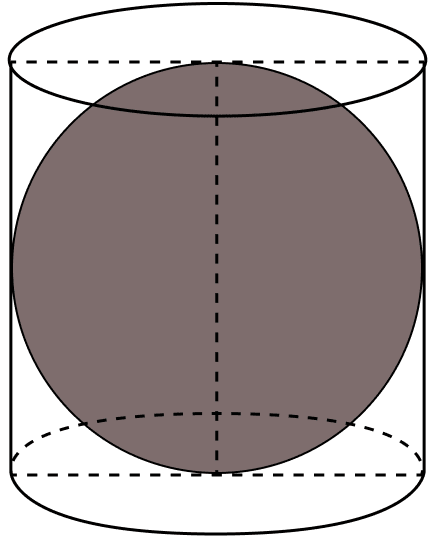
Equation of line :

⇒ y - y1 = m(x - x1)

Equation of line AB :

⇒ y - 6 = 1(x - 0)

⇒ y - 6 = x

⇒ x - y + 6 = 0

Hence, equation of line AB is x - y + 6 = 0.

(c) Given,

Line PQ cuts x-axis at point R.

Let R = (a, 0)

Equation of line PQ = x + y + 1 = 0

Since, point R lies on line PQ,

⇒ a + 0 + 1 = 0

⇒ a + 1 = 0

⇒ a = -1.

R = (a, 0) = (-1, 0)

Given,

AB is perpendicular to PQ at point S.

∴ Point S is the intersection point of AB and PQ.

PQ : x + y + 1 = 0

AB : y - x = 6 or y = x + 6

Substituting value of y from equation AB in equation PQ, we get :

⇒ x + (x + 6) + 1 = 0

⇒ 2x + 7 = 0

⇒ 2x = -7

⇒ x = $-\frac{7}{2}$

Substituting value of x in equation AB, we get :

y = $-\frac{7}{2} + 6 = \frac{-7 + 12}{2} = \frac{5}{2}$.

S = $\Big(-\frac{7}{2}, \frac{5}{2}\Big)$.

Hence, coordinates of R = (-1, 0) and S = $\Big(-\frac{7}{2}, \frac{5}{2}\Big)$.

2(iii)1 Mark · 2025 · Section A · 2025 SpecimenFull page

In the given figure AC is the diameter of the circle with center O. CD is parallel to BE.

∠AOB = 80° and ∠ACE = 20°. Calculate :

(a) ∠BEC

(b) ∠BCD

(c) ∠CED

In the given figure AC is the diameter of the circle with center O. CD is parallel to BE. ICSE 2025 Maths Solved Question Paper.
Show SolutionHide Solution↓

(a) Join AE.

In the given figure AC is the diameter of the circle with center O. CD is parallel to BE. ICSE 2025 Maths Solved Question Paper.

We know that,

The angle subtended by a chord at the centre is twice the angle subtended on the circumference.

∴ ∠AOB = 2∠AEB

⇒ 80° = 2∠AEB

⇒ ∠AEB = $\frac{80°}{2}$ = 40°.

We know that,

Angle in a semi-circle is a right angle.

⇒ ∠AEC = 90°

From figure,

⇒ ∠BEC = ∠AEC - ∠AEB = 90° - 40° = 50°.

Hence, ∠BEC = 50°.

(b) From figure,

⇒ ∠ECD = ∠CEB = 50° (Alternate angles are equal)

We know that,

The angle subtended by a chord at the centre is twice the angle subtended on the circumference.

⇒ ∠AOB = 2∠BCA

⇒ 80° = 2∠BCA

⇒ ∠BCA = $\frac{80}{2}$ = 40°.

From figure,

⇒ ∠BCD = ∠BCA + ∠ACE + ∠ECD = 40° + 20° + 50° = 110°.

Hence, ∠BCD = 110°.

(c) As sum of opposite angles of cyclic quadrilateral = 180°.

⇒ ∠BED + ∠BCD = 180°

⇒ ∠BED = 180° - ∠BCD = 180° - 110° = 70°.

From figure,

⇒ ∠BED = ∠BEC + ∠CED

⇒ 70° = 50° + ∠CED

⇒ ∠CED = 70° - 50° = 20°.

Hence, ∠CED = 20°.

3(i)1 Mark · 2025 · Section A · 2025 SpecimenFull page

In a Geometric Progression (G.P.) the first term is 24 and the fifth term is 8. Find the ninth term of the G.P.

Show SolutionHide Solution↓

Let first term of G.P. be a and common ratio be r.

Given,

First term (a) = 24

Fifth term (ar4) = 8

$$\begin{aligned}\Rightarrow \frac{ar^4}{a} = \frac{8}{24} \\[1em] \Rightarrow r^4 = \frac{1}{3} \Rightarrow (r^4)^2 = \Big(\frac{1}{3}\Big)^2 \\[1em] \Rightarrow r^8 = \frac{1}{9}.\end{aligned}$$

By formula,

Ninth term of G.P. (a9) = ar8

= $24 \times \frac{1}{9} = \frac{8}{3}$.

Hence, ninth term of G.P. = $\frac{8}{3}$.

3(ii)1 Mark · 2025 · Section A · 2025 SpecimenFull page

In the adjoining diagram, a tilted right circular cylindrical vessel with base diameter 7 cm contains a liquid. When placed vertically, the height of the liquid in the vessel is the mean of two heights shown in the diagram. Find the area of wet surface, when the cylinder is placed vertically on a horizontal surface. (Use $\pi = \frac{22}{7}$ )

In the adjoining diagram, a tilted right circular cylindrical vessel with base diameter 7 cm contains a liquid. When placed vertically, the height of the liquid in the vessel is the mean of two heights shown in the diagram. Find the area of wet surface, when the cylinder is placed vertically on a horizontal surface. ICSE 2025 Maths Solved Question Paper.
Show SolutionHide Solution↓

When vertically placed,

Height of liquid (h) = $\frac{1 + 6}{2} = \frac{7}{2}$ cm

Diameter of base = 7 cm

Radius (r) = $\frac{7}{2}$ cm

$$\begin{aligned}\text{Area of wet surface} = πr^2 + 2πrh \\[1em] = πr(r + 2h) \\[1em] = \frac{22}{7} \times \frac{7}{2}\Big(\frac{7}{2} + 2\times \frac{7}{2}\Big) \\[1em] = 11 \times (3.5 + 7) \\[1em] = 11 \times 10.5 \\[1em] = 115.5 \text{ cm}^2.\end{aligned}$$

Hence, area of wet surface = 115.5 cm2.

3(iii)1 Mark · 2025 · Section A · 2025 SpecimenFull page

Study the graph and answer each of the following :

(a) Write the coordinates of points A, B, C and D.

(b) Given that, point C is the image of point A. Name and write the equation of the line of reflection.

(c) Write the coordinates of the image of the point D under reflection in y-axis.

(d) What is the name given to a point whose image is the point itself ?

(e) On joining the points A, B, C, D and A in order, a figure is formed. Name the closed figure.

Study the graph and answer each of the following : ICSE 2025 Maths Solved Question Paper.
Show SolutionHide Solution↓

(a) From graph,

Coordinates of A = (3, 3), B = (-2, 1), C = (3, -1) and D = (0, 1).

Study the graph and answer each of the following : ICSE 2025 Maths Solved Question Paper.

(b) From graph,

C is the image of point A in the line y = 1.
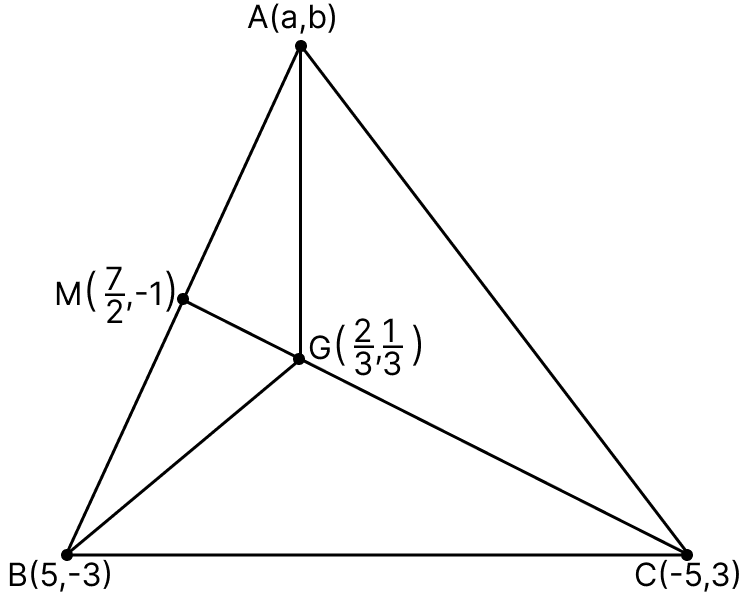
Hence, the line is BD and its equation is y = 1.
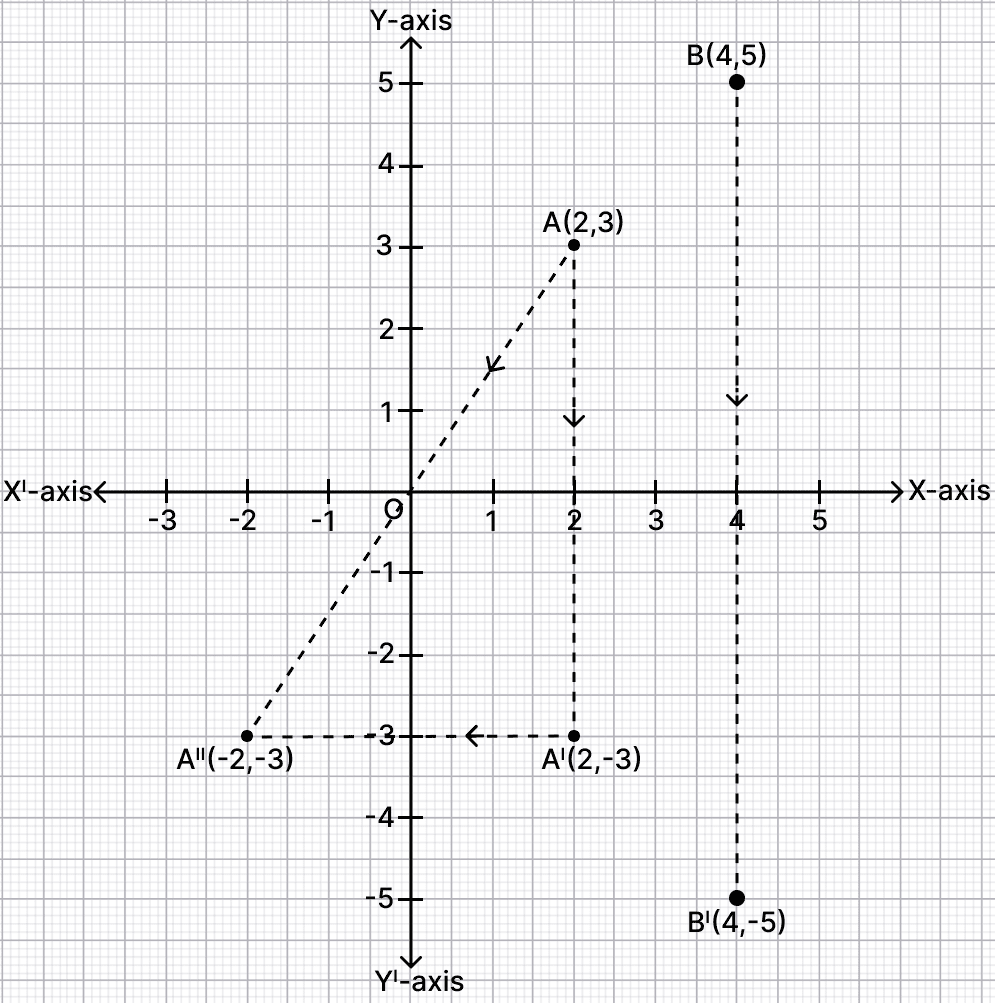
(c) Since, point D lies on y-axis, thus it is invariant under reflection in y-axis.

Hence, coordinates of point D on reflection in y-axis is (0, 1).

(d) A point whose image is the point itself is called invariant point.

(e) On joining the points A, B, C, D and A in order the figure formed is a concave quadrilateral or arrowhead.

4(i)Written · 2025 · Section B · 2025 SpecimenFull page

A man buys 250, ten-rupee shares each at ₹12.50. If the rate of dividend is 7%, find the :

(a) dividend he receives annually.

(b) percentage return on his investment.

Show SolutionHide Solution↓

(a) Nominal Value of 1 share = ₹10

Market Value of 1 share = ₹12.50

Number of shares purchased = 250

Nominal Value of 250 shares = 250 x 10 = ₹2500

Rate of dividend = 7%

∴ Dividend received = 7% of 2500

= $\frac{7}{100} \times 2500$

= ₹175.

Hence, annual dividend = ₹175.

(b) Amount Invested = No. of shares x Market Value

= 250 x 12.50

= ₹3125

$$\begin{aligned}\text{Return percentage } = \frac{\text{Dividend received}}{\text{Investment}} \times 100 \\[1em] = \frac{175}{3125} \times 100 \\[1em] = \frac{17500}{3125} \\[1em] = 5.6%.\end{aligned}$$

Hence, return percentage = 5.6%.

4(ii)Written · 2025 · Section B · 2025 SpecimenFull page

Solve the following inequation, write the solution set and represent it on the real number line.

5x - 21 < $\frac{5x}{7} - 6 \le -3\frac{3}{7} + x$, x ∈ R.

Show SolutionHide Solution↓

Given, inequation : 5x - 21 < $\frac{5x}{7} - 6 \le -3\frac{3}{7} + x$

Solving L.H.S. of the inequation :

$$\begin{aligned}\Rightarrow 5x - 21 \lt \frac{5x}{7} - 6\\[1em] \Rightarrow 5x - \frac{5x}{7} \lt 21 - 6 \\[1em] \Rightarrow \frac{35x - 5x}{7} \lt 15 \\[1em] \Rightarrow \frac{30x}{7} \lt 15 \\[1em] \Rightarrow x \lt \frac{7 \times 15}{30} \\[1em] \Rightarrow x \lt \frac{7}{2} \text{ ..........(1)}\end{aligned}$$

Solving R.H.S. of the inequation :

$$\begin{aligned}\Rightarrow \frac{5x}{7} - 6 \le -3\frac{3}{7} + x \\[1em] \Rightarrow \frac{5x}{7} - 6 \le -\frac{24}{7} + x \\[1em] \Rightarrow x - \frac{5x}{7} \ge -6 + \frac{24}{7} \\[1em] \Rightarrow \frac{7x - 5x}{7} \ge \frac{-42 + 24}{7} \\[1em] \Rightarrow \frac{2x}{7} \ge \frac{-18}{7} \\[1em] \Rightarrow 2x \ge -18 \\[1em] \Rightarrow x \ge \frac{-18}{2} \\[1em] \Rightarrow x \ge -9 \text{ ..........(2)}\end{aligned}$$

From equation (1) and (2),

Solution set = {x : -9 ≤ x < $\frac{7}{2}$, x ∈ R}

Solve the following inequation, write the solution set and represent it on the real number line. ICSE 2025 Maths Solved Question Paper.

Hence, solution set = {x : -9 ≤ x < $\frac{7}{2}$, x ∈ R}.

4(iii)Written · 2025 · Section B · 2025 Specimen · 🔁 also 2026Full page

Prove the following trigonometry identity :

(sin θ + cos θ)(cosec θ - sec θ) = cosec θ.sec θ - 2 tan θ

Show SolutionHide Solution↓

Solving,

$$\begin{aligned}\phantom{\Rightarrow} \text{(sin θ + cos θ)(cosec θ - sec θ)} \\[1em] \Rightarrow \text{(sin θ + cos θ)} \times \Big(\frac{1}{\text{sin θ}} - \frac{1}{\text{cos θ}}\Big) \\[1em] \Rightarrow \text{(sin θ + cos θ)} \times \Big(\frac{\text{cos θ - sin θ}}{\text{sin θ cos θ}}\Big) \\[1em] \Rightarrow \frac{\text{cos}^2 θ - \text{sin}^2 θ}{\text{sin θ. cos θ}} \\[1em] \Rightarrow \frac{\text{1 - 2 sin}^2 \text{ θ}}{\text{sin θ.cos θ}} \quad [\because \text{cos}^2 \text{ θ} = 1 - \text{sin}^2 \text{ θ}] \\[1em] \Rightarrow \frac{1}{\text{sin θ.cos θ}} - \frac{\text{2 sin}^2 \text{ θ}}{\text{sin θ.cos θ}} \\[1em] \Rightarrow \text{cosec θ.sec θ} - \frac{\text{2 sin}^2 \text{ θ}}{\text{sin θ.cos θ}} \\[1em] \Rightarrow \text{cosec θ.sec θ - 2 tan θ}.\end{aligned}$$

Hence, proved that (sin θ + cos θ)(cosec θ - sec θ) = cosec θ.sec θ - 2 tan θ.

5(i)Written · 2025 · Section B · 2025 SpecimenFull page

In the given figure (drawn not to scale) chords AD and BC intersect at P, where AB = 9 cm, PB = 3 cm and PD = 2 cm.

(a) Prove that △ APB ~ △ CPD

(b) Find the length of CD

(c) Find area △ APB : area △ CPD.

In the given figure (drawn not to scale) chords AD and BC intersect at P, where AB = 9 cm, PB = 3 cm and PD = 2 cm. ICSE 2025 Maths Solved Question Paper.
Show SolutionHide Solution↓

(a) In △ APB and △ CPD,

⇒ ∠APB = ∠CPD (Vertically opposite angles are equal)

⇒ ∠BAP = ∠DCP (Angles in same segment are equal)

∴ △ APB ~ △ CPD (By A.A. axiom)

Hence, proved that △ APB ~ △ CPD.

(b) We know that,

Corresponding sides of similar triangles are proportional.

$$\begin{aligned}\therefore \frac{CD}{AB} = \frac{PD}{PB} \\[1em] \Rightarrow \frac{CD}{9} = \frac{2}{3} \\[1em] \Rightarrow CD = 9 \times \frac{2}{3} \\[1em] \Rightarrow CD = 6\text{ cm}.\end{aligned}$$

Hence, CD = 6 cm.

(c) We know that,

Ratio of area of similar triangles is equal to the ratio of square of the corresponding sides.

$$\begin{aligned}\therefore \frac{\text{Area of △APB}}{\text{Area of △CPD}} = \frac{PB^2}{PD^2} \\[1em] = \frac{3^2}{2^2} \\[1em] = \frac{9}{4} \\[1em] = 9 : 4.\end{aligned}$$

Hence, area △ APB : area △ CPD = 9 : 4.

5(ii)Written · 2025 · Section B · 2025 SpecimenFull page

Mr. Sameer has a recurring deposit account and deposits ₹ 600 per month for 2 years. If he gets ₹ 15600 at the time of maturity, find the rate of interest earned by him.

Show SolutionHide Solution↓

Let rate of interest be r%.

Given,

P = ₹ 600/month

n = 2 years or 24 months

M.V. = ₹ 15600

By formula,

M.V. = $P \times n + P \times \frac{n(n + 1)}{2 \times 12} \times \frac{r}{100}$

Substituting values we get :

$$\begin{aligned}\Rightarrow 15600 = 600 \times 24 + 600 \times \frac{24 \times (24 + 1)}{2 \times 12} \times \frac{r}{100} \\[1em] \Rightarrow 15600 = 14400 + 6 \times 25 \times r \\[1em] \Rightarrow 15600 - 14400 = 6 \times 25 \times r \\[1em] \Rightarrow 150r = 1200 \\[1em] \Rightarrow r = \frac{1200}{150} = 8%.\end{aligned}$$

Hence, rate of interest = 8%.

5(iii)Written · 2025 · Section B · 2025 Specimen · 🔁 also 2026Full page

Using step-deviation method, find mean for the following frequency distribution

ClassFrequency
0-153
15-304
30-457
45-606
60-758
75-902
Show SolutionHide Solution↓

In the given table i is the class interval which is equal to 15.

ClassClass mark (x)d = (x - A)u = d/iFrequency (f)fu
0-157.5-45-33-9
15-3022.5-30-24-8
30-4537.5-15-17-7
45-60A = 52.50060
60-7567.515188
75-9082.530224
TotalΣf = 30Σfu = -12

Mean = A + $\frac{Σfu}{Σf} \times i = 52.5 + \frac{-12}{30} \times 15$

= $52.5 - \frac{180}{30}$

= 52.5 - 6

= 46.50

Hence, mean = 46.50

6(i)Written · 2025 · Section B · 2025 Specimen · 🔁 also 2026Full page

Find the coordinates of the centroid P of the △ ABC, whose vertices are A(-1, 3), B(3, -1) and C(0, 0). Hence, find the equation of a line passing through P and parallel to AB.

Show SolutionHide Solution↓

By formula,

Centroid of triangle = $\Big(\frac{x_1 + x_2 + x_3}{3}, \frac{y_1 + y_2 + y_3}{3}\Big)$

Substituting values we get :

$$\begin{aligned}\Rightarrow \text{Centroid of △ ABC} = \Big(\frac{-1 + 3 + 0}{3}, \frac{3 + (-1) + 0}{3}\Big) \\[1em] \Rightarrow P = \Big(\frac{2}{3}, \frac{2}{3}\Big).\end{aligned}$$

By formula,

Slope = $\frac{y_2 - y_1}{x_2 - x_1}$

Substituting values we get :

$$\begin{aligned}\text{Slope of AB} = \frac{-1 - 3}{3 - (-1)} \\[1em] = \frac{-4}{4} \\[1em] = -1.\end{aligned}$$

We know that,

Slope of parallel lines are equal.

By point-slope form,

Equation of line : y - y1 = m(x - x1)

Substituting values we get :

Equation of line passing through P and parallel to AB :

$$\begin{aligned}\Rightarrow y - \frac{2}{3} = -1\Big(x - \frac{2}{3}\Big) \\[1em] \Rightarrow \frac{3y - 2}{3} = -1 \times \frac{3x - 2}{3} \\[1em] \Rightarrow 3y - 2 = -1(3x - 2) \\[1em] \Rightarrow 3y - 2 = -3x + 2 \\[1em] \Rightarrow 3y + 3x = 2 + 2 \\[1em] \Rightarrow 3y + 3x = 4.\end{aligned}$$

Hence, required equation is 3x + 3y = 4.

6(ii)Written · 2025 · Section B · 2025 SpecimenFull page

In the given figure PT is a tangent to the circle. Chord BA produced meets the tangent PT at P. Given PT = 20 cm and PA = 16 cm.

(a) Prove △ PTB ~ △ PAT

(b) Find the length of AB.

In the given figure PT is a tangent to the circle. Chord BA produced meets the tangent PT at P. Given PT = 20 cm and PA = 16 cm. ICSE 2025 Maths Solved Question Paper.
Show SolutionHide Solution↓

(a) In △ PTB and △ PAT,

⇒ ∠PTA = ∠PBT (Alternate segment theorem)

⇒ ∠TPA = ∠BPT (Common angle)

∴ △ PTB ~ △ PAT (By A.A. axiom)

Hence, proved that △ PTB ~ △ PAT.

(b) We know that,

If a chord and a tangent intersect externally, then the product of the lengths of segments of the chord is equal to the square of the length of the tangent from the point of contact to the point of intersection.

⇒ PA × PB = PT2

⇒ PA × (PA + AB) = PT2

⇒ 16 × (16 + AB) = 202

⇒ 16 × (16 + AB) = 400

⇒ 16 + AB = 25

⇒ AB = 25 - 16 = 9 cm.

Hence, AB = 9 cm.

6(iii)Written · 2025 · Section B · 2025 SpecimenFull page

The following bill shows the GST rate and the marked price of articles :

Rajdhani Departmental Store

S.No.ItemMarked priceDiscountRate of GST
(a)Dry fruits (1 kg)₹ 1200₹ 10012%
(b)Packed Wheat Flour (5 kg)₹ 286Nil5%
(c)Bakery Products₹ 50010%12%

Find the total amount to be paid (including GST) for the above bill.

Show SolutionHide Solution↓

For Dry fruits :

M.P. = ₹ 1200

Discount = ₹ 100

Discounted price = ₹ 1200 - ₹ 100 = ₹ 1100

GST = 12%

Tax = $\frac{12}{100} \times 1100$ = ₹ 132

Price including tax = ₹ 1100 + ₹ 132 = ₹ 1232.

For Wheat flour :

M.P. = ₹ 286

Discount = Nil

GST = 5%

Tax = $\frac{5}{100} \times 286$ = ₹ 14.30

Price including tax = ₹ 286 + ₹ 14.30 = 300.30

For bakery products :

M.P. = ₹ 500

Discount = 10% = $\frac{10}{100} \times 500$ = ₹ 50.

Discounted price = ₹ 500 - ₹ 50 = ₹ 450

GST = 12%

Tax = $\frac{12}{100} \times 450$ = ₹ 54

Price including tax = ₹ 450 + ₹ 54 = ₹ 504.

Total price = ₹ 1232 + ₹ 300.30 + ₹ 504 = ₹ 2036.30

Hence, total amount to be paid = ₹ 2036.30

7(i)Written · 2025 · Section B · 2025 SpecimenFull page

A vertical tower standing on a horizontal plane is surmounted by a vertical flagstaff. At a point 100 m away from the foot of the tower, the angle of elevation of the top and bottom of the flagstaff are 54° and 42° respectively. Find the height of the flagstaff. Give your answer correct to nearest metre.

A vertical tower standing on a horizontal plane is surmounted by a vertical flagstaff. At a point 100 m away from the foot of the tower, the angle of elevation of the top and bottom of the flagstaff are 54° and 42° respectively. Find the height of the flagstaff. Give your answer correct to nearest metre. ICSE 2025 Maths Solved Question Paper.
Show SolutionHide Solution↓

In △APB,

⇒ tan 42° = $\frac{AB}{AP}$

⇒ 0.9004 = $\frac{AB}{100}$

⇒ AB = 0.9004 × 100 = 90.04 m

In △APF,

⇒ tan 54° = $\frac{AF}{AP}$

⇒ 1.3764 = $\frac{AF}{100}$

⇒ AF = 1.3764 × 100 = 137.64 m

From figure,

BF = AF - AB = 137.64 - 90.04 = 47.60 ≈ 48 m.

Hence, height of flagstaff = 48 m.

7(ii)Written · 2025 · Section B · 2025 SpecimenFull page

The marks of 200 students in a test were recorded as follows :

Marks %No. of students
0-105
10-207
20-3011
30-4020
40-5040
50-6052
60-7036
70-8015
80-909
90-1005

Using graph sheet draw ogive for the given data and use it to find the,

(a) median

(b) number of students who obtained more than 65% marks

(c) number of students who did not pass, if the pass percentage was 35.

Show SolutionHide Solution↓
Marks %No. of students (f)CF
0-1055
10-20712
20-301123
30-402043
40-504083
50-6052135
60-7036171
70-8015186
80-909195
90-1005200

Steps :

  1. Take 1 cm = 10 marks on x-axis.
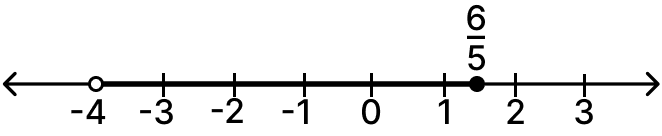
  2. Take 1 cm = 20 students on y-axis.

  3. Plot the points (10, 5), (20, 12), (30, 23), (40, 43), (50, 83), (60, 135), (70, 171), (80, 186), (90, 195) and (100, 200).

  4. Join the points by free hand curve.

The marks of 200 students in a test were recorded as follows : ICSE 2025 Maths Solved Question Paper.

(a) n = 200, which is even

Median = $\frac{n}{2} = \frac{200}{2}$ = 100th term.

Through point L = 100 draw a horizontal line parallel to x-axis touching the graph at point M, through M draw a vertical line parallel to y-axis touching x-axis at point N = 53.

Hence, median = 53.

(b) Total marks = 100

65% of 100 = 65

Through point O = 65 draw a vertical line parallel to y-axis touching the graph at point P, through P draw a horizontal line parallel to x-axis touching y-axis at point Q = 154.

∴ 154 students score less than or equal to 65%.

∴ 46 (200 - 154) students score more than 65%.

Hence, 46 students score more than 65%.

(c) Total marks = 100

35% of 100 = 35

Through point R = 35 draw a vertical line parallel to y-axis touching the graph at point S, through S draw a horizontal line parallel to x-axis touching y-axis at point T = 33.

Hence, 33 students did not pass the exam.

8(i)Written · 2025 · Section B · 2025 SpecimenFull page

In a T.V. show, a contestant opt for video call a friend life line to get an answer from three of his friends, named Amar, Akbar and Anthony. The question which he asks from one of his friends has four options. Find the probability that :

(a) Akbar is chosen for the call.

(b) Akbar couldn't give the correct answer.

Show SolutionHide Solution↓

(a) Since, there are three people which can be called.

Hence, probability that Akbar is chosen for the call = $\frac{1}{3}$.

(b) Since, there are four options out of which one is correct.

Hence, probability that Akbar couldn't give the correct answer = $\frac{3}{4}$.

8(ii)Written · 2025 · Section B · 2025 Specimen · 🔁 also 2026Full page

If x, y and z are in continued proportion, prove that :

$\frac{x}{y^2.z^2} + \frac{y}{z^2.x^2} + \frac{z}{x^2.y^2} = \frac{1}{x^3} + \frac{1}{y^3} + \frac{1}{z^3}$

Show SolutionHide Solution↓

Given,

x, y and z are in continued proportion.

$$\begin{aligned}\therefore \frac{x}{y} = \frac{y}{z} \\[1em] \Rightarrow y^2 = xz\end{aligned}$$

To prove :

$\frac{x}{y^2.z^2} + \frac{y}{z^2.x^2} + \frac{z}{x^2.y^2} = \frac{1}{x^3} + \frac{1}{y^3} + \frac{1}{z^3}$

Solving L.H.S.,

$$\begin{aligned}\Rightarrow \frac{x}{y^2.z^2} + \frac{y}{z^2.x^2} + \frac{z}{x^2.y^2} \\[1em] \Rightarrow \frac{x^3 + y^3 + z^3}{x^2.y^2.z^2} \\[1em] \Rightarrow \frac{x^3 + y^3 + z^3}{x^2.xz.z^2} \\[1em] \Rightarrow \frac{x^3 + y^3 + z^3}{x^3.z^3} \\[1em] \Rightarrow \frac{x^3}{x^3.z^3} + \frac{y^3}{x^3z^3} + \frac{z^3}{x^3.z^3} \\[1em] \Rightarrow \frac{1}{z^3} + \frac{y^3}{(xz)^3} + \frac{1}{x^3} \\[1em] \Rightarrow \frac{1}{z^3} + \frac{y^3}{(y^2)^3} + \frac{1}{x^3} \\[1em] \Rightarrow \frac{1}{z^3} + \frac{y^3}{y^6} + \frac{1}{x^3} \\[1em] \Rightarrow \frac{1}{z^3} + \frac{1}{y^3} + \frac{1}{x^3}.\end{aligned}$$

Since, L.H.S. = R.H.S.

Hence, proved that $\frac{x}{y^2.z^2} + \frac{y}{z^2.x^2} + \frac{z}{x^2.y^2} = \frac{1}{x^3} + \frac{1}{y^3} + \frac{1}{z^3}$.

8(iii)Written · 2025 · Section B · 2025 SpecimenFull page

A manufacturing company prepares spherical ball bearings, each of radius 7 mm and mass 4 gm. These ball bearings are packed into boxes. Each box can have maximum of 2156 cm3 of ball bearings. Find the :

(a) maximum number of ball bearings that each box can have.

(b) mass of each box of ball bearings in kg.

$\Big(\text{use } \pi = \frac{22}{7}\Big)$

Show SolutionHide Solution↓

(a) Given,

Radius of ball bearings = 7 mm

Volume of box = 2156 cm3 = 2156 × 103 mm3

Number of ball bearings that each box can have (N)

= $\frac{\text{Volume of box}}{\text{Volume of each ball}}$

Substituting values we get :

$$\begin{aligned}N = \frac{2156 \times 10^3}{\frac{4}{3} \times \frac{22}{7} \times 7^3} \\[1em] = \frac{2156 \times 10^3}{\frac{88}{3} \times 7^2} \\[1em] = \frac{2156 \times 3 \times 1000}{88 \times 49} \\[1em] = \frac{6468000}{4312} \\[1em] = 1500.\end{aligned}$$

Hence, maximum no. of ball bearings in a box = 1500.

(b) Mass of each box = No. of balls × Mass of each ball

= 1500 × 4 gm

= 6000 gm

= $\frac{6000}{1000}$ = 6 kg.

Hence, mass of each box = 6 kg.

9(i)Written · 2025 · Section B · 2025 SpecimenFull page

The table given below shows the runs scored by a cricket team during the overs of a match.

OversRuns scored
20-3037
30-4045
40-5040
50-6060
60-7051
70-8035

(a) Draw a histogram representing the above distribution.

(b) Estimate the modal runs scored.

Show SolutionHide Solution↓

Steps :

  1. Take 2 cm along x-axis = 10 overs and 1 cm along y-axis = 10 runs.
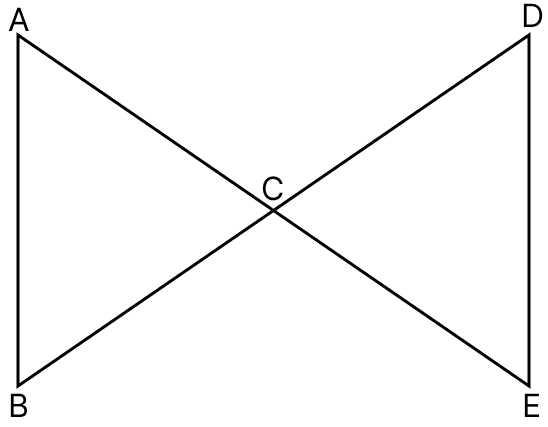
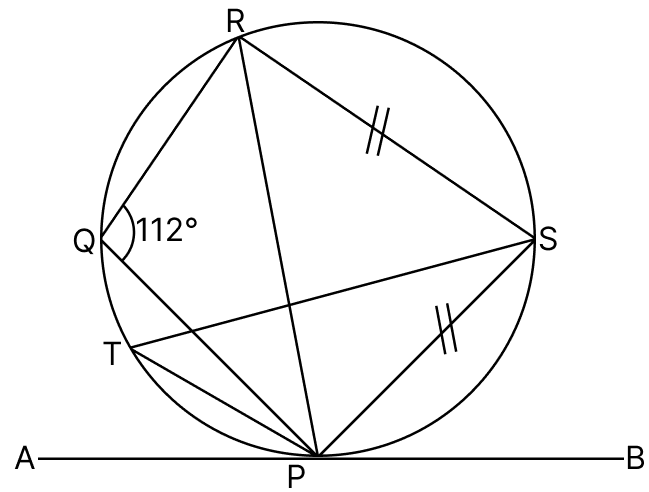
  2. Since, the scale on x-axis starts at 20, a break (zig-zag curve) is shown near the origin along x-axis to indicate that the graph is drawn to scale beginning at 20 and not at origin itself.

  3. Construct rectangles corresponding to the given data.

  4. In highest rectangle, draw two st. lines KN and LI from corners of the rectangles on either side of the highest rectangle to the opposite corners of the highest rectangle. Let Z be the point of intersection of KN and LI.

  5. Through Z, draw a vertical line to meet the x-axis at A. The abscissa of the point A represents 57.

The table given below shows the runs scored by a cricket team during the overs of a match. ICSE 2025 Maths Solved Question Paper.

Hence, mode = 57.

9(ii)Written · 2025 · Section B · 2025 Specimen · 🔁 also 2026Full page

An arithmetic progression (A.P.) has 3 as its first term. The sum of the first 8 terms is twice the sum of the first 5 terms. Find the common difference of the A.P.

Show SolutionHide Solution↓

Let common difference be d.

a = 3

Sum of first n terms of an A.P. = $\frac{\text{n}}{2}(\text{a } + \text{ l})$

Given,

The sum of the first 8 terms is twice the sum of the first 5 terms.

$$\begin{aligned}\therefore \frac{8}{2}(a + a_8) = 2 \times \frac{5}{2}(a + a_5) \\[1em] \Rightarrow 4[a + a + (8 - 1)d] = 5[a + a + (5 - 1)d] \\[1em] \Rightarrow 4[2a + 7d] = 5[2a + 4d] \\[1em] \Rightarrow 4[2 \times 3 + 7d] = 5[2 \times 3 + 4d] \\[1em] \Rightarrow 4[6 + 7d] = 5[6 + 4d] \\[1em] \Rightarrow 24 + 28d = 30 + 20d \\[1em] \Rightarrow 28d - 20d = 30 - 24 \\[1em] \Rightarrow 8d = 6 \\[1em] \Rightarrow d = \frac{6}{8} = \frac{3}{4}.\end{aligned}$$

Hence, common difference = $\frac{3}{4}$.

9(iii)Written · 2025 · Section B · 2025 SpecimenFull page

The roots of the equation (q - r)x2 + (r - p)x + (p - q) = 0 are equal.

Prove that : 2q = p + r, that is, p, q and r are in A.P.

Show SolutionHide Solution↓

Given,

The roots of the equation (q - r)x2 + (r - p)x + (p - q) = 0 are equal.

∴ Discriminant (D) = 0

⇒ b2 - 4ac = 0

⇒ (r - p)2 - 4 × (q - r) × (p - q) = 0

⇒ r2 + p2 - 2pr - 4(qp - q2 - rp + qr) = 0

⇒ r2 + p2 - 2pr - 4qp + 4q2 + 4rp - 4qr = 0

⇒ r2 + p2 + 2pr - 4qp - 4qr + 4q2 = 0

⇒ (p + r)2 - 4q(p + r) + 4q2 = 0

Let p + r = y

⇒ y2 - 4qy + 4q2 = 0

⇒ (y - 2q)2 = 0

⇒ y - 2q = 0

⇒ y = 2q

⇒ p + r = 2q.

Hence, proved that p + r = 2q.

10(i)Written · 2025 · Section B · 2025 SpecimenFull page

A car travels a distance of 72 km at a certain average speed of x km per hour and then travels a distance of 81 km at an average speed of 6 km per hour more than its original average speed. If it takes 3 hours to complete the total journey then form a quadratic equation and solve it to find its original average speed.

Show SolutionHide Solution↓

Given,

A car travels a distance of 72 km at a certain average speed of x km per hour and then travels a distance of 81 km at an average speed of 6 km per hour more than its original average speed.

Total time taken to complete the journey = 3 hours

$$\begin{aligned}\therefore \frac{72}{x} + \frac{81}{x + 6} = 3 \\[1em] \Rightarrow \frac{72(x + 6) + 81x}{x(x + 6)} = 3 \\[1em] \Rightarrow 72(x + 6) + 81x = 3x(x + 6) \\[1em] \Rightarrow 72x + 432 + 81x = 3x^2 + 18x \\[1em] \Rightarrow 3x^2 + 18x - 72x - 81x - 432 = 0 \\[1em] \Rightarrow 3x^2 - 135x - 432 = 0 \\[1em] \Rightarrow 3(x^2 - 45x - 144) = 0 \\[1em] \Rightarrow x^2 - 45x - 144 = 0 \\[1em] \Rightarrow x^2 - 48x + 3x - 144 = 0 \\[1em] \Rightarrow x(x - 48) + 3(x - 48) = 0 \\[1em] \Rightarrow (x + 3)(x - 48) = 0 \\[1em] \Rightarrow x + 3 = 0 \text{ or } x - 48 = 0 \\[1em] \Rightarrow x = -3 \text{ or } x = 48.\end{aligned}$$

As speed cannot be negative in this case,

Hence, the original speed = 48 km/hr.

10(ii)Written · 2025 · Section B · 2025 SpecimenFull page

Given matrix, X = $$\begin{bmatrix*}[r] 1 & 1 \\ 8 & 3 \end{bmatrix*} \text{ and } I = \begin{bmatrix*}[r] 1 & 0 \\ 0 & 1 \end{bmatrix*},$$ prove that X2 = 4X + 5I.

Show SolutionHide Solution↓

Given,

X2 = 4X + 5I

Solving for L.H.S.,

$$X^2 = \begin{bmatrix*}[r] 1 & 1 \\ 8 & 3 \end{bmatrix*}\begin{bmatrix*}[r] 1 & 1 \\ 8 & 3 \end{bmatrix*} \\[1em] = \begin{bmatrix*}[r] 1 \times 1 + 1 \times 8 & 1 \times 1 + 1\times 3 \\ 8 \times 1 + 3 \times 8 & 8 \times 1 + 3 \times 3 \end{bmatrix*} \\[1em] = \begin{bmatrix*}[r] 1 + 8 & 1 + 3 \\ 8 + 24 & 8 + 9 \end{bmatrix*} \\[1em] = \begin{bmatrix*}[r] 9 & 4 \\ 32 & 17 \end{bmatrix*}.$$

Solving for R.H.S.,

$$4X + 5I = 4\begin{bmatrix*}[r] 1 & 1 \\ 8 & 3 \end{bmatrix*} + 5\begin{bmatrix*}[r] 1 & 0 \\ 0 & 1 \end{bmatrix*} \\[1em] = \begin{bmatrix*}[r] 4 & 4 \\ 32 & 12 \end{bmatrix*} + \begin{bmatrix*}[r] 5 & 0 \\ 0 & 5 \end{bmatrix*} \\[1em] = \begin{bmatrix*}[r] 4 + 5 & 4 + 0 \\ 32 + 0 & 12 + 5 \end{bmatrix*} \\[1em] = \begin{bmatrix*}[r] 9 & 4 \\ 32 & 17 \end{bmatrix*}.$$

Since, L.H.S. = R.H.S.

Hence, proved that X2 = 4X + 5I.

10(iii)Written · 2025 · Section B · 2025 SpecimenFull page

Use ruler and compasses for the following question taking a scale of 10 m = 1 cm.

A park in the city is bounded by straight fences AB, BC, CD and DA.

Given that AB = 50 m, BC = 63 m, ∠ABC = 75°. D is a point equidistant from the fences AB and BC. If ∠BAD = 90°, construct the outline of the park ABCD.

Also locate a point P on the line BD for the flag post which is equidistant from the corners of the park A and B.

Show SolutionHide Solution↓

We know that,

The locus of a point equidistant from two intersecting lines is pair of bisectors of the angles between the two lines.

The locus of a point which is equidistant from two given points is actually the perpendicular bisector of the segment that joins the two points.

Given,

Scale : 10 m = 1 cm

BC = 63 m = $\frac{63}{10}$ = 6.3 cm.

AB = 50 m = $\frac{50}{10}$ = 5 cm.

Steps of construction :

  1. Draw a line BC = 6.3 cm.

  2. Draw ∠ABC = 75° such that AB = 5 cm.

  3. Draw BE, angle bisector of ∠ABC.

  4. Construct ∠BAF = 90°, intersecting BE at D.

  5. Join ABCD.

  6. Construct XY, the perpendicular bisector of AB, intersecting BE at P.

Use ruler and compasses for the following question taking a scale of 10 m = 1 cm. ICSE 2025 Maths Solved Question Paper.
1(i)1 Mark · 2024 · Section A · 2024 PaperFull page

For an Intra-state sale, the CGST paid by a dealer to the Central government is ₹120. If the marked price of the article is ₹2000, the rate of GST is:

Show SolutionHide Solution↓

CGST% = $\frac{CGST}{M.P.} \times 100$

Substituting values we get :

CGST% = $\frac{120}{2000} \times 100$ = 6%

GST% = 2 × CGST% = 2 × 6% = 12%.

Hence, Option 3 is the correct option.

1(ii)1 Mark · 2024 · Section A · 2024 PaperFull page

What must be subtracted from the polynomial x3 + x2 - 2x + 1, so that the result is exactly divisible by (x - 3)?

Show SolutionHide Solution↓

Polynomial : x3 + x2 - 2x + 1

Division by x - 3

⇒ x - 3 = 0

⇒ x = 3.

Let k be subtracted from the polynomial, so resulting polynomial is x3 + x2 - 2x + 1 - k.

Resulting polynomial should be exactly divisible by x - 3,

Thus, substituting x = 3, in polynomial x3 + x2 - 2x + 1 - k, remainder = 0.

⇒ 33 + 32 - 2(3) + 1 - k = 0

⇒ 27 + 9 - 6 + 1 - k = 0

⇒ 31 - k = 0

⇒ k = 31.

Hence, Option 4 is the correct option.

1(iii)1 Mark · 2024 · Section A · 2024 PaperFull page

The roots of the quadratic equation px2 - qx + r = 0 are real and equal if :

(a) p2 = 4qr

(b) q2 = 4pr

(c) –q2 = 4pr

(d) p2 > 4qr

Show SolutionHide Solution↓

By formula,

D = b2 - 4ac

For equation, px2 - qx + r = 0

D = (-q)2 - 4 × p × r

We know that,

Roots of a quadratic equation are real and equal if discriminant = 0.

⇒ q2 - 4pr = 0

⇒ q2 = 4pr.

Hence, Option 2 is the correct option.

1(iv)1 Mark · 2024 · Section A · 2024 PaperFull page

If matrix 𝐴 = $$\begin{bmatrix*}[r] 2 & 2 \\ 0 & 2 \end{bmatrix*}\text{ and } A^2 = \begin{bmatrix*}[r] 4 & x \\ 0 & 4 \end{bmatrix*}$$, then the value of x is :

Show SolutionHide Solution↓

$$\phantom{\Rightarrow} A^2 = \begin{bmatrix*}[r] 2 & 2 \\ 0 & 2 \end{bmatrix*}\begin{bmatrix*}[r] 2 & 2 \\ 0 & 2 \end{bmatrix*} \\[1em] \Rightarrow A^2 = \begin{bmatrix*}[r] 2 \times 2 + 2\times 0 & 2 \times 2 + 2 \times 2 \\ 0 \times 2 + 2 \times 0 & 0 \times 2 + 2 \times 2 \end{bmatrix*} \\[1em] \Rightarrow \begin{bmatrix*}[r] 4 & x \\ 0 & 4 \end{bmatrix*} = \begin{bmatrix*}[r] 4 + 0 & 4 + 4 \\ 0 + 0 & 0 + 4 \end{bmatrix*} \\[1em] \Rightarrow \begin{bmatrix*}[r] 4 & x \\ 0 & 4 \end{bmatrix*} = \begin{bmatrix*}[r] 4 & 8 \\ 0 & 4 \end{bmatrix*} \\[1em] \Rightarrow x = 8.$$

Hence, Option 3 is the correct option.

1(v)1 Mark · 2024 · Section A · 2024 PaperFull page

The median of the following observations arranged in ascending order is 64. Find the value of x :

27, 31, 46, 52, x, x + 4, 71, 79, 85, 90

Show SolutionHide Solution↓

No. of observations = 10, which is even.

Median = $\frac{\left(\frac{n}{2}\right)^\text{th}\text{term} + \left(\frac{n}{2} + 1\right)^\text{th}\text{term}}{2}$

$\left(\frac{n}{2}\right)^\text{th}\text{term} = \frac{10}{2}$ = 5th term = x

$\left(\frac{n}{2} + 1\right)^\text{th}\text{term} = \frac{10}{2} + 1$ = 5 + 1 = 6th term = x + 4

Given,

Median = 64

$$\begin{aligned}\therefore \frac{x + x + 4}{2} = 64 \\[1em] \Rightarrow \frac{2x + 4}{2} = 64 \\[1em] \Rightarrow \frac{2(x + 2)}{2} = 64 \\[1em] \Rightarrow x + 2 = 64 \\[1em] \Rightarrow x = 64 - 2 \\[1em] \Rightarrow x = 62\end{aligned}$$

Hence, Option 3 is the correct option.

1(vi)1 Mark · 2024 · Section A · 2024 PaperFull page

Points A(x, y), B(3, -2) and C(4, -5) are collinear. The value of y in terms of x is ∶

Show SolutionHide Solution↓

Since, points A, B and C are collinear.

∴ Slope of AB = Slope of BC.

$$\begin{aligned}\Rightarrow \frac{-2 - y}{3 - x} = \frac{-5 - (-2)}{4 - 3} \\[1em] \Rightarrow \frac{-2 - y}{3 - x} = \frac{-5 + 2}{1} \\[1em] \Rightarrow \frac{-2 - y}{3 - x} = -3 \\[1em] \Rightarrow -2 - y = -3(3 - x) \\[1em] \Rightarrow -2 - y = -9 + 3x \\[1em] \Rightarrow y = -2 + 9 - 3x \\[1em] \Rightarrow y = 7 - 3x.\end{aligned}$$

Hence, Option 4 is the correct option.

1(vii)1 Mark · 2024 · Section A · 2024 PaperFull page

The given table shows the distance covered and the time taken by a train moving at a uniform speed along a straight track.

Distance (in m)Time (in sec)
602
90x
y5

The values of x and y are :

Show SolutionHide Solution↓

Speed = $\frac{\text{Distance}}{\text{Time}}$

Average speed = $\frac{60}{2}$ = 30 km/hr

$$\begin{aligned}\Rightarrow \frac{90}{x} = 30 \\[1em] \Rightarrow x = \frac{90}{30} = 3. \\[1em] \phantom{\Rightarrow} \frac{y}{5} = 30 \\[1em] \Rightarrow y = 30 \times 5 = 150.\end{aligned}$$

Hence, Option 4 is the correct option.

1(viii)1 Mark · 2024 · Section A · 2024 PaperFull page

The 7th term of the given Arithmetic Progression (A.P.):

$\frac{1}{a}, \Big(\frac{1}{a} + 1\Big), \Big(\frac{1}{a} + 2\Big), ......$ is :

Show SolutionHide Solution↓

In the A.P. :

$\frac{1}{a}, \Big(\frac{1}{a} + 1\Big), \Big(\frac{1}{a} + 2\Big), ......$

First term (x) = $\frac{1}{a}$

Common difference (d) = $\frac{1}{a} + 1 - \frac{1}{a}$ = 1.
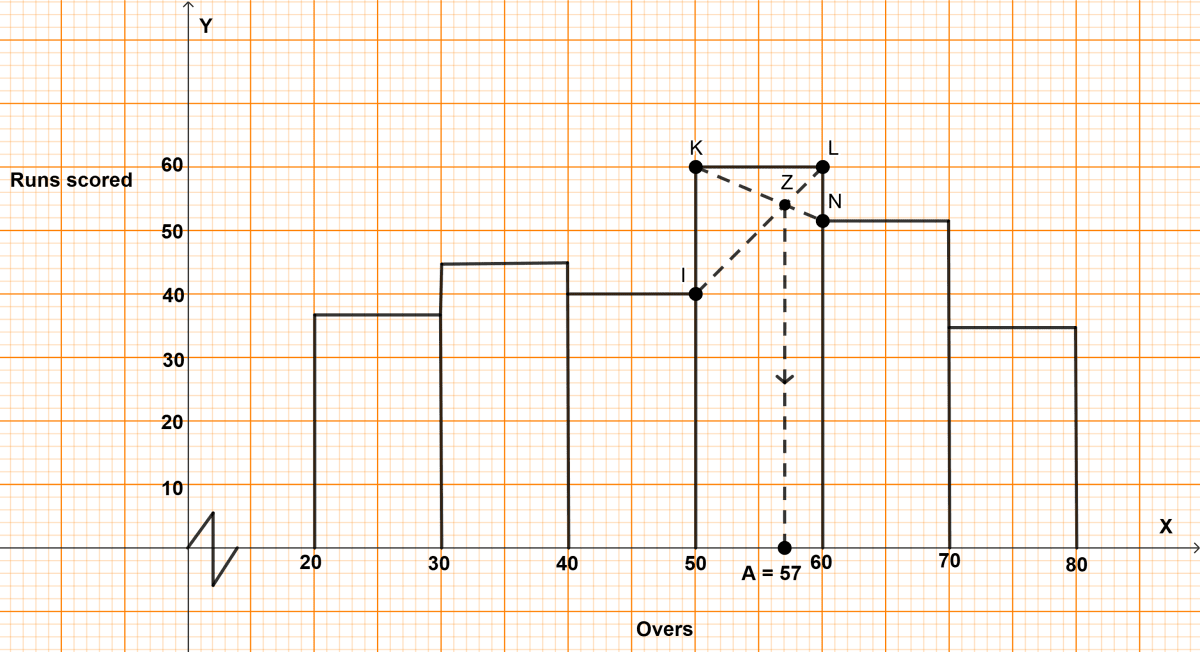
x7 = x + (7 - 1)d

= $\frac{1}{a} + 6 \times 1$

= $\Big(\frac{1}{a} + 6\Big)$.

Hence, Option 1 is the correct option.

1(ix)1 Mark · 2024 · Section A · 2024 PaperFull page

The sum invested to purchase 15 shares of a company of nominal value ₹ 75 available at a discount of 20% is:

Show SolutionHide Solution↓

N.V. = ₹ 75

Discount = 20%

M.V. = ₹ 75 - $\frac{20}{100} \times 75$

= ₹ 75 - ₹ 15

= ₹ 60.

Cost of 15 shares = 15 × ₹ 60 = ₹ 900.

Hence, Option 4 is the correct option.

1(x)1 Mark · 2024 · Section A · 2024 PaperFull page

The circumcentre of a triangle is the point which is ∶

Show SolutionHide Solution↓

The circumcenter of a triangle is defined as the point equidistant from the three vertices of the triangle.

Hence, Option 2 is the correct option.

1(xi)1 Mark · 2024 · Section A · 2024 PaperFull page

Statement (i) : sin2 θ + cos2 θ = 1

Statement (ii) : cosec2 θ + cot2 θ = 1

Which of the following is valid ?

Show SolutionHide Solution↓

Trigonometry identity :

sin2 θ + cos2 θ = 1

cosec2 θ - cot2 θ = 1

∴ Only statement (i) is correct.

Hence, Option 1 is the correct option.

1(xii)1 Mark · 2024 · Section A · 2024 PaperFull page

In the given diagram, PS and PT are the tangents to the circle. SQ || PT and ∠SPT = 80°. The value of ∠QST is :

In the given diagram, PS and PT are the tangents to the circle. SQ || PT and ∠SPT = 80°. The value of ∠QST is : ICSE 2024 Maths Solved Question Paper.
Show SolutionHide Solution↓

In △ PST,

⇒ PS = PT (Tangents from an external point to a circle are equal in length)

⇒ ∠PST = ∠PTS = a (let) (Angles opposite to equal sides are equal)

By angle sum property of triangle,

⇒ ∠PST + ∠PTS + ∠SPT = 180°

⇒ a + a + 80° = 180°

⇒ 2a = 180° - 80°

⇒ 2a = 100°

⇒ a = $\frac{100°}{2}$ = 50°.

From figure,

⇒ ∠QST = ∠STP = 50° (Alternate angles are equal)

Hence, Option 4 is the correct option.

1(xiii)1 Mark · 2024 · Section A · 2024 PaperFull page

Assertion (A): A die is thrown once and the probability of getting an even number is $\frac{2}{3}$.

Reason (R): The sample space for even numbers on a die is {2, 4, 6}

Show SolutionHide Solution↓

Sample space when a die is thrown = {1, 2, 3, 4, 5, 6}.

Sample space for even numbers = {2, 4, 6}

Probability of getting an even number = $\frac{3}{6} = \frac{1}{2}$.

∴ A is false and R is true.

Hence, Option 2 is the correct option.

1(xiv)1 Mark · 2024 · Section A · 2024 PaperFull page

A rectangular sheet of paper of size 11 cm x 7 cm is first rotated about the side 11 cm and then about the side 7 cm to form a cylinder, as shown in the diagram. The ratio of their curved surface areas is:

A rectangular sheet of paper of size 11 cm x 7 cm is first rotated about the side 11 cm and then about the side 7 cm to form a cylinder, as shown in the diagram. ICSE 2024 Maths Solved Question Paper.
Show SolutionHide Solution↓

In first case :

Height of cylinder (h) = 7 cm

Let radius be r cm

⇒ 2πr = 11

⇒ r = $\frac{11}{2π}$

In second case :

Height of cylinder (H) = 11 cm

Let radius be R cm

⇒ 2πR = 7

⇒ R = $\frac{7}{2π}$

$$\begin{aligned}\therefore \frac{\text{CSA of 1st cylinder}}{\text{CSA of 2nd cylinder}} = \frac{2πrh}{2πRH} \\[1em] = \frac{rh}{RH} \\[1em] = \frac{\frac{11}{2π} \times 7}{\frac{7}{2π} \times 11} \\[1em] = \frac{\frac{77}{2π}}{\frac{77}{2π}} \\[1em] = \frac{1}{1} \\[1em] = 1 : 1.\end{aligned}$$

Hence, Option 1 is the correct option.

1(xv)1 Mark · 2024 · Section A · 2024 PaperFull page

In the given diagram, ∆ABC ∼ ∆PQR. If AD and PS are bisectors of ∠BAC and ∠QPR respectively then:

In the given diagram, ∆ABC ∼ ∆PQR. If AD and PS are bisectors of ∠BAC and ∠QPR respectively then: ICSE 2024 Maths Solved Question Paper.
Show SolutionHide Solution↓

Given,

∆ABC ∼ ∆PQR

∴ ∠A = ∠P

⇒ $\frac{∠A}{2} = \frac{∠P}{2}$

⇒ ∠BAD = ∠QPS

∠B = ∠Q [∵ ∆ABC ∼ ∆PQR]

In ∆ABD ∼ ∆PQS,

⇒ ∠BAD = ∠QPS

⇒ ∠B = ∠Q

∴ ∆ABD ∼ ∆PQS (By A.A. axiom)

Hence, Option 2 is the correct option.

2(i)1 Mark · 2024 · Section A · 2024 PaperFull page

A = $$\begin{bmatrix*}[r] x & 0 \\ 1 & 1 \end{bmatrix*}, B = \begin{bmatrix*}[r] 4 & 0 \\ y & 1 \end{bmatrix*}\text{ and } C = \begin{bmatrix*}[r] 4 & 0 \\ x & 1 \end{bmatrix*}$$.

Find the values of x and y, if AB = C.

Show SolutionHide Solution↓

$$\phantom{\Rightarrow} AB = C \\[1em] \Rightarrow \begin{bmatrix*}[r] x & 0 \\ 1 & 1 \end{bmatrix*}\begin{bmatrix*}[r] 4 & 0 \\ y & 1 \end{bmatrix*} = \begin{bmatrix*}[r] 4 & 0 \\ x & 1 \end{bmatrix*} \\[1em] \Rightarrow \begin{bmatrix*}[r] x \times 4 + 0 \times y & x \times 0 + 0 \times 1 \\ 1 \times 4 + 1 \times y & 1 \times 0 + 1 \times 1 \end{bmatrix*} = \begin{bmatrix*}[r] 4 & 0 \\ x & 1 \end{bmatrix*} \\[1em] \Rightarrow \begin{bmatrix*}[r] 4x + 0 & 0 + 0 \\ 4 + y & 0 + 1 \end{bmatrix*} = \begin{bmatrix*}[r] 4 & 0 \\ x & 1 \end{bmatrix*} \\[1em] \Rightarrow \begin{bmatrix*}[r] 4x & 0 \\ 4 + y & 1 \end{bmatrix*} = \begin{bmatrix*}[r] 4 & 0 \\ x & 1 \end{bmatrix*} \\[1em] \Rightarrow 4x = 4 \text{ and } 4 + y = x \\[1em] \Rightarrow x = \frac{4}{4} \text{ and } 4 + y = x \\[1em] \Rightarrow x = 1 \text{ and } 4 + y = 1 \\[1em] \Rightarrow x = 1 \text{ and } y = 1 - 4 = -3.$$

Hence, x = 1 and y = -3.

2(ii)1 Mark · 2024 · Section A · 2024 PaperFull page

A solid metallic cylinder is cut into two identical halves along its height. The diameter of the cylinder is 7 cm and the height is 10 cm. Find :

(a) The total surface area (both the halves).

(b) The total cost of painting the two halves at the rate of ₹ 30 per cm2.

$\Big(\text{use } \pi = \frac{22}{7}\Big)$

A solid metallic cylinder is cut into two identical halves along its height. The diameter of the cylinder is 7 cm and the height is 10 cm. Find : ICSE 2024 Maths Solved Question Paper.
Show SolutionHide Solution↓

(a) Given,

Diameter of cylinder (d) = 7 cm

Radius of cylinder (r) = $\frac{d}{2} = \frac{7}{2}$ = 3.5 cm

Height of cylinder (h) = 10 cm

Total surface area (both the halves) = Total surface area of cylinder + Area of two rectangles

= [2πr(h + r)] + [2 × (l × b)]

= [2πr(h + r)] + [2 × (h × d)]

= $\Big[2 \times \frac{22}{7} \times 3.5 \times (3.5 + 10) \Big] + [2 \times 10 \times 7]$

= (2 × 22 × 0.5 × 13.5) + 140

= 297 + 140

= 437 cm2.

Hence, total surface area of both the halves = 437 cm2.

(b) Total cost of painting the two halves = Total surface area × Rate

= 437 × 30

= ₹ 13,110.

Hence, total cost of painting the two halves = ₹ 13,110.

2(iii)1 Mark · 2024 · Section A · 2024 PaperFull page

15, 30, 60, 120 ...... are in G.P. (Geometric Progression).

(a) Find the nth term of this G.P. in terms of n.

(b) How many terms of the above G.P. will give the sum 945 ?

Show SolutionHide Solution↓

Given,

G.P. : 15, 30, 60, 120 ......

First term (a) = 15

Common ratio (r) = $\frac{30}{15}$ = 2

(a) nth term of G.P. = arn - 1 = 15 x 2n - 1

= $\frac{15}{2}$ x 2n

= 7.5 x 2n

Hence, nth term of the given G.P. is 7.5 x 2n

(b) Let sum of n terms of G.P. is 945.

By formula,

Sum of n terms of G.P. = $\frac{a(r^n - 1)}{(r - 1)}$

Substituting values we get :

$$\begin{aligned}\Rightarrow 945 = \frac{15.(2^n - 1)}{2 - 1} \\[1em] \Rightarrow 945 = \frac{15.(2^n - 1)}{1} \\[1em] \Rightarrow 2^n - 1 = \frac{945}{15} \\[1em] \Rightarrow 2^n - 1 = 63 \\[1em] \Rightarrow 2^n = 63 + 1 \\[1em] \Rightarrow 2^n = 64 \\[1em] \Rightarrow 2^n = 2^6 \\[1em] \Rightarrow n = 6.\end{aligned}$$

Hence, sum of 6 terms of G.P. = 945.

3(i)1 Mark · 2024 · Section A · 2024 PaperFull page

Factorize: sin3 θ + cos3 θ

Hence, prove the following identity :

$\frac{\text{sin}^3 θ + \text{cos}^3 θ}{\text{sin θ + cos θ}}$ + sin θ cos θ = 1

Show SolutionHide Solution↓

Factorizing,

⇒ sin3 θ + cos3 θ = (sin θ + cos θ)(sin2 θ + cos2 θ - sin θ cos θ)

⇒ sin3 θ + cos3 θ = (sin θ + cos θ)(1 - sin θ cos θ) ...........(1)

To prove,

$\frac{\text{sin}^3 θ + \text{cos}^3 θ}{\text{sin θ + cos θ}}$ + sin θ cos θ = 1

Substituting value of sin3 θ + cos3 θ from equation (1) in L.H.S. of above equation :

⇒ $\frac{\text{(sin θ + cos θ)(1 - sin θ cos θ)}}{\text{sin θ + cos θ}} + \text{sin θ cos θ}$

⇒ 1 - sin θ cos θ + sin θ cos θ

⇒ 1.

Since, L.H.S. = R.H.S.

Hence, proved that $\frac{\text{sin}^3 θ + \text{cos}^3 θ}{\text{sin θ + cos θ}} + \text{sin θ cos θ} = 1$.

3(ii)1 Mark · 2024 · Section A · 2024 PaperFull page

In the given diagram, O is the centre of the circle. PR and PT are two tangents drawn from the external point P and touching the circle at Q and S respectively. MN is a diameter of the circle. Given ∠PQM = 42° and ∠PSM = 25°.

Find :

(a) ∠OQM

(b) ∠QNS

(c) ∠QOS

(d) ∠QMS

In the given diagram, O is the centre of the circle. PR and PT are two tangents drawn from the external point P and touching the circle at Q and S respectively. ICSE 2024 Maths Solved Question Paper.
Show SolutionHide Solution↓

(a) From figure,

⇒ ∠OQP = 90° (Tangent is perpendicular to radius at the point of contact)

⇒ ∠OQM = ∠OQP - ∠PQM

⇒ ∠OQM = 90° - 42° = 48°.

Hence, ∠OQM = 48°.

(b) From figure,

⇒ ∠QNM = ∠PQM = 42° (By alternate segment theorem)

⇒ ∠SNM = ∠PSM = 25° (By alternate segment theorem)

⇒ ∠QNS = ∠QNM + ∠SNM

⇒ ∠QNS = 42° + 25° = 67°.

Hence, ∠QNS = 67°.

(c) We know that,

Angle subtended by an arc at the center is twice the angle subtended by the arc at any other point of the circle.

⇒ ∠QOS = 2∠QNS

⇒ ∠QOS = 2 × 67° = 134°.

Hence, ∠QOS = 134°.

(d) From figure,

QMSN is a cyclic quadrilateral.

We know that,

Sum of opposite angles of a cyclic quadrilateral is 180°.

⇒ ∠QMS + ∠QNS = 180°

⇒ ∠QMS + 67° = 180°

⇒ ∠QMS = 180° - 67° = 113°.

Hence, ∠QMS = 113°.

3(iii)1 Mark · 2024 · Section A · 2024 PaperFull page

Use graph sheet for this question.

(a) Plot A(0, 3), B(2, 1) and C(4, -1).

(b) Reflect point B and C in y-axis and name their images as B' and C' respectively. Plot and write coordinates of the points B' and C'.

(c) Reflect point A in the line BB' and name its images as A'.

(d) Plot and write coordinates of point A'.

(e) Join the points ABA'B' and give the geometrical name of the closed figure so formed.

Show SolutionHide Solution↓

From figure,

Use graph sheet for this question. ICSE 2024 Maths Solved Question Paper.

Coordinates of point A' = (0, -1), B' = (-2, 1) and C' = (-4, -1).

The closed figure ABA'B' is a square.

4(i)Written · 2024 · Section B · 2024 PaperFull page

Suresh has a recurring deposit account in a bank. He deposits ₹2000 per month and the bank pays interest at the rate of 8% per annum. If he gets ₹1040 as interest at the time of maturity, find in years total time for which the account was held.

Show SolutionHide Solution↓

Let time be n months.

By formula,

I = $P \times \frac{n(n + 1)}{2\times 12} \times \frac{r}{100}$

Substituting values we get :

$$\begin{aligned}\Rightarrow 1040 = 2000 \times \frac{n(n + 1)}{24} \times \frac{8}{100} \\[1em] \Rightarrow 1040 = 2000 \times \frac{n(n + 1)}{300} \\[1em] \Rightarrow n(n + 1) = \frac{1040 \times 300}{2000} \\[1em] \Rightarrow n(n + 1) = 156 \\[1em] \Rightarrow n^2 + n - 156 = 0 \\[1em] \Rightarrow n^2 + 13n - 12n - 156 = 0 \\[1em] \Rightarrow n(n + 13) - 12(n + 13) = 0 \\[1em] \Rightarrow (n - 12)(n + 13) = 0 \\[1em] \Rightarrow n - 12 = 0 \text{ or } n + 13 = 0 \\[1em] \Rightarrow n = 12 \text{ or } n = -13.\end{aligned}$$

Since, no. of months cannot be negative.

∴ n = 12.

Hence, total time for which the account was held = 12 months.

4(ii)Written · 2024 · Section B · 2024 PaperFull page

The following table gives the duration of movies in minutes.

Duration (in minutes)No. of movies
100-1105
110-12010
120-13017
130-1408
140-1506
150-1604

Using step–deviation method, find the mean duration of the movies.

Show SolutionHide Solution↓

In the given table i is the class interval which is equal to 10.

ClassClass mark (x)d = (x - A)u = d/iFrequency (f)fu
100-110105-30-35-15
110-120115-20-210-20
120-130125-10-117-17
130-140A = 1350080
140-15014510166
150-16015520248
TotalΣf = 50Σfu = -38

Mean = A + $\frac{Σfu}{Σf} \times i = 135 + \frac{-38}{50} \times 10$

= $135 + \frac{-380}{50}$

= 135 - 7.6

= 127.4

Hence, mean = 127.4

4(iii)Written · 2024 · Section B · 2024 PaperFull page

If $\frac{(a + b)^3}{(a - b)^3} = \frac{64}{27}$

(a) Find $\frac{a + b}{a - b}$

(b) Hence using properties of proportion, find a : b.

Show SolutionHide Solution↓

(a) Solving,

$$\begin{aligned}\Rightarrow \frac{(a + b)^3}{(a - b)^3} = \frac{64}{27} \\[1em] \Rightarrow \frac{(a + b)^3}{(a - b)^3} = \frac{4^3}{3^3} \\[1em] \Rightarrow \Big(\frac{a + b}{a - b}\Big)^3 = \Big(\frac{4}{3}\Big)^3 \\[1em] \Rightarrow \frac{a + b}{a - b} = \frac{4}{3} \\[1em]\end{aligned}$$

Hence, $\frac{a + b}{a - b} = \frac{4}{3}.$

(b) Solving further,

$$\begin{aligned}\Rightarrow 3(a + b) = 4(a - b) \\[1em] \Rightarrow 3a + 3b = 4a - 4b \\[1em] \Rightarrow 4a - 3a = 3b + 4b \\[1em] \Rightarrow a = 7b \\[1em] \Rightarrow \frac{a}{b} = \frac{7}{1} \\[1em] \Rightarrow a : b = 7 : 1.\end{aligned}$$

Hence, a : b = 7 : 1.

5(i)Written · 2024 · Section B · 2024 PaperFull page

The given graph with a histogram represents the number of plants of different heights grown in a school campus. Study the graph carefully and answer the following questions :

The given graph with a histogram represents the number of plants of different heights grown in a school campus. Study the graph carefully and answer the following questions : ICSE 2024 Maths Solved Question Paper.

(a) Make a frequency table with respect to the class boundaries and their corresponding frequencies.

(b) State the modal class.

(c) Identify and note down the mode of the distribution.

(d) Find the number of plants whose height range is between 80 cm to 90 cm.

Show SolutionHide Solution↓

(a) Frequency table :

Height (class)Number of plants
30-404
40-502
50-608
60-7012
70-806
80-903
90-1004

(b) From graph,

The modal class is 60-70.

(c) From graph,

The mode = 64.

(d) From graph,

The number of plants whose height range is between 80 cm to 90 cm are 3.

5(ii)Written · 2024 · Section B · 2024 PaperFull page

The angle of elevation of the top of a 100 m high tree from two points A and B on the opposite side of the tree are 52° and 45° respectively. Find the distance AB, to the nearest metre.

The angle of elevation of the top of a 100 m high tree from two points A and B on the opposite side of the tree are 52° and 45° respectively. Find the distance AB, to the nearest metre. ICSE 2024 Maths Solved Question Paper.
Show SolutionHide Solution↓

From figure,

⇒ tan 52° = $\frac{CD}{AC}$

⇒ 1.28 = $\frac{100}{AC}$

⇒ AC = $\frac{100}{1.28}$ = 78.125 m

⇒ tan 45° = $\frac{CD}{BC}$

⇒ 1 = $\frac{100}{BC}$

⇒ BC = 100 m

⇒ AB = AC + BC = 78.125 + 100 = 178.125 m

Hence, AB = 178.125 m

6(i)Written · 2024 · Section B · 2024 PaperFull page

Solve the following quadratic equation for x and give your answer correct to three significant figures :

2x2 - 10x + 5 = 0

Show SolutionHide Solution↓

Comparing equation 2x2 - 10x + 5 = 0 with ax2 + bx + c = 0, we get :

a = 2, b = -10 and c = 5

By formula,

⇒ x = $\frac{-b \pm \sqrt{b^2 - 4ac}}{2a}$

Substituting values we get :

$$\begin{aligned}\Rightarrow x = \frac{-(-10) \pm \sqrt{(-10)^2 - 4 \times 2 \times 5}}{2 \times 2} \\[1em] = \frac{10 \pm \sqrt{100 - 40}}{4} \\[1em] = \frac{10 \pm \sqrt{60}}{4} \\[1em] = \frac{10 \pm 2\sqrt{15}}{4} \\[1em] = \frac{2(5 \pm \sqrt{15})}{4} \\[1em] = \frac{5 \pm \sqrt{15}}{2} \\[1em] = \frac{5 \pm 3.87}{2} \\[1em] = \frac{5 + 3.87}{2}, \frac{5 - 3.87}{2} \\[1em] = \frac{8.87}{2}, \frac{1.13}{2} \\[1em] = 4.44, 0.565\end{aligned}$$

Hence, x = 4.44, 0.565

6(ii)Written · 2024 · Section B · 2024 PaperFull page

The nth term of an Arithmetic Progression (A.P.) is given by the relation Tn = 6(7 - n). Find ∶

(a) its first term and common difference

(b) sum of its first 25 terms

Show SolutionHide Solution↓

(a) Tn = 6(7 - n)

Substituting n = 1, we get :

T1 = 6(7 - 1) = 6 × 6 = 36.

Substituting n = 2, we get :

T2 = 6(7 - 2) = 6 × 5 = 30.

Common difference (d) = T2 - T1

= 30 - 36 = -6.

Hence, common difference (d) = -6 and first term = 36.

(b) By formula,

Sum upto n terms = $\frac{n}{2}[2a + (n - 1)d]$

$$\begin{aligned}\text{Sum upto 25 terms} = \frac{25}{2}[2 \times 36 + (25 - 1) \times -6] \\[1em] = 12.5 \times [72 + 24 \times -6] \\[1em] = 12.5 \times [72 - 144] \\[1em] = 12.5 \times -72 \\[1em] = -900.\end{aligned}$$

Hence, sum of its first 25 terms = -900.

6(iii)Written · 2024 · Section B · 2024 PaperFull page

In the given diagram ∆ADB and ∆ACB are two right angled triangles with ∠ADB = ∠BCA = 90°. If AB = 10 cm, AD = 6 cm, BC = 2.4 cm and DP = 4.5 cm

In the given diagram ∆ADB and ∆ACB are two right angled triangles with ∠ADB = ∠BCA = 90°. If AB = 10 cm, AD = 6 cm, BC = 2.4 cm and DP = 4.5 cm. ICSE 2024 Maths Solved Question Paper.

(a) Prove that ∆APD ∼ ∆BPC.

(b) Find the length of BD and PB

(c) Hence, find the length of PA

(d) Find area ∆APD : area ∆BPC

Show SolutionHide Solution↓

(a) In ∆APD and ∆BPC,

⇒ ∠APD = ∠BPC (Vertically opposite angles are equal)

⇒ ∠ADP = ∠BCP (Both equal to 90°)

Hence, proved that ∆APD ∼ ∆BPC.

(b) In ∆ADB,

By pythagoras theorem,

⇒ AB2 = AD2 + BD2

⇒ 102 = 62 + BD2

⇒ BD2 = 100 - 36

⇒ BD2 = 64

⇒ BD = $\sqrt{64}$ = 8 cm.

⇒ PB = BD - PD = 8 - 4.5 = 3.5 cm

Hence, BD = 8 cm and PB = 3.5 cm.

(c) In ∆APD,

By pythagoras theorem,

⇒ AP2 = AD2 + DP2

⇒ AP2 = 62 + (4.5)2

⇒ AP2 = 36 + 20.25

⇒ AP2 = 56.25

⇒ AP = $\sqrt{56.25}$ = 7.5 cm

Hence, length of AP = 7.5 cm.

(d) We know that,

Ratio of area of similar triangles is equal to the square of the corresponding sides.

$$\begin{aligned}\therefore \frac{\text{Area of △APD}}{\text{Area of △BPC}} = \frac{AD^2}{BC^2} \\[1em] = \frac{6^2}{(2.4)^2} \\[1em] = \frac{6 \times 6}{2.4 \times 2.4} \\[1em] = \frac{1 \times 1}{0.4 \times 0.4} \\[1em] = \frac{10 \times 10}{4 \times 4} \\[1em] = \frac{100}{16} \\[1em] = \frac{25}{4} \\[1em] = 25 : 4.\end{aligned}$$

Hence, area ∆APD : area ∆BPC = 25 : 4.

7(i)Written · 2024 · Section B · 2024 PaperFull page

In the given diagram, an isosceles ∆ABC is inscribed in a circle with centre O. PQ is a tangent to the circle at C. OM is perpendicular to chord AC and ∠COM = 65°. Find :

(a) ∠ABC

(b) ∠BAC

(c) ∠BCQ

In the given diagram, an isosceles ∆ABC is inscribed in a circle with centre O. PQ is a tangent to the circle at C. OM is perpendicular to chord AC and ∠COM = 65°. Find : ICSE 2024 Maths Solved Question Paper.
Show SolutionHide Solution↓

(a) From figure,

∠AOC = ∠AOM + ∠COM = 65° + 65° = 130°.

We know that,

Angle at the center is twice the angle formed by the same arc at any other point of the circle.

⇒ ∠AOC = 2∠ABC

⇒ ∠ABC = $\frac{1}{2} \times ∠AOC = \frac{1}{2} \times 130°$ = 65°.

Hence, ∠ABC = 65°.

(b) In △ABC,

⇒ AB = AC (Given)

⇒ ∠ACB = ∠ABC = 65° (Opposite angles of equal sides are equal)

By angle sum property of triangle,

⇒ ∠ACB + ∠ABC + ∠BAC = 180°

⇒ 65° + 65° + ∠BAC = 180°

⇒ ∠BAC = 180° - 65° - 65° = 50°.

Hence, ∠BAC = 50°.

(c) We know that,

The angle formed between the tangent and the chord through the point of contact of the tangent is equal to the angle formed by the chord in the alternate segment.

∴ ∠BCQ = ∠BAC = 50°.

Hence, ∠BCQ = 50°.

7(ii)Written · 2024 · Section B · 2024 PaperFull page

Solve the following inequation, write down the solution set and represent it on the real number line.

-3 + x ≤ $\frac{7x}{2} + 2$ < 8 + 2x, x ∈ I.

Show SolutionHide Solution↓

Given,

-3 + x ≤ $\frac{7x}{2} + 2$ < 8 + 2x

Solving L.H.S. of the above inequation :

$$\begin{aligned}\Rightarrow -3 + x \le \frac{7x}{2} + 2 \\[1em] \Rightarrow \frac{7x}{2} -x \ge -3 - 2 \\[1em] \Rightarrow \frac{7x - 2x}{2} \ge -5 \\[1em] \Rightarrow \frac{5x}{2} \ge -5 \\[1em] \Rightarrow x \ge \frac{-5 \times 2}{5} \\[1em] \Rightarrow x \ge -2 \text{ ..........(1)}\end{aligned}$$

Solving R.H.S. of the above inequation :

$$\begin{aligned}\Rightarrow \frac{7x}{2} + 2 \lt 8 + 2x \\[1em] \Rightarrow \frac{7x}{2} - 2x \lt 8 - 2 \\[1em] \Rightarrow \frac{7x - 4x}{2} \lt 6 \\[1em] \Rightarrow \frac{3x}{2} \lt 6 \\[1em] \Rightarrow x \lt \frac{6 \times 2}{3} \\[1em] \Rightarrow x \lt 4 \text{ ..........(2)}\end{aligned}$$

From inequation (1) and (2), we get :

-2 ≤ x < 4.

Since, x ∈ I.

x = {-2, -1, 0, 1, 2, 3}.

Solve the following inequation, write down the solution set and represent it on the real number line. ICSE 2024 Maths Solved Question Paper.

Hence, solution set = {-2, -1, 0, 1, 2, 3}.

7(iii)Written · 2024 · Section B · 2024 PaperFull page

In the given diagram, ABC is a triangle, where B(4, -4) and C(-4, -2). D is a point on AC.

(a) Write down the coordinates of A and D.

(b) Find the coordinates of the centroid of ∆ABC.

(c) If D divides AC in the ratio k : 1, find the value of k.

(d) Find the equation of the line BD.

In the given diagram, ABC is a triangle, where B(4, -4) and C(-4, -2). D is a point on AC. ICSE 2024 Maths Solved Question Paper.
Show SolutionHide Solution↓

(a) From graph,

Co-ordinates of A = (0, 6) and D = (-3, 0)

(b) By formula,

Co-ordinates of centroid = $\Big(\frac{x_1 + x_2 + x_3}{3}, \frac{y_1 + y_2 + y_3}{3}\Big)$

$$\begin{aligned}= \Big(\frac{0 + 4 + (-4)}{3}, \frac{6 + (-4) + (-2)}{3}\Big) \\[1em] = \Big(\frac{0}{3}, \frac{0}{3}\Big) \\[1em] = (0, 0).\end{aligned}$$

Hence, co-ordinates of centroid of ∆ABC = (0, 0).

(c) By section-formula,

(x, y) = $\Big(\frac{m_1x_2 + m_2x_1}{m_1 + m_2}, \frac{m_1y_2 + m_2y_1}{m_1 + m_2}\Big)$

Given,

D divides AC in the ratio k : 1.

$$\begin{aligned}\therefore (-3, 0) = \Big(\frac{k \times -4 + 1 \times 0}{k + 1}, \frac{k \times -2 + 1 \times 6}{k + 1}\Big) \\[1em] \Rightarrow (-3, 0) = \Big(\frac{-4k + 0}{k + 1}, \frac{-2k + 6}{k + 1}\Big) \\[1em] \Rightarrow (-3, 0) = \Big(\frac{-4k}{k + 1}, \frac{-2k + 6}{k + 1}\Big) \\[1em] \Rightarrow -3 = -\frac{4k}{k + 1} \text{ and } 0 = \frac{-2k + 6}{k + 1} \\[1em] \Rightarrow -3(k + 1) = -4k \text{ and } 0 = -2k + 6 \\[1em] \Rightarrow 3(k + 1) = 4k \text{ and } 2k = 6 \\[1em] \Rightarrow 3k + 3 = 4k \text{ and } k = \frac{6}{2} \\[1em] \Rightarrow 4k - 3k = 3 \text{ and } k = 3 \\[1em] \Rightarrow k = 3.\end{aligned}$$

Hence, k = 3.

(d) By two point form,

Equation of line :

y - y1 = $\frac{y_2 - y_1}{x_2 - x_1}(x - x_1)$

Equation of BD :

⇒ y - (-4) = $\frac{0 - (-4)}{-3 - 4}(x - 4)$

⇒ y + 4 = $\frac{4}{-7}(x - 4)$

⇒ -7(y + 4) = 4(x - 4)

⇒ -7y - 28 = 4x - 16

⇒ 4x + 7y - 16 + 28 = 0

⇒ 4x + 7y + 12 = 0.

Hence, equation of BD is 4x + 7y + 12 = 0.

8(i)Written · 2024 · Section B · 2024 PaperFull page

The polynomial 3x3 + 8x2 - 15x + k has (x - 1) as a factor. Find the value of k. Hence factorize the resulting polynomial completely.

Show SolutionHide Solution↓

⇒ x - 1 = 0

⇒ x = 1.

Given, (x - 1) is a factor of 3x3 + 8x2 - 15x + k.

Thus, on substituting x = 1 in 3x3 + 8x2 - 15x + k, the remainder will be zero.

⇒ 3.(1)3 + 8.(1)2 - 15(1) + k = 0

⇒ 3.1 + 8.1 - 15 + k = 0

⇒ 3 + 8 - 15 + k = 0

⇒ 11 - 15 + k = 0

⇒ k - 4 = 0

⇒ k = 4.

Polynomial = 3x3 + 8x2 - 15x + 4

On dividing (3x3 + 8x2 - 15x + 4) by (x - 1), we get :

$$\begin{array}{l} \phantom{x - 1)}{\quad 3x^2 + 11x - 4} \\ x - 1\overline{\smash{\big)}\quad 3x^3 + 8x^2 - 15x + 4} \\ \phantom{x - 1)}\phantom{)}\underline{\underset{-}{+}3x^3 \underset{+}{-}3x^2} \\ \phantom{{x - 1}31x^3-2}11x^2 - 15x \\ \phantom{{x - 1)}x^3-2}\underline{\underset{-}{+}11x^2 \underset{+}{-} 11x} \\ \phantom{{x - 1)}31x^3-2+1}-4x + 4 \\ \phantom{{x - 1)}31x^3-2+11}\underline{\underset{+}{-}4x \underset{-}{+} 4} \\ \phantom{{x - 1)}31x^3-2+11+1}\times \end{array}$$

⇒ 3x3 + 8x2 - 15x + 4 = (x - 1)(3x2 + 11x - 4)

= (x - 1)[3x2 + 12x - x - 4]

= (x - 1)[3x(x + 4) - 1(x + 4)]

= (x - 1)(3x - 1)(x + 4).

Hence, 3x3 + 8x2 - 15x + 4 = (x - 1)(3x - 1)(x + 4).

8(ii)Written · 2024 · Section B · 2024 PaperFull page

The following letters A, D, M, N, O, S, U, Y of the English alphabet are written on separate cards and put in a box. The cards are well shuffled and one card is drawn at random. What is the probability that the card drawn is a letter of the word,

(a) MONDAY?

(b) which does not appear in MONDAY?

(c) which appears both in SUNDAY and MONDAY?

Show SolutionHide Solution↓

Letters written on cards = {'A', 'D', 'M', 'N', 'O', 'S', 'U', 'Y'}

No. of cards = 8

(a) Letters of the word MONDAY present in the cards = {'M', 'O', 'N', 'D', 'A', 'Y'}

Probability that the card drawn is a letter of the word MONDAY

= $\frac{\text{Letters of MONDAY present}}{\text{No. of cards}} = \frac{6}{8} = \frac{3}{4}$.

Hence, required probability = $\frac{3}{4}$.

(b) Letters of the word not present in MONDAY = {'S', 'U'}

Probability that the card drawn is not a letter of the word MONDAY

= $\frac{\text{Letters not present in MONDAY}}{\text{No. of cards}} = \frac{2}{8} = \frac{1}{4}$.

Hence, required probability = $\frac{1}{4}$.

(c) Letters of the word present in SUNDAY and MONDAY are {'N', 'D', 'A', 'Y'}.

Probability that the card drawn has a letter which appears both in SUNDAY and MONDAY

= $\frac{\text{Letters present in both MONDAY and SUNDAY}}{\text{No. of cards}} = \frac{4}{8} = \frac{1}{2}$.

Hence, required probability = $\frac{1}{2}$.

8(iii)Written · 2024 · Section B · 2024 PaperFull page

Oil is stored in a spherical vessel occupying $\frac{3}{4}$ of its full capacity. Radius of this spherical vessel is 28 cm. This oil is then poured into a cylindrical vessel with a radius of 21 cm. Find the height of the oil in the cylindrical vessel (correct to the nearest cm).

Take $\pi = \frac{22}{7}$

Oil is stored in a spherical vessel occupying 3/4 of its full capacity. Radius of this spherical vessel is 28 cm. ICSE 2024 Maths Solved Question Paper.
Show SolutionHide Solution↓

Given,

Radius of spherical vessel (r) = 28 cm

Volume of spherical vessel (v) = $\frac{4}{3}πr^3$

Volume of oil in vessel = $\frac{3}{4}v$

Substituting values we get :

$$\begin{aligned}\Rightarrow v = \frac{4}{3} \times \frac{22}{7} \times 28^3 \\[1em] \Rightarrow \frac{3}{4}v = \frac{3}{4} \times \frac{4}{3} \times \frac{22}{7} \times 28^3 \\[1em] \Rightarrow \frac{3}{4}v = \frac{22}{7} \times 28^3.\end{aligned}$$

Radius of cylindrical vessel (R) = 21 cm

Let height of oil in cylindrical vessel be h cm.

Volume of oil = Volume of cylinder upto which oil is filled (πR2h)

$$\begin{aligned}\Rightarrow \frac{22}{7} \times 28^3 = \frac{22}{7} \times 21^2 \times h \\[1em] \Rightarrow 28^3 = 21^2 \times h \\[1em] \Rightarrow h = \frac{28^3}{21^2}\\[1em] \Rightarrow h = \frac{21952}{441} \\[1em] \Rightarrow h = 49.77 ≈ 50 \text{ cm}.\end{aligned}$$

Hence, height of the oil in the cylindrical vessel = 50 cm.

9(i)Written · 2024 · Section B · 2024 PaperFull page

The figure shows a circle of radius 9 cm with O as the centre. The diameter AB produced meets the tangent PQ at P. If PA = 24 cm, find the length of tangent PQ.

The figure shows a circle of radius 9 cm with O as the centre. The diameter AB produced meets the tangent PQ at P. If PA = 24 cm, find the length of tangent PQ. ICSE 2024 Maths Solved Question Paper.
Show SolutionHide Solution↓

Given,

Radius of circle (r) = OA = OB = 9 cm

From figure,

AB = OA + OB = 9 + 9 = 18 cm

PB = PA - AB = 24 - 18 = 6 cm

We know that,

If a secant segment and tangent segment are drawn to a circle from the same external point, the length of the tangent segment is the geometric mean between the length of the secant segment and the length of the external part of the secant segment.

⇒ PQ2 = PB × PA

⇒ PQ2 = 6 × 24

⇒ PQ2 = 144

⇒ PQ = $\sqrt{144}$ = 12 cm.

Hence, length of tangent PQ = 12 cm.

9(ii)Written · 2024 · Section B · 2024 PaperFull page

Mr. Gupta invested ₹33000 in buying ₹100 shares of a company at 10% premium. The dividend declared by the company is 12%.

Find:

(a) the number of shares purchased by him.

(b) his annual dividend.

Show SolutionHide Solution↓

Money invested = ₹33000

N.V. of share = ₹100

M.V. = N.V + Premium

= ₹100 + $\frac{10}{100} \times 100$

= ₹100 + ₹10

= ₹110.

(a) Number of shares = $\frac{\text{Money invested}}{\text{M.V.}} = \frac{33000}{110}$ = 300.

Hence, no. of shares purchased = 300.

(b) By formula,

Annual dividend = Number of shares × Rate of dividend × N.V.

= 300 × $\frac{12}{100} \times 100$

= ₹3600.

Hence, annual dividend = ₹3600.

9(iii)Written · 2024 · Section B · 2024 PaperFull page

A life insurance agent found the following data for distribution of ages of 100 policy holders:

Age in yearsPolicy holders (frequency)Cumulative frequency
20-2522
25-3046
30-351218
35-402038
40-452866
45-502288
50-55896
55-604100

On a graph sheet draw an ogive using the given data. Take 2 cm = 5 years along one axis and 2 cm = 10 policy holders along the other axis. Use your graph to find:

(a) The median age.

(b) Number of policy holders whose age is above 52 years.

Show SolutionHide Solution↓

Steps of construction :

  1. Take 2 cm = 5 years on x-axis.

  2. Take 1 cm = 10 policy holders on y-axis.

  3. Plot the points (20, 0), (25, 2), (30, 6), (35, 18), (40, 38), (45, 66), (50, 88), (55, 96) and (60, 100).

  4. Join the points by a free-hand curve.

Here, n = 100

Median = $\frac{n}{2} = \frac{100}{2}$ = 50th term

A life insurance agent found the following data for distribution of ages of 100 policy holders: ICSE 2024 Maths Solved Question Paper.

(a) Through J = 50 draw a horizontal line to meet the ogive at K. Through K, draw a vertical line to meet the x-axis at L. The abscissa of the point L represents 42.

Hence, the median age = 42 years.

(b) Through M = 52 draw a vertical line to meet the ogive at N. Through N, draw a horizontal line to meet the y-axis at O. The ordinate of the point O represents 91.

Hence, 91 people have their age less than or equal to 52.

∴ No. of people whose age is greater than 52 = 100 - 91 = 9.

Hence, number of policy holders whose age is above 52 years equal to 9.

10(i)Written · 2024 · Section B · 2024 PaperFull page

Rohan bought the following eatables for his friends :

Soham Sweet Mart : Bill

S.No.ItemPriceQuantityRate of GST
1Laddu₹ 500 per kg2 kg5%
2Pastries₹ 100 per piece12 pieces18%

Calculate :

(a) Total GST paid.

(b) Total bill amount including GST.

Show SolutionHide Solution↓

For Laddu :

Total cost = ₹ 500 × 2 = ₹ 1000

GST = $\frac{5}{100} \times 1000$ = ₹50

Total amount (including GST) = 1000 + 50 = ₹ 1050.

For pastries :

Total cost = ₹ 100 × 12 = ₹ 1200

GST = $\frac{18}{100} \times 1200$ = ₹ 216

Total amount (including GST) = 1200 + 216 = ₹ 1416.

(a) Total GST paid = ₹50 + ₹216 = ₹266.

Hence, total GST paid = ₹266.

(b) Total bill (including GST) = ₹ 1050 + ₹ 1416 = ₹ 2466.

Hence, total bill = ₹ 2466.

10(ii)Written · 2024 · Section B · 2024 PaperFull page

(a) If the lines kx - y + 4 = 0 and 2y = 6x + 7 are perpendicular to each other, find the value of k.

(b) Find the equation of a line parallel to 2y = 6x + 7 and passing through (-1, 1)

Show SolutionHide Solution↓

(a) 1st equation :

⇒ kx - y + 4 = 0

⇒ y = kx + 4

Slope (s1) : k

2nd equation :

⇒ 2y = 6x + 7

⇒ y = $\frac{6}{2}x + \frac{7}{2}$

⇒ y = 3x + $\frac{7}{2}$

Slope (s2) : 3

We know that,

Product of slope of perpendicular lines = -1

⇒ k × 3 = -1

⇒ k = $-\frac{1}{3}$

Hence, k = $-\frac{1}{3}$.

(b) We know that,

Slope of parallel lines are equal.

Slope of line parallel to line 2y = 6x + 7 is 3.

By point-slope form :

⇒ y - y1 = m(x - x1)

⇒ y - 1 = 3[x - (-1)]

⇒ y - 1 = 3[x + 1]

⇒ y - 1 = 3x + 3

⇒ y = 3x + 3 + 1

⇒ y = 3x + 4.

Hence, equation of line parallel to 2y = 6x + 7 and passing through (–1, 1) is y = 3x + 4.

10(iii)Written · 2024 · Section B · 2024 PaperFull page

Use ruler and compass to answer this question. Construct ∠ABC = 90°, where AB = 6 cm, BC = 8 cm.

(a) Construct the locus of points equidistant from B and C.

(b) Construct the locus of points equidistant from A and B.

(c) Mark the point which satisfies both the conditions (a) and (b) as O. Construct the locus of points keeping a fixed distance OA from the fixed point O.

(d) Construct the locus of points which are equidistant from BA and BC.

Show SolutionHide Solution↓

Steps of construction :

  1. Draw a line segment BC = 8 cm

  2. Construct ∠ABC = 90°, such that AB = 6 cm.

  3. Draw XY, the perpendicular bisector of BC.

  4. Draw PQ, the perpendicular bisector of AB.

  5. Mark point O, the intersection of segment XY and PQ.

  6. Draw BZ, the angle bisector of AB and BC.

Use ruler and compass to answer this question. Construct ∠ABC = 90°, where AB = 6 cm, BC = 8 cm. ICSE 2024 Maths Solved Question Paper.

We know that,

Locus of points equidistant from two points is the perpendicular bisector of the line joining the two points segment.

(a) Locus of points equidistant from B and C is XY.

(b) Locus of points equidistant from A and B is PQ.

We know that,

Locus of points equidistant from two sides is the angular bisector of angle between them.

(d) Locus of points which are equidistant from BA and BC is BZ.

1(i)1 Mark · 2024 · Section A · 2024 SpecimenFull page

If A = $$\begin{bmatrix*}[r] -1 & 2 \end{bmatrix*} \text{ and } B = \begin{bmatrix*}[r] 1 & -2 \\ 0 & 3 \end{bmatrix*}$$. Which of the following operations is possible ?

Show SolutionHide Solution↓

Order of A : 1 × 2 and order of B : 2 × 2

Since, no. of columns in A is same as the no. of rows in B.

∴ AB is possible.

Hence, Option 3 is the correct option.

1(ii)1 Mark · 2024 · Section A · 2024 SpecimenFull page

If x2 + kx + 6 = (x - 2)(x - 3) for all values of x, then the value of k is :

Show SolutionHide Solution↓

Given,

⇒ x2 + kx + 6 = (x - 2)(x - 3)

⇒ x2 + kx + 6 = x2 - 3x - 2x + 6

⇒ x2 + kx + 6 = x2 - 5x + 6

⇒ x2 - x2 + kx + 6 - 6 = -5x

⇒ kx = -5x

⇒ k = -5.

Hence, Option 1 is the correct option.

1(iii)1 Mark · 2024 · Section A · 2024 SpecimenFull page

A retailer purchased an item for ₹ 1,500 from a wholesaler and sells it to a customer at 10% profit. The sales are intra-state and the rate of GST is 10%. The amount of GST paid by the customer is :

Show SolutionHide Solution↓

C.P. for retailer = ₹ 1500

S.P. for retailer = ₹ 1500 + 10% of ₹ 1500

= ₹ 1500 + $\frac{10}{100} \times 1500$

= ₹ 1500 + ₹ 150

= ₹ 1650.

GST paid = 10%

= $\frac{10}{100} \times$ ₹ 1650

= ₹ 165.

Hence, Option 4 is the correct option.

1(iv)1 Mark · 2024 · Section A · 2024 SpecimenFull page

If the roots of equation x2 - 6x + k = 0 are real and distinct, then value of k is :

Show SolutionHide Solution↓

Given,

Roots of equation x2 - 6x + k = 0 are real and distinct.

∴ D > 0

⇒ b2 - 4ac > 0

⇒ (-6)2 - 4 × 1 × k > 0

⇒ 36 - 4k > 0

⇒ 4k < 36

⇒ k < $\frac{36}{4}$

⇒ k < 9.

Hence, Option 4 is the correct option.

1(v)1 Mark · 2024 · Section A · 2024 SpecimenFull page

Which of the following is/are an Arithmetic Progression (A.P.) ?

(i) 1, 4, 9, 16, ........

(ii) $\sqrt{3}, 2\sqrt{3}, 3\sqrt{3}, 4\sqrt{3},$ ............

(iii) 8, 6, 4, 2, ...........

Show SolutionHide Solution↓

In first series :

1, 4, 9, 16, ...........

16 - 9 = 7, 9 - 4 = 5.

Since, difference between consecutive terms are not equal.

∴ It is not an A.P.

In second series :

$\sqrt{3}, 2\sqrt{3}, 3\sqrt{3}, 4\sqrt{3},$ ............

$4\sqrt{3} - 3\sqrt{3} = 3\sqrt{3} - 2\sqrt{3} = 2\sqrt{3} - \sqrt{3} = \sqrt{3}$.

Since, difference between consecutive terms are equal.

∴ It is an A.P.

In third series :

8, 6, 4, 2, ..........

2 - 4 = 4 - 6 = 6 - 8 = -2.

Since, difference between consecutive terms are equal.

∴ It is an A.P.

Hence, Option 3 is the correct option.

1(vi)1 Mark · 2024 · Section A · 2024 SpecimenFull page

The table shows the values of x and y, where x is proportional to y. What are the values of M and N ?

xy
6M
1218
N6
Show SolutionHide Solution↓

Given, x is proportional to y.

$$\begin{aligned}\Rightarrow \frac{6}{M} = \frac{12}{18} \\[1em] \Rightarrow M = \frac{6 \times 18}{12} \\[1em] \Rightarrow M = \frac{108}{12} \\[1em] \Rightarrow M = 9. \\[1.5em] \frac{12}{18} = \frac{N}{6} \\[1em] \Rightarrow N = \frac{12 \times 6}{18} \\[1em] \Rightarrow N = \frac{72}{18} \\[1em] \Rightarrow N = 4.\end{aligned}$$

Hence, Option 3 is the correct option.

1(vii)1 Mark · 2024 · Section A · 2024 SpecimenFull page

In the given diagram, △ ABC ~ △ PQR and $\frac{AD}{PS} = \frac{3}{8}$. The value of AB : PQ is :

In the given diagram, △ ABC ~ △ PQR and AD/PS = 3/8. The value of AB : PQ is : ICSE 2024 Maths Specimen Solved Question Paper.
Show SolutionHide Solution↓

Given,

△ ABC ~ △ PQR

⇒ ∠B = ∠Q (Corresponding angles of similar triangle are equal)

In △ ABD and △ PQS,

⇒ ∠B = ∠Q (Proved above)

⇒ ∠D = ∠S (Both equal to 90°)

∴ △ ABD ~ △ PQS (By A.A. axiom)

We know that,

Corresponding sides of similar triangles are proportional.

$\therefore \frac{AB}{PQ} = \frac{AD}{PS} = \frac{3}{8}$.

∴ AB : PQ = 3 : 8.

Hence, Option 3 is the correct option.

1(viii)1 Mark · 2024 · Section A · 2024 SpecimenFull page

A right angle triangle shaped piece of hard board is rotated completely about its hypotenuse, as shown in the diagram. The solid so formed is always :

(i) a single cone

(ii) a double cone

Which of the statement is valid ?

A right angle triangle shaped piece of hard board is rotated completely about its hypotenuse, as shown in the diagram. The solid so formed is always : ICSE 2024 Maths Specimen Solved Question Paper.
Show SolutionHide Solution↓

On rotating the right angle triangle figure formed is :

A right angle triangle shaped piece of hard board is rotated completely about its hypotenuse, as shown in the diagram. The solid so formed is always : ICSE 2024 Maths Specimen Solved Question Paper.

Hence, Option 2 is the correct option.

1(ix)1 Mark · 2024 · Section A · 2024 SpecimenFull page

Event A : The sun will rise from east tomorrow.

Event B : It will rain on Monday.

Event C : February month has 29 days in a leap year.

Which of the above event(s) has probability equal to 1 ?

Show SolutionHide Solution↓

The sun always rises from east and also in a leap year February has 29 days.

∴ Event A and Event C has probability equal to 1.

Hence, Option 4 is the correct option.

1(x)1 Mark · 2024 · Section A · 2024 SpecimenFull page

The three vertices of a scalene triangle are always equidistant from a fixed point. The point is :

Show SolutionHide Solution↓

Let ABC be the triangle and O is the circumcenter of triangle.

The three vertices of a scalene triangle are always equidistant from a fixed point. The point is : ICSE 2024 Maths Specimen Solved Question Paper.

Circumcenter is the center of circle which passes through all vertices of triangle.

∴ OA = OB = OC (Radius of circle)

Hence, Option 3 is the correct option.

1(xi)1 Mark · 2024 · Section A · 2024 SpecimenFull page

In a circle with radius R, the shortest distance between two parallel tangents is equal to :

Show SolutionHide Solution↓

Let l and m be tangents to circle with center O, touching the circle at point A and B.

In a circle with radius R, the shortest distance between two parallel tangents is equal to : ICSE 2024 Maths Specimen Solved Question Paper.

From figure,

Shortest distance between tangents = OA + OB = R + R = 2R.

Hence, Option 2 is the correct option.

1(xii)1 Mark · 2024 · Section A · 2024 SpecimenFull page

An observer at point E, which is at a certain distance from the lamp post AB, finds the angle of elevation of top of lamp post from positions C, D and E as α, β and γ. It is given that B, C, D and E are along a straight line.

Which of the following conditions is satisfied ?

An observer at point E, which is at a certain distance from the lamp post AB, finds the angle of elevation of top of lamp post from positions C, D and E as α, β and γ. It is given that B, C, D and E are along a straight line. ICSE 2024 Maths Specimen Solved Question Paper.
Show SolutionHide Solution↓

From figure,

⇒ tan α = $\frac{AB}{BC}$

⇒ tan β = $\frac{AB}{BD}$

⇒ tan γ = $\frac{AB}{BE}$

Since, BC < BD < BE.

∴ tan α > tan β > tan γ.

∴ tan α > tan β.

Hence, Option 1 is the correct option.

1(xiii)1 Mark · 2024 · Section A · 2024 SpecimenFull page

(i) Shares of company A, paying 12%, ₹ 100 shares are at ₹ 80.

(ii) Shares of company B, paying 12%, ₹ 100 shares are at ₹ 100.

(iii) Shares of company C, paying 12%, ₹ 100 shares are at ₹ 120.

Shares of which company are at premium ?

Show SolutionHide Solution↓

Companies in which Market value is greater than nominal value, there shares are at premium.

∴ Shares of company C are at premium.

Hence, Option 3 is the correct option.

1(xiv)1 Mark · 2024 · Section A · 2024 SpecimenFull page

Which of the following equations represents a line passing through origin ?

Show SolutionHide Solution↓

Substituting x = 0 and y = 0 in L.H.S. of the equation 2x - 3y = 0, we get :

⇒ 2 × 0 - 3 × 0

⇒ 0 - 0

⇒ 0.

Since, L.H.S. = R.H.S.

∴ Line 2x - 3y = 0 represents a line passing through origin.

Hence, Option 2 is the correct option.

1(xv)1 Mark · 2024 · Section A · 2024 SpecimenFull page

For the given 25 variables :

x1, x2, x3, ................, x25.

Assertion (A) : To find the median of the given data, the variate needs to be arranged in ascending or descending order.

Reason (R) : The median is the central most term of the arranged data.

Show SolutionHide Solution↓

We know that,

To find the median of the given data, the variate needs to be arranged in ascending or descending order and also the median is the central most term of the arranged data.

∴ Both A and R are true.

Hence, Option 3 is the correct option.

2(i)1 Mark · 2024 · Section A · 2024 SpecimenFull page

Shown alongside is a horizontal water tank composed of a cylinder and two hemispheres. The tank is filled up to a height of 7 m. Find the surface area of the tank in contact with water. Use $\pi = \frac{22}{7}$.

Shown alongside is a horizontal water tank composed of a cylinder and two hemispheres. The tank is filled up to a height of 7 m. Find the surface area of the tank in contact with water. ICSE 2024 Maths Specimen Solved Question Paper.
Show SolutionHide Solution↓

From figure,

Radius of cylindrical part = Radius of hemispherical part = r = 7 m.

Length (Height h) of the cylindrical part = 34 - 7 - 7 = 20 m.

Surface of cylindrical part in contact of water

= $\frac{1}{2} \times 2πrh = \frac{1}{2} \times 2 \times \frac{22}{7} \times 7 \times 20$ = 440 m2

Surface of each hemisphere in contact of water

= $\frac{1}{2} \times 2πr^2$

= πr2

= $\frac{22}{7} \times 7^2$

= 22 × 7

= 154 m2.

∴ Surface area of the tank in contact of water = 440 + 2 × 154

= 440 + 308

= 748 m2.

Hence, surface area of tank in contact with water = 748 m2.

2(ii)1 Mark · 2024 · Section A · 2024 SpecimenFull page

In a recurring deposit account for 2 years, the total amount deposited by a person is ₹ 9600. If the interest earned by him is one-twelfth of his total deposit, then find :

(a) the interest he earns

(b) his monthly deposit

(c) the rate of interest

Show SolutionHide Solution↓

(a) Given,

Interest earned by man = One-twelfth of the total deposit

= $\frac{1}{12} \times 9600$

= ₹ 800.

Hence, the interest earned = ₹ 800.

(b) Given,

In a recurring deposit account for 2 years (or 24 months), the total amount deposited by a person is ₹ 9600.

Money deposited per month = $\frac{9600}{24}$ = ₹ 400.

Hence, monthly deposit = ₹ 400.

(c) By formula,

$\text{Interest} = \frac{P \times n \times (n + 1)}{2 \times 12} \times \frac{r}{100}$

Substituting values we get :

$$\begin{aligned}\Rightarrow 800 = \frac{400 \times 24 \times (24 + 1)}{2 \times 12} \times \frac{r}{100} \\[1em] \Rightarrow 800 = \frac{400 \times 24 \times 25}{24} \times \frac{r}{100} \\[1em] \Rightarrow 800 = 400 \times 25 \times \frac{r}{100} \\[1em] \Rightarrow 800 = 4 \times 25 \times r \\[1em] \Rightarrow 800 = 100 \times r \\[1em] \Rightarrow r = \frac{800}{100} \\[1em] \Rightarrow r = 8%.\end{aligned}$$

Hence, rate of interest = 8%.

2(iii)1 Mark · 2024 · Section A · 2024 SpecimenFull page

Find :

(a) (sin θ + cosec θ)2

(b) (cos θ + sec θ)2

Using the above results prove the following trigonometry identity :

(sin θ + cosec θ)2 + (cos θ + sec θ)2 = 7 + tan2 θ + cot2 θ

Show SolutionHide Solution↓

(a) Solving,

⇒ (sin θ + cosec θ)2

⇒ sin2 θ + cosec2 θ + 2 × sin θ × cosec θ

⇒ sin2 θ + 1 + cot2 θ + 2 × sin θ × $\frac{1}{\text{sin θ}}$

⇒ sin2 θ + 1 + cot2 θ + 2

⇒ sin2 θ + cot2 θ + 3.

(b) Solving,

⇒ (cos θ + sec θ)2

⇒ cos2 θ + sec2 θ + 2 × cos θ × sec θ

⇒ cos2 θ + 1 + tan2 θ + 2 × cos θ × $\frac{1}{\text{cos θ}}$

⇒ cos2 θ + tan2 θ + 1 + 2

⇒ cos2 θ + tan2 θ + 3.

Solving,

⇒ (sin θ + cosec θ)2 + (cos θ + sec θ)2

⇒ sin2 θ + cot2 θ + 3 + cos2 θ + tan2 θ + 3.

⇒ sin2 θ + cos2 θ + cot2 θ + tan2 θ + 3 + 3

⇒ 1 + cot2 θ + tan2 θ + 3 + 3

⇒ 7 + tan2 θ + cot2 θ.

Hence, proved that (sin θ + cosec θ)2 + (cos θ + sec θ)2 = 7 + tan2 θ + cot2 θ.

3(i)1 Mark · 2024 · Section A · 2024 SpecimenFull page

If a, b and c are in continued proportion, then prove that :

$\frac{3a^2 + 5ab + 7b^2}{3b^2 + 5bc + 7c^2} = \frac{a}{c}$.

Show SolutionHide Solution↓

Since, a, b and c are in continued proportion.

$$\begin{aligned}\therefore \frac{a}{b} = \frac{b}{c} \\[1em] \Rightarrow b^2 = ac.\end{aligned}$$

Substituting, b2 = ac in L.H.S. of equation $\frac{3a^2 + 5ab + 7b^2}{3b^2 + 5bc + 7c^2} = \frac{a}{c}$, we get :

$$\begin{aligned}\Rightarrow \frac{3a^2 + 5ab + 7ac}{3ac + 5bc + 7c^2} \\[1em] \Rightarrow \frac{a(3a + 5b + 7c)}{c(3a + 5b + 7c)} \\[1em] \Rightarrow \frac{a}{c}.\end{aligned}$$

Hence, proved that $\frac{3a^2 + 5ab + 7b^2}{3b^2 + 5bc + 7c^2} = \frac{a}{c}$.

3(ii)1 Mark · 2024 · Section A · 2024 SpecimenFull page

In the given diagram, O is the center of circle circumscribing the △ABC, CD is perpendicular to chord AB. ∠OAC = 32°. Find each of the unknown angles, x, y and z.

In the given diagram, O is the center of circle circumscribing the △ABC, CD is perpendicular to chord AB. ∠OAC = 32°. Find each of the unknown angles, x, y and z. ICSE 2024 Maths Specimen Solved Question Paper.
Show SolutionHide Solution↓

In △OAC,

⇒ OA = OC (Radius of same circle)

⇒ ∠OCA = ∠OAC = 32° (Angles opposite to equal sides are equal)

By angle sum property of triangle,

⇒ ∠OCA + ∠OAC + ∠AOC = 180°

⇒ 32° + 32° + ∠AOC = 180°

⇒ ∠AOC + 64° = 180°

⇒ ∠AOC = 180° - 64°

⇒ ∠AOC (x°) = 116°.

We know that,

Angle subtended by an arc at the center of the circle is twice the angle subtended at the remaining part of the circumference.

⇒ ∠AOC = 2∠ABC

⇒ x° = 2y°

⇒ y° = $\frac{x°}{2} = \frac{116°}{2}$ = 58°.

In △ BDC,

⇒ ∠BDC + ∠BCD + ∠CBD = 180°

⇒ 90° + z° + y° = 180°

⇒ z° = 180° - 90° - y° = 90° - 58° = 32°.

Hence, x° = 116°, y° = 58° and z° = 32°.

3(iii)1 Mark · 2024 · Section A · 2024 SpecimenFull page

Study the graph and answer each of the following :

(a) Name the curve plotted

(b) Total number of students

(c) The median marks

(d) Number of students scoring between 50 and 80 marks.

Study the graph and answer each of the following : ICSE 2024 Maths Specimen Solved Question Paper.
Show SolutionHide Solution↓

(a) From graph,

The curve plotted is a cumulative frequency curve (ogive).

(b) From graph,

The total number of students = 40.

(c) From graph,

The median marks = 56.

(d) From graph,

No of students scoring below 80 = 37

No of students scoring below 50 = 12

∴ No. of students scoring between 50 and 80 = 37 - 12 = 25.

Hence, the no. of students scoring between 50 and 80 = 25.

4(i)Written · 2024 · Section B · 2024 SpecimenFull page

If A = $$\begin{bmatrix*}[r] 4 & -4 \\ -4 & 4 \end{bmatrix*}$$, find A2. If A2 = pA, then find the value of p.

Show SolutionHide Solution↓

Given,

⇒ A2 = pA

$$\Rightarrow \begin{bmatrix*}[r] 4 & -4 \\ -4 & 4 \end{bmatrix*}\begin{bmatrix*}[r] 4 & -4 \\ -4 & 4 \end{bmatrix*} = p\begin{bmatrix*}[r] 4 & -4 \\ -4 & 4 \end{bmatrix*} \\[1em] \Rightarrow \begin{bmatrix*}[r] 4 \times 4 + (-4) \times (-4) & 4 \times (-4) + (-4) \times 4 \\ -4 \times 4 + 4 \times (-4) & (-4) \times (-4) + 4 \times 4 \end{bmatrix*} = p\begin{bmatrix*}[r] 4 & -4 \\ -4 & 4 \end{bmatrix*} \\[1em] \Rightarrow \begin{bmatrix*}[r] 16 + 16 & -16 - 16 \\ -16 - 16 & 16 + 16 \end{bmatrix*} = p\begin{bmatrix*}[r] 4 & -4 \\ -4 & 4 \end{bmatrix*} \\[1em] \Rightarrow \begin{bmatrix*}[r] 32 & -32 \\ -32 & 32 \end{bmatrix*} = p\begin{bmatrix*}[r] 4 & -4 \\ -4 & 4 \end{bmatrix*} \\[1em] \Rightarrow 32\begin{bmatrix*}[r] 1 & -1 \\ -1 & 1 \end{bmatrix*} = 4p\begin{bmatrix*}[r] 1 & -1 \\ -1 & 1 \end{bmatrix*} \\[1em] \Rightarrow 32 = 4p \\[1em] \Rightarrow p = \frac{32}{4} = 8.$$

Hence, p = 8.

4(ii)Written · 2024 · Section B · 2024 SpecimenFull page

Solve the given equation x2 - 4x - 2 = 0 and express your answer correct to two places of decimal.

Show SolutionHide Solution↓

Given, equation : x2 - 4x - 2 = 0.

By formula,

x = $\frac{-b \pm \sqrt{b^2 - 4ac}}{2a}$

Substituting values we get :

$$\begin{aligned}\Rightarrow x = \frac{-(-4) \pm \sqrt{(-4)^2 - 4 \times 1\times -2}}{2 \times 1} \\[1em] = \frac{4 \pm \sqrt{16 + 8}}{2} \\[1em] = \frac{4 \pm \sqrt{24}}{2} \\[1em] = \frac{4 \pm 2\sqrt{6}}{2} \\[1em] = 2 \pm \sqrt{6} \\[1em] = 2 + \sqrt{6}, 2 - \sqrt{6} \\[1em] = 2 + 2.449, 2 - 2.449 \\[1em] = 4.449, -0.449\end{aligned}$$

Hence, x = 4.449 or -0.449

4(iii)Written · 2024 · Section B · 2024 SpecimenFull page

In the given diagram, △ ABC is right angled at ∠B. BDFE is a rectangle. AD = 6 cm, CE = 4 cm and BC = 12 cm.

(a) prove that △ADF ~ △FEC.

(b) prove that △ADF ~ △ABC.

(c) find the length of FE

(d) find area △ADF : area △ABC

In the given diagram, △ ABC is right angled at ∠B. BDFE is a rectangle. AD = 6 cm, CE = 4 cm and BC = 12 cm. ICSE 2024 Maths Specimen Solved Question Paper.
Show SolutionHide Solution↓

(a) In △ADF,

⇒ ∠ADF = 90°

In the given diagram, △ ABC is right angled at ∠B. BDFE is a rectangle. AD = 6 cm, CE = 4 cm and BC = 12 cm. ICSE 2024 Maths Specimen Solved Question Paper.

By angle sum property of triangle,

⇒ ∠ADF + ∠AFD + ∠A = 180°

⇒ 90° + ∠AFD + ∠A = 180°

⇒ ∠AFD + ∠A = 180° - 90°

⇒ ∠AFD + ∠A = 90° .........(1)

In △ ABC,

By angle sum property of triangle,

⇒ ∠A + ∠B + ∠C = 180°

⇒ ∠A + 90° + ∠C = 180°

⇒ ∠A + ∠C = 180° - 90°

⇒ ∠A + ∠C = 90° .........(2)

From equation (1) and (2), we get :

⇒ ∠AFD + ∠A = ∠A + ∠C

⇒ ∠AFD = ∠C

In △ ADF and △ FEC,

⇒ ∠ADF = ∠FEC (Both equal to 90°)

⇒ ∠AFD = ∠C (Proved above)

∴ △ ADF ~ △ FEC [By A.A. axiom]

Hence, proved that △ ADF ~ △ FEC.

(b) In △ ADF and △ ABC,

⇒ ∠DAF = ∠BAC (Common angle)

⇒ ∠ADF = ∠ABC (Both equal to 90°)

∴ △ ADF ~ △ ABC [By A.A. axiom]

Hence, proved that △ ADF ~ △ ABC.

(c) From figure,

⇒ DB = FE = x (let)

⇒ AB = AD + DB = (6 + x) cm

⇒ DF = BE = BC - CE = 12 - 4 = 8 cm.

△ ADF ~ △ ABC [proved above]

We know that,

Corresponding sides of similar triangle are proportional.

$$\begin{aligned}\Rightarrow \frac{AD}{AB} = \frac{DF}{BC} \\[1em] \Rightarrow \frac{6}{6 + x} = \frac{8}{12} \\[1em] \Rightarrow 8(6 + x) = 6 \times 12 \\[1em] \Rightarrow 48 + 8x = 72 \\[1em] \Rightarrow 8x = 72 - 48 \\[1em] \Rightarrow 8x = 24 \\[1em] \Rightarrow x = \frac{24}{8} = 3 \text{ cm}.\end{aligned}$$

Hence, FE = 3 cm.

(d) We know that,

The ratio of the area of two similar triangles is equal to the square of the ratio of any pair of the corresponding sides of the similar triangles.

$$\begin{aligned}\Rightarrow \frac{\text{Area of △ ADF}}{\text{Area of △ ABC}} = \frac{AD^2}{AB^2} \\[1em] \Rightarrow \frac{\text{Area of △ ADF}}{\text{Area of △ ABC}} = \frac{6^2}{(6 + 3)^2} \\[1em] \Rightarrow \frac{\text{Area of △ ADF}}{\text{Area of △ ABC}} = \frac{6^2}{9^2} \\[1em] \Rightarrow \frac{\text{Area of △ ADF}}{\text{Area of △ ABC}} = \frac{36}{81} = \frac{4}{9}.\end{aligned}$$

Hence, area △ ADF : area △ ABC = 4 : 9.

5(i)Written · 2024 · Section B · 2024 SpecimenFull page

Shown below is a table illustrating the monthly income distribution in a company with 100 employees.

Monthly income (in ₹ 10,000)Number of employees
0-455
4-815
8-1206
12-1608
16-2012
20-244

Using step-deviation method, find the mean monthly income of an employee.

Show SolutionHide Solution↓

In the given table,

Class size (i) = 4.

Monthly incomeNo.of employees (f)Class markd = x - Au = d/ifu
0-4552-4-1-55
4-815A = 6000
8-1206104106
12-1608148216
16-20121812336
20-2442216416
TotalΣf = 100Σfu = 19

By formula,

Mean = A + $\frac{Σfu}{Σf} \times i$

= 6 + $\frac{19}{100} \times 4$

= 6 + $\frac{76}{100}$

= 6 + 0.76

= 6.76

Hence, mean = 6.76

5(ii)Written · 2024 · Section B · 2024 SpecimenFull page

The following bill shows the GST rate and the marked price of articles :

Vidhyut Electronics

S.No.ItemMarked priceQuantityRate of GST
(a)LED TV set₹ 12,0000128%
(b)MP4 player₹ 5,0000118%

Find the total amount to be paid (including GST) for the above bill.

Show SolutionHide Solution↓

For LED TV set,

M.P. = ₹ 12,000

G.S.T. = 28%

G.S.T. amount = 28% of ₹ 12,000

= $\frac{28}{100} \times 12,000$

= 28 × 120

= ₹ 3360.

Total amount = ₹ 12,000 + ₹ 3360 = ₹ 15,360.

For MP4 player,

M.P. = ₹ 5,000

G.S.T. = 18%

G.S.T. amount = 18% of ₹ 5,000

= $\frac{18}{100} \times 5,000$

= 18 × 50

= ₹ 900.

Total amount = ₹ 5,000 + ₹ 900 = ₹ 5900.

Total bill = ₹ 15,360 + ₹ 5,900 = ₹ 21,260.

Hence, total bill = ₹ 21,260.

5(iii)Written · 2024 · Section B · 2024 SpecimenFull page

In the given figure, O is the centre of the circle and AB is a tangent to the circle at B. If ∠PQB = 55°.

(a) find the value of the angles x, y and z.

(b) prove that RB is parallel to PQ.

In the given figure, O is the centre of the circle and AB is a tangent to the circle at B. If ∠PQB = 55°. ICSE 2024 Maths Specimen Solved Question Paper.
Show SolutionHide Solution↓

(a) We know that,

Angle between the radius and tangent at the point of contact is 90°.

∴ ∠PBA = ∠PBQ = 90°

In △ PBQ,

By angle sum property of triangle,

⇒ ∠PBQ + ∠BQP + ∠QPB = 180°

⇒ 90° + 55° + ∠QPB = 180°

⇒ ∠QPB = 180° - 90° - 55° = 35°.

From figure,

⇒ ∠SPB = ∠QPB = 35°

We know that,

Angles in same segment are equal.

⇒ ∠SRB (x°) = ∠SPB = 35°

⇒ x° = 35°.

We know that,

The angle subtended by an arc of a circle at its center is twice the angle it subtends anywhere on the circle's circumference.

∴ ∠SOB = 2∠SRB

⇒ y° = 2x° = 2 × 35° = 70°.

From figure,

⇒ z° = x° = 35° (Angles in alternate segment are equal)

Hence, x° = 35°, y° = 70° and z° = 35°.

(b) From figure,

⇒ OB = OR (Radius of the same circle)

⇒ ∠OBR = ∠ORB (Angles opposite to equal sides are equal)

⇒ ∠OBR = x° = 35°

∴ ∠OBR = ∠OPS

The above angles are alternate angles.

∴ RB // PS.

Hence, proved that RB // PS.

6(i)Written · 2024 · Section B · 2024 SpecimenFull page

There are three positive numbers in Geometric Progression (G.P.) such that :

(a) their product is 3375

(b) the result of the product of first and second number added to the product of second and third number is 750.

Find the numbers.

Show SolutionHide Solution↓

(a) Let the three positive numbers be $\frac{a}{r}, a, ar$.

Given,

Product of the numbers is 3375.

$$\begin{aligned}\Rightarrow \frac{a}{r} \times a \times ar = 3375 \\[1em] \Rightarrow a^3 = 3375 \\[1em] \Rightarrow a^3 = (15)^3 \\[1em] \Rightarrow a = 15.\end{aligned}$$

(b) Given,

Result of the product of first and second number added to the product of second and third number is 750.

$$\begin{aligned}\therefore \frac{a}{r} \times a + a \times ar = 750 \\[1em] \Rightarrow \frac{a^2}{r} + a^2r = 750 \\[1em] \Rightarrow a^2\Big(\frac{1}{r} + r\Big) = 750 \\[1em] \Rightarrow 15^2\Big(\frac{1}{r} + r\Big) = 750 \\[1em] \Rightarrow \Big(\frac{1 + r^2}{r}\Big) = \frac{750}{15^2} \\[1em] \Rightarrow \Big(\frac{1 + r^2}{r}\Big) = \frac{10}{3} \\[1em] \Rightarrow 3(1 + r^2) = 10r \\[1em] \Rightarrow 3 + 3r^2 = 10r \\[1em] \Rightarrow 3r^2 - 10r + 3 = 0 \\[1em] \Rightarrow 3r^2 - 9r - r + 3 = 0 \\[1em] \Rightarrow 3r(r - 3) - 1(r - 3) = 0 \\[1em] \Rightarrow (3r - 1)(r - 3) = 0 \\[1em] \Rightarrow 3r - 1 = 0 \text{ or } r - 3 = 0 \\[1em] \Rightarrow 3r = 1 \text{ or } r = 3 \\[1em] \Rightarrow r = \frac{1}{3} \text{ or } r = 3.\end{aligned}$$

Let r = $\frac{1}{3}$

Numbers : $\frac{a}{r}, a, ar$

= $\frac{15}{\frac{1}{3}}, 15, 15 \times \frac{1}{3}$

= 45, 15, 5.

Let r = 3

Numbers : $\frac{a}{r}, a, ar$

= $\frac{15}{3}, 15, 15 \times 3$

= 5, 15, 45.

Hence, numbers are 5, 15 and 45 or 45, 15 and 5.

6(ii)Written · 2024 · Section B · 2024 SpecimenFull page

The table given below shows the ages of members of a society.

Age (in years)Number of members of society
25-3505
35-4532
45-5569
55-6580
65-7561
75-8513

(a) Draw a histogram representing the above distribution.

(b) Estimate the modal age of the members.

Show SolutionHide Solution↓

Steps of construction :

  1. Draw a histogram of the given distribution.

  2. Inside the highest rectangle, which represents the maximum frequency (or modal class), draw two lines AC and BD diagonally from the upper corners C and D of adjacent rectangles.

  3. Through the point K (the point of intersection of diagonals AC and BD), draw KL perpendicular to the horizontal axis.

  4. The value of point L on the horizontal axis represents the value of mode.

The table given below shows the ages of members of a society. ICSE 2024 Maths Specimen Solved Question Paper.

From graph,

L = 59 years

Hence, required mode = 59 years.

6(iii)Written · 2024 · Section B · 2024 SpecimenFull page

A tent is in the shape of a cylinder surmounted by a conical top. If height and radius of the cylindrical part are 7 m each and the total height of the tent is 14 m. Find the :

(a) quantity of air contained inside the tent.

(b) radius of a sphere whose volume is equal to the quantity of air inside the tent.

Use $\pi = \frac{22}{7}$

Show SolutionHide Solution↓

(a) From figure,

Radius of cylindrical part = Radius of conical part = r = 7 m

Height of cylindrical part (H) = 7 m

Height of conical part (h) = 14 - 7 = 7 m.

A tent is in the shape of a cylinder surmounted by a conical top. If height and radius of the cylindrical part are 7 m each and the total height of the tent is 14 m. Find the : ICSE 2024 Maths Specimen Solved Question Paper.

Quantity of air inside the tent = Volume of cylindrical part + Volume of conical part

$$\begin{aligned}= πr^2H + \frac{1}{3}πr^2h \\[1em] = \frac{22}{7} \times 7^2 \times 7 + \frac{1}{3} \times \frac{22}{7} \times 7^2 \times 7 \\[1em] = 22 \times 49 + \frac{1}{3} \times 22 \times 49 \\[1em] = 1078 + 359.33 \\[1em] = 1437.33 \text{ m}^3.\end{aligned}$$

Hence, the quantity of air inside the tent = 1437.33 m3.

(b) Let radius of required sphere be R m.

According to question,

Volume of sphere = Quantity of air inside the tent

$$\begin{aligned}\therefore \frac{4}{3}πR^3 = πr^2H + \frac{1}{3}πr^2h \\[1em] \Rightarrow \frac{4}{3}R^3 = r^2H + \frac{1}{3}r^2h \\[1em] \Rightarrow \frac{4}{3}R^3 = \frac{3r^2H + r^2h}{3} \\[1em] \Rightarrow 4R^3 = 3r^2H + r^2h \\[1em] \Rightarrow R^3 = \frac{3 \times 7^2 \times 7 + 7^2 \times 7}{4} \\[1em] \Rightarrow R^3 = \frac{3 \times 49 \times 7 + 49 \times 7}{4} \\[1em] \Rightarrow R^3 = \frac{1029 + 343}{4} \\[1em] \Rightarrow R^3 = \frac{1372}{4} \\[1em] \Rightarrow R^3 = 343 \\[1em] \Rightarrow R^3 = 7^3 \\[1em] \Rightarrow R = 7 \text{ m}.\end{aligned}$$

Hence, radius of sphere = 7 m.

7(i)Written · 2024 · Section B · 2024 SpecimenFull page

The line segment joining A(2, -3) and B(-3, 2) is intercepted by the x-axis at the point M and the y-axis at the point N. PQ is perpendicular to AB at R and meets the y-axis at a distance of 6 units form the origin O, as shown in the diagram, at S. Find the :

(a) coordinates of M and N.

(b) coordinates of S

(c) slope of AB.

(d) equation of line PQ.

The line segment joining A(2, -3) and B(-3, 2) is intercepted by the x-axis at the point M and the y-axis at the point N. ICSE 2024 Maths Specimen Solved Question Paper.
Show SolutionHide Solution↓

(a) From figure,

Coordinates of M = (-1, 0) and coordinates of N = (0, -1).

(b) From figure,

Coordinates of S = (0, 6).

(c) By formula,

Slope = $\frac{y_2 - y_1}{x_2 - x_1}$

Slope of AB = $\frac{2 - (-3)}{-3 - 2} = \frac{2 + 3}{-5} = \frac{5}{-5}$ = -1.

Hence, slope of AB = -1.

(d) We know that,

Product of slope of perpendicular lines = -1.

∴ Slope of AB × Slope of PQ = -1

⇒ -1 × Slope of PQ = -1

⇒ Slope of PQ = $\frac{-1}{-1}$ = 1.
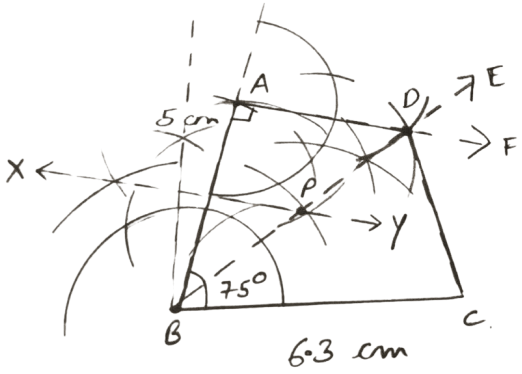
Since, PQ passes through point S.

By point-slope form,

Equation of line : y - y1 = m(x - x1)

⇒ y - 6 = 1(x - 0)

⇒ y - 6 = x

⇒ y = x + 6.

Hence, equation of line PQ is y = x + 6.

7(ii)Written · 2024 · Section B · 2024 SpecimenFull page

The angles of depression of two ships A and B on opposite sides of a light house of height 100 m are respectively 42° and 54°. The line joining the two ships passes through the foot of the light house.

(a) Find the distance between the two ships A and B.

(b) Give your final answer correct to the nearest whole number.

(Use mathematical tables for this question)

The angles of depression of two ships A and B on opposite sides of a light house of height 100 m are respectively 42° and 54°. The line joining the two ships passes through the foot of the light house. ICSE 2024 Maths Specimen Solved Question Paper.
Show SolutionHide Solution↓

Let ∠BCP = α and ∠ACP = β

The angles of depression of two ships A and B on opposite sides of a light house of height 100 m are respectively 42° and 54°. The line joining the two ships passes through the foot of the light house. ICSE 2024 Maths Specimen Solved Question Paper.

From figure,

⇒ α + 54° = 90°

⇒ α = 90° - 54° = 36°.

⇒ β + 42° = 90°

⇒ β = 90° - 42° = 48°.

⇒ tan α = $\frac{BP}{CP}$

⇒ tan 36° = $\frac{BP}{100}$

⇒ 0.7265 = $\frac{BP}{100}$

⇒ BP = 0.7265 × 100 = 72.65 m

⇒ tan β = $\frac{AP}{CP}$

⇒ tan 48° = $\frac{AP}{100}$

⇒ 1.1106 = $\frac{AP}{100}$

⇒ AP = 1.1106 × 100 = 111.06 m

(a) From figure,

AB = AP + BP = 72.65 + 111.06 = 183.71 m

Hence, the distance between two ships = 183.71 m.

(b) On rounding off,

AB = 184 m.

Hence, the distance between two ships = 184 m.

8(i)Written · 2024 · Section B · 2024 SpecimenFull page

Solve the following inequation and write the solution and represent it on the real number line.

3 - 2x ≥ x + $\frac{1 - x}{3}$ > $\frac{2x}{5}$, x ∈ R.

Show SolutionHide Solution↓

To prove:

3 - 2x ≥ x + $\frac{1 - x}{3}$ > $\frac{2x}{5}$

Solving L.H.S. of the above inequation, we get :

⇒ 3 - 2x ≥ x + $\frac{1 - x}{3}$

⇒ 3 - 2x ≥ $\frac{3x + 1 - x}{3}$

⇒ 3(3 - 2x) ≥ 2x + 1

⇒ 9 - 6x ≥ 2x + 1

⇒ 2x + 6x ≤ 9 - 1

⇒ 8x ≤ 8

⇒ x ≤ $\frac{8}{8}$

⇒ x ≤ 1 ............(1)

Solving R.H.S. of the above equation, we get :

⇒ x + $\frac{1 - x}{3} \gt \frac{2x}{5}$

⇒ $\frac{3x + 1 - x}{3} \gt \frac{2x}{5}$

⇒ 5(2x + 1) > 3 × 2x

⇒ 10x + 5 > 6x

⇒ 10x - 6x > -5

⇒ 4x > -5

⇒ x > $-\frac{5}{4}$ ...........(2)

From equation (1) and (2), we get :

Solution set = {x : $-\frac{5}{4}$ < x ≤ 1, x ∈ R}

Representation of solution set on real number line is :

Solve the following inequation and write the solution and represent it on the real number line. ICSE 2024 Maths Specimen Solved Question Paper.
8(ii)Written · 2024 · Section B · 2024 SpecimenFull page

ABCD is a cyclic quadrilateral in which BC = CD and EF is a tangent at A. ∠CBD = 43° and ∠ADB = 62°. Find :

(a) ∠ADC

(b) ∠ABD

(c) ∠FAD

ABCD is a cyclic quadrilateral in which BC = CD and EF is a tangent at A. ∠CBD = 43° and ∠ADB = 62°. Find : ICSE 2024 Maths Specimen Solved Question Paper.
Show SolutionHide Solution↓

(a) In △ BDC,

⇒ BC = CD (Equal sides)

⇒ ∠BDC = ∠DBC = 43° (Angles opposite to equal sides are equal)

From figure,

⇒ ∠ADC = ∠ADB + ∠BDC = 62° + 43° = 105°.

Hence, ∠ADC = 105°.

(b) We know that,

Opposite angles of a cyclic quadrilateral are supplementary.

⇒ ∠ABC + ∠ADC = 180°

⇒ ∠ABC + 105° = 180°

⇒ ∠ABC = 180° - 105° = 75°.

From figure,

⇒ ∠ABD = ∠ABC - ∠DBC = 75° - 43° = 32°.

Hence, ∠ABD = 32°.

(c) From figure,

⇒ ∠FAD = ∠ABD = 32°. (Angles in alternate segment are equal)

Hence, ∠FAD = 32°.

8(iii)Written · 2024 · Section B · 2024 SpecimenFull page

A(a, b), B(-4, 3) and C(8, -6) are the vertices of a △ ABC. Point D is on BC such that BD : DC is 2 : 1 and M(6, 0) is mid-point of AD. Find :

(a) coordinates of point D.

(b) coordinates of point A.

(c) equation of a line parallel to line BC, through M.

Show SolutionHide Solution↓

(a) Given,

BD : DC = 2 : 1.

A(a, b), B(-4, 3) and C(8, -6) are the vertices of a △ ABC. Point D is on BC such that BD : DC is 2 : 1 and M(6, 0) is mid-point of AD. Find : ICSE 2024 Maths Specimen Solved Question Paper.

Let coordinates of D be (x, y)

By section-formula,

(x, y) = $\Big(\frac{m_1x_2 + m_2x_1}{m_1 + m_2}, \frac{m_1y_2 + m_2y_1}{m_1 + m_2}\Big)$

Substituting values, we get :

$$\begin{aligned}\Rightarrow (x, y) = \Big(\frac{2 \times 8 + 1 \times (-4)}{2 + 1}, \frac{2 \times -6 + 1 \times 3}{2 + 1}\Big) \\[1em] \Rightarrow (x, y) = \Big(\frac{16 - 4}{3}, \frac{-12 + 3}{3}\Big) \\[1em] \Rightarrow (x, y) = \Big(\frac{12}{3}, \frac{-9}{3}\Big) \\[1em] \Rightarrow (x, y) = (4, -3).\end{aligned}$$

Hence, coordinates of D = (4, -3).

(b) By mid-point formula,

Mid-point = $\Big(\frac{x_1 + x_2}{2}, \frac{y_1 + y_2}{2}\Big)$

Given,

M(6, 0) is the mid-point of AD.

$$\begin{aligned}\therefore (6, 0) = \Big(\frac{a + 4}{2}, \frac{b + (-3)}{2}\Big) \\[1em] \Rightarrow (6, 0) = \Big(\frac{a + 4}{2}, \frac{b - 3}{2}\Big) \\[1em] \Rightarrow \frac{a + 4}{2} = 6 \text{ and } \frac{b - 3}{2} = 0 \\[1em] \Rightarrow a + 4 = 12 \text{ and } b - 3 = 0 \\[1em] \Rightarrow a = 12 - 4 = 8 \text{ and } b = 3.\end{aligned}$$

A = (a, b) = (8, 3).

Hence, coordinates of A = (8, 3).

(c) By formula,

Slope of line = $\frac{y_2 - y_1}{x_2 - x_1}$

Slope of line BC = $\frac{-6 - 3}{8 - (-4)} = \frac{-9}{12} = -\frac{3}{4}$.

We know that,

Slope of parallel lines are equal.

Slope of line parallel to BC = $-\frac{3}{4}$.

By point-slope form,

Equation of line : y - y1 = m(x - x1)

Equation of line parallel to BC and passing through M is :

⇒ y - 0 = $-\frac{3}{4}(x - 6)$

⇒ y = $-\frac{3}{4}(x - 6)$

⇒ 4y = -3(x - 6)

⇒ 4y = -3x + 18

⇒ 3x + 4y = 18.

Hence, equation of the required line is 3x + 4y = 18.

9(i)Written · 2024 · Section B · 2024 SpecimenFull page

Use componendo and dividendo to find the value of x, when :

$\frac{x^2 + 3x}{3x^2 + 1} = \frac{14}{13}$

Show SolutionHide Solution↓

Given,

$\frac{x^2 + 3x}{3x^2 + 1} = \frac{14}{13}$

Applying componendo and dividendo, we get :

$$\begin{aligned}\Rightarrow \frac{x^2 + 3x + 3x^2 + 1}{x^2 + 3x - (3x^2 + 1)} = \frac{14 + 13}{14 - 13} \\[1em] \Rightarrow \frac{x^2 + 3x + 3x^2 + 1}{x^2 + 3x - 3x^2 - 1}= \frac{27}{1} \\[1em] \Rightarrow \frac{(x + 1)^3}{(x - 1)^3} = \frac{3^3}{1^3} \\[1em] \Rightarrow \Big(\frac{x + 1}{x - 1}\Big)^3 = \Big(\frac{3}{1}\Big)^3 \\[1em] \Rightarrow \frac{x + 1}{x - 1} = 3 \\[1em] \Rightarrow x + 1 = 3(x - 1) \\[1em] \Rightarrow x + 1 = 3x - 3 \\[1em] \Rightarrow 3x - x = 1 + 3 \\[1em] \Rightarrow 2x = 4 \\[1em] \Rightarrow x = \frac{4}{2} = 2.\end{aligned}$$

Hence, x = 2.

9(ii)Written · 2024 · Section B · 2024 SpecimenFull page

The total expenses of a trip for certain number of people is ₹ 18,000. If three more people join them, then the share of each reduces by ₹ 3,000. Take x to be the original number of people, form a quadratic equation in x and solve it to find the value of x.

Show SolutionHide Solution↓

Let no. of people be x.

Total expense = ₹ 18,000

Expense per person = ₹ $\frac{18000}{x}$

Given,

If three more people join them, then the share of each reduces by ₹ 3,000.

No, of people now = x + 3

Expense per person = ₹ $\frac{18000}{x + 3}$

According to question,

$$\begin{aligned}\Rightarrow \frac{18000}{x} - \frac{18000}{x + 3} = 3000 \\[1em] \Rightarrow \frac{18000(x + 3) - 18000x}{x(x + 3)} = 3000 \\[1em] \Rightarrow \frac{18000x + 54000 - 18000x}{x^2 + 3x} = 3000 \\[1em] \Rightarrow \frac{54000}{x^2 + 3x} = 3000 \\[1em] \Rightarrow x^2 + 3x = \frac{54000}{3000} \\[1em] \Rightarrow x^2 + 3x = 18 \\[1em] \Rightarrow x^2 + 3x - 18 = 0 \\[1em] \Rightarrow x^2 + 6x - 3x - 18 = 0 \\[1em] \Rightarrow x(x + 6) - 3(x + 6) = 0 \\[1em] \Rightarrow (x - 3)(x + 6) = 0 \\[1em] \Rightarrow x - 3 = 0 \text{ or } x + 6 = 0 \\[1em] \Rightarrow x = 3 \text{ or } x = -6.\end{aligned}$$

Since, no. of people cannot be negative.

∴ x = 3.

Hence, original number of people = 3.

9(iii)Written · 2024 · Section B · 2024 SpecimenFull page

Using ruler and compass only construct ∠ABC = 60°, AB = 6 cm and BC = 5 cm.

(a) construct the locus of all points which are equidistant from AB and BC.

(b) construct the locus of all points equidistant from A and B.

(c) mark the point which satisfies both the conditions (a) and (b) as P.

Hence, construct a circle with center P and passing through A and B.

Show SolutionHide Solution↓

Steps of construction :

  1. Draw a line segment BC = 5 cm.

  2. Draw ∠DBC = 120°.

  3. From DB cut off AB = 6 cm.

  4. Draw BE the angle bisector of ∠ABC.

  5. Draw RS, the perpendicular bisector of AB.

  6. Mark point P, the intersection point of RS and BE.

  7. Taking P as center and PA or PB as radius draw a circle.

Using ruler and compass only construct ∠ABC = 60°, AB = 6 cm and BC = 5 cm. ICSE 2024 Maths Specimen Solved Question Paper.

(a) We know that,

The locus of points which are equidistant from two sides is the angular bisector of the angle between two sides.

Hence, required locus is BE.

(b) We know that,

The locus of points which are equidistant from two points is the perpendicular bisector of the line joining the two points.

Hence, required locus is RS.

(c) From figure,

Point P satisfies both the conditions (a) and (b).

10(i)Written · 2024 · Section B · 2024 SpecimenFull page

Using remainder and factor theorem, factorize completely, the given polynomial :

2x3 - 9x2 + 7x + 6.

Show SolutionHide Solution↓

Substituting x = 2, in the given polynomial, we get :

⇒ 2(2)3 - 9(2)2 + 7(2) + 6

⇒ 2 × 8 - 9 × 4 + 14 + 6

⇒ 16 - 36 + 20

⇒ -20 + 20

⇒ 0.

∴ x - 2 is the factor of the given polynomial.

On dividing 2x3 - 9x2 + 7x + 6 by x - 2, we get :

$$\begin{array}{l} \phantom{x - 2)}{\quad 2x^2 - 5x - 3} \\ x - 2\overline{\smash{\big)}\quad 2x^3 - 9x^2 + 7x + 6} \\ \phantom{x - 2)}\phantom{)}\underline{\underset{-}{+}2x^3 \underset{+}{-}4x^2} \\ \phantom{{x - 2}2x^3-4}-5x^2 + 7x \\ \phantom{{x - 2)}2x^3-4}\underline{\underset{+}{-}5x^2 \underset{-}{+} 10x} \\ \phantom{{x - 2)}31x^3-2+1}-3x + 6 \\ \phantom{{x - 2)}31x^3-2+11}\underline{\underset{+}{-}3x \underset{-}{+} 6} \\ \phantom{{x - 2)}31x^3-2+11+1}\times \end{array}$$

∴ 2x3 - 9x2 + 7x + 6 = (x - 2)(2x2 - 5x - 3)

= (x - 2)[2x2 - 6x + x - 3]

= (x - 2)[2x(x - 3) + 1(x - 3)]

= (x - 2)(2x + 1)(x - 3).

Hence, 2x3 - 9x2 + 7x + 6 = (x - 2)(2x + 1)(x - 3).

10(ii)Written · 2024 · Section B · 2024 SpecimenFull page

Each of the letter of the word "HOUSEWARMING" is written on cards and put in a bag. If a card is drawn at random from the bag after shuffling, what is the probability that the letter on the card is :

(a) a vowel

(b) one of the letters of the word SEWING

(c) not a letter from the word WEAR

Show SolutionHide Solution↓

Total no. of outcomes = No. of different letters in the word "HOUSEWARMING" = 12.

(a) No. of vowels in the given word = 5 (o, u, e, a, i)

∴ No. of favourable outcomes = 5

P(that the letter on card is a vowel) = $\frac{\text{No. of favourable outcomes}}{\text{No. of possible outcomes}} = \frac{5}{12}$.

Hence, the probability that the letter on the card is a vowel = $\frac{5}{12}$.

(b) No. of different letters in the word SEWING that are also present in the word HOUSEWARMING = 6

∴ No. of favourable outcomes = 6

P(that the letter on card is a letter of the word SEWING)

= $\frac{\text{No. of favourable outcomes}}{\text{No. of possible outcomes}} = \frac{6}{12} = \frac{1}{2}$.

Hence, the probability that the letter on the card is a letter of the word SEWING = $\frac{1}{2}$.

(c) No. of different letters in the word WEAR that are also present in the word HOUSEWARMING = 4

No. of letters that are not in word WEAR = 12 - 4 = 8

P(that the letter on the card is not a letter from the word)

= $\frac{\text{No. of favourable outcomes}}{\text{No. of possible outcomes}} = \frac{8}{12} = \frac{2}{3}$.

Hence, the probability that the letter on the card is not a letter of the word WEAR = $\frac{2}{3}$.

10(iii)Written · 2024 · Section B · 2024 SpecimenFull page

Use graph sheet for this question. Tek 2 cm = 1 unit along the axes.

(a) Plot A(1, 2), B(1, 1) and C(2, 1)

(b) Reflect A, B and C about y-axis and name them as A', B' and C'.

(c) Reflect A, B, C, A', B' and C' about x-axis and name them as A'', B'', C'', A''', B''' and C''' respectively.

(d) Join A, B, C, C'', B'', A'', A''', B''', C''', C', B' , A' and A to make it a closed figure.

Show SolutionHide Solution↓

Below graph shows all the required points:

Use graph sheet for this question. Tek 2 cm = 1 unit along the axes. ICSE 2024 Maths Specimen Solved Question Paper.
1(i)1 Mark · 2023 · Section A · 2023 PaperFull page

If $$\begin{bmatrix*}[r] 2 & 0 \\ 0 & 4 \end{bmatrix*}\begin{bmatrix*}[r] x \\ y \end{bmatrix*} = \begin{bmatrix*}[r] 2 \\ -8 \end{bmatrix*}$$, the values of x and y respectively are :

Show SolutionHide Solution↓

Solving,

$$\Rightarrow \begin{bmatrix*}[r] 2 & 0 \\ 0 & 4 \end{bmatrix*}\begin{bmatrix*}[r] x \\ y \end{bmatrix*} = \begin{bmatrix*}[r] 2 \\ -8 \end{bmatrix*} \\[1em] \Rightarrow \begin{bmatrix*}[r] 2.x + 0.y \\ 0.x + 4.y \end{bmatrix*} = \begin{bmatrix*}[r] 2 \\ -8 \end{bmatrix*} \\[1em] \Rightarrow \begin{bmatrix*}[r] 2x + 0 \\ 0 + 4y \end{bmatrix*} = \begin{bmatrix*}[r] 2 \\ -8 \end{bmatrix*} \\[1em] \Rightarrow \begin{bmatrix*}[r] 2x \\ 4y \end{bmatrix*} = \begin{bmatrix*}[r] 2 \\ -8 \end{bmatrix*} \\[1em] \Rightarrow 2x = 2 \text{ and } 4y = -8 \\[1em] \Rightarrow x = \frac{2}{2} \text{ and } y = -\frac{8}{4} \\[1em] \Rightarrow x = 1 \text{ and } y = -2.$$

Hence, Option 1 is the correct option.

1(ii)1 Mark · 2023 · Section A · 2023 PaperFull page

If x - 2 is a factor of x3 - kx - 12, then the value of k is :

Show SolutionHide Solution↓

By factor theorem,

If x - a is a factor of f(x), then f(a) = 0.

Given,

x - 2 is a factor of x3 - kx - 12

⇒ x - 2 = 0

⇒ x = 2.

∴ 23 - 2k - 12 = 0

⇒ 8 - 2k - 12 = 0

⇒ -2k - 4 = 0

⇒ 2k = -4

⇒ k = $-\frac{4}{2}$ = -2.

Hence, Option 3 is the correct option.

1(iii)1 Mark · 2023 · Section A · 2023 PaperFull page

In the given diagram, RT is a tangent touching the circle at S. If ∠PST = 30° and ∠SPQ = 60° then ∠PSQ is equal to :

In the given diagram, RT is a tangent touching the circle at S. If ∠PST = 30° and ∠SPQ = 60° then ∠PSQ is equal to : ICSE 2023 Maths Solved Question Paper.
Show SolutionHide Solution↓

We know that,

Angle between tangent and the chord at the point of contact is equal to angle of the alternate segment.

∴ ∠PQS = ∠PST = 30°

In the given diagram, RT is a tangent touching the circle at S. If ∠PST = 30° and ∠SPQ = 60° then ∠PSQ is equal to : ICSE 2023 Maths Solved Question Paper.

In △ PQS,

By angle sum property of triangle,

⇒ ∠PQS + ∠QPS + ∠PSQ = 180°

⇒ 30° + 60° + ∠PSQ = 180°

⇒ ∠PSQ + 90° = 180°

⇒ ∠PSQ = 180° - 90° = 90°.

Hence, Option 4 is the correct option.

1(iv)1 Mark · 2023 · Section A · 2023 PaperFull page

A letter is chosen at random from all the letters of the English alphabets. The probability that the letter chosen is a vowel, is :

Show SolutionHide Solution↓

All the letters of English alphabets have 5 vowels (a, e, i, o and u) and total number of English alphabets = 26.

Probability that letter chosen is a vowel = $\frac{\text{No. of vowels}}{\text{No. of alphabets}} = \frac{5}{26}$.

Hence, Option 2 is the correct option.

1(v)1 Mark · 2023 · Section A · 2023 PaperFull page

If 3 is a root of the quadratic equation x2 - px + 3 = 0 then p is equal to :

Show SolutionHide Solution↓

Given,

3 is a root of the quadratic equation x2 - px + 3 = 0

∴ 32 - 3p + 3 = 0

⇒ 9 - 3p + 3 = 0

⇒ 12 - 3p = 0

⇒ 3p = 12

⇒ p = $\frac{12}{3}$ = 4.

Hence, Option 1 is the correct option.

1(vi)1 Mark · 2023 · Section A · 2023 PaperFull page

In the given figure ∠BAP = ∠DCP = 70°, PC = 6 cm and CA = 4 cm, then PD : DB is :

In the given figure ∠BAP = ∠DCP = 70°, PC = 6 cm and CA = 4 cm, then PD : DB is : ICSE 2023 Maths Solved Question Paper.
Show SolutionHide Solution↓

Given,

∠BAP = ∠DCP = 70°

From figure,

∠BAP and ∠DCP are corresponding angles and since they are equal.

∴ AB // CD.

From figure,

PA = PC + AC = 6 + 4 = 10 cm.

In △ PAB and △ PCD,

⇒ ∠PAB = ∠PCD (Both equal to 70°)

⇒ ∠BPA = ∠DPC (Both are equal)

∴ △ PAB ~ △ PCD (By A.A. axiom)

We know that,

Corresponding sides of similar triangle are proportional to each other.

$$\begin{aligned}\Rightarrow \frac{PB}{PD} = \frac{PA}{PC} \\[1em] \Rightarrow \frac{PB}{PD} = \frac{10}{6} \\[1em] \Rightarrow \frac{PB}{PD} = \frac{5}{3}.\end{aligned}$$

Let PB = 5x and PD = 3x.

From figure,

DB = PB - PD = 5x - 3x = 2x.

$\Rightarrow \frac{PD}{DB} = \frac{3x}{2x} = \frac{3}{2}$

⇒ PD : DB = 3 : 2.

Hence, Option 3 is the correct option.

1(vii)1 Mark · 2023 · Section A · 2023 PaperFull page

The printed price of an article is ₹ 3080. If the rate of GST is 10% then the GST charged is :

Show SolutionHide Solution↓

GST charged = GST (%) × M.P.

= $\frac{10}{100} \times 3080$

= ₹ 308.

Hence, Option 2 is the correct option.

1(viii)1 Mark · 2023 · Section A · 2023 PaperFull page

(1 + sin A)(1 - sin A) is equal to :

Show SolutionHide Solution↓

Solving,

⇒ (1 + sin A)(1 - sin A)

⇒ 1 - sin A + sin A - sin2 A

⇒ 1 - sin2 A

⇒ cos2 A.

Hence, Option 4 is the correct option.

1(ix)1 Mark · 2023 · Section A · 2023 PaperFull page

The coordinates of the vertices of △ABC are respectively (-4, -2), (6, 2) and (4, 6). The centroid G of △ABC is :

Show SolutionHide Solution↓

By formula,

Centroid of triangle = $\Big(\frac{x_1 + x_2 + x_3}{3}, \frac{y_1 + y_2 + y_3}{3}\Big)$

Centroid of triangle ABC (G)

$$\begin{aligned}= \Big(\frac{-4 + 6 + 4}{3}, \frac{-2 + 2 + 6}{3}\Big) \\[1em] = \Big(\frac{6}{3}, \frac{6}{3}\Big) \\[1em] = (2, 2).\end{aligned}$$

Hence, Option 1 is the correct option.

1(x)1 Mark · 2023 · Section A · 2023 PaperFull page

The nth term of an Arithmetic Progression (A.P.) is 2n + 5. The 10th term is :

Show SolutionHide Solution↓

Given,

⇒ an = 2n + 5

⇒ a10 = 2(10) + 5 = 20 + 5 = 25.

Hence, Option 3 is the correct option.

1(xi)1 Mark · 2023 · Section A · 2023 PaperFull page

The mean proportional between 4 and 9 is :

Show SolutionHide Solution↓

Let x be the mean proportional between 4 and 9 then,

$$\begin{aligned}\Rightarrow \frac{4}{x} = \frac{x}{9} \\[1em] \Rightarrow x^2 = 4 \times 9 \\[1em] \Rightarrow x^2 = 36 \\[1em] \Rightarrow x = \sqrt{36} = 6.\end{aligned}$$

Hence, Option 2 is the correct option.

1(xii)1 Mark · 2023 · Section A · 2023 PaperFull page

Which of the following cannot be determined graphically for a grouped frequency distribution ?

Show SolutionHide Solution↓

We know that,

To determine mean we do not need any graphical method.

Hence, Option 4 is the correct option.

1(xiii)1 Mark · 2023 · Section A · 2023 PaperFull page

Volume of a cylinder of height 3 cm is 48π. Radius of the cylinder is :

Show SolutionHide Solution↓

Let radius of cylinder be r cm.

Given,

Height of cylinder (h) = 3 cm

By formula,

⇒ Volume of cylinder = πr2h

⇒ 3πr2 = 48π

⇒ 3r2 = 48

⇒ r2 = $\frac{48}{3}$

⇒ r2 = $\frac{48}{3}$

⇒ r2 = 16

⇒ r = $\sqrt{16}$ = 4 cm.

Hence, Option 3 is the correct option.

1(xiv)1 Mark · 2023 · Section A · 2023 PaperFull page

Naveen deposits ₹ 800 every month in a recurring deposit account for 6 months. If he receives ₹ 4884 at the time of maturity, then the interest he earns is :

Show SolutionHide Solution↓

By formula,

Interest earned = Maturity value - Sum deposited

= ₹ 4884 - ₹ (800 × 6)

= ₹ 4884 - ₹ 4800

= ₹ 84.

Hence, Option 1 is the correct option.

1(xv)1 Mark · 2023 · Section A · 2023 PaperFull page

The solution set for the inequation 2x + 4 ≤ 14, x ∈ W is :

Show SolutionHide Solution↓

Solving,

⇒ 2x + 4 ≤ 14

⇒ 2x ≤ 14 - 4

⇒ 2x ≤ 10

⇒ x ≤ $\frac{10}{2}$

⇒ x ≤ 5.

Since, x ∈ W,

∴ x = {0, 1, 2, 3, 4, 5}.

Hence, Option 2 is the correct option.

2(i)1 Mark · 2023 · Section A · 2023 PaperFull page

Find the value of 'a' if x - a is a factor of the polynomial 3x3 + x2 - ax - 81.

Show SolutionHide Solution↓

By factor theorem,

If x - a is a factor of f(x), then f(a) = 0.

Given,

x - a is a factor of the polynomial 3x3 + x2 - ax - 81.

⇒ x - a = 0

⇒ x = a.

∴ 3a3 + a2 - a.a - 81 = 0

⇒ 3a3 + a2 - a2 - 81 = 0

⇒ 3a3 - 81 = 0

⇒ 3a3 = 81

⇒ a3 = $\frac{81}{3}$

⇒ a3 = 27

⇒ a3 = 33

⇒ a = 3.

Hence, value of a = 3.

2(ii)1 Mark · 2023 · Section A · 2023 PaperFull page

Salman deposits ₹ 1,000 every month in a recurring deposit account for 2 years. If he receives ₹ 26,000 on maturity, find :

(a) total interest Salman earns

(b) the rate of interest.

Show SolutionHide Solution↓

(a) Given,

Salman deposits ₹ 1000 every month in a recurring deposit account for 2 years.

Total deposit = ₹ 1,000 × 2 × 12 = ₹ 24,000.

By formula,

Total interest earned = Maturity value - Total deposit

= ₹ 26,000 - ₹ 24,000

= ₹ 2,000.

Hence, interest earned = ₹ 2,000.

(b) Let rate of interest be r%. Time (n) = 24 months

By formula,

Interest = $\frac{P \times n \times (n + 1)}{2 \times 12} \times \frac{r}{100}$

Substituting values we get :

$$\begin{aligned}\Rightarrow 2000 = 1000 \times \frac{24 \times 25}{2 \times 12} \times \frac{r}{100} \\[1em] \Rightarrow 2000 = 1000 \times 25 \times \frac{r}{100} \\[1em] \Rightarrow 2000 = 250r \\[1em] \Rightarrow r = \frac{2000}{250} \\[1em] \Rightarrow r = 8%.\end{aligned}$$

Hence, rate of interest earned = 8%.

2(iii)1 Mark · 2023 · Section A · 2023 PaperFull page

In the given figure O, is the center of the circle. CE is a tangent to the circle at A. If ∠ABD = 26°, then find :

(a) ∠BDA

(b) ∠BAD

(c) ∠CAD

(d) ∠ODB

In the given figure O, is the center of the circle. CE is a tangent to the circle at A. If ∠ABD = 26°, then find : ICSE 2023 Maths Solved Question Paper.
Show SolutionHide Solution↓

(a) We know that,

Angle in a semi-circle is a right angle.

∴ ∠BDA = 90°.

Hence, ∠BDA = 90°.

(b) In △ BAD,

By angle sum property of triangle,

⇒ ∠BDA + ∠BAD + ∠ABD = 180°

⇒ 90° + ∠BAD + 26° = 180°

⇒ ∠BAD + 116° = 180°

⇒ ∠BAD = 180° - 116° = 64°.

Hence, ∠BAD = 64°.

(c) From figure,

CE is tangent to the circle.

Angle between tangent and radius of the circle is 90°.

From figure,

⇒ ∠CAD + ∠BAD = 90°

⇒ ∠CAD + 64° = 90°

⇒ ∠CAD = 90° - 64° = 26°.

Hence, ∠CAD = 26°.

(d) Join OD.

In the given figure O, is the center of the circle. CE is a tangent to the circle at A. If ∠ABD = 26°, then find : ICSE 2023 Maths Solved Question Paper.

In △ OBD,

⇒ OD = OB (Radius of same circle)

We know that,

Angles opposite to equal sides are equal.

⇒ ∠ODB = ∠OBD = 26°.

Hence, ∠ODB = 26°.

3(i)1 Mark · 2023 · Section A · 2023 PaperFull page

Solve the following quadratic equation :

x2 + 4x - 8 = 0.

Give your answer correct to one decimal place.

Show SolutionHide Solution↓

Comparing x2 + 4x - 8 = 0 with ax2 + bx + c, we get :

a = 1, b = 4 and c = -8.

By formula,

$$\begin{aligned}\Rightarrow x = \frac{-b \pm \sqrt{b^2 - 4ac}}{2a} \\[1em] = \frac{-4 \pm \sqrt{4^2 - 4 \times 1 \times (-8)}}{2 \times 1} \\[1em] = \frac{-4 \pm \sqrt{16 + 32}}{2} \\[1em] = \frac{-4 \pm \sqrt{48}}{2} \\[1em] = \frac{-4 \pm 4\sqrt{3}}{2} \\[1em] = -2 \pm 2\sqrt{3} \\[1em] = -2 \pm 2 \times 1.732 \\[1em] = -2 \pm 3.464 \\[1em] = -2 + 3.464 \text{ or } -2 - 3.464 \\[1em] = 1.464 \text{ or } -5.464 \\[1em] = 1.5 \text{ or } -5.5\end{aligned}$$

Hence, x = 1.5 or 5.5

3(ii)1 Mark · 2023 · Section A · 2023 PaperFull page

Prove the following identity :

(sin2 θ - 1)(tan2 θ + 1) + 1 = 0

Show SolutionHide Solution↓

Solving L.H.S. of the given equation :

⇒ (sin2 θ - 1)(tan2 θ + 1) + 1

⇒ (1 - cos2 θ - 1).sec2 θ + 1

⇒ -cos2 θ. sec2 θ + 1

⇒ -cos2 θ $\times \frac{1}{\text{cos}^2 \text{θ}}$ + 1

⇒ -1 + 1

⇒ 0.

Since, L.H.S. = R.H.S.

Hence, proved that (sin2 θ - 1)(tan2 θ + 1) + 1 = 0.

3(iii)1 Mark · 2023 · Section A · 2023 PaperFull page

Use graph sheet to answer this question. Take 2 cm = 1 unit along both the axes.

(a) Plot A, B, C where A(0, 4), B(1, 1) and C(4, 0).

(b) Reflect A and B on the x-axis and name them as E and D respectively.

(c) Reflect B through the origin and name it F. Write down the coordinates of F.

(d) Reflect B and C on the y-axis and name them as H and G respectively.

(e) Join points A, B, C, D, E, F, G, H and A in order and name the closed figure formed.

Show SolutionHide Solution↓

The points are shown in the graph below:

Use graph sheet to answer this question. Take 2 cm = 1 unit along both the axes. ICSE 2023 Maths Solved Question Paper.

(c) From graph,

F = (-1, -1)

Hence, co-ordinates of F = (-1, -1).

(e) From graph,

The closed figure formed is a star.

4(i)Written · 2023 · Section B · 2023 PaperFull page

If $$A = \begin{bmatrix*}[r] 1 & 3 \\ 2 & 4 \end{bmatrix*}, B = \begin{bmatrix*}[r] 1 & 2 \\ 2 & 4 \end{bmatrix*}, C = \begin{bmatrix*}[r] 4 & 1 \\ 1 & 5 \end{bmatrix*} \text{ and } I = \begin{bmatrix*}[r] 1 & 0 \\ 0 & 1 \end{bmatrix*}$$. Find A(B + C) - 14I.

Show SolutionHide Solution↓

B + C = $$\begin{bmatrix*}[r] 1 & 2 \\ 2 & 4 \end{bmatrix*} + \begin{bmatrix*}[r] 4 & 1 \\ 1 & 5 \end{bmatrix*} = \begin{bmatrix*}[r] 5 & 3 \\ 3 & 9 \end{bmatrix*}$$

Substituting values we get :

$$A(B + C) - 14I = \begin{bmatrix*}[r] 1 & 3 \\ 2 & 4 \end{bmatrix*}\begin{bmatrix*}[r] 5 & 3 \\ 3 & 9 \end{bmatrix*} - 14\begin{bmatrix*}[r] 1 & 0 \\ 0 & 1 \end{bmatrix*} \\[1em] = \begin{bmatrix*}[r] 1 \times 5 + 3 \times 3 & 1 \times 3 + 3 \times 9 \\ 2 \times 5 + 4 \times 3 & 2 \times 3 + 4 \times 9 \end{bmatrix*} - \begin{bmatrix*}[r] 14 & 0 \\ 0 & 14 \end{bmatrix*} \\[1em] = \begin{bmatrix*}[r] 5 + 9 & 3 + 27 \\ 10 + 12 & 6 + 36 \end{bmatrix*} - \begin{bmatrix*}[r] 14 & 0 \\ 0 & 14 \end{bmatrix*} \\[1em] = \begin{bmatrix*}[r] 14 & 30 \\ 22 & 42 \end{bmatrix*} - \begin{bmatrix*}[r] 14 & 0 \\ 0 & 14 \end{bmatrix*} \\[1em] = \begin{bmatrix*}[r] 14 - 14 & 30 - 0 \\ 22 - 0 & 42 - 14 \end{bmatrix*} \\[1em] = \begin{bmatrix*}[r] 0 & 30 \\ 22 & 28 \end{bmatrix*}.$$

Hence, A(B + C) - 14I = $$\begin{bmatrix*}[r] 0 & 30 \\ 22 & 28 \end{bmatrix*}.$$

4(ii)Written · 2023 · Section B · 2023 PaperFull page

ABC is a triangle whose vertices are A(1, -1), B(0, 4) and C(-6, 4), D is the mid-point of BC. Find the :

(a) coordinates of D.

(b) equation of the median AD.

Show SolutionHide Solution↓

(a) By formula,

Mid-point (M) = $\Big(\frac{x_1 + x_2}{2}, \frac{y_1 + y_2}{2}\Big)$

ABC is a triangle whose vertices are A(1, -1), B(0, 4) and C(-6, 4), D is the mid-point of BC. Find the : ICSE 2023 Maths Solved Question Paper.

Given,

D is the mid-point of BC.

$$\begin{aligned}\therefore \text{Co-ordinates of D} = \Big(\frac{0 + (-6)}{2}, \frac{4 + 4}{2}\Big) \\[1em] = \Big(\frac{-6}{2}, \frac{8}{2}\Big) \\[1em] = (-3, 4).\end{aligned}$$

Hence, co-ordinates of D = (-3, 4).

(b) By two-point form :

Equation of a line :

y - y1 = $\frac{y_2 - y_1}{x_2 - x_1}(x - x_1)$

Substituting values we get :

Equation of AD :

⇒ y - (-1) = $\frac{4 - (-1)}{(-3) - 1}(x - 1)$

⇒ y + 1 = $\frac{5}{-4}(x - 1)$

⇒ -4(y + 1) = 5(x - 1)

⇒ -4y - 4 = 5x - 5

⇒ 5x + 4y = -4 + 5

⇒ 5x + 4y = 1.
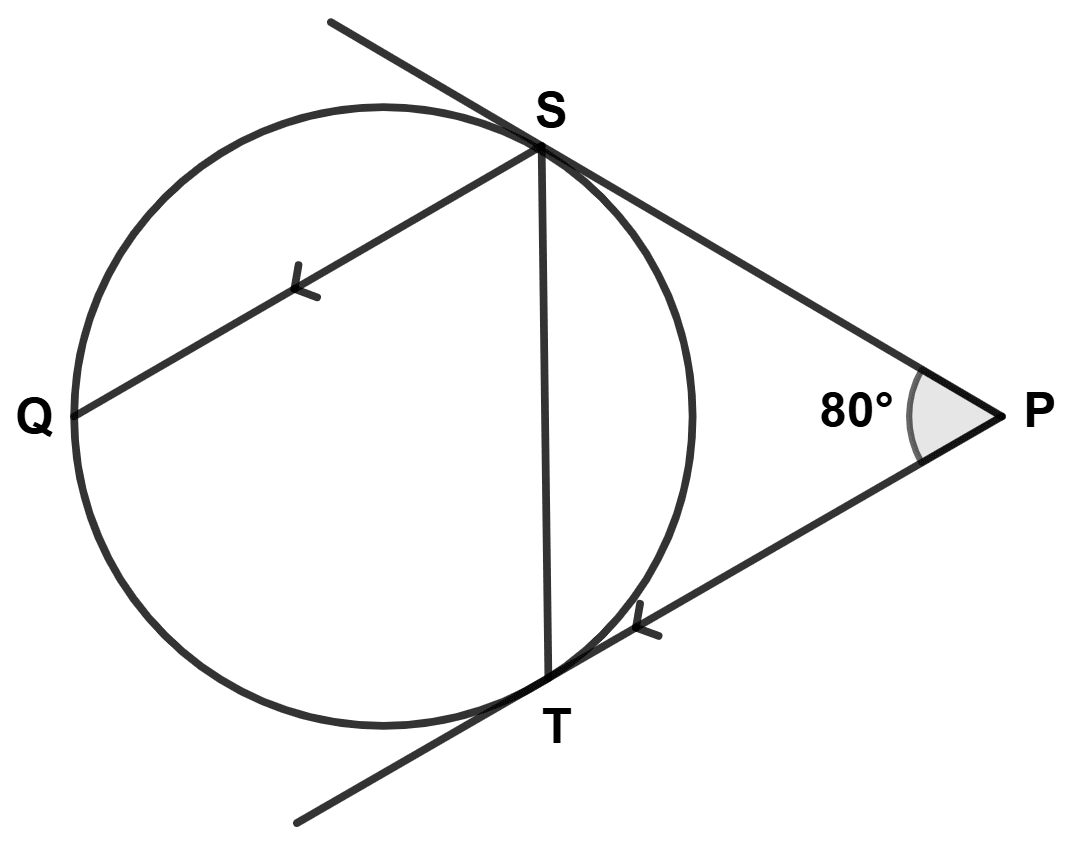
Hence, equation of median AD is 5x + 4y = 1.
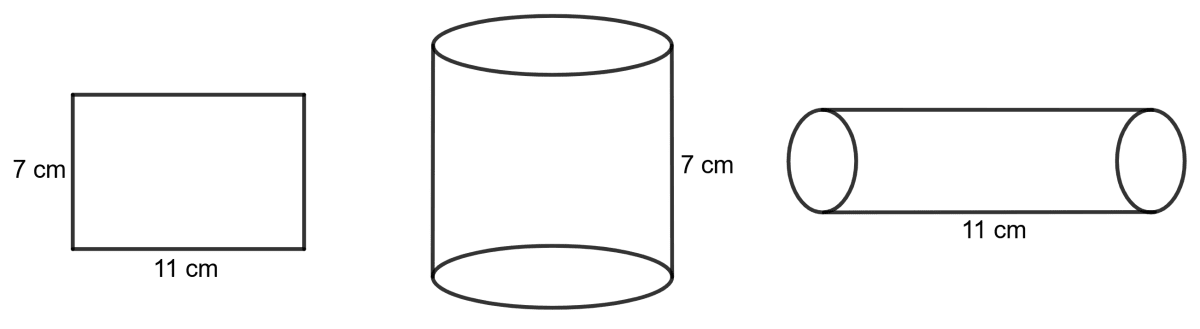
4(iii)Written · 2023 · Section B · 2023 PaperFull page

In the given figure, O is the center of the circle. PQ is a tangent to the circle at T. Chord AB produced meets the tangent at P. AB = 9 cm, BP = 16 cm, ∠PTB = 50°, ∠OBA = 45°. Find :

(a) length of PT

(b) ∠BAT

(c) ∠BOT

(d) ∠ABT

In the given figure, O is the center of the circle. PQ is a tangent to the circle at T. Chord AB produced meets the tangent at P. AB = 9 cm, BP = 16 cm, ∠PTB = 50°, ∠OBA = 45°. Find : ICSE 2023 Maths Solved Question Paper.
Show SolutionHide Solution↓

(a) We know that,

If a chord and a tangent intersect externally, then the product of the lengths of the segments of the chord is equal to the square of the length of the tangent from the point of contact to the point of intersection.

Since, PT is tangent from point P and PAB is secant.

∴ PT2 = PA × PB

⇒ PT2 = (9 + 16) × 16

⇒ PT2 = 25 × 16

⇒ PT2 = 400

⇒ PT = $\sqrt{400}$ = 20 cm.

Hence, PT = 20 cm.

(b) Since, angle between tangent and chord at point of contact is equal to angle of alternative segment.

∴ ∠BAT = ∠PTB = 50°.

Hence, ∠BAT = 50°.

(c) We know that,

Angle subtended by an arc at the centre of the circle is twice the angle subtended by the same arc at some point on the remaining circumference.

∴ ∠BOT = 2 × ∠BAT = 2 × 50° = 100°.

Hence, ∠BOT = 100°.

(d) From figure,

⇒ OB = OT (Radii of same circle)

⇒ ∠OBT = ∠OTB = x (let) (Angles opposite to equal sides are equal)

In △ BOT,

By angle sum property of triangle,

⇒ ∠OBT + ∠OTB + ∠BOT = 180°

⇒ x + x + 100° = 180°

⇒ 2x = 180° - 100°

⇒ 2x = 80°

⇒ x = $\frac{80°}{2}$ = 40°.

∴ ∠OBT = 40°

From figure,

⇒ ∠ABT = ∠ABO + ∠OBT = 45° + 40° = 85°.

Hence, ∠ABT = 85°.

5(i)Written · 2023 · Section B · 2023 PaperFull page

Mrs. Arora bought the following articles from a departmental store :

S.No.ItemPriceRate of GSTDiscount
1Hair oil₹ 120018%₹ 100
2Cashew nuts₹ 60012%-

Find the :

(a) Total GST paid.

(b) Total bill amount including GST.

Show SolutionHide Solution↓

(a) By formula,

GST on an article = (Price of item - Discount) × Rate of GST

GST on hair oil = (1200 - 100) × 18%

= 1100 × $\frac{18}{100}$

= 11 × 18

= ₹ 198.

GST on cashew nuts = (600 - 0) × 12%

= 600 × $\frac{12}{100}$

= 6 × 12

= ₹ 72.

Total GST paid = ₹ 198 + ₹ 72 = ₹ 270.

Hence, total GST paid = ₹ 270.

(b) Total bill amount including GST = Total cost price + Total GST paid

= [(₹ 1200 - ₹ 100) + ₹ 600] + ₹ 270

= ₹ 1100 + ₹ 600 + ₹ 270

= ₹ 1970.

Hence, total bill amount = ₹ 1970.

5(ii)Written · 2023 · Section B · 2023 PaperFull page

Solve the following inequation. Write down the solution set and represent it on the real number line.

-5(x - 9) ≥ 17 - 9x > x + 2, x ∈ R.

Show SolutionHide Solution↓

Given, equation :

-5(x - 9) ≥ 17 - 9x > x + 2

Solving L.H.S. of the given equation :

⇒ -5(x - 9) ≥ 17 - 9x

⇒ -5x + 45 ≥ 17 - 9x

⇒ -5x + 9x ≥ 17 - 45

⇒ 4x ≥ -28

⇒ x ≥ $-\frac{28}{4}$

⇒ x ≥ -7 ............(1)

Solving L.H.S. of the given equation :

⇒ 17 - 9x > x + 2

⇒ x + 9x < 17 - 2

⇒ 10x < 15

⇒ x < $\frac{15}{10}$

⇒ x < $\frac{3}{2}$

⇒ x < 1.5 .............(2)

From equation (1) and (2), we get :

Solution set : {x : -7 ≤ x < 1.5}

Solution set on the number line :

Solve the following inequation. Write down the solution set and represent it on the real number line. ICSE 2023 Maths Solved Question Paper.
5(iii)Written · 2023 · Section B · 2023 PaperFull page

In the given figure, AC // DE // BF. If AC = 24 cm, EG = 8 cm, GB = 16 cm, BF = 30 cm.

(a) Prove △ GED ~ △ GBF

(b) Find DE

(c) Find DB : AB.

In the given figure, AC // DE // BF. If AC = 24 cm, EG = 8 cm, GB = 16 cm, BF = 30 cm. ICSE 2023 Maths Solved Question Paper.
Show SolutionHide Solution↓

(a) Given,

DE // BF

∴ ∠DEG = ∠GBF (Alternate angles are equal)

∠EDG = ∠GFB (Alternate angles are equal)

⇒ △GED ~ △ GBF (By A.A. axiom)

Hence, proved that △GED ~ △ GBF.

(b) We know that,

Corresponding sides of similar triangle are proportional.

Since, △ GED ~ △ GBF

$$\begin{aligned}\Rightarrow \frac{DE}{BF} = \frac{EG}{BG} \\[1em] \Rightarrow \frac{DE}{30} = \frac{8}{16} \\[1em] \Rightarrow DE = 30 \times \frac{8}{16} \\[1em] \Rightarrow DE = 15 \text{ cm}.\end{aligned}$$

Hence, DE = 15 cm.

(c) In △ BAC and △ BDE,

⇒ ∠BAC = ∠BDE (Corresponding angles are equal)

⇒ ∠ABC = ∠DBE (Common angle)

⇒ △ BAC ~ △ BDE (By A.A. axiom)

We know that,

Corresponding sides of similar triangle are proportional.

Since, △ BAC ~ △ BDE

$$\begin{aligned}\Rightarrow \frac{AB}{BD} = \frac{AC}{DE} \\[1em] \Rightarrow \frac{BD}{AB} = \frac{DE}{AC} \\[1em] \Rightarrow \frac{BD}{AB} = \frac{15}{24} \\[1em] \Rightarrow \frac{BD}{AB} = \frac{5}{8}\end{aligned}$$

⇒ BD : AB = 5 : 8.

Hence, BD : AB = 5 : 8.

6(i)Written · 2023 · Section B · 2023 PaperFull page

The following distribution gives the daily wages of 60 workers of a factory.

Daily income in ₹Number of workers
200-3006
300-40010
400-50014
500-60016
600-70010
700-8004

Use graph paper to answer this question.

Take 2 cm = ₹ 100 along one axis and 2 cm = 2 workers along the other axis. Draw a histogram and hence find the mode of the give distribution.

Show SolutionHide Solution↓

Steps of construction :

  1. Draw a histogram of the given distribution.
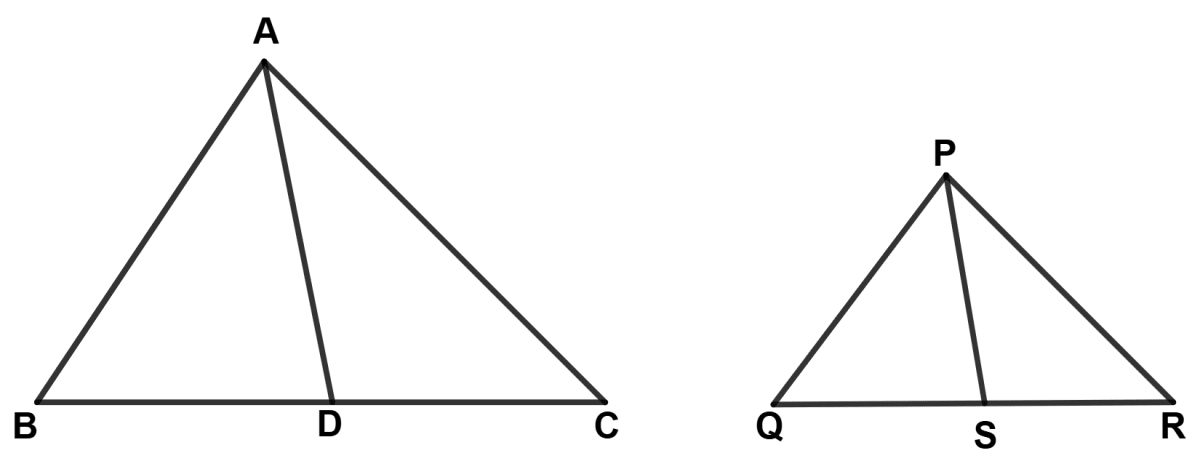
  2. Inside the highest rectangle, which represents the maximum frequency (or modal class), draw two lines AC and BD diagonally from the upper corners C and D of adjacent rectangles.

  3. Through the point K (the point of intersection of diagonals AC and BD), draw KL perpendicular to the horizontal axis.

  4. The value of point L on the horizontal axis represents the value of mode.

The following distribution gives the daily wages of 60 workers of a factory. ICSE 2023 Maths Solved Question Paper.

From graph,

L = ₹ 530

Hence, required mode = ₹ 530.

6(ii)Written · 2023 · Section B · 2023 PaperFull page

The 5th and 9th term of an Arithmetic Progression are 4 and -12 respectively. Find :

(a) the first term

(b) common difference

(c) sum of 16 terms of the A.P.

Show SolutionHide Solution↓

If first term is a and common difference is d of the A.P.

By formula,

nth term = an = a + (n - 1)d

Given,

⇒ 5th term = 4

⇒ a5 = 4

⇒ a + (5 - 1)d = 4

⇒ a + 4d = 4 .........(1)

⇒ 9th term = -12

⇒ a9 = -12

⇒ a + (9 - 1)d = -12

⇒ a + 8d = -12 .........(2)

Subtracting equation (1) from (2), we get :

⇒ (a + 8d) - (a + 4d) = -12 - 4

⇒ a - a + 8d - 4d = -16

⇒ 4d = -16

⇒ d = $-\frac{16}{4}$

⇒ d = -4.

Substituting value of d in equation (1), we get :

⇒ a + 4d = 4

⇒ a + 4(-4) = 4

⇒ a - 16 = 4

⇒ a = 4 + 16 = 20.

(a) Hence, first term of A.P. = 20.

(b) Common difference of A.P. = -4.

(c) By formula,

Sum of n terms of A.P. = $\frac{n}{2}(a + l)$

Sum of 16 terms of A.P. = $\frac{n}{2}(a + a_{16})$

$$\begin{aligned}= \frac{16}{2}[a + a + (16 - 1)d] \\[1em] = 8(2a + 15d) \\[1em] = 8 \times (2 \times 20 + 15 \times -4) \\[1em] = 8 \times (40 - 60) \\[1em] = 8 \times -20 \\[1em] = -160.\end{aligned}$$

Hence, sum of 16 terms of A.P. = -160.

6(iii)Written · 2023 · Section B · 2023 PaperFull page

A and B are two points on the x-axis and y-axis respectively.

A and B are two points on the x-axis and y-axis respectively. ICSE 2023 Maths Solved Question Paper.

(a) Write down the co-ordinates of A and B.

(b) P is a point on AB such that AP : PB = 3 : 1. Using section formula find the coordinates of point P.
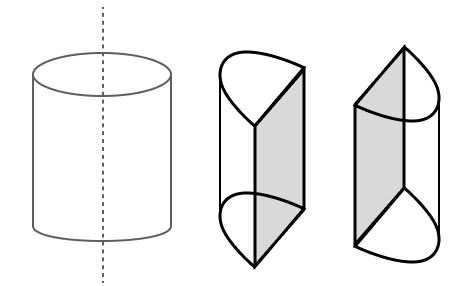
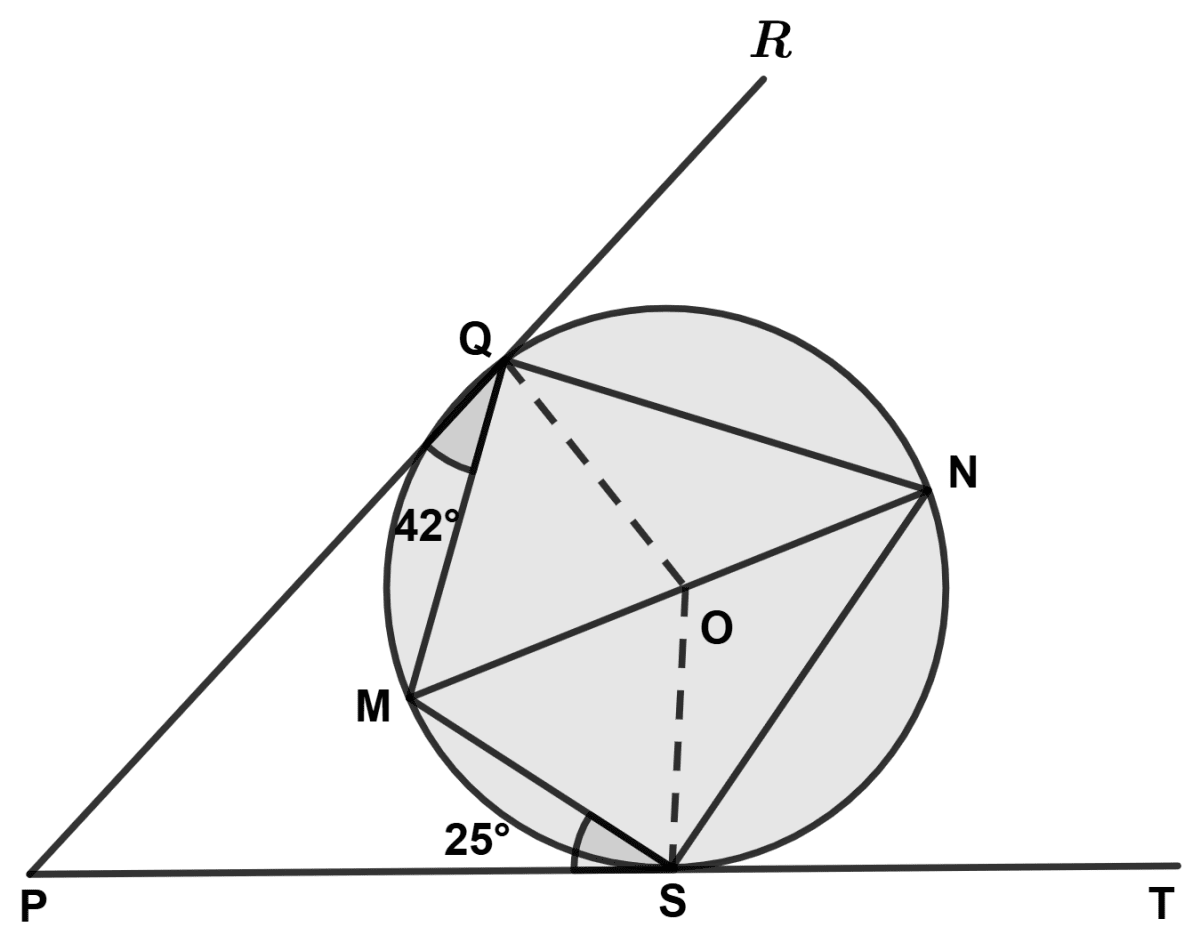
(c) Find the equation of a line passing through P and perpendicular to AB.

Show SolutionHide Solution↓

(a) From figure,

A = (4, 0) and B = (0, 4).

(b) Let coordinates of P be (x, y).

By section formula,

(x, y) = $\Big(\frac{m_1x_2 + m_2x_1}{m_1 + m_2}, \frac{m_1y_2 + m_2y_1}{m_1 + m_2}\Big)$

Substituting values we get :

$$\begin{aligned}\Rightarrow (x, y) = \Big(\frac{3 \times 0 + 1 \times 4}{3 + 1}, \frac{3 \times 4 + 1 \times 0}{3 + 1}\Big) \\[1em] = \Big(\frac{0 + 4}{4}, \frac{12 + 0}{4}\Big) \\[1em] = \Big(\frac{4}{4}, \frac{12}{4}\Big) \\[1em] = (1, 3).\end{aligned}$$

Hence, coordinates of P = (1, 3).

(c) By formula,

Slope = $\frac{y_2 - y_1}{x_2 - x_1}$

Substituting values we get :

Slope of AB = $\frac{4 - 0}{0 - 4} = \frac{4}{-4}$ = -1.

We know that,

Product of slope of perpendicular lines = -1.

∴ Slope of AB × Slope of line perpendicular to AB = -1

⇒ -1 × Slope of line perpendicular to AB = -1

⇒ Slope of line perpendicular to AB = $\frac{-1}{-1}$ = 1.

Line passing through P and perpendicular to AB :

⇒ y - y1 = m(x - x1)

⇒ y - 3 = 1(x - 1)

⇒ y - 3 = x - 1

⇒ y = x - 1 + 3

⇒ y = x + 2.

Hence, required equation is y = x + 2.

7(i)Written · 2023 · Section B · 2023 PaperFull page

A bag contains 25 cards, numbered through 1 to 25. A card is drawn at random. What is the probability that the number on the card drawn is :

(a) a multiple of 5

(b) a perfect square

(c) a prime number ?

Show SolutionHide Solution↓

Total number of outcomes = 25

(a) Number of multiples of 5 between 1 to 25 = 5 (5, 10, 15, 20, 25).

P(that number on card is a multiples of 5)

= $\frac{\text{No. of multiples of 5}}{\text{Total number of outcomes}} = \frac{5}{25} = \frac{1}{5}$.

Hence, the required probability is $\frac{1}{5}$.

(b) Number of perfect squares between 1 to 25 = 5 (1, 4, 9, 16, 25).

P(that number on card is a perfect square)

= $\frac{\text{No. of perfect squares}}{\text{Total number of outcomes}} = \frac{5}{25} = \frac{1}{5}$.

Hence, the required probability is $\frac{1}{5}$.

(c) Number of prime numbers between 1 to 25 = 9 (2, 3, 5, 7, 11, 13, 17, 19, 23).

P(that number is a prime number)

= $\frac{\text{No. of prime numbers}}{\text{Total number of outcomes}} = \frac{9}{25}$.

Hence, the required probability is $\frac{9}{25}$.

7(ii)Written · 2023 · Section B · 2023 PaperFull page

A man covers a distance of 100 km, travelling with a uniform speed of x km/hr. Had the speed been 5 km/hr more it would have taken 1 hour less. Find x the original speed.

Show SolutionHide Solution↓

In first case :

Distance = 100 km

Speed = x km/hr

Time = $\frac{\text{Distance}}{\text{Speed}} = \frac{100}{x}$

In second case :

Distance = 100 km

Speed = (x + 5) km/hr

Time = $\frac{\text{Distance}}{\text{Speed}} = \frac{100}{x + 5}$

According to question,

The difference between the time taken between first and second case is 1 hour.

$$\begin{aligned}\therefore \frac{100}{x} - \frac{100}{x + 5} = 1 \\[1em] \Rightarrow \frac{100(x + 5) - 100x}{x(x + 5)} = 1 \\[1em] \Rightarrow \frac{100x + 500 - 100x}{x^2 + 5x} = 1 \\[1em] \Rightarrow \frac{500}{x^2 + 5x} = 1 \\[1em] \Rightarrow 500 = x^2 + 5x \\[1em] \Rightarrow x^2 + 5x - 500 = 0 \\[1em] \Rightarrow x^2 + 25x - 20x - 500 = 0 \\[1em] \Rightarrow x(x + 25) - 20(x + 25) = 0 \\[1em] \Rightarrow (x - 20)(x + 25) = 0 \\[1em] \Rightarrow x - 20 = 0 \text{ or } x + 25 = 0 \\[1em] \Rightarrow x = 20 \text{ or } x = -25.\end{aligned}$$

Since, speed cannot be negative.

∴ x = 20 km/hr.

Hence, original speed = 20 km/hr.

7(iii)Written · 2023 · Section B · 2023 PaperFull page

A solid is in the shape of a hemisphere of radius 7 cm, surmounted by a cone of height 4 cm. The solid is immersed completely in a cylindrical container filled with water to a certain height so that the solid is completely submerged in water. If the radius of the cylinder is 14 cm, find the rise in the water level.

A solid is in the shape of a hemisphere of radius 7 cm, surmounted by a cone of height 4 cm. The solid is immersed completely in a cylindrical container filled with water to a certain height so that the solid is completely submerged in water. If the radius of the cylinder is 14 cm, find the rise in the water level. ICSE 2023 Maths Solved Question Paper.
Show SolutionHide Solution↓

Let the rise in water level be x cm.

∴ Volume of water that rises by x cm in the cylindrical container = Volume of hemisphere submerged + Volume of cone submerged

⇒ π × (14)2 × x = $\frac{2}{3} \times π \times 7^3 + \frac{1}{3} \times π \times 7^2 \times 4$

⇒ 196πx = $\frac{2}{3} \times π \times 343 + \frac{1}{3} \times π \times 196$

⇒ 196x = $\frac{2}{3} \times 343 + \frac{1}{3} \times 196$

⇒ 196x = $\frac{686 + 196}{3}$

⇒ 196x = $\frac{882}{3}$

⇒ x = $\frac{882}{3 \times 196} = \frac{882}{588}$ = 1.5 cm.

Hence, rise in water level = 1.5 cm

8(i)Written · 2023 · Section B · 2023 PaperFull page

The following table gives the marks scored by a set of students in an examination. Calculate the mean of the distribution by using the short cut method.

MarksNumber of students (f)
0-103
10-208
20-3014
30-409
40-504
50-602
Show SolutionHide Solution↓
MarksNumber of students (f)Class marks (x)Deviation from assumed mean (A) (d = x - A)f × d
0-1035-20-60
10-20815-10-80
20-3014A = 2500
30-409351090
40-504452080
50-602553060
TotalΣf = 40Σfd = 90

By formula,

Mean = A + $\frac{Σfd}{Σf} = 25 + \frac{90}{40}$

= 25 + 2.25

= 27.25

Hence, required mean = 27.25

8(ii)Written · 2023 · Section B · 2023 PaperFull page

What number must be added to each of the number 4, 6, 8, 11 in order to get the four numbers in proportion ?

Show SolutionHide Solution↓

Let x be added to each number.

So, 4 + x, 6 + x, 8 + x and 11 + x must be in proportion.

$$\begin{aligned}\therefore \frac{4 + x}{6 + x} = \frac{8 + x}{11 + x} \\[1em] \Rightarrow (4 + x) \times (11 + x) = (8 + x) \times (6 + x) \\[1em] \Rightarrow 44 + 4x + 11x + x^2 = 48 + 8x + 6x + x^2\\[1em] \Rightarrow 44 + 15x + x^2 = 48 + 14x + x^2 \\[1em] \Rightarrow 15x - 14x = 48 - 44 \\[1em] \Rightarrow x = 4.\end{aligned}$$

Hence, required number is 4.

8(iii)Written · 2023 · Section B · 2023 PaperFull page

Using ruler and compass construct a triangle ABC in which AB = 6 cm. ∠BAC = 120° and AC = 5 cm. Construct a circle passing through A, B and C. Measure and write down the radius of the circle.

Show SolutionHide Solution↓

Steps of construction :

  1. Draw AB = 6 cm.

  2. Draw AP so that angle BAP = 120°.

  3. From AP cut AC = 5 cm ⇒ ∠BAC = 120°.

  4. Join B and C to get triangle ABC.

  5. Draw perpendicular bisectors of AB and AC which cut each other at point O.

  6. With O as center and OA (or OB or OC) as radius draw circle which passes through points A, B and C.

Using ruler and compass construct a triangle ABC in which AB = 6 cm. ∠BAC = 120° and AC = 5 cm. Construct a circle passing through A, B and C. Measure and write down the radius of the circle. ICSE 2023 Maths Solved Question Paper.

Hence, radius of circle obtained = 5 cm.

9(i)Written · 2023 · Section B · 2023 PaperFull page

Using componendo and dividendo solve for x : $\frac{\sqrt{2x + 2} + \sqrt{2x - 1}}{\sqrt{2x + 2} - \sqrt{2x - 1}} = 3$.

Show SolutionHide Solution↓

Given : $\frac{\sqrt{2x + 2} + \sqrt{2x - 1}}{\sqrt{2x + 2} - \sqrt{2x - 1}} = 3$

Applying componendo and dividendo, we get :

$$\begin{aligned}\Rightarrow \frac{\sqrt{2x + 2} + \sqrt{2x - 1} + \sqrt{2x + 2} - \sqrt{2x - 1}}{\sqrt{2x + 2} + \sqrt{2x - 1} - (\sqrt{2x + 2} - \sqrt{2x - 1})} = \frac{3 + 1}{3 - 1} \\[1em] \Rightarrow \frac{2\sqrt{2x + 2}}{2\sqrt{2x - 1}} = \frac{4}{2} \\[1em] \Rightarrow \frac{\sqrt{2x + 2}}{\sqrt{2x - 1}} = 2 \\[1em] \Rightarrow \sqrt{2x + 2} = 2\sqrt{2x - 1}\end{aligned}$$

Squaring both sides we get :

⇒ 2x + 2 = 4(2x - 1)

⇒ 2x + 2 = 8x - 4

⇒ 8x - 2x = 2 + 4

⇒ 6x = 6

⇒ x = $\frac{6}{6}$ = 1.

Hence, x = 1.

9(ii)Written · 2023 · Section B · 2023 PaperFull page

Which term of the Arithmetic Progression (A.P.) 15, 30, 45, 60 ..... is 300 ? Hence find the sum of all terms of the Arithmetic Progression (A.P.).

Show SolutionHide Solution↓

Given,

A.P. : 15, 30, 45, 60 .....

First term (a) = 15

Common difference (d) = 30 - 15 = 15

Let nth term be 300.

⇒ an = 300

⇒ a + (n - 1)d = 300

⇒ 15 + 15(n - 1) = 300

⇒ 15 + 15n - 15 = 300

⇒ 15n = 300

⇒ n = $\frac{300}{15}$ = 20.

Sum of the terms of the given A.P. :

⇒ Sn = $\frac{n}{2}(a + a_n)$

⇒ S20 = $\frac{20}{2}(15 + 300)$

= 10 × 315

= 3150.

Hence, sum of all terms of the given A.P. = 3150.

9(iii)Written · 2023 · Section B · 2023 PaperFull page

From the top of a tower 100 m high, a man observes the angle of depression of two ships A and B, on opposite sides of the tower as 45° and 38° respectively. If the foot of tower and the ships are in the same horizontal line, find the distance between two ships A and B to the nearest metre.

From the top of a tower 100 m high, a man observes the angle of depression of two ships A and B, on opposite sides of the tower as 45° and 38° respectively. If the foot of tower and the ships are in the same horizontal line, find the distance between two ships A and B to the nearest metre. ICSE 2023 Maths Solved Question Paper.
Show SolutionHide Solution↓

Let CD be the tower.

From the top of a tower 100 m high, a man observes the angle of depression of two ships A and B, on opposite sides of the tower as 45° and 38° respectively. If the foot of tower and the ships are in the same horizontal line, find the distance between two ships A and B to the nearest metre. ICSE 2023 Maths Solved Question Paper.

From figure,

⇒ ∠A = ∠EDA = 45° (Alternate angles are equal)

⇒ ∠B = ∠FDB = 38° (Alternate angles are equal)

In △ ACD,

⇒ tan A = $\frac{CD}{AC}$

⇒ tan 45° = $\frac{100}{AC}$

⇒ AC = $\frac{100}{\text{tan 45°}} = \frac{100}{1}$ = 100 m.

In △ BCD,

⇒ tan B = $\frac{CD}{BC}$

⇒ tan 38° = $\frac{100}{BC}$

⇒ BC = $\frac{100}{\text{tan 38°}} = \frac{100}{0.7813}$ = 127.99 m.

From figure,

The distance between ships A and B = AC + BC

= 100 + 127.99

= 227.99 m ≈ 228 m.

Hence, the distance between the two ships A and B = 228 m.

10(i)Written · 2023 · Section B · 2023 PaperFull page

Factorize completely using factor theorem : 2x3 - x2 - 13x - 6.

Show SolutionHide Solution↓

Substituting x = -2 in 2x3 - x2 - 13x - 6, we get :

⇒ 2(-2)3 - (-2)2 - 13(-2) - 6

⇒ 2(-8) - 4 + 26 - 6

⇒ -16 - 4 + 20

⇒ -20 + 20

⇒ 0.

∴ x + 2 is a factor of the polynomial 2x3 - x2 - 13x - 6.

Dividing, 2x3 - x2 - 13x - 6 by x + 2, we get :

$$\begin{array}{l} \phantom{x + 2)}{\quad 2x^2 -5x - 3} \\ x + 2\overline{\smash{\big)}\quad 2x^3 - x^2 - 13x - 6} \\ \phantom{x + 2)}\phantom{)}\underline{\underset{-}{+}2x^3 \underset{-}{+}4x^2} \\ \phantom{{x + 2}x^3-2}-5x^2 - 13x \\ \phantom{{x + 2)}x^3-2}\underline{\underset{+}{-}5x^2 \underset{+}{-} 10x} \\ \phantom{{x + 2)}{x^3-2x^{2}(3)}}-3x - 6 \\ \phantom{{x + 2)}{x^3-2x^{2}(31)}}\underline{\underset{+}{-}3x \underset{+}{-} 6} \\ \phantom{{x + 2)}{x^3-2x^{2}(31)}{-2x}}\times \end{array}$$

∴ 2x3 - x2 - 13x - 6 = (x + 2)(2x2 - 5x - 3)

= (x + 2)(2x2 - 6x + x - 3)

= (x + 2)[2x(x - 3) + 1(x - 3)]

= (x + 2)(2x + 1)(x - 3).

Hence, 2x3 - x2 - 13x - 6 = (x + 2)(2x + 1)(x - 3).

10(ii)Written · 2023 · Section B · 2023 PaperFull page

Use graph paper to answer this question.

During a medical checkup of 60 students in a school, weights were recorded as follows :

Weight (in kg)Number of students
28-302
30-324
32-3410
34-3613
36-3815
38-409
40-425
42-442

Taking 2 cm = 2 kg along one axis and 2 cm = 10 students along the other axis draw an ogive. Use your graph to find the :

(a) median

(b) upper quartile

(c) number of students whose weight is above 37 kg.

Show SolutionHide Solution↓

(a)

Weight (in kg)Number of students (f)Cumulative frequencies (c.f.)
28-3022
30-3246
32-341016
34-361329
36-381544
38-40953
40-42558
42-44260
TotalΣf = 60

Here, n = 60, which is even.

Median = $\frac{n}{2}$ th term = $\frac{60}{2}$ = 30th term.

Steps of construction :

  1. Take 1 cm = 2 kg on x-axis.

  2. Take 1 cm = 10 students on y-axis.

  3. Since, x axis starts at 28 hence, a kink is drawn at the starting of x-axis. Plot the point (28, 0) as ogive starts on x-axis representing lower limit of first class.

  4. Plot the points (30, 2), (32, 6), (34, 16), (36, 29), (38, 44), (40, 53), (42, 58) and (44, 60).

  5. Join the points by a free-hand curve.

  6. Draw a line parallel to x-axis from point A (no. of students) = 30, touching the graph at point B. From point B draw a line parallel to y-axis touching x-axis at point C.

Use graph paper to answer this question. ICSE 2023 Maths Solved Question Paper.

From graph, C = 36.2

Hence, median = 36.2 kg

(ii) Here, n = 60, which is even.

By formula,

Upper quartile = $\frac{3n}{4} = \frac{3 \times 60}{4}$ = 45th term.

Draw a line parallel to x-axis from point D (no. of students) = 45, touching the graph at point E. From point E draw a line parallel to y-axis touching x-axis at point F.

From graph, F = 38.2 kg

Hence, upper quartile = 38.2 kg.

(iii) Draw a line parallel to y-axis from point G (weight) = 37 kg, touching the graph at point H. From point H draw a line parallel to x-axis touching y-axis at point I.

From graph, I = 38.

∴ 38 students have weight less than or equal to 37 kg.

No. of students whose weight is more than 37 kg = 60 - 38 = 22.

Hence, no. of students whose weight is more than 37 kg = 22.

Use ↑ ↓ to move between questions. Press ↓ once to reveal a solution.

Free sample bank