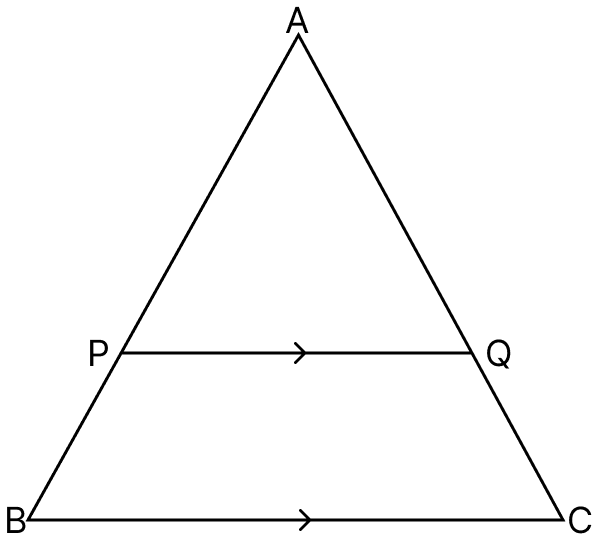
In the given diagram, PQ // BC and ar∆APQ = ar quad BPQC. The value of AP : PB is:
- (a)1 : 2
- (b)2 : 1
- (c)1 : $\sqrt{2}$
- (d)$(\sqrt{2} + 1)$ : 1
Show SolutionHide Solution↓
Given,
PQ // BC and ar ∆APQ = ar quad BPQC.
From figure,
ar ∆ABC = ar ∆APQ + ar quad BPQC = ar ∆APQ + ar ∆APQ = 2 ar ∆APQ.
$\Rightarrow \frac{\text{ar ∆APQ}}{\text{ar ∆ABC}} = \frac{1}{2}$
In ∆APQ and ∆ABC,
⇒ ∠PAQ = ∠BAC [Common]
⇒ ∠APQ = ∠ABC [Corresponding angles as PQ // BC]
∴ ∆APQ ~ ∆ABC (By A.A. axiom)
We know that,
The ratio of areas of similar triangles is equal to the ratio of the squares of their corresponding sides.
$$\begin{aligned}\therefore \frac{\text{ar ∆APQ}}{\text{ar ∆ABC}} = \frac{AP^2}{AB^2} \\[1em] \Rightarrow \frac{1}{2} = \frac{AP^2}{AB^2} \\[1em] \Rightarrow \frac{AP}{AB} = \frac{1}{\sqrt{2}}.\end{aligned}$$
Let AP = $k$, then AB = $\sqrt{2}k$.
$$\begin{aligned}\Rightarrow PB = AB - AP = \sqrt{2}k - k = (\sqrt{2} - 1)k \\[1em] \Rightarrow \frac{AP}{PB} = \frac{k}{(\sqrt{2} - 1)k} = \frac{1}{\sqrt{2} - 1}.\end{aligned}$$
Rationalizing the denominator,
$\Rightarrow \frac{AP}{PB} = \frac{1}{\sqrt{2} - 1} \times \frac{\sqrt{2} + 1}{\sqrt{2} + 1} = \frac{\sqrt{2} + 1}{2 - 1} = \frac{\sqrt{2} + 1}{1}.$
AP : PB = $(\sqrt{2} + 1)$ : 1.
Hence, option 4 is the correct option.