Improvement Paper2026

ICSE Class 10 Mathematics — 2026 Improvement

41 solved questions from Solved 2026 Improvement Paper ICSE Class 10 Mathematics. Every answer follows the ICSE marking scheme.

Section
Marks
Insight
1(i)1 Mark · 2026 · Section A · 2026 ImprovementFull page

The marked price of a smart TV is ₹ 18,000. The rate of GST is 18%. The price paid by the customer for the smart TV is:

Show SolutionHide Solution↓

Given,

Marked price = ₹ 18,000

Rate of GST = 18%

GST = $\frac{18}{100} \times 18000$ = ₹ 3,240

Price paid by customer = Marked price + GST

= ₹ 18,000 + ₹ 3,240

= ₹ 21,240.

Hence, option 4 is the correct option.

1(ii)1 Mark · 2026 · Section A · 2026 ImprovementFull page

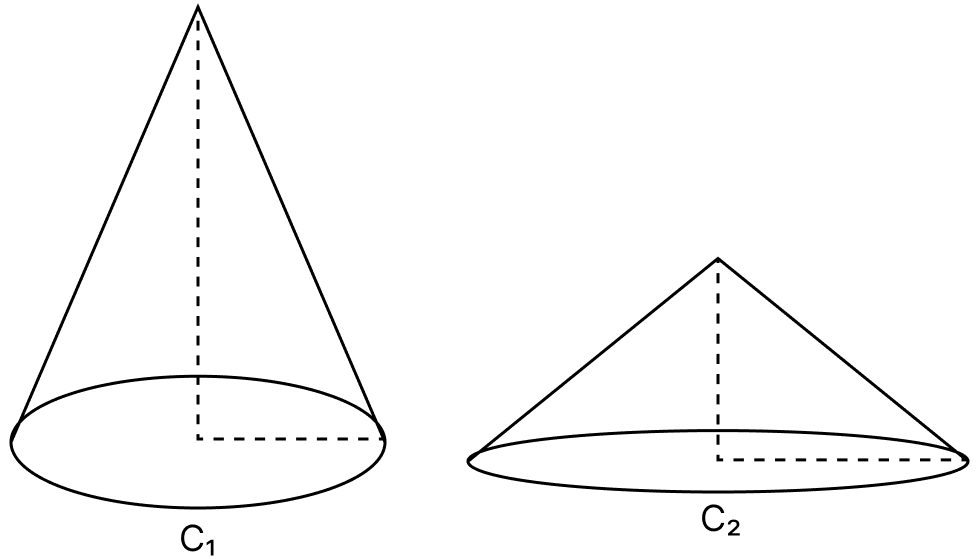
Two right circular cones, C1 and C2, have their heights in the ratio 2 : 1 and radii in the ratio 1 : 2. The ratio of their volumes is:

Two right circular cones, C 1 and C 2, have their heights in the ratio 2: 1 and radii in the ratio 1: 2. The ratio of their volumes is:. Improvement 2026, ICSE 2026 Improvement Maths Solved Question Paper.
Show SolutionHide Solution↓

Given,

Ratio of heights ($h_1 : h_2$) = 2 : 1

Ratio of radii ($r_1 : r_2$) = 1 : 2

By formula,

Volume of cone = $\frac{1}{3} \pi r^2 h$

$$\begin{aligned}\therefore \frac{V_1}{V_2} = \frac{\frac{1}{3} \pi r_1^2 h_1}{\frac{1}{3} \pi r_2^2 h_2} \\[1em] = \frac{r_1^2 h_1}{r_2^2 h_2} \\[1em] = \frac{1^2 \times 2}{2^2 \times 1} \\[1em] = \frac{2}{4} \\[1em] = \frac{1}{2}.\end{aligned}$$

Ratio of volumes = 1 : 2.

Hence, option 2 is the correct option.

1(iii)1 Mark · 2026 · Section A · 2026 ImprovementFull page

A person deposited ₹500 per month in a recurring deposit account for one year at $r$% per annum. The rate of interest is revised to $2r$%. The interest earned by the person compared to the original amount of interest will be:

Show SolutionHide Solution↓

By formula,

Interest = $P \times \frac{n(n + 1)}{2 \times 12} \times \frac{r}{100}$

In this formula, the interest is directly proportional to the rate of interest, as the principal (P) and the number of months ($n$) remain unchanged.

When the rate is revised from $r$% to $2r$%, the rate becomes double.

∴ The interest earned also becomes double.

Hence, option 4 is the correct option.

1(iv)1 Mark · 2026 · Section A · 2026 ImprovementFull page

A company declares 9% dividend on its shares of ₹100 available at ₹120. It means a person will receive annual dividend which is 9% of:

Show SolutionHide Solution↓

Dividend is always calculated on the face value (nominal value) of the shares.

Here, the face value of the share is ₹ 100.

∴ The person will receive an annual dividend which is 9% of the face value.

Hence, option 2 is the correct option.

1(v)1 Mark · 2026 · Section A · 2026 ImprovementFull page

The discriminant of the quadratic equation $2x^2 + 5x + c = 0$ is 1. The value of $c$ is:

Show SolutionHide Solution↓

Given,

Quadratic equation : $2x^2 + 5x + c = 0$

Comparing with $ax^2 + bx + c = 0$,

$a = 2, b = 5, c = c$

By formula,

Discriminant (D) = $b^2 - 4ac$

$$\begin{aligned}\Rightarrow 1 = 5^2 - 4 \times 2 \times c \\[1em] \Rightarrow 1 = 25 - 8c \\[1em] \Rightarrow 8c = 25 - 1 \\[1em] \Rightarrow 8c = 24 \\[1em] \Rightarrow c = 3.\end{aligned}$$

Hence, option 4 is the correct option.

1(vi)1 Mark · 2026 · Section A · 2026 ImprovementFull page

$(x + 3), (x + 6)$ and $(x + 10)$ are in continued proportion. The value of $x$ is:

Show SolutionHide Solution↓

Given,

$(x + 3), (x + 6)$ and $(x + 10)$ are in continued proportion.

We know that,

Three quantities $a, b$ and $c$ are said to be in continued proportion if the ratio of the first to the second is equal to the ratio of the second to the third.

i.e. $a : b = b : c$

$$\begin{aligned}\Rightarrow \frac{a}{b} = \frac{b}{c} \\[1em] \Rightarrow b^2 = ac.\end{aligned}$$

So, the square of the middle term is equal to the product of the first and the last terms.

Here,

$a = (x + 3), b = (x + 6)$ and $c = (x + 10)$

∴ $(x + 6)^2 = (x + 3)(x + 10)$

Expanding both sides,

$\Rightarrow x^2 + 12x + 36 = x^2 + 13x + 30$

Cancelling $x^2$ from both sides,

$\Rightarrow 12x + 36 = 13x + 30$

Transposing the like terms,

$$\begin{aligned}\Rightarrow 36 - 30 = 13x - 12x \\[1em] \Rightarrow 6 = x \\[1em] \Rightarrow x = 6.\end{aligned}$$

Hence, option 2 is the correct option.

1(vii)1 Mark · 2026 · Section A · 2026 ImprovementFull page

$(x – 1)$ is a factor of the polynomial $x^3 + 2x^2 – x – k$. The value of $k$ is:

Show SolutionHide Solution↓

Given,

$(x – 1)$ is a factor of $x^3 + 2x^2 – x – k$.

∴ On putting $x = 1$, the value of the polynomial is zero.

$$\begin{aligned}\Rightarrow (1)^3 + 2(1)^2 - (1) - k = 0 \\[1em] \Rightarrow 1 + 2 - 1 - k = 0 \\[1em] \Rightarrow 2 - k = 0 \\[1em] \Rightarrow k = 2.\end{aligned}$$

Hence, option 4 is the correct option.

1(viii)1 Mark · 2026 · Section A · 2026 ImprovementFull page

Matrix $$A = \begin{bmatrix} -1 & 2 \\ 3 & 0 \end{bmatrix}$$ and the Matrix $$mA = \begin{bmatrix} 3 & -6 \\ -9 & 0 \end{bmatrix}$$. The value of $m$ is:

Show SolutionHide Solution↓

Given,

$$mA = m\begin{bmatrix} -1 & 2 \\ 3 & 0 \end{bmatrix} = \begin{bmatrix} -m & 2m \\ 3m & 0 \end{bmatrix}$$

Comparing this with the given matrix $$\begin{bmatrix} 3 & -6 \\ -9 & 0 \end{bmatrix}$$,

$$\begin{aligned}\Rightarrow -m = 3\\[1em] \Rightarrow m = -3.\end{aligned}$$

Hence, option 2 is the correct option.

1(ix)1 Mark · 2026 · Section A · 2026 ImprovementFull page

The points A ($x$, 0), B (−1, −1) and C (0, $y$) are collinear. The value of $\frac{1}{x} + \frac{1}{y}$ is:

Show SolutionHide Solution↓

Given,

The points A ($x$, 0), B (−1, −1) and C (0, $y$) are collinear.

We know that,

Collinear points lie on the same straight line, so they cannot enclose a triangle.

∴ Area of the triangle formed by them = 0.

By formula,

Area of triangle = $\frac{1}{2}[x_1(y_2 - y_3) + x_2(y_3 - y_1) + x_3(y_1 - y_2)]$

Here,

$$\begin{aligned}\Rightarrow x_1 = x, y_1 = 0 \\[1em] \Rightarrow x_2 = −1, y_2 = −1 \\[1em] \Rightarrow x_3 = 0, y_3 = y\end{aligned}$$

Substituting values we get :

$\Rightarrow \frac{1}{2}[x(-1 - y) + (-1)(y - 0) + 0(0 - (-1))] = 0$

Multiplying both sides by 2,

$$\begin{aligned}\Rightarrow x(-1 - y) + (-1)(y - 0) + 0(0 - (-1)) = 0 \\[1em] \Rightarrow -x - xy - y + 0 = 0 \\[1em] \Rightarrow -(x + y + xy) = 0 \\[1em] \Rightarrow x + y + xy = 0 \\[1em] \Rightarrow x + y = -xy.\end{aligned}$$

Since $\frac{1}{x} + \frac{1}{y}$ is required, we divide both sides by $xy$ (where $x ≠ 0$ and $y ≠ 0$),

$$\begin{aligned}\Rightarrow \frac{x + y}{xy} = \frac{-xy}{xy} \\[1em] \Rightarrow \frac{x}{xy} + \frac{y}{xy} = -1 \\[1em] \Rightarrow \frac{1}{y} + \frac{1}{x} = -1 \\[1em] \Rightarrow \frac{1}{x} + \frac{1}{y} = -1.\end{aligned}$$

Hence, option 1 is the correct option.

1(x)1 Mark · 2026 · Section A · 2026 ImprovementFull page

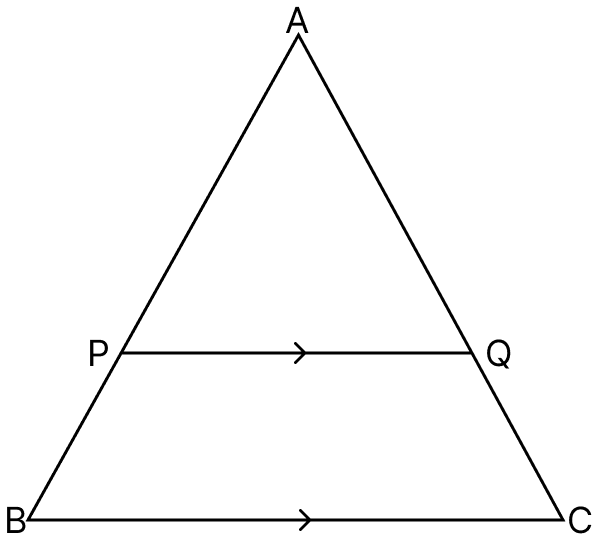
In the given diagram, PQ // BC and ar∆APQ = ar quad BPQC. The value of AP : PB is:

In the given diagram, PQ // BC and ar∆APQ = ar quad BPQC. The value of AP: PB is:. Improvement 2026, ICSE 2026 Improvement Maths Solved Question Paper.
Show SolutionHide Solution↓

Given,

PQ // BC and ar ∆APQ = ar quad BPQC.

From figure,

ar ∆ABC = ar ∆APQ + ar quad BPQC = ar ∆APQ + ar ∆APQ = 2 ar ∆APQ.

$\Rightarrow \frac{\text{ar ∆APQ}}{\text{ar ∆ABC}} = \frac{1}{2}$

In ∆APQ and ∆ABC,

⇒ ∠PAQ = ∠BAC [Common]

⇒ ∠APQ = ∠ABC [Corresponding angles as PQ // BC]

∴ ∆APQ ~ ∆ABC (By A.A. axiom)

We know that,

The ratio of areas of similar triangles is equal to the ratio of the squares of their corresponding sides.

$$\begin{aligned}\therefore \frac{\text{ar ∆APQ}}{\text{ar ∆ABC}} = \frac{AP^2}{AB^2} \\[1em] \Rightarrow \frac{1}{2} = \frac{AP^2}{AB^2} \\[1em] \Rightarrow \frac{AP}{AB} = \frac{1}{\sqrt{2}}.\end{aligned}$$

Let AP = $k$, then AB = $\sqrt{2}k$.

$$\begin{aligned}\Rightarrow PB = AB - AP = \sqrt{2}k - k = (\sqrt{2} - 1)k \\[1em] \Rightarrow \frac{AP}{PB} = \frac{k}{(\sqrt{2} - 1)k} = \frac{1}{\sqrt{2} - 1}.\end{aligned}$$

Rationalizing the denominator,

$\Rightarrow \frac{AP}{PB} = \frac{1}{\sqrt{2} - 1} \times \frac{\sqrt{2} + 1}{\sqrt{2} + 1} = \frac{\sqrt{2} + 1}{2 - 1} = \frac{\sqrt{2} + 1}{1}.$

AP : PB = $(\sqrt{2} + 1)$ : 1.

Hence, option 4 is the correct option.

1(xi)1 Mark · 2026 · Section A · 2026 ImprovementFull page

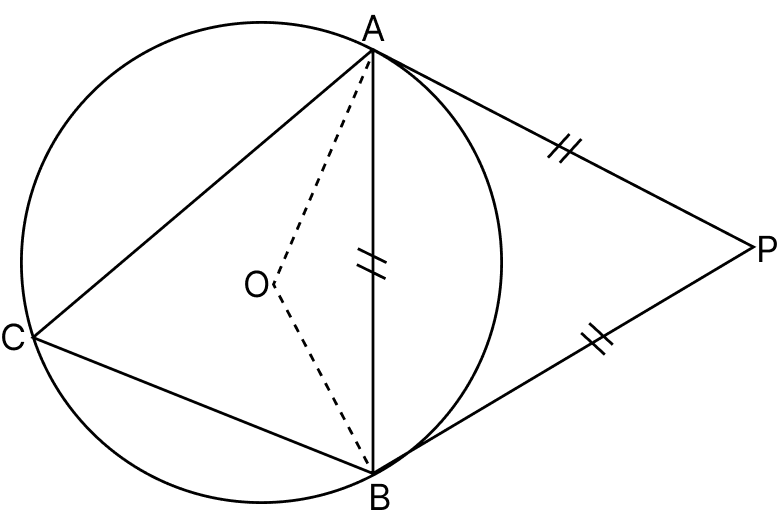
In the given diagram, PA and PB are the tangents to the circle with centre O, such that PA = PB = AB. The value of ∠ACB is:

In the given diagram, PA and PB are the tangents to the circle with centre O, such that PA = PB = AB. The value of ∠ACB is:. Improvement 2026, ICSE 2026 Improvement Maths Solved Question Paper.
Show SolutionHide Solution↓

Given,

PA = PB = AB.

Since all three sides of ∆PAB are equal, ∆PAB is an equilateral triangle.

∴ ∠APB = 60°.

We know that,

Radius is perpendicular to the tangent at the point of contact.

∴ ∠OAP = ∠OBP = 90°.

In quadrilateral OAPB,

⇒ ∠AOB + ∠OAP + ∠APB + ∠OBP = 360°

⇒ ∠AOB + 90° + 60° + 90° = 360°

⇒ ∠AOB = 360° - 240° = 120°.

We know that,

The angle subtended by an arc at the centre is twice the angle subtended by it at any point on the remaining part of the circle.

$\Rightarrow \angle \text{ ACB }= \frac{1}{2} \angle \text{ AOB }= \frac{1}{2} \times 120° = 60°.$

Hence, option 3 is the correct option.

1(xii)1 Mark · 2026 · Section A · 2026 ImprovementFull page

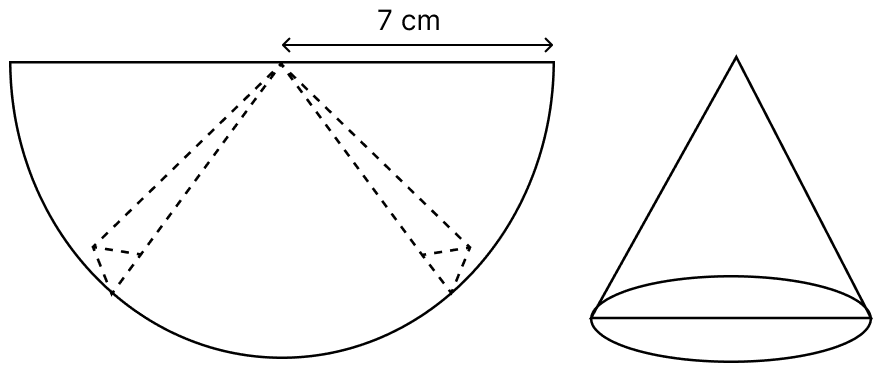
A semi-circular sheet of paper having radius 7 cm is folded to form a right circular cone, as shown in the diagram. The slant height of the cone so formed is:

A semi-circular sheet of paper having radius 7 cm is folded to form a right circular cone, as shown in the diagram. The slant height of the cone so formed is:. Improvement 2026, ICSE 2026 Improvement Maths Solved Question Paper.
Show SolutionHide Solution↓

When a semi-circular sheet is folded to form a right circular cone, the radius of the semi-circle becomes the slant height of the cone.

Radius of semi-circular sheet = 7 cm.

∴ Slant height of the cone = 7 cm.

Hence, option 2 is the correct option.

1(xiii)1 Mark · 2026 · Section A · 2026 ImprovementFull page

Assertion (A): $\sec θ(1 + \sin θ)(\sec θ + \tan θ) = 1$

Reason (R): $\sec^2 θ - \tan^2 θ = 1$, for any value of $θ$.

Show SolutionHide Solution↓

Solving the L.H.S. of the Assertion,

$$\begin{aligned}\Rightarrow \sec θ(1 + \sin θ)(\sec θ + \tan θ) \\[1em] \Rightarrow \sec θ(1 + \sin θ)\Big(\frac{1}{\cos θ} + \frac{\sin θ}{\cos θ}\Big) \\[1em] \Rightarrow \sec θ(1 + \sin θ) \times \frac{1 + \sin θ}{\cos θ} \\[1em] \Rightarrow \frac{1}{\cos θ} \times \frac{(1 + \sin θ)^2}{\cos θ} \\[1em] \Rightarrow \frac{(1 + \sin θ)^2}{\cos^2 θ} \\[1em] \Rightarrow \frac{(1 + \sin θ)^2}{1 - \sin^2 θ} \\[1em] \Rightarrow \frac{(1 + \sin θ)^2}{(1 - \sin θ)(1 + \sin θ)} \\[1em] \Rightarrow \frac{1 + \sin θ}{1 - \sin θ}.\end{aligned}$$

Since, $\frac{1 + \sin θ}{1 - \sin θ} \ne 1$, the Assertion (A) is false.

Now, $\sec^2 θ - \tan^2 θ = 1$ is a fundamental trigonometric identity which is true.

So, Reason (R) is true.

Thus, (A) is false, (R) is true.

Hence, option 2 is the correct option.

1(xiv)1 Mark · 2026 · Section A · 2026 ImprovementFull page

Assertion (A): The probability of Sun rising from the west is 0.

Reason (R): The probability of an impossible event is always 0.

Show SolutionHide Solution↓

The Sun rising from the west is an impossible event, so its probability is 0.

∴ Assertion (A) is true.

The probability of an impossible event is always 0.

∴ Reason (R) is true.

Also, Reason (R) correctly explains why the probability of the Sun rising from the west (an impossible event) is 0.

Thus, both (A) and (R) are true and (R) is the correct explanation of (A).

Hence, option 3 is the correct option.

1(xv)1 Mark · 2026 · Section A · 2026 ImprovementFull page

The mean of $x_1, x_2, x_3, ……, x_n$ is $m$. The value of each variate is increased by 2. The mean of the new data is:

Show SolutionHide Solution↓

Given,

Mean of $x_1, x_2, x_3, ……, x_n$ = $m$

$\Rightarrow \frac{x_1 + x_2 + \dots + x_n}{n} = m$

When each variate is increased by 2, the new mean is:

$$\begin{aligned}\Rightarrow \frac{(x_1 + 2) + (x_2 + 2) + \dots + (x_n + 2)}{n} \\[1em] \Rightarrow \frac{(x_1 + x_2 + \dots + x_n) + 2n}{n} \\[1em] \Rightarrow \frac{x_1 + x_2 + \dots + x_n}{n} + \frac{2n}{n} \\[1em] \Rightarrow m + 2.\end{aligned}$$

Hence, option 3 is the correct option.

2(i)1 Mark · 2026 · Section A · 2026 ImprovementFull page

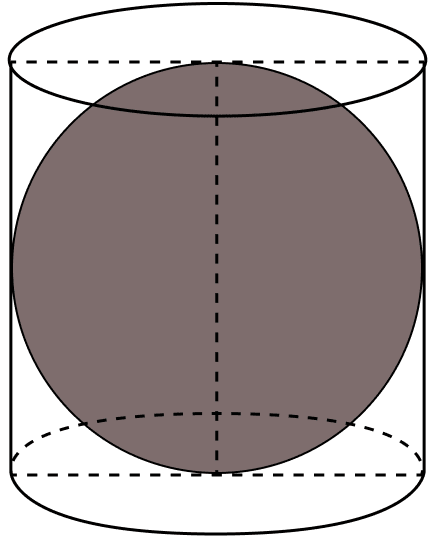
A solid sphere completely fits into a cylindrical container of radius 3.5 cm and height 7 cm as shown in the figure below. Find the volume of water required to fill the remaining (unshaded) space of the container to the nearest of a whole number. $\left(\pi = \frac{22}{7}\right)$

A solid sphere completely fits into a cylindrical container of radius 3.5 cm and height 7 cm as shown in the figure below. Find the volume of water required to fill the remaining (unshaded) space of the container to the nearest of a whole number. ( pi = 22/7 ). Improvement 2026, ICSE 2026 Improvement Maths Solved Question Paper.
Show SolutionHide Solution↓

Given,

Radius of cylinder (R) = 3.5 cm

Height of cylinder (H) = 7 cm

Since the sphere completely fits into the cylinder,

Radius of sphere ($r$) = 3.5 cm

By formula,

Volume of cylinder = $\pi R^2 H$

$$\begin{aligned}= \frac{22}{7} \times (3.5)^2 \times 7 \\[1em] = \frac{22}{7} \times 12.25 \times 7 \\[1em] = 22 \times 12.25 \\[1em] = 269.5 \text{ cm}^3.\end{aligned}$$

By formula,

Volume of sphere = $\frac{4}{3} \pi r^3$

$$\begin{aligned}= \frac{4}{3} \times \frac{22}{7} \times (3.5)^3 \\[1em] = \frac{4}{3} \times \frac{22}{7} \times 42.875 \\[1em] = \frac{4312}{24} \\[1em] = 179.67 \text{ cm}^3.\end{aligned}$$

Volume of water required = Volume of cylinder − Volume of sphere

= 269.5 − 179.67

= 89.83

≈ 90 cm3.

Hence, the volume of water required = 90 cm3.

2(ii)1 Mark · 2026 · Section A · 2026 ImprovementFull page

A car covers a distance of 400 km at a certain speed. Had the speed been 12 km/h more, the time taken for the journey would have been 1 hour 40 minutes less. Find the:

(a) original speed of the car.

(b) time taken with the increased speed.

Show SolutionHide Solution↓

(a) Given,

Distance covered = 400 km

Let the original speed of the car be $x$ km/h.

Since the speed is 12 km/h more in the second case,

Increased speed = $(x + 12)$ km/h.

By formula,

Time = $\frac{\text{Distance}}{\text{Speed}}$

∴ Time taken with the original speed = $\frac{400}{x}$ hours

∴ Time taken with the increased speed = $\frac{400}{x + 12}$ hours

Converting the given difference of time into hours,

1 hour 40 minutes = $1\frac{40}{60}$ hours = $\frac{5}{3}$ hours.

The question says that with the increased speed the journey takes 1 hour 40 minutes less. So the time taken with the increased speed is smaller, and subtracting it from the time taken with the original speed must give $\frac{5}{3}$ hours.

∴ Time with original speed − Time with increased speed = $\frac{5}{3}$

According to the question,

$$\begin{aligned}\Rightarrow \frac{400}{x} - \frac{400}{x + 12} = \frac{5}{3} \\[1em] \Rightarrow 400\Big[\frac{(x + 12) - x}{x(x + 12)}\Big] = \frac{5}{3} \\[1em] \Rightarrow 400 \times \frac{12}{x^2 + 12x} = \frac{5}{3} \\[1em] \Rightarrow \frac{4800}{x^2 + 12x} = \frac{5}{3} \\[1em] \Rightarrow 5(x^2 + 12x) = 14400 \\[1em] \Rightarrow x^2 + 12x = 2880 \\[1em] \Rightarrow x^2 + 12x - 2880 = 0 \\[1em] \Rightarrow x^2 + 60x - 48x - 2880 = 0 \\[1em] \Rightarrow x(x + 60) - 48(x + 60) = 0 \\[1em] \Rightarrow (x - 48)(x + 60) = 0 \\[1em] \Rightarrow x = 48 \text{ or } x = -60.\end{aligned}$$

Since speed cannot be negative, $x = 48$.

Hence, the original speed of the car = 48 km/h.

(b) Increased speed = $x + 12 = 48 + 12 = 60$ km/h.

By formula,

Time taken with increased speed = $\frac{\text{Distance}}{\text{Speed}}$

$$\begin{aligned}= \frac{400}{60} \\[1em] = \frac{20}{3} \\[1em] = 6\frac{2}{3} \text{ hours}.\end{aligned}$$

= 6 hours 40 minutes.

Hence, the time taken with the increased speed = 6 hours 40 minutes.

2(iii)1 Mark · 2026 · Section A · 2026 ImprovementFull page

The coordinates of the vertex of ∆ABC are A ($a, b$), B (5, −3) and C (−5, 3). The coordinates of the centroid G of ∆ABC is $G\left(\frac{2}{3}, \frac{1}{3}\right)$. Find the:

(a) coordinates of the vertex A.

(b) equation of median through the vertex C.

Show SolutionHide Solution↓

(a) Given,

Vertices of ∆ABC are A ($a, b$), B (5, −3) and C (−5, 3).

Centroid G = $\Big(\frac{2}{3}, \frac{1}{3}\Big)$

By formula,

Centroid = $\Big(\frac{x_1 + x_2 + x_3}{3}, \frac{y_1 + y_2 + y_3}{3}\Big)$

Here,

$x_1 = a, y_1 = b$

$x_2 = 5, y_2 = -3$

$x_3 = -5, y_3 = 3$

Substituting values we get :

$$\begin{aligned}\Rightarrow \Big(\frac{2}{3}, \frac{1}{3}\Big) = \Big(\frac{a + 5 + (-5)}{3}, \frac{b + (-3) + 3}{3}\Big) \\[1em] \Rightarrow \Big(\frac{2}{3}, \frac{1}{3}\Big) = \Big(\frac{a}{3}, \frac{b}{3}\Big).\end{aligned}$$

Comparing the coordinates,

$$\begin{aligned}\Rightarrow \frac{a}{3} = \frac{2}{3} \\[1em] \Rightarrow a = 2 \\[1em] \Rightarrow \frac{b}{3} = \frac{1}{3} \\[1em] \Rightarrow b = 1.\end{aligned}$$

Hence, the coordinates of vertex A are (2, 1).

(b) Let CM be the median, passing through C, here M is the mid-point of AB.
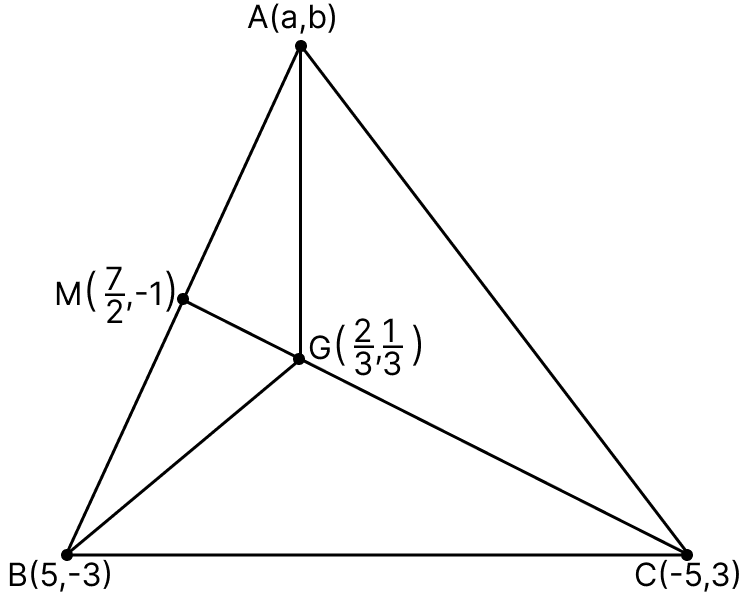
The coordinates of the vertex of ∆ABC are A ( a, b ), B (5, −3) and C (−5, 3). The coordinates of the centroid G of ∆ABC is G (2/3, 1/3 ). Find the:. Improvement 2026, ICSE 2026 Improvement Maths Solved Question Paper.

A = (2, 1) and B = (5, −3)

By formula,

Mid-point of AB = $\Big(\frac{x_1 + x_2}{2}, \frac{y_1 + y_2}{2}\Big)$

Here,

$x_1 = 2, y_1 = 1$

$x_2 = 5, y_2 = -3$

Substituting values we get :

$$\begin{aligned}\text{ M }= \Big(\frac{2 + 5}{2}, \frac{1 + (-3)}{2}\Big) \\[1em] = \Big(\frac{7}{2}, \frac{-2}{2}\Big) \\[1em] = \Big(\frac{7}{2}, -1\Big).\end{aligned}$$

Hence, M = $\Big(\frac{7}{2}, -1\Big)$.

The median through C is the line joining C (−5, 3) and M $\Big(\frac{7}{2}, -1\Big)$.

By formula,

Slope of a line = $\frac{y_2 - y_1}{x_2 - x_1}$

Here,

$x_1 = -5, y_1 = 3$

$x_2 = \frac{7}{2}, y_2 = -1$

Substituting values we get :

$$\begin{aligned}\text{Slope (m)} = \frac{-1 - 3}{\frac{7}{2} - (-5)} \\[1em] = \frac{-4}{\frac{7 + 10}{2}} \\[1em] = \frac{-4}{\frac{17}{2}} \\[1em] = \frac{-8}{17}.\end{aligned}$$

By point-slope form,

Equation of a line : $y - y_1 = m(x - x_1)$

Substituting values we get :

$$\begin{aligned}\Rightarrow y - 3 = \frac{-8}{17}(x - (-5)) \\[1em] \Rightarrow 17(y - 3) = -8(x + 5) \\[1em] \Rightarrow 17y - 51 = -8x - 40 \\[1em] \Rightarrow 8x + 17y - 51 + 40 = 0 \\[1em] \Rightarrow 8x + 17y - 11 = 0.\end{aligned}$$

Hence, the equation of the median through vertex C is $\bm{8x + 17y - 11 = 0}$.
3(i)1 Mark · 2026 · Section A · 2026 ImprovementFull page

Anamika deposited ₹300 per month in a cumulative deposit account with a bank for 3 years. Her brother Sanjeev started depositing ₹500 per month for 2 years in the same scheme. The banks paid 10% simple interest per annum to both. At the time of maturity, find:

(a) the interest earned by Anamika.

(b) who got more money as interest and how much?

Show SolutionHide Solution↓

(a) For Anamika,

P = ₹ 300, $n$ = 3 years = 36 months, $r$ = 10%

By formula,

Interest = $P \times \frac{n(n + 1)}{2 \times 12} \times \frac{r}{100}$

Substituting values we get :

$$\begin{aligned}= 300 \times \frac{36(36 + 1)}{2 \times 12} \times \frac{10}{100} \\[1em] = 300 \times \frac{36 \times 37}{24} \times \frac{10}{100} \\[1em] = 300 \times 55.5 \times \frac{10}{100} \\[1em] = 1665.\end{aligned}$$

Hence, the interest earned by Anamika = ₹ 1,665.

(b) For Sanjeev,

P = ₹ 500, $n$ = 2 years = 24 months, $r$ = 10%

By formula,

Interest = $P \times \frac{n(n + 1)}{2 \times 12} \times \frac{r}{100}$

Substituting values we get :

$$\begin{aligned}= 500 \times \frac{24(24 + 1)}{2 \times 12} \times \frac{10}{100} \\[1em] = 500 \times \frac{24 \times 25}{24} \times \frac{10}{100} \\[1em] = 500 \times 25 \times \frac{10}{100} \\[1em] = 1250.\end{aligned}$$

Interest earned by Anamika = ₹ 1,665

Interest earned by Sanjeev = ₹ 1,250

Difference = ₹ 1,665 − ₹ 1,250 = ₹ 415.

Hence, Anamika got more interest, by an amount of ₹ 415.

3(ii)1 Mark · 2026 · Section A · 2026 ImprovementFull page

$\sqrt{2}, \sqrt{8}, \sqrt{18}$ …… forms a progression.

(a) Identify the type of progression.

(b) The sum of its first 10 terms is $p\sqrt{2}$. Find the value of $p$.

Show SolutionHide Solution↓

(a) Given,

$\sqrt{2}, \sqrt{8}, \sqrt{18}$ ......

Simplifying the terms,

$\sqrt{2}, 2\sqrt{2}, 3\sqrt{2}$ ......

Second term − First term = $2\sqrt{2} - \sqrt{2} = \sqrt{2}$

Third term − Second term = $3\sqrt{2} - 2\sqrt{2} = \sqrt{2}$

Since the difference between consecutive terms is constant, the progression is an Arithmetic Progression (A.P.) with first term $a = \sqrt{2}$ and common difference $d = \sqrt{2}$.

Hence, the progression is an Arithmetic Progression.

(b) Given,

$a = \sqrt{2}, d = \sqrt{2}, n = 10$

By formula,

Sum of first $n$ terms = $\frac{n}{2}[2a + (n - 1)d]$

Substituting values we get :

$$\begin{aligned}= \frac{10}{2}[2\sqrt{2} + (10 - 1)\sqrt{2}] \\[1em] = 5[2\sqrt{2} + 9\sqrt{2}] \\[1em] = 5 \times 11\sqrt{2} \\[1em] = 55\sqrt{2}.\end{aligned}$$

Given, the sum of first 10 terms = $p\sqrt{2}$.

$$\begin{aligned}\Rightarrow p\sqrt{2} = 55\sqrt{2} \\[1em] \Rightarrow p = 55.\end{aligned}$$

Hence, the value of $\bm{p}$ = 55.

3(iii)1 Mark · 2026 · Section A · 2026 ImprovementFull page

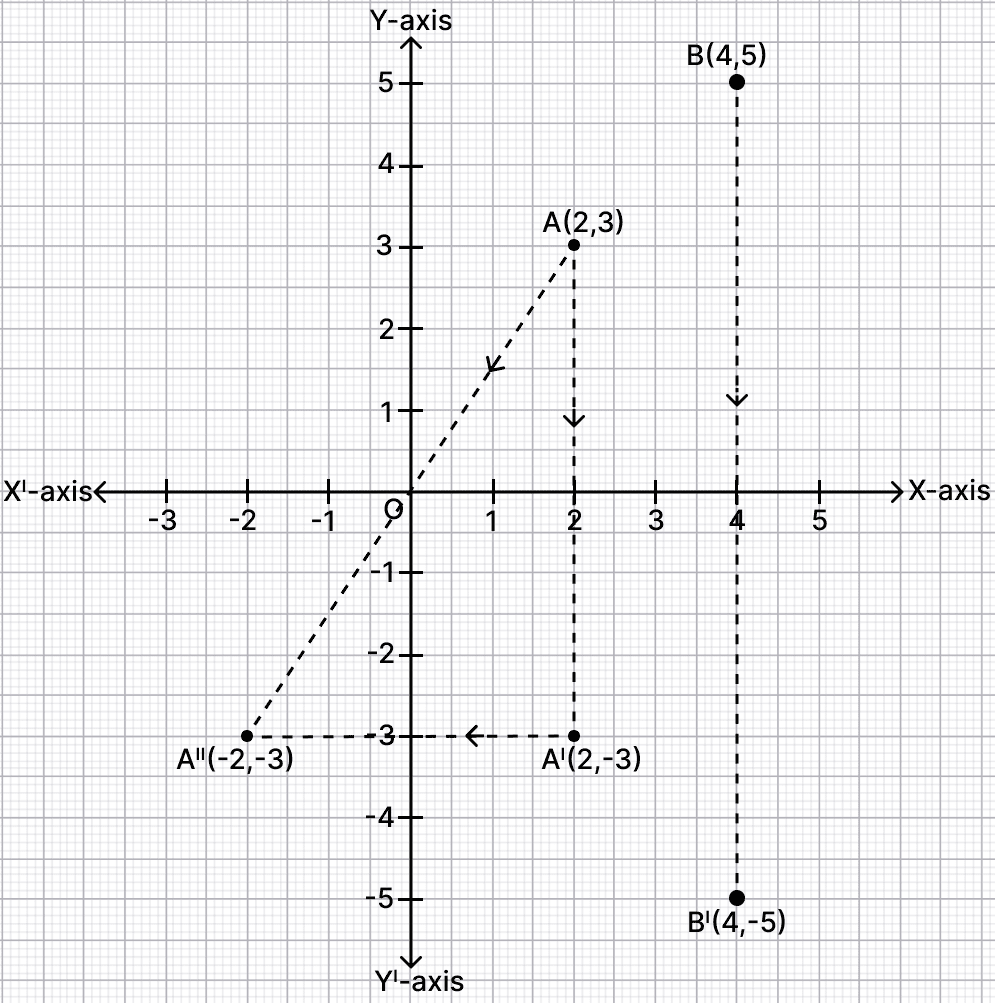
Use graph sheet for this question. Take 2 cm = 1 unit along the axes. Plot and write coordinates of:

(a) A (2, 3) and B (4, 5).

(b) image of A and B in the x-axis as A′ and B′.

(c) image of A′ in the y-axis as A″.

(d) name the single transformation that maps A to A″.

Show SolutionHide Solution↓

(a) The points A (2, 3) and B (4, 5) are plotted on the graph :

Use graph sheet for this question. Take 2 cm = 1 unit along the axes. Plot and write coordinates of:. Improvement 2026, ICSE 2026 Improvement Maths Solved Question Paper.

(b) From figure,

On reflecting points A and B in the x-axis, we get :

A′ = (2, −3) and B′ = (4, −5).

(c) From figure,

On reflecting point A' in y-axis, we get :

A″ = (−2, −3).

(d) Point A (2, 3) is mapped to A″ (−2, −3).

Since both the coordinates change their signs, the single transformation that maps A to A″ is a reflection in the origin.

Hence, the single transformation that maps A to A″ is reflection in the origin.

4(i)Written · 2026 · Section B · 2026 ImprovementFull page

A computer mechanic charges repairing cost of different components as tabulated below:

ComponentRepairing cost (₹)Discount (%)
A₹500020%
B₹650030%

The rate of GST is 18%. Find the total:

(a) discount

(b) amount of GST

Show SolutionHide Solution↓

(a) For Component A,

Repairing cost = ₹ 5,000, Discount = 20%

Discount = $\frac{20}{100} \times 5000$ = ₹ 1,000

For Component B,

Repairing cost = ₹ 6,500, Discount = 30%

Discount = $\frac{30}{100} \times 6500$ = ₹ 1,950

Total discount = ₹ 1,000 + ₹ 1,950 = ₹ 2,950.

Hence, the total discount = ₹ 2,950.

(b) For Component A,

Cost after discount = ₹ 5,000 − ₹ 1,000 = ₹ 4,000

For Component B,

Cost after discount = ₹ 6,500 − ₹ 1,950 = ₹ 4,550

Total taxable amount = ₹ 4,000 + ₹ 4,550 = ₹ 8,550

GST = $\frac{18}{100} \times 8550$ = ₹ 1,539.

Hence, the total amount of GST = ₹ 1,539.

4(ii)Written · 2026 · Section B · 2026 ImprovementFull page

Given, matrix $$A = \begin{bmatrix} 3 & -5 \\ -4 & 2 \end{bmatrix}$$ and I is a unit matrix of order 2 × 2.

(a) Find the matrix, A2 and 5A

(b) value of $k$, such that $A^2 - 5A = k.I$

Show SolutionHide Solution↓

(a) Calculating A2,

$$A^2 = \begin{bmatrix} 3 & -5 \\ -4 & 2 \end{bmatrix}\begin{bmatrix} 3 & -5 \\ -4 & 2 \end{bmatrix} \\[1em] = \begin{bmatrix} 3 \times 3 + (-5)(-4) & 3 \times (-5) + (-5)(2) \\ (-4)(3) + 2(-4) & (-4)(-5) + 2 \times 2 \end{bmatrix} \\[1em] = \begin{bmatrix} 9 + 20 & -15 - 10 \\ -12 - 8 & 20 + 4 \end{bmatrix} \\[1em] = \begin{bmatrix} 29 & -25 \\ -20 & 24 \end{bmatrix}.$$

Calculating 5A,

$$5A = 5\begin{bmatrix} 3 & -5 \\ -4 & 2 \end{bmatrix} = \begin{bmatrix} 15 & -25 \\ -20 & 10 \end{bmatrix}.$$

Hence, $$A^2 = \begin{bmatrix} 29 & -25 \\ -20 & 24 \end{bmatrix}$$ and $$5A = \begin{bmatrix} 15 & -25 \\ -20 & 10 \end{bmatrix}$$.

(b) Calculating A2 − 5A,

$$A^2 - 5A = \begin{bmatrix} 29 & -25 \\ -20 & 24 \end{bmatrix} - \begin{bmatrix} 15 & -25 \\ -20 & 10 \end{bmatrix} \\[1em] = \begin{bmatrix} 29 - 15 & -25 - (-25) \\ -20 - (-20) & 24 - 10 \end{bmatrix} \\[1em] = \begin{bmatrix} 14 & 0 \\ 0 & 14 \end{bmatrix} \\[1em] = 14\begin{bmatrix} 1 & 0 \\ 0 & 1 \end{bmatrix} \\[1em] = 14 \cdot I.$$

Comparing with $A^2 - 5A = k.I$,

$\Rightarrow k = 14.$

Hence, the value of $\bm{k}$ = 14.

4(iii)Written · 2026 · Section B · 2026 ImprovementFull page

Prove that:

$\sqrt{\frac{\sec\theta + 1}{\sec\theta - 1}} + \sqrt{\frac{\sec\theta - 1}{\sec\theta + 1}} = 2,\text{cosec},\theta$

Show SolutionHide Solution↓

Solving the L.H.S.,

$$\begin{aligned}\Rightarrow \sqrt{\frac{\sec θ + 1}{\sec θ - 1}} + \sqrt{\frac{\sec θ - 1}{\sec θ + 1}} \\[1em] \Rightarrow \frac{\sqrt{\sec θ + 1}}{\sqrt{\sec θ - 1}} + \frac{\sqrt{\sec θ - 1}}{\sqrt{\sec θ + 1}} \\[1em] \Rightarrow \frac{\sqrt{\sec θ + 1} \times \sqrt{\sec θ + 1} + \sqrt{\sec θ - 1} \times \sqrt{\sec θ - 1}}{\sqrt{\sec θ - 1} \times \sqrt{\sec θ + 1}} \\[1em] \Rightarrow \frac{(\sec θ + 1) + (\sec θ - 1)}{\sqrt{(\sec θ + 1)(\sec θ - 1)}} \\[1em] \Rightarrow \frac{\sec θ + 1 + \sec θ - 1}{\sqrt{\sec^2 θ - 1}} \\[1em] \Rightarrow \frac{2\sec θ}{\sqrt{\sec^2 θ - 1}} \\[1em] \Rightarrow \frac{2\sec θ}{\sqrt{\tan^2 θ}} \\[1em] \Rightarrow \frac{2\sec θ}{\tan θ} \\[1em] \Rightarrow \frac{\frac{2}{\cos θ}}{\frac{\sin θ}{\cos θ}} \\[1em] \Rightarrow 2 \times \frac{1}{\cos θ} \times \frac{\cos θ}{\sin θ} \\[1em] \Rightarrow \frac{2}{\sin θ} \\[1em] \Rightarrow \text{2 cosec θ}.\end{aligned}$$

Since, L.H.S. = R.H.S.

Hence, proved that $\bm{\sqrt{\frac{\sec θ + 1}{\sec θ - 1}} + \sqrt{\frac{\sec θ - 1}{\sec θ + 1}} = 2,\text{cosec},θ}$.

5(i)Written · 2026 · Section B · 2026 ImprovementFull page

Prasoon invests ₹7500 in a company paying 6% dividend annually. ₹100 shares of this company are available at ₹150.

(a) Find the number of shares he purchased.

(b) Find his annual income.

(c) After one year, he sold 50% of his original shares at ₹175 each. Find his gain on the shares he sold.

Show SolutionHide Solution↓

(a) Given,

Investment = ₹ 7,500, Market value of each share = ₹ 150

By formula,

Number of shares = $\frac{\text{Investment}}{\text{Market value of each share}}$

$= \frac{7500}{150}$

= 50.

Hence, the number of shares purchased = 50.

(b) Given,

Face value = ₹ 100, Dividend rate = 6%, Number of shares = 50

By formula,

Annual income = Number of shares × Rate of dividend × Face value

$= 50 \times \frac{6}{100} \times 100$

= ₹ 300.

Hence, his annual income = ₹ 300.

(c) Number of shares sold = 50% of 50 = $\frac{50}{100} \times 50$ = 25 shares.

Selling price of each share = ₹ 175

Cost price of each share = ₹ 150

Gain on each share = ₹ 175 − ₹ 150 = ₹ 25

Total gain = 25 × ₹ 25 = ₹ 625.

Hence, his gain on the shares he sold = ₹ 625.

5(ii)Written · 2026 · Section B · 2026 ImprovementFull page

Solve the following inequation, write the solution set and represent it on the real number line.

$3x + \frac{14}{3} \gt \frac{4x}{3} - 2 \geq 3x - 4, ; x \in R$

Show SolutionHide Solution↓

Given,

$3x + \frac{14}{3} \gt \frac{4x}{3} - 2 \geq 3x - 4, ; x \in R$

Solving the L.H.S. of the inequation, we get:

$$\begin{aligned}\Rightarrow 3x + \frac{14}{3} \gt \frac{4x}{3} - 2 \\[1em] \Rightarrow 3x - \frac{4x}{3} \gt -2 - \frac{14}{3} \\[1em] \Rightarrow \frac{9x - 4x}{3} \gt \frac{-6 - 14}{3} \\[1em] \Rightarrow \frac{5x}{3} \gt \frac{-20}{3} \\[1em] \Rightarrow 5x \gt \frac{-20}{3} \times 3 \\[1em] \Rightarrow 5x \gt -20 \\[1em] \Rightarrow x \gt \frac{-20}{5} \\[1em] \Rightarrow x \gt -4 \text{ ......(1)}\end{aligned}$$

Solving the R.H.S. of the inequation, we get:

$$\begin{aligned}\Rightarrow \frac{4x}{3} - 2 \geq 3x - 4 \\[1em] \Rightarrow \frac{4x}{3} - 3x \ge -4 + 2 \\[1em] \Rightarrow \frac{4x - 9x}{3} \ge -2 \\[1em] \Rightarrow \frac{-5x}{3} \ge -2 \\[1em] \Rightarrow \frac{-5x}{3} \times 3 \ge -2 \times 3 \\[1em] \Rightarrow -5x \ge -6 \\[1em] \Rightarrow -5x \times -1 \le -6 \times (-1) \\[1em] \Rightarrow 5x \le 6 \\[1em] \Rightarrow x \le \frac{6}{5} \text{ ......(2)}\end{aligned}$$

From equations (1) and (2),

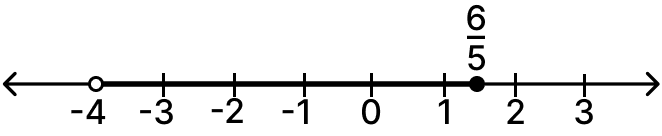
Solution set = $\Big\lbrace x : -4 \lt x \le \frac{6}{5}, x \in R\Big\rbrace$

Representing on the real number line :

Solve the following inequation, write the solution set and represent it on the real number line. 3x + 14/3 gt 4x/3 - 2 ≥ 3x - 4,; x in R. Improvement 2026, ICSE 2026 Improvement Maths Solved Question Paper.

Hence, solution set = $\bm{\Big\lbrace x : -4 \lt x \le \frac{6}{5}, x \in R\Big\rbrace}$.

5(iii)Written · 2026 · Section B · 2026 ImprovementFull page

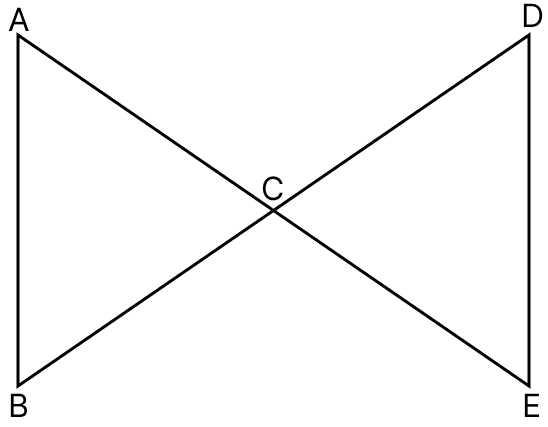
In the given diagram, lines AE and BD intersect each other at C such that ∆ABC ~ ∆DEC.

In the given diagram, lines AE and BD intersect each other at C such that ∆ABC ~ ∆DEC. Improvement 2026, ICSE 2026 Improvement Maths Solved Question Paper.

(a) Complete the equation with corresponding sides of ∆ABC and ∆DEC.

$\frac{AB}{DE} = \frac{AC}{?} = \frac{?}{EC}$

(b) ∠ABC is equal to which angle of ∆DEC?

(c) If, AB : DE = 2 : 3, find the ratio of ar (∆ABC) : ar (∆DEC).

Show SolutionHide Solution↓

(a) Since ∆ABC ~ ∆DEC, their corresponding sides are proportional.

$\frac{AB}{DE} = \frac{AC}{DC} = \frac{BC}{EC}$

Hence, $\mathbf{\frac{AB}{DE} = \frac{AC}{DC} = \frac{BC}{EC}}$.

(b) Since ∆ABC ~ ∆DEC, their corresponding angles are equal.

∴ ∠ABC = ∠DEC.

Hence, ∠ABC is equal to ∠DEC.

(c) We know that,

The ratio of areas of similar triangles is equal to the ratio of the squares of their corresponding sides.

$$\begin{aligned}\therefore \frac{\text{ar (∆ABC)}}{\text{ar (∆DEC)}} = \frac{AB^2}{DE^2} \\[1em] = \Big(\frac{2}{3}\Big)^2 \\[1em] = \frac{4}{9} \\[1em] = 4 : 9.\end{aligned}$$

Hence, ar (∆ABC) : ar (∆DEC) = 4 : 9.

6(i)Written · 2026 · Section B · 2026 ImprovementFull page

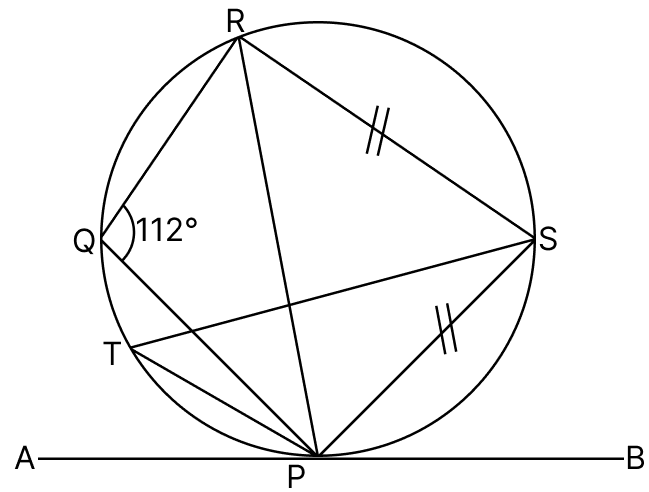
In the given diagram, AB is a tangent to the circle at P. If ∠PQR = 112° and PS = SR, find:

In the given diagram, AB is a tangent to the circle at P. If ∠PQR = 112° and PS = SR, find:. Improvement 2026, ICSE 2026 Improvement Maths Solved Question Paper.

(a) ∠PSR

(b) ∠BPR

(c) ∠PTS

Show SolutionHide Solution↓

(a) PQRS is a cyclic quadrilateral.

We know that,

The sum of opposite angles of a cyclic quadrilateral is 180°.

$$\begin{aligned}\Rightarrow \angle PQR + \angle PSR = 180° \\[1em] \Rightarrow 112° + \angle PSR = 180° \\[1em] \Rightarrow \angle PSR = 180° - 112° = 68°.\end{aligned}$$

Hence, ∠PSR = 68°.

(b) We know that,

By the alternate segment theorem, the angle between the tangent and a chord equals the angle subtended by the chord in the alternate segment.

∠BPR is the angle between tangent PB and chord PR, and its alternate segment contains Q.

∴ ∠BPR = ∠PQR = 112°.

Hence, ∠BPR = 112°.

(c) Given, PS = SR.

Equal chords subtend equal arcs.

∴ arc PS = arc SR.

We know that,

The angle subtended by an arc at the centre is twice the angle subtended by it on the circumference.

∠PQR is the inscribed angle standing on arc PSR.

$\Rightarrow \text{arc PSR} = 2 \times \angle PQR = 2 \times 112° = 224°.$

Since arc PS = arc SR,

$\Rightarrow \text{arc PS} = \frac{224°}{2} = 112°.$

∠PTS is the inscribed angle standing on arc PS.

$\Rightarrow \angle PTS = \frac{1}{2} \times \text{arc PS} = \frac{1}{2} \times 112° = 56°.$

Hence, ∠PTS = 56°.

6(ii)Written · 2026 · Section B · 2026 ImprovementFull page

Using step – deviation method, find mean for the following data. Give your answer to the nearest of a whole number.

MarksNo. of Students
20 – 2510
25 – 307
30 – 359
35 – 4013
40 – 455
45 – 506
Show SolutionHide Solution↓
MarksClass Mark (x)d = x - Au = d/iFrequency (f)fu
20 – 2522.5−10−210−20
25 – 3027.5−5−17−7
30 – 35A = 32.50090
35 – 4037.5511313
40 – 4542.5102510
45 – 5047.5153618
TotalΣf = 50Σfu = 14

Let assumed mean A = 32.5 and class size $i = 5$.

By formula,

Mean = A + $\frac{Σfu}{Σf} \times i$

$$\begin{aligned}= 32.5 + \frac{14}{50} \times 5 \\[1em] = 32.5 + \frac{70}{50} \\[1em] = 32.5 + 1.4 \\[1em] = 33.9 \\[1em] ≈ 34.\end{aligned}$$

Hence, the mean = 34.

6(iii)Written · 2026 · Section B · 2026 ImprovementFull page

The remainder obtained by dividing the polynomial $mx^2 - 3x + 6$ by $(x - 2)$ is twice the remainder obtained by dividing the polynomial $3x^2 + 5x - m$ by $(x + 3)$.

(a) Find the value of '$m$'.

(b) Using the value of '$m$', find the remainder when $mx^2 − 3x + 6$ is divided by $(x − 2)$.

Show SolutionHide Solution↓

(a) By the Remainder Theorem, the remainder when a polynomial is divided by $(x − a)$ is the value of the polynomial at $x = a$.

Let R1 be the remainder when $mx^2 − 3x + 6$ is divided by $(x − 2)$. Put $x = 2$ :

$$\begin{aligned}\Rightarrow R_1 = m(2)^2 - 3(2) + 6 \\[1em] \Rightarrow R_1 = 4m - 6 + 6 \\[1em] \Rightarrow R_1 = 4m.\end{aligned}$$

Let R2 be the remainder when $3x^2 + 5x − m$ is divided by $(x + 3)$. Put $x = −3$ :

$$\begin{aligned}\Rightarrow R_2 = 3(-3)^2 + 5(-3) - m \\[1em] \Rightarrow R_2 = 27 - 15 - m \\[1em] \Rightarrow R_2 = 12 - m.\end{aligned}$$

According to the question, R1 = 2R2.

$$\begin{aligned}\Rightarrow 4m = 2(12 - m) \\[1em] \Rightarrow 4m = 24 - 2m \\[1em] \Rightarrow 4m + 2m = 24 \\[1em] \Rightarrow 6m = 24 \\[1em] \Rightarrow m = 4.\end{aligned}$$

Hence, the value of $\bm{m}$ = 4.

(b) The remainder when $mx^2 − 3x + 6$ is divided by $(x − 2)$ is R1 = $4m$.

$\Rightarrow R_1 = 4 \times 4 = 16.$

Hence, the remainder = 16.

7(i)Written · 2026 · Section B · 2026 ImprovementFull page

Each of the letters of the word 'BINOCULARS' is written on identical cards and put in a bag. They are well shuffled. If a card is drawn at random from the bag, find the probability that the letter is:

(a) a vowel

(b) one of the first 8 letters of the English alphabet which appears in the given word.

(Support your working with at least one sample space)

Show SolutionHide Solution↓

The word 'BINOCULARS' has 10 letters, all distinct.

Sample space = {B, I, N, O, C, U, L, A, R, S}

Total number of outcomes = 10.

(a) The vowels in the word are I, O, U, A.

Number of vowels = 4.

By formula,

Probability = $\frac{\text{No. of favourable outcomes}}{\text{Total number of outcomes}}$

$\Rightarrow P(\text{vowel}) = \frac{4}{10} = \frac{2}{5}.$

Hence, the probability that the letter is a vowel = $\mathbf{\frac{2}{5}}$.

(b) The first 8 letters of the English alphabet are A, B, C, D, E, F, G, H.

The letters among these which appear in 'BINOCULARS' are B, C and A.

Number of favourable outcomes = 3.

$\Rightarrow P = \frac{3}{10}.$

Hence, the required probability = $\mathbf{\frac{3}{10}}$.

7(ii)Written · 2026 · Section B · 2026 ImprovementFull page

Using properties of proportion, solve for $x$:

$\frac{\sqrt{2x + 3} + \sqrt{2x - 3}}{\sqrt{2x + 3} - \sqrt{2x - 3}} = 3$

Show SolutionHide Solution↓

Given,

$\frac{\sqrt{2x + 3} + \sqrt{2x - 3}}{\sqrt{2x + 3} - \sqrt{2x - 3}} = \frac{3}{1}$

Applying componendo and dividendo,

$$\begin{aligned}\Rightarrow \frac{(\sqrt{2x + 3} + \sqrt{2x - 3}) + (\sqrt{2x + 3} - \sqrt{2x - 3})}{(\sqrt{2x + 3} + \sqrt{2x - 3}) - (\sqrt{2x + 3} - \sqrt{2x - 3})} = \frac{3 + 1}{3 - 1} \\[1em] \Rightarrow \frac{2\sqrt{2x + 3}}{2\sqrt{2x - 3}} = \frac{4}{2} \\[1em] \Rightarrow \frac{\sqrt{2x + 3}}{\sqrt{2x - 3}} = 2.\end{aligned}$$

Squaring both sides,

$$\begin{aligned}\Rightarrow \frac{2x + 3}{2x - 3} = 4 \\[1em] \Rightarrow 2x + 3 = 4(2x - 3) \\[1em] \Rightarrow 2x + 3 = 8x - 12 \\[1em] \Rightarrow 3 + 12 = 8x - 2x \\[1em] \Rightarrow 15 = 6x \\[1em] \Rightarrow x = \frac{15}{6} = \frac{5}{2}.\end{aligned}$$

Hence, $\bm{x = \frac{5}{2}}$.

7(iii)Written · 2026 · Section B · 2026 ImprovementFull page

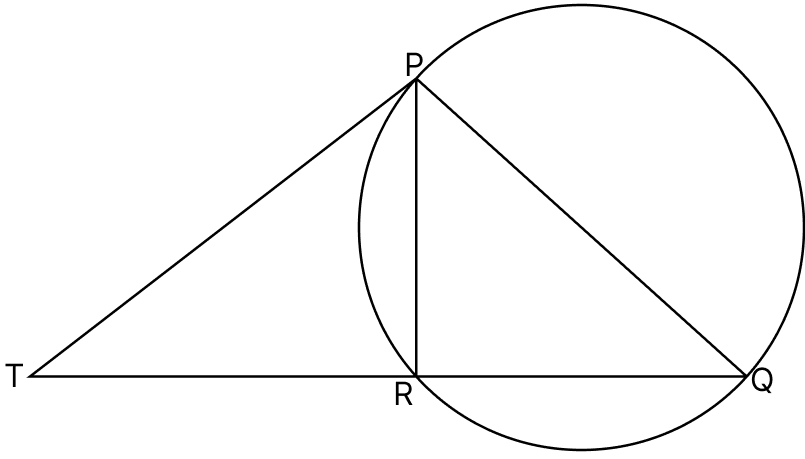
In the given diagram, PT is a tangent to the circle and QT is a secant meeting the circle at R, such that QR = 9 cm and RT = 16 cm.

In the given diagram, PT is a tangent to the circle and QT is a secant meeting the circle at R, such that QR = 9 cm and RT = 16 cm. Improvement 2026, ICSE 2026 Improvement Maths Solved Question Paper.

(a) Prove that: ∆PTR ~ ∆QTP.

(b) Find the length of PT.

Show SolutionHide Solution↓

(a) In ∆PTR and ∆QTP,

⇒ ∠PTR = ∠QTP [Common angle]

⇒ ∠TPR = ∠TQP [Angle between tangent and chord is equal to the angle in the alternate segment]

∴ ∆PTR ~ ∆QTP (By A.A. axiom)

Hence, proved that ∆PTR ~ ∆QTP.

(b) Since, ∆PTR ~ ∆QTP, their corresponding sides are proportional.

$$\begin{aligned}\Rightarrow \frac{PT}{QT} = \frac{TR}{TP} \\[1em] \Rightarrow PT^2 = QT \times TR.\end{aligned}$$

From figure,

QT = QR + RT = 9 + 16 = 25 cm.

Substituting the values,

$$\begin{aligned}\Rightarrow PT^2 = 25 \times 16 \\[1em] \Rightarrow PT^2 = 400 \\[1em] \Rightarrow PT = \sqrt{400} \\[1em] \Rightarrow PT = 20 \text{ cm}.\end{aligned}$$

Hence, the length of PT = 20 cm.

8(i)Written · 2026 · Section B · 2026 ImprovementFull page

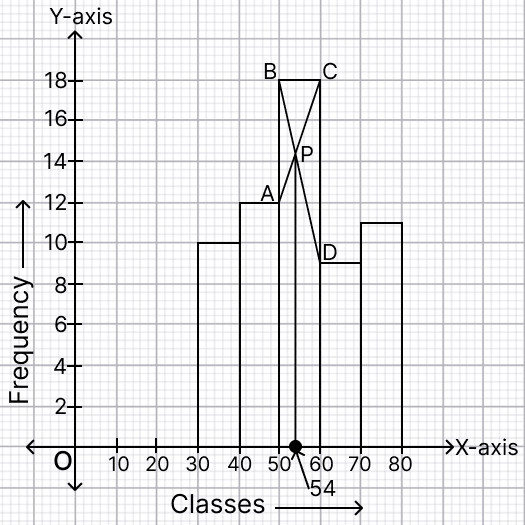
Use graph paper for this question; draw the histogram and estimate mode for the following data. Use 2 cm = 10 units along the x-axis, and 2 cm = 2 units along the y-axis.

ClassFrequency
30 – 4010
40 – 5012
50 – 6018
60 – 709
70 – 8011
Show SolutionHide Solution↓

Steps of construction :

  1. Take 2 cm = 10 units along the x-axis and 2 cm = 2 units along the y-axis.

  2. Draw the rectangles (bars) for each class with heights equal to their frequencies.

  3. The modal class is the class with the highest frequency, i.e. 50 – 60 (frequency 18).

  4. In the highest rectangle, draw two lines AC and BD from corners of the rectangles on either side of the highest rectangle to the opposite corners of the highest rectangle. Let P be the point of intersection of AC and BD.

  5. From the point of intersection of AC and BD, draw a vertical line to meet the x-axis. The point where it meets the x-axis gives the mode.

Use graph paper for this question; draw the histogram and estimate mode for the following data. Use 2 cm = 10 units along the x-axis, and 2 cm = 2 units along the y-axis. Improvement 2026, ICSE 2026 Improvement Maths Solved Question Paper.

From the graph, the mode = 54.

Hence, the mode = 54.

8(ii)Written · 2026 · Section B · 2026 ImprovementFull page

Solve the quadratic equation $x^2 - 6x - 8 = 0$ and give your answer correct to three significant figures.

Show SolutionHide Solution↓

Given,

$x^2 - 6x - 8 = 0$

Comparing with $ax^2 + bx + c = 0$,

$a = 1, b = -6, c = -8$

By formula,

$x = \frac{-b \pm \sqrt{b^2 - 4ac}}{2a}$

Substituting values we get :

$$\begin{aligned}\Rightarrow x = \frac{-(-6) \pm \sqrt{(-6)^2 - 4(1)(-8)}}{2(1)} \\[1em] \Rightarrow x = \frac{6 \pm \sqrt{36 + 32}}{2} \\[1em] \Rightarrow x = \frac{6 \pm \sqrt{68}}{2} \\[1em] \Rightarrow x = \frac{6 \pm 8.2462}{2}.\end{aligned}$$

Case 1:

$\Rightarrow x = \frac{6 + 8.2462}{2} = \frac{14.2462}{2} = 7.1231 ≈ 7.12.$

Case 2:

$\Rightarrow x = \frac{6 - 8.2462}{2} = \frac{-2.2462}{2} = -1.1231 ≈ -1.12.$

Hence, $\bm{x}$ = 7.12 or $\bm{x}$ = −1.12.

8(iii)Written · 2026 · Section B · 2026 ImprovementFull page

The surface area of a solid metallic sphere is 616 cm2. It is melted and recast into solid right circular cones of diameter 3.5 cm and height 3.5 cm. Find the:

(a) radius of the sphere.

(b) number of cones formed.

$\left(\pi = \frac{22}{7}\right)$

Show SolutionHide Solution↓

(a) Given,

Surface area of the solid metallic sphere = 616 cm2

Let the radius of the sphere be $r$ cm.

By formula,

Surface area of sphere = $4\pi r^2$

Equating this to the given surface area and substituting $\pi = \frac{22}{7}$, we get :

$$\begin{aligned}\Rightarrow 4 \times \frac{22}{7} \times r^2 = 616 \\[1em] \Rightarrow \frac{88}{7} \times r^2 = 616 \\[1em] \Rightarrow r^2 = \frac{616 \times 7}{88} \\[1em] \Rightarrow r^2 = 49 \\[1em] \Rightarrow r = 7 \text{ cm}.\end{aligned}$$

Hence, the radius of the sphere = 7 cm.

(b) We know that,

When a solid is melted and recast into a number of smaller solids, the material only changes its shape and no material is lost.

∴ Volume of the sphere = Number of cones × Volume of one cone

$\Rightarrow \text{Number of cones} = \frac{\text{Volume of sphere}}{\text{Volume of one cone}}$

So, we first find the volume of the sphere and the volume of one cone.

Volume of the sphere :

From part (a), radius of the sphere ($r$) = 7 cm.

By formula,

Volume of sphere = $\frac{4}{3} \pi r^3$

Substituting values we get :

$$\begin{aligned}= \frac{4}{3} \times \frac{22}{7} \times 7^3 \\[1em] = \frac{4}{3} \times \frac{22}{7} \times 343 \\[1em] = \frac{4}{3} \times 22 \times 49 \\[1em] = \frac{4312}{3} \text{ cm}^3.\end{aligned}$$

Volume of one cone :

Given,

Diameter of cone = 3.5 cm

$\Rightarrow \text{Radius of cone (r)} = \frac{\text{Diameter}}{2} = \frac{3.5}{2} = \frac{7}{4} \text{ cm}$

Height of cone ($h$) = 3.5 cm = $\frac{7}{2}$ cm

By formula,

Volume of cone = $\frac{1}{3} \pi r^2 h$

Substituting values we get :

$$\begin{aligned}= \frac{1}{3} \times \frac{22}{7} \times \Big(\frac{7}{4}\Big)^2 \times \frac{7}{2} \\[1em] = \frac{1}{3} \times \frac{22}{7} \times \frac{49}{16} \times \frac{7}{2} \\[1em] = \frac{22 \times 49 \times 7}{3 \times 7 \times 16 \times 2} \\[1em] = \frac{539}{48} \text{ cm}^3.\end{aligned}$$

Number of cones :

$$\begin{aligned}\text{Number of cones} = \frac{\text{Volume of sphere}}{\text{Volume of one cone}} \\[1em] = \frac{\frac{4312}{3}}{\frac{539}{48}} \\[1em] = \frac{4312}{3} \times \frac{48}{539} \\[1em] = \frac{4312}{539} \times \frac{48}{3} \\[1em] = 8 \times 16 \\[1em] = 128.\end{aligned}$$

Hence, the number of cones formed = 128.

9(i)Written · 2026 · Section B · 2026 ImprovementFull page

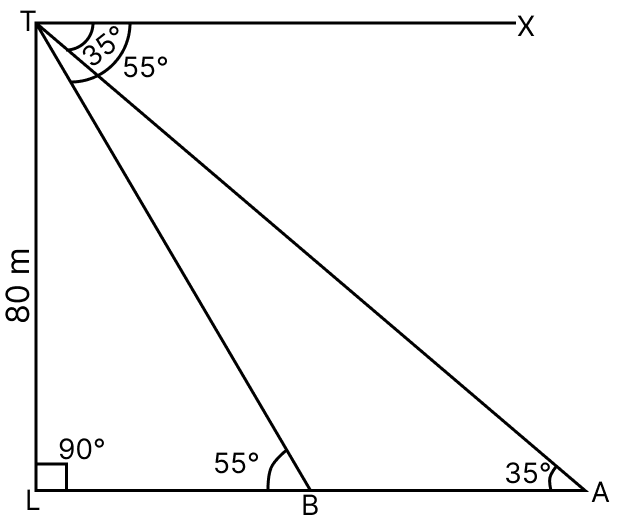
As observed from the top of a light house, 80 m above sea level, the angle of depression of a ship, sailing directly towards it, changes from 35° to 55°.

(a) Draw a free hand sketch representing the given information.

(b) Find the distance travelled by the ship during the period of observation. Give your answer to the nearest meter.

Show SolutionHide Solution↓

(a) Let T be the top of the lighthouse and L be its foot. Let A and B be the two positions of the ship, where the angles of depression are 35° and 55° respectively.

As observed from the top of a light house, 80 m above sea level, the angle of depression of a ship, sailing directly towards it, changes from 35° to 55°. Improvement 2026, ICSE 2026 Improvement Maths Solved Question Paper.

(b) From figure,

∠TAL = ∠ATX = 35° (alternate angles are equal)

∠TBL = ∠BTX = 55° (alternate angles are equal)

Height of lighthouse, TL = 80 m.

In right-angled triangle TLA,

$$\begin{aligned}\Rightarrow \tan 35° = \frac{TL}{LA} \\[1em] \Rightarrow LA = \frac{TL}{\tan 35°} \\[1em] \Rightarrow LA = \frac{80}{0.7002} \\[1em] \Rightarrow LA = 114.25 \text{ m}.\end{aligned}$$

In right-angled triangle TLB,

$$\begin{aligned}\Rightarrow \tan 55° = \frac{TL}{LB} \\[1em] \Rightarrow LB = \frac{TL}{\tan 55°} \\[1em] \Rightarrow LB = \frac{80}{1.4281} \\[1em] \Rightarrow LB = 56.02 \text{ m}.\end{aligned}$$

Distance travelled by the ship (AB) = LA − LB

= 114.25 − 56.02

= 58.23 m

≈ 58 m.

Hence, the distance travelled by the ship = 58 m.

9(ii)Written · 2026 · Section B · 2026 ImprovementFull page

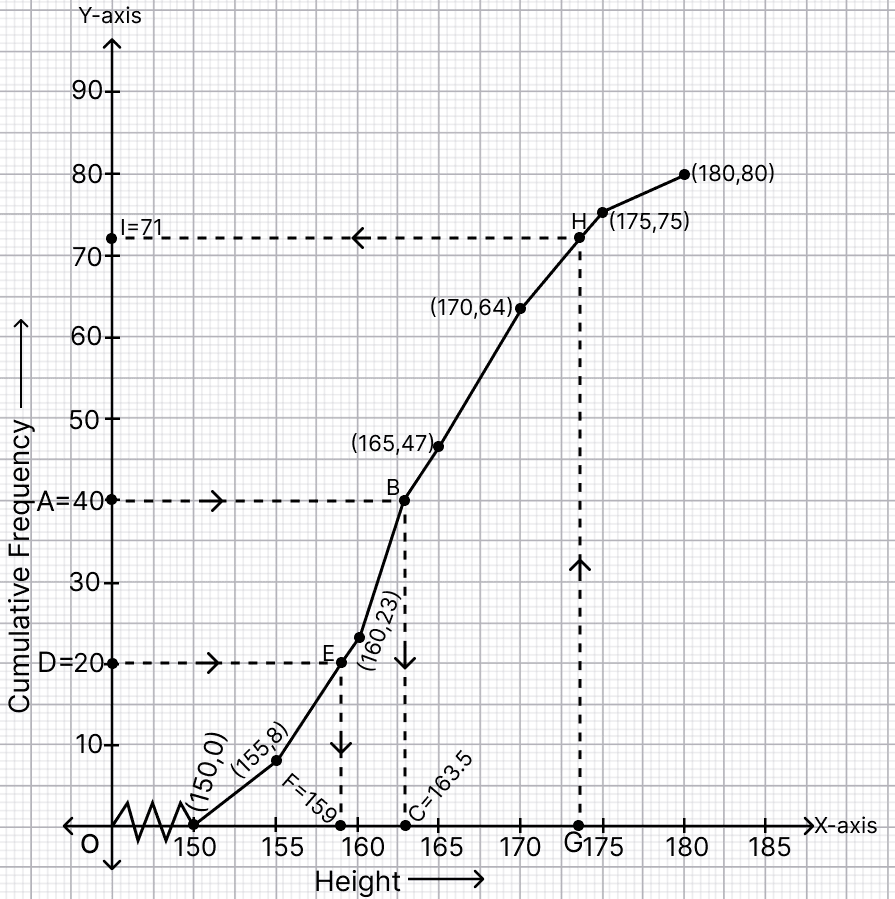
Use graph sheet for this question. Take 2 cm = 10 students along one axis and 2 cm = 5 cm of height along the other axis.

The following table shows the height of 80 students in a class.

Height (in cm)No. of students
150 – 1558
155 – 16015
160 – 16524
165 – 17017
170 – 17511
175 – 1805

Draw the cumulative frequency curve for the above distribution and find the:

(a) median height.

(b) lower – quartile height.

(c) number of students whose height is more than 173 cm.

Show SolutionHide Solution↓

Forming the cumulative frequency table :

Height (in cm)No. of studentsCumulative frequency (cf)
150 – 15588
155 – 1601523
160 – 1652447
165 – 1701764
170 – 1751175
175 – 180580

Steps :

  1. Take 2 cm = 10 students on the y-axis and 2 cm = 5 cm of height on the x-axis.

  2. Plot the points (150, 0), (155, 8), (160, 23), (165, 47), (170, 64), (175, 75) and (180, 80).

  3. Join the points with a free hand smooth curve to obtain the ogive.

Use graph sheet for this question. Take 2 cm = 10 students along one axis and 2 cm = 5 cm of height along the other axis. The following table shows the height of 80 students in a class. Improvement 2026, ICSE 2026 Improvement Maths Solved Question Paper.

(a) Here, $n$ = 80.

Median = $\frac{n}{2} = \frac{80}{2}$ = 40th term.

Through the point A = 40 on the y-axis, draw a horizontal line to meet the curve at B, then a vertical line down to meet the x-axis at point C = 163.5.

Hence, the median height = 163.5 cm.

(b) Lower quartile = $\frac{n}{4} = \frac{80}{4}$ = 20th term.

Through the point D = 20 on the y-axis, draw a horizontal line to meet the curve at E, then a vertical line down to meet the x-axis at point F = 159.

Hence, the lower-quartile height = 159 cm.

(c) Through the point G = 173 on the x-axis, draw a vertical line to meet the curve at H, then a horizontal line to meet the y-axis at point I = 71.

Thus, 71 students have a height less than or equal to 173 cm..

∴ Number of students with height more than 173 cm = 80 − 71 = 9.

Hence, the number of students whose height is more than 173 cm = 9.

10(i)Written · 2026 · Section B · 2026 ImprovementFull page

The sum of first three terms of a Geometric Progression (G.P.) is $\frac{21}{2}$ and their product is 27. Given $r \lt 1$, find its:

(a) common ratio.

(b) first three terms.

Show SolutionHide Solution↓

Let the first three terms of the G.P. be $\frac{a}{r}, a$ and $ar$.

(a) Given,

Product of the terms = 27.

$$\begin{aligned}\Rightarrow \frac{a}{r} \times a \times ar = 27 \\[1em] \Rightarrow a^3 = 27 \\[1em] \Rightarrow a = 3.\end{aligned}$$

Given,

Sum of the terms = $\frac{21}{2}$.

$$\begin{aligned}\Rightarrow \frac{a}{r} + a + ar = \frac{21}{2} \\[1em] \Rightarrow a\Big(\frac{1}{r} + 1 + r\Big) = \frac{21}{2} \\[1em] \Rightarrow 3\Big(\frac{1}{r} + 1 + r\Big) = \frac{21}{2} \\[1em] \Rightarrow \frac{1}{r} + 1 + r = \frac{7}{2} \\[1em] \Rightarrow \frac{1}{r} + r = \frac{7}{2} - 1 \\[1em] \Rightarrow \frac{1}{r} + r = \frac{5}{2}.\end{aligned}$$

Multiplying both sides by $2r$,

$$\begin{aligned}\Rightarrow 2 + 2r^2 = 5r \\[1em] \Rightarrow 2r^2 - 5r + 2 = 0 \\[1em] \Rightarrow 2r^2 - 4r - r + 2 = 0 \\[1em] \Rightarrow 2r(r - 2) - 1(r - 2) = 0 \\[1em] \Rightarrow (2r - 1)(r - 2) = 0 \\[1em] \Rightarrow r = \frac{1}{2} \text{ or } r = 2.\end{aligned}$$

Since $r \lt 1, r = \frac{1}{2}$.

Hence, the common ratio = $\mathbf{\frac{1}{2}}$.

(b) With $a = 3$ and $r = \frac{1}{2}$,

First term = $\frac{a}{r} = \frac{3}{\frac{1}{2}} = 6$

Second term = $a = 3$

Third term = $ar = 3 \times \frac{1}{2} = \frac{3}{2}$.

Hence, the first three terms are 6, 3 and $\mathbf{\frac{3}{2}}$.

10(ii)Written · 2026 · Section B · 2026 ImprovementFull page

The equation of a line is $3x - 4y + 7 = 0$. Find the:

(a) slope of the line.

(b) equation of a line perpendicular to the given line and having a y-intercept equals to 2.

Show SolutionHide Solution↓

(a) Given,

$3x - 4y + 7 = 0$

Writing in the form $y = mx + c$,

$$\begin{aligned}\Rightarrow 4y = 3x + 7 \\[1em] \Rightarrow y = \frac{3}{4}x + \frac{7}{4}.\end{aligned}$$

Comparing with $y = mx + c$, slope $m = \frac{3}{4}$.

Hence, the slope of the line = $\mathbf{\frac{3}{4}}$.

(b) We know that,

The product of the slopes of two perpendicular lines is −1.

Slope of the required line = $-\frac{1}{m} = -\frac{1}{\frac{3}{4}} = -\frac{4}{3}$.

Given, y-intercept $c = 2$.

By slope-intercept form, $y = mx + c$,

$$\begin{aligned}\Rightarrow y = -\frac{4}{3}x + 2 \\[1em] \Rightarrow 3y = -4x + 6 \\[1em] \Rightarrow 4x + 3y - 6 = 0.\end{aligned}$$

Hence, the equation of the required line is $\bm{4x + 3y - 6 = 0}$.

10(iii)Written · 2026 · Section B · 2026 ImprovementFull page

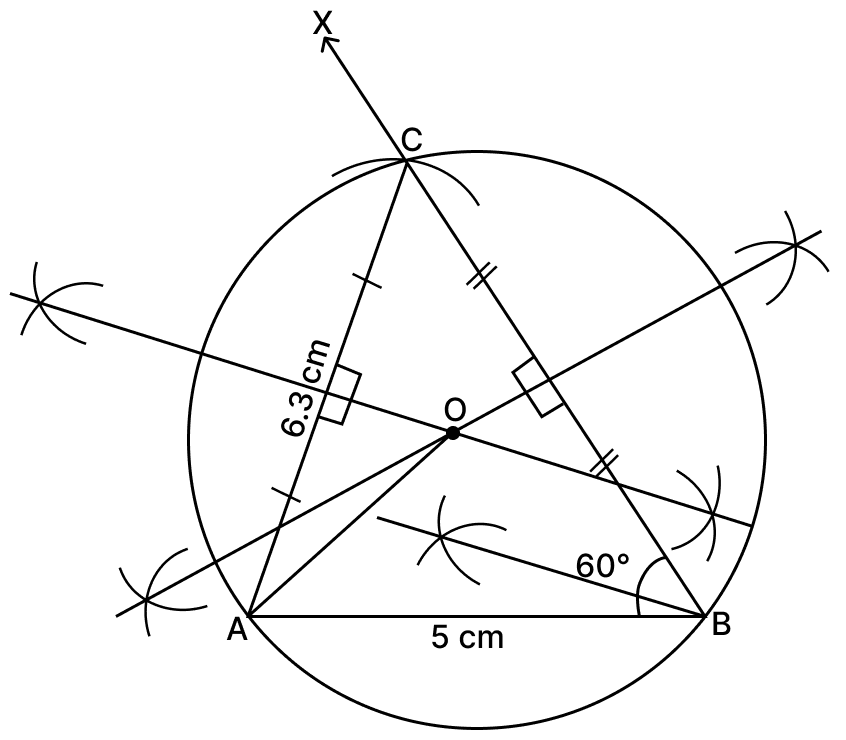
Using a ruler and compass only, construct:

(a) ∆ABC such that AB = 5 cm, AC = 6.3 cm and ∠ABC = 60°.

(b) the circumcircle of ∆ABC.

(c) the locus of points which are equidistant from AB and BC.

Show SolutionHide Solution↓
Using a ruler and compass only, construct:. Improvement 2026, ICSE 2026 Improvement Maths Solved Question Paper.

(a) Steps of construction :

  1. Draw a line segment AB = 5 cm.

  2. At B, construct ∠ABX = 60°.

  3. With A as centre and radius 6.3 cm, draw an arc cutting the ray BX at C.

  4. Join AC. Thus, ∆ABC is constructed.

  5. In ∆ABC, draw the perpendicular bisectors of any two sides (say AC and BC). Let them intersect at O.

  6. With O as centre and radius OA, draw a circle. This is the circumcircle of ∆ABC passing through A, B and C.

  7. In ∆ABC, draw the bisector of ∠ABC. This bisector is the locus of points equidistant from AB and BC.

Hence, the required construction is completed, where the bisector of ∠ABC is the locus of points equidistant from AB and BC.

Press ↓ to reveal a solution and move to the next question. Browse the free sample bank.

All 409 Mathematics questions