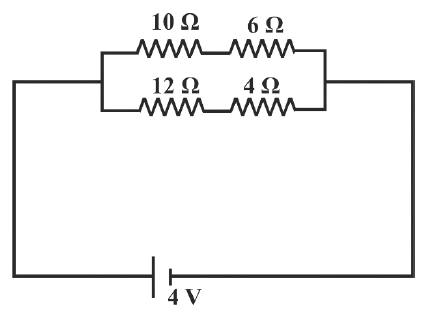
Given,
V = 4 V
Let,
R1 = 10 Ω,
R2 = 6 Ω,
R3 = 12 Ω and
R1 = 4 Ω
(a) As, R1 and R2 are in series then
RS = R1 + R2 = 10 + 6 = 16 Ω
Similarly,
R3 and R4 are also in series,
RS' = R3 + R4 = 12 + 4 = 16 Ω
Now, RS and RS' are in parallel combination then
$\frac{1}{\text R_\text{eq}}=\frac{1}{\text R_\text{S}}+\frac{1}{\text R_\text{S'}} = \frac{1}{16}+\frac{1}{16}=\frac{2}{16}$
⟹ ${\text R_\text{eq}} = \frac{16}{2} = 8\ \text Ω$
So, total resistance of the circuit is 8 Ω.
(b) From Ohm's law :
$\text {Current (I)} = \frac{\text V}{\text R_\text{eq}}=\frac{4}{8}=0.5\ \text A$
Current drawn from the cell is 0.5 A.
(c) As potential difference across 10 Ω and 6 Ω resistances is same as potential difference across 12 Ω and 4 Ω resistances which is V = 4 V.
Now,
$\text {Current through 10 Ω resistance} = \frac{\text V}{\text R_\text{S}}=\frac{4}{16}=0.25\ \text A$ .....equation 1
and
$\text {Current through 12 Ω resistance} = \frac{\text V}{\text R_\text{S'}}=\frac{4}{16}=0.25\ \text A$ .....equation 2
From equations 1 and 2
Current through 10 Ω resistance = Current through 12 Ω resistance = 0.25 A
So, the current through 10 Ω resistor is equal to the current through the 12 Ω resistor.